“We retain the dignity of the revolution’s early days” – Marcell Shehwaro

The following is written by Syrian writer, Marcell Shehwaro. I came across it this morning on a facebook page called ‘Ghouta’. She is a journalist and activist from Aleppo, and executive director of Kesh Malek, a group that ran schools in opposition-held areas of Aleppo.

Two things strike me about the post. First, the question of ‘surrender’. There is a view among some in what passes for ‘the left’ today that the Syrian people could never win their struggle against the Assad regime. It has even been put to me that they were wrong to challenge an ‘unbeatable’ regime. This view, logically, also opposes the entire Arab Spring – or, more precisely, the bourgeois democratic revolution occurring in the region. As with Iraq, the stability of fascism, with all its regime horrors, is regarded as preferable to the chaos of revolutionary democratic change, with its potential for liberation.

The writer makes it clear why surrender is not an option.

Secondly, a profound point is made in the following sentence:

‘I and my group of friends never imagined as we hid from the bullets that shot at our peaceful demonstration that we could defeat Russian planes all by ourselves’. 

Who, other than a US-led coalition, can provide the military support necessary to defeat the Russian (and Syrian regime) planes? Failure to confront this reality results in the absurd proposition that one should oppose both Russian/Iranian and US/UK/French military intervention; that the recent bombardment and destruction of a chemical weapons storage facility, a research centre and command post by the US/UK/France was morally equivalent to the death toll of about 500,000 and refugee toll (half the population), for which Russia/Assad are overwhelmingly responsible. Not to mention the destruction by aerial bombardment by the regime and Russia of vast areas of cities, towns and camps, schools, hospitals, markets, mosques, and bakeries.

Trump persists with his pledge to wash his hands of Syria but has targeted the regime in a way that Obama never did. The epithet ‘Animal Assad’, used by Trump in a tweet, is now used by the Syrian and Arab democrats.

Meanwhile, the overt far-Right and the pseudo-left take to the streets demanding ‘Hands of Syria!’

Where is the moral compass?

We find one in the Syrian voice in the following post.


* * * * * *


What if we accept Bashar Al Assad?

Let’s discuss “peacefully” that “elephant in the room”, as you say, what if we accept that Assad remains in power?

We are asked the question sometimes obliquely, and sometimes filtered through the closed circles that decide on Syrian affairs without the attendance of any Syrians. Sometimes it is brought up in ways that infantalize as if we are children who don’t dare to confront the “truth realistically”.

In the harshest times, this question is posed to us as a negotiation over the bodies of our children. Instead of the answer of “why we don’t accept that Assad remain in power” is obvious because he killed our children and the scars of their smiles are etched on our hearts. The blackmailing question becomes: He will kill your children and their smiles, why don’t you just accept him?

Excuse us for a moment! We need some time to understand this world’s logic, the world ruled by Trump, Putin and a bunch of politicians who only care about their 4-year period in office.

Hafez al-Assad has blocked us from the outside world. Now his son follows in his footsteps. The liberationists amongst us gazed towards the United Nations Charters and the Universal Declaration for Human Rights. Some of us believed that those charters mean something. When the revolution broke out, we discovered that those charters are ruined due to the misuse of the members in the U.N.’s Security Council.

Apologies for the digression. So: why don’t we accept Assad?

We wish you tell your people the “harsh truth”. We want to challenge your empty words and courtesy rhetoric. We know you mean nothing when you say things like: using chemical weapon is a red line, or Aleppo is a red line, or Assad lost his legitimacy.

The truth is that Assad is more your ally than the naïve group of dreamers that we are, believing like we do in democracy, justice and accountability.


Isn’t this the message of bombing in Idlib and Ghouta today? To convince us, “gently”, to accept a political solution—the only solution that you lectured us about—as we are being killed?

You say that we are defeated. Well, gentlemen, I and my group of friends never imagined as we hid from the bullets that shot at our peaceful demonstration that we could defeat Russian planes all by ourselves. We never thought that we can win the “war” while we were being tortured, or suffocated by chemical weapons, destroyed by shelling, rape and detention.


It may be true that we have lost. But this defeat made me aware of something I never wanted to know.

I know today the terminology of violence: The Golan cluster bombs, the difference between Sarin and Chlorine, and the new version of bunker blaster that can destroy our “safe” basements. I learned even how to pronounce these words in English.

You say we were defeated in Sochi! We were not even at Sochi. Sochi was the costume party that gathered the regime himself with you.

You have all our sympathy for the time you are forced to spend with them.
I keep digressing away from that nightmare, Bashar Assad’s ruling Syria, excuse me!

What if we “accept” that Bashar al-Assad stays in power? First, Who are “we”? The cities that are besieged and bombed, the people that must cross a thousand barriers to visit one another. Who are “we”? The refugees who fail to have a proper family reunion? Or need an official permission to breathe?

And if some of us actually accept Bashar al-Assad as president, what can we do with all those of us who are “rude” enough to reject giving up their dignity? What can we do with all those who still believe in their right to their homeland? What if mothers who buried their sons refused to believe that justice had died also? We have to let them die.

So the suggestion is that some of us surrender, so that others die in silence. Or maybe we can give you the names and coordinates of all those who oppose Bashar al-Assad, so that you and your Russian friends can ensure their disappearance?

What if some of us actually accepted that Bashar Al Assad stays in power, do you guarantee that the war will stop? That the brutal dictator won’t celebrate his victory with taste of our defeated blood?


You say that you want him to stay for a transitional period. Funny joke, this one. Do you logically believe in your power to pressure Russia and the regime?

We have asked you for years to stop the shelling. We then felt sorry for you so we minimized our demands and asked you to stop the shelling of hospitals and schools. You failed here too. For years we have asked you to send relief convoys to the besieged areas; to move the sick for a distance of 10 kilometers, or to guarantee the families’ right to know the fate of their disappeared sons , and you failed to do so. You repeatedly explained that you are failing to put pressure on “Damascus.”

What logic do you want to believe, that “You cannot stop a school bombing and you can guarantee Bashar Assad’s removal after a transitional period?”


So the offer, that you are in a shock that we are refusing is, that we have to surrender without restriction, guaranties or condition and preferably silently.


Even if that means killing those who do not give up, we have to accept.
Even if that means that the form of death going only to change from one form to another, we must accept.

Even if that means that he will rule us with iron and fire, and that our children, who will believe again in their own freedom, will may be killed by nuclear weapons this time, we must accept.
So the equation is
Whether

To accept Bashar Al Assad, surrender and die.
Or oppose Bashar Al Assad, resist and die.

We reject the whole equation then, and learn to resist the idea of choosing between death and death through thousands of borders that limit us every day.

And we retain all the anger caused by the killings of our people, who we were unable to grieve amidst the ongoing massacre, we retain the dignity of the revolution’s early days. We retain all of our memory and the choice of life. We retain the fragment of a beautiful dream we had one day to have a homeland.


* * * * * *

Open Borders Manifesto

In light of recent revival of an anti-immigration push in Australia, which seems to have divided the two major parties internally, I’m rerunning this post from 2015.

Also highly recommend this article by David McMullen (originally published at On Line Opinion).


workers have no country

* * * * * *

I have added my name to this Manifesto for Open Borders because in principle I believe in freedom of movement and that the workers of the world have no country. Also, I think the various groups in Australia who oppose the policies of the Labor and Coalition parties need to think beyond the paradigm that divides people into genuine and non-genuine, and political and economic, asylum seekers. It doesn’t matter. Just let them in and share the chaos. It’s time for ‘open borders’ to be part of the public discussion and debate on immigration.

****

On Open Borders Day 2015, the 16th day of March, we marked the third anniversary of Open Borders: The Case. We also published the Open Borders Manifesto, a brief document summarising the objectives of the open borders movement.

The list of signatories is in alphabetical order, based on surname, and is current as of March 16, 2015. If you would like to add yourself to the signatory list, please contact us (preferably via email: openborders@googlegroups.com) and provide your name, with professional or academic affiliations if applicable.

Open Borders Manifesto

Freedom of movement is a basic liberty that governments should respect and protect unless justified by extenuating circumstances. This extends to movement across international boundaries.
International law and many domestic laws already recognise the right of any individual to leave his or her country. This right may only be circumscribed in extreme circumstances, where threats to public safety or order are imminent.

We believe international and domestic law should similarly extend such protections to individuals seeking to enter another country. Although there may be times when governments should treat foreign nationals differently from domestic citizens, freedom of movement and residence are fundamental rights that should only be circumscribed when the situation absolutely warrants.

The border enforcement status quo is both morally unconscionable and economically destructive. Border controls predominantly restrict the movement of people who bear no ill intentions. Most of the people legally barred from moving across international borders today are fleeing persecution or poverty, desire a better job or home, or simply want to see the city lights.

The border status quo bars ordinary people from pursuing the life and opportunity they desire, not because they lack merit or because they pose a danger to others. Billions of people are legally barred from realising their full potential and ambitions purely on the basis of an accident of birth: where they were born. This is both a drain on the economic and innovative potential of human societies across the world, and indefensible in any order that recognises the moral worth and dignity of every human being.

We seek legal and policy reforms that will reduce and eventually remove these bars to movement for billions of ordinary people around the world. The economic toll of the modern restrictive border regime is vast, the human toll incalculable. To end this, we do not need a philosopher’s utopia or a world government. As citizens and human beings, we only demand accountability from our own governments for the senseless immigration laws that they enact in our name. Border controls should be minimised to only the extent required to protect public health and security. International borders should be open for all to cross, in both directions.

Signatories, listed in alphabetical order by surname:

Thorvald Aagaard, Associate Professor, Director of Theater, Pacific Union College
Brian C. Albrecht, PhD candidate, Economics, University of Minnesota
Pedro H. Albuquerque, Associate Professor, KEDGE Business School
Jesús Alfaro, Professor of Law, Universidad Autónoma de Madrid
Shanu Athiparambath
Ben Bachrach
Dave Barnes
Simon Bedford
David Bennion, Attorney
Daniel Bier
Niklas Blanchard, PhD candidate, Human Capital Management, Bellevue University
Luke Blanshard
Joseph Bonneau, Postdoctoral Research Fellow, Computer Science, Stanford University
Donald J. Boudreaux, Professor of Economics, George Mason University
Sam Bowman, Deputy Director, Adam Smith Institute
Geoffrey Brand
Jason Brennan, Assistant Professor, Philosophy, Georgetown University
Beno Brito, Projects Director, Instituto Liberal do Centro-Oeste
Steve Buller
Jason Lee Byas, Fellow, Center for a Stateless Society
Bryan Caplan, Professor of Economics, George Mason University
Leonel Caraciki
Ryan Carey
Simon Cartledge
Richard Yetter Chappell, Lecturer in Philosophy, University of York
Grieve Chelwa, PhD candidate, Economics, University of Cape Town
Lars Christensen
Andrew Jason Cohen, Associate Professor, Philosophy, Georgia State University
Phillip Cole, Senior Lecturer in Politics and International Relations at the University of West of England
Paul Crider
Christopher Dobrogosz
Bryan Joseph Dodson
Eli Dourado
Charles DuHadway
Robert Eckerson, Attorney
Margaret A. Elberson
Ross B. Emmett, Professor of Political Economy and Political Theory & Constitutional Democracy, James Madison College, Michigan State University
Mustafa Erdogan, Professor of Political and Constitutional Theory, Istanbul Commerce University
Daniel Fernández Méndez, Professor, Economics, Universidad Francisco Marroquín
Luis Figueroa, Professor of Ethics of Freedom, Universidad Francisco Marroquín
Bryan T. Fine
Nicholas Fletcher
Scott Freeman
Joshua Gans, Jeffrey S. Skoll Chair of Technical Innovation and Entrepreneurship, University of Toronto
Paul Geddes, Economics Instructor, Columbia College
Jacob Aaron Geller
Giuseppe Germinario
Casey C. Glick, Graduate Researcher in Physics, UC Berkeley
Zachary Gochenour, Visiting Assistant Professor of Economics, Western Carolina University
Nathan Goodman, Lysander Spooner Research Scholar in Abolitionist Studies at the Center for a Stateless Society
Maithreyi Gopalan, Ph.D. candidate, School of Public and Environmental Affairs, Indiana University
Manick Govinda, Visiting Artists Co-ordinator, Manifesto Club
Jameson Graber
Joe Green, Associate Professor of Political Science, Dixie State University
Priscila Guinovart
Jeff Hallman
John Halstead, PhD candidate, Political Philosophy, St Anne’s College, Oxford University
Robin Hanson, Associate Professor of Economics, George Mason University
Mikael Hellstrom, Instructor, Political Science, University of Alberta
Christopher Hendrix
Javier S. Hidalgo, Assistant Professor, Jepson School of Leadership Studies, University of Richmond
Fergus Hodgson, Editor-in-Chief, PanAm Post
Jeffrey Horn
Steven Horwitz, Charles A. Dana Professor and Chair, Department of Economics, St. Lawrence University
Michael Huemer, Professor, Department of Philosophy, University of Colorado
Giancarlo Ibarguen, Former President, Universidad Francisco Marroquín
Tom Jackson
Peter Martin Jaworski, Assistant Teaching Professor, McDonough School of Business, Georgetown University
Scott A. Jenks, Instructor, Department of Medicine, Emory University
Nathan Jones
Emmanuelle Baya Julien
Valdenor M. Brito Júnior, Attorney
Angela Keaton
Rick Kelo
William Kiely
Milo King
Gavin A. Kitchens
Thomas L. Knapp, Director, William Lloyd Garrison Center
Anna Krupitsky
Chandran Kukathas, Chair of Political Theory, Department of Government, London School of Economics
Michelangelo Geovanny Landgrave Lara
Daniele Latella
Mark LeBar
John Lee
Daniel Lin, Professorial Lecturer, American University
Anthony Ling, Editor-in-Chief, Caos Planejado
Raffaele Lo Moro
Ryan P. Long
Roderick T. Long, Professor of Philosophy, Auburn University and President, Molinari Institute
Ray Lopez
Trent MacDonald, PhD candidate, School of Economics, Finance and Marketing, RMIT University
Pedro Magalhães, Attorney and PhD candidate, Law and Economics, Johann Wolfgang Goethe-Universität Frankfurt
Akiva Malamet
Rafael Bortoluzzi Massaiol
Kevin McGartland
Jeremy McLellan
Justin Merrill
Jared Meyer, Fellow, Manhattan Institute for Policy Research
Gary Miguel
Walter Morris, Director, Acton School of Ballet
Joe Munson
Darren Nah, PhD candidate, Politics, Yale University
Vipul Naik
Janet Neilson, Program Developer, Institute for Liberal Studies
Chad Nelson, Attorney and Fellow at the Center for a Stateless Society
Russell Nelson
Jeremy L. Neufeld
Joel Newman
Sebastian Nickel
Eric Nielsen
Federico Oliveri, Research Fellow, Sciences for Peace Interdisciplinary Centre, University of Pisa
Yaël Ossowski, Programs Director, European Students for Liberty
George Pareja
Andrew Pearson
Ryan Pelkey
Luis Pellicano
Alicia Perez
Graham Peterson, PhD candidate, Sociology, University of Chicago
Kaveh Pourvand, PhD candidate, Political Theory, London School of Economics
Lukas Puettmann, PhD candidate, Economics, University of Bonn
Shaun Raviv
Jose L. Ricon
Dylan Risenhoover
Fabio Rojas, Associate Professor, Department of Sociology, Indiana University
John Roccia
Trish Ruebottom, Assistant Professor, Goodman School of Business, Brock University
Antonio Saravia, Assistant Professor of Economics and Director, BB&T Center for Undergraduate Research in Public Policy and Capitalism, Mercer University
Paul Sas
Philip Saunders
Yaakov Schatz
Eric Schmidt
James Schumacher
Andrew Scobie
Hafiz Noor Shams, Founding Associate, Institute for Democracy and Economic Affairs
Jay Shooster
Joshua Shurley, PhD candidate, Politics, University of Manchester
Sarah Skwire, Fellow, Liberty Fund, Inc.
Ben Smith
Evelyn Smith
Nathan Smith, Assistant Professor of Economics and Finance at Fresno Pacific University
Ilya Somin, Professor of Law at the George Mason University School of Law
Piero Stanig, Assistant Professor of Political Science, Università Bocconi
Marilyn Steffen
Wouter Stekelenburg
Barry Stocker, Assistant Professor in Philosophy, Istanbul Technical University
Drew Stonebraker
Scott Sumner, Professor, Economics, Bentley University
Kyle Swan, Assistant Professor of Philosophy, California State University Sacramento
Alex Tabarrok, Bartley J. Madden Chair in Economics at the Mercatus Center at George Mason University
Batur Talu
Laron Tamaye
Fernando R. Tesón, Tobias Simon Eminent Scholar, Florida State University
Pedro Trujillo Alvarez, Director, Department of Political Science, Universidad Francisco Marroquín
Bas Van der Vossen, Assistant Professor, Department of Philosopy, UNC Greensboro
Brian Wagers
Tyler Walker
Hansjörg Walther
Ladan Weheliye
Nicholas Weininger
Christoph Widenhorn
Michael Wiebe, PhD candidate, Economics, University of British Columbia
Samuel Wilson
Stephen Winkler
Barrett Young
Barry York OAM, Historian
Zachary Yost
David Zetland, Assistant Professor of Economics, Leiden University College
Matt Zwolinski, Associate Professor, Philosophy, University of San Diego
* * * * * * *

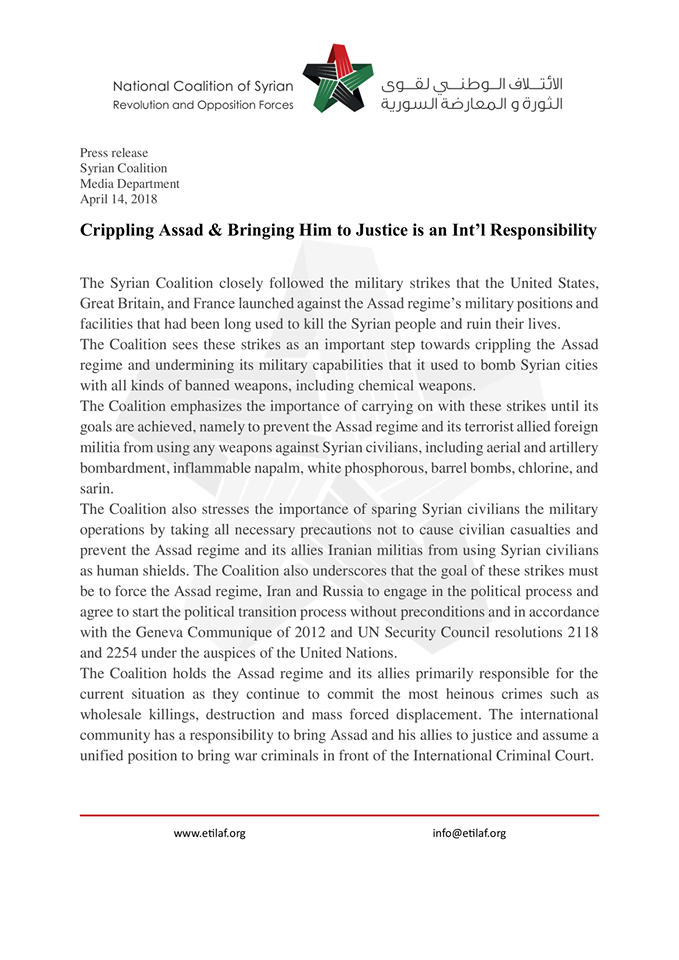
Crippling Assad and bringing him to justice is an international responsibility

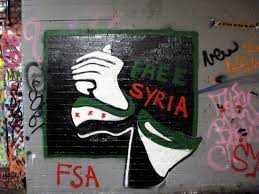
free syria fsa


The National Coalition of Syrian Revolution and Opposition Forces (ETILAF) has issued a statement calling for the continuation of military strikes against the Assad regime with a view to stopping it, and its allies, from massacring Syrian civilians. ETILAF sees the air strikes as “an important new step”.

The statement calls for enforcement of the Geneva Communique of 2012 and UN Security Council resolutions 2118 and 2245 as a strategic objective of the military strikes. In other words, for the political transition from Assad dictatorship to democracy.

ETILAF and the Free Syrian Army and the Local Coordinating Committees are the ‘good guys’ that reactionaries like Tony Abbott and John Pilger say don’t exist. They are the equivalent of the National Liberation Front in Vietnam in the 1960s and the fighters against apartheid in South Africa.

Whether secular or Islamist, those fighting for democracy must be supported by the international community, as the massacres and suffering have gone on for way too long. The ‘international community’ is a euphemism for ‘United States and anyone else willing to take effective action against the fascist regime in a way that strengthens the hand of the people relative to the regime’.

ETILAF is recognized as the legitimate representative of the Syrian people by 120 states and organizations, including the United States, the European Union, the Arab League, and the Gulf Cooperation Council. ETILAF seeks a “democratic, inclusive and pluralistic civil state” for Syria.

The big question now is whether the recent US-led air strikes will be a ‘one off’ or develop into a strategy along the lines sought by ETILAF.

An important lesson to those who fear ‘war with Russia’ is the very weak response of the chest-beating Putin. Russia is unlikely to go to war with the US over Assad. It would be his downfall if he did, with the Russian economy already feeling the effects of sanctions, and the Russian opposition leader, Alexei Navalny, saying: “Bashar al-Assad is not our friend. Putin is now saving Assad with the money of Russian retirees. This must be stopped.”


Here is the ETILAF statement:

30729033_1676360065783105_975233167063515136_n


More bogus ‘anti-war’ responses to Ghouta chemical attack

With thanks again to Bill Weinberg, of Countervortex.


6. “Do you want a nuclear war?” This is some high irony. The “anti-war” (sic) left has basically been saying for five years that the Syrians should submit to genocide as the price of world peace. It’s really been working out great, hasn’t it? All the “anti-war” fools who abetted Assad’s genocide over the past five years by denying it or making excuses for it are utterly complicit in having brought the world to the brink. They helped make use of WMD acceptable. They helped place us on the slippery slope to Armageddon that they now sanctimoniously warn against.

7. “I’ll bet you believed there were WMD in Iraq too.” Talk about fighting the last war! To say this days after a deadly chemical attack (once again) betrays an unthinking analogy to Iraq, overlooking obvious, overwhelming context. This is akin to denying that Saddam had WMD after the Halabja chemical attack in 1988—not in 2003, when he had long since been disarmed and Dubya was looking for an excuse to go to war. Assad has had a blank check to carry out acts of genocide for years now. That analogy is bogus to the core.

Alas, we’re even hearing this crap on the deplorable Amy Goodman‘s ironically named Democracy Now, in which co-host Juan Gonzalez joins with the left’s perennial Mideast expert Phyllis Bennis to spin this as Iraq redux, recalling “the horrific stories about the invasion force of Saddam Hussein in Kuwait marching into a hospital and killing babies.” This is of course a reference to “Nurse Nayirah,” whose bogus testimony about non-existent Iraqi war crimes in Kuwait helped lubricate Operation Desert Storm in 1991. Except that Nayirah testified before Congress months after the Kuwait invasion, and was groomed by the Kuwaiti regime’s public relations firm Hill & Knowlton. So what does this have to do with fresh reports from aid workers from several organizations on the ground in Douma (Syrian-American Medical SocietyWhite HelmetsSyria Civil Defence), with harrowing video evidence, and not even enough time for any PR grooming? Oh that’s right, nothing.

Bennis skirted the edges of denialism after the 2013 Ghouta chemical attack. She seems to be getting worse. (Note, by the way, that Nurse Nayirah was invoked by some paranoid bloggers to plug the notion that the shooting of Malala Yousafzai was a hoax.)

8. “Assad is innocent until proven guilty.” This is more high irony. The same people who will refuse to believe what the facts all indicate until there is an exhaustive investigation are the last ones to protest when Russia uses its Security Council veto to block an investgation. Apparently, they prefer the comfort of their ignorance.

Putin’s useful idiots on the Internet are also avidly reposting clips from Russian state media (RTSputnikTASS) to the effect that the Red Crescent found no evidence of poisonous gas having been used at Douma. Look past the headlines (heaven forbid), and the claims come from two individual workers with the Syrian Arab Red Crescent, and the quotes make it ambiguous whether they are refering to the current attack or previous ones. These are completely misleading headlines, and those who share them without even bothering to read them (let alone vet them) are spreading bullshit. Go to the actual website of the Syrian Arab Red Crescent, and there is not a word about any of this. Their most recent update from Eastern Ghouta is dated Feb. 23.

BBC also quotes Moscow’s foreign minister Sergei Lavrov saying: “Our military specialists have visited this place, along with representatives of the Syrian Red Crescent… and they did not find any trace of chlorine or any other chemical substance used against civilians.” OK, could we please get a quote from the Red Crescent on this? They can presumably speak for themselves, rather than through the Russian foreign minister. Thank you.

This innocent-until-proven-guilty line is kind of a soft-sell on the “false flag” tack, but possibly even loopier when you really scratch it, since it implies the attack didn’t even happen. Maybe all those traumatized children in the videos are “crisis actors”?

9. “You sound like John Bolton.” OK, we are to judge facts on the basis of their convenience to imperial propaganda (or our own)? Talk about “post-truth.” And you denialists, by the way, sound like Fox News. Their predictable Tucker Carlson was last night spewing identical shit: “All the geniuses tell us that Assad killed those children. But do they really know that? Of course, they don’t really know that, they’re making it up. They have no real idea what happened. Actually, both sides in the Syrian Civil War possess chemical weapons. How would it benefit Assad, from using chlorine gas last weekend?”

As Mediaite notes, Carlson then brought on the grievous Glenn Greenwald (who is turning into a regular on Fox News) to spin bankrupt Iraq analogies.

So don’t lecture me about strange bedfellows, Assad-suckers.

Bogus ‘anti-war’ responses to Ghouta chemical attack

Bogus ‘anti-war’ responses to Ghouta chemical attack – republished with permission of the author, Bill Weinberg.

You can already hear them coming. Expect to see on Facebook and the “anti-war” (sic) blogosphere in the coming days the following propaganda tactics:

1. “False flag.” Even the increasingly problematic Noam Chomsky is parroting this malarky. Every time there is a chemical attack in Syria, it is speculated, on no evidence, that the rebels did it as a provocation—even as the attacks come amid massive Assad-Putin bombardment of the same locales. Funny how the rebels have so much poisonous gas yet they only ever seem to use it against themselves. Has there been one single report of a gas attack on regime-held territory throughout the course of the war? This is contemptible denialist bullshit of the lowest order.

What’s particularly ironic is that the folks who spew this jive think they are such cognescenti, seeing through the lies of the dreaded “mainstream media.” In fact, it is mainstream outlets like Newsweek that are increasingly floating such theories, particularly in the recent writings of a self-promoting ex-spook named Ian Wilkie.
Meanwhile, his transparent lies are being called out by truly alternative media such as EA Worldview, which closely and seriously monitors the Syrian war, and independent investigative websites like Eliot Higgins’ Bellingcat.
Serial pro-Assad propagandist James Carden has also engaged in such baseless theorizing in The Nation—a publication which has now repeatedly served as a vehicle for the Assad regime’s lying propaganda. (Carden may protest that he is not “pro-Assad,” but when you rally to the defense of the regime every time it carries out some ghastly atrocity, we would love to know in what sense this does not constitute support.)

2. “Not our problem.” This response is an exercise in imperial narcissism which makes every question about “us.” There are obvious problems with any extension of US military power in Syria or anywhere else, which we presumably do not have to elaborate on here. But if you have greater outrage for whatever military action Trump takes in response to this attack than you do for the attack itself, there is something seriously wrong with you.
It was just a year ago, when “anti-war” types took to the streets of New York to protest Trump’s air-strikes in response to the chemical attack on Khan Shaykhun, that I was quoted on Eyewitness News calling out their hypocrisy. Even if you think we have no responsibility to protest any atrocity not directly carried out by the US or its client states such as Israel (itself a problematic position), note that in the weeks prior to Trump’s air-strikes in response to Khan Shaykhun, some 600 (overwhelmingly civilians) had been killed in the US bombardment of ISIS-held Raqqa and Mosul—eliciting no street protests whatsoever. But an Assad regime airbase gets bombed and a few warpanes destroyed, and then they all take to the streets. Whatever else this may be, it is certainly not a consistent “anti-war” position! Sadly, we are probably looking at a replay of such morally depraved “anti-war” (sic) protests in the coming days.

3. “But what about Gaza?” Amnesty International calls this tactic “”Whataboutery“” and notes that Bashar Assad uses it himself when cornered by interviewers about his campaigns of mass murder. When you talk about Syria, you have to talk about Syria, and not immediately change the subject. Those who use Gaza as a distraction from Ghouta are exploiting dead Palestinians. Why is the response to the latest ghastly news from Gaza never “What about Ghouta?” (Except, of course, from reactionary Zionists who we’re all supposed to hate.)

4. “The CIA stirred up trouble, so Assad isn’t to blame.” File this one under “blame the victim.” For starters, it is based on a lie. The Syrian revolution was sparked by an incident in which school-children were tortured after painting anti-regime slogans on a wall in Deraa in March 2011. And now, seven years later, Assad is getting a pass for gassing children. Even if the Syrian Revolution was entirely CIA astroturf (which is total ahistorical baloney), it would in no sense justify mass murder and chemical attacks.

5. “The rebels are all al-Qaeda.” Again, that is (first of all) not true (the make-up of the rebel factions at Ghouta is clear for those who care to look), and (more to the point) irrelevant even if it were true. Justifying war crimes and acts of genocide as necessary to counterinsurgency against a demonized enemy is the logic of Guernica and My Lai. Nice company you are in, “anti-war” (sic) fools.

It’s an indication of just how far through the looking glass we are that Seymour Hersh, who broke the My Lai story in 1968, has now become an open supporter of the genocidal Assad regime.

Once again, there is nothing worse than pro-war “anti-war” jive.

* * * * * *

Syrian Coalition Calls for Military Strikes Against Assad Regime in Response to Douma Massacre

download syria

With the defeat of Daesh (ISIS) more or less complete, it is no longer possible for the Assad regime to hide behind the lie that it should be supported against terrorists. The regime itself has engaged in terrorism to the extent that nearly 500,000 have been killed (overwhelmingly by Assad/Russian forces), six million are internally displaced and there are five million refugees who fled to other countries.

The Syrian struggle is not a socialist one but rather a struggle for democracy, encompassing many different factions and ways of thinking, including Islamists. The principal enemy has always been the fascist regime.

Trump has called Assad an “animal” and indicated that, unlike Obama, he will not allow a ‘second red line’ to be ignored. With support from France and Britain, Trump has said the US will act against the regime with or without United Nations support. Hopefully, he can build a wider coalition.

Will this be the turning point that the people of Syria and their supporters have been hoping for?

If it is, then prepare for the pseudo-left to launch a ‘Hands of Syria’ campaign of exactly the same reactionary kind as the overt neo-fascist admirers of Assad.

And also prepare for an advance in the position of the revolutionary forces on the ground in Syria.


* * * * *

Below is the text of the statement by the Syrian National Coalition of Revolution and Opposition Forces calling for military strikes against the Assad regime. 

The Syrian Coalition called upon permanent members of the UN Security Council, namely the United States, Great Britain and France to launch military strikes against the Assad regime in response to the repeated use of chemical weapons. The latest of these chemical weapons attacks took place in the town of Douma late on Saturday claiming the lives of more than 100 civilians.

In a press release issued on Sunday, the Coalition said that the use of force to strike the Assad regime’s army positions and airbases is part of the responsibility to maintain international peace and security.

“Calling a UN Security Council session has proved futile given Russia’s repeated blocking of any action by the Council. The Syrian Coalition, therefore, calls on the Council’s permanent members and the concerned countries, namely the United States, Great Britain, and France, to take urgent action in accordance with their responsibilities for maintaining international peace and security,” the Coalition said.

The Syrian Coalition also called for the urgent referral of the Assad regimes’ crimes to the International Criminal Court. “It is the responsibility of everyone to put an end to the brutal onslaught on Douma and eastern Ghouta and protect about 200,000 civilians who are still trapped in the liberated part of eastern Ghouta.”

The Coalition said that the attack on Douma was carried out in blatant defiance and utter disregard for all human values. It stressed that the use chemical weapons, inflammable napalm, and the white phosphorus in the bombings of eastern Ghouta constituted a war crime and genocide.

Moreover, the Coalition said that Russia and the Assad regime “bear total and direct responsibility for these barbaric crimes,” adding that the violent Saturday bombings targeted women and children who sought shelter in makeshift underground basements in Douma.

The Coalition called upon the Syrian and Arab communities and all free people around the world to speak up against the Assad regime’s crimes and exert pressure on the governments of the countries that remain silent over these heinous crimes.

The Coalition said it was communicating with the countries concerned to urge a response to Russia’s military escalation and the genocide taking place in eastern Ghouta as well as to ensure accountability for these crimes and protection for the people in Douma. (Source: Syrian Coalition’s Media Department)

Book review: The Civil War in the United States: Karl Marx and Friedrich Engels (edited and with an introduction by Andrew Zimmerman) International Publishers, New York, 2nd edition, 2016

civil war book cover

“Labor cannot emancipate itself in the white skin where in the black it is branded”. – Karl Marx, Capital, vol. 1, 1867

* * * * * *

(The following review by Barry York is from the latest edition of ‘Recorder’, the newsletter of the Melbourne Labour History Society. It is published here in its unedited form).

This collection of writings by Marx and Engels about the American Civil War was originally published in 1937 by Dr. H. M. Morais. Dr Morais lost his college teaching job as a result. It’s good that in 2016 it can be published as a second edition without any job losses. Zimmerman, a professor of history in Washington DC, provides very useful introductory contextualisation to each section. There are nine parts in all, from Marx and Engels on slavery and abolition before the civil war through to ‘Slavery and the Civil War in Capital’.

Zimmerman’s introductions are helpful for those of us who need reminding of the significance of the various places, battles, politicians and military figures.

Marx and Engels certainly knew their stuff. Considering they wrote from England, Marx’s knowledge of American geography and topography is astonishing. It’s remarkable to read the extent of their detailed knowledge of the unfolding struggle against the “oligarchy of 300,000 slave holders”. They drew on wide sources of information, including correspondence with German communists who had fled to the United States following the defeat of the 1848 European revolutions and who took up arms for the Union. But they also read the American newspapers, including the New York Tribune. And Engels even communicated with a Confederate major.

This is how it should be, of course. ‘No investigation, no right to speak’. They did not see it through the lens of dogma, or force the events into some formula or ideological schema. Their letters and other writings reveal a materialist dialectical approach, an understanding that things unfolded as they did, influenced by human thought and motored by action, but not as one might wish they should. Revolutions are innovative and experimental, devising their own strategies and defining their own nature.

We must keep in mind that the American Civil War was Marx and Engels’ equivalent of ‘Vietnam’ (for those of us politicized in the 1960s). It was the big issue – “the most momentous thing happening in the world today” – especially for internationalists who see no distinction between ‘them’ and ‘us’. The US struggle against slavery was also a source of inspiration following the dispiriting rise of Bonapartism in Europe.

It was also inspiring for Marx and Engels to witness the great support by the English working classes for the Union forces, at a time when the British ruling class was sympathetic to the Confederacy.

I was surprised by the extent of Engels’ military knowledge. He sure loved guns. Marx, by contrast, comes across as more adept at political and economic analysis. Engels emerges as less optimistic than Marx. But for Marx there was no doubt of Union victory. In a letter to his uncle (yes, he had one), Marx knew that the North had “a last card up its sleeve in the shape of a slave revolution”.

Marx and Engels were great pro-war ‘hawks’. Not for them the ineffective non-violent tactics of naval blockades. They supported and welcomed military invasion of the South.

The edited selection of writings reveal how Marx and Engels saw through the false argument that the emerging war was not about slavery but rather tariffs.

And they contended with the ‘ultra-leftists’ who were highly critical of Lincoln. It took 18 months before Lincoln issued the preliminary Emancipation Proclamation in September 1862, but Marx and Engels recognised him as a strategic thinker who was creating conditions to take his class, the working class, with him against the pre-industrial slave owners.

Lincoln was their ‘Ho Chi Minh’. Marx’s letter to Lincoln on behalf of the International Workingmen’s Association in 1864 can be read here: https://www.marxists.org/archive/marx/iwma/documents/1864/lincoln-letter.htm

Revolutions do not always succeed, they can fail, but they can push things forward. When one fails, you have another. Marx and Engels were very disappointed by Andrew Johnson’s presidency, following Lincoln’s assassination. He restored plantations to ex-slave owners and reversed the planned land reform program. Slavery was abolished but racial and class hierarchies kept in place. It took another century, marked by Jim Crow segregation and lynchings, before the next leap forward in 1965 with the Civil Rights Act.

The faint-hearted should be warned that Marx and Engels sometimes used the term ‘Nigger’. They used it infrequently and ironically, usually.

Of all the great quotes by Marx in this book, one stands out for me: “Labor cannot emancipate itself in the white skin where in the black it is branded”. (Captial, vol. 1, 1867)

* * * * * *

Toronto Museum – An exercise in ‘education’, irritation and Bertolt Brecht

‘We do not want to be depicted in the way we were when we were first discovered in our homeland in North America. We do not want museums to continue to present us as something from the past. We believe we are very, very much here now and we are going to be very important in the future’.

– North American Indigenous exhibit, Toronto Museum

* * * * * *

(by Tom Griffiths)

Recently my wife and I had the opportunity of visiting the Toronto Museum at the invitation of a Toronto based colleague of hers, in order to see a Viking exhibition. Well, historical remnants and explanations thereof – if you want to see the long boats you need to go to the Viking Museum in Oslo. We did not expect this to be able to match the Viking museum, not a fair ask in any case and in this sense our expectations were met.

Before moving on to the purpose of this post, which is not really about the Viking exhibits, two comments about it, both positive, are worth making, especially since they affected my expectations (and disappointments) of what I would be exposed to in the rest of the museum, or rather those parts I visited. And these left me peeved and irritated with Brecht buzzing around my head. But more on this later.

The two positives, while modest in themselves, showed an attempt being made by either the curating bods at Toronto or Oslo to engage the visitor in the life and times of the Vikings. And having vicariously visited Valhalla courtesy of Dirk Gently’s adventures in The Long Dark Tea-Time of The Soul I was ready to be engaged.

The first positive was an obvious attempt by the curators to explain aspects of context, specifically social and economic, that helped shape the Vikings. As one would expect these days particular attention was placed on the place and role of women, making them visible. This aspect painted with a broad brush. The other positive was about fine detail. As one would expect after a thousand odd years many of the exhibits were showing their age and associated brittleness. One, a sword, made decrepit and fragile by rust, was partnered by a reproduction that had been placed in front of it. Above the repro was a sign saying Touch Me. I didn’t need to be asked twice. Briefly, for a fleeting second, I was able to imagine myself there. I will leave it to your imagination to decide whether ‘there’ was somewhere in the former Viking territories or in Valhalla.

While it would be an exaggeration to say that I was buoyed by this experience, it had certainly lodged somewhere in my head as my wife headed off to work leaving me to explore the rest of the museum. At this stage Brecht was, shall I say, keeping a low profile.

Whilst I did not ‘do’ the whole museum I did see three of their substantial exhibitions. In order of my seeing them these were an exhibition of 1stC to 20thC AD Korean sculptures and artifacts, a North American Indigenous section and a series of 16thC to early 20thC bed and sitting room furniture in ‘typical’ domestic settings. A legacy of European style as the Museum put it. Hint: the inverted commas serve as a warning. By the time I had finished Brecht was buzzing furiously.

Leaving Odin, Thor and their Viking worshipers behind I headed off to a Korean exhibition, the focus of which was mythology, mythological figures (the King of Hell, for example), furnishings and residential representations of the wealthy and … I don’t know what the collective noun is for numerous Buddha statues gathered in a small space is – a chill of Buddhas perhaps? – and a chill of Buddhas.

An O.D. of Buddhas- insouciance for all

I entered this exhibition curious but without any specific expectations. I left it Buddha’d out, having been through a Charge of the Light Brigade moment – Buddhas to the right, Buddhas to the left … The benefit of this over dose was it forced me to think and what follows is a distillation of that.

There were several aspects to this, the most immediately obvious being the historical, the retreat inward in the face of powerlessness. Whilst not true in any absolute sense the old boy himself and his many followers were, like the Stoics of ancient Greece and the Brahmin aesthetes, to name but a few, suffering an acute on chronic shortage of places to go with any dissatisfactions or grievances they had with the material world. And more importantly the people generally had even fewer places to go – they had no choice other than to put up with it and figure out ways to survive.

Hobbes’ dystopian description of the primitive world where life outside society was ‘solitary, poor, nasty, brutish, and short’ could also have been applied to the social conditions surrounding Buddha et al because life inside these societies wasn’t much better. From such materially and spiritually impoverished soil, “a heartless world” as Marx put it, sprang both need, “the sigh of the oppressed creature” and solution.

Withdrawing into the inner self was something they could do – and proselytise about – and they did. And yes, I know that proselytising about it is an external act and a defacto, if not intentional, political act but we moderns have Buddha et al at a considerable disadvantage when it comes to passing judgement on the value of what he or others were promoting as solutions to the miseries and injustices of social life.

So what is my gripe about confronting these ‘chilled out’ stone figures? None. As just mentioned, judging those times by today’s values and insights wouldn’t even make the grade as picking low hanging fruit; my gripe with the museum’s display is with how these concrete historical figures have been removed from their actual, material conditions and the human needs these ‘nurtured’ and gave birth to and rendered them abstract.

Museums all around the world, including Toronto, promote themselves as having an educative function. Unlike their Viking display, this was not education, but mystification. The saving grace, if I can put it that way, of the Buddas one can see in temples across South and SouthEast Asia – my favourites are the giant, recumbent Buddhas I’ve seen in Thailand and Sri Lanka, whose eyes peer lazily beyond, looking like they’ve just had a shot of heroin – is that they make no attempt to educate in a rational, secular sense; they are religious figures at places of worship.

There the term education takes on an entirely different meaning, one that is part of a religious faith’s ‘job description’. I disagree with the message but have no gripes with their honesty. I am unable to be so generous with the museum and this connects it with the following.

Another aspect is quite contemporary, a comment on the times. At the dawn of the modern era we see someone like Bacon revolutionizing philosophy by turning it outward, to the objective world of things. He took more than a passing swipe at medieval predecessors and ancient Greek philosophy alike for their looking inward and took a very direct swipe at Plato and Platonism generally: “when you taught us to turn our minds inward and grovel before our own blind and confused idols under the name of contemplative philosophy; then truly you dealt us a mortal injury.”

While not directed against Buddha or what his adherents stood for it could easily have done so. There was a world to conquer. The means to do it were emerging and these means were accompanied by and encouraged a spirit full of confidence and vision. This bullish spirit (or should that be Bolshie spirit?) of the young bourgeois revolution, so admired by Marx, is now in an almost apologetic retreat. Where once a critique of the shortcomings and hypocrisies of this revolution created elbow room for proletarian promise and daring do, there is now among ‘informed opinion’ and the broad spectrum of bourgeois ideology a de energised, timid state characterised by a sense of diminished hope and glumness if not outright funk.

And just when we thought things had reached rock bottom who should step, or rather who is pushed, onto the stage, but Buddha, eyes closed or glazed over telling us to focus on the inner self. Now in whose interest could that sage advice possibly be I wonder?

Tellingly, perhaps, my favourite figure in this section of the museum was the King of Hell, a diabolical little chap who at least displayed a sense of vitality. And here Brecht made his first appearance. As I looked and smiled at the King I was reminded of Brecht’s Mask of Evil: “On my wall hangs a Japanese carving/ The mask of an evil demon, decorated with gold lacquer./ Sympathetically I observe/ The swollen veins on the forehead, indicating/ What a strain it is to be evil.”

As with my little ‘mate’ the King there is tension, there is contradiction, there is life. And thank heavens for that! Or should that be thank hell?
After entering this exhibit with casual interest I found myself relieved to be leaving it and without consulting the museum map soon found myself outside (and then inside) the North American Indigenous Exhibit.

The North American Indigenous section

It may be odd to say this but these exhibits had a certain familiarity courtesy of my childhood and adolescence watching westerns on TV and Saturday arvo matinees. That being said the exhibits were of interest and some attention had been paid (not enough as I was soon to discover) to explanation of context.

Then it happened, an exhibit that not only caught my attention (seized it was more accurate) but made me audibly laugh in surprise and approval. This was the highlight of the museum and demonstrates how the dead and buried can be made to live, for their living descendents to embrace the challenges of modernity without sacrificing their heritage and how easy this transformation can be. But I’m getting a little ahead of myself.

This exhibit was of three native Americans, life size plaster cast figures, two men and a woman, originally installed about 100 years ago. The male figure to my left was squatting and reaching for something with his left hand; in the middle, and standing was the female figure and to her left the second male figure in a semi squatting pose. An unremarkable exhibit of the past and a defeated past at that. Comforting for the victors perhaps, but not so for the vanquished and it was this discomfort (pissed offness is probably more accurate) that transformed what was before me into something exceptional. What I actually saw and what had given the exhibit life and relevance was the male figure to my left reaching for a power drill, the female figure holding a tripod and camera and the remaining figure wired up with a ipod.

After my initial ‘wow’ response my gaze fell to an explanatory note at the base of the trio. It said it all:

‘We do not want to be depicted in the way we were when we were first discovered in our homeland in North America. We do not want museums to continue to present us as something from the past. We believe we are very, very much here now and we are going to be very important in the future’.

European Style through the Ages

I left the Indigenous display in a buoyant mood and soon ended up, in more familiar territory, in the Samuel European Galleries where I was assailed and increasingly irritated by the ‘legacy of European style through the ages’ – the ages here meaning the late middle ages – the birth of the modern period – to the 20thC. I later discovered, courtesy of their website, that during the period covered, “Europe witnessed agricultural, social, economic and industrial innovation that would change how Europeans lived, worked, and viewed with the world around them” and was invited to “examine the influence these changes had through the lens of decorative arts development in central and Western Europe. Walk among period rooms and vignettes, including those of the Renaissance, Baroque, Rococo, Neoclassical, and Victorian periods, and discover the different stylistic signatures of each.”

Now, I need to disclose that I gained this information after my visit and after the irritation I increasingly felt as I walked “among the period rooms and vignettes” conversing in my head with Brecht as I went. Had I had this info with me at the time my irritation would have been greater.

The problem I had was not with what was there but with what was not. The period rooms and vignettes displayed were, not surprisingly, either the “stylistic signatures” of the emergent bourgeoisie (landed or otherwise) or of the decaying aristocracies of Europe. This fails to surprise on two levels. The first is that the display artifacts were made by skilled craftsmen using quality materials and these have a tendency to last and to be handed down across generations. The second is political, or ideological more broadly and ironically sits in the same camp as that identified and rectified by the Indigenous activists referred to above. In much the same way as the common working people – you know, the ones that actually make all the stuff and keep it working – are written out of history, the lens employed at the museum airbrushes them out too. The pity of this is that their signature appears in every single exhibit, but remains unseen and devalued. As I traipsed my way through the centuries, looking at these rooms with their ‘stylistic signatures’ the one signature that emerged as dominant was that of class, of ownership.

On the one hand this is all rather ho hum – what had I expected to see anyway? But on the other, consigning it to the ‘ho hum’ department is itself a problem because it colludes with the obscuring of social relations. The question that kept repeating in my head was ”where are the people?” And I mean all of them – the property owners, the quality sort of chap with his quality sort of wife, their servants (who cooked the meals? who changed the sheets and cleaned? who…?) the craftsmen who had built everything before me. Where were they? And what were their quarters like? where and how did the craftsmen live?

The Indigenous example – the power drill, the camera and the ipod – demonstrated how the past can be made highly pertinent to the present, how the gap between them shrinks and can be traversed. With curatorship guided by curiosity and social awareness and how these are shaped by the times, we can be given the opportunity of asking questions of history. We can tackle, like our indigenous friends, how we can bring these questions into the present and ask ourselves what aspects of this past remain tangled in the present, holding us up and what aspects have opened doors and propelled us forward.

But why Brecht? Why him in my head, needling me? Brecht is one of my favorite poets and the answer lies in one of them, Questions From a Worker Who Reads:

Who built Thebes of the 7 gates ?
In the books you will read the names of kings.
Did the kings haul up the lumps of rock ?
And Babylon, many times demolished,
Who raised it up so many times ?
In what houses of gold glittering Lima did its builders live ?
Where, the evening that the Great Wall of China was finished, did the masons go?
Great Rome is full of triumphal arches.
Who erected them ?
Over whom did the Caesars triumph ?
Had Byzantium, much praised in song, only palaces for its inhabitants ?
Even in fabled Atlantis, the night that the ocean engulfed it,
The drowning still cried out for their slaves.
The young Alexander conquered India.
Was he alone ?
Caesar defeated the Gauls.
Did he not even have a cook with him ?
Philip of Spain wept when his armada went down.
Was he the only one to weep ?
Frederick the 2nd won the 7 Years War.
Who else won it ?
Every page a victory.
Who cooked the feast for the victors ?
Every 10 years a great man.
Who paid the bill ?
So many reports.
So many questions.


* * * * * * 

Marx Supported Capitalist Globalization

Marx Supported Capitalist Globalization

Thanks to David McMullen

Today’s “Marxists” share with the rest of the pseudo left an opposition to capitalist, indeed any, globalization. This puts them totally at odds with Marx. The following quote from The Communist Manifesto leaves no doubt about Marx’s pro position:

The bourgeoisie has through its exploitation of the world market given a cosmopolitan character to production and consumption in every country. To the great chagrin of Reactionists, it has drawn from under the feet of industry the national ground on which it stood. All old-established national industries have been destroyed or are daily being destroyed. They are dislodged by new industries, whose introduction becomes a life and death question for all civilised nations, by industries that no longer work up indigenous raw material, but raw material drawn from the remotest zones; industries whose products are consumed, not only at home, but in every quarter of the globe. In place of the old wants, satisfied by the production of the country, we find new wants, requiring for their satisfaction the products of distant lands and climes. In place of the old local and national seclusion and self-sufficiency, we have intercourse in every direction, universal inter-dependence of nations. And as in material, so also in intellectual production. The intellectual creations of individual nations become common property. National one-sidedness and narrow-mindedness become more and more impossible, and from the numerous national and local literatures, there arises a world literature.

The bourgeoisie, by the rapid improvement of all instruments of production, by the immensely facilitated means of communication, draws all, even the most barbarian, nations into civilisation. The cheap prices of commodities are the heavy artillery with which it batters down all Chinese walls, with which it forces the barbarians’ intensely obstinate hatred of foreigners to capitulate. It compels all nations, on pain of extinction, to adopt the bourgeois mode of production; it compels them to introduce what it calls civilisation into their midst, i.e., to become bourgeois themselves. In one word, it creates a world after its own image.

Then in a letter to Engels of October 8 1858 he wrote:

The proper task of bourgeois society is the creation of the world market, at least in outline, and of the production based on that market. Since the world is round, the colonisation of California and Australia and the opening up of China and Japan would seem to have completed this process.

In his other writings, Marx supported Europe’s colonial conquests, the “process” that got globalization going.  In his view Europe was the only source of capitalism which in turn was the necessary  precursor of communism. Support for this historical necessity did not prevent him from expressing his disgust at the barbarity and hypocrisy of the Europeans as they went about this conquest nor was he impressed with the tardy pace at which the old societies were being replaced by the new. What he was doing was recognizing that capitalism has a dialectical or contradictory nature. Only capitalism can create the conditions for its own demise. You have to support it in order to oppose it.  In “The British Rule in India” New York Daily News of June 25, 1853, he wrote:

These small stereotype forms of social organism [autonomous villages] have been to the greater part dissolved, and are disappearing, not so much through the brutal interference of the British tax-gatherer and the British soldier, as to the working of English steam and English free trade. Those family-communities were based on domestic industry, in that peculiar combination of hand-weaving, hands-spinning and hand-tilling agriculture which gave them self-supporting power. English interference having placed the spinner in Lancashire and the weaver in Bengal, or sweeping away both Hindoo spinner and weaver, dissolved these small semi-barbarian, semi-civilized communities, by blowing up their economical basis, and thus produced the greatest, and to speak the truth, the only social revolution ever heard of in Asia.

Now, sickening as it must be to human feeling to witness those myriads of industrious patriarchal and inoffensive social organizations disorganized and dissolved into their units, thrown into a sea of woes, and their individual members losing at the same time their ancient form of civilization, and their hereditary means of subsistence, we must not forget that these idyllic village-communities, inoffensive though they may appear, had always been the solid foundation of Oriental despotism, that they restrained the human mind within the smallest possible compass, making it the unresisting tool of superstition, enslaving it beneath traditional rules, depriving it of all grandeur and historical energies. We must not forget the barbarian egotism which, concentrating on some miserable patch of land, had quietly witnessed the ruin of empires, the perpetration of unspeakable cruelties, the massacre of the population of large towns, with no other consideration bestowed upon them than on natural events, itself the helpless prey of any aggressor who deigned to notice it at all. We must not forget that this undignified, stagnatory, and vegetative life, that this passive sort of existence evoked on the other part, in contradistinction, wild, aimless, unbounded forces of destruction and rendered murder itself a religious rite in Hindostan. We must not forget that these little communities were contaminated by distinctions of caste and by slavery, that they subjugated man to external circumstances instead of elevating man the sovereign of circumstances, that they transformed a self-developing social state into never changing natural destiny, and thus brought about a brutalizing worship of nature, exhibiting its degradation in the fact that man, the sovereign of nature, fell down on his knees in adoration of Kanuman, the monkey, and Sabbala, the cow.

England, it is true, in causing a social revolution in Hindostan, was actuated only by the vilest interests, and was stupid in her manner of enforcing them. But that is not the question. The question is, can mankind fulfil its destiny without a fundamental revolution in the social state of Asia? If not, whatever may have been the crimes of England she was the unconscious tool of history in bringing about that revolution.

In “The Future Results of British Rule in India” New York Daily News of August 8, 1853, he wrote:

England has to fulfill a double mission in India: one destructive, the other regenerating – the annihilation of old Asiatic society, and the laying of the material foundation of Western society in Asia.

He expressed a similar view when writing about  Britain’s beastly treatment of China. So that  in “Revolution in China and In Europe”, New York Daily News, June 14, 1853 we read:

It is almost needless to observe that, in the same measure in which opium has obtained the sovereignty over the Chinese, the Emperor and his staff of pedantic mandarins have become dispossessed of their own sovereignty. It would seem as though history had first to make this whole people drunk before it could rouse them out of their hereditary stupidity.

and then:
All these dissolving agencies acting together on the finances, the morals, the industry, and political structure of China, received their full development under the English cannon in 1840, which broke down the authority of the Emperor, and forced the Celestial Empire into contact with the terrestrial world. Complete isolation was the prime condition of the preservation of Old China. That isolation having come to a violent end by the medium of England, dissolution must follow as surely as that of any mummy carefully preserved in a hermetically sealed coffin, whenever it is brought into contact with the open air.

In an article published in the Deutsche-Brüsseler-Zeitung No. 7, January 23, 1848, Engels expressed his delight at America’s victory in the war with Mexico and the conquest of California, Texas and areas in between. In their footnotes the editors at Progress Press in Moscow try to make out that both Engels and Marx later took a different view. They cite an 1861 article by Marx called “The Civil War in North America”. Here Marx mentions how expansionism at the time was driven by the slave owners. Although he makes no actual mention of the Mexican-American War. In hindsight we can see that one good thing about the annexations was that they contributed to the outbreak of the Civil War which the slave-owners went on to lose. Their attempt to spread slavery to the new territories was the last straw.  And we can now say without fear of contradiction that capitalist development greatly benefited from the switch in sovereignty. Here is a link to the 1861 article. It is no use on the Mexican-American War but it is a very illuminating exposition of the expansionist threat posed by the slave states and a very good argument against British “neutrality”.

Marx was quite unsupportive of rebellions by reactionary or backward elements in colonial societies. These included the Taiping Rebellion in China and the Indian Mutiny.

In “Chinese Affairs” Die Presse, No. 185, July 7, 1862, Marx has nothing positive to say about the Taiping Rebellion that rocked southern China from 1850 to 1864:

They have no slogans. They are an even greater abomination for the masses of the people than for the old rulers. They seem to have no other vocation than, as opposed to conservative stagnation, to produce destruction in grotesquely detestable forms, destruction without any nucleus of new construction.

“Marxists” have tried to tell a different tale. Over at The Marx and Engels Internet Archive they have a section entitled  Articles on China 1853 – 1860.  It has other articles that deal with rebellion but not the  Die Presse article for copyright reasons. In their introduction they paint the Taiping in glowing colors:

At the same time, the Taiping rebellion broke out in 1850 and attacked the status quo Confucianist Manchu Dynasty — which had ruled since 1644. The rebellion was based in social revolutionary ideas of equality and was popular among the masses. It abolished private property, established sexual equality, and banned drugs (from alcohol to opium). By 1853, it dominated much of SE China. It would not be until 1864 that the Taiping capital of Nanking was captured by the imperial Manchu government.

Progress Press also have this rather gratuitous footnote in Volume I of Capital:

 In 1850-64, China was swept by an anti-feudal liberation movement in the form of a large-scale peasant war, the Taiping Revolt.

The fairly uncontroversial Wikipedia entry on the Taiping Rebellion gives a far less flattering picture.

There is also an attempt to paint the Indian Mutiny as a national liberation movement. The Soviet  Foreign Languages Publishing House in 1959 brought out a collection of articles by Marx on the Indian Mutiny entitled The First Indian War of Independence, 1857-1859. Also the The Marx and Engels Internet Archive has a web page entitled The First Indian War of Independence (1857-1858)  
Marx does not explicitly repudiate the Mutiny in the way that he did in the case of the Taiping Rebellion. However, the total absence of any explicit statement of support is just as telling. He is very concerned to expose British military incompetence and brutality. He is also pleased by the financial and political strain it is placing on Britain.  But that is as far as it goes. It is hard to imagine him supporting a pack of princes who wanted to reinstate the Mogul empire after what we know about his view on the role of the British in India.

The editors of Progress Press were also embarrassed by an article by Engels called “French Rule in Algeria” (The Northern Star January 22 1848). Here he wrote:

Upon the whole it is, in our opinion, very fortunate that the Arabian chief has been taken. The struggle of the Bedouins was a hopeless one, and though the manner in which brutal soldiers, like Bugeaud, have carried on the war is highly blameable, the conquest of Algeria is an important and fortunate fact for the progress of civilisation. The piracies of the Barbaresque states, never interfered with by the English government as long as they did not disturb their ships, could not be put down but by the conquest of one of these states. And the conquest of Algeria has already forced the Beys of Tunis and Tripoli, and even the Emperor of Morocco, to enter upon the road of civilisation. They were obliged to find other employment for their people than piracy, and other means of filling their exchequer than tributes paid to them by the smaller states of Europe. And if we may regret that the liberty of the Bedouins of the desert has been destroyed, we must not forget that these same Bedouins were a nation of robbers,—whose principal means of living consisted of making excursions either upon each other, or upon the settled villagers, taking what they found, slaughtering all those who resisted, and selling the remaining prisoners as slaves. All these nations of free barbarians look very proud, noble and glorious at a distance, but only come near them and you will find that they, as well as the more civilised nations, are ruled by the lust of gain, and only employ ruder and more cruel means. And after all, the modern bourgeois, with civilisation, industry, order, and at least relative enlightenment following him, is preferable to the feudal lord or to the marauding robber, with the barbarian state of society to which they belong.

Progress Press in its footnotes refers to this resistance as a liberation struggle. They also then claim that in an 1844 article Engels had made commendable noises about the resistance and that an article “Algeria” written for the New American Encyclopaedia in 1857 reverses the position expressed in the 1848 article. There is nothing in either article that can be construed in this way. An editor’s footnote to the latter article claims that the relevant material was left out by the encylcopaedia editors and this is conformed by a letter from Engels to Marx on 22 September 1857. The letter shows nothing of the sort. The reader is invited to read those three  pieces to make up their own mind.

These views of Marx are not at odds with support by communists for the 20th century anti-colonial movement. By that stage the movement was primarily lead by western educated elements who sought to modernize their countries rather than take them backwards.  Although there were some oddities such as Mahatma Gandhi, and  independence brought many monsters like Idi Amin in Uganda and Mobutu in Zaire, and the whole process was badly affected by the Cold War.

* * * * *