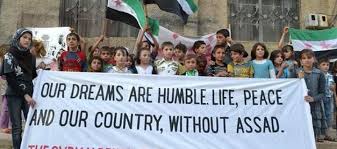
Refusing to listen to the Syrians… ‘Stop the War’ reaches a new depth of pseudo-leftism

“Stop the War, which prides itself on being an anti-imperialist organisation, has an imperialist mind-set par excellence… Syrians are not allowed to have an opinion about their own country. Only Westerners are allowed to talk about Syria.”

The following is republished with permission of James Bloodworth of Leftfootforward.

****

The Stop the War Coalition (StWC) have been accused of preventing victims of Syrian dictator Bashar al-Assad from speaking at an anti-war event.

During a panel event on Monday evening to discuss the case against British military intervention in Syria, StWC included no Syrians on the speaker’s panel and reportedly refused to allow Syrians to speak from the floor.

The meeting was chaired by Labour MP Diane Abbott and featured chair of the Stop the War coalition Andrew Murray, former leader of the Green Party Caroline Lucas, Labour MP Catherine West, Tory MP Crispin Blunt MP and SNP MP Tommy Shephard.

According to human rights activist Peter Tatchell, who attended the event, no Syrians were included on the panel and the Syrian activists who turned up to the event were threatened with arrest.

Speaking to LFF, Tatchell said:

“Some Syrian victims of Assad’s brutalities turned up but were not allowed to speak. They eventually shouted out in frustration, turning the meeting into momentary chaos, as they were jeered by some of the audience and as StWC stewards tried to eject them – allegedly threatening that they’d be arrested. The police turned up soon afterwards.”

Tatchell went on: “Near the end of the meeting, I personally appealed to Diane Abbott to let the Syrians have their say, but she refused and closed the meeting.”

Tatchell’s comments mirrored those of Amr Salahi, an activist from the Syria Solidarity Movement who was also present at the meeting.

“Andrew Murray said absolutely nothing about the people being killed in Syria on a daily basis in Assad’s airstrikes,” Salahi said.

“Murray said that ISIS had to be defeated militarily, and the way to do that was not for the West to get involved but for the Iraqi army and the Syrian army (i.e. Assad’s army) to be helped to defeat ISIS.”

He added: “The [war] was not discussed in reference to the Syrian people in any way. The only focus was on British or American involvement. Not a single Syrian was on the panel. There were Syrians in the audience and at the first opportunity they raised their hands to speak.”

However after raising their disagreements with the StWC panel over the organisation’s views of conflict in Syria, Salahi said the Syrians were prevented from speaking again.

“The first [Syrian activist] to challenge the panel told the speakers they were only looking at ISIS, while Assad was killing dozens of people on a daily basis. [The Syrian] then compared Assad to Hitler, and I told the speakers they were like the Neville Chamberlains of today. [Panellist] Crispin Blunt MP, a supporter of the Iraq war, answered that people in Syria were now looking to Assad to protect them from Islamist extremists. He was unaware that [the Syrian activist in question] had lived in regime controlled Damascus for more than three years since the start of the revolution,” Salahi said.

He added: “After this intervention, no other Syrians were permitted to speak. [The panel] kept opposing the possibility of Western intervention as if that was the only factor. Clara Connolly, an immigration lawyer and activist with Syria Solidarity UK, later told the StWC they were silent about Assad’s crimes but they didn’t care. I told the speakers they just wanted Assad to keep killing people. Clara kept trying to make the point to the speakers that they had nothing to say about what was happening on the ground. All she got in return was silence. Then some of the organisers went up to her and warned her that if she didn’t be quiet, she would be forced to leave.”

Peter Tatchell told LFF a similar story: “When it came to questions from the floor, other members of the audience were asked to speak but not the Syrians. Near the end of the meeting, I personally appealed to Diane Abbott to let the Syrians have their say but she refused and closed the meeting.”

Tatchell added that he was “shocked, surprised and saddened by Diane Abbott’s unwillingness to invite Assad’s victims to express their opinions”. He added that not listening to victims of Assad’s war crimes was “arrogant, insensitive and appalling. It has a whiff of ‘we know best’ and Syrian opinions ‘don’t count’”.

This is not the first time Syrians have been prevented from speaking at a StWC event on Syria. In September, in reply to a letter from Syria Solidarity UK asking StWC to include a Syrian in a separate panel event on Syria, StWC’s Lindsey German replied that it was “not appropriate” to hear from Syrians if they did not clearly oppose military intervention.

“Stop the War, which prides itself on being an anti-imperialist organisation, has an imperialist mind-set par excellence,” Salahi said. “Syrians are not allowed to have an opinion about their own country. Only Westerners are allowed to talk about Syria.”

James Bloodworth is the editor of Left Foot Forward. Follow him on Twitter

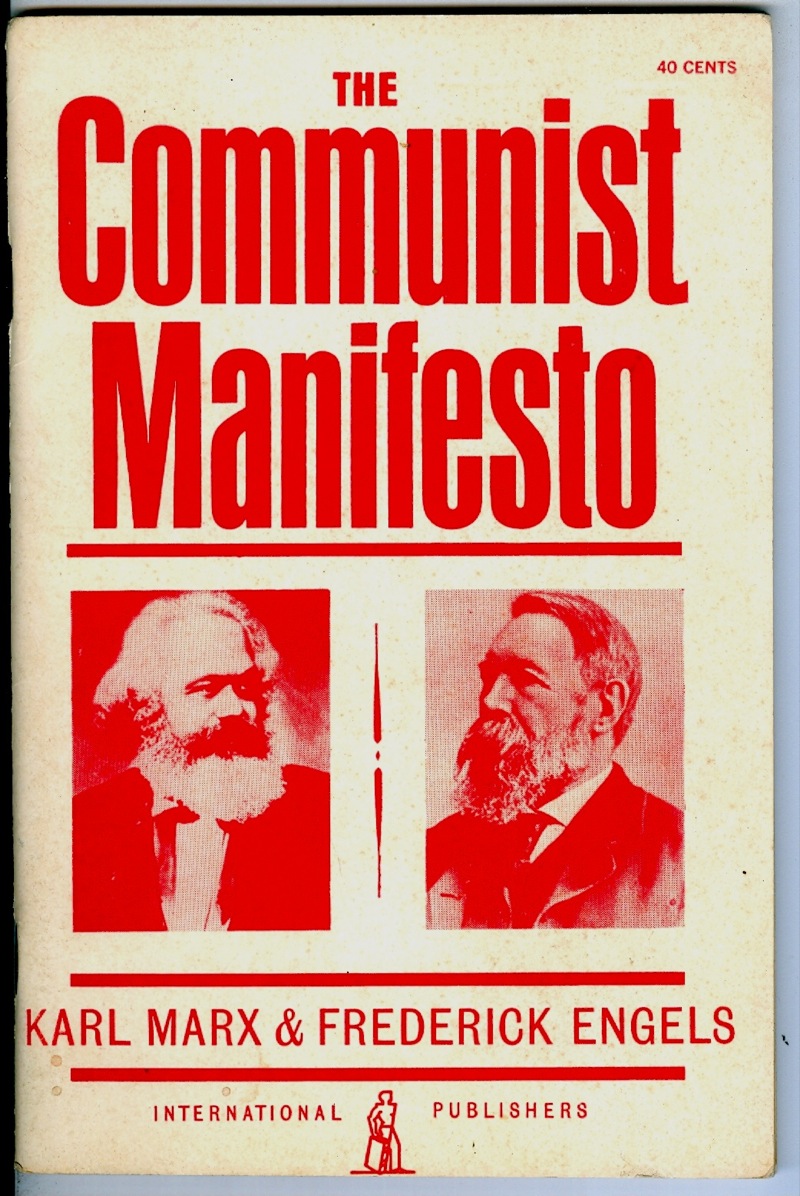
The Communist Manifesto Project – opposing the ‘reactionists’. Some annotations.

“The bourgeoisie, historically, has played a most revolutionary part” – Karl Marx 1848

Marx considered capitalism revolutionary, an advance on all previous societies. Most contemporary “Marxists” and the pseudo left more broadly either disagree or are highly ambivalent… For example, they bemoan “corporate globalization” and believe that the very far from complete process of economic development is ecologically unsustainable and we need to revert to a something “simpler”. Marx refers to these people as “reactionists”.

(Via The Communist Manifesto Project)


communist-manifesto


****

Annotations

These are some comments to consider while reading The Communist Manifesto. Most of them highlight the many instances where Marx’s views are contrary to those of present-day “Marxists”. Marx is referred to as the writer here. While Engels was a co-author, the final writing was the work of Marx.

Chapter 1: Bourgeois and Proletarians

“The bourgeoisie, historically, has played a most revolutionary part.”

Marx then goes on to elaborate on this point in the subsequent 11 paragraphs. He considered capitalism revolutionary, an advance on all previous societies. Most contemporary “Marxists” and the pseudo left more broadly either disagree or are highly ambivalent. They do not see the capitalist transformation of the economy and society as the launching pad for communism. Rather, the society they want requires a retreat from this process. For example, they bemoan “corporate globalization” and believe that the very far from complete process of economic development is ecologically unsustainable and we need to revert to a something “simpler”. Marx refers to these people as “reactionists”.

” We see then: the means of production and of exchange, on whose foundation the bourgeoisie built itself up, were generated in feudal society. At a certain stage in the development of these means of production and of exchange, the conditions under which feudal society produced and exchanged, the feudal organisation of agriculture and manufacturing industry, in one word, the feudal relations of property became no longer compatible with the already developed productive forces; they became so many fetters. They had to be burst asunder; they were burst asunder.”

So the transition from capitalism to communism will not be unique. As well as the transition from feudalism to capitalism there was also the transition from hunter-gathering to agriculture based society. In each case there was a total change in thinking and doing – “human nature”.

” For many a decade past the history of industry and commerce is but the history of the revolt of modern productive forces against modern conditions of production, against the property relations that are the conditions for the existence of the bourgeois and of its rule. ”

Marx goes on to cite capitalist economic crises as a prime example of the system’s obsolescence. Some claim that crises are not inevitable under capitalism. However, the evidence seems to suggest that they can only be delayed and at the cost of making them worse.

Other economic failings of the system include its slowness to innovate [see here] and its inability to tap the enthusiasm and initiative of workers [see here].

” Owing to the extensive use of machinery, ……. according to their age and sex.”

This is an accurate description of machine tending where work becomes confined to simple repetition. However, this should not be taken to be Marx’s overall assessment of work under capitalism. In Capital Vol. I Chapter Fifteen Section 9, he has two paragraphs that gives his general view of the labor process under capitalism. These are quoted in full below.

“Modern industry never looks upon and treats the existing form of a process as final. The technical basis of that industry is therefore revolutionary, while all earlier modes of production were essentially conservative. [225] By means of machinery, chemical processes and other methods, it is continually causing changes not only in the technical basis of production, but also in the functions of the labourer, and in the social combinations of the labour-process. At the same time, it thereby also revolutionises the division of labour within the society, and incessantly launches masses of capital and of workpeople from one branch of production to another. But if modern industry, by its very nature, therefore necessitates variation of labour, fluency of function, universal mobility of the labourer, on the other hand, in its capitalistic form, it reproduces the old division of labour with its ossified particularisations.We have seen how this absolute contradiction between the technical necessities of modern industry, and the social character inherent in its capitalistic form, dispels all fixity and security in the situation of the labourer; how it constantly threatens, by taking away the instruments of labour, to snatch from his hands his means of subsistence, [226] and, by suppressing his detail-function, to make him superfluous, we have seen, too, how this antagonism vents its rage in the creation of that monstrosity, an industrial reserve army, kept in misery in order to be always at the disposal of capital; in the incessant human sacrifices from among the working-class, in the most reckless squandering of labour-power and in the devastation caused by a social anarchy which turns every economic progress into a social calamity. This is the negative side. But if, on the one hand, variation of work at present imposes itself after the manner of an overpowering natural law, and with the blindly destructive action of a natural law that meets with resistance [227] at all points, modern industry, on the other hand, through its catastrophes imposes the necessity of recognising, as a fundamental law of production, variation of work, consequently fitness of the labourer for varied work, consequently the greatest possible development of his varied aptitudes. It becomes a question of life and death for society to adapt the mode of production to the normal functioning of this law. Modern Industry, indeed, compels society, under penalty of death, to replace the detail-worker of to-day, grappled by life-long repetition of one and the same trivial operation, and thus reduced to the mere fragment of a man, by the fully developed individual, fit for a variety of labours, ready to face any change of production, and to whom the different social functions he performs, are but so many modes of giving free scope to his own natural and acquired powers.

“One step already spontaneously taken towards effecting this revolution is the establishment of technical and agricultural schools, and of “écoles d’enseignement professionnel,” in which the children of the working-men receive some little instruction in technology and in the practical handling of the various implements of labour. Though the Factory Act, that first and meagre concession wrung from capital, is limited to combining elementary education with work in the factory, there can be no doubt that when the working-class comes into power, as inevitably it must, technical instruction, both theoretical and practical, will take its proper place in the working-class schools. There is also no doubt that such revolutionary ferments, the final result of which is the abolition of the old division of labour, are diametrically opposed to the capitalistic form of production, and to the economic status of the labourer corresponding to that form. But the historical development of the antagonisms, immanent in a given form of production, is the only way in which that form of production can be dissolved and a new form established. “Ne sutor ultra crepidam” — this nec plus ultra of handicraft wisdom became sheer nonsense, from the moment the watchmaker Watt invented the steam-engine, the barber Arkwright, the throstle, and the working-jeweller, Fulton, the steamship. [228]”

“226.
“You take my life
When you do take the means whereby I live.”
Shakespeare.

227. A French workman, on his return from San-Francisco, writes as follows: “I never could have believed, that I was capable of working at the various occupations I was employed on in California. I was firmly convinced that I was fit for nothing but letter-press printing…. Once in the midst of this world of adventurers, who change their occupation as often as they do their shirt, egad, I did as the others. As mining did not turn out remunerative enough, I left it for the town, where in succession I became typographer, slater, plumber, &c. In consequence of thus finding out that I am fit to any sort of work, I feel less of a mollusk and more of a man.” (A. Corbon, “De l’enseignement professionnel,” 2ème ed., p. 50.)

228. John Bellers, a very phenomenon in the history of Political Economy, saw most clearly at the end of the 17th century, the necessity for abolishing the present system of education and division of labour, which beget hypertrophy and atrophy at the two opposite extremities of society. Amongst other things he says this: “An idle learning being little better than the learning of idleness…. Bodily labour, it’s a primitive institution of God…. Labour being as proper for the bodies’ health as eating is for its living; for what pains a man saves by ease, he will find in disease…. Labour adds oil to the lamp of life, when thinking inflames it…. A childish silly employ” (a warning this, by presentiment, against the Basedows and their modern imitators) “leaves the children’s minds silly,” (“Proposals for Raising a Colledge of Industry of all Useful Trades and Husbandry.” Lond., 1696, pp. 12, 14, 18.)”

The basic message is that despite the tendency for capitalism to impose a narrow division of labor, the objective conditions of modern industry limit the extent they can do that.

This view is very much at odds with Braverman’s Labor and Monopoly Capital, The Degradation of Work in the Twentieth Century. This book has had a very unfortunate influence of how people on the left view the labor process under capitalism. It claims that capitalism tends to increasingly degrade work and deskill workers. The present situation totally refutes this view given that 15-20 per cent of the workforce have university degrees and a larger number have vocational training. If it were true that capitalism was simply reducing the workforce to automatons, it would be hard to see how they could ever get rid of, and then manage without, the bourgeoisie. For a full refutation of Braverman see Deskilling Debunked.

” The various interests and conditions of life within the ranks of the proletariat are more and more equalized, in proportion as machinery obliterates all distinctions of labour, and nearly everywhere reduces wages to the same low level. ”

While proletarians are no longer mainly machine tenders, the point about equalization is still quite valid.
The wage disparity among the vast majority of workers is not enough to generate major differences in material conditions of life. There is a mass mainstream, with perhaps 10 per cent at the top and 10 per cent at the bottom living in different worlds. This is important from the point of view of overall solidarity and individuals identifying with most other people. The way that the vast bulk of people think of themselves as ‘middle class’ is one reflection of this.

” Finally, in times when the class struggle nears the decisive hour, the progress of dissolution going on within the ruling class, in fact within the whole range of old society, assumes such a violent, glaring character, that a small section of the ruling class cuts itself adrift, and joins the revolutionary class, the class that holds the future in its hands. Just as, therefore, at an earlier period, a section of the nobility went over the bourgeoisie, so now a portion of the bourgeoisie goes over to the proletariat, and in particular, a portion of the bourgeois ideologists, who have raised themselves to the level of comprehending theoretically the historical movement as a whole.”

Now most members of the intelligentsia are part of the proletariat. They come from proletarian families and works for a salary. Unfortunately, because of their employee status most are hacks working in the service of the bourgeoisie. This includes the pseudo left in the social sciences who have done much to stifle young inquiring minds. Under these circumstances independent thinkers with independent means would be most valuable.

” Of all the classes that stand face to face with the bourgeoisie today, the proletariat alone is a really revolutionary class. The other classes decay and finally disappear in the face of Modern Industry; the proletariat is its special and essential product.”

In modern capitalist societies the vast majority of people are members of the proletariat. They are either wage or salary earners or on welfare. They have no means of production of their own. The capitalists are a tiny minority and the petty bourgeoisie comprise around 10 per cent. The proletariat is revolutionary because it has no interest in the present system and can do without the bourgeoisie. For more on the modern proletariat go here.

“All the preceding classes that got the upper hand sought to fortify their already acquired status by subjecting society at large to their conditions of appropriation. The proletarians cannot become masters of the productive forces of society, except by abolishing their own previous mode of appropriation, and thereby also every other previous mode of appropriation. They have nothing of their own to secure and to fortify; their mission is to destroy all previous securities for, and insurances of, individual property.

“All previous historical movements were movements of minorities, or in the interest of minorities. The proletarian movement is the self-conscious, independent movement of the immense majority, in the interest of the immense majority. The proletariat, the lowest stratum of our present society, cannot stir, cannot raise itself up, without the whole superincumbent strata of official society being sprung into the air.”

The proletariat has to own all the means of production in common. Parceling them out to separate groups of workers would simply bring you back to capitalism.

” The modern labourer, on the contrary, instead of rising with the process of industry, sinks deeper and deeper below the conditions of existence of his own class. He becomes a pauper, and pauperism develops more rapidly than population and wealth. And here it becomes evident, that the bourgeoisie is unfit any longer to be the ruling class in society, and to impose its conditions of existence upon society as an over-riding law. It is unfit to rule because it is incompetent to assure an existence to its slave within his slavery, because it cannot help letting him sink into such a state, that it has to feed him, instead of being fed by him. Society can no longer live under this bourgeoisie, in other words, its existence is no longer compatible with society.”

This is still indeed the case for a significant section of the proletariat. A pauper is someone who cannot support them-self. In the present context that means being on the dole or invalid pension. Pauperism occurs because capitalism fails to ensure that everyone is equipped with the abilities required for the workforce and also leaves many people the psychological casualties of a dog eat dog society.

Chapter 2: Proletarians and Communists

“In the national struggles of the proletarians of the different countries, they point out and bring to the front the common interests of the entire proletariat, independently of all nationality.’

A lot of the pseudo left demand protection from “cheap foreign labor”.

“Communistic abolition of buying and selling”
This means no more markets. Most “Marxists” have gone to water on this and agree with the bourgeoisie that it is impossible. For a discussion of how communism would thrive without markets go here.

” The proletariat will use its political supremacy to wrest, by degree, all capital from the bourgeoisie, to centralise all instruments of production in the hands of the State,i.e., of the proletariat organised as the ruling class; and to increase the total productive forces as rapidly as possible.”

This is totally at odds with the green anti-growth view that is now so widely held.

” In place of the old bourgeois society, with its classes and class antagonisms, we shall have an association, in which the free development of each is the condition for the free development of all.”

Another way of expressing this is to say – each person’s free development depends on the free development of everyone else. This is obvious if you think about how difficult it would be to fully thrive if those around you are hopelessly inadequate.

Chapter 3: Socialist and Communist Literature

​In this chapter Marx lists the various types of “anti -capitalism” that prevailed at that time. A new list for the present time needs to be prepared. There will be significant similarities and they will be as equally reactionary.

Chapter 4: Position of the Communists in Relation to the Various Existing Opposition Parties

This chapter looks at immediate tasks for communists at that time. At the present moment the big issue is the Arab Spring. This revolution, no matter however totally bourgeois, is in the interest of the proletariat and people, both of the region and internationally. The major capitalist powers must be placed under the greatest possible pressure to do all they can assist, including militarily. The “Marxists” and other pseudo leftists have done all they can to oppose this and are a total disgrace.

‘Fairness and Accuracy in Reporting’ serves up more lies on Syria

Reblogged with permission of Bill Weinberg and his World War 4 Report.


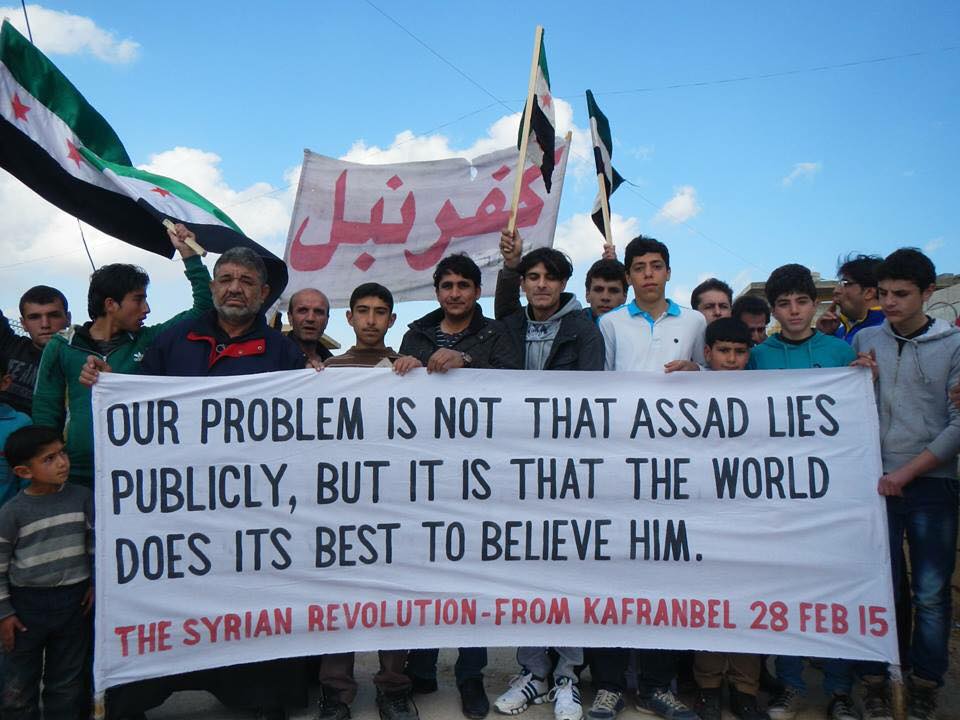
syria banner

“Leftist” (sic) shilling for fascist dictator Bashar Assad reaches new levels of deception in an entry from one Adam Johnson of Fairness and Accuracy in Reporting (FAIR), perversely entitled “Down the Memory Hole: NYT Erases CIA’s Efforts to Overthrow Syria’s Government.” The chutzpah of invoking Orwell in his title is downright Orwellian, as his distortions reveal the very name “Fairness and Accuracy in Reporting” to be pure doublethink. Wedded to the persistent pseudo-left hallucination of a US campaign to destabilize Assad, Johnson gripes: “This past week, two pieces—one in the New York Times detailing the ‘finger pointing’ over Obama’s ‘failed’ Syria policy, and a Vox ‘explainer’ of the Syrian civil war—…didn’t just omit the fact that the CIA has been arming, training and funding rebels since 2012, they heavily implied they had never done so.” So what is Johnson’s evidence that the CIA has been doing this? In defense of his claim, he links to articles in (funny) the New York Times, The Guardian,Der Spiegel and the Washington Post. But if you bother actually click on the links (perish the thought), you’ll find that none of them quite back up Johnson’s assertions…

The Times story, from March 24, 2013, says nothing about the US “training” or “funding” the rebels—only a “secret airlift of arms and equipment.” If this support was ever “secret,” it wasn’t for very long. The very next month, John Kerry was openly boasting of US support for the Syrian rebels at an Istanbul meeting—although it is questionable how much of the promised aid actually reached the rebels. And by the end of 2013, Kerry had announced a cut-off of “non-lethal” aid to the FSA. National Security Advisor Susan Rice later stated that “lethal aid” had continued—but emphasized that it was in the interests of “counterterrorism”; that is, fighting ISIS, not Assad. (Haaretz, June 7, 2014)

The Guardian story (March 8, 2013) says nothing about the CIA, only “Western” training of Syrian rebels in Jordan. Actually read the story (persih the thought) and it turns out to be the British and the French, and the whole thing is based on anonymous sources. The only indirect reference to the CIA is the following line: “A Jordanian source familiar with the training operations said: ‘It’s the Americans, Brits and French with some of the Syrian generals who defected. But we’re not talking about a huge operation.'”

The story from Der Spiegel (the actual link is to a March 10, 2013 Reuters story citing Der Spiegel) is essentially a recapitulation of The Guardian’s claims, and concludes: “The reports could not be independently verified.”

The Washington Post story (June 12, 2015) actually reports that Congress was moving to cutCIA aid to the rebels. Again citing unnamed or fuzzy sources, the account claims the CIA has spent around $1 billion over the past “several years” to arm and train Syrian rebels—but emphasizes again that the primary enemy is ISIS, not Assad.

So of Johnson’s four sources, it is only the last that vaguely backs up his claim. And he leaves out two salient facts: that the aid is primarily directed against the jihadists who Assad is also fighting, not Assad; and that it is coming to an end.

Johnson does mention the far less ambitious but better publicized Pentagon program to train Syrian rebels, admitting it has been an “abysmal failure.” He doesn’t mention (as we have) that the fighters trained under this program amount to a whopping 54—of whom only 37 were still actually in combat last time we checked back in August. Nor does he mention (as we have) that rebels have refused to participate in the training program because of the Pentagon’s insistence that they do not use their training to fight Assad—only ISIS.

After this subterfuge, Johnson goes on to gripe that the Sept. 13 New York Times story fails to mention the CIA training program. Distortions, eh? Cast the beam from thine own eye, Adam.

He closes with the usual sickening bogus neutrality:

As the military build-up and posturing in Syria between Russia and the United States escalates, policy makers and influencers on this side of the Atlantic are urgently trying to portray the West’s involvement in Syria as either nonexistent or marked by good-faith incompetence. By whitewashing the West’s clandestine involvement in Syria, the media not only portrays [sic] Russia as the sole contributor to hostilities, it absolves Europe and the United States of their own guilt in helping create a refugee crisis and fuel a civil war that has devastated so many for so long.

Oh really, Johnson? How many of the refugees are fleeing the FSA, as opposed to Assad’srelentless aerial bombadment and ISIS sectarian cleansing? A case can be made that it is the West’s failure to meaningfully support the rebels—without condescending conditions that they don’t fight Assad—that has led to the disaster in Syria. The notion that “the West” is to blame for the refugees is literally echoing Assad’s propaganda. See CNN Sept. 16 (“Syria’s Bashar al-Assad: West is to blame for refugee crisis”).

In fact, even ISIS is a distant second to Assad as the aggressor the refugees are fleeing. An account based on refugee interviews on the German website Qantara quotes one refugee in its headline: “Stop Assad’s bombs, then we’ll go back.” A salient passage:

Indeed, the key reason for displacement in Syria is not IS, but Assad. The regime’s air force is killing at least seven times as many people as IS. This “terror from the air”, as it is referred to by civil groups, is destroying all those areas controlled by rebels—both moderate and Islamist. The aid organisation Doctors Without Borders reported that in August “heavy bombardments were carried out on 20 consecutive days in besieged Eastern Ghouta” where it is supporting 12 provisional underground clinics… One in every four victims—whether dead or injured—was a child under the age of five.

But you would get no sense of that from the ironically named Fairness & Accuracy in Reporting. This is the same FAIR, recall, that was eager to jump on utterly dubious claimsthat the rebels and not the Assad regime were behind the Ghouta chemical attack. Now it is plugging the utterly fictional notion of a “CIA Effort to Overthrow Syria’s Government.” Bunk. On the contrary, the US is tilting to Assad, viewing ISIS as the greater and common enemy. This is a betrayal of the Syrian revolution, which is ultimately even counter-productive to the aim of fighting ISIS. Telling the secular and pro-democratic forces they must accept rule under one tyrant is hardly conducive to a strong resistance against a rival gang of fascists.

Why does the increasingly reactionary FAIR continue to have any legitimacy whatsoever?

Draining the Swamps: Correspondence with Chomsky (lead up to, and during, the Iraq War).

I have long believed in the importance of engagement with ideas and the exchange of ideas and analyses through debate. Our political culture has changed greatly since my early experiences with this process in the late 1960s. Today, it seems to me that too many people shun debate and are happy to be reinforced by group-think and their own sense of righteousness rather than be open to challenge. It really boils down to individuals stopping thinking and finding comfort in a kind of religious satisfaction.

It is telling, I think, as to who seeks debate, who is willing to be open to challenge and follow it through, and who is not. In the following email correspondence between Arthur Dent (formerly Albert Langer) and Noam Chomsky in 2002 and 2003, it is very clear as to who fits which category.

– C21styork

* * * *

In September 2002, Noam Chomsky wrote an article entitled ‘Drain The Swamps And There Will Be No More Mosquitoes’. Subsequently the article ‘Mayday – It’s the Festival of the Distressed’ was published, which argued that the US is indeed following a policy of draining the swamps. This view was presented to Chomsky who refused to give it any serious consideration.

This document contains:

1. First message to Noam Chomsky
2. Noam Chomsky’s reply .
3. Long explanation of why he thinks that Bush has adopted a policy very close to the one Chomsky proposed in  his article  Drain The Swamps  And There Will Be No More Mosquitoes (September 2002)
4. Noam Chomsky’s very short response.
5. Full text of Chomsky’s  article.
6. Full text of article May Day – it’s the festival of the distressed

**********************************************

First message to Chomsky:

Hi,

Some comments comparing your article on “Draining the Swamps” with  the
position George W Bush switched to more recently, are in an article I
published in “The Australian” (national serious mainstream broadsheet) today
(2003-05-01):

http://www.theaustralian.news.com.au/printpage/0,5942,6362012,00.html

(NB the above url no longer works. The article is included below (scroll down).  Alternatively you could open it in a separate window by right clicking here)

Apart from the courtesy notification, I was hoping you might be interested
in further discussion/debate.

Although you have clearly identified with the peace movement and, in my
view, adopted a very different position from your earlier article, it seems
to me that there is still a subtle difference between your analysis on Iraq
and many other articles I have seen on Znet.

Perhaps a debate could clarify the nature of those differences?

Finally, if you happen to know of any other “pro-war left” (as opposed to
pro-war liberal) web sites I would be grateful for any links.

Seeya


2. CHOMSKY’S RESPONSE

—–Original Message—–
From: Noam Chomsky [mailto:chomsky@MIT.EDU]
Sent: Sunday, May 04, 2003 12:12 AM
Subject: Re: Draining the swamp reply
Thanks for sending your article.  I’ve received 100s of letters in response to the article to which you refer, some of which misunderstood it, but nothing remotely like this.  I can only assume that you have not actually seen the article.  I’ll quote the relevant parts.

The quote from Harkabi is as follows:

Twenty years ago, the former head of Israeli military intelligence, Yehoshaphat Harkabi, also a leading Arabist, made a point that still holds true. “To offer an honourable solution to the Palestinians respecting their right to self-determination: that is the solution of the problem of terrorism,” he said. “When the swamp disappears, there will be no more mosquitoes.”

The reference to the campaign of hatred is as follows:

“The president is not the first to ask: “Why do they hate us?” In a staff discussion 44 years ago, President Eisenhower described “the campaign of hatred against us [in the Arab world], not by the governments but by the people”. His National Security Council outlined the basic reasons: the US supports corrupt and oppressive governments and is “opposing political or economic progress” because of its interest in controlling the oil resources of the region.  Post-September 11 surveys in the Arab world reveal that the same reasons hold today, compounded with resentment over specific policies. Strikingly, that is even true of privileged, western-oriented sectors in the region.”

The words you quote state — clearly and unambiguously — that the way to reduce the threat of terror is to change the policies that Eisenhower and his staff identified, and the subsequent policies that are identified.  That is, the US should stop supporting corrupt and oppressive government and blocking political and economic progress because of its interest in controlling Near East oil, and should stop its support for Israeli terror and integration of the occupied territories, and its murderous sanctions that are devastating the people of Iraq while strengthening Saddam Hussein.

I am sure you agree that the only relation between this and Bush’s policies is the relation of flat-out contradiction.

Once you look at the actual article to which you refer, I trust you will agree that a published retraction is in order.

I’m afraid I can’t answer your last question because of its assumptions, which are based on total misunderstanding.

Noam Chomsky


3. REPLY TO CHOMSKY:

Thanks for your prompt email response (May 4).
I had read your original article (“Drain the Swamps..”) before I wrote mine. My understanding when I read it agrees with the summary in your email quoted below. I agree that your article did “clearly and unambiguously” advocate that:
“…the way to reduce the threat of terror is to change the policies that Eisenhower and his staff identified, and the subsequent policies that are identified.  That is, the US should stop supporting corrupt and oppressive government and blocking political and economic progress because of its interest in controlling Near East oil, and should stop its support for Israeli terror and integration of the occupied territories, and its murderous sanctions that are devastating the people of Iraq while strengthening Saddam Hussein.”

If you believe readers of my article might gain some other impression of your views, you are welcome to include this email with the above acknowledgement in any request you make to ‘The Australian’ for a correction or clarification.
For my part I do not agree that a published retraction is in order as I do not believe my article would give any other impression. Further discussion/debate/clarification certainly is in order.
In my view the real disagreement between us is expressed by your statement:

“I am sure you agree that the only relation between this and Bush’s policies is the relation of flat-out contradiction.”
In fact I do not agree.
You must get a lot of email, and have reasonable defences against getting dragged into pointless disputes with random nutters. Before assuming I am one, I hope you will carefully consider the points below:

My position is that Bush has now switched to a policy very similar to the one you advocated both in your orginal article and as summarized by you above.  I  stated  this “clearly and unambiguously” in my article as follows:
“Stripped of the ‘God bless America’ stuff, the US President’s case now goes like this:
‘If we devote our resources to draining the swamps, addressing the roots of the “campaigns of hatred”, we can not only reduce the threats we face, but also live up to ideals that we profess and that are not beyond reach if we choose to take them seriously.’
Actually, those words are from Noam Chomsky two days before Bush’s UN speech on September 10, 2002.”

I made it clear that I was asserting that it was not a case of you endorsing Bush’s policy, but of Bush switching to a policy similar to yours, as follows:
“But if Bush had adopted Chomsky’s position so early, that would have prevented congressional authorisation. Such a position threatens to destabilise despotic, reactionary regimes everywhere. But those in the US foreign policy establishment have devoted their entire careers to supporting the most corrupt tyrannies in the Middle East, in the name of ‘stability’.”

The above also explicitly highlights that I am saying that traditional US policy has been to support the corrupt tyrannies and that Bush’s policy reverses direction. Clearly you are entitled to disagree as to whether Bush has changed direction.

But only Bush could claim to be misrepresented and ask for a retraction. You cannot ask for a retraction while reaffirming that you do in fact, as is well known, advocate a policy opposed to the traditional US foreign policy line of supporting corrupt tyrannies, as I implied above.
Again, I made it clear that despite what I believe should follow logically from your analysis, you in fact opposed the war:
For Chomsky, ‘draining the swamps’ apparently didn’t include killing people and blowing things up. Fortunately, Bush is made of sterner stuff.”
“Both Bush and Chomsky know the US cannot be secure from medievalist terrorist mosquitoes while the Middle East remains a swamp. But Bush also knows that modernity grows out of the barrel of a gun.”


I emphasized the depth of the switch I claimed had occurred in Bush’s policy as follows:

“That is a genuinely Left case for a revolutionary war of liberation, such as has occurred in Iraq. The pseudo-Left replies: ‘That’s illegal.'”
“Well, of course revolutionary war is illegal. Legal systems are created by revolutions, not revolutions by legal systems.”


Finally I highlighted my view that Bush’s new policy includes acceptance that the US “should stop its support for Israeli terror and integration of the occupied territories” as follows:
“The next logical step for the new policy is to establish a viable Palestinian state. Bush has put himself in a position where he can and must take that step. Naturally, he will not admit to the enormous strategic and policy retreat that such a step implies, so he has preceded it with enough triumphalist rhetoric to make even the Fox News team look queasy.”


Thus my position is that Bush’s actual policy now is the same as the policy you advocated in September last year – and which you summarized for me in your email. Namely Bush agrees that:
“the US should stop supporting corrupt and oppressive government and blocking political and economic progress because of its interest in controlling Near East oil, and should stop its support for Israeli terror and integration of the occupied territories, and its murderous sanctions that are devastating the people of Iraq while strengthening Saddam Hussein.”

Perhaps you find that view of Bush’s actual policy so bizarre that you cannot imagine I would be saying it?

Nevertheless, I am.

Of course I am not claiming that Bush admits that US policy was aimed at blocking political and economic progress because of US interest in controlling Near East oil, nor that he would endorse such terms as “Israeli terror” or “murderous sanctions”.
I am simply saying that Bush has changed policy, and done so for essentially the reasons you advocate. There should be nothing inconceivable about that. After all at one time US policy was to escalate the war in Vietnam until a US victory. Nixon changed that policy to withdrawing all troops and accepting defeat, but describing defeat as “peace with honour”. He did that by redefining the goal of the war as “return of all American Prisoners of War” and then rallying the American right to achieve that goal (which was won very simply by signing the peace agreement and withdrawing the troops).
I suggest something similar is going on now. Bush has redefined America’s goals in the middle east as being to promote democracy and has rallied the right by linking that to defeating terrorism. He doesn’t need to worry about the left because we’ve always been in favor of promoting democracy just as we were in favor of Vietnam defeating the US aggression.

He doesn’t need to worry about the pseudo-Left because they are just bizarre (the anti-war movement may have appeared to be a roaring flash flood that rose much faster and extended much wider than the Vietnam war movement but it was in fact also much more shallow and immediately turned into a puddle).

Even before September 11, Israeli goals were being redefined as an “end to Palestinian terrorism” rather than “Greater Israel”, as preparation for accepting defeat of the occupation and creation of a Palestinian state. That has now become mainstream. A victory against Palestinian terrorism can of course be achieved just as easily as the return of American POWs was achieved in Vietnam – by simply withdrawing from the occupied territories etc.
Instead of simply dismissing my view as inconceivable, you do need to consider and reply to it.

First, I’m not the only person on the left drawing similar conclusions about changes in US policy. It is also, less explicitly, part of the background to the collapse of the mass anti-war movement and the somewhat bizarre debates about whether it would be “irresponsible” to call for an immediate end to the occupation.

While you might be able to get away with simply brushing me off, the view of Bush’s policy that you seem to have just dismissed as inconceivable is going to keep coming up and will need to be debated eventually.

For example KADEK/PKK (the Kurdish Workers Party) has several thousand troops in Kurdistan, has been actively involved in armed struggle with the Turkish government and was originally opposed to the US attack on Iraq. Its May Day statement(same date as my article) included the following:

Middle East countries have been suffering from severe national and social problems but are now involved in a new process which started with the war on Iraq. Those severe problems are forcing the regimes to improve freedom and human rights. The prerequisites required for a solution are available now. The main characteristics of the new process are that the democratic unity issue involves both war and peaceful efforts. Although concrete results have not been achieved yet, as the Iraq case proves, if diplomatic and political methods, peaceful efforts, do not resolve the problem then the only option is war.”


Talking about peace, without offering a solution does not make any sense to people of the Middle East, who are suffering from severe problems. The collapse of the Iraqi regime will serve the interests of the society, and lead to social improvement.”


“The sovereign regimes in all Middle East countries have lost their capacities of solving the problems. In spite of colossally rich natural resources, making available opportunities to develop, those regimes could not solve the problems, but on the contrary have exacerbated them. This is the main reason for lack of developments in democracy, freedom, and human rights. The existing regimes reply to peoples’ demands for democracy, freedoms, and human rights by increasing pressures. Local people cannot benefit from their countries’ rich resources, but suffer from poverty, hunger and poor socio-economic living conditions. In spite of all this, the regimes refuse to change, do not reply the democratic change and transformation efforts and this will require their removal.”

[…]

“Whether the intervention in Iraq will succeed or not depends on the development of democracy, freedom, and human rights. The more improvements are achieved in these human values the more the US intervention in Iraq will succeed. Setting up the kind of regimes in continuity with the past will lead to chaos.”


“Therefore, the only option for the US should be to support democratic regimes. The wider dimension of the problem is the necessity of democratic change and transformation imposed upon the regimes within the region, which is the only option in order prevent war and conflict. Radical democratic reforms will prevent war.” […]


Note that KADEK/PKK is saying “The more improvements are achieved in these human values the more the US intervention in Iraq will succeed” – directly opposite to the line you have been taking. Of course they can be completely wrong, just as I can. But so can you be wrong and you certainly aren’t going to prove you are right just by saying “I am sure you agree”!
Next, note that your summary of your position is “clearly and unambiguously” advocated by former CIA Director James Woolsey, one of the leading proponents of the war in Iraq:
From his Washington Post article “Objective: Democracy“, Tuesday, November 27, 2001; Page A13:

[…] “This ought to be enough to make us call into question some of the European-generated ‘truths’ about another region, the Mideast, that have generally guided our conduct there for the past 80 years: that Arabs and Muslims have no aptitude for democracy, that we are well-advised to stay in bed with corrupt rulers — occasionally changing them if they seem to threaten, especially, our access to oil — and that the general rule should be: better the devil we know than the devil we don’t.”
“We have, on the whole, followed this European conceptual lead, and it has brought us Sept. 11, disdain and hatred. Only in Afghanistan, and in Iran, where we are perceived to be at odds with the repressive regime, do the demonstrating crowds chant ‘U-S-A.'”
“One of these days we’re going to get the picture. It has been the received wisdom at various times in the 20th century that Germans, Japanese, Koreans, Russians and Chinese would never be able to manage democracy. Yet from Berlin to Taipei, people seem to have figured out how to make it work. And no democracy threatens us, for the very good reason that, unlike dictators, democracies turn to war last, not first. And no democracy consciously harbors terrorists or encourages them to attack us.”
“The Mideast does present a special problem. Outside Israel and secular Turkey, the governments of the region comprise no democracies but rather vulnerable autocracies and pathological predators. Some of the autocracies have launched reforms and may evolve toward constitutional monarchies with parliaments and the rule of law — Jordan and Bahrain, for example — if a predator doesn’t get them first. Other autocracies, such as Saudi Arabia, seem mired in self-destructive behavior: spending vast sums to promote a whole set of domestic and foreign institutions, such as Saudi and Pakistani schools, that build hatred against both us and the modern world and that will, in time, undermine their own rule.”
“Many in the West see hatred and conclude that the people of the Muslim and Arab worlds are our enemies. They could not be more wrong. If we continue to follow the European paradigm — as, tragically, the first Bush administration did in the spring of 1991, when it failed to back the Iraqi resistance’s rebellion against Saddam — we will continue to be hated both by predator governments and by a vocal minority in the streets of the autocracies. Our only sound strategy is to take the side of the people against the predators and, albeit less urgently, the autocrats as well.”
http://www.washingtonpost.com/ac2/wp-dyn/A19477-2001Nov26?language=printer

Woolsey describes existing US policy as “staying in bed” with, or “tolerating” corrupt tyrannies rather than actively “supporting” them.

Also he bizarrely describes this policy, as “European” instead of using your presumably tongue in cheek phrase “live up to ideals that we profess”.

The policy recommendation as to how to reduce the threat of terrorist attacks from the Middle East is however, utterly clear and entirely the same as yours – “take the side of the people against (their oppressors, whether anti-US or pro-US regimes)”.

The only difference is that “take the side of the people” is rather stronger than “stop supporting” the oppressors”, and leads directly to support for a revolutionary war.
Incidentally, as well as describing US policy in terms of access to oil, Woolsey also describes the Baath regime as “fascist” in the same way that I do:
From JINSA Online, June 04, 2002.
The following interview with James Woolsey appeared on Insight Magaizine’s website on May 13, 2002.

Mr. Woolsey is a member of JINSA’s Board of Advisors and was Director of Central Intelligence from 1993 until 1995.

[…]

Insight: If the United States topples Saddam, what kind of regime will replace him?”

JW: That’s the right question for those folks in the U.S. government who might sponsor coups! But for those of us who want democracy to flourish in Iraq, there’s only one answer: whomever the Iraqi people choose. Mideast scholar Bernard Lewis is absolutely right – Iraq is one of the Arab states most suited to democracy. It has a well-educated populace and is far less tribally diverse or divisive than a number of other nations. Iraq also possesses great oil wealth. But, first, we need to de-Ba’ath the country as the U.S. and her allies de-Nazified Germany. Our role as Americans should be to assist the Iraqi nation in establishing new democratic institutions. Then, as good partners, we should stand back and let the Iraqi people decide who will rule their nation.

Insight: What is the Ba’ath Party?”

JW: It is a despotic organization modeled after the fascist regimes of Hitler’s Germany and Mussolini’s Italy. Essentially, Ba’athists are modern-day fascists. Indeed, among some circles in the Mideast, there is much admiration for German fascism of the 1930s.
Insight: How do you bring about regime change in the Mideast, yet avoid catastrophic upheaval?
JW: For the last 40 or 50 years we have tolerated Mideast tyrants because of the U.S. thirst for oil. Of the 22 Arab states in the region, not one is a democracy. The U.S. must rid the Mideast of its tyrants, beginning with the most horrible of predators, Saddam. As we stay the course in Afghanistan, eradicating the Taliban and al-Qaeda infrastructures, other autocrats in the region will realize the U.S. means business. In time, the region will progress toward democracy.

Insight: How do you dispel the notion that the West must coddle these regimes?”

JW: In 1945, a lot of people in the nation’s capital said Germany and Japan never would progress toward democracy. They also said nations like South Korea and even Russia would never become democracies. Yet these nations proved to be able to govern themselves. Spain, Portugal and Chile also were ruled by dictators. Today they are democracies. In 1914, there were not more than 10 democracies in the world; today there are more than 120.
The Mideast, however, remains a part of the world untouched by democracy, except for Israel and Turkey. The region systematically produces terrorists, weapons of mass destruction, autocrats and dictators.
Dictators start wars. They seek out external enemies. More often than not, they escalate conflict beyond their own borders to distract internal suspicions of the illegitimacy of their regimes. In the case of Iraq, Saddam invaded Iran in 1980, just one year after coming formally to power.
Democracies, on the other hand, use force as a last resort because they are responsive to the wishes of their citizens. If we make it clear that we are determined to bring democracy to this part of the world, it will encourage hundreds of millions of decent people in the Mideast. For us to win this war the entire face of the Mideast must change. But, first, all this hinges on our success in bringing down Saddam.
http://www.jinsa.org/articles/print.html/documentid/1494

Again, while it would be easy to wax sarcastic about the last paragraphs, and the role of the USA in escalating conflict beyond its borders, the fact remains that Woolsey has recognized the same policy imperatives that you pointed out and is simply presenting them in language that can appeal to fellow senior officials of US imperialism.
Would you agree that Woolsey is indeed seriously advocating a policy that “the US should stop supporting corrupt and oppressive government and blocking political and economic progress because of its interest in controlling Near East oil“?
If so, an assertion that Bush has also accepted this policy, and that it is actual rather than merely declaratory, should be considered seriously rather than merely dismissed as inconceivable.
The point is of course that nobody familiar with the Middle East could possibly reach any other conclusions, when studying the question of how to respond to September 11, even though they might have an interest in presenting those conclusions in a more apologetic way than you do.

It is difficult to imagine how any US imperialist policy making group reviewing US policy in the light of September 11 could possibly avoid advising that supporting Islamist terrorism hadn’t been such a good idea, supporting Baath fascism hadn’t been such a good idea, supporting the House of Saud isn’t a good idea, supporting “Greater Israel” isn’t a good idea and it’s way past time to drain the swamps.
As you noted in “Wars of Terror” on 30 April:

In serious scholarship, at least, it is recognized that “Unless the social, political, and economic conditions that spawned Al Qaeda and other associated groups are addressed, the United States and its allies in Western Europe and elsewhere will continue to be targeted by Islamist terrorists.” 13″

http://www.zmag.org/content/showarticle.cfm?SectionID=11&ItemID=3543
Given that, why on earth should we assume the real, as opposed to the declared conclusions of US policy makers differ from those reached by serious scholarship?
(Incidentally, the copy at the above URL appears to be broken as it ends in mid-sentence. Please let me know when it is fixed. I noticed that almost every paragraph from “Draining the Swamps” is expanded in “Wars of Terror” and am curious to see what happened to the concluding paragraph I quoted in my article, in the light of recent shifts in US rhetoric.)
Finally, although Bush stuck rigidly to the “Saddam must disarm” line right up until the last minute, this has now taken a back seat to more or less open explanations of the new policy.

As mentioned in my article, Bush presents the new line with lots of “God bless America” rhetoric as a triumphant reaffirmation of American values rather than an admission of defeat and retreat. He is able to get away with that precisely because of the stand taken by the anti-war movement.

Instead of taking credit for having opposed the criminal and disasterous policy that brought “Sept. 11, disdain and hatred” long before Woolsey, you allow Bush to present the adoption of your views as a triumph for US imperialism!
Unlike Woolsey, Bush needs to present his declaratory policy less clearly and unambiguously than either Woolsey or your summary of it in your email to me.
Nevertheless, here’s an example (from February 26, 2003), to show that Bush is indeed saying things that sound very similar to the words I quoted from your article:
[…] A liberated Iraq can show the power of freedom to transform that vital region, by bringing hope and progress into the lives of millions. America’s interests in security, and America’s belief in liberty, both lead in the same direction: to a free and peaceful Iraq. (Applause.)
[…]

There was a time when many said that the cultures of Japan and Germany were incapable of sustaining democratic values. Well, they were wrong. Some say the same of Iraq today. They are mistaken. (Applause.) The nation of Iraq — with its proud heritage, abundant resources and skilled and educated people — is fully capable of moving toward democracy and living in freedom.
(Applause.)

The world has a clear interest in the spread of democratic values, because stable and free nations do not breed the ideologies of murder. They encourage the peaceful pursuit of a better life. And there are hopeful signs of a desire for freedom in the Middle East. Arab intellectuals have called on Arab governments to address the “freedom gap” so their peoples can fully share in the progress of our times. Leaders in the region speak of a new Arab charter that champions internal reform, greater politics participation, economic openness, and free trade. And from Morocco to Bahrain and beyond, nations are taking genuine steps toward politics reform. A new regime in Iraq would serve as a dramatic and inspiring example of freedom for other nations in the region. (Applause.)
It is presumptuous and insulting to suggest that a whole region of the world — or the one-fifth of humanity that is Muslim — is somehow untouched by the most basic aspirations of life. Human cultures can be vastly different. Yet the human heart desires the same good things, everywhere on Earth. In our desire to be safe from brutal and bullying oppression, human beings are the same. In our desire to care for our children and give them a better life, we are the same. For these fundamental reasons, freedom and democracy will always and everywhere have greater appeal than the slogans of hatred and the tactics of terror. (Applause.)
[…]
http://www.whitehouse.gov/news/releases/2003/02/iraq/20030226-11.html
Clearly Bush is deliberately linking the question of US security from terrorist attack (mosquitoes) to the question of liberating people from corrupt tyrannies (draining the swamps).

That is exactly the theme of the paragraph I quoted from your article. The context is support for a war that you oppose. But what is there in the words that Bush uses to make the case for linking US security from terrorist attack with freedom and democracy in the Middle East, that you would disagree with?
Of course the fact that Bush is making a (declaratory) “case” that includes quotes like the one above does not establish what his actual policy is.

Nevertheless, given such quotes it is necessary to seriously consider the question and argue the issue rather than simply dismiss it. Certainly raising expectations in this way is not going to be helpful to any US project for imposing a puppet dictatorship in Iraq.
In the summary of your views that I quoted above from your last email, you mentioned 3 policies that would have to be changed “in order to reduce the threat of terror”. These were the policies of:

1.    ”supporting corrupt and oppressive government and blocking political and economic progress because of the US interest in controlling Near East oil.”
2.    “supporting Israeli terror and integration of the occupied territories.”
3.    “maintaining murderous sanctions that are devastating the people of Iraq while strengthening Saddam Hussein.”

I will look at each of these separately:

1. ”supporting corrupt and oppressive government and blocking political and economic progress because of the US interest in controlling Near East oil.”

That has certainly been actual US policy in the past (though of course never “declaratory policy”). If there has been a change, the onus is clearly on those saying so to demonstrate it. I have attempted to demonstrate above the plausability of such a shift and the adoption of a declaratory policy that would correspond to it.
It’s too early to conclusively demonstrate to what extent actual policy has changed. However nothing that has happened so far either in Iraq itself or in its neighbours Saudi Arabia and Turkey has conformed to the expectations of people in the anti-war movement claiming there would be no shift towards democracy.

Already political parties such as the Iraqi Communist Party are free to setup offices and publish newspapers in Baghdad when they cannot do that elsewhere and pictures of (anti-US) demonstrations are being beamed into other capitals where the people know they do not have the same freedom to protest.
The governments of neighbouring regimes are clearly petrified. Bush and Blair have done nothing to reassure them by talking about Saddam wasting oil revenues on “palaces” and by allowing the Shia to very openly celebrate. Likewise democratic forces have been heartened.

Even people opposed to the war (as is still almost obligatory throughout the region) are able to point to the impotence of the current regimes in the face of US intervention as grounds for modernizing and democratizing.

2. “supporting Israeli terror and integration of the occupied territories.”

Again, that has clearly been US policy in the past and the onus is on me to demonstrate that actual US policy has changed, which I will attempt below.
Moreover Bush has gone out of his way to express unconditional declaratory support for Sharon’s stepped up Israeli terror against the Palestinians and has been very ostentatious about doing nothing to declare policies that hinder integration of the occupied territories. Declaratory policy in this case has been fairly close to actual policy (with the usual euphemisms instead of “Israeli terror”, and very minimal purely cosmetic reservations concerning the details of integration of the occupied territories).
First however, would you agree that your quote from Yehoshaphat Harkabi demonstrates that a former head of Israeli military intelligence advocates stopping “Israeli terror and integration of the occupied territories”?
If so, an assertion that Bush has also accepted this policy, and that it is actual rather than merely declaratory, should again be considered seriously rather than merely dismissed as inconceivable.
According to your article:

“One way for the US to lessen Israeli-Palestinian tensions would be to stop refusing to join the long-standing international consensus that calls for recognition of the right of all states in the region to live in peace and security, including a Palestinian state in the currently occupied territories (perhaps with minor and mutual border adjustments).”

Well, now the road map has been oficially released:

A settlement, negotiated between the parties, will result in the emergence of an independent, democratic, and viable Palestinian state living side by side in peace and security with Israel and its other neighbors. The settlement will resolve the Israel-Palestinian conflict, and end the occupation that began in 1967, based on the foundations of the Madrid Conference, the principle of land for peace, UNSCRs 242, 338 and 1397, agreements previously reached by the parties, and the initiative of Saudi Crown Prince Abdullah — endorsed by the Beirut Arab League Summit — calling for acceptance of Israel as a neighbor living in peace and security, in the context of a comprehensive settlement.”
http://usinfo.state.gov/regional/nea/summit/text2003/0430roadmap.htm

As well as the Palestine National Authority, this “road map” for ending the occupation of the territories that were occupied in 1967 has been endorsed by the Arab League, the UN, the EU and Russia. If that is not joining “the long-standing international consensus” what would be? Only Israel is complaining.

If Bush intends to persist with the previous policy, his recent moves to commit himself personally to major efforts for the achievement of a viable Palestinian state within a set time frame will be extremely damaging for him.
If on the other hand he intends to adopt your proposal, his reputation as a hard-line supporter of Israeli state terrorism against the Palestinians will make it much easier for him to do so. (“Only Nixon could go to Peking“).
Anyone attempting to defeat the Zionist lobby in the USA needs a plan and Bush’s plan for outflanking them seems like a good one.

Solidarity with the Palestinians is not expressed by endorsing defeatist propaganda that the Israeli position has been strengthened by the US occupation of Iraq. On the contrary we should be emphasizing that the Palestinian right of return is critical to the achievement of US goals in the Middle East as without it, even the establishment of a Palestinian state will not avoid an ongoing festering sense of grievance like that in Northern Ireland, which will continue to be exploited by terrorists.

3.“maintaining murderous sanctions that are devastating the people of Iraq while strengthening Saddam Hussein.”

Once again, sanctions have clearly been US policy in the past and the effect of those sanctions has clearly been murderous and devastating for the people of Iraq while strengthening Saddam.
It seems obvious that US policy is now opposed to continued sanctions, so I will not discuss this third element further.
However it is worth commenting on some aspects of how the US carried out and presented that change in policy, for the light it sheds on how I suggest the US has carried out and presented the changes I claim have been made policy on the other two elements.
It seems unlikely that the intended effect of the US sanctions policy was to strengthen Saddam. The US has sincerely and genuinely wanted to get rid of Saddam, at least since shortly after the immediate aftermath of the Kuwait war, even though they did not wish to get rid of the Baath regime (presided over by some other, more manageable dictator) until much later. The intended effect of the sanctions was to weaken Saddam, not to strengthen him.
Given that a policy had an actual effect opposite to the intention, the question must have arisen as to how to change that policy without damaging other US imperialist interests.
It seems reasonable to suppose that a serious problem for US policy makers must have been that simply dropping the sanctions would have been widely perceived as a defeat for US imperialism.
More specifically it would have been presented by both Saddam and Osama bin Laden as a victory for them. Any US policy maker would have had to propose some measure to counteract the impact of that.
By carrying out the dropping of sanctions as a simple consequence of the occupation of Iraq and destruction of Saddam’s regime, the US has certainly avoided any perception that abandoning sanctions was a victory for either Saddam Hussain or Osama bin Laden or indeed that it involved any defeat for US imperialism whatever.
Nevertheless, the long term impact of that on the roots of the ‘campaigns of hatred’ is the same. The US is no longer perceived as continuing murderous sanctions that are devastating the people of Iraq. Therefore the cumulative effect of campaigns about that (for example from supporters of Osama bin Laden), will cease growing, even though there will be short term damage to US interests from hostility to the deaths and devastation caused by the war.

Likewise the US has now announced that it will meet two other demands exploited by Osama bin Laden – withdrawal from Saudi Arabia and reducing the oppression of Palestinians – without any risk of Islamist victory celebrations.
My position is that in a similar way as with the other 2 policies, US policy makers have been looking for, and have adopted, a method of carrying out and presenting a reversal of previous policy that is intended to avoid any perception of a defeat for US imperialism (and that both the war in Iraq and the position adopted by the anti-war movement has been central to enabling them to get away with that).
In your Guardian interview of February 4, 2003 you were asked:
Matthew Tempest: Will the propaganda rebound if democracy is not established in Iraq after ‘liberation’?”

You replied:

NC: You’re right to call it propaganda. If this is a war aim, why don’t they say so? Why are they lying to the rest of the world? What is the point of having the UN inspectors? According to this propaganda, everything we are saying in public is pure farce – we don’t care about the weapons of mass destruction, we don’t care about disarmament, we have another goal in mind, which we’re not telling you, and that is, all of a sudden, we’re going to bring democracy by war. Well, if that’s the goal, let’s stop lying about it and put an end to the whole farce of inspections and everything else and just say now we’re on a crusade to bring democracies to countries that are suffering under miserable leadership. Actually that is a traditional crusade, that’s what lies behind the horrors of colonial wars and their modern equivalents, and we have a very long rich record to show just how that worked out. It’s not something new in history.”
http://www.zmag.org/content/Activism/chomsky_antiwar.cfm

Well, Bush pretty much took you up on that proposal too!

My suggestion is that in February you treated your question “why don’t they say so?” as rhetorical with an assumed answer that they would say they were on a crusade for democracy instead of maintaining the inspections farce if that was actually the case. Now that they have abandoned the farce and are speaking openly of the crusade, one must conclude that your assumed answer to the rhetorical question was wrong.

You should have treated it as a non-rhetorical question and thought about what the reason for them not saying so at the time might actually have been. In fact there were good reasons why it was not in their interests to say so then, just as you have mentioned that the US has a policy of sometimes attempting to appear less rational and more vindictive than it is.
Instead of developing the idea about “colonial wars”, which would at least be consistent with continued reactionary opposition, you advanced several demonstrably wrong reasons why the US could not promote democracy in Iraq:
“The chances that they will allow anything approximating real democracy are pretty slight. There’s major problems in the way of that – problems that motivated Bush No 1 to oppose the rebellions in 1991 that could have overthrown Saddam Hussein. After all, he could have been overthrown then if the US had not authorised Saddam to crush the rebellions.”

“One major problem is that roughly 60% of the population is Shi’ite. If there’s any form of democratic government, they’re going to have a say, in fact a majority say, in what the government is. Well they are not pro-Iranian but the chances are that a Shi’ite majority would join the rest of the region in trying to improve relations with Iran and reduce the levels of tension generally in the region by re-integrating Iran within it. There have been moves in that direction among the Arab states and Shi’ite majority in Iraq is likely to do that. That’s the last thing the US wants. Iran is its next target.”
“It doesn’t want improved relations. Furthermore if the Shi’ite majority gets for the first time a real voice in the government, the Kurdish minority will want something similar. And they will want a realisation of their quite just demands for a degree of autonomy in the northern regions. Well Turkey is not going to tolerate that. Turkey already has thousands of troops in Northern Iraq basically to prevent any such development. If there’ s a  move towards Kirkuk, which they regard as their capital city, Turkey will move to block it, the US will surely back them, just as the United States has strongly supported Turkey in its massive atrocities against the Kurds in the 1990s in the south-eastern regions. What you’re going to be left with is either a military dictatorship with some kind of democratic façade, like maybe a parliament that votes while the military runs it behind the scenes – it’s not unfamiliar – or else putting power back into the hands of something like the Sunni minority which has been running it in the past.
“Nobody can predict any of this. What happens when you start a war is unknown. The CIA can’t predict it, Rumsfeld can’t predict it, nobody can. It could be anywhere over this range. That’s why sane people refrain from the use of violence unless there are overwhelming reasons to undertake it – the dangers are simply far too great. However it’s striking that neither Bush nor Blair present anything like this as their war aim. Have they gone to the security council and said let’s have a resolution for the use of force to bring democracy to Iraq? Of course not. Because they know they’d be laughed at.
Essentially you were insisting that the policies of the Bush Senior administration would prevail, despite the change in US perceptions since September 11, 2001. Not much of the above has stood the test of time – except for your tacit admission that you cannot predict what is happening.

So far Rumsfeld’s predictions have held up quite well. But after only 3 months your own speculations have proved completely irrelevant. I suggest that your acknowledged inability to make accurate predictions and your demonstrated inability to even make relevant speculations is not because there is nothing predictable about current events but because we are in a new situation and your assumptions based on an analysis of the previous situation no longer reflect reality.

Once it becomes clear to you that the US actually is introducing (bourgeois) democracy in Iraq, you can of course simply abandon your arguments about why that would be inconceivable and just shift to opposing the “imposition” of democracy as being a colonialist “crusade”.
But you have demonstrated an ability to analyse new situations in the past and should not be afraid to do so now.
Regards,
PS Your concluding paragraph was:

“I’m afraid I can’t answer your last question because of its assumptions, which are based on total misunderstanding.”
I am not sure what this was referring to.
My last paragraph was an implicit question as follows:

“Finally, if you happen to know of any other ‘pro-war left’ (as opposed to pro-war liberal) web sites I would be grateful for any links.”
Your concluding paragraph does not seem to be responsive unless perhaps you thought I was under the bizarre impression that Znet is a “pro-war left” web site.
I was of course referring to the web site URL given in my article, and mentioned in my final PPS, following the article text, as being “pro-war left” – http://www.lastsuperpower.net.
If you don’t know of any others. Please say so.
Alternatively, perhaps more likely, you were referring to the assumptions in an earlier paragraph that was followed by a question as to whether debate might clarify the nature of “a subtle difference” I had perceived to exist between your analysis and other Znet articles.
At any rate I accept that your response rejects my suggestion that there might be some difference between your previous and current positions or between your current position and that of other Znet contributors. Note that I did not make that suggestion in my published article but only directly to you.


4. CHOMSKY’S RESPONSE:

Original Message—–
From: Noam Chomsky [mailto:chomsky@MIT.EDU]
Sent: Friday, May 09, 2003 11:54 PM
Subject: RE: Draining the swamp reply

I’m rather surprised that you see no need for public retraction of the extreme falsification in your article, particularly where it is so transparent.  But to be frank, that’s no concern of mine.

I won’t discuss the fallacies in your message.  I’m sure we both have better things to do than to enter into discussion where we do not even share the most elementary assumptions about fact and logic.

Noam Chomsky


5. CHOMSKY’S ARTICLE:

Drain The Swamp And There Will Be No More Mosquitoes

by Noam Chomsky; September 10, 2002

September 11 shocked many Americans into an awareness that they had better pay much closer attention to what the US government does in the world and how it is perceived. Many issues have been opened for discussion that were not on the agenda before. That’s all to the good.
It is also the merest sanity, if we hope to reduce the likelihood of future atrocities. It may be comforting to pretend that our enemies “hate our freedoms,” as President Bush stated, but it is hardly wise to ignore the real world, which conveys different lessons.
The president is not the first to ask: “Why do they hate us?” In a staff discussion 44 years ago, President Eisenhower described “the campaign of hatred against us [in the Arab world], not by the governments but by the people”. His National Security Council outlined the basic reasons: the US supports corrupt and oppressive governments and is “opposing political or economic progress” because of its interest in controlling the oil resources of the region.
Post-September 11 surveys in the Arab world reveal that the same reasons hold today, compounded with resentment over specific policies. Strikingly, that is even true of privileged, western-oriented sectors in the region.
To cite just one recent example: in the August 1 issue of Far Eastern Economic Review, the internationally recognised regional specialist Ahmed Rashid writes that in Pakistan “there is growing anger that US support is allowing [Musharraf’s] military regime to delay the promise of democracy”.
Today we do ourselves few favours by choosing to believe that “they hate us” and “hate our freedoms”. On the contrary, these are attitudes of people who like Americans and admire much about the US, including its freedoms. What they hate is official policies that deny them the freedoms to which they too aspire.
For such reasons, the post-September 11 rantings of Osama bin Laden – for example, about US support for corrupt and brutal regimes, or about the US “invasion” of Saudi Arabia – have a certain resonance, even among those who despise and fear him. From resentment, anger and frustration, terrorist bands hope to draw support and recruits.
We should also be aware that much of the world regards Washington as a terrorist regime. In recent years, the US has taken or backed actions in Colombia, Nicaragua, Panama, Sudan and Turkey, to name a few, that meet official US definitions of “terrorism” – that is, when Americans apply the term to enemies.
In the most sober establishment journal, Foreign Affairs, Samuel Huntington wrote in 1999: “While the US regularly denounces various countries as ‘rogue states,’ in the eyes of many countries it is becoming the rogue superpower … the single greatest external threat to their societies.”
Such perceptions are not changed by the fact that, on September 11, for the first time, a western country was subjected on home soil to a horrendous terrorist attack of a kind all too familiar to victims of western power. The attack goes far beyond what’s sometimes called the “retail terror” of the IRA, FLN or Red Brigades.
The September 11 terrorism elicited harsh condemnation throughout the world and an outpouring of sympathy for the innocent victims. But with qualifications.
An international Gallup poll in late September found little support for “a military attack” by the US in Afghanistan. In Latin America, the region with the most experience of US intervention, support ranged from 2% in Mexico to 16% in Panama.
The current “campaign of hatred” in the Arab world is, of course, also fuelled by US policies toward Israel-Palestine and Iraq. The US has provided the crucial support for Israel’s harsh military occupation, now in its 35th year.
One way for the US to lessen Israeli-Palestinian tensions would be to stop refusing to join the long-standing international consensus that calls for recognition of the right of all states in the region to live in peace and security, including a Palestinian state in the currently occupied territories (perhaps with minor and mutual border adjustments).
In Iraq, a decade of harsh sanctions under US pressure has strengthened Saddam Hussein while leading to the death of hundreds of thousands of Iraqis – perhaps more people “than have been slain by all so-called weapons of mass destruction throughout history”, military analysts John and Karl Mueller wrote in Foreign Affairs in 1999.
Washington’s present justifications to attack Iraq have far less credibility than when President Bush Sr was welcoming Saddam as an ally and a trading partner after he had committed his worst brutalities – as in Halabja, where Iraq attacked Kurds with poison gas in 1988. At the time, the murderer Saddam was more dangerous than he is today.
As for a US attack against Iraq, no one, including Donald Rumsfeld, can realistically guess the possible costs and consequences. Radical Islamist extremists surely hope that an attack on Iraq will kill many people and destroy much of the country, providing recruits for terrorist actions.
They presumably also welcome the “Bush doctrine” that proclaims the right of attack against potential threats, which are virtually limitless. The president has announced: “There’s no telling how many wars it will take to secure freedom in the homeland.” That’s true.
Threats are everywhere, even at home. The prescription for endless war poses a far greater danger to Americans than perceived enemies do, for reasons the terrorist organisations understand very well.
Twenty years ago, the former head of Israeli military intelligence, Yehoshaphat Harkabi, also a leading Arabist, made a point that still holds true. “To offer an honourable solution to the Palestinians respecting their right to self-determination: that is the solution of the problem of terrorism,” he said. “When the swamp disappears, there will be no more mosquitoes.”
At the time, Israel enjoyed the virtual immunity from retaliation within the occupied territories that lasted until very recently. But Harkabi’s warning was apt, and the lesson applies more generally.
Well before September 11 it was understood that with modern technology, the rich and powerful will lose their near monopoly of the means of violence and can expect to suffer atrocities on home soil.
If we insist on creating more swamps, there will be more mosquitoes, with awesome capacity for destruction.
If we devote our resources to draining the swamps, addressing the roots of the “campaigns of hatred”, we can not only reduce the threats we face but also live up to ideals that we profess and that are not beyond reach if we choose to take them seriously.


6. May Day article

May Day – it’s the festival of the distressed

THE Left tide that rose worldwide in the 1960s subsided in the ’70s, just as
the previous tides from the ’30s and ’40s subsided in the ’50s.

There was no significant Left upsurge in the ’80s or ’90s, partly because
reactionary forces were already on the retreat, with the liberation of
southern Africa, East Timor and Eastern Europe, the creation of the
Palestinian Authority and the shift from military to parliamentary rule
throughout Latin America, the Philippines and Indonesia.

When the left tide is rising, May Day provides an opportunity to sum up past
victories and preview the revolutionary “festival of the oppressed” to come.
When the tide is low or dropping, as now, Mayday is just the international
distress call – a cry for help.

For more than two decades, the genuine Left has been swamped by a
pseudo-Left whose hostility to capitalism is reactionary rather than
progressive. The pseudo-Left opposes modernity, development, globalisation,
technology and progress.

It embraces obscurantism, relativism, romanticism and even nature worship.
At May Day rallies, the pseudo-Left whines about how things aren’t what they
used to be.

The real Left has been marginalised, debating neither the neo-cons nor the
pseudo-Left, simply because there has been no audience for that debate.
Incoherent nonsense from complete imbeciles is published as “Left” comment
in newspapers just so right-wing commentators can pretend they have
something intelligent to say. In fact “Left” is used as a euphemism for
“pessimistic”, “unimaginative” and just plain “dull”.

But now there is an audience. The war in Iraq has woken people everywhere –
and the pseudo-Left has really blown its chance.

Millions who marched in mid February stopped marching two months later, as
soon as the argument shifted towards democratising and liberating the Iraqi
people. Those millions still agree that George W. Bush is an arrogant bully,
but they no longer believe the peacemongers have got it right. People want
to figure out what is going on and are joining the debate at websites such
as http://www.lastsuperpower.net.

For months, the argument was about weapons of mass destruction and the role
of the UN. If the demands of the US, and the UN, had been fully met, Saddam
Hussein could have lived happily, and the Iraqi people miserably, for ever
after.

But look at what happened next! Suddenly we were hearing a different song.
Bush has been making the argument not for disarming Iraq but for liberating
Iraq.

Stripped of the “God bless America” stuff, the US President’s case now goes
like this:

“If we devote our resources to draining the swamps, addressing the roots of
the ‘campaigns of hatred’, we can not only reduce the threats we face, but
also live up to ideals that we profess and that are not beyond reach if we
choose to take them seriously.”

Actually, those words are from Noam Chomsky two days before Bush’s UN speech
on September 10, 2002.

But if Bush had adopted Chomsky’s position so early, that would have pre
vented congressional authorisation. Such a position threatens to destabilise
despotic, reactionary regimes everywhere. But those in the US foreign policy
establishment have devoted their entire careers to supporting the most
corrupt tyrannies in the Middle East, in the name of “stability”.

For Chomsky, “draining the swamps” apparently didn’t include killing people
and blowing things up. Fortunately, Bush is made of sterner stuff.

Both Bush and Chomsky know the US cannot be secure from medievalist
terrorist mosquitoes while the Middle East remains a swamp. But Bush also
knows that modernity grows out of the barrel of a gun.

That is a genuinely Left case for a revolutionary war of liberation, such as
has occurred in Iraq. The pseudo-Left replies: “That’s illegal.”

Well, of course revolutionary war is illegal. Legal systems are created by
revolutions, not revolutions by legal systems.

The next logical step for the new policy is to establish a viable
Palestinian state. Bush has put himself in a position where he can and must
take that step. Naturally, he will not admit to the enormous strategic and
policy retreat that such a step implies, so he has preceded it with enough
triumphalist rhetoric to make even the Fox News team look queasy.

The revival of the Left in the ’60s only began once it was widely noticed
that the remnants of the previous movement were reactionaries obstructing
progress. After it tried so hard to preserve fascism in Iraq, even after
Bush Jr had wisely given up on Bush Sr’s policy of keeping the Iraqi
dictator in power, can anyone deny the pseudo-Left is reactionary?

End —

The Anti-War Left 100 Years Ago vs the Anti-War Left Today

Thanks to Ben Norton for permission to reprint his article. It’s spirit is spot on.

He concludes with the question: ” “Dialectics”? What’s that?”

One might also ask of today’s pseudo-left: “Internationalist solidarity”? What’s that?

* * * *

When confronted with the obscene violence of World War I 100 years ago, the strategy of the leaders of the internationalist Left was to oppose both bourgeois sides of the inter-imperialist conflict and instead advance the cause of proletarian internationalism.

Today, the strategy of much of the “internationalist” “Left” is to simply support the side that’s not the West in a kneejerk reaction and dub it “anti-imperialism.”

World War I caused a major split in the global Left. Many of the leading revolutionaries—those of whom are now some of the most celebrated figures in the history of socialism—opposed the war outright. Yet more than a few parties supported the war. This disagreement led to the dissolution of the Second International, and later to the failure of the German Revolution.

Rosa Luxemburg, Karl Liebknecht, and Clara Zetkin formed Die Internationale—which later became the Spartacus League (not to be confused with the absurd Sparticist League of today), which in turn later became the Communist Party of Germany (KPD)—explicitly in order to oppose the pro-war Left, particularly the Social Democratic Party (SPD), which supported the war. Luxemburg and Liebknecht were imprisoned for their opposition to the war.

Lenin referred to the war as “the imperialist war” and condemned socialists who chose a side as “social-chauvinists.” US leftists steadfastly opposed the war, and Woodrow Wilson was even re-elected in 1916 with the slogan “He Kept Us Out of War”—although he reneged on his promises and plunged into the inter-imperialist violence.

If today’s “leftists” were alive then and endorsed the same logic they do now, they would have likely written off these leading leftist figures as “utopians” and “‘useful idiots’ of Western imperialism” and instead supported the Central Powers. After all, the Central Powers consisted of relatively eastern nations—the Ottoman Empire, Bulgaria, Austria-Hungary, Germany, and the Emirate of Jabal Shammar (in much of modern-day Saudi Arabia)—which were fighting the imperialist West—including the UK, France, the US, and more of the states in modern-day NATO.

Our day’s supposed anti-imperialists insist that we must defend the bourgeois, quasi-fascist regimes of Syria, Russia, and more against supposed “Western encroachment” (mimicking the “lesser evil” argument liberals love to wield to continuously re-elect neoliberal Democrats who were bought and sold on Wall Street on day one). Assad’s counterrevolutionary war of terrorism against his own population must be defended, they insist; Putin’s war in Ukraine must be supported, even though he himself is supported by and supports Europe’s neo-Nazi and other fascist groups.

This strange illogic leads to authoritarian “leftists” fighting in Ukraine literally side-by-side with Nazis, in defense of Russia. In 2015, a group of Spanish “communists” who returned from fighting on behalf of Russia in the war in Ukraine—which has left many thousands dead—were arrested. They had joined the pro-Russian so-called Donbass International Brigades (so named in a slanderous and ludicrous attempt to associate itself with the International Brigades from the Spanish Civil War). They received neither travel expenses nor a salary for their fighting. They proudly boasted that they fought aside both Nazis and “communists.”

“Half of them are communists and the other half are Nazis,” they explained. “We fought together, communists and Nazis alike … We all want the same: social justice and the liberation of Russia from the Ukrainian invasion.”

If today’s “leftists” are incapable of actually distinguishing leftists from fascists, one can only imagine their response to World War II. After all, the far-right, capitalist, racist tyranny of National “Socialism” presented itself as a “worker’s party.” Hitler exploited the popularity of socialism among the working class, in order to advance one of the most horrific campaigns of terror in human history. One can almost hear the same “leftists” today who claim “Actually, it was the rebels who gassed themselves, not Assad” saying, in the 1940s, “Actually, I think it was Jews who used the gas chambers against the Nazis.” “The allegations against the ‘legitimate government’ are just Western propaganda,” they would claim, in both cases.

Today’s “leftists” would have doubtless sided with the Ottoman Empire too in its crushing of the 1916-1918 Arab Revolt, disparaging it as a “Western-backed plot,” in the same manner in which they slander the Syrian Revolution now.

Just as many “leftists” today insist that Russia, Iran, and China are not actually imperialist powers because—although they are bourgeois capitalist nations engaging in imperial domination—their imperialism is not equivalent in magnitude to that of the world’s hegemon, the US, they would likely have supported the “lesser evil” of the Central Powers in WWI. (“Here’s a map of the world’s ubiquitous US military bases and here’s a map of Iran’s (lack of) military bases—see, proof Iran is not imperialist!” constitutes a common “anti-imperialist” argument today.)

Sure, the Central Powers may have been brutally oppressive bourgeois regimes—like those today of Assad, Putin, Ayatollah Khamenei, and more—but they were not the world’s leading imperialist powers, so they should have been defended. Muh “anti-imperialism”!

Today’s Left has absorbed the manichean, black-or-white Stalinist logic of the Cold War into their very beings.

“Dialectics”? What’s that?

Are you Progressive Except for Syria? Take the handy test here!

Are you Progressive Except for Syria? Take the handy test here! Reprinted with permission of Wewritewhatwelike Written by Mary Rizzo.


11026000_779426898808194_4074548925708639184_n


* * * *

We have all already heard of the phenomenon of PEP (Progressive Except on Palestine), in which those who consider themselves progressives (liberals in the USA) or leftists are pretty liberal on every single issue except the Israeli-Palestinian conflict. But, their syndrome has been pointed out and diagnosed fully. A lot of them justify this position by saying that supporting the government of Israel is a liberal position. Their problems are not our problem… they need help that we surely can’t provide.

However, there is another phenomenon far more worrisome because it involves those who are Progressive ALSO for Palestine, and that is the case of PES (Progressive Except on Syria). Those who are afflicted by this malady feel safety in numbers, because they are in fact the majority of non-Palestinian supporters of Palestine. They will actually USE the argument of Palestine as justification of their support of Assad, even though his regime has a terrible record regarding Palestinians, (as did that of his father). They will argue that support of Assad is a progressive (liberal) leftist value. Whether it’s called “selective humanitarianism” “double standards” or “hypocrisy”, it is a dangerous and insidious disease and should be cured. Here is a little test to discover if perhaps YOU are afflicted with this mental illness.

Do you perhaps suffer from PES without being aware of it? Fear no more! We’re happy to provide you a self-diagnosis test with simple YES / NO replies so that you can discover your own hypocritical stance, and hopefully, be on the path to the cure.

Did you protest or complain about the unfairness of the USA elections for any reason but believe that Assad won a landslide victory in free and fair elections?

Do you think that Assad is fighting terrorism?

Do you think that the Palestinian cause is being defended by Assad?

Do you believe that the war in Syria is all about foreign aggression “due to their national and pan-Arab stances” and is not a people’s uprising? In fact, you think the whole Arab Spring has got to be “exposed” as an imperialist, western plot.

Do you think that the Intifada in Palestine is legitimate and that the uprising in Syria is manufactured (while of course saying so having been paid guest to Assad’s presidential palace)?

Do you think that the Palestinian cause is being defended by Hezbollah even when they target and kill Palestinian refugees and ignore the growing tensions between Palestinian refugees in Lebanon and Hezbollah?

Do you condemn religiously-inspired militias such as ISIS and Al Nusra when they commit murder and use violence against civilians but have not condemned Hezbollah when it commits murder and uses violence against civilians?

Do you think that it was a good idea for the Popular Front for the Liberation of Palestine – General Command (PFLP-GC) to shoot on the Palestinians who mourned those killed on Naksa Day 2011?

Have you called Gaza “the world’s largest open-air prison” but don’t agree with the UNHCR claim that Syria’s war “is more brutal and destructive than the wars in Afghanistan and Iraq, and has turned into the worst humanitarian disaster since the end of the cold war.”?

Have you endorsed or thought a No Fly Zone was a good idea for Gaza but reject it as Imperialist meddling or a bid to save Al Qaeda if it’s done in Syria?

Do you condemn the Palestinians tortured to death in Israeli prisons (since 1967, a total of 72 Palestinians have been tortured to death) but have not condemned the 200 Palestinians tortured to death in Syrian prisons since 2011? You naturally probably don’t know about the at least 2100 Syrians who were tortured to death inside these prisons.

Do the at least 10,000 bodies of prisoners in Syrian regime prisons that were ordered to be catalogued by the regime mean nothing to you since you don’t have details on what the reasons for their deaths could be?

Do you call for release of political prisoners from Israeli jails but do not call for the release of the tens of thousands of political prisoners in Syrian jails?

Have you actually asked for money to bring Gazan children to make a protest for the NFZ but think that asking for a NFZ in Syria is a bid to help Al Qaeda?

Do you think Al Qaeda and ISIS are Mossad / CIA inventions?

Do you protest against the death penalty in the USA: Executions in 2014, 35, but don’t do the same for Iran: executions in 2014, Between 721 and 801 at least.

Do you think it is wrong for the US to provide Israel with armaments because it engages in war crimes but at the same time, think it is justified for Russia to provide the Syrian regime with armaments and military experts because “it’s war against NATO”?

Do you condemn Israel’s “extra judicial killing” but claim that Assad must do everything he needs to maintain power because blocking his actions in any way, even by condemning them “… could end up ousting Assad. It would mean replacing him with pro-Western stooge governance. It would eliminate another Israeli rival. It would isolate Iran. It would be disastrous for ordinary Syrians.”

Have you ever praised Assad’s government because it is secular, or “fighting the enemy of the West”: because after all, you only see the alternatives being Assad or the “Islamic Fundamentalists”?

Did you support Haniyeh and Meshaal until they started waving the Syrian revolution flag?

Do you erroneously refer to the Syrian revolution flag as the “French Mandate Flag” ignoring that even the Assad regime celebrated it as the Independence flag each “Evacuation (Independence) Day on 17 April to celebrate the resistance against the French colonialists?

Do you know the names of at least one Palestinian dissident/political writer but don’t know any Syrian ones?

Do you call the opposition to Assad “Western-backed rebels” either from a Pro-Israel or Pro-Iran standpoint?

Did you protest for Palestinian detainees and even know their names but not do the same for Palestinian detainees in Syrian’s prisons?

Do you know the name of at least one minor arrested or killed by Israel but don’t know the name of at least one minor arrested or killed by the Assad regime?

You have protested against the racist and discriminatory Apartheid Wall and checkpoints in Israel/Palestine but you have nothing much to say about Syrian military checkpoints and sniper-lined checkpoints?

Did you get angry when a US newspaper used a photo of Iraqi deaths, claiming they were Syrian, but when Palestinian supporters use Syrian ones, it’s “illustrating the suffering in Gaza”?

You have protested against Israeli use of phosphorus bombs but you have nothing much to say about the unconventional weapons use by Assad against both opposition fighters and civilians such as barrel bombs and chemical weapons?

Are you critical of the US for intervening in affairs of other countries but think it’s normal for Iran and Russia to be sending troops into Syria to help the regime?

You would never consider Palestine compromising with Israel but you believe that the opposition must compromise with the regime in Syria.

Do you condemn the Saudi monarchy and refer to them as Wahhabis, Salafis, etc., but refuse to recognise that Iran is a theocracy?

Do you think that Assad is simply doing everything he can to protect the minorities in his country?

Do you call the Israeli occupation of Palestine ethnic cleansing but do not speak out against the regime-driven massacres in Syria that are ethnically based?

Do you refer to the Assad regime, Hezbollah and Iran as the “Axis of Resistance” even when they don’t react to Israeli attacks on them?

Do you think the following two statements are both true?

a. Dissent in the United States is patriotic.
b. Protesting in Syria is an assault on the State and needs to be quelled.

Do you think the following two statements are true?
a. Pepper spraying protesters in the USA is a violation of human rights.
b. The Syrian regime has to use whatever force it deems necessary against protesters, because they protesters have violent intentions.

Do you think that Israel must be brought to the ICC for crimes against humanity but think that the Syrian regime should not?

Do you condemn the USA vetoes on the UN Security Council in favour of Israel but praise the Russian and Chinese ones in favour of Assad both to stop sanctions and to prohibit ICC investigation including three Chinese vetoes on Syria alone out of eight total vetoes in their history?

Do you think the following statements are both true?
a.Calling a U.S. citizen anti-American or un-American for being critical of the US government is ridiculous, knee-jerk, unintelligent and actually incorrect.
b.People who are critical of Assad are closet or overt imperialists and want US control over the region.

You do not believe that Russia is an imperialist state while you are certain that Syria is an anti-imperialist state defending itself against imperialist onslaught.

Do you think that Erdogan is seeking to dominate politics in the region in an attempt to restore what was once the Ottoman Empire or even think the US is trying to establish an Islamic State but support Iranian domination and the Shi’a Crescent?

Have you signed petitions against companies such as Soda Stream and Coca-cola but not against weapons provider, the Russian monopoly Rosoboronexport or even the western companies providing the Syrian and Iranian regimes with surveillance equipment that they use against dissidents and opposition?

Do you call innocent victims killed by American drones or victims of war crimes but consider the Syrians and Palestinians killed by Syrian bombs and chemical weapons collateral damage?

Do you reject the USA/UK “War on Terror” but believe that Assad has a right to use whatever means possible to kill whoever he considers as a terrorist in Syria and that Syria is a sovereign nation fighting Al Qaeda?

Have you mentioned the Blockade on Gaza in conversations and know it is illegal and a crime against humanity but don’t feel the same about the Blockade on Yarmouk?

Do you respond to criticism of Assad by pointing out USA human rights violations?

You know the name of USA civilians killed by cops or vigilantes, but you don’t know the name of a single Syrian victim of torture in the Assad prisons.

You have protested for the closure of Gitmo, but you don’t raise your voice or even one eyebrow over the Syrian Torture Archipelago in which “The systematic patterns of ill-treatment and torture [in the 27 detention facilities run by Syrian Intelligence] that Human Rights Watch documented clearly point to a state policy of torture and ill-treatment and therefore constitute a crime against humanity.” Moreover, you don’t want to notice that Syria’s government has been cooperating with the CIA extensively in renditions and the torture programme.

You think that Israel should not have nuclear capacity but that Iran should have nuclear capacity. Extra points if you support Non-Proliferation. Super extra points if you participated in any No Nukes events in the West or signed any such petitions, super extra and mega extra points if you are against nuclear power.

You believe that the Palestinian struggle is about human rights but the Syrian protests were sectarian and religious-oriented, driven by people who wanted to overthrow and overtake power illegitimately if not in fact manufactured by the West?

Do you believe it’s normal for the Syrian constitution to be amended every time that it serves the Assad family but the US Constitution is sacred and especially no amendments should be made to limit gun possession whether you detest the US government or think it should basically call all the shots around the world?

Do you think that Jews protesting the Israel government are noble people who are fighting for human rights and justice while any Syrian protesting the Assad regime are in cahoots with the Israeli government.

Do you believe that, “We must not in any way call for the removal of President Assad unless he commits acts of terror against us. Assad’s government has committed no such act, thus rendering it criminal for foreign governments to undermine the Syrian regime. You either stand for national sovereignty, or against it. The choice is yours.” While at the same time have supported efforts from the liberals or conservatives to have Obama impeached?

Do you believe that foreign countries helping the Palestinians militarily to win against Israel is legitimate but helping Syrians win against Assad is meddling and think that “any further intervention in Syria would be for U.S. interests, like weakening an ally of Iran, and would encourage Assad’s allies to step up their armament shipments. The carnage would continue, and perhaps increase.”?

Do you reject claims that the involvement of Iran and Russia in favour of Assad is meddling?

Do you think that the entire Syrian war is for the purpose of the US weakening Syria so that it can pursue its own interests in the region but ignore the fact that Russia has enormous interests in Syria that are far more evident?

Have you ever found yourself denying Assad had chemical weapons but also applauding the Syrian regime’s decision to hand them over to Russia as a strong gesture towards peace?

How many questions did you answer YES to?

Between 1 and 5? You are headed towards selective humanitarianism, or even are afflicted with Western Privilege Syndrome!

Between 6 and 10? You are dangerously using double standards and believe that human rights aren’t something universal, but allow your ideological or dogmatic prejudices to influence your ethical judgement!

Over 10? You are a dyed in the wool Hypocrite! Maybe you should avoid “current events” altogether, you have no understanding of what human rights and justice mean, you should wash your mouth out before you ever speak about human rights for Palestinians or anyone.

Some left-wing poetry (and a little self-indulgence)

Poetry can be a powerful weapon against reactionaries. A while back I tried to recite some good left-wing poetry by Nazim Hikmet and put it on youtube:

Recital with images of Nazim Hikmet’s poem “Regarding Art”. Images include photos taken by Barry York in New York in May 2008. Nazim Hikmet (1902-1963) was a poet, writer and communist who spent much of his adult life in prison or in exile. Music composed and performed (with apologies to any real musicians out there) by Barry York.

Excerpt from poem “On Living” by Nazim Hikmet (1948) recited by Barry York.

I also attempted some of my own – please excuse my self-indulgence!

This poem, inspired by Allen Ginsberg’s ‘Howl’, is an attack on the reactionary and conservative nature of pseudo-leftism. Footage used was filmed in New York by the writer – from a hotel room window on W42nd Street and elsewhere in May 2008.

The Future is Bright but the Road is Hard is a poem by Barry York. It reflects an optimistic view of the future, based on the writer’s appreciation of history and the revolutions that pushed it forward.

Marx, Murdoch and freedom of the press

“Censorship should be resisted in all its insidious forms. We should be vigilant of the gradual erosion of our freedom to know, to be informed, and make reasoned decisions in our society and in our democracy” – from ‘Smash fascism!’ leaflet, published by the Red Left group, Melbourne, 1970.

If you didn’t blink at the above quote, from the ‘Red Left’ group in 1970, then that’s because the sentiment expressed is precisely what you would expect from a ‘Red Left’ group in 1970. It is what those of us on the left actually believed back then. The quote, however, is not from a leaflet: the ‘Red Left’ group is fictitious. The words are those of Lachlan Murdoch in his 2014 ‘Keith Murdoch Oration’ in Melbourne.

Censoriousness is yet another indicator of the move to the Right in Australia’s political culture. In common with the C19th Prussian ruling class, who wanted to ban publication of anything offensive to religion or morality, in Australia the Labor Party, the Coalition and the Greens have been all for allowing the C21st bourgeois state to decide what is offensive in a publication and what isn’t. And, like the Prussian state, they supported a body to ensure that only ‘proper’ and ‘accurate’ content is published. In Australia, the previous government – with delightful Orwellian sensibility – called this the ‘Public Media Interest Advocate’ (PMIA). After all, the masses – you know, the “motive force of history” – cannot be trusted. Ah, what would they know?! Fortunately, the PMIA was defeated.

When individuals and groups self-identifying as ‘left-wing’ support censoriousness, the notion of a pseudo-left comes into play. Opposition to press freedom has nothing in common with Marxism or a Marxist-influenced Left.

* * *

Fighting censorship

I first intentionally broke the law as a left-wing political activist in the late 1960s, when I was a student at high school. Armed with a bundle of copies of a banned pamphlet, which from memory was called either ‘US War Crimes in Vietnam’ or ‘North Vietnam: an eye-witness account’, I distributed the banned material to those among my fellow students whom I knew, or felt, were thinkers.

The pamphlet had been banned under the Obscene Publications Act (from memory) and I was worried about being caught and facing the embarrassment of arrest for distribution of ‘obscene literature’. To young blokes in their mid-teens, ‘obscene literature’ was something other than images of napalmed women and children.

I wasn’t caught, or punished, but the school principal spoke in generality at the next assembly about the importance of the law and the consequences of breaking it, even in situations where it may seem unjust. I wasn’t – and have never been – an anarchist, so I accepted the need for the law but also felt it was right to break it in this particular circumstance.

A couple of years later at university, I – and other young communists – expected, and DEMANDED, the right to freely distribute the pamphlets, leaflets, and off-set-printed newspapers that we were publishing at frenetic pace.

Within a short period of time, I came to identify with the Maoist rebels in Melbourne, and happily embraced that label. The main thing that appealed to me was the fact that Mao had declared “It is right to rebel!” at a time when Australia’s political leaders were either doing their best to crush dissent or contain it by telling us radicals to ‘use the proper channels for change’. During the Cultural Revolution in China, in the early period, hundreds of new newspapers were being published and expressing divergent and often antagonistic views. ‘Big character posters’ were pasted on walls, criticizing corrupt party officials and exposing bureaucrats who were holding things back.

Freedom to express one’s views means freedom to speak them, and also freedom to publish them. In the flair of our own youth ‘cultural revolution’ back then, I loved the slogans coming out of Paris in 1968. ‘Sous les paves, la plage’ (beneath the paving stones, the beach) is on the masthead of this blog, but I also relished others, including ‘Il est interdit d’interdire’ (It is forbidden to forbid).

Struggle against censorship was a big issue in Australia in the 1960s and the left played an important part in opposing it.

* * *

‘Comrade’ Lachlan Murdoch – “Every citizen a journalist!”

In his oration, Lachlan Murdoch makes some important points. For instance, he understands how the new technologies have a liberating potential in the sense that everyone can be a publisher or a reporter:

“Journalists today file electronically, not just by email but through streaming live images through Skype or Facetime. Pictures taken seconds before can be seen in newsrooms half the world away. Social media such as Twitter, Facebook, Buzzfeed, Tumblr, Instagram, even Snapchat are used to amplify a story to devastating effect. These are tools available not only to journalists but to everyone with a mobile phone. Every journalist has these tools, yes, but also every soldier, every citizen, every teenager, taxi driver, mum, dad, troll, and yes, terrorist”.

“Every citizen a journalist!” – Sounds like something Mao might have said.

Murdoch jr also takes a very good line on the recent Australian security anti-terror proposals. He says: “Our current government is introducing legislation that includes jailing journalists for up to 10 years if they disclose information that relates to a “special intelligence operation.” This proscription lasts in perpetuity. Forever. Long after an operation is complete. And breaching it has no defined defences, despite such defences being well understood under Australian law”.

He provides important facts about the extent of the new “era of human communication” in which we all live:

“Of the 5 billion mobile phones in use today, 1.8 billion are smart phones, capable of publishing and receiving media. Currently smartphone sales are running at about 400 million units per quarter… Over 2 billion pieces of user-generated content are created every day. There are 277,000 tweets every minute. Ten per cent of the world’s images were recorded in the last six months. In fact, 90 per cent of the world’s digital data has been created in the last two years”.

It must be increasingly difficult being a dictator, trying to control a population. In the old days, they could send in goons to seize printing-presses. But today?

Lachlan Murdoch also points out that “the creation of the internet has not, in itself, made the world a better place. It cannot force any of us to be better human beings. But, through the knowledge it facilitates, the internet can help us to choose to be better. Choice is the nature of freedom. And knowledge is at the very root of free choice. It is also at the very core of our democracy”.

And through that knowledge and that choice, people like myself see the likelihood of a better future, one in which the big media empires will be redundant and ‘melt into air’.

* * *

Karl Marx: the free press as the ubiquitous vigilant eye of a people’s soul

Karl Marx’s first political activism was prompted by the issue of press censorship by the Prussian ruling class. He was a journalist from the 1840s to the 1860s and, as a supporter of the bourgeois democratic revolutions in Europe, he wrote eloquently about the need for freedom of the press. Marx had been editor of ‘Rheinische Zeitung’ and ‘Neue Rheinische Zeitung’, as well as European correspondent for the ‘New York Tribune’. He wrote nearly 500 articles for the latter.

The context for Marx’s campaign against press censorship was the decision taken by the Prussian cabinet in 1841 to extend the scope of the censorship law by decree. Under the decree, the state could censor anything critical of the “fundamental principles of religion and offensive to morality and good will”. It was long ago but, gee, there is resonance there with attacks on press freedom in the C21st, including in Australia. The term “offensive” certainly leaps out. And Marx responded as any good leftist should: “The censorship law”, he stated, “is not a law, it is a police measure”. And, moreover, “The censorship law is a law of suspicion against freedom”.

In 1843, Marx himself was censored when he wrote an article exposing the poverty among wine-farmers in the Mosel region. The ‘Rheinische Zeitung’ was banned and Marx was threatened with arrest. So, he did what any good revolutionary would do: he quickly married his fiance and fled to Paris.

For Marx, there could be no progress without freedom of the press. Comparing it to a beautiful woman, he declared that it “has its beauty… which one must have loved to be able to defend”. Censorship to Marx was an “illogical paradox” as the Prussian rulers and their ideologues argued that it was necessary in order to improve the quality of the press. Again, this has remarkable resonance with C21st press censorship. That a free press will sometimes produce lots of nonsense and much that is repugnant is true, but as Marx pointed out: “You can’t pluck the rose without its thorns!” How strange that some people and groups claiming to be left-wing today actually seem to believe that the state – the bourgeois state, I hasten to add – should be empowered to remove the thorns for our protection, as though we – the members of society – could not decide what is, or what isn’t, a thorn for ourselves. A Marxist-influenced left opposes press censorship.

Marx spent a fair bit of time fleeing different places but finally settled in London in 1849, one year after publication of the ‘Communist Manifesto’ which he wrote with Frederick Engels. He died in London in 1883.

Among his rich legacy of revolutionary thought and writing are these words against press censorship; perhaps among the finest ever written on the topic:

“The free press is the ubiquitous vigilant eye of a people’s soul, the embodiment of a people’s faith in itself, the eloquent link that connects the individual with the state and the world, the embodied culture that transforms material struggles into intellectual struggles and idealises their crude material form. It is a people’s frank confession to itself, and the redeeming power of confession is well known. It is the spiritual mirror in which a people can see itself, and self-examination is the first condition of wisdom. It is the spirit of the state, which can be delivered into every cottage, cheaper than coal gas. It is all-sided, ubiquitous, omniscient. It is the ideal world which always wells up out of the real world and flows back into it with ever greater spiritual riches and renews its soul.” (Censorship, Karl Marx 1842)

__________

Postscript: There is an article at The Drum about this, which argues the Murdoch print media supports the new ‘security laws’: Murdoch’s belated stand.

No such thing as a ‘watermelon’. Why the Green world outlook is not left-wing.

Andrew Bolt and John Pilger both agree that there is something ‘red’ about being Green. Bolt claims that the Greens include those who are really red – hence the ‘watermelon’ metaphor – while Pilger sees them as being on the side of progress and the left. Both are wrong and in this article, which I originally wrote for ‘On-Line Opinion’ in 2008, I explain why.

* * * *

In the political discourse around green issues, the world outlook associated with various green groups is portrayed as left wing. This is largely because the green world outlook generally opposes capitalism, its leaders frequently use the rhetoric of the Left, are promoted as being left wing by the mainstream media, and usually identify themselves as being of the Left.

Moreover, many green leaders and activists were radicalised in the 1960s and 1970s and have genuinely left wing backgrounds. They see the green movement as a continuation of their previous left wing radicalism.

The measure of whether an outlook is on the Left needs to be assessed against criteria based on core values that have given meaning to the concept historically. Left wing traditions have never been green and, I would argue, the identification of the green outlook with left wing politics has only been possible over the past few decades because of the decline of the Left.

Contrary to what right wing commentators declare, the green movement is not the Left in new form but a product of its absence as a significant force in contemporary politics. Like nature, politics abhors a vacuum. Green ideology has filled the vacuum created when the Left went into hibernation in the mid 1970s, after a spectacular rise during the second half of the previous decade.

What then are the core values that determine a left wing outlook, and what are the traditions of the Left in regard to nature and the non-synthetic environment?

The values of the Left are based on two interconnected qualities: opposition to oppression and tyranny (i.e., support for democracy and freedom); and enthusiastic support for material progress, for a world of (as we used to say in the communist party) “abundance for all”. These values have defined the Left since 1848, when Karl Marx issued the Communist Manifesto.

Marx, and the genuine Marxists, wanted to overthrow capitalism, not because it was supposedly bad for the natural environment, but because the key contradiction within it – between the social nature of production on one hand and private appropriation on the other – stood in the way of personal freedom for the workers and a real unleashing of the productive capacities of human beings.

Marx believed that wage slavery was based on exploitation and alienation, and that the workers should rise up and seize the means of production for their own ends rather than for the profit of the small group of owners. In a sense, Marx was a real supporter of “free enterprise”: but for the producers rather than the owners. There is nothing green at all in a Marxist position.

Marx’s comrade, Frederick Engels, compiled the booklet ‘Socialism: Utopian and Scientific’ precisely to defeat the influence of the “greenies” (i.e. utopians) of his time. Marx and Engels established a left wing tradition that fully embraced – indeed waxed lyrical about – modernity and the achievements of industrial capitalism.

Their opposition to capitalism, I repeat, was based on an analysis that saw it as retarding social and material progress. Their views on the relationship between progress and nature were consistent with the “Age of Reason” and the scientific revolution: nature, to the Left, has never been something with which to seek harmony and balance – let alone with which to live “sustainably”.

The classical Marxist view was expressed at the left wing lastsuperpower website in the following way:

The whole history of humanity is that we are a species that does not adapt its lifestyle to its environment but develops “unsustainably” in ways that require transforming our environment, our technological forces of production and our social relations of production. Our unsustainable development has already terraformed most of this planet so that it is no longer a “wilderness”, substituted “synthetic” for “natural” products for everything we live on (including ancient things like domesticated wheat and other food staples) and will go much further both intensively here and extensively across the universe and at the same time it has totally transformed the way we relate to each other and will continue to do so.

Throughout our history there have been progressives wanting to speed up the movement forward and reactionaries demanding that we should live within our means. These ideologies are closely connected with the fact that ruling classes fear the instability and threat to their domination that goes with changes undermining our old mode of life while oppressed classes always want more from life than what their exploiters think they should live on.

* * * *

According to Engels, the struggle for human liberation required the overcoming of the limitations placed on people by the natural environment. Science, technology, and politics were ways by which humans constantly created something new, rendering the old “unsustainable”.

It’s hard to imagine a more reactionary and conservative notion than “sustainability”, but it has permeated the psyche of the populations of the advanced industrial nations and has become a mantra. It is a buzzword, basically meaning let’s not take risks, let’s get cosy with nature rather than continue to transform it for our own benefit; as we have done since the harnessing of fire.

The green outlook’s opposition to capitalism does not qualify it as being on the Left because its opposition is to the industrial and social advances ushered in by capitalism. The greens look backwards to small-scale production, to a social system based on village/community life, to a society in which humans were more in touch with nature. This type of society has existed, prior to capitalism, during the feudal era. However, capitalism, as Marx enthusiastically asserted:

… has put an end to all feudal, patriarchal, idyllic relations … Constant revolutionising of production, uninterrupted disturbance of all social conditions, everlasting uncertainty and agitation distinguish the bourgeois epoch from all earlier ones … All that is solid melts into air, all that is holy is profaned, and man is at last compelled to face with sober senses, his real conditions of life, and his relations with his kin. ( See: Karl Marx, Chapter 1, Communist Manifesto, 1848).

Support for turning back the clock to small-scale production based on village/community life found expression in Australia in the 1940s, with the publication of B. A. Santamaria’s ‘The Earth, Our Mother’. Santamaria was on the far right of politics and never renounced his support for Mussolini and the Italian fascists. It made sense that someone on the right would support such a backward social system, and bemoan the liberating consequences and direction of modernity because this was the tradition of the right.

Leftists are the ones who want to “overcome nature” rather than be submissive before it. We are the ones who want to reach for the stars!

To understand just how completely opposite to the left wing position Santamaria’s view was, and how completely opposite to the left wing view the green world outlook is today, one can consider Engels, writing in ‘Anti-Duhring’ (1877). Engels speculates about the radical consequences of man finally confronting the material conditions of existence, and understands humanity’s mastery of nature as the key to its social liberation: the leap from the “kingdom of necessity to the kingdom of freedom”.

… for the first time man, in a certain sense, is finally marked off from the rest of the animal kingdom, and emerges from mere animal conditions of existence into really human ones. The whole sphere of the conditions of life which environ man, and which have hitherto ruled man, now comes under the dominion and control of man who for the first time becomes the real, conscious lord of nature because he has now become master of his own social organisation. The laws of his own social action, hitherto standing face to face with man as laws of nature foreign to, and dominating him, will then be used with full understanding, and so mastered by him. Man’s own social organisation, hitherto confronting him as a necessity imposed by nature and history, now becomes the result of his own free action. The extraneous objective forces that have hitherto governed history pass under the control of man himself. Only from that time will man himself, with full consciousness, make his own history – only from that time will the social causes set in movement by him have, in the main and in a constantly growing measure, the results intended by him. It is the humanity’s leap from the kingdom of necessity to the kingdom of freedom.

Not surprisingly, there are left wingers around the world who speak out against the green outlook. Their views are rarely heard in the mainstream media but their critiques can be read at sites such as Spiked Online, and Strange Times (which archives of the old LastSuperpower site). Both are basically Marxist when it comes to the green issue. The UK-based editors of Spiked Online previously ran the journal ‘Living Marxism’. There are also occasional anti-green Marxist-influenced books, such as Austin Williams’ ‘Enemies of progress: the dangers of sustainability’ and David McMullen’s ‘Bright future’, but these receive minimal publicity in the mainstream compared to the voices of doom and gloom.

* * * *

Conclusion

OK, so there’s no left wing green tradition, and the greens are antithetical to left wing values. Who then are these green ideologues who are described as, and claim to be, left wingers?

To me, a new concept is needed to understand their politics and that concept is “pseudo-left”. The concept has been around for a few years now and has been used by public intellectuals such as Christopher Hitchens and Nick Cohen. In Australia it was promoted at strangetimes/lastsuperpower. It is time for the “pseudo-left” descriptor to be taken up by many more people, so that the green outlook can be situated where it rightly belongs.

____________

Hegel, Engels, and the pseudo-left… “All that is real is rational, and all that is rational is real”

The following is a discussion from the Lastsuperpower site in 2003 about the philosophical basis of pseudo-leftism. The two contributors are ‘Albert’ and ‘Keza’. It stands up very well ten years on, and had a big impact on me at the time. – c21styork

Revolutionaries are historical optimists who stress the inevitability of progress. Pseudo-Leftists are reactionaries who merely denounce how bad things are and actively reinforce the idea that they cannot be changed. But when revolutionaries reject the irrational obscurantism and moralistic posturing of pseudo-Leftists and line up together with the ruling class against them, by asserting that “all that is real is rational”, they are also implicitly saying “all that exists deserves to perish”

Author: albert

Date : Jun 15, 2003 4:48 am

“All that is real is rational; and all that is rational is real”

Hegel’s remark “All that is real is rational; and all that is rational is real.” is central to understanding the philosophical outlook of communism.

It’s worth carefully studying Engel’s explanation of this seemingly paradoxical position, as it sheds a lot of light on some aspects of the problems with pseudo-Leftists and other reactionaries conservatives.

Fundamental to the genuine left is this concept:

“Just as knowledge is unable to reach a complete conclusion in a perfect, ideal condition of humanity, so is history unable to do so; a perfect society, a perfect “state”, are things which can only exist in imagination. On the contrary, all successive historical systems are only transitory stages in the endless course of development of human society from the lower to the higher. Each stage is necessary, and therefore justified for the time and conditions to which it owes its origin. But in the face of new, higher conditions which gradually develop in its own womb, it loses vitality and justification. It must give way to a higher stage which will also in its turn decay and perish.”

One aspect of that is the idea that “each stage is necessary, and therefore justified for the time and conditions to which it owes its origin”. Pseudo-Leftists assert the opposite. They are able to present themselves as more “militantly opposed” to the status quo than revolutionaries because they refuse to “understand” current reality as “necessary” and “therefore justified for the time and conditions to which it owes its origin”. Instead they simply denounce it from an ahistorical perspective as contrary to some absolute morality.

Anyone critical of the status quo is bound to highlight its negative features and denounce them as intolerable. But by denying that those negative features had their own rational basis the pseudo-Left obscures the rational necessity for inevitable change to the status quo arising from new circumstances that obsolete the justification for the old reality and necessitate a new reality.

Revolutionaries are historical optimists who stress the inevitability of progress. Pseudo-Leftists are reactionaries who merely denounce how bad things are and actively reinforce the idea that they cannot be changed. But when revolutionaries reject the irrational obscurantism and moralistic posturing of pseudo-Leftists and line up together with the ruling class against them, by asserting that “all that is real is rational”, they are also implicitly saying “all that exists deserves to perish” as explained by Engels:

“And so, in the course of development, all that was previously real becomes unreal, loses it necessity, its right of existence, its rationality. And in the place of moribund reality comes a new, viable reality — peacefully if the old has enough intelligence to go to its death without a struggle; forcibly if it resists this necessity. Thus the Hegelian proposition turns into its opposite through Hegelian dialectics itself: All that is real in the sphere of human history, becomes irrational in the process of time, is therefore irrational by its very destination, is tainted beforehand with irrationality, and everything which is rational in the minds of men is destined to become real, however much it may contradict existing apparent reality. In accordance with all the rules of the Hegelian method of thought, the proposition of the rationality of everything which is real resolves itself into the other proposition: All that exists deserves to perish.”

__________________________

Hegel and the pseudo-left

Author: keza

Date : Jun 21, 2003 3:00 am

After reading Albert’s Hegel message I got a bit interested in Hegel and tried to find out what he was on about. The following message results from that. It’s not really finished but I’ve had enough of it for now…

In his Australian article ‘Not in Your Name Indeed’, Barry York described the politics of the pseudo-Left as a “mish-mash” , a “jumble of prejudices”, “more akin to a sub-culture than a political movement”.

I think these words captured something very important about the pseudo-left – in particular its atheoretical and ahistorical nature. Pseudo-left ideology lends itself well to bulleted lists of things to oppose and things to support. At the same time, events in the world are classified according to surface appearance rather than in terms of what underlies them. The pseudo-left may talk of the “underlying reasons” for something like the war in Iraq but this talk is always of “hidden agendas”, “secret motives” and is quite different from studying such events in light of the underlying flow of history.

Hegel’s statement: “All that is real is rational; and all that is rational is real” asserts that history makes sense: “the phantom of a world whose events are an incoherent concourse of fortuitous circumstances, utterly vanishes”.

In contrast, pseudo-left ideology attributes only the most superficial rationality to what happens in the world.

Indeed it seems to me that the pseudo-left has an essentially folk-loric version of how the world works. There is evil and there is good. (Or there is God and there is Satan). Being “good” means being pure and true and perfect and this comes down to opposing the dark forces of evil. It’s an abstract, ideal position which is capable of generating protests but has no serious orientation toward actually changing the world. The feel-good slogan “Not in My Name” captures its nature rather well.

The Hegelian conception of history exerted an enormous influence on both Marx and Engels. Although Hegel was an idealist, his view of history was one in which humans were seen as becoming progressively more capable of controlling their own destiny. He saw history as always progressing in the direction of greater freedom – driven by the dialectical opposition between what is actual and what is potential.

Hegel was an idealist because of his adherence to the idea of the supremacy of “Spirit” (akin to mind) over matter (which he saw as inert – “its essence outside itself’.:

“Spirit knows itself. It involves an appreciation of its own nature, as also an energy enabling it to realise itself; to make itself actually that which it is potentially. According to this abstract definition it may be said of Universal History, that it is the exhibition of Spirit in the process of working out the knowledge of that which it is potentially. And as the germ bears in itself the whole nature of the tree, and the taste and form of its fruits, so do the first traces of Spirit virtually contain the whole of that History.”

and

“The life of a people ripens a certain fruit; its activity aims at the complete manifestation of the principle which it embodies. But this fruit does not fall back into the bosom of the people that produced and matured it; on the contrary, it becomes a poison-draught to it. That poison-draught it cannot let alone, for it has an insatiable thirst for it: the taste of the draught is its annihilation., though at the same time the rise of a new principle.”

Engels pointed out that “according to Hegel certainly not everything that exists is also real, without further qualification. For Hegel the attribute of reality belongs only to that which at the same time is necessary: “In the course of its development reality proves to be necessity.” “.

This qualification is important, otherwise Hegel’s statement could be taken as no more than the assertion that the status quo (being “real”) is always rational and therefore justified. Such an interpretation would contradict his view of history as a process of progressive change in which what is actual loses its necessity and gives way to its own potential: “It certainly makes war upon itself — consumes its own existence; but in this very destruction it works up with existence into a new form, and each successive phase becomes in its turn a material, working on which it exalts itself to a new grade.”

Getting back to the pseudo-left …it seems to me that their political outlook is characterized by a denial/ignorance of both necessity and rationality (and therefore of reality). Opposition to US imperialism turns out to be an unchallengeable, immutable, stand-alone principle of some sort. The idea that Bush et al could intend to democratize the Middle East – that their old policy is no longer rational (ie that in the current world situation it has lost its necessity) is seen as strange and nonsensical. How could it be possible for US imperialism to do such a thing?

It’s easy to appear as very revolutionary and militant if your stance does not include any appreciation of current reality and necessity. And the opposite is also true – it’s easy to attack those who are being (correctly) radical and militant. Basically you don’t have to feel responsible for anything that happens because such a stance does not involve actually trying to change the world.

In “Socialism, Utopian and Scientific”, Engels said this about Hegel:

“This new German philosophy culminated in the Hegelian system. In this system — and herein is its great merit — for the first time the whole world, natural, historical, intellectual, is represented as a process — i.e., as in constant motion, change, transformation, development; and the attempt is made to trace out the internal connection that makes a continuous whole of all this movement and development. From this point of view, the history of mankind no longer appeared as a wild whirl of senseless deeds of violence, all equally condemnable at the judgment seat of mature philosophic reason and which are best forgotten as quickly as possible, but as the process of evolution of man himself. It was now the task of the intellect to follow the gradual march of this process through all its devious ways, and to trace out the inner law running through all its apparently accidental phenomena.”

Pseudo left ideology does not encourage people to use their intellects to grasp the nature of what is happening in the world . On the contrary it propagates the idea that the truth can be hidden – (and sometimes) that there’s really no such thing as truth, that intuition and “gut feeling” are superior to logic, that the people who rule the world are stupid/irrational enough to “let things get out of control” and so on.

Anyway I’m getting tired of writing this ….

___________

Comments :

(by albert on 06/20/2003)

Thanks for the excellent article!

I’m getting inspired to read up on Hegel again too (also philosophy generally and have started reading Marx’s Notebooks on Epicurus to shed some light on why he wrote his doctoral thesis on atomic physics 😉

One point I’d stress is that it isn’t just the pseudo-Left which suffers from the various problems described. What distinguishes the pseudo-Left is often merely that it dresses up conventional ruling class ideas in a “militant”, “radical”, “leftist” but essentially a “pseudo” guise.

The basic idea that Engels finds appealing in Hegel is “the whole world, natural, historical, intellectual, is represented as a process — i.e., as in constant motion, change, transformation, development”. That dialectical emphasis on a process of progress and development is especially problematic to a decaying, moribund, parasitic ruling class.

Although some sections of the bourgeoisie still sing “Happy Days Are Here Again” and present themselves as at least complacent, if not progressive or revolutionary, the dominant mood is full of doom and gloom – literally terrified of what the future might bring (with a corresponding emphasis on “terrorists” as only one aspect of that).

As Marx pointed out, in any class society the ideas of the ruling class are of course the ruling ideas. That can easily be said glibly but it stands in direct opposition to such views as Chomsky’s “Manufacturing Consent”.

The ruling ideas, those that dominate education, culture etc, are thoroughly pessimistic and stress the hopelessness of any struggle for change. That is especially the case for state sponsored education (“post-modern” university departments of doom and gloom) and culture (national broadcasters such as the British BBC and Australian ABC bringing daily sermons that everything is going from bad to worse).

The pseudo-Left has been let off the hook because it has been challenged only by the complacent right, which accepts the pseudos self-image as something “radical”, “militant” etc (by denouncing them on that basis, in support of the status quo).

Instead the pseudo-Left must be exposed as a direct reflection of ruling class ideology delivering exactly the official line – that nothing positive can be done to challenge the ruling class since even though they are obviously hopeless, no better alternative is possible.

That is what strips away the “radical” veneer. For example when faced with the usual diatribes against “consumerism” from greenies, these should just be treated as obviously a proposal to reduce real wages and discussed seriously on that basis. “Ok, so you want people to consume less. That’s easy – simply reduce their incomes. So I guess what you would need would be more unemployment – both to reduce incomes directly and to add to the pressure for reducing wages indirectly. That would explain a lot of green policies. I guess if we used less technology that would pretty well guarantee a sharp reduction in productivity and therefore in incomes and consumption. Hmm, interesting approach. Must be appealing to governments and corporations so they would give you a lot of funding. But aren’t you up against History – isn’t there something unstoppable about people’s desire to live better than before?”

___________________________