Fighting on all fronts: Women’s resistance in Syria

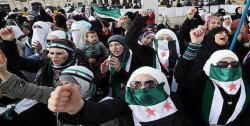
“As the state collapsed women have often taken a leading role in supporting their communities and building alternatives to the state’s totalitarianism. Today they work as doctors, nurses and teachers in underground clinics and schools. They volunteer for the White Helmets and sacrifice their lives to pull victims of airstrikes from the ruins. They provide logistical support for armed groups and in some instances have taken up arms themselves, establishing women-only battalions. In the case of the Alawite general Zubaida Al Meeki, they have even trained Free Army fighters”.

Leila Al Shami's avatarLeila's blog

123%d8%ad%d8%b1%d8%a7%d9%8a%d9%94%d8%b1_%d8%b3%d9%88%d8%b1%d9%8a%d8%a7This was originally published in Al-Jumhuriya

As eastern Aleppo falls, pounded by regime and Russian airstrikes, and stormed by Iranian sponsored militia on the ground, one young woman risks everything to communicate to the outside world the horror of the last days in the liberated part of the city.

View original post 1,644 more words

Save Aleppo! Oh, hang on, Aleppo is not Kobani …

I like the passion and anger and the use of the term ‘left-fascists’ in the article below. But the author falls short of the obvious logical conclusion: the west, led by the US, must now intervene on the side of the people, and that means militarily. No matter what the risks, the situation cannot be allowed to continue as it is. The point has been reached where the UN has to be bypassed and a coalition of the willing brought together. The millions of refugees in Germany and Turkey and elsewhere could be given the option of forming an army of liberation, as part of an expeditionary force to liberate Syria from Assad. Sorry, but all the rage and anger, and identifying the ‘fascist-left’ is meaningless and hard to take seriously unless the option of external military intervention on the side of the Syrian people is considered and recognized as valid. Boots on the ground will also be necessary to protect the Alawite enclave once Assad is overthrown and, of course, to maintain the peace and ensure that elections are democratic and free and fair.

****

mkaradjis's avatarSyrian Revolution Commentary and Analysis

Please help the people of Aleppo, just like we helped the people of Kobani. Oh, hang on, Aleppo? Kobani? Oh, that’s right. In Kobani they were Kurds. Civilised, secular, “progressive”, feminists, even green warriors apparently. They were like “us.” “We” (western imperialists and western … “anti-imperialists”) understand them. Therefore, they deserved to be saved from ISIS beasts, said the imperialist leaders, and their “anti-imperialist” echo in unison. Aleppo? Facing a fascistic enemy that has massacred twenty times as many people as ISIS fascists could ever manage, is not full of Good Kurds. It is full of Arabs. And we all know what western imperialist leaders, the far-right, neo-Nazis, Trumpists, racists, and “left-wing anti-imperialists” think of Arabs, especially when they live in Syria. They are all backward, blood-thirsty, barbaric, “jihadis” and “head-choppers,” *all* of the above categories tell us, yes, the left-fascists just as emphatically as any of the others. So…

View original post 1,462 more words

How the Syrian revolution has transformed me (Budour Hassan)

The following is reprinted from Budour Hassan’s blog Random Shelling.

Comments welcome.

* * * *


The world revolves around Palestine, or so I thought until 2011.

The Palestinian cause, I argued, was the litmus test for anyone’s commitment to freedom and justice. Palestine was the one and only compass that must guide any Arab revolution. Whether a regime is good or bad should be judged, first and foremost, based on its stance from the Palestinian cause. Every event should somehow be viewed through a Palestinian lens. The Arab people have failed us, and we inspired the entire world with our resistance.


Yes, I called myself internationalist. I claimed to stand for universal and humanist ideals. I blathered on and on about breaking borders and waging a socialist revolution.

But then came Syria, and my hypocrisy and the fragility of those ideals became exposed.


When I first heard the Syrian people in Daraa demand a regime reform on 18 March 2011, all I could think about, subconsciously, was: “If the Egyptian scenario happens in Syria, it would be a disaster for Palestine.”

I did not think about those who were killed by the regime on that day. I did not think of those arrested or tortured.

I did not think about the inevitable crackdown by the regime.

I did not greet the incredibly courageous protests in Daraa with the same elation and zeal I felt during the Tunisian, Egyptian, Bahraini, Yemeni, and Libyan uprisings.

All I could muster was a sigh of suspicion and fear.

“Assad is a tyrant and his regime is rotten,” I thought to myself, “but the subsequent results of its fall might be catastrophic for Palestine and the resistance.” That sacred axis of resistance meant to me back then much more than the Syrian lives being cut short by its defenders.

I was one of those whose hearts would pound when Hassan Nasrallah appeared on TV. I bookmarked loads of YouTube videos of his speeches and teared up while listening to songs glorifying the resistance and its victories.

And while I supported the demands of the Syrian protesters in principle, I did so with reluctance and it was a conditional support. It was not even solidarity because it was so selfish and always centered around Palestine.

I retweeted a blog post by an Egyptian activist calling on Syrians to carry Palestinian flags, in order to “debunk” regime propaganda. The Syrian people took to the streets defending the same universal ideals that I claimed to stand for, yet I was incapable of viewing their struggle outside my narrow Palestinian prism. I claimed to be internationalist while prioritizing Palestinian concerns over Syrian victims. I shamelessly took part in the Suffering Olympics and was annoyed that Syrian pain occupied more newspaper pages than Palestinian pain. I was too gullible to notice that the ordeals of both Syrians and Palestinians are just footnotes and that the breaking news would become too routine, too dull and unworthy of consumption in the space of few months.

I claimed to reject all forms of oppression while simultaneously waiting for the head of a sectarian militia to say something about Syria and to talk passionately about Palestine.


The Syrian revolution put me on trial for betraying my principles. But instead of condemning me, it taught me the lesson of my life: it was a lesson given with grace and dignity.

It was delivered with love, by the women and men dancing and singing in the streets, challenging the iron fist with creativity, refusing to give up while being chased by security forces, turning funeral processions into exuberant marches for freedom, rethinking ways to subvert regime censorship; introducing mass politics amidst unspeakable terror; and chanting for unity despite sectarian incitement; and chanting the name of Palestine in numerous protests and carrying the Palestinian flag without needing a superstar Egyptian blogger to ask them to do so.

It was a gradual learning process in which I had to grapple with my own prejudices of how a revolution should “look like,” and how we should react to a movement against a purportedly pro-Palestinian regime. I desperately tried to overlook the ugly face beneath the mask of resistance worn by Hezbollah, but the revolution tore that mask apart. And that was not the only mask torn apart, many more followed. And now the real faces of self-styled freedom fighters and salon leftists were exposed; the long-crushed Syrian voices emerged.

How can one not be inspired by a people rediscovering their voices, transforming folk songs and football chants into revolutionary chants? How can one not be taken aback by protests choreographed in front of tanks?


The Syrian geography was much more diverse and rich than that promoted by the regime and the official narrative collapsed as Syrians from the margins reconstructed their own narratives. The Syrian rainbow had many more colors than those permitted by the regime. And Syrians could raise their voices in places other than football stadiums, using their famous victory chant in public squares and streets to curse Hafez al-Assad, the “eternal leader.”


If Hafez al-Assad’s name could only be whispered with trembles before 2011, people at last could vociferously curse him and his son, shaking both the physical as well as the symbolic hegemony of this dynasty to its foundations.


I could not remain neutral as Syrians redefined the feasible and stretched the boundaries of people power, albeit briefly, during those early months of fatal hope.

Wouldn’t remaining impartial have been an act of treason to anything I claimed to stand for? How could I possibly read out Howard Zinn’s quote “You cannot be neutral on a moving train” to those sitting on the fence on Palestine, while I was doing the same on Syria? The Syrian revolution crumbled the fence from under me. I rediscovered my voice thanks to the mass mobilization I witnessed in Syria. I would listen to clips from Syrian protests, memorize their chants, and repeat them in Palestinian protests. Thinking of the fearlessness of Syrians would immediately make my voice louder and help make me overcome any slight semblance of fear.


You do not choose the nationality into which you were born but you don’t have to be bound by its shackles.

My Syrian identity, my sense of belonging to the Syrian revolution, was not forced onto me. I chose to adopt it. I never stepped foot in Syria. It was not until 2013 that I first met a Syrian not from the Occupied Golan Heights in the flesh, face to face. My main way of connecting with Syrians was and remains through social media and Skype. Yet, I couldn’t help but feel Syrian and completely identify with the struggle.

Until 2011, my talk about breaking borders and internationalist solidarity was but a soundbite, mere rhetorics. Thanks to the Syrian uprising, I finally understood what solidarity is really about.


I always expected people to support the Palestinian cause without imposing conditions, without preaching or lecturing, without dictating. When the Syrian uprising erupted, I acted exactly like those armchair preaches demanding a jasmine revolution from Palestinians, constantly asking us about the New Gandhi and MLK. But as the revolution went on, I could finally comprehend the true meaning of solidarity from below, a solidarity that is unconditional yet also critical. I saw how people like martyr Omar Aziz applied horizontal self-governance in some of the more conservative and traditional neighborhoods, and I learned from his model.

I learned the meaning of communal solidarity and Palestinian-Syrian togetherness from the Palestinian residents of Daraa refugee camp: they risked their lives to smuggle bread and medicine and break the siege on the rising city of Daraa. It was not just a humanitarian act; it was a political statement and the beginning of the formation of an identity, that of the Palestinian-Syrian revolutionary.


Khaled Bakrawi, a Palestinian refugee from Yarmouk, and Zaradasht Wanly, a Syrian youngster from Damascus, were both injured by Israeli occupation forces during “return marches” to the Golan Heights in 2011. Both Khaled and Zaradasht were murdered by the Syrian regime: the former was killed under torture, the latter was shot dead during a peaceful protest.


Syrians marched in solidarity with Gaza amid the rubble of their houses destroyed by Syrian regime air strikes. The Syrian Revolutionary Youth put out posters against the ethnic cleansing of Palestinians in the Naqab when most of the group’s members were in hiding, jails, exile, or graves.

Such is the solidarity of the oppressed which Syrians turned from rhetorics to practice. How can one not admire it?


If the Second Intifada in October 2000 shaped the political consciousness and national identity of an 11-year-old girl who had just left her tiny village to move to the city; the first wave of the Syrian revolution in March 2011 rebirthed a woman making her more confident steps in Jerusalem. Jerusalem, my city, the one I chose to call home, could not by any means be liberated by the oppressors of my people, of Syrians. Jerusalem’s spirit cannot be hijacked by those bombing a hospital carrying its name.

Far from struggling to reconcile my Palestinian and Syrian identity layers, The Syrian uprising made me even more committed to the struggle for Palestinian liberation: the liberation of the land from the occupier and the liberation of the cause from dictators and bandwagoners.


And while I parted company with people I once regarded comrades because of their support for the Syrian regime, I also gained new, lifelong friendships that have imbued my world with warmth and strength.


I owe so much to the Syrian revolution, which re-created me. I have no status or self-importance or willingness to speak on behalf of anyone, let alone on behalf of the Palestinian people, but I personally owe an apology to the Syrian people. I should have never hesitated in supporting their just cause. I should have never privileged geopolitical concerns over Syrian lives; and I should have never been so naively deceived by the propaganda of the resistance axis.

I owe an apology to a people who, for decades, were trodden upon, silenced, and humiliated in the name of my own cause; to a people whose only encounter with “Palestine” was in a prison dungeon carrying this name; the people who were blamed and mocked for being so docile yet when they did rise up, they were abandoned.

I owe an apology to a people who are blamed for a carnage committed against them, just as we have been, and who have been betrayed by an opposition pretending to represent them, just as we have been, too. I owe an apology to a people cynically called upon to bring an alternative to the Assad regime and Islamists while bombs and missiles fall on their heads. Those same people asking “Where is the alternative?” ignore that Syrians who were ready to offer a progressive vision have either been jailed, killed or displaced by the regime.

One would think that Palestinians know the cynicism behind the question of alternatives that they wouldn’t pose it to another oppressed people fighting to build everything from scratch.


Yet despite contradictions, Palestinians and Syrians do share the same yearning for freedom, the same burning desire to live in dignity and the dream to walk in the streets of the Old City of Damascus and the Old City of Jerusalem.

The road we shall cross to get there, though, is not the one that the regime and Hezbollah saturated with Syrian corpses, but one paved with the hands of Palestinian and Syrian freedom fighters: by people who know that their freedom is always incomplete without the freedom of their sisters and brothers.

 

Daesh, the (pseudo) Left, and the Unmaking of the Syrian Revolution

“The role of socialists is not to counterpose themselves to democratic revolutions, which gave rise (in Egypt) to the first democratic government, and (in Syria) to emancipatory projects such as networks of local councils against the existing state, but to take the democratic side against tyranny”.

My response: WHY for heaven’s sake does this even have to be stated?

The reason is because of the general failure to understand that ‘socialists’ who side with tyrants are not worthy of the name, and that the pseudo-left which has been dominant for decades needs to be called out. I wish the reviewer had used that term rather than seeming to accept that one can oppose democratic revolution and still be on the left.

9780992650964-cov-front-sml


The following book review is published with permission of Syria Solidarity UK.

* * * *

Khiyana: Daesh, the Left, and the Unmaking of the Syrian Revolution, ed. Jules Alford and Andy Wilson, published by Unkant, London.

Review by Clara Connolly

This book should be required reading for every leftist, as an antidote to the growing mountain of ignorant comment on the subject of Syria. The title Khiyana (betrayal) is an accusing cry; the book is a trenchant denunciation of the Western Left for its abandonment of the principles of internationalism and solidarity in favour of an alignment with the ‘anti imperialist’ camp, a hangover from the geo-politics of the Cold War.

Assad An-Nar, like most of the authors, situates himself on the Marxist left, and his prefatory chapter could be considered a direct response to Tariq Ali’s infamous dismissal of the Arab Spring in What is a Revolution? (Guernica, Sept. 2013). He sets his critique in the context of the changing nature of revolution in an age of global neoliberalism, where post colonial states are collapsing because neoliberal policies have slashed the limited social protections they used to offer. In this world, he says, the principles of self emancipation and of collective and democratic struggle are ‘ideas in search of a subject.’ Ideas about democracy, socialism, and anti-imperialism used to run in the same direction, but now they are counterposed.

With the collapse of the progressive moment of secular Arab nationalism, Islamist organisations like the Muslim Brotherhood can rise beyond identity/sectarian politics in resistance to tyranny. Though not necessarily opposed to neoliberalism, they are the voice of those who are excluded from its benefits. Hezbollah’s current role in Syria shows that such movements can swing between revolution and counter revolution without moving in a socialist direction.

The role of socialists is not to counterpose themselves to democratic revolutions, which gave rise (in Egypt) to the first democratic government, and (in Syria) to emancipatory projects such as networks of local councils against the existing state, but to take the democratic side against tyranny. Instead the left has responded by either supporting their favourite dictatorships (the neo Stalinists) or by re-hashing theories of ‘permanent revolution,’ i.e. insisting that revolutions can only end in socialism or defeat (the Trotskyists). Yes, he says, a democratic revolution is possible in these countries, but the outcomes are uncertain; the socialist left, while recognising its marginal role, should not condemn itself to irrelevance by denouncing the struggles for democracy because they are not socialist. Instead he urges the left to make the ‘democratic wager,’ in hope that the outcomes lead to more collective forms of struggle. There is little to lose for socialists, he believes, since neoliberalism has led worldwide to the fatal weakening of working class self-organisation.

The subsequent chapters examine and demolish the standard left myths about the Syrian revolution: the ‘jihadist’ nature of the ‘rebels’; the selective anti imperialism which admires Rojava but has no time for similar experiments in local democracy elsewhere in Syria; the role of regional imperialisms like Iran and Russia in propping up a monstrous regime; and above all the lies and distortions peddled by the institutional left (Stop the War Coalition, and the éminence grise of left journalism like Patrick Cockburn, Robert Fisk, and Seymour Hersh) who place the national interests of states they consider to be in the ‘axis of resistance’ above solidarity with the struggles of the oppressed in those countries.

In a short review I can refer only to two further articles in the core of the book; but I cannot resist a passing mention of the glorious satirical piece by M Idrees Ahmad, The Anti-Imperialist Guide to Inaction in Syria. Anyone familiar with debate on Syria will recognise the strategies he lists: ‘Don’t defend Assad, attack his opponents; sympathise selectively; functional doubt where straight denial is risky; defend peace and sovereignty; champion the minorities; talk about ISIS, not Assad; talk about refugees but not the cause of flight,’ etc. Most of these strategies are shared with the establishment and the extreme Right.

Mark Boothroyd describes the responses of Stop the War Coalition (STWC) to Syria, in a case study that echoes the critique in the preface. It has consistently viewed developments through its relation to the US and the UK. In a multi polar world system with competing imperialisms, it persists in viewing events through the prism of the Cold War. The agency of Syrians is erased altogether.

In 2013, STWC opposed the proposed intervention of the UK and when this proposal was defeated in Parliament, it claimed victory; but Boothroyd claims that if the West had really wanted to intervene in Syria it would have done so—its actual strategy is to let the country bleed. I think he underestimates the power of popular protest in democratic countries, and the degree to which STWC was able to tap into post Iraq war weariness. But he is right in pointing out that STWC has missed a trick in failing to expose the real cruelties of the Western role.

In its weaker response to the 2015 intervention against ISIS, STWC has consistently refused to allow oppositional Syrians on its platforms—who have opposed the Coalition campaign against ISIS as useless and counter-productive, but have also proposed more positive measures for the protection of Syrian civilians. Once again, its failure to listen to Syrians has weakened its moral stance even in its own terms—in opposing its own Government.

It could have been different, he believes: the anti war movement could have risen beyond its current ethnocentric, isolationist positions to meet the challenge of changing times, and been a movement to build solidarity with the revolutions in the Middle East.

In The Rise of Daesh in Syria, Sam Charles Hamad attacks the myth of Saudi funding and support for Daesh; instead, in a detailed study, he convincingly shows their deadly rivalry despite their similar ideologies. He demonstrates the origins of Daesh in post invasion Iraq, and its nurture by the sectarian regimes in Iraq and Syria. He shows, by tracing its sources of income, how it is self sustaining. Finally he argues that the current tactics of the west, in fighting Daesh from the air but hampering the oppositions in their fight against the sectarian regimes of Assad and Maliki, are counter-productive. And the left’s narrative is complicit in this.

The book, and particularly its opening chapter, is weakened by a failure to examine more closely such terms as ‘democracy’ and ‘emancipation,’ given their ambivalent history among Marxists; and to analyse the demands of the revolution—Freedom Justice and Dignity—in more detail. This is particularly the case since there is little discussion of class, and no accounts of the role of women in the Syrian revolution, nor of the role of Western women’s peace groups or feminists in relation to Syria. My own recent experience of organising solidarity events with Syrian women suggests that the hostility to, and silencing of, Syrian voices is much less prevalent among feminist organisations than in the left as a whole. The ‘democratic wager’ which is urged upon us might be weighted more favourably with the inclusion of women activists, within Syria and in the West.

Syria: links

free syria flag

Nothing much happening at Strange Times so I’m hoping to kick-start some new links to information and analysis – and discussion – about Syria.

Hoping to set this up as a separate page soon. But for now… contributions welcome.

Just to start things off:

  • The ceasefire, which some people regarded as doomed to failure before it had even started, has been working, in the main, for nearly six weeks now. It has provided breathing space, with parts of Syria under rebel control able to commence reorganisation of their localities. For the first time in years, Syrians have been able to take to the streets again demanding the regime’s overthrow. Some humanitarian aid is getting through where needed, but this is still a problem area in places where the regime is obstructing aid delivery – and further isolating itself (and strengthening the case for miltiary intervention on the side of the pro-democratic forces).
  • Assad is increasingly isolated, with Putin looking for a way out and supporting the UN transitional plan; a plan that means the end of Assad’s rule.
  • The next round of talks might happen within a week. The co-ordinator for the Higher Negotiation Committee has said that there is no international will, especially from the US, which means that the rebels continue to want greater international involvement and support, especially from the US.
  • As the talks progress and the regime remains more intransigent and isolated, the need for some form of military ‘boots on the ground’ will become more acceptable as a way of resolving the situation and allowing the transition’s timetable to be followed in an effective way. A ‘coalition of the willing’ will be required to ensure that the terms of the transition are enforced, and that the Syrian people will be able to assert their sovereignty in free and fair democratic elections as aimed for in the timetable.


* * * * * *

Syria’s bourgeois-democratic revolution and the need for boots on the ground.

I share the following view by the Antiwar Committee in Solidarity with the Struggle for Selfdetermination but the important question is how can any decisions arising from the negotiations be enforced and maintained without a military force on the ground that is committed to enforcing and maintaining the transition.

The question of ‘boots on the ground’ needs to be tackled pro-actively by the governments and the UN that established the opportunity presented by the coming negotiations.

Boots on the ground that are sympathetic to the Syrian people would make delivery of humanitarian supplies more likely on the scale that is required.

Apart from needing to protect Syrians from the likes of Daesh, a military coalition on the ground (and backed by air support) will be necessary to guarantee that people can vote freely and to protect the Assad loyalists among the Alawite community once he is tossed out.

Comments welcome.


11055328_621048241328691_7043512423930289502_o


* * * *


We support efforts by the High Negotiations Committee of the Syrian Opposition to negotiate a political settlement which will lead to a transitional governing body, and to human rights for all, rule of law, and democracy for Syria. Given the scale of documented atrocities carried out by the Assad regime, it follows that such a process must bring an end to regime rule.

We further support the demand by the High Negotiations Committee that the international community implement in full the humanitarian provisions of UN Security Council Resolution 2254 prior to negotiations.

The current Geneva III Conference has begun against a background of escalating Russian and regime bombardment of populated areas and civilian infrastructure, escalating starvation sieges, and ongoing mass detention and torture of political prisoners.

UN Security Council Resolution 2254, which set out the international endorsement for these talks, called on the parties to “allow immediate, humanitarian assistance to reach all people in need, in particular in all besieged and hard-to-reach areas, release any arbitrarily detained persons, particularly women and children,” and demanded the full implementation of the long list of unenforced Security Council resolutions on Syria: 2139 (2014), 2165 (2014), 2191 (2014) and any other applicable resolutions.

Resolution 2254 further demanded “that all parties immediately cease any attacks against civilians and civilian objects as such, including attacks against medical facilities and personnel, and any indiscriminate use of weapons, including through shelling and aerial bombardment.”

These items are the express will of the Security Council and as such are not for negotiation between parties. The international community should never preside over a process where humanitarian relief is allowed to be used as a card in political negotiation.

As long as the international community fails to enforce its own resolutions, the Syrian people can have little faith in the peace process. If the international community can’t deliver baby milk to besieged areas, how can they be trusted to deliver free and fair elections?

For peace talks to succeed, the international community must implement the humanitarian provisions of its own UN Security Council Resolution 2254 in full

Syria: the facts and figures – the Syria Campaign

As Europe struggles to deal with a surge in refugees, attention is now shifting to Syria where most people are coming from. But what is the violence they’re fleeing?

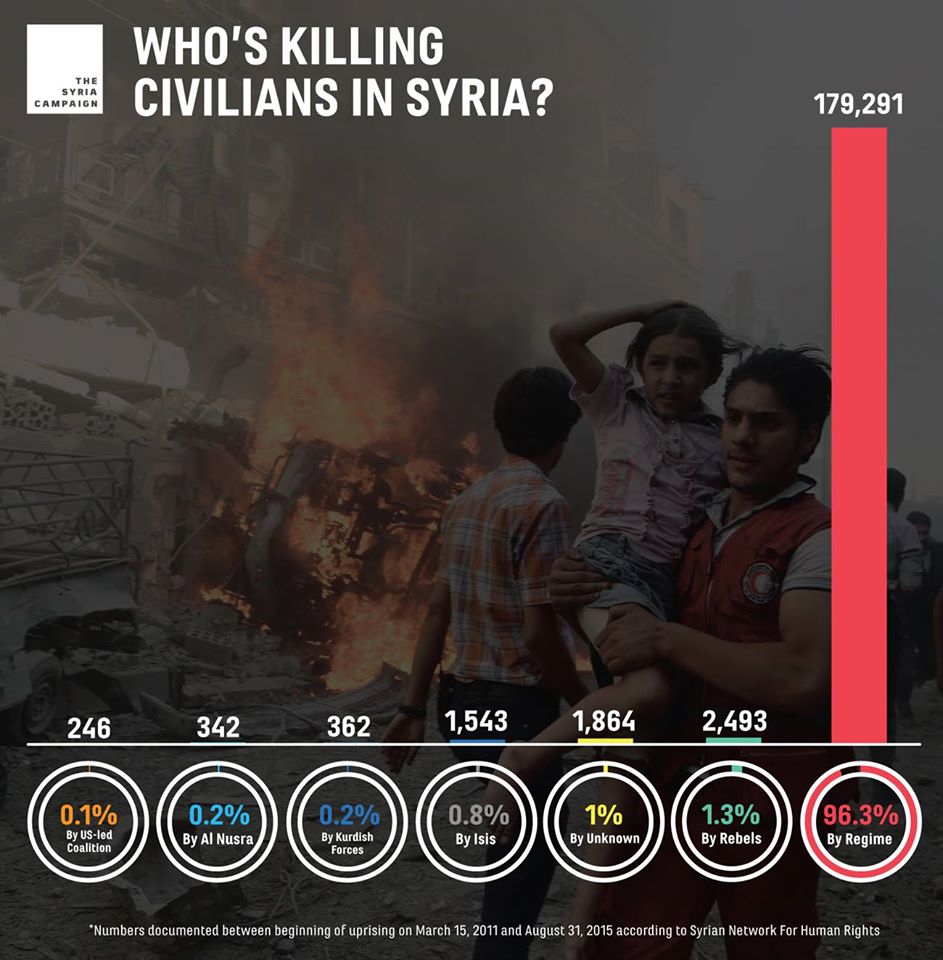
Many assume that Isis is doing most of the killing, which is partly why so many countries are now talking about bombing Isis in Syria. But the truth is different – and shocking. The vast majority of Syrian civilians killed – more than 95% according to human rights groups – have been killed by the regime of Bashar al-Assad.

Have a look at the data from the Syrian Network for Human Rights [1]:

12017617_910929855665695_3506046935164010625_o

Lots of people respond with astonishment when they see these figures, mostly because they don’t fit with their existing picture of the conflict. Some even say the numbers are lying. They’re not. While no monitoring group claims to have perfect data since their methodology and sources all differ, there appears to be agreement about the proportion of civilians killed by the Assad regime. [2]

So why do so many of us have such a bad understanding of where the violence is coming from?

Part of the answer may lie in how we hear about the conflict in Syria. The media talks about it increasingly as a “civil war”, a phrase that conjures up images of messy chaos, of various similarly-matched sides fighting each other. Likewise, the United Nations and well-meaning NGOs diligently criticise “all parties to the conflict” which promotes a perception of equal sides – or some sort of balance.

But there’s something else too. Part of the answer may lie in the disproportionate obsession with Isis. Our news is full of stories of Isis horror and brutality, but the larger scale state repression of the Bashar al-Assad regime seems to slip by mostly unreported.

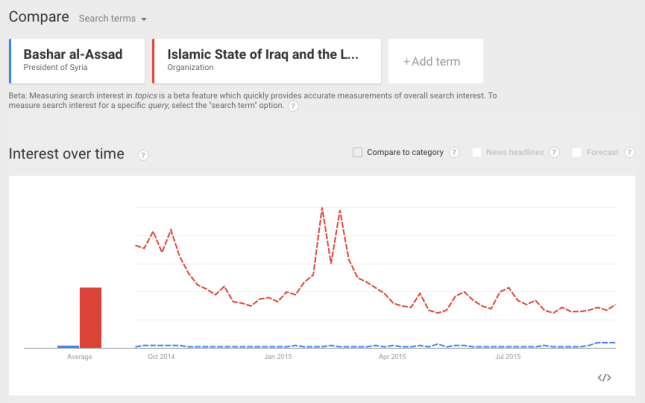
Have a look at Google Trends for news over the past year:google_trend_assad_2

Google Trends: Assad vs Isis

There was 43 times more interest in Isis than there was in Bashar al-Assad. And that’s taking in global internet users.

When we filter by United States only, we get an error message:

“Bashar al-Assad wasn’t searched for often enough to appear on the chart. Try selecting a longer time period.”

Same goes for the UK, France and Germany.

Astonishing. Together we have collectively airbrushed the biggest perpetrator of human rights violations out of the the Syrian conflict – Bashar al-Assad.

Why has the world chosen to ignore Assad’s crimes? Is it because he claims to be a secular leader? Is it because he is clean shaven and wears a suit? Is it because we don’t realise that by ignoring these crimes by the regime, we are becoming recruiting cheerleaders for Isis? [3]

Whatever the reason, the obsession with Isis over Assad bears no relation to their respective levels of violence.

The implications of this skewed focus are serious.

Right now the UK government is debating intervening in Syria to strike Isis. [4] Australia has just started anti-Isis strikes too. [5] France is about to join.[6] Russia has moved a heavy deployment of fighter jets and tanks into Syria to fight alongside Assad. [7] Russia has just days ago agreed to coordinate with Israel on its Syria operations. [8]

And yet nobody, nobody, is doing anything to curtail the biggest killer in Syria by far – the Assad regime and its air war on civilians.

As the United Nations envoy to Syria, Staffan de Mistura said, it is “totally unacceptable that the Syrian airforce attacks its own territory in an indiscriminate way, killing its own citizens. The use of barrel bombs must stop. All evidence shows that the overwhelming majority of the civilian victims in the Syrian conflict have been caused by the use of such indiscriminate aerial weapons.” [9]

All efforts at stopping the violence in Syria will fail unless we understand where it is coming from. The story of the data is unarguable – if we want to stop the killing of civilians in Syria we have to address the Assad regime.

What can you do?

Arm those around you with the facts. Share this with your friends and family.

We have used data from the Syrian Network of Human Rights to put together more infographics, on children, medical workers and media activists. You can view and share them here:

https://diary.thesyriacampaign.org/whats-happening-to-civilians-in-syria/

It’s crucial that we get the story right.

James Sadri – The Syria Campaign

[1] http://sn4hr.org/

[2] Nine months ago, data from a separate human rights organisation, the Violations Documentation Center, revealed an almost identical proportion of civilian killing by the regime – 95%.

[3] http://soufangroup.com/tsg-intelbrief-assads-atrocities-continue/

[4] http://www.ft.com/cms/s/0/84184f06-5e05-11e5-a28b-50226830d644.html

[5] http://www.rt.com/news/315150-australia-raaf-syria-mission

[6] http://www.dailymail.co.uk/news/article-3225008/France-prepares-airstrikes-against-ISIS-begins-reconnaissance-missions-terror-targets-Syria.html

[7] http://time.com/4043955/russia-syria-latakia-28-aircraft-assad-isis/

[8] http://www.aljazeera.com/news/2015/09/russia-coordinate-syria-military-actions-israel-150922045752894.html

[9] http://www.un.org/apps/news/story.asp?NewsID=51011#.VfAUos6x47w

——————————————————————————–

The Syria Campaign is building an open, global movement working for a peaceful future for Syria. We are people from all over the world who are coming together to tackle what the UN has described as “the greatest humanitarian tragedy of our time”.

‘Fairness and Accuracy in Reporting’ serves up more lies on Syria

Reblogged with permission of Bill Weinberg and his World War 4 Report.


syria banner

“Leftist” (sic) shilling for fascist dictator Bashar Assad reaches new levels of deception in an entry from one Adam Johnson of Fairness and Accuracy in Reporting (FAIR), perversely entitled “Down the Memory Hole: NYT Erases CIA’s Efforts to Overthrow Syria’s Government.” The chutzpah of invoking Orwell in his title is downright Orwellian, as his distortions reveal the very name “Fairness and Accuracy in Reporting” to be pure doublethink. Wedded to the persistent pseudo-left hallucination of a US campaign to destabilize Assad, Johnson gripes: “This past week, two pieces—one in the New York Times detailing the ‘finger pointing’ over Obama’s ‘failed’ Syria policy, and a Vox ‘explainer’ of the Syrian civil war—…didn’t just omit the fact that the CIA has been arming, training and funding rebels since 2012, they heavily implied they had never done so.” So what is Johnson’s evidence that the CIA has been doing this? In defense of his claim, he links to articles in (funny) the New York Times, The Guardian,Der Spiegel and the Washington Post. But if you bother actually click on the links (perish the thought), you’ll find that none of them quite back up Johnson’s assertions…

The Times story, from March 24, 2013, says nothing about the US “training” or “funding” the rebels—only a “secret airlift of arms and equipment.” If this support was ever “secret,” it wasn’t for very long. The very next month, John Kerry was openly boasting of US support for the Syrian rebels at an Istanbul meeting—although it is questionable how much of the promised aid actually reached the rebels. And by the end of 2013, Kerry had announced a cut-off of “non-lethal” aid to the FSA. National Security Advisor Susan Rice later stated that “lethal aid” had continued—but emphasized that it was in the interests of “counterterrorism”; that is, fighting ISIS, not Assad. (Haaretz, June 7, 2014)

The Guardian story (March 8, 2013) says nothing about the CIA, only “Western” training of Syrian rebels in Jordan. Actually read the story (persih the thought) and it turns out to be the British and the French, and the whole thing is based on anonymous sources. The only indirect reference to the CIA is the following line: “A Jordanian source familiar with the training operations said: ‘It’s the Americans, Brits and French with some of the Syrian generals who defected. But we’re not talking about a huge operation.'”

The story from Der Spiegel (the actual link is to a March 10, 2013 Reuters story citing Der Spiegel) is essentially a recapitulation of The Guardian’s claims, and concludes: “The reports could not be independently verified.”

The Washington Post story (June 12, 2015) actually reports that Congress was moving to cutCIA aid to the rebels. Again citing unnamed or fuzzy sources, the account claims the CIA has spent around $1 billion over the past “several years” to arm and train Syrian rebels—but emphasizes again that the primary enemy is ISIS, not Assad.

So of Johnson’s four sources, it is only the last that vaguely backs up his claim. And he leaves out two salient facts: that the aid is primarily directed against the jihadists who Assad is also fighting, not Assad; and that it is coming to an end.

Johnson does mention the far less ambitious but better publicized Pentagon program to train Syrian rebels, admitting it has been an “abysmal failure.” He doesn’t mention (as we have) that the fighters trained under this program amount to a whopping 54—of whom only 37 were still actually in combat last time we checked back in August. Nor does he mention (as we have) that rebels have refused to participate in the training program because of the Pentagon’s insistence that they do not use their training to fight Assad—only ISIS.

After this subterfuge, Johnson goes on to gripe that the Sept. 13 New York Times story fails to mention the CIA training program. Distortions, eh? Cast the beam from thine own eye, Adam.

He closes with the usual sickening bogus neutrality:

As the military build-up and posturing in Syria between Russia and the United States escalates, policy makers and influencers on this side of the Atlantic are urgently trying to portray the West’s involvement in Syria as either nonexistent or marked by good-faith incompetence. By whitewashing the West’s clandestine involvement in Syria, the media not only portrays [sic] Russia as the sole contributor to hostilities, it absolves Europe and the United States of their own guilt in helping create a refugee crisis and fuel a civil war that has devastated so many for so long.

Oh really, Johnson? How many of the refugees are fleeing the FSA, as opposed to Assad’srelentless aerial bombadment and ISIS sectarian cleansing? A case can be made that it is the West’s failure to meaningfully support the rebels—without condescending conditions that they don’t fight Assad—that has led to the disaster in Syria. The notion that “the West” is to blame for the refugees is literally echoing Assad’s propaganda. See CNN Sept. 16 (“Syria’s Bashar al-Assad: West is to blame for refugee crisis”).

In fact, even ISIS is a distant second to Assad as the aggressor the refugees are fleeing. An account based on refugee interviews on the German website Qantara quotes one refugee in its headline: “Stop Assad’s bombs, then we’ll go back.” A salient passage:

Indeed, the key reason for displacement in Syria is not IS, but Assad. The regime’s air force is killing at least seven times as many people as IS. This “terror from the air”, as it is referred to by civil groups, is destroying all those areas controlled by rebels—both moderate and Islamist. The aid organisation Doctors Without Borders reported that in August “heavy bombardments were carried out on 20 consecutive days in besieged Eastern Ghouta” where it is supporting 12 provisional underground clinics… One in every four victims—whether dead or injured—was a child under the age of five.

But you would get no sense of that from the ironically named Fairness & Accuracy in Reporting. This is the same FAIR, recall, that was eager to jump on utterly dubious claimsthat the rebels and not the Assad regime were behind the Ghouta chemical attack. Now it is plugging the utterly fictional notion of a “CIA Effort to Overthrow Syria’s Government.” Bunk. On the contrary, the US is tilting to Assad, viewing ISIS as the greater and common enemy. This is a betrayal of the Syrian revolution, which is ultimately even counter-productive to the aim of fighting ISIS. Telling the secular and pro-democratic forces they must accept rule under one tyrant is hardly conducive to a strong resistance against a rival gang of fascists.

Why does the increasingly reactionary FAIR continue to have any legitimacy whatsoever?

Second Anniversary of The Ghoutal Chemical Attack: Assad’s fascist regime must be overthrown

1359839008-nationalist-demonstration-against-globalism-and-imperialism--paris_1766972
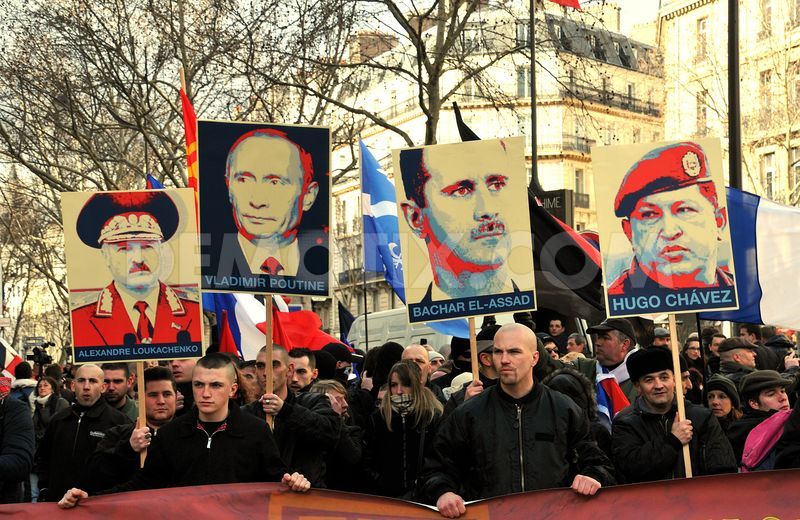
Extreme right-wing protestors in Europe with portraits of those they support

The Assad fascist regime is responsible for extreme human rights violations in Syria today. More than 220,000 people have been killed, 10 million people – half the country – have been forced from their homes, hundreds of thousands of political prisoners have been detained and 640,000 are living under brutal sieges without regular access to food, water or medicines. In September last year, the US-led coalition invaded Syrian airspace to bomb Daesh (ISIS) positions; yet a blind eye is turned when Assad’s aircraft bomb civilian populations and the revolutionary democrats from the same airspace, killing many more than Daesh.

* * * *

From Planet Syria: Two years ago on 21st August 2013 the world was focused on Syria after the government of Bashar al-Assad used Sarin on civilians in the worst chemical attack for a quarter of a century. (Since the Halabjah chemical attacks by the Saddam Hussein regime in 1988).

The world feigned outrage. Obama said a red line had been crossed.

But today the chemical attacks continue. Chlorine is routinely used in barrel bomb attacks on civilian neighborhoods. But it’s not the chemicals that are killing most people, it’s the bombs themselves.

Here are 5 things everyone should know about what is happening in Syria today:

1. The Assad regime is killing 7 times more civilians than Isis.

2. More than 11,000 barrel bombs made of scrap metal and high explosive have been rolled out of regime helicopters onto hospitals, homes and schools since the UN banned them. They are the biggest killer of civilians. They drive extremism.

3. These barrel bombs are the leading cause of displacement, forcing refugees to cross the Mediterranean and other borders.

4. Many of the barrel bombs are dropped on areas under siege. More than half a million people in Syria live in areas with no access to food, water or medicine since 2013, including the areas of Ghouta that were targeted by the sarin gas attacks in the same year.

5. The international anti-Isis coalition is flying in the same airspace where many of these barrel bombs are dropped, choosing to look the other way.

On the occasion of the second anniversary of the chemical attack on Ghouta, a suburb of Damascas, the National Coalition of Syrian Revolution and Opposition Forces has issued this statement:

It was a declared crime whose details and elements are well-known to everyone, whether they admitted it or not. They know the only party that does not lack the ability, the authority or the criminal will required to commit such a massacre, which is the Assad regime. They also fully aware that the regime has all the means of production, assembly and delivery of chemical weapons that were the tools of this this crime. They know the perpetrator by name, and also the names of the top regime officials who were involved with him. They know how he committed this crime and how he handed, with the utmost shamelessness, the murder weapon.

Two years have passed since the crime of the century, but the perpetrator is still at large. The families of 1,507 victims killed are still looking around for an international response equivalent to the size of the crime committed against their loved ones. And yet not a single measure has been taken to prevent the repetition of this crime. Death stills looms large over the head of Syrians, armed with every means of killing, ranging from knives and cleavers to barrel bombs, Scud missiles and chemical weapons. The Syrian Network for Human Rights documented 125 regime breaches of UN Security Council resolution 2118 and 56 breaches of UNSC resolution 2209 which criminalizes the military use of chlorine gas.

While we in the Syrian Coalition renew calls on the UN Security Council to shoulder its responsibilities in maintaining security and peace in Syria, and to take immediate action to stop the crimes against humanity and violations and to ensure that criminals are held accountable, we deplore the indifference of the international community which continues to deal with the blood of Syrians as a bargaining chip, a means to settle scores and exhaust opponents.

Having paid heavily for the sake of achieving our goals, we Syrians are now fully aware that we have to fight this battle relying only on the resolve of rebel fighters. Indeed, unity, rejecting discord, commitment to the principles of the revolution are the only guarantee of victory and liberating Syria from the Assad regime and its thuggish repressive security apparatuses and of the establishment of democratic rule which is bases on pluralism, justice and the rule of law.

We ask for Mercy for our fallen heroes, recovery for the wounded, and freedom for detainees.
Long live Syria and its people, free and with honor.

Assad’s strategy: don’t fight Daesh; direct it

The left has a proud history of opposition to fascism and indeed is the most reliable anti-fascist group politically. It is a puzzle as to how and why what passes for ‘left wing’ today can either be so neutral toward the Assad regime or adopt the entirely crypto-fascist slogan ‘Hands off Syria’. The puzzle is explained, in my opinion, by the fact that the left is more than a self-identifying label. It has a real content, defined by history, practice and theory. If someone tells you that western military involvement on the side of the Syrian people against the regime would be a disaster for the region, just ask the fundamental question: “A disaster for whom?” To those who beat their chests warning that US imperialism is out to dominate the region and that that claim somehow should mean leaving the unarmed populus to Assad’s barrel bombs, just tell them: “Your anti-imperialism is worthless if it ends up putting you on the side of the regional dictators who are oppressing and massacring the people as we speak”.

I wish to thank the good people at NOW. for permission to publish this article by Haid Haid, who is a program manager at the Heinrich Böll Stiftung’s office in Beirut. He tweets @HaidHaid22

c21styork

* * * *

 images

Assad is trying to turn his problems into opportunities by helping ISIS (Daesh; ISIL) choose what’s in his own best interests and allowing ISIS easier access to some areas than to others.

“Reports indicate that the regime is making air-strikes in support of#ISIL‘s advance on #Aleppo, aiding extremists against Syrian population,” the US Embassy in Syria tweeted on 1 June. Similar reports were published by other regional and international media outlets when ISIS made an unexpected and successful move against rebel groups north of Aleppo, disrupting their recent momentum.

To many of those who have been closely following what’s happening in Syria, this might not come as a surprise. Assad has avoided confronting ISIS, as they both benefit from one another. ISIS degrades and eliminates rebel groups that would otherwise be fighting Assad, and Assad’s regime presents itself to the West as the only local partner that can fight the terrorist group. This—at least publicly—unspoken agreement was broken in June last year after ISIS announced its caliphate. It seems, however, that the same arrangement is back on the table with some amendments due to recent developments.

Game changer Palmyra

Seizing Palmyra gave ISIS the advantage of many new strategic options, which will most likely change the dynamics of the armed conflict in Syria. The strategic location of Palmyra has allowed ISIS to cut the regime’s supply line to Deir Ezzor, and it opens the possibility of capturing other strategic locations, such as the Shaer gas and oil field. The broad desert has given them many alternative roads to various areas of Syria to expand and enforce their presence there; eastern Ghouta and eastern Qalamoun, rural Hama, rural Homs and rural Sweida. Capturing Palmyra was a game changer not only for ISIS but for the regime as well. Just consider the big number, and high symbolic value, of Assad regime losses on various fronts; the fear of the next rebels attack; the continued draining of resources (locally and regionally); the withdrawal of Iraqi militias who have returned home to fight; and the division in strategies between Assad and Iran—the former still trying to control all provincial centers, the latter restricting itself to areas considered useful within Iranian strategy.

Revised strategy

These developments have pushed Assad and his allies to find ways to cut down their losses and to conserve resources. It seems that Assad has found a way to turn his problems into opportunities by giving ISIS access to areas controlled by the rebels in order to drain their resources as they fight away from the regime, and he does so even if this costs him more territory. In Aleppo, for example, ISIS could advance through regime-controlled areas, including As-Safirah or Kweires Air Base, given the importance of these locations and due to pressure on the regime by other rebels groups in Idleb, combined with rumors that an Aleppo battle will be launched, which has made the regime even weaker. Even though capturing air bases might be considered its most important strategic goal, ISIS instead decided to intensify its attacks on areas controlled by rebels along the Suran-Mare axis in rural Aleppo. The regime also intensified its attacks on areas that have helped ISIS advance and control new villages. These developments forced many rebel groups, including members of the Army of Conquest coalition, to mobilize their forces and move them to prioritize fighting ISIS over the regime—at least in Aleppo.

The regime might also help ISIS to enforce its presence in eastern Ghouta, which will help the regime completely besiege Ghouta and engage rebels in another fight. Some recent reports mentioned that the regime has been busy transporting equipment from Al-Seine Airbase to Ad-Dumayr Airbase, which Assad’s opponents interpret as an evacuation plan. If this is the case, it could mean that the regime is either trying to conserve resources, or is scared that it might lose the air base, or both, which in any case will give ISIS access to eastern Ghouta. The same thing could also apply in eastern Qalamoun, Ar-Ruhaybah and Jayrud, to enforce their presence there and to keep the opposition busy in the fight against it.

US inaction

While the air force of the American-led coalition played a large role in defeating ISIS in Kobani, it didn’t react to ISIS’s latest attack on rebel-held areas, which gave ISIS the opportunity to move its forces freely. Many rebel leaders complained publically about the lack of US interest in helping them defeat ISIS in Syria, though it’s now apparent the US administration knows of the cooperation between Assad and ISIS. Sarcastically, activists started wondering if the US Air Force didn’t strike ISIS because Assad had crowded up the sky striking rebel groups. Maybe sarcasm is the only way that many Syrians, and to some extent non-Syrians, are able to understand US policy towards fighting ISIS.

* * * *