
I was one of three panelists. I argue that China’s regime is both fascist and imperialist and that this happened after the coup in the years 1977-1980.
Continue readingTag Archives: Marxism
What the women of Iran know
A poem written by Tom Griffiths, read by me, with music by my late, much lamented musician friend Peter Gelling (1960-2108), using some material from his archive.
Continue readingWe are living through days into which 20 years are compressed
Arthur Dent at Platypus Conference
The world wants collective security, countries want independence, nations want liberation, the people want revolution, and information wants to be free.
Continue readingGoethe’s Faust: a talisman for our time
Tom G.

Faust’s transformations rely upon magic. As an artistic contrivance this is quite acceptable, but in the real world, where those lower down the pecking order live, something more is required – and that is an economic development that can transform our material existence and provide a foundation for growth. It is here, still under the assistance of Mephisto, that Goethe gives Faust his most dramatic – and for us – his most significant transformation, that of the developer.
Continue readingEcosocialism and degrowth are great ways to become irrelevant
David McMullen
This essay originally appeared in Platypus Review 167 | June 2024
ECOSOCIALISM IS NOW well entrenched in the “Left,” and is endorsed by many long-established sects. Proponents believe the deteriorating natural environment has created an urgent need to cast off capitalism and adopt this new green and crunchy variety of socialism. We will then be able to cease growing the world economy and start degrowing to a lower, steady state. Only in this way can we remain within “planetary boundaries”; for the present system cannot do this, with capitalist competition dictating both growth through the treadmill of accumulation and an indifference to environmental costs that do not show up on company balance sheets. Their slogan is “system change not climate change.”
Continue readingA response to “The legacy of 1968”
Platypus Review 165 | April 2024
On June 24, 2023 at Trades Hall in Melbourne, Australia, the Platypus Affiliated Society hosted a panel on the legacy of 1968.[1] The speakers included Andy Blunden, Alison Thorne, and Arthur Dent. Barry York provides his response to the panel.
Continue readingTechnology and the future of work: a Marxist perspective
Technology and the Future of Work
Albert Langer
(Originally published in Readings on Technology and Change, Community Research Centre, Monash University 1985)
Attitudes towards technology and the future of work reflect a fundamental division in world outlook generally.
People with a progressive world outlook compare the present with the future and find it wanting. They are excited by the possibilities of the future and optimistic about achieving those possibilities. Correspondingly they are discOntented with the present and welcome its disintegration. Above all, progressives advocate the abolition of the wages system, and the system of property ownership on which it rests, as the principal barrier to the unfolding of human potential.
Continue readingThe Legacy of 1968 – panel discussion
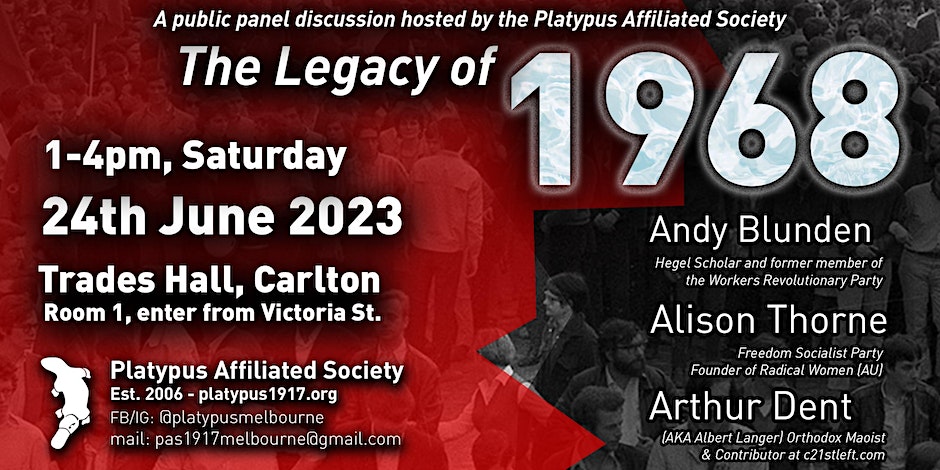
A panel discussion on the Legacy of 1968, and how Marxism was transformed by the radical decade of the 1960s.
Continue readingInternational Women’s Day – a lesson from Nina Simone
Nina Simone was influenced by two actvists who were themselves influenced by Marxism and who she knew personally, Lorraine Hansberry and Langston Hughes. She was a fighter, who used her music as a weapon in struggle.
Continue reading‘Mother’ Nature is punishing us with Covid? Call Child Protection!
Tom Griffiths
******
“In a tribal society in which ‘everyone knows’ that you need to sacrifice a goat to have a healthy baby, you make sure you sacrifice a goat. Better safe than sorry.” – Daniel Dennett (Breaking the spell: religion as a natural phenomenon, 2006)
******
The world is now well into the third year of Covid and how we have dealt with it is a mixed bag. Scientifically we have ticked quite a few boxes with research and treatment responses being rapid, ongoing and impressive. The political and policy responses, nationally and internationally, are less impressive due to varied approaches, all ostensibly following the same scientific advice. Regardless of this, governments have taken the pandemic and its impacts – health, social and economic – seriously and negatively.
Continue reading C21st Left