… western civilisation is no longer western. It is global and a far better term is modernity. By the end of this century we can expect it to have totally supplanted all pre-existing conditions, even in the most backward regions. This will be a jolly good thing too.
* * * * * *
The pseudo-left wants to stop a multi-million-dollar donation by the conservative Ramsay Centre for Western Civilisation to the Australian National University for a new course on Western civilisation. According to the heads of the staff and student unions at the university it is racist to prioritize western history or culture. It mustn’t be “privileged”.
I guess we are supposed to look back lovingly at all those civilisations that crumbled in the face of the western onslaught, for example, Czarist Russia, Qing China, Mughal India, Ottoman MENA and Aztec Mesoamerica. And then of course there were the remnants of hunter-gathering society that lived in harmony with nature, and from whom we can learn so much, so we are told.
Of course, western civilisation is no longer western. It is global and a far better term is modernity. By the end of this century we can expect it to have totally supplanted all pre-existing conditions, even in the most backward regions. This will be a jolly good thing too.
Western history should indeed be prioritized over other history because that is where modernity began. The history of other regions is still important, but mainly in order to understand how their traditional cultures are an obstacle to modernity.
By studying western history, we get to understand how the connection between the economic, social and political transform the way be live.
The collapse of the Roman Empire is a good place to start. That’s when things slowly began to get interesting. Under the dead hand of Rome, innovation had been forbidden or a matter of indifference. But with the “Dark Ages” came something of a technological revolution in comparison. For the first time we saw the harnessing of horse-power with the adoption of the saddle, stirrups, horse shoes, bridle, horse collar and tandem harness. Water and wind mills sprang up everywhere. The cranks and gears used in mills would become the basis of modern machinery. Lock gates in rivers and streams appeared for the first time. There were ships that could sail into the wind. And in the meantime, the church was doing a good job preserving literacy for a later time when it could be put to good use.
We gradually saw the spread of the market. This was assisted by the political fragmentation of Europe where the local thugs (sorry, lords) did not have their own raw materials for weapons and finery, and also of course by the development of ocean going sailing ships.
However, the feudal conditions became a fetter that could only be broken by the development of capitalist property relations. Small scale production could not meet the demand of the growing markets. Production carried out with the cooperation of large numbers of workers using machinery replaced small scale individual production. Steam power for machines and locomotion replaced wind and water.
This new economic system was compatible with, indeed required, more freedom of thought and action by the individual. A totally new society sprung up.
Studying the emergence of the modern world also gives an appreciation of how progress can be a messy thing.
When Martin Luther undermined a pillar of the feudal order, the Catholic Church, the achievement did not come cheaply. Notably, the subsequent religious wars killed off a quarter or more of the population of central Europe and half the male population of Germany. About the same time, we had The English Civil War. This was critical to the creation of modern Britain but was a protracted bloodbath and lead to the death of 40 percent of the population of Ireland. Then it took a century of mucking about for the French Revolution to replace the old feudal regime with a respectable bourgeois one.
And nearer to the present we have seen the rocky road out of feudalism achieved in the former Czarist empire, China and eastern Europe. In the 1940s, we had to resist fascism’s attempt to roll back history, and that struggle cost millions of lives. So, if you think change seems pretty messy in the Middle East at the moment just look back at modern history.
The Ramsay Centre for Western Civilisation will of course want modernity to stop at capitalism. They are aptly called conservative. In their view, not only are capitalist property relations superior to older forms but attempts to move beyond them are bound to be a tragic folly. Exhibit one is the failed attempts in the 20th century to create post-capitalist societies on the back of totally unsuitable pre-capitalist conditions. Exhibit two is the doubtful results of “socialist” tinkering under capitalism. That sort of evidence would not get past a committal hearing but it has wide acceptance.
We then have the revolutionary wing of western civilisation that I belong to. Modernity in its preliminary capitalist form is a vast advance on everything else past or present and lays the conditions for the next stage. We should welcome its global spread.
In a letter to Engels of October 8 1858 Marx wrote: “The proper task of bourgeois society is the creation of the world market, at least in outline, and of the production based on that market. Since the world is round, the colonisation of California and Australia and the opening up of China and Japan would seem to have completed this process.” He was being rather optimistic but his point of view is clear. And notice the reference to Australia. No black armband there. (You may like to check out more Marx at the Marx Engels Archive.)
While capitalism is an advance it is still the exploitation of the many by the few. But as luck would have it capitalism is an incubator of the next stage, a classless society based on social ownership of the means of production. Capitalism turns most people into workers with no vested interest in capitalism; it unshackles our brains from pre-capitalist, traditional junk; and it creates a level of economic development that makes it possible to imagine equality because it would no longer be a case of sharing want and toil.
We can expect a messy transition. To start with those who want change will be confused about what they want and how to get there while those opposed to change will have a very clear idea on both counts and years of practice. But let’s hope the transition is not as tortuous as the transition from feudalism to capitalism.
However, that is for the future. At the moment there is no revolutionary movement nor any support for revolution. For now, fully entrenching and advancing the present capitalist stage of modernity is the priority. There are still large regions of the world where backwardness and tyranny reign supreme. MENA is a priority area from the point of view of lifting tyranny from people’s backs. Then in the long hall we have Sub-Saharan Africa. It is the most backward region and has a huge and growing population. Possibly a third of people will live there by century’s end.
Unfortunately, there seems to be an alignment of toxic trends hampering this process. In the US and Europe, “both sides of politics” are heavily infected by isolationism and protectionism. Europe has its disgraceful agricultural policy that adds to Africa’s misery and a limited ability to project military power. Then we had Obama’s appalling failure to stay the course in Iraq and to intervene in a timely fashion in Syria.
And now nobody is denouncing Trump’s failure to do the right thing and occupy Syria while arranging regime change. Doing nothing is a policy fully endorsed by both the pseudo-left and the alt-right. The former all supported Saddam and now some even support Assad.
The pseudos have also built a whole movement over the last 20 years or so opposing the global spread of capitalism. And even more insidiously, they oppose economic development because it is “unsustainable”. They want the darkies to live in noble simplicity.
To get down to brass tacks, a genuine left would align itself with the neo-cons and support their re-emergence. They stand for an activist foreign policy of regime change, nation building and economic development. There needs to be military support for change where it has a chance of success. (It is worth noting here that the recent Iraqi elections have been surprisingly open notwithstanding the violent efforts of Baathists and Islamo-fascists.) Diplomacy should be heavily focused on giving kleptocrats and tyrants a hard time.
Australia could play a special role given the failure of the Americans and Europeans. We can pressure them to act and take a much more activist military policy. Being a pipsqueak power, our contribution is limited. However, we can be good at training and deploying special forces.
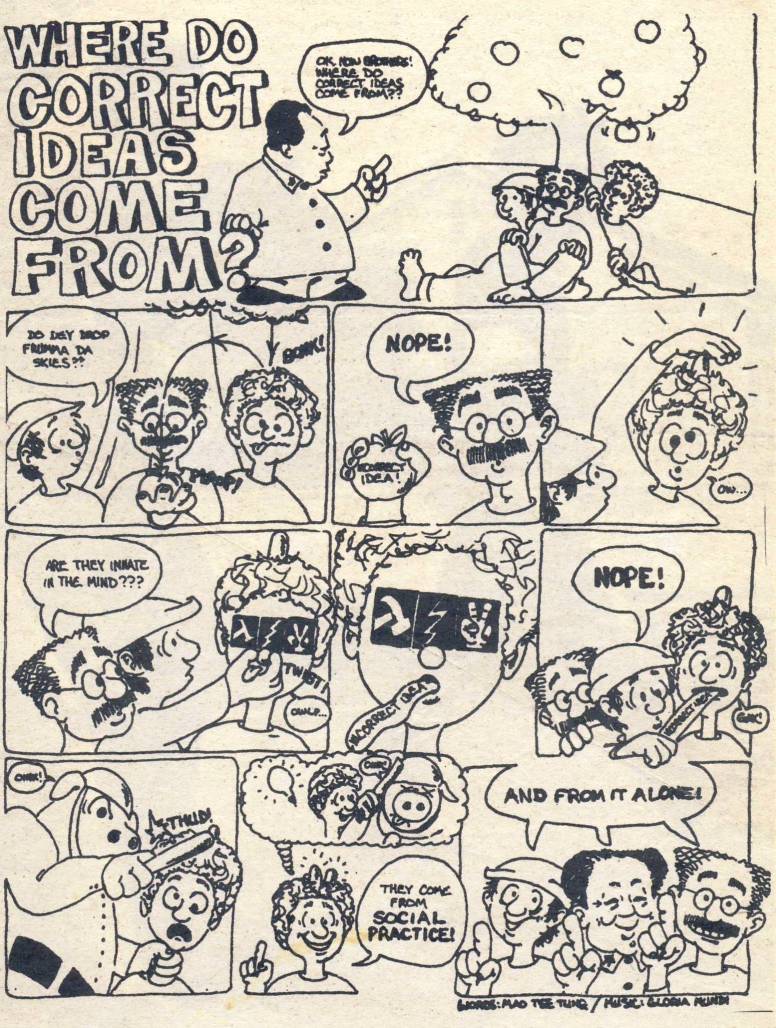
“Where do correct ideas come from? Do they drop from the skies? No. Are they innate in the mind? No. They come from social practice, and from it alone; they come from three kinds of social practice, the struggle for production, the class struggle and scientific experiment. It is man’s social being that determines his thinking”.
(Cartoon from ‘Rabelais’, La Trobe University SRC newspaper, 1970)
“Once the correct ideas characteristic of the advanced class are grasped by the masses, these ideas turn into a material force which changes society and changes the world. In their social practice, men engage in various kinds of struggle and gain rich experience, both from their successes and from their failures. Countless phenomena of the objective external world are reflected in a man’s brain through his five sense organs — the organs of sight, hearing, smell, taste and touch.
“At first, knowledge is perceptual. The leap to conceptual knowledge, i.e., to ideas, occurs when sufficient perceptual knowledge is accumulated. This is one process in cognition. It is the first stage in the whole process of cognition, the stage leading from objective matter to subjective consciousness from existence to ideas. Whether or not one’s consciousness or ideas (including theories, policies, plans or measures) do correctly reflect the laws of the objective external world is not yet proved at this stage, in which it is not yet possible to ascertain whether they are correct or not.
“Then comes the second stage in the process of cognition, the stage leading from consciousness back to matter, from ideas back to existence, in which the knowledge gained in the first stage is applied in social practice to ascertain whether the theories, policies, plans or measures meet with the anticipated success. Generally speaking, those that succeed are correct and those that fail are incorrect, and this is especially true of man’s struggle with nature. In social struggle, the forces representing the advanced class sometimes suffer defeat not because their ideas are incorrect ! but because, in the balance of forces engaged in struggle, they are not as powerful for the time being as the forces of reaction; they are therefore temporarily defeated, but they are bound to triumph sooner or later.
“Man’s knowledge makes another leap through the test of practice. This leap is more important than the previous one. For it is this leap alone that can prove the correctness or incorrectness of the first leap in cognition, i.e., of the ideas, theories, policies, plans or measures formulated in the course of reflecting the objective external world. There is no other way of testing truth. Furthermore, the one and only purpose of the proletariat in knowing the world is to change it. Often, correct knowledge can be arrived at only after many repetitions of the process leading from matter to consciousness and then back to matter, that is, leading from practice to knowledge and then back to practice. Such is the Marxist theory of knowledge, the dialectical materialist theory of knowledge.
“Among our comrades there are many who do not yet understand this theory of knowledge. When asked the sources of their ideas, opinions, policies, methods, plans and conclusions, eloquent speeches and long articles they consider the questions strange and cannot answer it. Nor do they comprehend that matter, can be transformed into consciousness and consciousness into matter, although such leaps are phenomena of everyday life. It is therefore necessary to educate our comrades in the dialectical materialist theory of knowledge, so that they can orientate their thinking correctly, become good at investigation and study and at summing up experience, overcome difficulties, commit fewer mistakes, do their work better, and struggle hard so as to build China into a great and powerful socialist country and help the broad masses of the oppressed and exploited throughout the world in fulfillment of our great internationalist duty”.
“Labor cannot emancipate itself in the white skin where in the black it is branded”. – Karl Marx, Capital, vol. 1, 1867
* * * * * *
(The following review by Barry York is from the latest edition of ‘Recorder’, the newsletter of the Melbourne Labour History Society. It is published here in its unedited form).
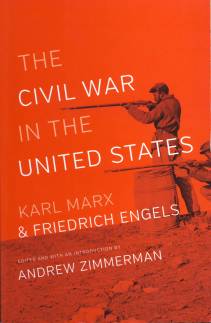
This collection of writings by Marx and Engels about the American Civil War was originally published in 1937 by Dr. H. M. Morais. Dr Morais lost his college teaching job as a result. It’s good that in 2016 it can be published as a second edition without any job losses. Zimmerman, a professor of history in Washington DC, provides very useful introductory contextualisation to each section. There are nine parts in all, from Marx and Engels on slavery and abolition before the civil war through to ‘Slavery and the Civil War in Capital’.
Zimmerman’s introductions are helpful for those of us who need reminding of the significance of the various places, battles, politicians and military figures.
Marx and Engels certainly knew their stuff. Considering they wrote from England, Marx’s knowledge of American geography and topography is astonishing. It’s remarkable to read the extent of their detailed knowledge of the unfolding struggle against the “oligarchy of 300,000 slave holders”. They drew on wide sources of information, including correspondence with German communists who had fled to the United States following the defeat of the 1848 European revolutions and who took up arms for the Union. But they also read the American newspapers, including the New York Tribune. And Engels even communicated with a Confederate major.
This is how it should be, of course. ‘No investigation, no right to speak’. They did not see it through the lens of dogma, or force the events into some formula or ideological schema. Their letters and other writings reveal a materialist dialectical approach, an understanding that things unfolded as they did, influenced by human thought and motored by action, but not as one might wish they should. Revolutions are innovative and experimental, devising their own strategies and defining their own nature.
We must keep in mind that the American Civil War was Marx and Engels’ equivalent of ‘Vietnam’ (for those of us politicized in the 1960s). It was the big issue – “the most momentous thing happening in the world today” – especially for internationalists who see no distinction between ‘them’ and ‘us’. The US struggle against slavery was also a source of inspiration following the dispiriting rise of Bonapartism in Europe.
It was also inspiring for Marx and Engels to witness the great support by the English working classes for the Union forces, at a time when the British ruling class was sympathetic to the Confederacy.
I was surprised by the extent of Engels’ military knowledge. He sure loved guns. Marx, by contrast, comes across as more adept at political and economic analysis. Engels emerges as less optimistic than Marx. But for Marx there was no doubt of Union victory. In a letter to his uncle (yes, he had one), Marx knew that the North had “a last card up its sleeve in the shape of a slave revolution”.
Marx and Engels were great pro-war ‘hawks’. Not for them the ineffective non-violent tactics of naval blockades. They supported and welcomed military invasion of the South.
The edited selection of writings reveal how Marx and Engels saw through the false argument that the emerging war was not about slavery but rather tariffs.
And they contended with the ‘ultra-leftists’ who were highly critical of Lincoln. It took 18 months before Lincoln issued the preliminary Emancipation Proclamation in September 1862, but Marx and Engels recognised him as a strategic thinker who was creating conditions to take his class, the working class, with him against the pre-industrial slave owners.
Revolutions do not always succeed, they can fail, but they can push things forward. When one fails, you have another. Marx and Engels were very disappointed by Andrew Johnson’s presidency, following Lincoln’s assassination. He restored plantations to ex-slave owners and reversed the planned land reform program. Slavery was abolished but racial and class hierarchies kept in place. It took another century, marked by Jim Crow segregation and lynchings, before the next leap forward in 1965 with the Civil Rights Act.
The faint-hearted should be warned that Marx and Engels sometimes used the term ‘Nigger’. They used it infrequently and ironically, usually.
Of all the great quotes by Marx in this book, one stands out for me: “Labor cannot emancipate itself in the white skin where in the black it is branded”. (Captial, vol. 1, 1867)
‘We do not want to be depicted in the way we were when we were first discovered in our homeland in North America. We do not want museums to continue to present us as something from the past. We believe we are very, very much here now and we are going to be very important in the future’.
– North American Indigenous exhibit, Toronto Museum
* * * * * *
(by Tom Griffiths)
Recently my wife and I had the opportunity of visiting the Toronto Museum at the invitation of a Toronto based colleague of hers, in order to see a Viking exhibition. Well, historical remnants and explanations thereof – if you want to see the long boats you need to go to the Viking Museum in Oslo. We did not expect this to be able to match the Viking museum, not a fair ask in any case and in this sense our expectations were met.
Before moving on to the purpose of this post, which is not really about the Viking exhibits, two comments about it, both positive, are worth making, especially since they affected my expectations (and disappointments) of what I would be exposed to in the rest of the museum, or rather those parts I visited. And these left me peeved and irritated with Brecht buzzing around my head. But more on this later.
The two positives, while modest in themselves, showed an attempt being made by either the curating bods at Toronto or Oslo to engage the visitor in the life and times of the Vikings. And having vicariously visited Valhalla courtesy of Dirk Gently’s adventures in The Long Dark Tea-Time of The Soul I was ready to be engaged.
The first positive was an obvious attempt by the curators to explain aspects of context, specifically social and economic, that helped shape the Vikings. As one would expect these days particular attention was placed on the place and role of women, making them visible. This aspect painted with a broad brush. The other positive was about fine detail. As one would expect after a thousand odd years many of the exhibits were showing their age and associated brittleness. One, a sword, made decrepit and fragile by rust, was partnered by a reproduction that had been placed in front of it. Above the repro was a sign saying Touch Me. I didn’t need to be asked twice. Briefly, for a fleeting second, I was able to imagine myself there. I will leave it to your imagination to decide whether ‘there’ was somewhere in the former Viking territories or in Valhalla.
While it would be an exaggeration to say that I was buoyed by this experience, it had certainly lodged somewhere in my head as my wife headed off to work leaving me to explore the rest of the museum. At this stage Brecht was, shall I say, keeping a low profile.
Whilst I did not ‘do’ the whole museum I did see three of their substantial exhibitions. In order of my seeing them these were an exhibition of 1stC to 20thC AD Korean sculptures and artifacts, a North American Indigenous section and a series of 16thC to early 20thC bed and sitting room furniture in ‘typical’ domestic settings. A legacy of European style as the Museum put it. Hint: the inverted commas serve as a warning. By the time I had finished Brecht was buzzing furiously.
Leaving Odin, Thor and their Viking worshipers behind I headed off to a Korean exhibition, the focus of which was mythology, mythological figures (the King of Hell, for example), furnishings and residential representations of the wealthy and … I don’t know what the collective noun is for numerous Buddha statues gathered in a small space is – a chill of Buddhas perhaps? – and a chill of Buddhas.
An O.D. of Buddhas- insouciance for all
I entered this exhibition curious but without any specific expectations. I left it Buddha’d out, having been through a Charge of the Light Brigade moment – Buddhas to the right, Buddhas to the left … The benefit of this over dose was it forced me to think and what follows is a distillation of that.
There were several aspects to this, the most immediately obvious being the historical, the retreat inward in the face of powerlessness. Whilst not true in any absolute sense the old boy himself and his many followers were, like the Stoics of ancient Greece and the Brahmin aesthetes, to name but a few, suffering an acute on chronic shortage of places to go with any dissatisfactions or grievances they had with the material world. And more importantly the people generally had even fewer places to go – they had no choice other than to put up with it and figure out ways to survive.
Hobbes’ dystopian description of the primitive world where life outside society was ‘solitary, poor, nasty, brutish, and short’ could also have been applied to the social conditions surrounding Buddha et al because life inside these societies wasn’t much better. From such materially and spiritually impoverished soil, “a heartless world” as Marx put it, sprang both need, “the sigh of the oppressed creature” and solution.
Withdrawing into the inner self was something they could do – and proselytise about – and they did. And yes, I know that proselytising about it is an external act and a defacto, if not intentional, political act but we moderns have Buddha et al at a considerable disadvantage when it comes to passing judgement on the value of what he or others were promoting as solutions to the miseries and injustices of social life.
So what is my gripe about confronting these ‘chilled out’ stone figures? None. As just mentioned, judging those times by today’s values and insights wouldn’t even make the grade as picking low hanging fruit; my gripe with the museum’s display is with how these concrete historical figures have been removed from their actual, material conditions and the human needs these ‘nurtured’ and gave birth to and rendered them abstract.
Museums all around the world, including Toronto, promote themselves as having an educative function. Unlike their Viking display, this was not education, but mystification. The saving grace, if I can put it that way, of the Buddas one can see in temples across South and SouthEast Asia – my favourites are the giant, recumbent Buddhas I’ve seen in Thailand and Sri Lanka, whose eyes peer lazily beyond, looking like they’ve just had a shot of heroin – is that they make no attempt to educate in a rational, secular sense; they are religious figures at places of worship.
There the term education takes on an entirely different meaning, one that is part of a religious faith’s ‘job description’. I disagree with the message but have no gripes with their honesty. I am unable to be so generous with the museum and this connects it with the following.
Another aspect is quite contemporary, a comment on the times. At the dawn of the modern era we see someone like Bacon revolutionizing philosophy by turning it outward, to the objective world of things. He took more than a passing swipe at medieval predecessors and ancient Greek philosophy alike for their looking inward and took a very direct swipe at Plato and Platonism generally: “when you taught us to turn our minds inward and grovel before our own blind and confused idols under the name of contemplative philosophy; then truly you dealt us a mortal injury.”
While not directed against Buddha or what his adherents stood for it could easily have done so. There was a world to conquer. The means to do it were emerging and these means were accompanied by and encouraged a spirit full of confidence and vision. This bullish spirit (or should that be Bolshie spirit?) of the young bourgeois revolution, so admired by Marx, is now in an almost apologetic retreat. Where once a critique of the shortcomings and hypocrisies of this revolution created elbow room for proletarian promise and daring do, there is now among ‘informed opinion’ and the broad spectrum of bourgeois ideology a de energised, timid state characterised by a sense of diminished hope and glumness if not outright funk.
And just when we thought things had reached rock bottom who should step, or rather who is pushed, onto the stage, but Buddha, eyes closed or glazed over telling us to focus on the inner self. Now in whose interest could that sage advice possibly be I wonder?
Tellingly, perhaps, my favourite figure in this section of the museum was the King of Hell, a diabolical little chap who at least displayed a sense of vitality. And here Brecht made his first appearance. As I looked and smiled at the King I was reminded of Brecht’s Mask of Evil: “On my wall hangs a Japanese carving/ The mask of an evil demon, decorated with gold lacquer./ Sympathetically I observe/ The swollen veins on the forehead, indicating/ What a strain it is to be evil.”
As with my little ‘mate’ the King there is tension, there is contradiction, there is life. And thank heavens for that! Or should that be thank hell?
After entering this exhibit with casual interest I found myself relieved to be leaving it and without consulting the museum map soon found myself outside (and then inside) the North American Indigenous Exhibit.
The North American Indigenous section
It may be odd to say this but these exhibits had a certain familiarity courtesy of my childhood and adolescence watching westerns on TV and Saturday arvo matinees. That being said the exhibits were of interest and some attention had been paid (not enough as I was soon to discover) to explanation of context.
Then it happened, an exhibit that not only caught my attention (seized it was more accurate) but made me audibly laugh in surprise and approval. This was the highlight of the museum and demonstrates how the dead and buried can be made to live, for their living descendents to embrace the challenges of modernity without sacrificing their heritage and how easy this transformation can be. But I’m getting a little ahead of myself.
This exhibit was of three native Americans, life size plaster cast figures, two men and a woman, originally installed about 100 years ago. The male figure to my left was squatting and reaching for something with his left hand; in the middle, and standing was the female figure and to her left the second male figure in a semi squatting pose. An unremarkable exhibit of the past and a defeated past at that. Comforting for the victors perhaps, but not so for the vanquished and it was this discomfort (pissed offness is probably more accurate) that transformed what was before me into something exceptional. What I actually saw and what had given the exhibit life and relevance was the male figure to my left reaching for a power drill, the female figure holding a tripod and camera and the remaining figure wired up with a ipod.
After my initial ‘wow’ response my gaze fell to an explanatory note at the base of the trio. It said it all:
‘We do not want to be depicted in the way we were when we were first discovered in our homeland in North America. We do not want museums to continue to present us as something from the past. We believe we are very, very much here now and we are going to be very important in the future’.
European Style through the Ages
I left the Indigenous display in a buoyant mood and soon ended up, in more familiar territory, in the Samuel European Galleries where I was assailed and increasingly irritated by the ‘legacy of European style through the ages’ – the ages here meaning the late middle ages – the birth of the modern period – to the 20thC. I later discovered, courtesy of their website, that during the period covered, “Europe witnessed agricultural, social, economic and industrial innovation that would change how Europeans lived, worked, and viewed with the world around them” and was invited to “examine the influence these changes had through the lens of decorative arts development in central and Western Europe. Walk among period rooms and vignettes, including those of the Renaissance, Baroque, Rococo, Neoclassical, and Victorian periods, and discover the different stylistic signatures of each.”
Now, I need to disclose that I gained this information after my visit and after the irritation I increasingly felt as I walked “among the period rooms and vignettes” conversing in my head with Brecht as I went. Had I had this info with me at the time my irritation would have been greater.
The problem I had was not with what was there but with what was not. The period rooms and vignettes displayed were, not surprisingly, either the “stylistic signatures” of the emergent bourgeoisie (landed or otherwise) or of the decaying aristocracies of Europe. This fails to surprise on two levels. The first is that the display artifacts were made by skilled craftsmen using quality materials and these have a tendency to last and to be handed down across generations. The second is political, or ideological more broadly and ironically sits in the same camp as that identified and rectified by the Indigenous activists referred to above. In much the same way as the common working people – you know, the ones that actually make all the stuff and keep it working – are written out of history, the lens employed at the museum airbrushes them out too. The pity of this is that their signature appears in every single exhibit, but remains unseen and devalued. As I traipsed my way through the centuries, looking at these rooms with their ‘stylistic signatures’ the one signature that emerged as dominant was that of class, of ownership.
On the one hand this is all rather ho hum – what had I expected to see anyway? But on the other, consigning it to the ‘ho hum’ department is itself a problem because it colludes with the obscuring of social relations. The question that kept repeating in my head was ”where are the people?” And I mean all of them – the property owners, the quality sort of chap with his quality sort of wife, their servants (who cooked the meals? who changed the sheets and cleaned? who…?) the craftsmen who had built everything before me. Where were they? And what were their quarters like? where and how did the craftsmen live?
The Indigenous example – the power drill, the camera and the ipod – demonstrated how the past can be made highly pertinent to the present, how the gap between them shrinks and can be traversed. With curatorship guided by curiosity and social awareness and how these are shaped by the times, we can be given the opportunity of asking questions of history. We can tackle, like our indigenous friends, how we can bring these questions into the present and ask ourselves what aspects of this past remain tangled in the present, holding us up and what aspects have opened doors and propelled us forward.
But why Brecht? Why him in my head, needling me? Brecht is one of my favorite poets and the answer lies in one of them, Questions From a Worker Who Reads:
Who built Thebes of the 7 gates ?
In the books you will read the names of kings.
Did the kings haul up the lumps of rock ?
And Babylon, many times demolished,
Who raised it up so many times ?
In what houses of gold glittering Lima did its builders live ?
Where, the evening that the Great Wall of China was finished, did the masons go?
Great Rome is full of triumphal arches.
Who erected them ?
Over whom did the Caesars triumph ?
Had Byzantium, much praised in song, only palaces for its inhabitants ?
Even in fabled Atlantis, the night that the ocean engulfed it,
The drowning still cried out for their slaves.
The young Alexander conquered India.
Was he alone ?
Caesar defeated the Gauls.
Did he not even have a cook with him ?
Philip of Spain wept when his armada went down.
Was he the only one to weep ?
Frederick the 2nd won the 7 Years War.
Who else won it ?
Every page a victory.
Who cooked the feast for the victors ?
Every 10 years a great man.
Who paid the bill ?
So many reports. So many questions.
Today’s “Marxists” share with the rest of the pseudo left an opposition to capitalist, indeed any, globalization. This puts them totally at odds with Marx. The following quote from The Communist Manifesto leaves no doubt about Marx’s pro position:
The bourgeoisie has through its exploitation of the world market given a cosmopolitan character to production and consumption in every country. To the great chagrin of Reactionists, it has drawn from under the feet of industry the national ground on which it stood. All old-established national industries have been destroyed or are daily being destroyed. They are dislodged by new industries, whose introduction becomes a life and death question for all civilised nations, by industries that no longer work up indigenous raw material, but raw material drawn from the remotest zones; industries whose products are consumed, not only at home, but in every quarter of the globe. In place of the old wants, satisfied by the production of the country, we find new wants, requiring for their satisfaction the products of distant lands and climes. In place of the old local and national seclusion and self-sufficiency, we have intercourse in every direction, universal inter-dependence of nations. And as in material, so also in intellectual production. The intellectual creations of individual nations become common property. National one-sidedness and narrow-mindedness become more and more impossible, and from the numerous national and local literatures, there arises a world literature.
The bourgeoisie, by the rapid improvement of all instruments of production, by the immensely facilitated means of communication, draws all, even the most barbarian, nations into civilisation. The cheap prices of commodities are the heavy artillery with which it batters down all Chinese walls, with which it forces the barbarians’ intensely obstinate hatred of foreigners to capitulate. It compels all nations, on pain of extinction, to adopt the bourgeois mode of production; it compels them to introduce what it calls civilisation into their midst, i.e., to become bourgeois themselves. In one word, it creates a world after its own image.
Then in a letter to Engels of October 8 1858 he wrote:
The proper task of bourgeois society is the creation of the world market, at least in outline, and of the production based on that market. Since the world is round, the colonisation of California and Australia and the opening up of China and Japan would seem to have completed this process.
In his other writings, Marx supported Europe’s colonial conquests, the “process” that got globalization going. In his view Europe was the only source of capitalism which in turn was the necessary precursor of communism. Support for this historical necessity did not prevent him from expressing his disgust at the barbarity and hypocrisy of the Europeans as they went about this conquest nor was he impressed with the tardy pace at which the old societies were being replaced by the new. What he was doing was recognizing that capitalism has a dialectical or contradictory nature. Only capitalism can create the conditions for its own demise. You have to support it in order to oppose it. In “The British Rule in India” New York Daily News of June 25, 1853, he wrote:
These small stereotype forms of social organism [autonomous villages] have been to the greater part dissolved, and are disappearing, not so much through the brutal interference of the British tax-gatherer and the British soldier, as to the working of English steam and English free trade. Those family-communities were based on domestic industry, in that peculiar combination of hand-weaving, hands-spinning and hand-tilling agriculture which gave them self-supporting power. English interference having placed the spinner in Lancashire and the weaver in Bengal, or sweeping away both Hindoo spinner and weaver, dissolved these small semi-barbarian, semi-civilized communities, by blowing up their economical basis, and thus produced the greatest, and to speak the truth, the only social revolution ever heard of in Asia.
Now, sickening as it must be to human feeling to witness those myriads of industrious patriarchal and inoffensive social organizations disorganized and dissolved into their units, thrown into a sea of woes, and their individual members losing at the same time their ancient form of civilization, and their hereditary means of subsistence, we must not forget that these idyllic village-communities, inoffensive though they may appear, had always been the solid foundation of Oriental despotism, that they restrained the human mind within the smallest possible compass, making it the unresisting tool of superstition, enslaving it beneath traditional rules, depriving it of all grandeur and historical energies. We must not forget the barbarian egotism which, concentrating on some miserable patch of land, had quietly witnessed the ruin of empires, the perpetration of unspeakable cruelties, the massacre of the population of large towns, with no other consideration bestowed upon them than on natural events, itself the helpless prey of any aggressor who deigned to notice it at all. We must not forget that this undignified, stagnatory, and vegetative life, that this passive sort of existence evoked on the other part, in contradistinction, wild, aimless, unbounded forces of destruction and rendered murder itself a religious rite in Hindostan. We must not forget that these little communities were contaminated by distinctions of caste and by slavery, that they subjugated man to external circumstances instead of elevating man the sovereign of circumstances, that they transformed a self-developing social state into never changing natural destiny, and thus brought about a brutalizing worship of nature, exhibiting its degradation in the fact that man, the sovereign of nature, fell down on his knees in adoration of Kanuman, the monkey, and Sabbala, the cow.
England, it is true, in causing a social revolution in Hindostan, was actuated only by the vilest interests, and was stupid in her manner of enforcing them. But that is not the question. The question is, can mankind fulfil its destiny without a fundamental revolution in the social state of Asia? If not, whatever may have been the crimes of England she was the unconscious tool of history in bringing about that revolution.
In “The Future Results of British Rule in India” New York Daily News of August 8, 1853, he wrote:
England has to fulfill a double mission in India: one destructive, the other regenerating – the annihilation of old Asiatic society, and the laying of the material foundation of Western society in Asia.
He expressed a similar view when writing about Britain’s beastly treatment of China. So that in “Revolution in China and In Europe”, New York Daily News, June 14, 1853 we read:
It is almost needless to observe that, in the same measure in which opium has obtained the sovereignty over the Chinese, the Emperor and his staff of pedantic mandarins have become dispossessed of their own sovereignty. It would seem as though history had first to make this whole people drunk before it could rouse them out of their hereditary stupidity.
and then:
All these dissolving agencies acting together on the finances, the morals, the industry, and political structure of China, received their full development under the English cannon in 1840, which broke down the authority of the Emperor, and forced the Celestial Empire into contact with the terrestrial world. Complete isolation was the prime condition of the preservation of Old China. That isolation having come to a violent end by the medium of England, dissolution must follow as surely as that of any mummy carefully preserved in a hermetically sealed coffin, whenever it is brought into contact with the open air.
In an article published in the Deutsche-Brüsseler-Zeitung No. 7, January 23, 1848, Engels expressed his delight at America’s victory in the war with Mexico and the conquest of California, Texas and areas in between. In their footnotes the editors at Progress Press in Moscow try to make out that both Engels and Marx later took a different view. They cite an 1861 article by Marx called “The Civil War in North America”. Here Marx mentions how expansionism at the time was driven by the slave owners. Although he makes no actual mention of the Mexican-American War. In hindsight we can see that one good thing about the annexations was that they contributed to the outbreak of the Civil War which the slave-owners went on to lose. Their attempt to spread slavery to the new territories was the last straw. And we can now say without fear of contradiction that capitalist development greatly benefited from the switch in sovereignty. Here is alinkto the 1861 article. It is no use on the Mexican-American War but it is a very illuminating exposition of the expansionist threat posed by the slave states and a very good argument against British “neutrality”.
Marx was quite unsupportive of rebellions by reactionary or backward elements in colonial societies. These included the Taiping Rebellion in China and the Indian Mutiny.
They have no slogans. They are an even greater abomination for the masses of the people than for the old rulers. They seem to have no other vocation than, as opposed to conservative stagnation, to produce destruction in grotesquely detestable forms, destruction without any nucleus of new construction.
“Marxists” have tried to tell a different tale. Over at The Marx and Engels Internet Archive they have a section entitled Articles on China 1853 – 1860. It has other articles that deal with rebellion but not the Die Presse article for copyright reasons. In their introduction they paint the Taiping in glowing colors:
At the same time, the Taiping rebellion broke out in 1850 and attacked the status quo Confucianist Manchu Dynasty — which had ruled since 1644. The rebellion was based in social revolutionary ideas of equality and was popular among the masses. It abolished private property, established sexual equality, and banned drugs (from alcohol to opium). By 1853, it dominated much of SE China. It would not be until 1864 that the Taiping capital of Nanking was captured by the imperial Manchu government.
Progress Press also have this rather gratuitousfootnotein Volume I of Capital:
In 1850-64, China was swept by an anti-feudal liberation movement in the form of a large-scale peasant war, the Taiping Revolt.
The fairly uncontroversial Wikipedia entry on the Taiping Rebellion gives a far less flattering picture.
There is also an attempt to paint the Indian Mutiny as a national liberation movement. The Soviet Foreign Languages Publishing House in 1959 brought out a collection of articles by Marx on the Indian Mutiny entitled The First Indian War of Independence, 1857-1859. Also the The Marx and Engels Internet Archive has a web page entitledThe First Indian War of Independence (1857-1858)
Marx does not explicitly repudiate the Mutiny in the way that he did in the case of the Taiping Rebellion. However, the total absence of any explicit statement of support is just as telling. He is very concerned to expose British military incompetence and brutality. He is also pleased by the financial and political strain it is placing on Britain. But that is as far as it goes. It is hard to imagine him supporting a pack of princes who wanted to reinstate the Mogul empire after what we know about his view on the role of the British in India.
The editors of Progress Press were also embarrassed by an article by Engels called “French Rule in Algeria” (The Northern Star January 22 1848). Here he wrote:
Upon the whole it is, in our opinion, very fortunate that the Arabian chief has been taken. The struggle of the Bedouins was a hopeless one, and though the manner in which brutal soldiers, like Bugeaud, have carried on the war is highly blameable, the conquest of Algeria is an important and fortunate fact for the progress of civilisation. The piracies of the Barbaresque states, never interfered with by the English government as long as they did not disturb their ships, could not be put down but by the conquest of one of these states. And the conquest of Algeria has already forced the Beys of Tunis and Tripoli, and even the Emperor of Morocco, to enter upon the road of civilisation. They were obliged to find other employment for their people than piracy, and other means of filling their exchequer than tributes paid to them by the smaller states of Europe. And if we may regret that the liberty of the Bedouins of the desert has been destroyed, we must not forget that these same Bedouins were a nation of robbers,—whose principal means of living consisted of making excursions either upon each other, or upon the settled villagers, taking what they found, slaughtering all those who resisted, and selling the remaining prisoners as slaves. All these nations of free barbarians look very proud, noble and glorious at a distance, but only come near them and you will find that they, as well as the more civilised nations, are ruled by the lust of gain, and only employ ruder and more cruel means. And after all, the modern bourgeois, with civilisation, industry, order, and at least relative enlightenment following him, is preferable to the feudal lord or to the marauding robber, with the barbarian state of society to which they belong.
Progress Press in its footnotes refers to this resistance as a liberation struggle. They also then claim that in an 1844 article Engels had made commendable noises about the resistance and that an article “Algeria” written for the New American Encyclopaedia in 1857 reverses the position expressed in the 1848 article. There is nothing in either article that can be construed in this way. An editor’s footnote to the latter article claims that the relevant material was left out by the encylcopaedia editors and this is conformed by a letter from Engels to Marx on 22 September 1857. The letter shows nothing of the sort. The reader is invited to read those three pieces to make up their own mind.
These views of Marx are not at odds with support by communists for the 20th century anti-colonial movement. By that stage the movement was primarily lead by western educated elements who sought to modernize their countries rather than take them backwards. Although there were some oddities such as Mahatma Gandhi, and independence brought many monsters like Idi Amin in Uganda and Mobutu in Zaire, and the whole process was badly affected by the Cold War.
Arise, you independent artists!
Arise, fair users great and small!
Those evil cartels and their jurists
Have, through their exploits, chained you all! (To the tune of “The Internationale”)
* * * * * *
The following, written by Bill Kerr, originally appeared in 2005 at LastSuperpower. The context was a challenge at a blog called Harry’s Place to discuss whether Marx and Engels are still relevant in the C21st.
* ** * * *
We need Marx and Engels because they understood things and said some things better than anyone else has since. It’s important to read the original because people who call themselves Marxists have always been in violent disagreement with what it means. If you don’t read the original then you have no chance of working it out for yourself.
Communism has had bad press following the failures of the Soviet Union, China etc. It’s seen as a dull grey world, with no variety in the shops, controlled by faceless, heartless apparatchiks- freedom of thought and expression is not allowed. At one time (the 1930s- WW1, The Great Depression, fascism in Spain destroyed faith in capitalism) it was fashionable to be communist or fellow traveller, but nowadays it is definitely not fashionable.
Personally, I draw these insights from the Manifesto, which help me understand the world today:
Capitalism is progressive relative to feudalism/ religious fundamentalism
It’s far better to live in our bourgeois democracy than to live under the rule of fascist Saddam or the religious fundamentalism of the Taliban.
Marx was very clear about the historical progressiveness of capitalism, a point also made by Marcus [who was one of the contributors at Harry’s Place blog] with this quote:
The bourgeoisie historically has played a most revolutionary part. The bourgeoisie, wherever it has got the upper hand, has put an end to all feudal, patriarchal, idyllic relations, It has pitilessly torn asunder the motley feudal ties that bound man his “natural superiors:, and has left no other nexus between the people than naked self-interest, than callous “cash payment”. It has drowned out the most heavenly ecstasies of religious fervour, of chivalrous enthusiasm, of philistine sentimentalism, in the icy water of egotistical calculation. It has resolved personal worth into exchange value and in place of the numberless indefeasible chartered freedoms, has set up that single, unconscionable freedom — Free Trade.
The melting, dynamic vision of capitalism and progress
The bourgeoisie cannot exist without constantly revolutionising the instruments of production, and thereby the relations of production, and with them the whole relations of society. Conservation of the old modes of production in unaltered form, was on the contrary, the first condition of existence for all the earlier industrial classes. Constant revolutionising of production, uninterrupted disturbance of all social conditions, everlasting uncertainty and agitation distinguish the bourgeois epoch from all earlier ones. All fixed, fast-frozen relations, with their train of ancient and venerable prejudices and opinions, are swept away, all new-formed ones become antiquated before they can ossify. All this is solid melts into air, all that is holy of profaned, and man is at last compelled to face with sober senses his, real conditions of life, and his relations with his kind.
We live in a world where things change, everything changes due to the continual development of productive forces and scientific progress. This provides the material basis for the elimination of poverty and a feeling of optimism and excitement about the future.
‘All that is solid melts into air’ is also the title of a great book about modernity and modern interpretation of Marx and others, by Marshall Berman, which I would highly recommend. Here’s a quote from Berman:
To be modern is to live a life of paradox and contradictions. It is to be overpowered by the immense bureaucratic organizations that have the power to control and often destroy all communities, values, lives; and yet to be undeterred in our determination to face these forces, to fight to change their world and make it our own. It is to be revolutionary and conservative; alive to new possibilities for experience and adventure, frightened by the nihilistic depths to which so many modern adventures lead, longing to create and to hold on to something real even as everything melts. We might even say that to be fully modern is to be anti-modern: from Marx’s and Dostoevsky’s time to our own, it has been impossible to grasp and embrace the modern worlds potentialities without loathing and fighting against some of its palpable realities. No wonder then that, as the great modernist and anti-modernist Kierkegaard said, the deepest modern seriousness must express itself through irony. Modern irony animates so many great works of art and thought over the past century; at the same time, it infuses millions of ordinary peoples lives. This book aims to bring these works and these lives together, to restore the spiritual wealth of modernist culture to the modern man and woman in the street, to show how, for all of us, modernism is realism. (pp 13- 14)
Productive forces are held back by capitalist productive relations
After praising capitalism for developing the productive, Marx and Engels then tear it down because the property relations of capitalism periodically (boom and bust) produces slow down and crisis:
The productive forces of the disposal of society no longer tend to further the development of the conditions of bourgeois property; on the contrary, they have become too powerful for these conditions, by which they are fettered, and so soon as they overcome these fetters, they bring disorder into the whole of the bourgeois society; endanger the existence of bourgeois property. The conditions of the bourgeois society are too narrow to comprise the wealth created by them.
The dominant productive relations today in western society are boss/worker. No thinking person much likes working for a boss but it’s what we have to do to survive.
The point about boss/worker relations is that they are anachronistic, they hold back the further rapid development of the productive forces. Workers hold back and do not work at their full capacity, initiative and creativity. In a society where the workplace nexus between people (is) naked self-interest (and) callous “cash payments” it makes no sense to give it your best shot.
The real communist critique of capitalism is that capitalism social relations – boss/worker relations – holds back in the rapid development of productive forces.
For example, the dominance of Microsoft holds back the rapid development of either superior or potentially superior software development such as the Linux operating system, which has been developed out of gift culture. We seem to have very significant groups of the open source software developers today who practise communist principles from each according to his ability, to each according to his needs- without even realising or connecting to the source.
This surfaced in a recent exchange between Bill Gates and his open source critics after Gates said:
There are some new modern-day sort of communists who want to get rid of the incentive for musicians and moviemakers and software makers under various guises.
This led to a flurry of design activity in the open source/creative commons community, who renamed themselves “creative communists” and developed a series of red flags and logos in response to the gibe:
One Gates critic has even adapted the words of ‘The Internationale’ as an anthem for the freedom of information movement.
‘The Free Culture Internationale’
(Lyrics by Andrew Mike (2005) To the tune of “The Internationale” by Pierre Degaytre, 1888)
Arise, you independent artists!
Arise, fair users great and small!
Those evil cartels and their jurists
Have, through their exploits, chained you all!
But we have thought up a new system,
To make the fairer through and through;
Right now, they say, “We’ll never miss them,”
But one day soon, they’ll say “We do!”
So Bill Gates calls us commies,
But he can’t stand the sight
Of information freedom,
Reform of copyright!
So we go on creating,
Joyous and full of mirth,
For our great newborn copyleft
Shall shine upon the earth!
The spirit of communism as envisaged by Marx is alive and well in the open source community but perhaps because communism has such a bad name and Marx is little read by software developers they have not made the connection.
4) Atheism, materialism, facing reality abandoning the hopeful, sentimental approach
The Communist revolution is the most radical rupture with traditional relations; no wonder that its development involved the most radical rupture with traditional ideas.
Before capitalism the rulers of society were the religious rulers.
With the development of science our Universe became far more interesting and beautiful place than anything envisioned by religion.
Atheism is strong in the Manifesto through its exposure of religious hypocrisy, as the transition was made into a society dominated by money. The Manifesto is an invitation to think for ourselves and to reject artificial soothings of religion.
Once again the most articulate exposures of these sorts of views comes from people like Richard Dawkins, who don’t personally identify with communism but who nevertheless show the relevance of the views expressed by Marx in 1848.
I was six years of age when ‘Sputnik’ became the first artificial earth satellite. It was sent into orbit by the Soviet Union on 4 October 1957. I have a vague memory of my parents taking me into the street that night and, with curious neighbours, peering into the dark star-lit skies over West Brunswick, Melbourne. I’m fairly sure someone said they could see it, and maybe I saw it, or something, among the stars too.
I also recall my father, Loreto, remarking on how the success of Sputnik highlighted ‘the superiority of socialism’. Of course, I didn’t understand what that meant. What was socialism? And what was it meant to be superior to? He was a Labor voter, but very much to the left, and it wasn’t uncommon for Labor men and women to talk favourably about socialism in those days.
About a decade later, when I was 16, my dad and I would sometimes take the number 19 tram from Brunswick to the City on Saturday mornings and visit the International Bookshop in Excelsior House, 17 Elizabeth Street. An antiquated rickety old lift would take us up to the second floor where we’d be greeted by the Communist Party shopkeeper, Jack Morrison.
Sometimes a couple of dad’s young workmates from the factory where he worked would meet us there. We’d browse through copies of glossy propaganda magazines like ‘Soviet Pictorial’ and ‘China Pictorial’, marvelling at the photographic evidence of bumper harvests and advanced technology. I was a reader of science fiction and the images of gigantic tractors and huge pumpkins enthused and fascinated me.
By this stage of my life I had an understanding of socialism and identified with it in a gut kind of way. It was about progress, about eradication of poverty, about imagining a better future based on scientific discovery and technological innovation – and about the working class who produced society’s wealth taking control of the means of producing it.
At a time when censorship laws in Australia and the west were ridiculous, it was also about greater freedom. The International Bookshop flaunted censorship laws by stocking some of the books that had been banned by the government for political or sexual content. (D H Lawrence’s ‘Lady Chatterley’s Lover’ was in the latter category).
An example of political censorship was a ban on a pamphlet that exposed US war crimes in Vietnam. I forget its title now but remember obtaining copies from the Eureka Youth League in 1968 and distributing them, surreptitiously, at my high school. The pamphlet was banned under the Obscene Publications Act, from memory.
* * * *
My father had served in the Second World War, volunteering in 1940 for the Royal Air Force in his homeland, Malta, when the Italian Fascists started bombarding the main island of the Mediterranean archipelago. He remembered the priests opposing British imperialism from the pulpit in the lead up to the War and assuring their congregations that Malta’s future was best served by accepting Mussolini’s Italia Irredenta.
By any measure, British imperialism’s crimes at that time were far worse than those of Italian imperialism, but on the other hand, British bourgeois democracy was much preferable to Italian/German fascism.
During the War, my father served in Africa, the Middle East, Palestine, and France, before being stationed in London after the War.
The War changed his world, everyone’s world, and in mixing with other RAF men, his eyes were opened to new ways of seeing and thinking. He remembered Jewish and Scottish airmen telling him about Stalin, the Soviet Union (“where the workers ruled”) and communism. (Note, they are called ‘airmen’ but they served on the ground, in regiments, and never flew).
The troops knew that Stalin’s Red Army were routing the Nazis in Europe and my dad’s comrades told him the story about the early British appeasement of Hitler and the west’s refusal to heed Stalin’s calls for collective security against fascism as early as 1933.
After the War, in London, still in uniform, my father thrived in the cosmopolitan environment of one of the world’s biggest cities. Servicemen in uniform were given free tickets to the West End theatres and to lectures given by the likes of George Bernard Shaw and Hewlett Johnson, the ‘Red Dean of Canterbury’. My dad took advantage of such opportunities.
He started buying the ‘Daily Worker’ regularly, the organ of the Communist Party of Great Britain, and found that while there were strong pockets of anti-communism, in general Londoners were tolerant of it and there was sympathy for Stalin and the Red Army.
My dad told me about an occasion when he went to work at his job in the Air Ministry in London after the War, having purchased the Daily Worker that morning. Walking through the main office, one of the heads of the ministry – a ‘Lord’ no less – noticed him and asked, ‘What’s that paper you’re carrying?’ My dad saluted and replied, ‘Sir! It’s the Daily Worker, the newspaper of the Communist Party’. Lord-so-and-so responded: ‘Oh, I thought it was. May I borrow it after you’ve finished with it? I forgot to buy mine this morning’.
It’s easy to forget that communism was popular after the War and that the Cold War arose in part because of communism’s popularity in Europe, west and east. If it’s true that reactionaries tremble at the mere rustle of leaves, then you can imagine how they responded to elections in places like France and Italy where between a quarter and third of the people voted Communist.
* * * *
I want to celebrate the centenary of the Russian revolution because it was an attempt to build socialism after the old feudal order had been overthrown by the people, led by the communist Bolsheviks. That it was led by communists was a rather flukish situation. The overthrow of the feudal order required a bourgeois democratic revolution that would develop capitalism. As David McMullen says in Rescuing the Message of the Communist Manifesto:
‘There is a thoroughly entrenched view that the experience of revolutions during the 20th century shows that communism has failed. It is true. There was a failure. However, it was not of communism, but rather of an attempt to sustain a path towards it when its preconditions were absent. Russia in 1917 and virtually all the “communist” regimes established mid-century were essentially backward pre-capitalist societies. Most people were peasants rather than proletarians, and they were more interested in land for the tiller than social ownership. There was little modern industry and thinking was more medieval than modern. They had not passed through the capitalist stage, which is necessary for a successful communist revolution’.
The Russian revolution also shows how the old order never just gives in. Civil war followed the revolutionary overthrow of the ruling class, with the old order backed by military forces of more than a dozen foreign governments.
Then there came the rise of fascism in Europe and the active pro-fascist fifth columns in various countries, especially the Soviet Union. Hitler hated communism, which he called Judeo-Bolshevism. In the Soviet Union, the fifth columnists engaged in sabotage and collaboration – as they did in some western countries too. In the west, the fascist sympathisers promoted isolationism in foreign policy. It’s “over there”, not our problem, we’ll only make things worse, blah blah blah. Such is the mentality that thinks in terms of ethnic identity and nationality rather than humanity.
As if things couldn’t become more difficult, there came the Second World War which, initially, the Soviet Union tried to keep out of; though Stalin had sought collective security agreements with Britain and other powers in the early 1930s when Hitler’s Nazis took power. Britain declined and instead entered into the Anglo-German Naval Agreement in 1934. Poland agreed to a non-aggression pact with Hitler, rather than collective security to thwart him, also in 1934.
The Nazi German invasion of the Soviet Union, and Soviet resistance, resulted in 25 million mainly Russian deaths. The Soviet Union instigated the greatest military action in world history known as Operation Bagration, codename for the 1944 Soviet Belorussian Strategic Offensive Operation, which secured the defeat of the Nazis. Women were mobilised along with men and the Red Army’s women’s sniper force became legendary in the Soviet Union. Lyudmila Pavlichenko shot 309 Nazi soldiers as a Ukrainian Red Army Soviet sniper during the war. (Woody Guthrie wrote a song for her in 1942).
It was understood at that time that the Soviet Union, despite what it had been through – a revolution followed by a civil war caused by the military intervention of forces backed by a dozen foreign governments, the subversive activities and sabotage of a pro-fascist fifth column, and an invasion by the German Nazis and their Finnish and Romanian allies that killed 25 million Soviet citizens – had achieved plenty through its socialist system.
Industrialisation, massive dam construction and electrification of the countryside had lifted millions from the acute poverty experienced under Tsardom. Stalin wanted to create “a second America” in terms of industrial progress. For the first time, the socialist republics of the USSR developed their own motor, aircraft, tank, tractor, machine tool, electrical and chemical industries – with the assistance of European and American experts.
The dam built on the Dnieper River from 1927 was the biggest hydro-electric station in Europe and was consistent with Lenin’s slogan: ‘Communism is soviet power plus electrification’.
New cities were built, most notably Magnitogorsk, which was based on iron ore mining and steel production. Hundreds of experts were brought in as advisers, including Americans, as the city was to be based on US steel-cities, Gary (Indiana) and Pittsburgh (Pennsylvania).
Roads, railways, canals also helped move Russia and the Soviet Union further from the feudal era of the ox-drawn plough. The Volga-Don Canal and the White Sea-Baltic Sea Canal were achievements of a system in which need and progress motivate planning and production. And, in 1954, the Soviet Union became the first country in the world to harness nuclear power for peaceful use, with the operation of the APS-1 nuclear power plant at Obninsk, the ‘Science City’.
This material progress, the application of human ingenuity in the creative-destructive transformation of Nature through labour, is a key reason as to why so many working class people in the west were attracted to socialism.
If the unleashing of the productive forces in a backward economy like Russia in the early C20th could produce such results via social ownership, then what could be achieved under socialism in the advanced industrial west where progress was held back by concentrated private ownership of the means of production and the pursuit of maximum profit for those private owners as the goal of production?
Despite the restoration of capitalism in the Soviet Union in the 1950s and 1960s, these questions remain. They just need to be put back on the agenda of public discourse. Instead, we can expect the same old ritualistic denunciations based on the false premise that ‘the History is settled’.
“Just as knowledge is unable to reach a complete conclusion in a perfect, ideal condition of humanity, so is history unable to do so; a perfect society, a perfect “state”, are things which can only exist in imagination. On the contrary, all successive historical systems are only transitory stages in the endless course of development of human society from the lower to the higher. Each stage is necessary, and therefore justified for the time and conditions to which it owes its origin. But in the face of new, higher conditions which gradually develop in its own womb, it loses vitality and justification. It must give way to a higher stage which will also in its turn decay and perish.”
(Engels, Ludwig Feuerbach and the End of Classical German Philosophy, 1886)
The following is a discussion from the Lastsuperpower site in 2003 about the philosophical basis of pseudo-leftism. The two contributors are ‘Albert’ and ‘Keza’. It stands up very well fourteen years on, and had a big impact on me at the time. –
c21styork
Revolutionaries are historical optimists who stress the inevitability of progress. Pseudo-Leftists are reactionaries who merely denounce how bad things are and actively reinforce the idea that they cannot be changed. But when revolutionaries reject the irrational obscurantism and moralistic posturing of pseudo-Leftists and line up together with the ruling class against them, by asserting that “all that is real is rational”, they are also implicitly saying “all that exists deserves to perish”
Author: albert
Date : Jun 15, 2003 4:48 am
“All that is real is rational; and all that is rational is real”
Hegel’s remark “All that is real is rational; and all that is rational is real.” is central to understanding the philosophical outlook of communism.
It’s worth carefully studying Engel’s explanation of this seemingly paradoxical position, as it sheds a lot of light on some aspects of the problems with pseudo-Leftists and other reactionaries conservatives.
Fundamental to the genuine left is this concept:
“Just as knowledge is unable to reach a complete conclusion in a perfect, ideal condition of humanity, so is history unable to do so; a perfect society, a perfect “state”, are things which can only exist in imagination. On the contrary, all successive historical systems are only transitory stages in the endless course of development of human society from the lower to the higher. Each stage is necessary, and therefore justified for the time and conditions to which it owes its origin. But in the face of new, higher conditions which gradually develop in its own womb, it loses vitality and justification. It must give way to a higher stage which will also in its turn decay and perish.”
One aspect of that is the idea that “each stage is necessary, and therefore justified for the time and conditions to which it owes its origin”. Pseudo-Leftists assert the opposite. They are able to present themselves as more “militantly opposed” to the status quo than revolutionaries because they refuse to “understand” current reality as “necessary” and “therefore justified for the time and conditions to which it owes its origin”. Instead they simply denounce it from an ahistorical perspective as contrary to some absolute morality.
Anyone critical of the status quo is bound to highlight its negative features and denounce them as intolerable. But by denying that those negative features had their own rational basis the pseudo-Left obscures the rational necessity for inevitable change to the status quo arising from new circumstances that obsolete the justification for the old reality and necessitate a new reality.
Revolutionaries are historical optimists who stress the inevitability of progress. Pseudo-Leftists are reactionaries who merely denounce how bad things are and actively reinforce the idea that they cannot be changed. But when revolutionaries reject the irrational obscurantism and moralistic posturing of pseudo-Leftists and line up together with the ruling class against them, by asserting that “all that is real is rational”, they are also implicitly saying “all that exists deserves to perish” as explained by Engels:
“And so, in the course of development, all that was previously real becomes unreal, loses it necessity, its right of existence, its rationality. And in the place of moribund reality comes a new, viable reality — peacefully if the old has enough intelligence to go to its death without a struggle; forcibly if it resists this necessity. Thus the Hegelian proposition turns into its opposite through Hegelian dialectics itself: All that is real in the sphere of human history, becomes irrational in the process of time, is therefore irrational by its very destination, is tainted beforehand with irrationality, and everything which is rational in the minds of men is destined to become real, however much it may contradict existing apparent reality. In accordance with all the rules of the Hegelian method of thought, the proposition of the rationality of everything which is real resolves itself into the other proposition: All that exists deserves to perish.”
__________________________
Hegel and the pseudo-left
Author: keza
Date : Jun 21, 2003 3:00 am
After reading Albert’s Hegel message I got a bit interested in Hegel and tried to find out what he was on about. The following message results from that. It’s not really finished but I’ve had enough of it for now…
In his Australian article ‘Not in Your Name Indeed’, Barry York described the politics of the pseudo-Left as a “mish-mash” , a “jumble of prejudices”, “more akin to a sub-culture than a political movement”.
I think these words captured something very important about the pseudo-left – in particular its atheoretical and ahistorical nature. Pseudo-left ideology lends itself well to bulleted lists of things to oppose and things to support. At the same time, events in the world are classified according to surface appearance rather than in terms of what underlies them. The pseudo-left may talk of the “underlying reasons” for something like the war in Iraq but this talk is always of “hidden agendas”, “secret motives” and is quite different from studying such events in light of the underlying flow of history.
Hegel’s statement: “All that is real is rational; and all that is rational is real” asserts that history makes sense: “the phantom of a world whose events are an incoherent concourse of fortuitous circumstances, utterly vanishes”.
In contrast, pseudo-left ideology attributes only the most superficial rationality to what happens in the world.
Indeed it seems to me that the pseudo-left has an essentially folk-loric version of how the world works. There is evil and there is good. (Or there is God and there is Satan). Being “good” means being pure and true and perfect and this comes down to opposing the dark forces of evil. It’s an abstract, ideal position which is capable of generating protests but has no serious orientation toward actually changing the world. The feel-good slogan “Not in My Name” captures its nature rather well.
The Hegelian conception of history exerted an enormous influence on both Marx and Engels. Although Hegel was an idealist, his view of history was one in which humans were seen as becoming progressively more capable of controlling their own destiny. He saw history as always progressing in the direction of greater freedom – driven by the dialectical opposition between what is actual and what is potential.
Hegel was an idealist because of his adherence to the idea of the supremacy of “Spirit” (akin to mind) over matter (which he saw as inert – “its essence outside itself’.:
“Spirit knows itself. It involves an appreciation of its own nature, as also an energy enabling it to realise itself; to make itself actually that which it is potentially. According to this abstract definition it may be said of Universal History, that it is the exhibition of Spirit in the process of working out the knowledge of that which it is potentially. And as the germ bears in itself the whole nature of the tree, and the taste and form of its fruits, so do the first traces of Spirit virtually contain the whole of that History.”
and
“The life of a people ripens a certain fruit; its activity aims at the complete manifestation of the principle which it embodies. But this fruit does not fall back into the bosom of the people that produced and matured it; on the contrary, it becomes a poison-draught to it. That poison-draught it cannot let alone, for it has an insatiable thirst for it: the taste of the draught is its annihilation., though at the same time the rise of a new principle.”
Engels pointed out that “according to Hegel certainly not everything that exists is also real, without further qualification. For Hegel the attribute of reality belongs only to that which at the same time is necessary: “In the course of its development reality proves to be necessity.” “.
This qualification is important, otherwise Hegel’s statement could be taken as no more than the assertion that the status quo (being “real”) is always rational and therefore justified. Such an interpretation would contradict his view of history as a process of progressive change in which what is actual loses its necessity and gives way to its own potential: “It certainly makes war upon itself — consumes its own existence; but in this very destruction it works up with existence into a new form, and each successive phase becomes in its turn a material, working on which it exalts itself to a new grade.”
Getting back to the pseudo-left …it seems to me that their political outlook is characterized by a denial/ignorance of both necessity and rationality (and therefore of reality). Opposition to US imperialism turns out to be an unchallengeable, immutable, stand-alone principle of some sort. The idea that Bush et al could intend to democratize the Middle East – that their old policy is no longer rational (ie that in the current world situation it has lost its necessity) is seen as strange and nonsensical. How could it be possible for US imperialism to do such a thing?
It’s easy to appear as very revolutionary and militant if your stance does not include any appreciation of current reality and necessity. And the opposite is also true – it’s easy to attack those who are being (correctly) radical and militant. Basically you don’t have to feel responsible for anything that happens because such a stance does not involve actually trying to change the world.
In “Socialism, Utopian and Scientific”, Engels said this about Hegel:
“This new German philosophy culminated in the Hegelian system. In this system — and herein is its great merit — for the first time the whole world, natural, historical, intellectual, is represented as a process — i.e., as in constant motion, change, transformation, development; and the attempt is made to trace out the internal connection that makes a continuous whole of all this movement and development. From this point of view, the history of mankind no longer appeared as a wild whirl of senseless deeds of violence, all equally condemnable at the judgment seat of mature philosophic reason and which are best forgotten as quickly as possible, but as the process of evolution of man himself. It was now the task of the intellect to follow the gradual march of this process through all its devious ways, and to trace out the inner law running through all its apparently accidental phenomena.”
Pseudo left ideology does not encourage people to use their intellects to grasp the nature of what is happening in the world . On the contrary it propagates the idea that the truth can be hidden – (and sometimes) that there’s really no such thing as truth, that intuition and “gut feeling” are superior to logic, that the people who rule the world are stupid/irrational enough to “let things get out of control” and so on.
Anyway I’m getting tired of writing this ….
___________
Comments :
(by albert on 06/20/2003)
Thanks for the excellent article!
I’m getting inspired to read up on Hegel again too (also philosophy generally and have started reading Marx’s Notebooks on Epicurus to shed some light on why he wrote his doctoral thesis on atomic physics 😉
One point I’d stress is that it isn’t just the pseudo-Left which suffers from the various problems described. What distinguishes the pseudo-Left is often merely that it dresses up conventional ruling class ideas in a “militant”, “radical”, “leftist” but essentially a “pseudo” guise.
The basic idea that Engels finds appealing in Hegel is “the whole world, natural, historical, intellectual, is represented as a process — i.e., as in constant motion, change, transformation, development”. That dialectical emphasis on a process of progress and development is especially problematic to a decaying, moribund, parasitic ruling class.
Although some sections of the bourgeoisie still sing “Happy Days Are Here Again” and present themselves as at least complacent, if not progressive or revolutionary, the dominant mood is full of doom and gloom – literally terrified of what the future might bring (with a corresponding emphasis on “terrorists” as only one aspect of that).
As Marx pointed out, in any class society the ideas of the ruling class are of course the ruling ideas. That can easily be said glibly but it stands in direct opposition to such views as Chomsky’s “Manufacturing Consent”.
The ruling ideas, those that dominate education, culture etc, are thoroughly pessimistic and stress the hopelessness of any struggle for change. That is especially the case for state sponsored education (“post-modern” university departments of doom and gloom) and culture (national broadcasters such as the British BBC and Australian ABC bringing daily sermons that everything is going from bad to worse).
The pseudo-Left has been let off the hook because it has been challenged only by the complacent right, which accepts the pseudos self-image as something “radical”, “militant” etc (by denouncing them on that basis, in support of the status quo).
Instead the pseudo-Left must be exposed as a direct reflection of ruling class ideology delivering exactly the official line – that nothing positive can be done to challenge the ruling class since even though they are obviously hopeless, no better alternative is possible.
That is what strips away the “radical” veneer. For example when faced with the usual diatribes against “consumerism” from greenies, these should just be treated as obviously a proposal to reduce real wages and discussed seriously on that basis. “Ok, so you want people to consume less. That’s easy – simply reduce their incomes. So I guess what you would need would be more unemployment – both to reduce incomes directly and to add to the pressure for reducing wages indirectly. That would explain a lot of green policies. I guess if we used less technology that would pretty well guarantee a sharp reduction in productivity and therefore in incomes and consumption. Hmm, interesting approach. Must be appealing to governments and corporations so they would give you a lot of funding. But aren’t you up against History – isn’t there something unstoppable about people’s desire to live better than before?”
Last month, La Trobe University organised a ‘Bold Thinking’ panel for its 50th anniversary program at the State Library of Victoria, Melbourne, Australia.
I was one of the four panellists. The others were Katie Holmes, professor of History at La Trobe, and my two old comrades, Fergus Robinson and Brian Pola. Fergus and Brian and I became known as ‘the La Trobe Three’ after we were gaoled for contempt of the Supreme Court of Victoria in 1972. Amnesty International became interested in our case as we were political prisoners.
La Trobe live-streamed the ‘Bold Thinking’ event, including question time, and it can be seen here. Anyone wanting greater background can check out my book ‘Student Revolt’ (1989) or this essay which appeared in ‘Vestes: Australian Universities Review’ in 1984: VESTES essay – Student dissent LTU 1967-72 (1984)
This morning, I viewed the film of the event for the first time. I thought each of us did well but had a lot more we could have said.
As for me, I was extremely nervous. The last time I had spoken before so many people in a public political forum was 1980 at the Lower Melbourne Town Hall when I was on a panel in support of a boycott of the Moscow Olympic Games.
Prior to the ‘Bold Thinking’ event, I jotted down a few key points. I was only able to make a few of them – after all, there were four of us sharing an hour – and I want to offer a few more thoughts (in no particular order) here.
* * * *
I had wanted to mention at the beginning of the evening that while the notion of ‘the La Trobe Three’ is valid because only three of us were gaoled, there were in fact four of us who were named in the Supreme Court injunctions. The fourth was Rodney Taylor, who was never captured and thus not gaoled.
Also, in late 1971, twenty-three left-wing students were fined by the University’s kangaroo court, or Proctorial Board, and twelve were excluded (expelled for specific periods). The authorities had accurately identified the core of the militant left, with one or two ‘innocents’ thrown in to make it look fairer. The point I had wanted to make was that of those 23 comrades, five are no longer with us. I want them to be remembered, and do so now: Rob Mathews, Ken Rushgrove, John Cummins, Jan Schapper and Maggie Grant.
A factual blooper on my part: I said that we escorted Defence Department recruiters from the campus in 1969 – it was actually 1970. (The first on-campus confrontation with the University’s governing body, the Council, had occurred in 1969, when a protest delegation entered a Council meeting without permission to demand student representation on the governing body).
Fergus made the point that the type of student rebellion of the late 1960s-early 1970s is “almost impossible to replicate today”. I broadly agree but feel that his reasoning – decentralised campus structures and overseas students – requires further consideration. To me, a glaring problem is the absence of communists on campuses. La Trobe – and Monash – had genuine left-wing leadership for at least a couple of years and we instigated and led the issues and set the pace. At La Trobe, this was the situation in 1970 and 1971. Today there are lots of ‘greens’ and post-modernists on campuses so…
Left-wing leadership was made possible through challenges we made to ‘revisionist’ or pseudo-left people with whom we were in open conflict. The CPA (Communist Party of Australia) was not just an opponent but an enemy. They sought to constrain our militancy and politically sought to divert our energies into supporting the Australian Labor Party. (At this time, after the ascendancy of Whitlam in 1967 as ALP Leader, the ALP’s position as the federal Opposition on Vietnam was no longer one of immediate withdrawal of all Australian troops but rather ‘holding operations’ in Vietnam. This pushed many of us further to the extra-parliamentary left, as there was no parliamentary party through which we could secure our goal in Vietnam).
The CPA was not in any sense a revolutionary organisation, and we were revolutionaries with an understanding of state power and the history of class struggle and the nature of the overthrow of one class by another. As with Marx and Engels in the C19th, some of our biggest ideological battles were with ostensible comrades, those seen as leftists or progressives. Within the left/rads/revs (whatever) is its opposite.
I believe there is a need for a similar overthrow of the faux left leadership today. Until that happens, the period of hibernation, or whatever it is, may continue for another 40 years.
The question of our relationship to the counter-culture came up and I wish I had been a bit more nuanced. It’s true that I wrote my book, ‘Student Revolt’, because I didn’t like the way the period was being portrayed/trivialised in popular culture as almost wholly about sex, drugs and rock music. But I should have made the point that, for all our hard-line politics, we were also part of a counter-culture in that we were working and thinking outside the system. We eschewed the ‘proper channels’ established by the La Trobe University Act to channel student discontent – the Student Representative Council – and I recall a leaflet describing the SRC as a ‘glorified high school prefect system’.
Personally, I had a good relationship with the hippy kind of people but I didn’t approve of the idea of ‘dropping out’ of society and living in share-houses or of the drug culture. Indeed, in 1971 or thereabouts, I compiled a pamphlet called ‘Goddam the pusher man’.
I did wear my hair long back then, wore a purple coloured top from London’s trendy Carnaby Street for a while and loved the more edgy music – especially The Animals, Nina Simone, Country Joe and the Fish, and J B Lenoir (one of the few overtly political blues men). And (gulp) I owned a pair of flairs.
My distaste for the idea of communal share-house living reflected my strong commitment to home ownership, something I retain to this day. I had this attitude because from the age of three to five, I was technically homeless (using the Australian Bureau of Statistics definition of homelessness).
My parents and I disembarked at Station Pier, Melbourne, in 1954 and after a very brief stint with my dad’s brother, Joe, who had worked on the wharves since the mid-1920s when he migrated from Malta, we became the ‘drifting migrants’ you see in the movies. My mum used to talk about how we had seven different accommodations – all boarding-houses in Coburg and Brunswick – within our first 21 months in Melbourne. That averages out as a move every three months. In each place, there was a single room for each family, with rooms running off long corridors. A notorious one in West Brunswick was run by a Lithuanian landlady. I was five but still vividly recall the police coming to evict an old drunk from his room. As they forced him out, the landlady ran behind them, screaming in her thick Baltic accent to the poor old bloke: “God help you! God help you!”
‘Housing for all!’ was a communist slogan back then. It should be revived today.
We also shared with the counter-culture a genuine interest in how society could be reorganised, how people could live differently to the alienating system based on wage slavery.
And we were all moved by the wonderful provocative slogans emanating from the 1968 Paris uprising when ten million workers went on strike and students took over the streets with them. I use one of the 1968 Paris slogans as part of the banner of C21st Left: “Sous les paves la plage” – Under the paving stones, the beach!” Awesome stuff and I hope I live long enough to see a revival of the soixante-huitard spirit.
“Society is a carnivorous flower!” Oui!
I had also wanted to mention and discuss Jean Luc Godard’s famous phrase (used in his 1960s film ‘Masculin-Feminin’): “The children of Karl Marx and Coca Cola”. It’s a rich comment, and an accurate one. We were the children of Karl Marx and Coca Cola in so many ways. I’ll flesh this out if I ever write a subjective memoir of those years.
Brian said he was still a communist. Fergus indicated he wasn’t. I described myself as a “revolutionary democrat” who supports all struggles against dictators and tyranny, especially in Syria. I said that I wouldn’t feel safe in North Korea or Cuba or any other nominally ‘communist’ country today. I wish I had expanded on what this means. The reason I wouldn’t be safe is because I’d seek out the dissenters and rebels against ‘dictatorship over the proletariat’.
Revolutionary democracy, to me, is entirely consistent with Marxism. But one can be a revolutionary democrat without being a Marxist. For instance, there are Islamists who are revolutionary democrats (and there are those who are very much the opposite). Under conditions of fascism, people who fight for basic bourgeois democracy can be revolutionary democrats regardless of how they self-identify politically.
For Marxists, the ultimate aim is a more democratic society, one in which democracy is extended to the social and economic realm through the ‘lifters’ overthrowing the rule of the 0.1% who are ‘leaners’ and establishing their own rule. In the C21st, no-one in their right mind will support this if it means one-party dictatorship or a continuation of the current Australian model of two-party dictatorship. They will want a genuine competitive multi-party electoral system, one in which the parliament and other representative bodies reflect accurately and proportionately the people’s will. There is no reason why this cannot be achieved in a system based on social ownership.
Which leads me to my regret that I didn’t once talk about ownership of the means of production. “Means of production”! Sometimes I feel like emulating Howard Beale, the character in Paddy Chayevsky’s great film script, ‘Network’ (1976), by going to a window in a tall building, opening it, and yelling to the universe: “I can’t take it anymore!!” but with the added words: “Why is no-one talking about the means of production?!!!!”
Revolutionary democracy, to me, implies the eventual social ownership of means of producing the stuff society needs, with a view to improving living standards and lifting everyone currently in poverty out of it globally, while also going well beyond catering for ‘social need’ through greatly expanding scientific and technological research and development in the interests of even greater progress – the pursuit of fun and fantasy. The early Suffragettes had it right when they talked about ‘Abundance for all!’ My early interest in communism, in the late 1960s, found that slogan enormously attractive. Old coms often talked like that. Back then.
Early influences. It’s always of interest to others to know how and why someone becomes a communist revolutionary. This is largely because 99.9% of people in the west don’t, and they find it intriguing and weird that anyone would.
The ‘Bold Thinking’ event provided opportunity for each of us to talk about this. Fergus and Brian and I had very different upbringings and socio-economic-family environments. I’m sure we each could have talked more about ourselves, and I’ll do so now partly because, for one thing, I regret not being able to explain the extent to which I was already political when I first went to La Trobe in 1969.
I had been involved in the campaign against capital punishment – the hanging of Ronald Ryan – in 1966 and 1967. It was easy as a 15 year old to cycle from my home in West Brunswick up to Coburg to attend protests outside Pentridge Gaol. This year is my 50th ‘on the left’.
In my final years of high school, 1968, I attended the ‘riot’ outside the US Consulate in Commercial Road, St Kilda, Melbourne. The militancy helped ‘bring the war home’ and also jolted the CPA revisionists who had assumed they could keep leading and controlling the growing Vietnam solidarity movement. I was in my school uniform and my emotional response to the police riot, baton assaults and mass arrests left me both very frightened and excited by the fact that people were fighting back.
It may have been my first experience of the feeling that I was taking part in something much bigger than Australia. I had seen footage of the French and US student uprisings of that year – thanks to television. I felt for the first time that little ol’ me was part of a truly international movement of solidarity. (It was not, however, my first riot, as I had been at Festival Hall, West Melbourne, in 1965 when the Mongolian Stomper attacked Domenic DeNucci with the heavy brass ringside bell causing 7,000 Italian wrestling fans to engage in riotous behaviour that required the attendance of many police and several police divisional vans).
And speaking of my old friend Television, I should have thanked it for bringing the world into my lounge-room. News reports of the Cuban missile crisis in 1962, when I was 11, stay with me to this day, as does film of Bull Connor setting vicious attack dogs onto black protestors in Alabama. Connor was a Democrat of the ‘southern’ kind and Birmingham’s Commissioner of Public Safety. There was also footage on the news of the Sharpeville massacre in South Africa. I wasn’t just disappointed or saddened by what was happening. I was angry – an anger intensified by the juxtaposition of programs like ‘Leave it to Beaver’, which promoted the idealised American family, against the real world characterised by so much oppression, suffering and resistance. Programs like ‘The Twilight Zone’ were among my favourites. In taking me into “a world of imagination”, Rod Serling really helped spark my imagination. Subversive stuff.
Another cultural influence of that time – another expression of the ‘Coca Cola’ in Godard’s formulation – was science-fiction literature (and movies). For a few years in my teenage years I read short stories in that genre and received at Christmas the year’s ‘Best of Sci Fi’ collections. Back then, there wasn’t so much dystopianism. Arthur C Clarke in particular saw the positive potential in rapid technological development. To this day, I believe in reaching for the stars, figuratively and literally. But we won’t get there via capitalism, where R&D is constrained by the pursuit of maximum profit and concentrated private ownership. I would have liked to have made that point on the night.
Still on personal influences, I told the audience how my parents were wage workers, my dad a factory worker and we were on the lower socio-economic side of life. I spent about 30 years growing up in Brunswick, which was all pretty much ‘lower socio-economic’ with many migrants from diverse places and many factories. You could be sure back then that wherever there were lots of migrants there would also be lots of factories. For more than ten years I lived next door to one. Its high red brick wall was the view a metre from my bedroom, blocking out the sun.
Perhaps coming from that background was the reason I do not share Fergus’ view that university life was fairly drab and that the left provided an avenue into stimulation from the boredom. To me, just going to the campus – two bus rides and eleven kilometres away in a strangely named suburb called Bundoora – was excitement in itself. My parents never owned a car and everything went into paying off our house. We never had a family holiday. I knew – and still know – West Brunswick like the back of my hand – every back alley, road and side street. There was a strong neighbourly ethos among some along my street but there was also insularity. For instance, West Brunswick ‘boys’ viewed East Brunswick, on ‘the other side’ of Sydney Road, with caution while we all regarded Coburg people as toffs and snobs. For me, going to La Trobe University in 1969 was like a whole new universe opening up. The politics was icing on that cake. I was meeting people of my own age cohort who lived on properties with beautiful gum trees in places I’d never normally visit, like Montmorency and Eltham. Not a factory wall in sight.
Brunswick suffered three main social problems back then: alcoholism, gambling and domestic violence. In my family home, there was no gambling and no alcoholism. Two out of three ain’t bad.
The act of going to university each day, all that way from Brunswick, was in itself liberating for me. An escape. I loved it.
There was a smattering of applause when Brian declared that ‘the New Left’ treated women very badly. I noticed that some of those applauding were not our age cohorts, so wondered how did they know?
I would gladly have swapped places with a woman, had one been able to replace me as a target in the Supreme Court injunctions, but none were in positions of leadership at that time to experience that degree of state repression. Was this because of the undoubtedly male dominated nature of the left’s leadership at La Trobe? Did the men hold them back, consciously? I don’t think so.
Was there a problem with male chauvinism? Yes.
When I enrolled at La Trobe I broadly sympathised with equality for women but I also brought with me the common assumptions about men and women of that time. I didn’t come from a ‘bohemian’ bayside background, where Simone de Beauvoir was discussed over fine wine in the evenings. Some of my personal attitudes and expectations were quite conservative in that regard. I was fairly backward in some ways but, as a slow learner, I’m a good learner. While achieving much progress for women, the women’s movement also challenged and changed many men. Including me.
Was there also egalitarianism within the left? Yes again. (I wish I had a dollar for every leaflet I typed – it’s a myth that women did all the typing. It is true, though, that nearly all the leaflets were written by men – which is certainly proof of male dominance).
Going by memory, I think the first regular newssheet published by a women’s lib group on the campus was called ‘Women Arise’ in 1970 (or perhaps 1969). Helen Reddy’s magnificent anthem, ‘I am woman’ was a year or two away but, to me, it sums up all that was and is great about the best politics of women’s liberation. No hint of victimhood, it is a song of defiance, determination and optimism.
I told the audience that I strongly supported the Women’s Liberation movement back then. I did, and still do. It was a very effective movement with clear, attainable, political objectives and it included many socialist women. I regard it as one of the great socio-cultural-political developments of the C20th. But it certainly fragmented – as part of the left’s rapid decline, I would argue – and some of the later varieties of feminism were distinctively not socialist and some were divisive and reactionary.
Any “ism” that uses the term “white men” as though it somehow wins an argument or proves a point, let alone as an insult, loses me as someone influenced by Marxism. These days, I’m favourably disposed to the libertarian feminists who, while not socialist, none the less display some of the qualities of the soixante-huitards. Conservative feminists don’t like them very much. I would have liked to make the point that, in my opinion, we need more Pussy Riots and fewer neo-Mary-Whitehouses.
An old comrade from the La Trobe days has made this comment: “The effect was certainly one of male dominance. A more contentious and important issue is that of intent. Did we write stuff out of a sense of ‘male entitlement’ or because we had things to say and stepped onto a stage that was as much our own making as not? Did we exclude women, that is, discourage their involvement? That is not my memory and the problem I have with the proposition that we did (it’s more an assumption than a proposition) is that it delivers a nice backhander to the women, a more pernicious form of sexism than anything I can remember us being guilty of”.
Smash Soviet social-imperialism! Fergus and Brian and I made it clear that we believed in international solidarity but it’s a pity none of us mentioned the fact that we supported the student and worker uprisings ‘behind the Iron Curtain’ as well as in the west. Again, I was a slow but good learner and came to regard the Czech and Polish rebellions as part and parcel of our own struggle. It made sense from a Marxist revolutionary democrat perspective to support the Polish Solidarity movement later and to rejoice in the fall of the Berlin Wall. I had no problem with the Maoist line that saw Soviet social-imperialism as an ascendant threat and US imperialism in decline following its defeat in Indo-China. Richard Nixon’s memoir (1978) shows how Mao and Zhou En Lai wanted more than just normalised diplomatic relations with the US in facing the Soviet threat.
Decline of the revolutionary left. I know that several hours would have been required to discuss and debate the above points. It’s understandable that people are interested mostly in the dynamic period of the late 1960s to early 1970s when there was so much passion, intensity, dedication, excitement, argument, optimism and resistance to repression. But I would have liked to have said something about the period of decline too, which I think was starting during 1972. The subsequent years in the 1970s were nothing like the period from 1968 to 1971, in activism or in spirit, and I’m still waiting for the spirit of ’68 to re-emerge in the C21st.
The period from 1972 to 1980 warrants the same level of investigation and discussion as the earlier period but this has not been undertaken. From my point of view, those years were characterised by increasing dogmatism. We stopped thinking anew, or dialectically. In some cases, ‘we’ turned into our opposites. I know this from personal experience, and to a large extent it happened to me.
One of the important lessons I learned from my activism back then is that it is very hard to think critically or dialectically. And it is even harder to think for oneself.
People usually want to know whether the gaolings, and involvement in left revolutionary politics, had an impact on our employment and careers. In my case, it had a very negative effect later in the 1970s when I was black-listed by the Director-General of the Victorian Education Department. I had completed my Diploma of Education and worked as an Emergency (or Relief) teacher in the Technical Schools Division of the Education Department. Back then, the principals of the schools could employ such casual teachers without needing the approval of the Department. To cut a long story short (I must write it up one day), I had been working at various schools on a casual basis, hoping to eventually be offered a ‘permanent’ teaching job, which would mean having a career and some security. I still have the references from principals of those schools and they range from good to very good in their assessments of me.
Finally, the principal at one of the schools told me that a full-time teacher was retiring and he would like to have me on the staff as an on-going teacher. I was thrilled, as I had been hoping for such an opportunity for many months. The principal took me into his office and rang the Staffing Office in my presence. He told the person on the phone that he had someone to replace the other teacher but when he mentioned my name the response made his face drop. His tone changed and at the end of the call he turned to me and said, “I’m very sorry, Barry, they told me you’re not to be employed”.
It’s hard for me to describe what a personal blow this was – in 1976 or 1977. It knocked me badly, emotionally and psychologically.
I was called to attend a meeting with someone from the Staffing Office, on a street corner in the CBD (I kid you not). I was told that the meeting was strictly ‘off the record’. The officer told me that “someone upstairs” had marked my file “Not to be employed” and that the reason was because I was “a known political activist”.
Of course, I went straight to the union with this news and, to their credit, the union leaders saw the issue in a principled way, as one of opposing the political black-listing of qualified teachers. I was able to keep working on a casual basis, as the Department regulations allowed principals in each school to decide who to take on as a Relief teacher. I had a lot of support and worked pretty much full-time as a Relief teacher, going from school to school as required. The fact that I was doing well in the classrooms, sometimes five days a week, completely undermined any arguments from the Department that I was not suitable for permanent employment.
It took about 18 months of protests, meetings, negotiations, and utter anguish on my part (I was almost certainly clinically depressed during this period) before the Director-General, Laurie Shears, surrendered and I was given an on-going teaching job. A highlight of the struggle was when the three separate teacher unions – The Victorian Teachers Union, the Victorian Secondary Teachers Association and the Technical Teachers Union of Victoria united and stopped work on my behalf. I was told by the TTUV president that it was the first time that the three teacher unions had taken united action.
Mao said that reactionaries lift a rock only to drop it on their own feet. I have experienced and witnessed that truth many times.
I hope this piece will prompt others from that period, or those with an interest in it, to send in their thoughts on that period of struggle… and beyond.