Marx Supported Capitalist Globalization

Marx Supported Capitalist Globalization

Thanks to David McMullen

Today’s “Marxists” share with the rest of the pseudo left an opposition to capitalist, indeed any, globalization. This puts them totally at odds with Marx. The following quote from The Communist Manifesto leaves no doubt about Marx’s pro position:

The bourgeoisie has through its exploitation of the world market given a cosmopolitan character to production and consumption in every country. To the great chagrin of Reactionists, it has drawn from under the feet of industry the national ground on which it stood. All old-established national industries have been destroyed or are daily being destroyed. They are dislodged by new industries, whose introduction becomes a life and death question for all civilised nations, by industries that no longer work up indigenous raw material, but raw material drawn from the remotest zones; industries whose products are consumed, not only at home, but in every quarter of the globe. In place of the old wants, satisfied by the production of the country, we find new wants, requiring for their satisfaction the products of distant lands and climes. In place of the old local and national seclusion and self-sufficiency, we have intercourse in every direction, universal inter-dependence of nations. And as in material, so also in intellectual production. The intellectual creations of individual nations become common property. National one-sidedness and narrow-mindedness become more and more impossible, and from the numerous national and local literatures, there arises a world literature.

The bourgeoisie, by the rapid improvement of all instruments of production, by the immensely facilitated means of communication, draws all, even the most barbarian, nations into civilisation. The cheap prices of commodities are the heavy artillery with which it batters down all Chinese walls, with which it forces the barbarians’ intensely obstinate hatred of foreigners to capitulate. It compels all nations, on pain of extinction, to adopt the bourgeois mode of production; it compels them to introduce what it calls civilisation into their midst, i.e., to become bourgeois themselves. In one word, it creates a world after its own image.

Then in a letter to Engels of October 8 1858 he wrote:

The proper task of bourgeois society is the creation of the world market, at least in outline, and of the production based on that market. Since the world is round, the colonisation of California and Australia and the opening up of China and Japan would seem to have completed this process.

In his other writings, Marx supported Europe’s colonial conquests, the “process” that got globalization going.  In his view Europe was the only source of capitalism which in turn was the necessary  precursor of communism. Support for this historical necessity did not prevent him from expressing his disgust at the barbarity and hypocrisy of the Europeans as they went about this conquest nor was he impressed with the tardy pace at which the old societies were being replaced by the new. What he was doing was recognizing that capitalism has a dialectical or contradictory nature. Only capitalism can create the conditions for its own demise. You have to support it in order to oppose it.  In “The British Rule in India” New York Daily News of June 25, 1853, he wrote:

These small stereotype forms of social organism [autonomous villages] have been to the greater part dissolved, and are disappearing, not so much through the brutal interference of the British tax-gatherer and the British soldier, as to the working of English steam and English free trade. Those family-communities were based on domestic industry, in that peculiar combination of hand-weaving, hands-spinning and hand-tilling agriculture which gave them self-supporting power. English interference having placed the spinner in Lancashire and the weaver in Bengal, or sweeping away both Hindoo spinner and weaver, dissolved these small semi-barbarian, semi-civilized communities, by blowing up their economical basis, and thus produced the greatest, and to speak the truth, the only social revolution ever heard of in Asia.

Now, sickening as it must be to human feeling to witness those myriads of industrious patriarchal and inoffensive social organizations disorganized and dissolved into their units, thrown into a sea of woes, and their individual members losing at the same time their ancient form of civilization, and their hereditary means of subsistence, we must not forget that these idyllic village-communities, inoffensive though they may appear, had always been the solid foundation of Oriental despotism, that they restrained the human mind within the smallest possible compass, making it the unresisting tool of superstition, enslaving it beneath traditional rules, depriving it of all grandeur and historical energies. We must not forget the barbarian egotism which, concentrating on some miserable patch of land, had quietly witnessed the ruin of empires, the perpetration of unspeakable cruelties, the massacre of the population of large towns, with no other consideration bestowed upon them than on natural events, itself the helpless prey of any aggressor who deigned to notice it at all. We must not forget that this undignified, stagnatory, and vegetative life, that this passive sort of existence evoked on the other part, in contradistinction, wild, aimless, unbounded forces of destruction and rendered murder itself a religious rite in Hindostan. We must not forget that these little communities were contaminated by distinctions of caste and by slavery, that they subjugated man to external circumstances instead of elevating man the sovereign of circumstances, that they transformed a self-developing social state into never changing natural destiny, and thus brought about a brutalizing worship of nature, exhibiting its degradation in the fact that man, the sovereign of nature, fell down on his knees in adoration of Kanuman, the monkey, and Sabbala, the cow.

England, it is true, in causing a social revolution in Hindostan, was actuated only by the vilest interests, and was stupid in her manner of enforcing them. But that is not the question. The question is, can mankind fulfil its destiny without a fundamental revolution in the social state of Asia? If not, whatever may have been the crimes of England she was the unconscious tool of history in bringing about that revolution.

In “The Future Results of British Rule in India” New York Daily News of August 8, 1853, he wrote:

England has to fulfill a double mission in India: one destructive, the other regenerating – the annihilation of old Asiatic society, and the laying of the material foundation of Western society in Asia.

He expressed a similar view when writing about  Britain’s beastly treatment of China. So that  in “Revolution in China and In Europe”, New York Daily News, June 14, 1853 we read:

It is almost needless to observe that, in the same measure in which opium has obtained the sovereignty over the Chinese, the Emperor and his staff of pedantic mandarins have become dispossessed of their own sovereignty. It would seem as though history had first to make this whole people drunk before it could rouse them out of their hereditary stupidity.

and then:
All these dissolving agencies acting together on the finances, the morals, the industry, and political structure of China, received their full development under the English cannon in 1840, which broke down the authority of the Emperor, and forced the Celestial Empire into contact with the terrestrial world. Complete isolation was the prime condition of the preservation of Old China. That isolation having come to a violent end by the medium of England, dissolution must follow as surely as that of any mummy carefully preserved in a hermetically sealed coffin, whenever it is brought into contact with the open air.

In an article published in the Deutsche-Brüsseler-Zeitung No. 7, January 23, 1848, Engels expressed his delight at America’s victory in the war with Mexico and the conquest of California, Texas and areas in between. In their footnotes the editors at Progress Press in Moscow try to make out that both Engels and Marx later took a different view. They cite an 1861 article by Marx called “The Civil War in North America”. Here Marx mentions how expansionism at the time was driven by the slave owners. Although he makes no actual mention of the Mexican-American War. In hindsight we can see that one good thing about the annexations was that they contributed to the outbreak of the Civil War which the slave-owners went on to lose. Their attempt to spread slavery to the new territories was the last straw.  And we can now say without fear of contradiction that capitalist development greatly benefited from the switch in sovereignty. Here is a link to the 1861 article. It is no use on the Mexican-American War but it is a very illuminating exposition of the expansionist threat posed by the slave states and a very good argument against British “neutrality”.

Marx was quite unsupportive of rebellions by reactionary or backward elements in colonial societies. These included the Taiping Rebellion in China and the Indian Mutiny.

In “Chinese Affairs” Die Presse, No. 185, July 7, 1862, Marx has nothing positive to say about the Taiping Rebellion that rocked southern China from 1850 to 1864:

They have no slogans. They are an even greater abomination for the masses of the people than for the old rulers. They seem to have no other vocation than, as opposed to conservative stagnation, to produce destruction in grotesquely detestable forms, destruction without any nucleus of new construction.

“Marxists” have tried to tell a different tale. Over at The Marx and Engels Internet Archive they have a section entitled  Articles on China 1853 – 1860.  It has other articles that deal with rebellion but not the  Die Presse article for copyright reasons. In their introduction they paint the Taiping in glowing colors:

At the same time, the Taiping rebellion broke out in 1850 and attacked the status quo Confucianist Manchu Dynasty — which had ruled since 1644. The rebellion was based in social revolutionary ideas of equality and was popular among the masses. It abolished private property, established sexual equality, and banned drugs (from alcohol to opium). By 1853, it dominated much of SE China. It would not be until 1864 that the Taiping capital of Nanking was captured by the imperial Manchu government.

Progress Press also have this rather gratuitous footnote in Volume I of Capital:

 In 1850-64, China was swept by an anti-feudal liberation movement in the form of a large-scale peasant war, the Taiping Revolt.

The fairly uncontroversial Wikipedia entry on the Taiping Rebellion gives a far less flattering picture.

There is also an attempt to paint the Indian Mutiny as a national liberation movement. The Soviet  Foreign Languages Publishing House in 1959 brought out a collection of articles by Marx on the Indian Mutiny entitled The First Indian War of Independence, 1857-1859. Also the The Marx and Engels Internet Archive has a web page entitled The First Indian War of Independence (1857-1858)  
Marx does not explicitly repudiate the Mutiny in the way that he did in the case of the Taiping Rebellion. However, the total absence of any explicit statement of support is just as telling. He is very concerned to expose British military incompetence and brutality. He is also pleased by the financial and political strain it is placing on Britain.  But that is as far as it goes. It is hard to imagine him supporting a pack of princes who wanted to reinstate the Mogul empire after what we know about his view on the role of the British in India.

The editors of Progress Press were also embarrassed by an article by Engels called “French Rule in Algeria” (The Northern Star January 22 1848). Here he wrote:

Upon the whole it is, in our opinion, very fortunate that the Arabian chief has been taken. The struggle of the Bedouins was a hopeless one, and though the manner in which brutal soldiers, like Bugeaud, have carried on the war is highly blameable, the conquest of Algeria is an important and fortunate fact for the progress of civilisation. The piracies of the Barbaresque states, never interfered with by the English government as long as they did not disturb their ships, could not be put down but by the conquest of one of these states. And the conquest of Algeria has already forced the Beys of Tunis and Tripoli, and even the Emperor of Morocco, to enter upon the road of civilisation. They were obliged to find other employment for their people than piracy, and other means of filling their exchequer than tributes paid to them by the smaller states of Europe. And if we may regret that the liberty of the Bedouins of the desert has been destroyed, we must not forget that these same Bedouins were a nation of robbers,—whose principal means of living consisted of making excursions either upon each other, or upon the settled villagers, taking what they found, slaughtering all those who resisted, and selling the remaining prisoners as slaves. All these nations of free barbarians look very proud, noble and glorious at a distance, but only come near them and you will find that they, as well as the more civilised nations, are ruled by the lust of gain, and only employ ruder and more cruel means. And after all, the modern bourgeois, with civilisation, industry, order, and at least relative enlightenment following him, is preferable to the feudal lord or to the marauding robber, with the barbarian state of society to which they belong.

Progress Press in its footnotes refers to this resistance as a liberation struggle. They also then claim that in an 1844 article Engels had made commendable noises about the resistance and that an article “Algeria” written for the New American Encyclopaedia in 1857 reverses the position expressed in the 1848 article. There is nothing in either article that can be construed in this way. An editor’s footnote to the latter article claims that the relevant material was left out by the encylcopaedia editors and this is conformed by a letter from Engels to Marx on 22 September 1857. The letter shows nothing of the sort. The reader is invited to read those three  pieces to make up their own mind.

These views of Marx are not at odds with support by communists for the 20th century anti-colonial movement. By that stage the movement was primarily lead by western educated elements who sought to modernize their countries rather than take them backwards.  Although there were some oddities such as Mahatma Gandhi, and  independence brought many monsters like Idi Amin in Uganda and Mobutu in Zaire, and the whole process was badly affected by the Cold War.

* * * * *


“From that moment on, we were beaten, and we knew we were”… Robert Smillie, quoted by Nye Bevan in Bevan’s memoir, ‘In place of fear’ (1952)

Aneurin (‘Nye’) Bevan (1897-1960) is best known for his achievement of bringing in the National Health Service (NHS) as Minister for Health in the United Kingdom’s Attlee Labour Government (1945-1951).

Bevan was an avowed socialist, though not a communist or Marxist. He saw the NHS as a socialist measure, of providing health services for everyone regardless of wealth and funded by everyone via the democratic state.

When I was growing up in Melbourne, his name – always ‘Nye Bevan’ – was often referred to reverentially by my working class father who had lived and worked in London after World War 2 and supported the Attlee Government that, to the great shock and surprise of most commentators, had defeated Churchill’s Conservatives. My dad told me more than once that, having put their lives on the line to fight fascism, ex-servicemen like him expected a much better world and social system after the War. They hadn’t fought to keep things the same.  (He demobbed in 1953, as the Royal Air Force, which he had joined in his native Malta in 1940, provided secure employment and opportunity for advancement). In Australia, when I was young, he would sometimes say: “Australia needs a Nye Bevan!” or “The Labor Party needs a leader like Bevan!”

Bevan was the real deal in the sense of being a working class man through and through. Born in a town in the southern coalfields of Wales, he went to work in a colliery at the age of thirteen. He hoped that socialism could be achieved through the ballot box, which made sense given that adult men had finally won the vote, without qualification, in the UK in 1918 when Bevan was twenty-one.

For women, the universal franchise came later – 1928 – and I love the way Bevan states early in his memoir, In place of fear (Simon & Schuster, New York ,1952) that he was elected to Britain’s first democratic parliament. The General Election of 1929 was the first based on universal adult suffrage.

* * * * *

I thought I’d revisit Bevan’s memoir after recently hearing John Hewson on ABC-TV. Hewson said that we might be heading for a big economic crisis. Hewson was leader of the Opposition in the early 1990s and had been an economics adviser to two Liberal Treasurers.

I’m not good at economics but I can see how ‘the big one’ might be coming. Of course, I’d heard this many times before, mostly from old communists. Every periodic crisis in the boom and bust cycle was seen as the beginning of the end of capitalism. But now, things do seem different, and everyday people feel it, as the rate of profit has steadily declined over the decades, with wages recently more or less stagnant, the standard of living in decline and government increasingly reliant on debt to fund services.

But I hadn’t heard it from a prominent conservative before.

What leapt out at me from Bevan’s memoir wasn’t the reassertion of socialism as a good thing, an extension of democracy into the social and economic realms, so much as the depressing reality that in the C21st the left in the advanced capitalist countries (ie, those requiring state funding to keep the system going) still faces the same dilemma as it did in 1919, when the UK seemed to be approaching a revolutionary moment. There was even unrest in the Army, and massive discontent and strike action – some of it violently suppressed – among the working class. The Russian revolution of 1917 had also put the fear of God into the British ruling class.

Bevan recalls (pp. 21-22) how the leader of the miners’ union, Robert Smillie, described to him a meeting at that time by the leaders of the ‘most formidable combination of industrial workers in the history of Great Britain’ – the miners, the transport workers and the railway workers  whose industrial action had brought the government of the day – headed by Liberal Lloyd George – to its knees.

Here is the full quote, and the lesson learned:

“Lloyd George sent for the Labour leaders, and they went, so Robert (Smillie) told me, ‘truculently determined they would not be talked over by the seductive and eloquent Welshman (Lloyd George, the Prime Minister)’. At this, Bob’s eyes twinkled in his grave, strong face. ‘He was quite frank with us from the outset’, Bob went on.

“He said to us: ‘Gentlemen, you have fashioned, in the Triple Alliance of the unions represented by you, a most powerful instrument. I feel bound to tell you that in our opinion we are at your mercy. The Army is disaffected and cannot be relied upon. Trouble has occurred already in a number of camps. We have just emerged from a great war and the people are eager for the reward of their sacrifices, and we are in no position to satisfy them. In these circumstances, if you carry out your threat and strike, then you will defeat us.

“‘But if you do so’, went on Mr Lloyd George, ‘have you weighed in the consequences? The strike will be in defiance of the Government of the country and by its very success will precipitate a constitutional crisis of the first importance. For, if a force arises in the State which is stronger than the State itself, then it must be ready to take on the functions of the State, or withdraw and accept the authority of the State.

“‘Gentlemen’, asked the Prime Minister quietly, ‘have you considered, and if you have, are you ready?

“‘From that moment on’, said Robert Smillie, ‘we were beaten and we knew we were'”.


“Il est interdit d’interdire”! It is forbidden to forbid! Free speech and the spirit of ’68.

7925f959a013ac307929fb9f15c28b0d

One of the most positive qualities of the great upheavals of the year 1968 was the assumption that people had a right to free speech. No-one was going to stop us speaking out, no matter how offensive some people found what we had to say – and we definitely were not going to allow the state to determine what could and couldn’t be said. Governments had forced the issue by banning publications – to protect us from ourselves – ranging from seedy crime novels to DH Lawrence’s ‘Lady Chatterley’s Lover’.

On the university campuses that helped fuel the ‘cultural revolution’ of that time, it was never doubted that we should have a right to say what we thought on any topic. The global student unrest had been sparked in 1964 by the Berkeley Free Speech Movement, where students and staff defied the University of California’s regulations restricting free speech.

In the People’s Republic of China a similar movement led by the young was underway, with ‘Big Character Posters‘ pasted up on buildings and in streets criticizing reactionary authorities within the Communist Party of China. Mao ZeDong said that  “The big-character poster is a very useful new weapon, which can be used in the cities and the rural areas, in factories, co-operatives, shops, government institutions, schools, army units and streets – in short, wherever the masses are to be found. It has already been widely used and should always be used.”

This was overturned in amendments to the Chinese Constitution in 1982, however, when reference to the right to produce Big Character Posters was removed.

One of my first defiant acts in ‘the Sixties’ took place in 1968, my final year at high school in Melbourne, when I unlawfully distributed to my fellow students a banned publication exposing US war crimes in Vietnam. I forget the exact title but it was banned under Obscene Publications legislation. I was very nervous giving out copies at school, without being part of any organised radical student group, as I was isolated and worried about getting into trouble – especially for distributing ‘obscene’ literature!

In my first year at University, in 1969, the free speech question again arose: a contingent of La Trobe students, organised by the Labour Club (not to be confused with Labor Party!), went to Melbourne’s City Square to defy with other protestors the Melbourne City Council’s bylaw 418, which prohibited the distribution of literature in the Central Business District. The bylaw claimed to be neutral but was really an attempt to suppress the handing out of leaflets opposing the US and allied aggression in Vietnam.

There is some irony in the fact that 50 years later, the assumption that individuals should be free to say what they think is in reversal. Groups who may think of themselves as ‘left-wing’ or ‘radical’ today seek to do what the overt right-wing reactionaries of the 1960s did: namely, protect us from ourselves in the interests of cohesion and harmony. It’s scary stuff – or should be. And especially worrying when it happens on campuses, usually through collusion between official student representatives and University authorities.

Perhaps Australia would benefit from its own version of the UK’s Free Speech University Rankings (FSUR), which are conducted by the on-line group, Spiked.

Spiked has just published its fourth annual report, and it shows that campus censorship isn’t going away. Their survey, ranking 115 UK universities using a ‘traffic-light system’, shows that 55 per cent of universities now actively censor speech, 39 per cent stifle speech through excessive regulation, and just six per cent are truly free, open places. What’s more, in some areas, the severity of restrictions seems to be increasing. The FSUR survey found that almost half of all institutions attempt to censor or chill criticism of religion and transgenderism. It concludes that ‘There are blasphemies on campus, new and old, that students commit at their peril’.

The spirit of 1968 – a spirit that boils down to the right to confront and engage in the open exchange and debate of ideas – in a word ‘to rebel’ – is in urgent need of revival, especially if the next global capitalist crisis is ‘the big one’.

The late 1960s to early 1970s were years of success for the Left precisely because we created a milieu in which reactionaries in power and within the movement could be exposed and challenged. There was meaningful debate about what it meant to be left-wing, set against the context of real struggle. We challenged the old revisionist farts of the Communist Party of Australia as well as the old conservative farts of the Coalition Government.

I commenced this post with the words “One of the most positive qualities”. It would not be accurate to say that the whole cultural and political movement from the late 1960s to the early 1970s in Australia, with its many factions and outlets for expression, was consistently imbued with the ‘free speech’ ethos. And after the movement’s quick decline, an authoritarianism set in – among some/too many (though not all) – that ran counter to the earlier rebellious ethos. At its worst, some of us turned into our opposites. I personally regret that very much. It applied to me, too – but not everyone. It’s what happens when you stop thinking and become obedient, a follower rather than a critical thinker. You can be obedient to the state or to the gods or God – or, in my case, to a party leadership. Big mistake.

There were some terrific – poetic – slogans from the French student-worker uprising of 1968. “Il est interdit d’interdire”! “It is forbidden to forbid” represents a certain spirit. Of course, if it is dissected clinically, one can immediately think of flaws and exceptions: is it forbidden to forbid murder? But it is the spirit of that slogan that mattered back then. And still does.


We need Marx!

images

Arise, you independent artists!
Arise, fair users great and small!

Those evil cartels and their jurists
Have, through their exploits, chained you all!
(To the tune of “The Internationale”)

* * * * * *

The following, written by Bill Kerr, originally appeared in 2005 at LastSuperpower. The context was a challenge at a blog called Harry’s Place to discuss whether Marx and Engels are still relevant in the C21st.

* ** * * *

We need Marx and Engels because they understood things and said some things better than anyone else has since. It’s important to read the original because people who call themselves Marxists have always been in violent disagreement with what it means. If you don’t read the original then you have no chance of working it out for yourself.

Communism has had bad press following the failures of the Soviet Union, China etc. It’s seen as a dull grey world, with no variety in the shops, controlled by faceless, heartless apparatchiks- freedom of thought and expression is not allowed. At one time (the 1930s- WW1, The Great Depression, fascism in Spain destroyed faith in capitalism) it was fashionable to be communist or fellow traveller, but nowadays it is definitely not fashionable.

Personally, I draw these insights from the Manifesto, which help me understand the world today:

  • Capitalism is progressive relative to feudalism/ religious fundamentalism

It’s far better to live in our bourgeois democracy than to live under the rule of fascist Saddam or the religious fundamentalism of the Taliban.

Marx was very clear about the historical progressiveness of capitalism, a point also made by Marcus [who was one of the contributors at Harry’s Place blog] with this quote:

The bourgeoisie historically has played a most revolutionary part. The bourgeoisie, wherever it has got the upper hand, has put an end to all feudal, patriarchal, idyllic relations, It has pitilessly torn asunder the motley feudal ties that bound man his “natural superiors:, and has left no other nexus between the people than naked self-interest, than callous “cash payment”. It has drowned out the most heavenly ecstasies of religious fervour, of chivalrous enthusiasm, of philistine sentimentalism, in the icy water of egotistical calculation. It has resolved personal worth into exchange value and in place of the numberless indefeasible chartered freedoms, has set up that single, unconscionable freedom — Free Trade.

  • The melting, dynamic vision of capitalism and progress

The bourgeoisie cannot exist without constantly revolutionising the instruments of production, and thereby the relations of production, and with them the whole relations of society. Conservation of the old modes of production in unaltered form, was on the contrary, the first condition of existence for all the earlier industrial classes. Constant revolutionising of production, uninterrupted disturbance of all social conditions, everlasting uncertainty and agitation distinguish the bourgeois epoch from all earlier ones. All fixed, fast-frozen relations, with their train of ancient and venerable prejudices and opinions, are swept away, all new-formed ones become antiquated before they can ossify. All this is solid melts into air, all that is holy of profaned, and man is at last compelled to face with sober senses his, real conditions of life, and his relations with his kind.

http://www.marxists,org/archive/marx/works/1848/communist-manifesto/cho1.htm

 * * * * * *

We live in a world where things change, everything changes due to the continual development of productive forces and scientific progress. This provides the material basis for the elimination of poverty and a feeling of optimism and excitement about the future.

‘All that is solid melts into air’ is also the title of a great book about modernity and modern interpretation of Marx and others, by Marshall Berman, which I would highly recommend. Here’s a quote from Berman:

To be modern is to live a life of paradox and contradictions. It is to be overpowered by the immense bureaucratic organizations that have the power to control and often destroy all communities, values, lives; and yet to be undeterred in our determination to face these forces, to fight to change their world and make it our own. It is to be revolutionary and conservative; alive to new possibilities for experience and adventure, frightened by the nihilistic depths to which so many modern adventures lead, longing to create and to hold on to something real even as everything melts. We might even say that to be fully modern is to be anti-modern: from Marx’s and Dostoevsky’s time to our own, it has been impossible to grasp and embrace the modern worlds potentialities without loathing and fighting against some of its palpable realities. No wonder then that, as the great modernist and anti-modernist Kierkegaard said, the deepest modern seriousness must express itself through irony. Modern irony animates so many great works of art and thought over the past century; at the same time, it infuses millions of ordinary peoples lives. This book aims to bring these works and these lives together, to restore the spiritual wealth of modernist culture to the modern man and woman in the street, to show how, for all of us, modernism is realism. (pp 13- 14)

  • Productive forces are held back by capitalist productive relations

After praising capitalism for developing the productive, Marx and Engels then tear it down because the property relations of capitalism periodically (boom and bust) produces slow down and crisis:

                 The productive forces of the disposal of society no longer tend to further the development of the conditions of bourgeois property; on the contrary, they have become too powerful for these conditions, by which they are fettered, and so soon as they overcome these fetters, they bring disorder into the whole of the bourgeois society; endanger the existence of bourgeois property. The conditions of the bourgeois society are too narrow to comprise the wealth created by them.

The dominant productive relations today in western society are boss/worker. No thinking person much likes working for a boss but it’s what we have to do to survive.

The point about boss/worker relations is that they are anachronistic, they hold back the further rapid development of the productive forces. Workers hold back and do not work at their full capacity, initiative and creativity. In a society where the workplace nexus between people (is) naked self-interest (and) callous “cash payments” it makes no sense to give it your best shot.

The real communist critique of capitalism is that capitalism social relations – boss/worker relations – holds back in the rapid development of productive forces.

For example, the dominance of Microsoft holds back the rapid development of  either superior or potentially superior software development such as the Linux operating system, which has been developed out of gift culture. We seem to have very significant groups of the open source software developers today who practise communist principles from each according to his ability, to each according to his needs- without even realising or connecting to the source.

This surfaced in a recent exchange between Bill Gates and his open source critics after Gates said:

               There are some new modern-day sort of communists who want to get rid of the incentive for musicians and moviemakers and software makers under various guises.

This led to a flurry of design activity in the open source/creative commons community, who renamed themselves “creative communists” and developed a series of red flags and logos in response to the gibe:

 One Gates critic has even adapted the words of ‘The Internationale’ as an anthem for the freedom of information movement.

‘The Free Culture Internationale’

(Lyrics by Andrew Mike (2005) To the tune of “The Internationale” by Pierre Degaytre, 1888)

Arise, you independent artists!

Arise, fair users great and small!

Those evil cartels and their jurists
Have, through their exploits, chained you all!

But we have thought up a new system,

To make the fairer through and through;

Right now, they say, “We’ll never miss them,”

But one day soon, they’ll say “We do!”

So Bill Gates calls us commies,

But he can’t stand the sight

Of information freedom,

Reform of copyright!

So we go on creating,

Joyous and full of mirth,

For our great newborn copyleft

Shall shine upon the earth!

The spirit of communism as envisaged by Marx is alive and well in the open source community but perhaps because communism has such a bad name and Marx is little read by software developers they have not made the connection.

4) Atheism, materialism, facing reality abandoning the hopeful, sentimental approach

The Communist revolution is the most radical rupture with traditional relations; no wonder that its development involved the most radical rupture with traditional ideas.

Before capitalism the rulers of society were the religious rulers.

With the development of science our Universe became far more interesting and beautiful place than anything envisioned by religion.

Atheism is strong in the Manifesto through its exposure of religious hypocrisy, as the transition was made into a society dominated by money. The Manifesto is an invitation to think for ourselves and to reject artificial soothings of religion.

Once again the most articulate exposures of these sorts of views comes from people like Richard Dawkins, who don’t personally identify with communism but who nevertheless show the relevance of the views expressed by Marx in 1848.


* * * * * *

The heat and the tennis – ‘Yes’ to team culture, ‘No’ to sheep culture

Elite sporting people are put up as role models and one may wonder what that model is.

by TomB

* * * *

The recent case of tennis players in the 2018 Australian Open having to play in 69 degree celsius (reflected) heat at Rod Laver Arena in Melbourne is raising eyebrows at the minute.

Elite sporting people are put up as role models and one may wonder what that model is.

They are told what to eat, where to go and what to do. They are monitored on a potential 24/7 basis.

The culture seeps through all levels of sport. That culture of ‘do what you are told and don’t ask questions no matter how bad it seems’ is designed to develop a sheep mentality not a team mentality.

Team is about working together, making decisions together for the general good not for the good of the few who are paying you.

The idea that you are expendable and can be easily replaced and therefore have few rights is not limited to sport but is something organised sport tries to reinforce.

The culture of ‘don’t ask questions – others know better’, ‘let the rulers rule’, etc, is one that needs changing.

It is right to rebel!


* * * *


Letter smuggled out of Pentridge Gaol, Melbourne, in July 1972

Pentridge
When I read my letter today – 45 years on – I stand by its description of prison life. However, I would moderate some of my language… Also, the analysis that concluded that ‘all prisoners are political prisoners’ because they were victims of the class war was manifestly wrong.

Letter written by Barry York and smuggled out of Pentridge Gaol in July 1972 when he was a political prisoner in ‘A’ Division with Fergus Robinson and Brian Pola.

Preamble (14 September 2017)
The letter was written secretly in my cell in ‘A’ Division when I was a prisoner in Pentridge Gaol with two comrades, Brian Pola and Fergus Robinson. There was no shortage of time to write it, as we were in solitary confinement, in our separate cells, for 16 hours each day.

In writing the letter, I was careful not to be detected by the screws. They would have been very angry about it. So, I hid it under my mattress, folding the letter narrowly so that I could hide it under the side of the mattress nearest to the wall. One day, the warders came in to do a cell inspection. They did the usual finger across the top of the door checking for dust, and then checked that the blankets were folded into perfect squares and then – to my horror – they decided to check under the mattress. They pushed it up from the bed-frame but not far enough and so my letter was still hidden at the side of the bed nearest to the wall. I was very worried, I can tell you.

I forget how the letter was smuggled out – possibly by Ted Hill on one of his visits or by one of our other ‘legal advisers’. I recall that Ted used to smuggle the newspaper ‘Vanguard’ into the gaol by rolling it up and putting it under his trouser leg. He would then give it to me, during a ‘legal visit’, and I’d do the same and carry it in my sock and trouser leg to A Division.

‘Vanguard’, the newspaper of the Communist Party of Australia (Marxist-Leninist), published the letter on 17 August 1972 after we were released (on 4th August). They knew not to publish it while we were still inside. Thank heavens.

* * * *

We were gaoled for contempt of the Supreme Court of Victoria in 1972.
We had been leaders of the militant student movement at La Trobe University and prohibited from entering the campus under an injunction taken out by the University authorities. We defied the injunction, seeing it as an encroachment on free speech and an attempt to quell campus militancy. For ‘stepping foot upon the premises known as La Trobe University’, we were gaoled without trial, without sentence (ie, indefinitely), without rights of bail or appeal.

Fergus was captured first and did four months. Brian Pola next, did three months. I was caught last, and served six weeks. Rodney Taylor, the fourth named in the injunction, avoided capture. We were released when the University authorities surrendered to the mass campaign against the gaolings and approached the Supreme Court for the abandonment of the injunctions.

* * * *

When I read my letter today – 45 years on – I stand by its description of prison life. However, I would moderate some of my language. For instance, I wouldn’t refer to the gaol as a concentration camp; though technically it was similar. But, ‘concentration camp’ brings to mind the Nazi rule of terror in Germany in the 1930s and Pentridge was nothing like that. (Did I even have to say that?)

Also, the analysis that concluded that ‘all prisoners are political prisoners’ because they were victims of the class war was manifestly wrong. There was, and is, a big difference between people who are imprisoned for their political activities or beliefs and those who rob banks and steal cars. I’m not sure now why I would have gone along with that anarchist slogan. I identified as a communist, after all.

* * * *

In 1973, Fergus and Brian and I, and others, revived the Victorian Prisoners’ Action Committee (PAC). I became its spokesman for three or four years. The PAC fought for prison reform but tried to connect the issue to the bigger question of capitalism and its overthrow. We supported the rebellion that was taking place inside Pentridge and other gaols, led by inmates with whom we had become friendly, and perhaps influenced, on the inside. (We used to hide works by Marx, Lenin and Mao on the very top of the bookcase in the prison library, laying them flat and out of view of the prison officers. We were able to receive such books from the outside, after a La Trobe academic comrade assured the prison authorities they were ‘for educational purposes’! Sympathetic prisoners knew of this secret stash of subversive material that was allowed in only for the ‘La Trobe Three’).

In campaigning for prison reform, we were able to assist individuals on their release. This experience was double-edged, and some negative experiences led me to better understand that there is such a thing as personal responsibility and agency, not just victimhood. Even the most oppressed individuals can make choices for the better within the confines of socio-economic limitation. Too many didn’t. Bad culture perpetuates oppression.

* * * *

This year, I came across the letter as published in ‘Vanguard’ while sorting and culling folders of old paperwork. It reminded me of how genuine we were in our commitment to revolutionary change back then, and how lucky I was to have been active in those years of global solidarity from 1967 to 1972. We really believed we were approaching a revolutionary situation. Perhaps the state had similar feelings, and that may explain why they came down so heavily on those who went beyond reformism and challenged the system itself.

Of course, the revolution didn’t materialize but the broader social movement, of which we were part, won changes that cannot be reversed.

And, perhaps best of all: we certainly gave some bad reactionaries a very hard time!

* * * *

For those interested in more detail, my book ‘Student Revolt’, is now available free on-line at https://c21stleft.com/2015/09/05/student-revolt-la-trobe-university-1967-to-1973/
Barry York, 14 September 2017

* * * *

The letter from Pentridge (July 1972)

As I write this letter from my cell in “A” Division, two very significant occurrences are taking place.

Firstly a radio announcement from the Prison Committee’s prisoners’ representative has called for prisoners in remand to submit affidavits to Mr. Kelly, a solicitor on the Government Prison Inquiry, regarding a vicious attack by about 30 screws (N.B. prison slang for warders) on 4 Bendigo escapees and about 6 other prisoners. Pentridge is buzzing with the news. The escapees, according to eye witness reports, were beaten with 3 ft. long night sticks. Apparently, one had his head forced through a railing on a staircase. The scalp split wide open and he lost much blood.

Other prisoners in remand who objected to the screws’ violent attack were also bashed. One of the prisoners who received a bashing has identified [name removed] not only as one of those most active in the baton attack, but also as one who laid in the boot after some of the prisoners were beaten unconscious!! The escapees, still without medical aid, have been placed in Pentridge’s ‘maximum security’ division, “H” Division.

HELL DIVISION
“H” Division stands for “Hell” Division. And this leads me to the second significant occurrence taking place as I write.

From his cell in “H”, Paul Hertzell [correct spelling is Hetzel] is screaming out the following statement:–
“Hey all you toffs (N.B. prison slang for ‘good blokes’) out there! You’re doing a terrific job! We’ve got to get rid of this incompetent government!”, “Down with the imperial government!”, “This is Paul Hertzell in ‘H’. All ‘H’ prisoners are political prisoners – a result of the government’s incompetency!”, “Free all political prisoners!”, “Abolish ‘H’!”, “Hey you toffs out there! This is Paul Hertzell in ‘H’…”

I have an almost uncontrollable urge to climb up to my window and scream back my complete support, but unfortunately, I lack the courage of Paul Hertzell. Confronted in an isolated prison cell by overpowering violence, Hertzell’s protests prove conclusively what we already know to be true – namely, that where there is repression there is resistance.

SYMBOL OF IMPERIALISM
Pentridge was born out of the domination of Australia by British imperialism in the 19th Century. Today it serves as a monument to the fascist bestiality of the U.S., British and Japanese imperialists and the local quislings who dominate Australia economically, politically, and culturally. This statement may seem rhetorical and emotional but the situation in Pentridge, with its emphasis on psychological as well as physical punishment, is similar to a concentration camp. It is an institution of fascism in the sense that it is an institution based on overt reactionary violence. Its existence and present function and nature proves that the state is a machine for the oppression of one class by another, and, that under capitalism this means the oppression of the working class by the capitalist class.

Let me elaborate by relating my own personal experiences and some of the experiences of other prisoners, in the form of a brief description of the divisions which constitute Pentridge.

“A” DIVISION
We are currently located in “A” Division. Relatively speaking, “A” is the “best” Division in Pentridge. The prisoners throughout Pentridge have waged heroic struggles which have improved conditions in “A” Division and led to a reduction in the use of violence against the prisoners by the screws. Applying the old colonial principle of ‘divide and rule’, one very small section of “A” Division is reserved for the elite of prisoners; the ‘aristocracy of prisoners’ if you like. This section (consisting of about ten out of 160 cells) is used as a public relations centre. Any visiting magistrates of government inquiry teams are promptly directed to this section. The prisoners there are the “good boys” who earn $2.50 a week in positions as head librarian and the like. The real “A” Division is the “A” in which the vast majority of prisoners exist. No T.V. sets, record players or heaters for these prisoners on $1.30 a week – just mental and psychological anguish, pre-planned long term physical destruction, and cruel, sadistic humiliation. This is the real “A” Division, the “A” Division in which the vast majority exist.

“B” DIVISION
“B” Division lacks the relative freedom of life in “A”. Conditions are far worse and the intensity of manual labour and degradation by the authorities are far more extreme. “B” is organised on the basis of strict regimented discipline. One prisoner who spent some years in “B” has informed me that the discipline in “B” reminded him of the discipline enforced upon him in “H” Division. Unlike in “A” where you are permitted to occasionally forget to address the screws as “sir” in “B” any such omission is sometimes met with physical assault, but more typically, verbal abuse. A report received from another prisoner who had just ‘graduated’ from “B” to “A” claims that “the tense atmosphere in ‘B’ can be sliced with a knife”. Again, I could not help but recall those words of Chairman Mao’s “Where there is repression there is resistance”.

“C” DIVISION
“C” Division looks like a scene from a ghost town in one of those old cowboy movies. The cells are literally iron bolted stables. Even the government declared “C” Division a ‘condemned’ division some years ago but still nothing has been done about it. “C” is renowned throughout Pentridge for its rat problem. Huge gaps exist in the cell doors which allow the rats to enter each cell. Naturally, there is a much higher rate of disease in “C” than in “A”. “C” remains unsewered. Prisoners must contend with only a small night pan. One old prisoner who spent several years in “C”, explained to me that during summer he used to sleep on the floor of his cell with his face near the gap below the door because the general stench of “C” and the specific smell of his cell used to become unbearable.

“D” DIVISION
“D” Division or “Remand” is second only to “H” Division. I spent some time in remand. The cells in “D” are basically toilets equipped with a bed. The entire cell smells of semi-sewered toilet. Even by the lowly standards of bourgeois morality the conditions are appalling. The “D” prisoners spend all day long pacing up and down the remand yard. This yard consists of a small triangular concrete yard surrounded by three huge blue-stone walls which block out any sunlight. One shower, one open toilet, and one clothes hoist allegedly make the yard suitable for fifty men. One prisoner I met had spent 12 months in remand awaiting trial. In this sense, remand is a sort of ‘limbo’. It represents an in-between world between the courts and prison.

“E” DIVISION
Any prisoner may see the prison doctor at “E” Division and receive medical or dental attention. “E” is basically a dormitory for sick prisoners. It is apparently based on very strict discipline and I have been told some prisoners are sent to “E” as a form of punishment. There is only one doctor to cater for Pentridge’s 1,200 prisoners.

“F” DIVISION
“F” is simply a dormitory for about 30 prisoners from the remand yard. The rest of the remand prisoners retire in “D” Division cells which I have already described.

“G” DIVISION
“G” is the Prison Psychiatric Centre. Not all prisoners who need psychiatric care get it though. In “A” at the moment, for one example, is a prisoner who just sits in the sun trembling all day. He studies his hands as though inspecting each intricate part of the mechanics of a clock, for hours on end. He showers each day but can never remember where the shower room is located. He clearly requires urgent psychiatric attention.

“J” DIVISION
Before describing the notorious “H” Division, let me say something about “J” Division. Presumably “J” stands for “Junior” as the prisoners here are aged between 18 and 21. Some of these lads are beaten and humiliated by the senior authorities and their lackeys, the screws. All sorts of sexually perverted acts are launched against some of these basically decent young Australians. Looking down into the “J” Division Labour Yard and seeing these tired, ragged, illiterate, scruffy uniformed young prisoners, I could not help but recollect some of the apt descriptions of the Pentridges of yesteryear as reported by Charles Dickens in “Little Dorrit”.

“THE SLOT”, “H” DIVISION
The maximum security Division is “H” Division or, to use the prison slang, the “Slot”. The “H” stands for “Hell”. I have interviewed ex-“H” prisoners who have informed me of the heinous sadistic crimes launched against them by the screws in “H”. I entered “H” two days ago to collect some laundry. It would not be an exaggeration if I were to describe the effect “H” had on me as “spine chilling”. The “Slot” is a small building guarded at the front entrance by two huge brutal looking screws. The first thing I noticed on entering the front doors with my laundry trolley was a large mirror (used to observe anyone approaching) with a long horizontal crack in it. I later discovered that a prisoner had been thrown onto the mirror. The whole situation struck me as nightmare like and unreal. It was very macabre, like something out of Luna Park’s Chamber of Horrors, only extremely serious. The two screws reminded me of “heavies” from a Boris Karloff movie. They abused me and attempted to humiliate me. Why? Simply because I dared enter the “Slot” and leave with my trolley full of laundry.

“H” prisoners are put to work in the “Labour Yard” where they spend hours each day breaking up rocks. They are marched around the yard with military discipline. Most of these men have been sent to “H” for breaches of internal discipline. Many of those who have visited “H” still have the signs to prove it: scars, broken noses, etc. Conditions are so bad that two “H” prisoners have hung themselves during the past few years. Others cut their wrists of throat in order to be removed from “H” and sent to hospital. One “H” prisoner swallowed a 12 inch long metal towel rack. He was sent to hospital and the rack was removed by surgical operation. He was then returned to “H” and promptly swallowed the metal towel rack once more.

“H” from what I can fathom, rightly deserves the title: “Hell”.

You have probably heard about the infamous “Bash”, or at least seen the slogans painted on factory walls around North Melbourne, “Ban the Bash”. The “Bash” has recently been abolished as a result of the prisoner’s rebellion and the government’s inquiry. I met one 26 year-old prisoner who had just been released from “H” after 3 and a half years! Snowy white hair, badly injured eyes, and sickly yellow skin, this once dark haired, normal, healthy young Australian has been subjected to one of capitalism’s “rehabilitation” programmes. He related to me his experiences in “H” when the “Bash” was a formal daily occurrence. The screws would order individual “H” prisoners to jump into the air. When the prisoner landed after having jumped into the air, he would be told: “You were ordered to jump into the air, you were not told to land” and promptly given a bashing. On other occasions prisoners in “H” would be directed to march into cell walls and keep marching until badly bruised and bleeding. Others would be humiliated and forced to imitate animals.

All this in the name of “rehabilitation”!!

A few days ago a riot broke out in “H”. I saw the smoke, heard the screams, and saw the screws frantically running hither and thither. Again I recalled those wise and correct words, “Where there is repression there is resistance”.

THE PRISONERS AND THE SCREWS
Now I would like to give you my general impressions of my fellow prisoners and the screws.

My fellow prisoners are, generally speaking, courageous and kind-hearted men. Most have an instinctive hatred of the capitalist class. They are all political prisoners in the sense that their alleged crimes are socially induced. No murderer is born a murderer, no rapist born a rapist. The various types of social pressures exerted on decent working people by the corrupt and exploitative capitalist class force some people to resort to crime. But what do we mean by “crime”? Is the man who steals food (or money to buy food) for his family really a criminal? And what of the unemployed or unemployable, the so called “vagrant”? Ah, but, you will ask, what of the man who murdered and raped his sister? Surely, I reply, he needs help and pity, not sadist-based punishment. He should be, to coin the popular stereotyped expression, “rehabilitated”. But the notion of “rehabilitation” is by no means a neutral concept. The fundamental question remains “rehabilitated” to what sort of social system and to what sort of value system? The capitalist class can be so hypocritical! They maintain and profit from the social system based on exploitation in the form of private appropriation and the value system based on selfishness and yet they seek to “rehabilitate” the convicted criminal to re-accept those very same social conditions and values which engender crime in the first place!!

This is the same capitalist class which gives out-and-out “Sanctity of Law” to mass destruction of property and people in Indo-China and to the foreign plunder of Australia, yet send basically decent working people to the Pentridge concentration camp for alleged “crimes against private property”. Of course there are criminals and there are criminals. But getting to the root cause of the problem, the real criminals are the very same hypocrites who uphold the present penal system. I refer of course to the criminal capitalist class which, like a lowly parasitic thief, thrives off the labour of others.

“PRISON POLICE”
Now let me comment on the screws, the prison police. Just as it is often claimed that there are “good” as well as “bad” police, so it is said there are the “good” screws and the “bad” screws. The role of the screws is really indefensible. They maintain “law-n-order” within the concentration camp. Some do it with a smile, others don’t give a damn, others take great pride in their work. This latter type is the most prominent, active, and vocal within Pentridge. All the screws are armed with either batons, guns, or .303 rifles. The latter type of screw is sadistic and gains pleasure from humiliating the prisoners. They abuse and try to humiliate us. In “H” Division for example, prisoners are forced to lie on their stomachs naked on their beds and hold the cheeks of their back-sides wide apart for the screws to examine. In “A” Division, one cold frosty morning I was ordered by a clenched fisted screw to “Get you f…… hands out of your f…… pockets”. (They are very foul-mouthed creatures.) However, in trying so desperately to humiliate others, they really only humiliate themselves.

The screws and prison authorities fear the prisoners’ rebellion. Like all reactionaries they are superficially strong but essentially weak. Like the vast majority of prisoners I hate the screws and prison authorities with an intense class hatred.

The day is not far off when justice will be dealt to the screws, the prison authorities, and the entire ruling class!

*********

Celebrating the Russian revolution: from the ox-drawn plough to nuclear power and Sputnik


Sputnik_670

I was six years of age when ‘Sputnik’ became the first artificial earth satellite. It was sent into orbit by the Soviet Union on 4 October 1957. I have a vague memory of my parents taking me into the street that night and, with curious neighbours, peering into the dark star-lit skies over West Brunswick, Melbourne. I’m fairly sure someone said they could see it, and maybe I saw it, or something, among the stars too.

I also recall my father, Loreto, remarking on how the success of Sputnik highlighted ‘the superiority of socialism’. Of course, I didn’t understand what that meant. What was socialism? And what was it meant to be superior to? He was a Labor voter, but very much to the left, and it wasn’t uncommon for Labor men and women to talk favourably about socialism in those days.

About a decade later, when I was 16, my dad and I would sometimes take the number 19 tram from Brunswick to the City on Saturday mornings and visit the International Bookshop in Excelsior House, 17 Elizabeth Street. An antiquated rickety old lift would take us up to the second floor where we’d be greeted by the Communist Party shopkeeper, Jack Morrison.

Sometimes a couple of dad’s young workmates from the factory where he worked would meet us there. We’d browse through copies of glossy propaganda magazines like ‘Soviet Pictorial’ and ‘China Pictorial’, marvelling at the photographic evidence of bumper harvests and advanced technology. I was a reader of science fiction and the images of gigantic tractors and huge pumpkins enthused and fascinated me.

By this stage of my life I had an understanding of socialism and identified with it in a gut kind of way. It was about progress, about eradication of poverty, about imagining a better future based on scientific discovery and technological innovation – and about the working class who produced society’s wealth taking control of the means of producing it.

At a time when censorship laws in Australia and the west were ridiculous, it was also about greater freedom. The International Bookshop flaunted censorship laws by stocking some of the books that had been banned by the government for political or sexual content. (D H Lawrence’s ‘Lady Chatterley’s Lover’ was in the latter category).

An example of political censorship was a ban on a pamphlet that exposed US war crimes in Vietnam. I forget its title now but remember obtaining copies from the Eureka Youth League in 1968 and distributing them, surreptitiously, at my high school. The pamphlet was banned under the Obscene Publications Act, from memory.

* * * *

My father had served in the Second World War, volunteering in 1940 for the Royal Air Force in his homeland, Malta, when the Italian Fascists started bombarding the main island of the Mediterranean archipelago. He remembered the priests opposing British imperialism from the pulpit in the lead up to the War and assuring their congregations that Malta’s future was best served by accepting Mussolini’s Italia Irredenta.

By any measure, British imperialism’s crimes at that time were far worse than those of Italian imperialism, but on the other hand, British bourgeois democracy was much preferable to Italian/German fascism.

During the War, my father served in Africa, the Middle East, Palestine, and France, before being stationed in London after the War.

The War changed his world, everyone’s world, and in mixing with other RAF men, his eyes were opened to new ways of seeing and thinking. He remembered Jewish and Scottish airmen telling him about Stalin, the Soviet Union (“where the workers ruled”) and communism. (Note, they are called ‘airmen’ but they served on the ground, in regiments, and never flew).

The troops knew that Stalin’s Red Army were routing the Nazis in Europe and my dad’s comrades told him the story about the early British appeasement of Hitler and the west’s refusal to heed Stalin’s calls for collective security against fascism as early as 1933.

After the War, in London, still in uniform, my father thrived in the cosmopolitan environment of one of the world’s biggest cities. Servicemen in uniform were given free tickets to the West End theatres and to lectures given by the likes of George Bernard Shaw and Hewlett Johnson, the ‘Red Dean of Canterbury’. My dad took advantage of such opportunities.

He started buying the ‘Daily Worker’ regularly, the organ of the Communist Party of Great Britain, and found that while there were strong pockets of anti-communism, in general Londoners were tolerant of it and there was sympathy for Stalin and the Red Army.

My dad told me about an occasion when he went to work at his job in the Air Ministry in London after the War, having purchased the Daily Worker that morning. Walking through the main office, one of the heads of the ministry – a ‘Lord’ no less – noticed him and asked, ‘What’s that paper you’re carrying?’ My dad saluted and replied, ‘Sir! It’s the Daily Worker, the newspaper of the Communist Party’. Lord-so-and-so responded: ‘Oh, I thought it was. May I borrow it after you’ve finished with it? I forgot to buy mine this morning’.

It’s easy to forget that communism was popular after the War and that the Cold War arose in part because of communism’s popularity in Europe, west and east. If it’s true that reactionaries tremble at the mere rustle of leaves, then you can imagine how they responded to elections in places like France and Italy where between a quarter and third of the people voted Communist.

* * * *

I want to celebrate the centenary of the Russian revolution because it was an attempt to build socialism after the old feudal order had been overthrown by the people, led by the communist Bolsheviks. That it was led by communists was a rather flukish situation. The overthrow of the feudal order required a bourgeois democratic revolution that would develop capitalism. As David McMullen says in Rescuing the Message of the Communist Manifesto:

‘There is a thoroughly entrenched view that the experience of revolutions during the 20th century shows that communism has failed. It is true. There was a failure. However, it was not of communism, but rather of an attempt to sustain a path towards it when its preconditions were absent. Russia in 1917 and virtually all the “communist” regimes established mid-century were essentially backward pre-capitalist societies. Most people were peasants rather than proletarians, and they were more interested in land for the tiller than social ownership. There was little modern industry and thinking was more medieval than modern. They had not passed through the capitalist stage, which is necessary for a successful communist revolution’.

The Russian revolution also shows how the old order never just gives in. Civil war followed the revolutionary overthrow of the ruling class, with the old order backed by military forces of more than a dozen foreign governments.

Then there came the rise of fascism in Europe and the active pro-fascist fifth columns in various countries, especially the Soviet Union. Hitler hated communism, which he called Judeo-Bolshevism. In the Soviet Union, the fifth columnists engaged in sabotage and collaboration – as they did in some western countries too. In the west, the fascist sympathisers promoted isolationism in foreign policy. It’s “over there”, not our problem, we’ll only make things worse, blah blah blah. Such is the mentality that thinks in terms of ethnic identity and nationality rather than humanity.

As if things couldn’t become more difficult, there came the Second World War which, initially, the Soviet Union tried to keep out of; though Stalin had sought collective security agreements with Britain and other powers in the early 1930s when Hitler’s Nazis took power. Britain declined and instead entered into the Anglo-German Naval Agreement in 1934. Poland agreed to a non-aggression pact with Hitler, rather than collective security to thwart him, also in 1934.

The Nazi German invasion of the Soviet Union, and Soviet resistance, resulted in 25 million mainly Russian deaths. The Soviet Union instigated the greatest military action in world history known as Operation Bagration, codename for the 1944 Soviet Belorussian Strategic Offensive Operation, which secured the defeat of the Nazis. Women were mobilised along with men and the Red Army’s women’s sniper force became legendary in the Soviet Union. Lyudmila Pavlichenko shot 309 Nazi soldiers as a Ukrainian Red Army Soviet sniper during the war. (Woody Guthrie wrote a song for her in 1942).

It was understood at that time that the Soviet Union, despite what it had been through – a revolution followed by a civil war caused by the military intervention of forces backed by a dozen foreign governments, the subversive activities and sabotage of a pro-fascist fifth column, and an invasion by the German Nazis and their Finnish and Romanian allies that killed 25 million Soviet citizens – had achieved plenty through its socialist system.

Industrialisation, massive dam construction and electrification of the countryside had lifted millions from the acute poverty experienced under Tsardom. Stalin wanted to create “a second America” in terms of industrial progress. For the first time, the socialist republics of the USSR developed their own motor, aircraft, tank, tractor, machine tool, electrical and chemical industries – with the assistance of European and American experts.

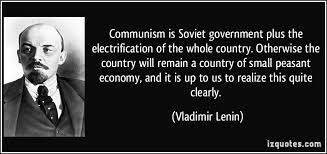
The dam built on the Dnieper River from 1927 was the biggest hydro-electric station in Europe and was consistent with Lenin’s slogan: ‘Communism is soviet power plus electrification’.

lenin electrification soviet

New cities were built, most notably Magnitogorsk, which was based on iron ore mining and steel production. Hundreds of experts were brought in as advisers, including Americans, as the city was to be based on US steel-cities, Gary (Indiana) and Pittsburgh (Pennsylvania).

Roads, railways, canals also helped move Russia and the Soviet Union further from the feudal era of the ox-drawn plough. The Volga-Don Canal and the White Sea-Baltic Sea Canal were achievements of a system in which need and progress motivate planning and production. And, in 1954, the Soviet Union became the first country in the world to harness nuclear power for peaceful use, with the operation of the APS-1 nuclear power plant at Obninsk, the ‘Science City’.

This material progress, the application of human ingenuity in the creative-destructive transformation of Nature through labour, is a key reason as to why so many working class people in the west were attracted to socialism.

If the unleashing of the productive forces in a backward economy like Russia in the early C20th could produce such results via social ownership, then what could be achieved under socialism in the advanced industrial west where progress was held back by concentrated private ownership of the means of production and the pursuit of maximum profit for those private owners as the goal of production?

Despite the restoration of capitalism in the Soviet Union in the 1950s and 1960s, these questions remain. They just need to be put back on the agenda of public discourse. Instead, we can expect the same old ritualistic denunciations based on the false premise that ‘the History is settled’.

Thanks for all the fish…

This has been timely for many years/decades, but more so now. (Anyone for gin?)

* * * *

Douglas Adams

“It comes from a very ancient democracy, you see…”


“You mean, it comes from a world of lizards?”


“No,” said Ford, who by this time was a little more rational and coherent than he had been, having finally had the coffee forced down him, “nothing so simple. Nothing anything like so straightforward.


On its world, the people are people. The leaders are lizards. The people hate the lizards and the lizards rule the people.”
“Odd,” said Arthur, “I thought you said it was a democracy.”


“I did,” said Ford. “It is.”


“So,” said Arthur, hoping he wasn’t sounding ridiculously obtuse, “why don’t people get rid of the lizards?”


“It honestly doesn’t occur to them,” said Ford. “They’ve all got the vote, so they all pretty much assume that the government they’ve voted in more or less approximates to the government they want.”


“You mean they actually vote for the lizards?”


“Oh yes,” said Ford with a shrug, “of course.”


“But,” said Arthur, going for the big one again, “why?”


“Because if they didn’t vote for a lizard,” said Ford, “the wrong lizard might get in.

Got any gin?”


“What?”


“I said,” said Ford, with an increasing air of urgency creeping into his voice, “have you got any gin?”


“I’ll look. Tell me about the lizards.”


Ford shrugged again.


“Some people say that the lizards are the best thing that ever happenned to them,” he said. “They’re completely wrong of course, completely and utterly wrong, but someone’s got to say it.”


“But that’s terrible,” said Arthur.


“Listen, bud,” said Ford, “if I had one Altairian dollar for every time I heard one bit of the Universe look at another bit of the Universe and say ‘That’s terrible’ I wouldn’t be sitting here like a lemon looking for a gin.”


― Douglas AdamsSo Long, and Thanks for All the Fish

Celebrating the Russian revolution

default (1)

Eye-witness accounts

The terrible conditions inherited by the Bolsheviks from Tsardom

The specific achievements under socialism

Homeless children 1927

‘Comrade’ Coal in the hands of the people

Baku oil fields

Women in Muslim-dominated parts of the Soviet

Basis laid for rapid industrialisation in first Five Year Plan

* * * *

The Russian revolution may be 100 years old but reactionaries of all stripes, if they must see it at all, want to see it dead and rotting. In this state its use to them is in glorifying its actual and putative failures and turning a blind eye to its successes.

If the communists and their allies were able to achieve what they did in such backward conditions, what is that saying about the bourgeoisie today? Slovenly, past their use by date and basically backward (lift your game or get out of the way!)

Bourgeois leadership may have been fine against the feudalists. However it was pretty pathetic in Russia and China – to the point where the proletarian parties had to do it for them and did a vastly better job in the process. This last point is an irony of significance. And that’s the point about the advances of the 1920’s in the USSR: they need to ‘live’ and be exciting for us now – and be used as a contemporary point of comparison.

‘It is true. There was a failure. However, it was not of communism, but rather of an attempt to sustain a path towards it when its preconditions were absent. Russia in 1917 and virtually all the “communist” regimes established mid-century were essentially backward pre-capitalist societies. Most people were peasants rather than proletarians, and they were more interested in land for the tiller than social ownership.

‘There was little modern industry and thinking was more medieval than modern. They had not passed through the capitalist stage, which is necessary for a successful communist revolution. As the experience of other backward countries shows, even getting capitalism off the ground under these circumstances is hard enough, let alone a society that aims to supersede it’.*

* * * *

Eye-witness accounts

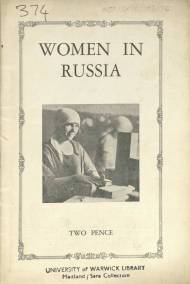
In browsing on the topic of the Russian revolution, I came across a 40 page pamphlet, Women in Russia. It was published by the Communist Party of Great Britain in 1928 and reveals some of the changes and improvements in everyday life for women in Russia in the short space of ten years after the revolution.

women in russia

Karl Marx once said that you can measure the progress of a society by looking at the condition of women within it and that great social changes were not possible without ‘the feminine ferment’. I think he was – and is – right.

The pamphlet is the report by a group of five English women who visited Russia on the occasion of the revolution’s first decade to see what was happening. They were Beth Turner, Rose Smith, Lily Webb, Fanny Deakin and Florence Maxwell.

I can’t find out much about them individually, except for Fanny Deakin who at some point in time joined the Communist Party. Fanny was also a graduate with distinction from the ‘University of Life and Hard Knocks’. The Working Class Movement Library outlines her story thus:

Fanny Deakin (1883–1968) was a lifelong activist from Silverdale in the North Staffordshire coalfield. Of the five children born to her marriage with Noah Deakin, only one survived into adulthood.  This experience, typical of that of many working class communities, led to lifetime campaigning for better maternity services.  But her political involvement incorporated membership of the Independent Labour Party, the Labour Party and, later, the Communist Party.  Her political experience was shaped by disputes in local collieries and, above all, by the 1926 General Strike where Fanny was involved in leading processions, holding protests and speaking at large gatherings. Her motivation was summed up as ‘Fighting for the Mothers’.

The five women visited Leningrad, Moscow, Kharkov and Baku in order to learn about health services, kindergartens, birth control and abortion. They also visited coalfields in the Don Basin and the newly developed oilfields in Azerbaijan. Their trip was funded by local collections in England.

If you want to know why so many working class people around the world were pro-communist or pro-Soviet back then, before the restoration of capitalism in the Soviet Union and the development of today’s openly authoritarian oligarchy, ‘Women in Russia’ is one among many eye-witness accounts that helps explain the reasons.

Women had fought in the revolution and in the civil war. During the latter, for instance, 14,000 women took part in the military defence of Leningrad against the ‘White’ army forces of the anti-communist anti-Semite General Yudenich.

Women’s liberation from feudal autocracy was a promise of the revolution, and it was certainly achieved.

****

The terrible conditions inherited by the Bolsheviks from Tsardom

In the decade after the Bolshevik-led victory, many foreign delegations visited to see for themselves what was happening, including some from the United Kingdom, which was geographically close and had a great militant working class socialist tradition of its own.

Could the seizure of state power by the Bolsheviks, the redistribution of land and the taking over of the principal means of production by the workers, lead to anything good? It’s amazing what was achieved so quickly, given the obstacles.

The mass poverty and suffering under Tsarist autocracy was bad enough – the Bolshevik-led government in 1917 was starting off under terrible socio-economic conditions. Russia was very backward economically with little industry.

And then, with the revolution’s success, a civil war instigated by the anti-communists in Russia and supported militarily by more than a dozen western governments made things extremely difficult for the new socialist government. About 8 million people were killed in the civil war, for which responsibility lay with the instigators. In the areas controlled by the anti-communist ‘White’ armies, such as the Ukraine, massacres were carried out by the ‘Whites’ against communists and Jews.

On top of that, Britain and its War allies blockaded Russia from 1918 to 1920, making trade (and the wealth arising from it) impossible.

In 1921, to make matters even worse (if that were possible), lack of rainfall led to famine.

Yet, under conditions of social ownership based on workers’ control, with production geared to social need rather than private profit, much progress was achieved.

****

The specific achievements under socialism

The five English women properly contrasted the things they saw and experienced in Russia in 1927 to what they understood about conditions prior to the revolution:

In comparison with pre-revolution standards and conditions, the lot of the workers and peasants has improved almost beyond belief and is still on the upgrade.

Among the changes introduced by the Soviet government that particularly impressed the women were:

Equal pay for equal work enforced.

Laws against child labour. No child under 14 could be employed and those aged between 14 and 16 could not work more than four hours a day.

Allowance for single mothers. Unheard of in Tsarist times, the revolutionary government compelled fathers to pay one-third of their income in child support.

Birth control information was freely available and ‘secret abortion’ (what we would call ‘backyard abortion’) was countered by the provision of ‘skilled medical assistance’.

Workers’ committees established in each factory to make decisions, including the power to recall foremen and bosses. (In the Rabotchi textile factory which the women visited, the factory committee was dominated by women workers. The factory employed 5,750 workers and was previously owned by English capitalists. Under workers’ control, the factory abolished the humiliating practice of fines for lateness and introduced a medical clinic, crèche and kindergarten, subsidised meals, study groups, a library, games, sporting activity and a theatre).

Reduction of the working day from 10-and-a-half hours to 8 hours, with plans to reduce it to 7 hours in 1928. (This happened in January 1929).

Child care. Any workplace with more than 40 workers had to provide a crèche for the children of parents in the factory (paid for by the industry). Larger factories had kindergartens as well.

Free health care, including dentistry, introduced, with a program of new clinics and hospitals being built in cities and towns.

Expansion of maternity hospitals – 12,221 new ones built between 1917 and 1927.

– ‘Mother and child institutes’ set up to provide pre- and post-natal care.

– Conversion of the mansions and palaces of the rich into ‘rest homes’ for the workers.

Maternity leave. Workers received two months leave on full pay plus an allowance for staying at home to nurse the baby for nine months.

– Attachment of vocational schools to some large factories.

– Provision of rent-free accommodation for workers in places where factories owned the residences.

Free travel on public transport for workers who lived far from their workplaces.

– Programs introduced to improve health and safety in the workplaces, such as regular health checks, ventilation, drinking fountains and appropriate work clothing.

Expansion of formal education. In 1914, there were seven million children at primary school. In 1927, there were 10 million. In 1914, Russia had 90 universities. In 1927, there were 136.

Consumer co-operatives. Retail shops set up, with 15 million share-holders, along with state shops, accounted for 80% of business transactions.

* * * *

Homeless children

The ‘big enduring problem’ observed by the women in Russia was ‘one of the biggest problems’: homeless children. These were children ‘orphaned by war, famine and blockade’. The issue had been taken up by Lenin’s wife, Krupskaya, and was, in part, a cultural problem. The children ‘prefer to roam about in bands… the wanderlust is in their blood’.

The state was trying to assist them, however, and the five women visited a former monastery that was now being used as a home for vagrant children. The chapel was still being used for religious purposes.

‘Comrade’ Coal in the hands of the people

As some of the women came from coal mining families and areas, they were also able to compare with the situation in England, as they experienced it. They visited two coal mines in the Don Basin and were favourably impressed. The Russian miners, for instance, worked a 6 hour day or an 8 hour day depending on the depth at which they worked underground. Under the Tsar, it was either 10-and-a-half or 12 hour day.

The mine workers enjoyed a month off each year, on full pay, whereas in England, the women said, coal miners dreaded holidays as it meant financial hardship. Fanny Deakin knew this from experience, as her husband was a coal miner.

Mine workers mostly lived in new housing developments, which the women said were based on the ‘English garden cities’, near the mines.

Under workers’ control, every pit-yard had a medical clinic and health-and-safety inspectors were brought in, for the first time. Medical treatment was free – an impossibility under the old order.

Work gear was also supplied free of charge, and mine workers retired at the age of 55 on a pension. When in between jobs, miners received ‘generous’ unemployment insurance.

Unlike under capitalism, coal production was increasing in the Soviet Union because of modernisation, not because of the workers being compelled to work faster.

Experts from Germany were recruited by the Soviet government to assist with new mines that were being sunk and the construction of power plants to supply electricity to areas that had lacked it.

****

Baku oil fields

The women visited part of the Baku oil field, and this is what they experienced:

In Baku we saw oilfields of enormous extent. They cover over a hundred square miles. Oil is exported from here to India, France, Britain, Italy, Turkey, Persia and America, and the wells now dug will last for fifty years.

Fabulous wealth is represented in this wonderful oilfield, and it is easy to see why it is coveted by the British capitalists.

On our way, we saw the place where the British General Thomas set fire to several oil tanks in 1917, when he was compelled to retreat. He blew up many buildings and a large part of the population.

When capitalists owned the oilfield, the workers were housed in mud huts without windows — places that reminded us of the middens in some of our English slums.

Now, 20,000 men are employed erecting houses. On one estate alone, accommodation has been provided for 10,000 families. Rents average 1s. 6d. a week, and each group of houses has an up-to-date wash-house and each estate its own social club for recreation.

The houses are built in family flats on the American style, each with its verandah… Gas, electricity and heating are all free. The average wage is about 35s. a week.

The workers have, in addition, many benefits from social insurance for which there are no deductions from their wages. When they are ill, they receive full pay for a month. Women get eight roubles a month (4s. a week) for nine months while nursing a baby, and 30 roubles (£3) at their confinement. At death, 45 roubles (£4 10s.) is paid for funeral expenses.

****

Women in Muslim-dominated parts of the Soviet

The report says:

It was in their work amongst the Eastern peoples, particularly the women, that the Bolsheviks encountered some of their most serious difficulties.

A backward and illiterate population, bound by superstition, religion and prejudice to keep its women in a state of seclusion, hidden from the eyes of men, bought and sold like cattle, subject to the whims and wishes of their husbands, had to be made to realise that the revolution had come, bringing with it freedom for women as well as men.

Under the influence of Bolshevik organisers tens of thousands of Eastern women threw off the “parandjak,” a hideous black veil of horsehair they had previously been compelled to wear when walking abroad, and dared to show their faces unveiled.

Although this was but a symbol of their new-found freedom, it was strenuously resisted by the priests and wealthy peasants. Women were beaten, in some cases to death, and murder and violence were frequent. Some of the organisers themselves met their death at the hands of the infuriated men.

Laws had to be passed for the protection of women who dared to unveil themselves, and funds were raised for the relief of the families of those who were killed during the campaign.

In spite of these difficulties the work progressed, and Eastern women are being drawn into the work of the co-operatives, the factories and even of the Soviets. In 1926-7 some 951,812 Eastern women took part in the elections to the rural Soviets, and 36,258 were elected as members of the Soviets.

****

Basis laid for rapid industrialisation in first Five Year Plan

The progress made in the first decade laid the basis for the first Five Year Plan adopted in 1928, which saw further rapid progress in the economic and social realms. The successes of the first 5 Year Plan influenced US President Roosevelt’s decision to officially recognize the Soviet Union in 1933.

****


Guy Fawkes – Reactionary who tried to return England to the tyranny of the Pope

The Gun Powder Plot was not, in any reasonable sense of the word, revolutionary. It was counter revolutionary in the strictest interpretation. The English Reformation was a social revolution that freed Britain from Papal tyranny. Under Queen Elizabeth I, the old Norman aristocracy lost their influence in favor of the new merchant class.
I’m re-running this one for Guy Fawkes’ Day. (Sorry – a day late).


I was planning to write a piece about Guy Fawkes for 5th November but in googling some sources came across this excellent piece by Bill Dunlap that says it all from my point of view. Bill ran the piece on his blog, Grumblings from a grumpy old man, in 2008 and has kindly given me permission to republish it. Like Bill, “I cannot for the life of me figure out how Guy Fawkes became a symbol of revolution”.

guy fawkes

****

I cannot for the life of me figure out how Guy Fawkes became a symbol of revolution. I see all these anarchist types wandering around with their V masks, and I wonder if they even know who Guy Fawkes really is? It baffles me why a reactionary like Fawkes has been so heartily adopted by the American left. Why did the main character of V for Vendetta wear a V mask rather than a Che mask, or a Lenin mask, or even an Abbie Hoffman mask? Why Guy Fawkes, for the love of heaven?

The Gun Powder Plot was not, in any reasonable sense of the word, revolutionary. It was counter revolutionary in the strictest interpretation. The English Reformation was a social revolution that freed Britain from Papal tyranny. Under Queen Elizabeth I, the old Norman aristocracy lost their influence in favor of the new merchant class. Guy Fawkes himself was the son of an upwardly mobile middle class Protestant family. His father was a minor official in the Church of England, and his mother was the daughter of a dry goods merchant. Fawkes’s conversion to Catholicism may have stemmed from teen rebellion.

Guy Fawkes and his fellow Gunpowder Plotters wanted to destroy the new Church of England and return England to Papal control. How can this possibly be seen as revolutionary? Despite popular belief, Guy Fawkes was not the ringleader. That dubious honor went to a hereditary Catholic by the name of Robert Catesby. The Gunpowder Plot could have been thought up by Sir Edmund Blackadder. The conspirators rented a house next to the Winchester Complex, planning to mine beneath the House of Lords, pack it with gunpowder and blow it up during Parliament’s opening session. That way they could get King James, most of his court and family, and all the influential Protestant nobles. The opening of Parliament was delayed three times on account of the Black Plague, yet the tunnel was still not completed. So they rented the cellar beneath the House of Lords and stocked that with gunpowder instead.

If Robert Catesby was Blackadder, then Guy Fawkes was Baldric. Even though Fawkes knew that the plot had been revealed by a Catholic nobleman who was appalled at the plot, he tried to go through with it anyway. The guards were looking for him. They caught him in the cellar with 32 kegs of gunpowder and with fuses and matches in his pocket. He still tried to lie his way out of it. He was taken to the Tower of London and tortured while his buddies epically failed at getting away.

That was the historic Guy Fawkes. He was not the great defender of freedom as portrayed in V for Vendetta. He was an expendable flunky in a hare-brained plot to stop the wheels of progress and to return England to the “good old days” of Papal domination. The only advantage to that would have been to the Catholic nobles such as Robert Catesby, who wanted their old power and influence back. Fawkes himself became a figure of ridicule amongst the British, as shown by this rhyme.

Remember, remember the fifth of November
It’s Gunpowder Plot, we never forgot
Put your hand in your pocket and pull out your purse
A ha’penny or a penny will do you no harm
Who’s that knocking at the window?
Who’s that knocking at the door?
It’s little Mary Ann with a candle in her hand
And she’s going down the cellar for some coal

Guy Fawkes became identified with the Anarchist movement in the early 20th Century. British Anarchists put up posters with the modern stylized sketch of Fawkes, declaring that Guy Fawkes was the only man to enter Parliament with honest intent. This was, of course, using Guy Fawkes as a figure of ridicule. It was meant as a sort of black joke. Somebody lacking a sense of humor started taking the joke seriously, and the next thing we knew, we had V for Vendetta, and kids wearing Guy Fawkes masks in honor of a man who was trying to put Britain back under Papal control.

The irony is that these kids in their Guy Fawkes masks are pretty well accomplishing what Fawkes set out to do. They want to destroy government control without replacing the structures that have been destroyed. In this they actually share the same goals as their neocon opponents. The result is that money rushes in to fill the vacuum left by the lost structures. The more government is torn down, the more control falls into the hands of those who have the most money. This has been going on for twenty eight years and nobody has yet figured out that our loss of civil liberties is equal to the amount of government regulations that have been eliminated. The American left has not figured out that tearing down the government is a bad idea which will accomplish the opposite of what we want. The bad guy in V for Vendetta said at the people need to realize that the people need the government. This is very true. A dear friend of mine, who is a big V for Vendetta fan, adds that the government needs the people’s consent in order to govern. This is equally true. Government and the people exist in a symbiotic relationship. When that symbiosis fall out of balance, disasters like the present economic melt down occurs.

This leads us to the present cult of the Constitution. America has become as conservative as the conspirators of the Gunpowder Plot. The American left has not yet realized that by trying to return us to the original Constitution, they want to return us to the times when only property owners were citizens and could vote. Women were chattel, and African Americans were bought and sold like cattle. America has grown beyond those times, and trying to return us to them is only going to place Wall St. in charge of our lives. Looking backwards, even to the days of the American Revolution, is as reactionary as the Gunpowder Plot. There is also the truth that it is easier to destroy what we have in a vain attempt to make the clock move backwards, than it is to build. The more we destroy the government, the more of our civil liberties fall into the hands of Wall St. The only logical step is to rebuild the Government into what we want it to be.

This is perfectly Constitutional. The Constitution was never meant to be Holy writ, nor is it a mortal sin to change and revise it. The writers of the Constitution knew fully well that the world changes. They wrote the Constitution in order to deal with the changing conditions of their own time. They knew the world would continue to change, and built structures of change right into the Constitution. Hence the constitution was changed to allow all economic classes to vote. In 1971, Richard M. Nixon signed an amendment that changed the voting age from 21 to 18. Women won the vote in the early 20th Century. African Americans were freed by a Constitutional amendment. We have all the tools we need to change the government back into what we want it to be. All we need now is a plan.

Planning is the difference between revolutionaries like Jefferson and Burr and morons like Catesby and Fawkes. Rather than have some vague idea about returning the country to what Tom Jefferson wanted, we need a clear idea of what we want and need as a nation. There were many movements which had clear and precise goals as to what they wanted the government to be. The Labor movement, the Suffragist movement, and the Civil Rights movement are three clear examples of revolutionary movements that have changed the nation. Despite the best efforts of the neocons and their religious lapdogs, we still enjoy many of the benefits we gained from those movements.

Remember that the Constitution was written to be an instrument of the will of the people and not chains to bind us to a past age. Trying to return the Constitution to the days of the founders is like Guy Fawkes trying to return England to the tyranny of the Pope. It simply cannot be done. Maybe Guy Fawkes is really the appropriate symbol for the 21st Century American left, as they lead us to the future with their asses firmly in front of them.

A penny loaf to feed the Pope
Hip hip hoorah hoorah!
A farthing o’ cheese to choke him.
Hip hip hoorah!
Then we’ll say ol’ Pope is dead.
A pint of beer to rinse it down.
A fagot of sticks to burn him.
Burn him in a tub of tar.
Burn him like a blazing star.
Burn his body from his head.

*****