Opening the borders – is it really unpopular?

The notion of opening borders is no longer a fringe idea of those on the Marxist Left and classical liberal Right. It has been implemented by Europe’s power-house and, to her great credit, Germany’s Chancellor Merkel is standing by her policy. And recent state elections and opinion polls show that the German people are not repudiating her. 

open borders x


* * * *

The Christian Democrat Chancellor of Germany, Angela Merkel, opened Germany’s borders to more than a million asylum seekers, mostly those fleeing the barrel bombs of the fascist regime in Syria.

The recent elections in three German states resulted in a new right-wing party, the AfD (Alternative fur Deutschland) which opposes the ‘open borders’ policy, receiving 25% of the vote in one electorate, 15% and 12% in the other two.

Googling ‘Merkel’ and ‘elections’, the headlines overwhelmingly suggest this is a defeat for Merkel’s open borders policy: a “disaster” for her. She has been “punished” by the voters for her open borders’ stance. So say the media headlines.

Yet further examination of the actual results in the three electorates – Saxony-Anhalt, Rhineland-Palatinate and Baden-Wuerttenberg – indicate that the results are a defeat for those who claimed the new party represents the silent majority.

In the elections, opponents of Merkel’s policy had their chance to test public opinion. And the result shows that they are marginal, averaging less than 15% of the vote.

It is true that the Christian Democrats, Merkel’s party, were defeated in Baden-Wuerttenberg. But they lost to the Green Party, which supported Merkel’s policy. Yes, they lost in Rhineland-Palatinate to the Social Democrats but the Christian Democrat candidate, Julia Klockner, stood as an opponent of her party leader’s open borders stance. The Social Democrat candidate was more favourably disposed to it.

In Saxony-Anhalt, the AfD did well with a quarter of the vote, but Merkel’s party came first with only a minor reduction in the Christian Democrat vote.

Moreover, opinion polls find that Merkel’s popularity hovers around the 50% mark. Currently, her approval rating is 54%.

A poll of voters about refugee policy in the three electorates found that Merkel’s approval rating is 58% in Rhineland-Palatinate, 54% in Baden-Wuerttenberg and 43% in Sachsen-Anhalt.

So, here we have a Chancellor who has shown that borders can be opened and, despite the inevitable chaos, the masses do not run from that Chancellor and her policy in anger and fear. Only a minority does that.

What Merkel has done is to change the paradigm of the debate over immigration and borders. Not just in Germany but everywhere.

The notion of opening borders is no longer a fringe idea of those on the Marxist Left and classical liberal Right. It has been implemented by Europe’s power-house and, to her great credit, Chancellor Merkel is standing by her policy. And the German people are not repudiating her.

She understands that ‘they’ are ‘us’ and ‘we’ are ‘they’, and that sharing the chaos does not preclude supporting measures to tackle the problem at its main source: the Assad regime.

She recently said that a million people is not many when you consider that Europe’s population is 500 million. The pity is that other governments are closing their borders rather than sharing the chaos caused by barrel bombs in a not-too-distant land.

Syria – Partial ceasefire has saved lives, but still a long way to go…

It will inevitably require boots on the ground to enforce a more complete ceasefire and for the transition to free and fair elections in Syria late next year.

* * * *

The following is from the Syria Campaign.

Dear Friend,

“Can you hear that? … It’s the birds singing…” That’s what one of the rescue heroes of the White Helmets said over the radio on the first day of the partial ceasefire in Syria.

Over the past few days there have been dozens of violations of this break in the fighting. We’ve been reporting sniper fire, barrel bombs and Russian air raids.[1] But while the violence has not stopped, it has reduced. And that means innocent civilians that would otherwise have been killed in the extreme carnage of Syria are still alive today. In short, the partial ceasefire has saved lives.

But right now the ceasefire is extremely fragile and it’s not just the violence that endangers it.

A key part of the agreement negotiated by the US and Russia was that aid would be delivered to areas under horrific ‘starvation sieges’ at the start of the ceasefire. This hasn’t been honoured. The Assad regime which is denying access to 99% of those under siege in Syria continues to block aid trucks.[2] Apart from a few small deliveries by the UN to some areas, the vast majority of those going hungry have seen nothing. In one of the worst hit towns, Daraya, many are on the very edge of starvation.

The continued denial of aid to besieged areas is a major breach of the ceasefire and threatens the whole agreement.

But there is something we can do. Tomorrow, in less than 24 hours, the most powerful countries in the world that make up the international “Humanitarian Task Force” on Syria will meet in Geneva to negotiate aid delivery.

These are diplomats and politicians that respond to public scrutiny and together have sway over the Assad regime. If they feel the pressure from the world outside their negotiation room, they will push harder to get this aid in. It’s the best hope of keeping this fragile ceasefire alive.

Take a moment to sign this urgent petition to the Humanitarian Task Force to ensure aid delivery to besieged areas like Daraya today. Let them know we’re watching:

http://act.thesyriacampaign.org/sign/save-ceasefire/

In solidarity,

James

NOTES

[1] We’ve been monitoring possible violations of the ceasefire at www.syriaceasefiremonitor.org

[2] Read more about the situation of sieges in Syria at http://www.breakthesieges.org

Syria’s bourgeois-democratic revolution and the need for boots on the ground.

I share the following view by the Antiwar Committee in Solidarity with the Struggle for Selfdetermination but the important question is how can any decisions arising from the negotiations be enforced and maintained without a military force on the ground that is committed to enforcing and maintaining the transition.

The question of ‘boots on the ground’ needs to be tackled pro-actively by the governments and the UN that established the opportunity presented by the coming negotiations.

Boots on the ground that are sympathetic to the Syrian people would make delivery of humanitarian supplies more likely on the scale that is required.

Apart from needing to protect Syrians from the likes of Daesh, a military coalition on the ground (and backed by air support) will be necessary to guarantee that people can vote freely and to protect the Assad loyalists among the Alawite community once he is tossed out.

Comments welcome.


11055328_621048241328691_7043512423930289502_o


* * * *


We support efforts by the High Negotiations Committee of the Syrian Opposition to negotiate a political settlement which will lead to a transitional governing body, and to human rights for all, rule of law, and democracy for Syria. Given the scale of documented atrocities carried out by the Assad regime, it follows that such a process must bring an end to regime rule.

We further support the demand by the High Negotiations Committee that the international community implement in full the humanitarian provisions of UN Security Council Resolution 2254 prior to negotiations.

The current Geneva III Conference has begun against a background of escalating Russian and regime bombardment of populated areas and civilian infrastructure, escalating starvation sieges, and ongoing mass detention and torture of political prisoners.

UN Security Council Resolution 2254, which set out the international endorsement for these talks, called on the parties to “allow immediate, humanitarian assistance to reach all people in need, in particular in all besieged and hard-to-reach areas, release any arbitrarily detained persons, particularly women and children,” and demanded the full implementation of the long list of unenforced Security Council resolutions on Syria: 2139 (2014), 2165 (2014), 2191 (2014) and any other applicable resolutions.

Resolution 2254 further demanded “that all parties immediately cease any attacks against civilians and civilian objects as such, including attacks against medical facilities and personnel, and any indiscriminate use of weapons, including through shelling and aerial bombardment.”

These items are the express will of the Security Council and as such are not for negotiation between parties. The international community should never preside over a process where humanitarian relief is allowed to be used as a card in political negotiation.

As long as the international community fails to enforce its own resolutions, the Syrian people can have little faith in the peace process. If the international community can’t deliver baby milk to besieged areas, how can they be trusted to deliver free and fair elections?

For peace talks to succeed, the international community must implement the humanitarian provisions of its own UN Security Council Resolution 2254 in full

The battle for democracy

David McMullen wrote a very good post last month at his new site, Different Wavelength, and has given me permission to republish it below.

Among the best sites for keeping tabs on democratic progress or otherwise are:

Freedom House

Human Rights Watch

Reporters without borders

Amnesty International

Electronic Frontiers

Transparency International

(Let me know of any that should be added to the list!)

* * * *


We have had quite a bit of progress on the democratic front in recent decades although there are still some very big and serious challenges.

Let us look first at the progress. Latin America is no longer run by military dictators and they are becoming the exception in sub-Saharan Africa. Then of course there is eastern Europe where most countries are now democracies.

However, the picture is still pretty grim when we consider the continuing extent of tyranny.

In Russia, democracy is more formality than substance and most the other states of the former Soviet Union are rather dodgy or downright nasty.

China is a police state. Dissidents are jailed. The Internet as we know it does not exist. Lots of western news sites are blocked. There is no Facebook, Twitter or YouTube. And they employ an army of censors taking down anything taboo. And by the way, North Korea only exists because of Chinese support.

Then we have the Middle East. It has more than its fair share of tyrannies and authoritarian governments. At the risk of seeming perverse, I would suggest that the present civil war in Syria could indeed be a bright spot on the democratic front. This will depend on the Western powers recognizing that their inevitable intervention can only end the civil war if it brings democracy.

* * * *


Marx’s moral theory (via Bill Kerr)

Thanks to Bill Kerr for permission to republish this.

****

HUMAN ESSENCE

If there is such as thing as human essence and we can discover what it is then that will go a long way towards developing a moral theory.

Human nature is part biological, part social and not religious. Religion is something to be explained rather than believed. This includes modern religions such as Nature worship (currently popular) and Marx worship (currently marginalised).

Humans have both needs and powers. Obviously, it follows that we are both needy and powerful and both of these aspects of being human need to be explored further.

The biological and social parts are connected or interact dialectically. It would be an error to see them in isolation from each other.

Fundamental biological needs include eating, drinking, habitation, clothing, sexuality …

Biological and Social. Humans produce their own existence / material life through social labour. Our biology allows this, eg. Opposable thumb, upright posture frees the hand, large brain. This separates us from other animals. Compared to other animals we are self conscious and wilful to a qualitatively different degree. Although we originate as part of nature, with our social labour we oppose nature. Our productivity is also imaginative. We imaginatively and self consciously transform nature and in that process also transform ourselves. This is a teleological process. Humans imagine new forms of the material and self and then through social labour bring that imagination into reality. This is human essence.

THE GUIDING MORAL PRINCIPLE

The guiding moral principle is to do whatever is required for the human flourishing of rich individuals, to dynamically expand human powers for all humans. Human flourishing is not original to Marx but Marx built on the best available ideas that came before him, those of Aristotle.

Marx and Engels were more aware than Aristotle about the role of social labour in this enrichment process. After all, Aristotle lived in a slave society. Refer Engels, The Part Played by Labour in the Transition from Ape to Man. In communist society there would not be a division of labour based around the supply and demand of the labour market. In a world where production for the needs of all is established then each individual would be free to pursue their own perceived interests.

PHILOSOPHICAL STANCE

The philosophical stance here is to investigate what is distinctive about humans (biologically and socially) and from that basis to articulate what a good or rich life is.

ONTOLOGY

Be clear about where our moral principles come from. Being determines consciousness. Matter is philosophically prior to ideas.

The theory is philosophically materialist. It starts from real people and real conditions. It ascends from earth to heaven, not descends from heaven to earth.

But, once we are in heaven how do we get back down to earth again? The only way is to make a detailed study of society in all its aspects. Mode of production, division of labour, social classes, Is there a surplus and who controls it?, the history of knowledge, current issues, individual self knowledge. There is a lot to know! The desirable actions that promote the best human nature at any point in history depends on the depth and perspicacity of such an analysis.

CAPITALISM and ALIENATION

Capitalist limitations. For the capitalist, because they own the means of production, the workers life activity becomes a mere use value. In general, workers have no direct stake in the products they produce. Temporary niche solutions may be possible for individual workers but overall work loses it human character. In class society, the economy operates as a thing more or less outside of human control. If there is no profit to be made then production grinds to a halt. There maybe poorly understood economic laws. But the best that could be said of capitalism is that it is a highly unstable system in which the future well being of the workers who make it is uncertain and problematic.

Capitalism gives labour a bad feel (alienation) and production a bad name. Under capitalism humans are alienated from their essence, their living social labour, since the capitalists own the means of production and determines which products are made and who owns those products.

The capitalist economy is an unstable monster, poorly understood, difficult to manage and continually spinning out of control. Workers are alienated from the products they produce. Creative people who produce things of beauty (some artists, some writers, some teachers etc) are often not seen or appreciated as typical workers, rather they are marginalised workers looking for a niche to survive in a system that systematically undermines them. Or a handful may become megastar celebrities who play a significant role in entertaining the masses. Moreover, many believe today that capitalist production is despoiling the environment at an alarming rate. I think there is some truth to this latter charge, although I also see talk of environmental Armageddon as exaggerated and a distraction from the main wrongs of our society.

These issues in combination (production for profit not human need) give production itself a bad name. Human essence, social labour, life’s prime want, is reduced to being a wage plug, without a real say in the overall progression of society.

Rather than saving the planet (the current “left” mainstream zeitgeist) we need to focus more on how to liberate the social productive forces, human essence, in all their real power and beauty. A power and beauty which is obscured by the ugliness of capitalism.

NATURAL NATURE

The natural world is the world created by humans, who are part of nature, as well as the world that existed before humans. The natural world is not “green” insofar as that suggests a world not touched by humans. Such a world no longer really exists on Earth. In a post natural world (aka the anthropocene) our needs will be created more by what we make than the natural world that exists independently of what we make.

As society evolves our tastes, including our basic biological tastes, become more sophisticated: “the forming of the 5 senses is a labour of the entire history of the world” (source)

THE SCOPE OF MORAL THEORY

A moral theory has to somehow account for all human moral thinking, good and bad, angelic and evil, noble and perverse, optimistic and pessimistic. But Marx’s moral theory is (intentionally?) thin. It does not claim or suggest that humans are any of essentially selfish, altruistic, competitive, fallen, vicious etc. Is this a feature or a bug? In my view Marx is right about the essentials but there is a lot of stuff that is not covered. Marx analyses the deep structure of capitalist society but there are important issues that lie more on the surface (eg. the dark and deep emotions such as love, grief, anger) that strongly motivate individual actions but are left hanging. Hence, many people find that other moral philosophers and novelists address their needs more directly.

UTOPIANS and OTHER ALTERNATIVES

Utopians make the error of promoting general moral principles in the abstract, without regard to the current real state of society, without assessing the social forces at play. They are not realistic. Mere moral persuasion in favour of a better society is inadequate / doesn’t work.

There are many alternative moral theories. For example Plato (Iris Murdoch provides a modern interpretation), Stoic, Christian (various branches), Kantian, Utilitarian (Bentham and JS Mill provide different interpretations), feminism / women’s liberation, Buddhism (meditation and mindfulness are currently popular), existentialism, libertarianism, animal liberation, Sufism (adopted by Doris Lessing after her disillusion with communism), pragmatism (Dewey, Putnam), the liberal Capabilities approach of Amartya Sen and Martha Nussbaum.

All of these need to be critically examined since what is correct only emerges clearly from a critique of such alternatives. At this stage I would say that none of these alternatives share with Marx the view that human essence is the conscious production of our existence / material life through social labour. Moreover, they tend to be indifferent to the analysis that the main current problems are generated by capitalism.

INDIVIDUALS and SOCIAL CLASS

Humans are self conscious, intelligent, purposive, active, self directed. But this doesn’t mean we can negate the so called “external world” (only external to humans, who are a part of nature, so not really external to nature in that broader sense of the word) or history.

Human individuality (as distinct from herd or tribal mentality) emerges historically from the bourgeois revolution against feudal relations (when it was “natural” to obey a preordained superior such as a lord or king). Herds are not good at shopping, whereas individuals are. But just as individuality emerges strongly in the capitalist era, you would expect it to also change dramatically in a post capitalist society.

In class society, social class is a more important determiner of who we are than individuality as such. Individuals pick their personalities, interests, work etc. from what is available socially (including the cutting edge, futuristic and off beat, quirky trends) at the time. The idea that we are free, autonomous individuals is more part of capitalist mythology or ideology than reality.

HISTORY

Morality is historically contingent. What is moral in one historical period becomes immoral in another. The central issue is doing whatever is required to maximise the human flourishing of rich individuals in the given time and place.

For example, in the French revolution the rising bourgeois class overthrew feudal relations, got rid of divine rule by the King etc. In that historical period bourgeois right coincided with the needs of the proletariat as well. But at a later date the bourgeois class held things back, became reactionary, used social labour for their own ends, promoted an economic system which went through periodic crises and still does. At that point the revolution to continue human liberation and the liberation of the productive forces must be picked up by the proletariat, sooner or later.

Given the views expressed here about ontology (materialists need to deeply investigate reality) and history (morality is historically contingent) it follows that to work out the best moral – political actions requires some hard work. No one said it would be easy.

TRANSITION FROM CAPITALISM TO COMMUNISM (SOCIALISM)

The productive forces developing within bourgeois society create the material conditions (preconditions?) for the solution to the problem of the antagonism of the individuals social conditions of existence. Big is beautiful, not small is beautiful (the latter from EF Schumacher). Not because capitalism is beautiful but because big, centralised production prepares the way for socialism.

COMMUNISM

Marx is grounded, not utopian. In The German Ideology, Marx rejects the idea of communism as “an ideal to which reality will have to adjust itself”, rather he sees it as “the real movement which abolishes the present state of things”

This is pretty much the opposite of what most people today believe about communism, that it is idealistic and unrealistic.

From a moral perspective the aim is to bring together social being (human existence as it is) with social essence (human existence as it ought to be). As the contradiction between the individual and the social diminishes then the need for morality to maintain social cohesion would also diminish. All the conditions for rich individuality would be met by society. Eventually, morality might disappear altogether. If everyone’s needs were being met through the basic social structure then wouldn’t concepts such as selfishness or altruism lose their meaning?

SOME THINGS MISSING FROM THIS ACCOUNT OF MARX’S MORAL THEORY

There are many important issues missing from both the theory and practice of Marxism in this account. I have a preliminary list but will leave that to another time. No doubt if you have read this far you are both interested in this topic and will have your own unanswered questions. This will require far more discussion.

REFERENCE:

I have done a lot of reading on this topic but won’t attempt a detailed bibliography at this stage. But I will mention one reference which to me is a stand out, a PhD thesis by Vanessa Wills titled Marx and Morality(pdf 269pp) who has read and understood all of Marx IMHO.

My dad Loreto York, Pastor Doug Nicholls and Brunswick’s Mayoral Ball 1973

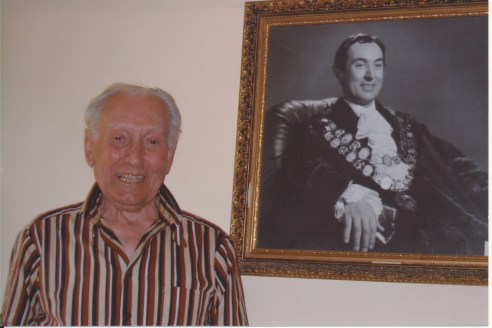
Loreto York, 2006, with portrait of himself as Mayor in 1972 ack Barry York

Loreto (‘Larry’) York, 2006, with photo of himself as Mayor of Brunswick in 1972.

****

My father, Loreto, would have turned 98 today. Sadly, he died in 2009 – but lived a healthy life for 90 years (save for his months of decline).

Loreto with his mother in Malta c1936 001

Loreto Meilak with his mother, Loretta, in Malta, c1936. (My dad changed his name to York in 1947 while in London with the RAF).

He was born in Malta in 1918, joined the Royal Air Force there during the Second World War, and ended up in London with the RAF after the War, where he met and married my mother, a Londoner ‘born within the sound of Bow-Bell’ named Olive Turner.

I was born there in 1951 and was three when my parents migrated to Melbourne, Australia.

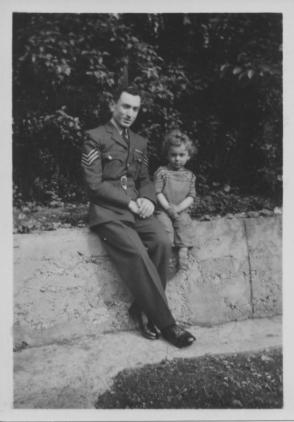
Loreto in RAF uniform and his son Barry c1954 at 15 Plympton Ave, Brondesbury, London jpeg

My dad in RAF uniform, with me, prior to being demobilized and migrating to Melbourne in 1954.


Apart from a brief stint as a mail sorter in the GPO, my father worked in factories all his working life in Melbourne. Radicalised by the experience of the anti-fascist war, especially by communist and socialist English and Scottish airmen he met while on service in the Middle East and Africa, he followed both the British Labour Party and the Communist Party while in uniform in London. (He was demobbed in 1953).

In Australia, he was shop steward in a couple of factories where he worked in the cosmetics industry and he eventually joined the Australian Labor Party. Back then, the ALP was the mainstream socialist party. (Hard to believe, I know).

A charismatic person who was self-taught (he had only four years of formal education in Malta) and who graduated with distinction from the ‘University of Poverty, War and Struggle’, he spoke several languages and this made him a huge asset to the Bruswick branch of the Labor Party.

As a family we had settled in Brunswick in 1954 and, after a couple of years in several different boarding houses, purchased our own place in Shamrock Street, West Brunswick, in 1956. I was there for nearly 30 years – my parents for about 40.

My father became active in local government politics in the 1960s and was elected to the Brunswick Council. Unlike the other Labor Councillors, he could speak Italian, Maltese, Arabic, some Greek and German and smatterings of other languages that were common in the significant migrant city.

In 1972, he became Mayor of the City of Brunswick – the first Maltese Mayor of an Australian city and the first ‘non-Anglo’ ‘non-Celtic’ Mayor of multicultural Brunswick. I should point out, too, that back then, being Mayor was not a paid position. There was a small allowance to cover costs but my dad had to continue working five days a week in the factory.

As he explains in the excerpt from a lengthy oral history interview I recorded with him in 1989/1990, he was involved in the Vietnam protest demonstrations and regarded himself as ‘progressive’. He felt strongly about Aboriginal issues and supported equal opportunity for all Australians. I have a childhood recollection of him exclaiming after watching a television documentary about Albert Namatjira: “They call this a democracy!” And: “How can there be poverty in a land with such vast natural resources?!”

In Melbourne back then, Pastor Doug Nicholls was the ‘face’ of Aboriginal Australia in the media. (That’s how I remember it, at any rate). He used to come to my school, Northcote High, and speak to us students at morning assemblies. He was quiet, understated, smartly dressed and very eloquent and persuasive. Above all, he was a man of enormous dignity, with no suggestion of victimhood.

The Brunswick Mayoral Ball of 1973

My parents admired him, as did most people, and when in 1973 my dad had to organise the traditional Mayoral Ball, he decided it would be a good opportunity to make a gesture in support of the Aboriginal cause and against racism. He arranged for a group of Indigenous dancers to perform – and he invited Pastor Doug to be special guest of honour, leading the official party into the hall.

As far as we knew at that time, no other Council had invited Aboriginal dancers to such a function. His decision to have Pastor Doug lead the official guests into the Brunswick Town Hall ballroom meant that he had to override the objections of the Town Clerk who, rightly, pointed out that it would breach Protocol (which stipulated that the order of entry into the ballroom by the official guests had to be led by the Governor (if attending), then Parliamentarians, then the RSL (of which my dad was a member), Councillors, etc.)

In the oral history excerpt, my dad is restrained in his description of how he insisted that Pastor Doug lead the official party. He told me at the time, and many times later, how he responded to the Town Clerk’s insistence that Protocol could not be broken, by saying: “I’m the f*&#ing Mayor and if I f*&#ing want Pastor Doug to lead the official f*&#ing party then it will f*&#ing happen!” (I’m told that the ‘f’ word was commonly used by members of the Royal Air Force during the War, and that is no doubt where he learned it). My dad had a theatrical side to his character, and relished re-enacting his response to the Town Clerk, even decades later when in his 80s. (His story-telling often took the form of highly animated re-enactment).

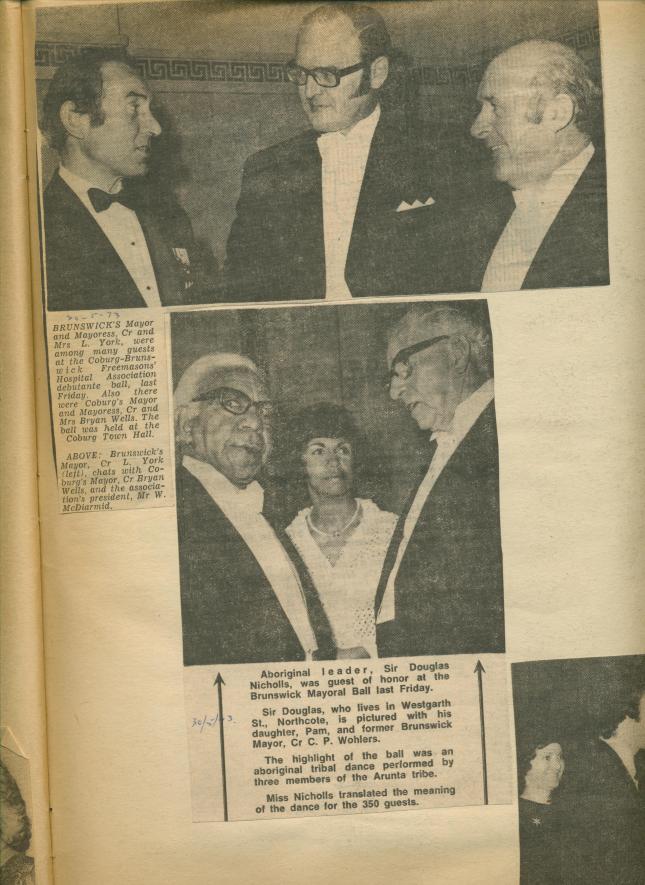
Dad's scrap album Pastor Doug Nicholls 1973 001

Pastor Doug Nicholls at the Brunswick Mayoral Ball in 1973 – newscuttings from my parents’ scrapbook.


My dad had a big impact on me in terms of awareness of the world, passionate opposition to injustice, interest in ideas, sympathies for socialism and communism and, above all, in terms of his spirit of irreverence and rebelliousness.

I hope you enjoy the oral history excerpt, commemorating, as it does, two of history’s good guys.


****


Marx Supported Capitalist Globalization

Even the most rabid anti-communists acknowledge that Karl Marx got it right in his understanding and prediction of ‘globalization’, how the economies of the world would industrialise and become increasingly integrated.


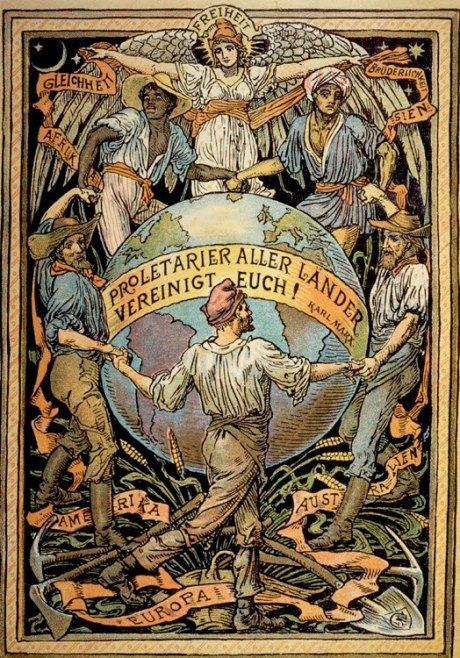
proletarians-walter-crane


“All that is solid melts into air” applies to the nation state as much as to the old feudal system that was overturned by the revolutionary bourgeoisie. Then, as now, reactionaries fought hard to keep things ‘solid’ but leftists welcome the globalizing changes that bring human beings closer together through amazing technological advances in transport and telecommunications.

There is an Index that follows the patterns of globalisation in our time: DHL Global Connectedness Index.

David McMullen has just added a new article to the Communist Manifesto Project that shows how Marx supported globalisation. Thanks to David for permission to republish it here.

****

Today’s “Marxists” share with the rest of the pseudo left an opposition to capitalist, indeed any, globalization. This puts them totally at odds with Marx. The following quote from The Communist Manifesto leaves no doubt about Marx’s pro position:

The bourgeoisie has through its exploitation of the world market given a cosmopolitan character to production and consumption in every country. To the great chagrin of Reactionists, it has drawn from under the feet of industry the national ground on which it stood. All old-established national industries have been destroyed or are daily being destroyed. They are dislodged by new industries, whose introduction becomes a life and death question for all civilised nations, by industries that no longer work up indigenous raw material, but raw material drawn from the remotest zones; industries whose products are consumed, not only at home, but in every quarter of the globe. In place of the old wants, satisfied by the production of the country, we find new wants, requiring for their satisfaction the products of distant lands and climes. In place of the old local and national seclusion and self-sufficiency, we have intercourse in every direction, universal inter-dependence of nations. And as in material, so also in intellectual production. The intellectual creations of individual nations become common property. National one-sidedness and narrow-mindedness become more and more impossible, and from the numerous national and local literatures, there arises a world literature.

The bourgeoisie, by the rapid improvement of all instruments of production, by the immensely facilitated means of communication, draws all, even the most barbarian, nations into civilisation. The cheap prices of commodities are the heavy artillery with which it batters down all Chinese walls, with which it forces the barbarians’ intensely obstinate hatred of foreigners to capitulate. It compels all nations, on pain of extinction, to adopt the bourgeois mode of production; it compels them to introduce what it calls civilisation into their midst, i.e., to become bourgeois themselves. In one word, it creates a world after its own image.

Then in a letter to Engels of October 8 1858 he wrote:

The proper task of bourgeois society is the creation of the world market, at least in outline, and of the production based on that market. Since the world is round, the colonisation of California and Australia and the opening up of China and Japan would seem to have completed this process.

In his other writings, Marx supported Europe’s colonial conquests, the “process” that got globalization going. In his view Europe was the only source of capitalism which in turn was the necessary precursor of communism. Support for this historical necessity did not prevent him from expressing his disgust at the barbarity and hypocrisy of the Europeans as they went about this conquest nor was he impressed with the tardy pace at which the old societies were being replaced by the new. What he was doing was recognizing that capitalism has a dialectical or contradictory nature. Only capitalism can create the conditions for its own demise. You have to support it in order to oppose it. In “The British Rule in India” New York Daily News of June 25, 1853, he wrote:

These small stereotype forms of social organism [autonomous villages] have been to the greater part dissolved, and are disappearing, not so much through the brutal interference of the British tax-gatherer and the British soldier, as to the working of English steam and English free trade. Those family-communities were based on domestic industry, in that peculiar combination of hand-weaving, hands-spinning and hand-tilling agriculture which gave them self-supporting power. English interference having placed the spinner in Lancashire and the weaver in Bengal, or sweeping away both Hindoo spinner and weaver, dissolved these small semi-barbarian, semi-civilized communities, by blowing up their economical basis, and thus produced the greatest, and to speak the truth, the only social revolution ever heard of in Asia.

Now, sickening as it must be to human feeling to witness those myriads of industrious patriarchal and inoffensive social organizations disorganized and dissolved into their units, thrown into a sea of woes, and their individual members losing at the same time their ancient form of civilization, and their hereditary means of subsistence, we must not forget that these idyllic village-communities, inoffensive though they may appear, had always been the solid foundation of Oriental despotism, that they restrained the human mind within the smallest possible compass, making it the unresisting tool of superstition, enslaving it beneath traditional rules, depriving it of all grandeur and historical energies. We must not forget the barbarian egotism which, concentrating on some miserable patch of land, had quietly witnessed the ruin of empires, the perpetration of unspeakable cruelties, the massacre of the population of large towns, with no other consideration bestowed upon them than on natural events, itself the helpless prey of any aggressor who deigned to notice it at all. We must not forget that this undignified, stagnatory, and vegetative life, that this passive sort of existence evoked on the other part, in contradistinction, wild, aimless, unbounded forces of destruction and rendered murder itself a religious rite in Hindostan. We must not forget that these little communities were contaminated by distinctions of caste and by slavery, that they subjugated man to external circumstances instead of elevating man the sovereign of circumstances, that they transformed a self-developing social state into never changing natural destiny, and thus brought about a brutalizing worship of nature, exhibiting its degradation in the fact that man, the sovereign of nature, fell down on his knees in adoration of Kanuman, the monkey, and Sabbala, the cow.

England, it is true, in causing a social revolution in Hindostan, was actuated only by the vilest interests, and was stupid in her manner of enforcing them. But that is not the question. The question is, can mankind fulfil its destiny without a fundamental revolution in the social state of Asia? If not, whatever may have been the crimes of England she was the unconscious tool of history in bringing about that revolution.

In “The Future Results of British Rule in India” New York Daily News of August 8, 1853, he wrote:

England has to fulfill a double mission in India: one destructive, the other regenerating – the annihilation of old Asiatic society, and the laying of the material foundation of Western society in Asia.

He expressed a similar view when writing about Britain’s beastly treatment of China. So that in “Revolution in China and In Europe”, New York Daily News, June 14, 1853 we read:

It is almost needless to observe that, in the same measure in which opium has obtained the sovereignty over the Chinese, the Emperor and his staff of pedantic mandarins have become dispossessed of their own sovereignty. It would seem as though history had first to make this whole people drunk before it could rouse them out of their hereditary stupidity.

and then:

All these dissolving agencies acting together on the finances, the morals, the industry, and political structure of China, received their full development under the English cannon in 1840, which broke down the authority of the Emperor, and forced the Celestial Empire into contact with the terrestrial world. Complete isolation was the prime condition of the preservation of Old China. That isolation having come to a violent end by the medium of England, dissolution must follow as surely as that of any mummy carefully preserved in a hermetically sealed coffin, whenever it is brought into contact with the open air.

In an article published in the Deutsche-Brüsseler-Zeitung No. 7, January 23, 1848, Engels expressed his delight at America’s victory in the war with Mexico and the conquest of California, Texas and areas in between. In their footnotes the editors at Progress Press in Moscow try to make out that both Engels and Marx later took a different view. They cite an 1861 article by Marx called “The Civil War in North America”. Here Marx mentions how expansionism at the time was driven by the slave owners. Although he makes no actual mention of the Mexican-American War. In hindsight we can see that one good thing about the annexations was that they contributed to the outbreak of the Civil War which the slave-owners went on to lose. Their attempt to spread slavery to the new territories was the last straw. And we can now say without fear of contradiction that capitalist development greatly benefited from the switch in sovereignty. Here is a link to the 1861 article. It is no use on the Mexican-American War but it is a very illuminating exposition of the expansionist threat posed by the slave states and a very good argument against British “neutrality”.

Marx was quite unsupportive of rebellions by reactionary or backward elements in colonial societies. These included the Taiping Rebellion in China and the Indian Mutiny.

In “Chinese Affairs” Die Presse, No. 185, July 7, 1862, Marx has nothing positive to say about the Taiping Rebellion that rocked southern China from 1850 to 1864

They have no slogans. They are an even greater abomination for the masses of the people than for the old rulers. They seem to have no other vocation than, as opposed to conservative stagnation, to produce destruction in grotesquely detestable forms, destruction without any nucleus of new construction.

“Marxists” have tried to tell a different tale. Over at The Marx and Engels Internet Archive they have a section entitled Articles on China 1853 – 1860. It has other articles that deal with rebellion but not the Die Presse article for copyright reasons. In their introduction they paint the Taiping in glowing colors:

At the same time, the Taiping rebellion broke out in 1850 and attacked the status quo Confucianist Manchu Dynasty — which had ruled since 1644. The rebellion was based in social revolutionary ideas of equality and was popular among the masses. It abolished private property, established sexual equality, and banned drugs (from alcohol to opium). By 1853, it dominated much of SE China. It would not be until 1864 that the Taiping capital of Nanking was captured by the imperial Manchu government.

Progress Press also have this rather gratuitous footnote in Volume I of Capital:

In 1850-64, China was swept by an anti-feudal liberation movement in the form of a large-scale peasant war, the Taiping Revolt.

The fairly uncontroversial Wikipedia entry on the Taiping Rebellion gives a far less flattering picture.

There is also an attempt to paint the Indian Mutiny as a national liberation movement. The Soviet Foreign Languages Publishing House in 1959 brought out a collection of articles by Marx on the Indian Mutiny entitled The First Indian War of Independence, 1857-1859. Also the The Marx and Engels Internet Archive has a web page entitled The First Indian War of Independence (1857-1858)
Marx does not explicitly repudiate the Mutiny in the way that he did in the case of the Taiping Rebellion. However, the total absence of any explicit statement of support is just as telling. He is very concerned to expose British military incompetence and brutality. He is also pleased by the financial and political strain it is placing on Britain. But that is as far as it goes. It is hard to imagine him supporting a pack of princes who wanted to reinstate the Mogul empire after what we know about his view on the role of the British in India.

The editors of Progress Press were also embarrassed by an article by Engels called “French Rule in Algeria” (The Northern Star January 22 1848). Here he wrote:

Upon the whole it is, in our opinion, very fortunate that the Arabian chief has been taken. The struggle of the Bedouins was a hopeless one, and though the manner in which brutal soldiers, like Bugeaud, have carried on the war is highly blameable, the conquest of Algeria is an important and fortunate fact for the progress of civilisation. The piracies of the Barbaresque states, never interfered with by the English government as long as they did not disturb their ships, could not be put down but by the conquest of one of these states. And the conquest of Algeria has already forced the Beys of Tunis and Tripoli, and even the Emperor of Morocco, to enter upon the road of civilisation. They were obliged to find other employment for their people than piracy, and other means of filling their exchequer than tributes paid to them by the smaller states of Europe. And if we may regret that the liberty of the Bedouins of the desert has been destroyed, we must not forget that these same Bedouins were a nation of robbers,—whose principal means of living consisted of making excursions either upon each other, or upon the settled villagers, taking what they found, slaughtering all those who resisted, and selling the remaining prisoners as slaves. All these nations of free barbarians look very proud, noble and glorious at a distance, but only come near them and you will find that they, as well as the more civilised nations, are ruled by the lust of gain, and only employ ruder and more cruel means. And after all, the modern bourgeois, with civilisation, industry, order, and at least relative enlightenment following him, is preferable to the feudal lord or to the marauding robber, with the barbarian state of society to which they belong.

Progress Press in its footnotes refers to this resistance as a liberation struggle. They also then claim that in an 1844 article Engels had made commendable noises about the resistance and that an article “Algeria” written for the New American Encyclopaedia in 1857 reverses the position expressed in the 1848 article. There is nothing in either article that can be construed in this way. An editor’s footnote to the latter article claims that the relevant material was left out by the encylcopaedia editors and this is conformed by a letter from Engels to Marx on 22 September 1857. The letter shows nothing of the sort. The reader is invited to read those three pieces to make up their own mind.

These views of Marx are not at odds with support by communists for the 20th century anti-colonial movement. By that stage the movement was primarily lead by western educated elements who sought to modernize their countries rather than take them backwards. Although there were some oddities such as Mahatma Gandhi, and independence brought many monsters like Idi Amin in Uganda and Mobutu in Zaire, and the whole process was badly affected by the Cold War.

Marx was no green

The Communist Manifesto Project has just published an article titled ‘Was Marx a green?‘ I’m republishing it below, with gratitude to the writer David McMullen.

In reading a draft of the piece, these thoughts came to mind:

In Mao’s critique of Stalin’s Economic Problems in the USSR Mao says Stalin is wrong to believe that human development is restricted by natural laws. Mao asserts that humans can work out ways to overcome these laws:

(Stalin) 2. Leaving aside astronomical, geological, and othersimilar processes, which man really is powerless to influence, even if he has come to know the laws of their development. . . . (Mao response) 2. This argument is wrong. Human knowledge and the capability to transform nature have no limit. Stalin did not consider these matters developmentally. What cannot now be done, may be done in the future.

To me, this kind of thinking – this spirit – was what attracted me to Maoists in the Left in Melbourne back in the late 1960s. They were the ones drawing critically from previous socialist experience, rather than rejecting it out of hand, and they were the ones really placing human conscious activity centre-stage and understanding the inter-relationship between economic base and cultural superstructure.

Marxists have always wanted progress and revolution and Karl Marx supported capital ‘p’ Progress in his time ­ but those who try to reinvent him as a green steady­-statist reverse his progressive and revolutionary nature and turn him into his opposite.

­As for the town and country divide, Engels nails the distinction between those greens (or ‘utopians’, in his time) who value small-scale craft-based life over the advances brought about by the C19th Industrial Revolution, despite its immediate grimness. In the Introduction to The Condition of the working class in England (1845) he talks about the much healthier, more humane, way of life in feudal rural England but says, no!, it sucks because in such a pre-industrial village and family based way of life, the people’s horizons were so limited. They were ‘comfortable in their silent vegetation’:

Before the introduction of machinery, the spinning and weaving of raw materials was carried on in the workingman’s home. Wife and daughter spun the yarn that the father wove or that they sold, if he did not work it up himself. These weaver families lived in the country in the neighbourhood of the towns, and could get on fairly well with their wages, because the home market was almost the only one and the crushing power of competition that came later, with the conquest of foreign markets and the extension of trade, did not yet press upon wages. There was, further, a constant increase in the demand for the home market, keeping pace with the slow increase in population and employing all the workers; and there was also the impossibility of vigorous competition of the workers among themselves, consequent upon the rural dispersion of their homes. So it was that the weaver was usually in a position to lay by something, and rent a little piece of land, that he cultivated in his leisure hours, of which he had as many as he chose to take, since he could weave whenever and as long as he pleased. True, he was a bad farmer and managed his land inefficiently, often obtaining but poor crops; nevertheless, he was no proletarian, he had a stake in the country, he was permanently settled, and stood one step higher in society than the English workman of today.

So the workers vegetated throughout a passably comfortable existence, leading a righteous and peaceful life in all piety and probity; and their material position was far better than that of their successors. They did not need to overwork; they did no more than they chose to do, and yet earned what they needed. They had leisure for healthful work in garden or field, work which, in itself, was recreation for them, and they could take part besides in the recreations and games of their neighbours, and all these games — bowling, cricket, football, etc., contributed to their physical health and vigour. They were, for the most part, strong, well-built people, in whose physique little or no difference from that of their peasant neighbours was discoverable. Their children grew up in the fresh country air, and, if they could help their parents at work, it was only occasionally; while of eight or twelve hours work for them there was no question.

What the moral and intellectual character of this class was may be guessed. Shut off from the towns, which they never entered, their yarn and woven stuff being delivered to travelling agents for payment of wages — so shut off that old people who lived quite in the neighborhood of the town never went thither until they were robbed of their trade by the introduction of machinery and obliged to look about them in the towns for work — the weavers stood upon the moral and intellectual plane of the yeomen with whom they were usually immediately connected through their little holdings. They regarded their squire, the greatest landholder of the region, as their natural superior; they asked advice of him, laid their small disputes before him for settlement, and gave him all honour, as this patriarchal relation involved. They were “respectable” people, good husbands and fathers, led moral lives because they had no temptation to be immoral, there being no groggeries or low houses in their vicinity, and because the host, at whose inn they now and then quenched their thirst, was also a respectable man, usually a large tenant-farmer who took pride in his good order, good beer, and early hours. They had their children the whole day at home, and brought them up in obedience and the fear of God; the patriarchal relationship remained undisturbed so long as the children were unmarried.

The young people grew up in idyllic simplicity and intimacy with their playmates until they married; and even though sexual intercourse before marriage almost unfailingly took place, this happened only when the moral obligation of marriage was recognised on both sides, and a subsequent wedding made everything good. In short, the English industrial workers of those days lived and thought after the fashion still to be found here and there in Germany, in retirement and seclusion, without mental activity and without violent fluctuations in their position in life. They could rarely read and far more rarely write; went regularly to church, never talked politics, never conspired, never thought, delighted in physical exercises, listened with inherited reverence when the Bible was read, and were, in their unquestioning humility, exceedingly well-disposed towards the “superior” classes. But intellectually, they were dead; lived only for their petty, private interest, for their looms and gardens, and knew nothing of the mighty movement which, beyond their horizon, was sweeping through mankind. They were comfortable in their silent vegetation, and but for the industrial revolution they would never have emerged from this existence, which, cosily romantic as it was, was nevertheless not worthy of human beings. In truth, they were not human beings; they were merely toiling machines in the service of the few aristocrats who had guided history down to that time. The industrial revolution has simply carried this out to its logical end by making the workers machines pure and simple, taking from them the last trace of independent activity, and so forcing them to think and demand a position worthy of men.

Anyway, here is David McMullen’s article, with which I basically agree.

Marx Was No Green
There are Greens who espouse an “ecological Marxism” and claim that if Marx was around today he would support organic agriculture and a steady state economy based on renewable resources that provides everyone with “sufficiency”. In such an economy the poor and rich countries would converge, with the former increasing somewhat and the latter shrinking a lot. The most notable exponent of this view is John Bellamy Foster, the editor of The Monthly Review. (We will call him JBF for short.) He goes through the writings of Marx and tortures them until they deliver a green essence.
JBF draws our attention to a number of Marx’s views that you could use to start building a case that he was a Green. Marx was concerned about the destruction of natural stocks of fertile soil, forests and fish needed by future generations. He also commented on how consumption often included frivolities that reflected people’s alienation rather than real needs and that human thriving requires more than increased consumption. JBF also correctly points out that when Marx talked about mastering nature he did not mean destroying it but mastering its laws and harnessing it accordingly. However, from here on the case begins to unravel.

JBF tries to extract greenness from the fact that Marx was a materialist who believed we lived in a material world where we depended on plants and animals for food, water to drink and air to breath. This is a long stretch.

The greening of Marx of course requires JBF to explain away how Marx and Engels talked about communism unleashing the productive forces. He claims this thoroughly ungreen viewpoint was confined to their youthful less mature writings. This is not true as these quotes from the 1870s attest:

Let us take, first of all, the words “proceeds of labor” in the sense of the product of labor; then the co-operative proceeds of labor are the total social product.
From this must now be deducted: First, cover for replacement of the means of production used up. Second, additional portion for expansion of production [emphasis added]. Third, reserve or insurance funds to provide against accidents, dislocations caused by natural calamities, etc.
Marx, Critique of the Gotha Programme, 1875
The expansive force of the means of production bursts the bonds that the capitalist mode of production had imposed upon them. Their deliverance from these bonds is the one precondition for an unbroken, constantly accelerated development of the productive forces, and therewith for a practically unlimited increase of production itself. Nor is this all. The socialised appropriation of the means of production does away, not only with the present artificial restrictions upon production, but also with the positive waste and devastation of productive forces and products that are at the present time the inevitable concomitants of production, and that reach their height in the crises. Further, it sets free for the community at large a mass of means of production and of products, by doing away with the senseless extravagance of the ruling classes of today and their political representatives. The possibility of securing for every member of society, by means of socialised production, an existence not only fully sufficient materially, and becoming day by day more full, but an existence guaranteeing to all the free development and exercise of their physical and mental faculties — this possibility is now for the first time here, but it is here.
Engels, Anti-Duhring, 1877
JBF also has to misconstrue Marx’s constant reference to the fact that capitalists are compelled by the forces of competition to accumulate  in order to survive, by suggesting that he actually disapproved of the process. For Marx the plowing back of much of the surplus value rather than spending it all on extravagant consumption was what made capitalism superior to previous societies where there was a compulsion to stagnate. It is what delivered economic and social progress.
Under communism, the robust development of the productive forces will lead both to the qualitative improvements in output and also to the use of increasing amounts of energy and materials. This would occur not just through accumulation but also through greater investment in research and development and through making each generation of plant and equipment better than the last. It is not hard to imagine the uses. Increased automation will require millions of robots. People will want ready access to various recreation facilities such as gyms, gardens, artificial ski slopes, master chef kitchens, laboratories, workshops and research facilities. The requirements of an increasing population will also have to be considered. While the population is expected to plateau and then decline later this century, under communism you would expect it to start rising again as the burden of having children will be much less. We need large emergency facilities to deal with super-volcanoes and tsunamis. We will need to prepare for the effects of major climate change such rising sea levels and eventually the next ice age.  Major space programs will among other things protect us from meteors and allow us to start moving off the planet in order to explore, settle and exploit extraterrestrial resources. It will be a long time before we run out of things to do with iron, steel, glass etc. This increasing production under communism will proceed with an on-going decoupling from impacts on the environment. We will see food produced with less and less use of land and water, and the industrial waste streams in extraction, production and disposal cleaned up and reduced.

JBF’s pièce de résistance is to pick up on Marx’s analysis of the contradiction between town and country. In the separation of town and country, Marx was concerned about two things. Firstly it stunted the brains of those in the country and ruined the physical health of those in city. Secondly it meant a break in the nutrient cycle as human waste and food scraps were not returned to the farm but instead dumped in rivers and oceans. This transfer of people from the land to cities was an inevitable part of capitalist development. Capitalist farming needed less workers and the cost to the soil and to workers of concentrating the latter in the cities was of no concern to industrial capitalists.

However, these problems are being resolved without having to spread the population evenly over the landscape. High density living in large cities can now be quite healthy and comfortable. Living in the countryside no longer means being cut off from the world given modern modes of transport and communications. This modern transport can also truck in fertilizer, be it human waste, animal manure or the synthetic kind that is now produced in abundance. Indeed, the present concern is excessive nutrients and resulting emissions into ground water or the atmosphere. The best hope for dealing with this under present capitalist conditions is through increased regulation and better management including greater adoption of precision farming.

The organic farming favored by JBF would just make things worse for the environment. It does not allow the use of synthetic fertilizer and so requires rotations that include nitrogen fixing legumes that are simply plowed back into the soil. So a world of organic agriculture would require far more land being assigned to farming to get the same net crop and less for forests and other natural uses. Magically getting the 7 billion people presently on the planet to become vegetarians would reduce the land pressure given that crops consumed directly provide humans with more calories than if they are fed to animals first. However, that would be undone later this century when we have 2 or 3 billion extra mouths to feed.
It is very important that red and green are seen as being at total odds. Humanity and the environment require economic progress and communism is impossible without it. The sooner we have a vocal Marxism supporting economic growth, and un-green things such as nuclear power and genetic engineering, the better
* * * *

THE KERR COUP AGAINST WHITLAM – 40 YEARS ON, STILL A MYTH

Originally published in Strange Times, no.10 April 1991. (This article was written well before Keating launched his ‘republican debate’.) On 11 November 1975 the Australian Governor General, Sir John Kerr, dismissed the Prime Minister, Gough Whitlam, on the grounds that he was unable to get the budget through the Opposition dominated upper house (the Senate). Kerr then appointed the opposition leader Malcom Fraser caretaker Prime Minister and called an election. Fraser subsequently won the election in a landslide.

I am republishing the discussion about the article as well, including my own which is the last comment below. I sum up my position thus: I look back on the semi-fascist coup analysis now with a sense of bewilderment. The writ by which Whitlam was sacked specified that a caretaker government be appointed and that an election be held. There’s nothing fascistic about that. Why then did people who had good leftwing credentials pursue that line?

****

THE KERR COUP – ANOTHER MYTH

The recent death of former Governor-General John Kerr is a good excuse to look back over the way the left reacted to his sacking of Whitlam. It is a remarkable example of how people who claimed to be radical leftists could tie themselves to the coat tails of the Laborites. They convinced themselves of all sorts of conspiracy theories about CIA involvement and described the sacking as a semi-fascist coup – a case of the ruling class abandoning parliamentary institutions. The left’s analysis of the Whitlam sacking is second only to its stance on the Gulf War as an example of its cretinism.

Essentially all Kerr did was to force the most unpopular government in Australian history to face the electorate. According to the left this was all terribly fascist because the government’s unpopularity was due to a malicious media campaign engineered by the media barons and multinationals. However, given the ability of the Whitlam government to shoot itself in the foot every other week, it would have required the media to be actively biased in its favour for it not to show the government in a bad light. It was also the time of the worst world economic downturn since the depression of the 1930s and for that reason alone very few elected governments anywhere in the world survived the mid 1970s.

The left was also outraged at the Liberal’s blocking supply in the Senate. The Labor Government liked to describe the House of Representatives as the ‘people’s house’ and to claim that it was being de_ed by the Senate which is elected on a less representative basis. This is a funny argument given that Fraser’s main interest was in getting an election for the lower house, so that ‘the people could decide’. It was Labour that was keen to avoid that at all costs. They had schemes for calling half senate elections, anything but an election over who was to govern.

Certainly the royalist institution of Governor-General should be replaced by a president, but that is another issue. Hopefully the appointment to the position of a republican and atheist in the person of Bill Hayden will do much to hasten its demise.

________________

• Re: The Kerr “coup” – Another myth
Posted by keza at 2005-11-24 10:01 PM

There’s a detailed account of the events referred to in the article above in the the Wikipedia entry for Sir John Kerr…

I notice that the “left” is still referring to what happened as a “coup” eg the following was posted on the GreenLeft website Just recently (November 11):

The enduring political significance of the coup lies in the fact that it demonstrated, in a particularly dramatic form, how ruthlessly the ruling class is prepared to defend its interests. Behind the assiduously cultivated façade of parliamentary democracy lies the organised violence of the capitalist state, ready to be called upon when needed.

Never mind that all John Kerr really did was to insist that an immediate general election be held.

Never mind that prior to this he had given Whitlam the opportunity to call a general election himself – and Whitlam had refused.

And never mind that when the election happened the Labour Party suffered a landslide defeat.

The pseudo- left dismissal of the recent Iraqi elections is a continuation of the same style of thinking. It indicates a deep misunderstanding of the meanings of words like “fascist”, “coup” and “democracy” as well a contempt for people as gullible victims of manipulation.

The genuine left always defends hard won democratic rights while pushing for more of them. Governments should have to face the electorate more often, not less often.

_________________

• government or referendum?
Posted by kerrb at 2005-11-25 08:38 PM
keza wrote:
Governments should have to face the electorate more often, not less often

Why? I think that needs more explanation.

Should governments be allowed to get on with the job or should policy be decided by a series of referendums? Don’t we already have enough populism and governments afraid to bite the bullet? What government today would introduce a measure that would have long term benefits 20 years down the track but few short term benefits – for example an intensive preschool program in disadvantaged areas?

If there were elections in USA right now then Bush would probably lose and I don’t think that would be a good thing. Should we get behind the Unions populism and demand that Howard’s IR reforms be decided by a new election? They are unpopular despite an expensive and phoney government advertising campaign.

From a broader perspective many correct ideas lack popular support: atheism, communism, the idea that we are not on the verge of environmental catastrophe. Democracy is a good idea too, far superior to fascism, but the concept of deciding everything by 51% vote has its limitations IMO. I’m not clear about the solutions.

The Whitlam government was elected in December 1972 and initiated a lot of reforms many of which were blocked by the hostile Senate. Because of this Whitlam called another election in May 1974 but that backfired, he was re-elected with a reduced majority. Obstruction from the Senate continued leading to the blocking of supply.

After the Queen’s representative intervened and sacked the Whitlam government there was another election in December 1975 which Whitlam this time lost. Three elections in three years, was that good?

Given that the Whitlam government was the first labour government since 1946 then it was easy to get the impression that the Liberals believed they were born to rule.

I take the point that what happened then wasn’t fascism, that that was bad analysis. But the combination of the Liberals born to rule attitude and the colonial relics in our constitution (Queens representative) were sound reasons to oppose The Dismissal.

And I still like Whitlam’s anger and speech on parliament house steps: “Well may we sing God Save the Queen… Because nothing will save the Governor-General”. Guess I’m a sucker for a nice piece of rhetoric.

_________________________

Bill Kerr
• Re: government or referendum?
Posted by keza at 2005-11-25 11:13 PM
Well of course populism can be a problem. The majority isn’t always right, people embrace all sorts of backward ideas etc etc. But the solution can’t be to support having restrictions on the democratic process. If there is popular support for backward or reactionary policies then it’s up to progressive people to fight for better ideas. The way I see it, the more opportunities for people to have their say, the more opportunities are provided for genuine struggle and the overall lifting of the general level of debate and understanding.

I remember this happening on a small scale in the Melbourne Moratorium debates in Richmond Town Hall (1970’s). As far as I know, the Melbourne Moratorium was run differently from the Moratoriums in other Australian cities because rather than being organised from on high by a committee, the major decisions were taken by open public meetings where policy issues were subject to a debate followed by a vote.

As a consequence the Melbourne moratorium policies were far to the left of anywhere else in Australia – eg here the USwas clearly labeled as an imperialist aggressor whereas in other places the policies were mainly pacifist. When there is genuine debate about things, the better ideas do tend to win out. It is lack of discussion and lack of opportunity to engage in any sort of democratic process which leads to the persistence of reactionary ideas.
If the voting system here in Australia was based on proportional representation this would break the current two party system but it would also have the effect of giving representation to all sorts of smallish groups – many of them with more reactionary policies than either Labour or Liberal. It would also lead to more unstable government. But I’d see both these things as good relative to the situation we have now. Anything which opens things up and gives people more of a chance to engage with the issues of the day has to be a good thing from a progressive perspective.

I think this has been happening in Iraq. Opponents of regime change have talked endlessly of the dangers of democracy in Iraq claiming that the result would be an Islamic state. the Iraqis aren’t ready for democracy, there’s no chance of the Shia, Kurds and Sunnis working things out, what they need is a strong leader etc etc.

If there was to be an election in the US aimed at trying to bring down Bush and his policies then the issues wouod have to be fought out. I think that would be a good thing.

________________________

• Re: government or referendum?
Posted by tomb at 2005-11-26 12:12 AM
perhaps not a fear of elections but a fear of losing. (whitlam would relate to this given his close relationship with the fascist indonesian government and support for the annexation of east timor)

________________________

• Re: government or referendum?
Posted by kerrb at 2005-11-26 01:27 AM
keza,

You have cited some good examples where more democracy / extended democracy is a very good thing – Melbourne Moratorium, proportional representation, Iraq elections …

It’s a fundamental point and as a general principle I agree … extended democracy combined with real discussion does work in favour of the best ideas winning through and there are precious few examples of discussion of this sort in Australian politics.

However, I can also think of examples where not following established democratic procedures was a good thing too … the US / Coalition of the Willing invasion of Iraq for example, not supported by the United Nations … I think the argument here is that fighting fascism is a more urgent principle

As for holding regular referendums in the USA about whether to continue the Iraq war, that strikes me as impractical – pull the troops out, a few months later send ’em back in – you can’t fight a war like that.

_________________________

Bill Kerr
• Re: government or referendum?
Posted by anita at 2005-11-26 05:35 AM

Thanks for following up my post, and apologies for the obtuseness of my original post.

What is highlighted is the paradoxical nature of democracy. (Take it away AL) I think it was courageous of Gough Whitlam to try and stand for his policies via election, but he didnot read the writing on the wall after they were soundly rejected and his majority was reduced. We know the outcome of his failure to take account of the mood of the electorate.

Politics is about brinkmanship and government’s can fall. My gut feeling is that a smart politician probably says yes to elections when out of office, and No when in office. I take the points Bill, but don’t think the example really works because the coalition did follow established democratic procedures, but broke from the outcome of those procedures muttering something about the numbers.

There is something to be said for a binding caucus type of principle but there comes a time when you might have to walk as the coalition did over failure to reach a necessary or desired outcome.

I support Proportional Representation with four year terms, but think that it is probably ok to maintain the Australian custom of the govt choosing the election time. I also think that the Australian practice of no limit on the number of terms in office is preferable to the American provision for 2 terms only. IMO it is about accountability, and George Bush for instance would be much more accountable and useful if he was facing the prospect of a third term in office.

Back to the so-called Kerr ‘coup’ which we find is not a coup. It was not, as happened in my own sphere of involvement, (Flinders uni in Sth Australia, mid 90’s) where democracy was about Annual elections; General Student Meetings; and Action Groups – there was a referendum policy measure that worked quite well in the circumstances – but I too would not recommend governing a country by referenda on policy questions) a matter of being hit with an unconstitutional referendum and having to wear the disastrous consequences of ‘boycotting’ said referendum, once the uni administration was convinced that pushing through an unconstitutional was in their political intrerests.

This resulted in… I’m losing count… maybe 4 or 5 full elections at Flinders in 1995.

Anyway in the example of Whitlam’s sacking, it was brought upon himself. So I don’t think his sacking – or more recently the decision to go to war in Iraq, strayed far from accepted democratic and legal conventions at all.

Bugger, I replied to the response and not the main topic,,, and now have only the last message to re-read before concluding these late-at-night, hastily written words. For better, or worse, and before i drag up anymore of my Flinders uni. memories.

c’est la vie

c’est la guerre

Que sera sera

Fare-the-well the ALP* student movement. (To the tune of Polly Wolly Doodle all the day)

Best of all RIP NUS** (I could not help myself) (

Anita

* ALP = Australian Labour Party

** NUS = National Union of Students)

• Re: The Kerr “coup” – Another myth
Posted by arthur at 2005-11-26 10:41 AM
Great to see Anita republishing stuff from “Red Politics”. Already seems to have raised the level of discussion by provoking deeper thought on both imperialism and “The Dismissal”. Hope this stuff gets properly integrated into the folder navigation structure of the site for permanent reference rather than lost in more ephemeral forum discussions. Also hope to see us starting to write articles like that from a current perspective (and David, who wrote both of those and many other excellent articles more than a decade ago, adding some more).

This topic has already branched into two additional issues of more contemporary and global (non-Australian) significance – “Revolutionary Democracy” (including the dialectics of leadership and mass line in broad struggles we have had experience of such as the student movement and Vietnam solidarity movement and “Constitutional Reform” (including electoral systems).

I’d like to see both of those separated out into topics of their own (and will do so myself if not beaten to it). Bill’s points about populism, majoritarianism, biting the bullet and not being limited by process is of even deeper relevance to how revolutionary democrats build mass movements (and how they organize themselves) than it is to how governments should be organized in modern western societies. We didn’t achieve the wider extended democracy favourable to left politics that keza refers to in either the student movement or the Vietnam war protests by accepting majority rule – we were a very small minority and loudly denounced as undemocratic by our opponents – but we avoided isolation by tight leadership following a mass line.

On “The Dismissal” itself, that’s precisely what the ALP did not do. Looking through the wikipedia article, their “radical” reforms – hysterically opposed by the conservative opposition at the time – were pretty tame then and are conventional wisdom now. When Harold Holt was denouncing Whitlam for betraying the American alliance by proposing to recognize China, Kissinger was already in secret negotiations with Peking.

The ALP government tore itself apart with no tight leadership and made no serious effort to mobilize the masses for its reform program. Instead they absorbed much of what had previously been anti-government and anti-system activism into a new caste of do gooders funded by government – completely gutting the activist movement that had been developing against their more conservative predecessors.

The sordid constitutional maneuverings on all sides were pathetic – bribing an opposition senator with an ambassadorial post to Ireland to gain a vote for the government, state governments appointing replacement senators opposed to the party of deceased senators to gain a vote for the opposition, the governor-general not warning the Prime Minister of his intention to dismiss him etc etc.

But on the fundamental issue, Fraser was open and above board in declaring his intention to bring down the government by blocking supply and mobilized the people in opposition to government policies, while Whitlam made no attempt to mobilize the people in defence of his policies but instead tried to minimize the landslide against his government by demagogic attempts to deflect popular anger through making the decision to call an election the central issue.

In the USA the Executive government with a fixed term in office is often dominated by one party while Congress is dominated by another and conflicts between the two occasionally result in the Federal Government grinding to a halt due to supply being cut by Congress.

Australia (wisely or not) deliberately chose the Westminster system of the executive being responsible to Parliament instead of fixed term governments. Whitlam tried to “crash through” in a system where the ultimate result of the opposition refusing to back down could only be a crash (before or after supply ran out, depending on the Governor-General).

Instead of defending his program, Whitlam tried to deflect attention of ALP supporters from his leadership failure by demagoguery against “colonial relics”. This worked and there is still deep anger among ALP supporters about this “betrayal of democracy” by holding an election, while Whitlam remains a party hero.

Its complete and utter phoniness was highlighted by the “Republican” fiasco in which the ALP proposed to remove the colonial relic while retaining EXACTLY the same system that led to the Dismissal.

In reality the only “colonial relic” involved was the ALP which, for the first time in Australian history actually appealed to the British (Labor) government to directly intervene in Australian affairs when the Speaker of the House asked the Queen to act on the advice of her imperial British Ministers rather than her Australian Ministers to refuse to hold the election advised by her Australian Ministers. Naturally the British government and the Queen did no such thing (and in fairness the ALP could not have imagined that they would but was just engaged in more demagoguery in appealing to the Queen).

I was outside Australia during the whole period leading up to The Dismissal and so missed out on the developing atmosphere. But it was quite stunning on coming back to find so much latent support for the ALP among leftists who had previously been completely contemptuous of it – with genuine anger about how “our” party had been viciously deposed by such undemocratic means as holding a (CIA inspired, fascist, etc etc) election at which it had been undemocratically rejected by a landslide due to the ignorance of the unwashed masses about the importance of governmental stability!

This really was an early warning about the tendencies that have now shown themselves more fully in the current collapse of the left in the face of the pseudo-left. Perhaps that historical event, as well as the Red Eureka Movement discussion about international questions was a factor in why there seems to be greater clarity about the pseudos in Australia than elsewhere.
• Re: The Kerr “coup” – Another myth
Posted by kerrb at 2005-11-26 05:29 PM
arthur wrote:
I was outside Australia during the whole period leading up to The Dismissal and so missed out on the developing atmosphere. But it was quite stunning on coming back to find so much latent support for the ALP among leftists who had previously been completely contemptuous of it – with genuine anger about how “our” party had been viciously deposed by such undemocratic means as holding a (CIA inspired, fascist, etc etc) election at which it had been undemocratically rejected by a landslide due to the ignorance of the unwashed masses about the importance of governmental stability!
I think there was evidence of CIA displeasure at the Whitlam government to do with two issues of substance – the raid on ASIO by Murphy and nervousness that Whitlam might kick out US military bases (Pine Gap) in Australia. The ASIO raid perhaps arose from the practice of ASIO keeping dossiers on some ALP politicians who were active in the anti-Vietnam war movement. Murphy believed that ASIO was withholding information about Ustasha involvement in Australia. This had an echo later in SA when Don Dunstan sacked the police commisioner Salisbury, I think for similar sorts of reasons (dirt files on ALP politicians).

Significant reforms by the Whitlam government included the medicare health reform, increased access to University education by students from working class backgrounds and some ongling support students from disadvantaged backgrounds. These reforms have been incrementally whittled away by the current Liberal / National Coalition, illustrating the point that more than reform is needed.

I agree with tomb’s point that Whitlam did a dirty deal with the Indonesian government on East Timor.

In the final analysis the people did vote out Whitlam, so no argument there.

Two Australian labour governments have been dismissed (Whitlam and Jack Lang in NSW) in this way – intervention by the Queens representative – and no Conservative governments. This contributes to the sense of foul play.
_________________________

Bill Kerr
• Re: The Kerr “coup” – Another myth
Posted by byork at 2005-11-28 01:56 AM
I was a member of the CPA(ML) at the time, in 1975, and the party line was that it was indeed a semi-fascist coup. But this was not seen, as I recall it, only in terms of CIA involvement but in terms of superpower contention. Whitlam had recognized Soviet domination of the Baltic states and had been friendly to the Australia-Soviet Friendship Society. There was also some minor stuff happening with the Moscow Narodny bank in Australia which was also meant to clinch the argument. I don’t think Whitlam ever threatened the US bases in Australia but rather sought joint US-Australia control over Pine Gap. The CIA didn’t need to do much, as world events such as the oil crisis, plus the Labor government’s own incompetence as a manager of capitalism, brought it down. Whitlam lost the plot, even in his own social democratic terms, and turned to the fascist regime in Iraq to raise election funds which he could never raise from the Australian working people.

I look back on the semi-fascist coup analysis now with a sense of bewilderment. The writ by which Whitlam was sacked specified that a caretaker government be appointed and that an election be held. There’s nothing fascistic about that. Why then did people who had good leftwing credentials pursue that line?

I think part of the reason relates to the fact that the struggles over the big issues like Vietnam, censorship, White Australia Policy, and apartheid, in which the Left did win ground, had been more or less successful. The resultant absence of issues, or vacuum, led to frustration and recrimination within the Left and a desire, by some of us, including me, to try to keep something alive that was really gone.

The religious type of analysis that saw dialectics in terms of constant progress with people’s struggles intensifying and going from victory to victory with every new year’s issue of Vanguard led those who accepted it into a dead end. When people close their minds, as I did, to debate and exchange of ideas, and instead conglomerate within a very small sect (within a sect), then they can’t possibly understand revolutionary theory and they have lost touch with reality. (“All that is real is rational”). They become self-satisfied opponents of everyone else, praised and egged on by respected veterans.

People like me applied themselves to the ‘semi-fascist coup’ issue with similar dedication as we applied ourselves to supporting the Vietnamese liberation struggle, the struggle against apartheid, etc. Being militantly active was part of the religious ritual, evidence of our ‘superiority’ – ie, we were making real sacrifices on demonstrations – and a substitute for critical thinking. I look back on it with regret and embarrassment but also think it a big pity as there were some astute minds zombified by that sect. Very few of them today take a progressive line on things like Iraq and globalisation.

Yes, there were people saying good things and the republication of the ‘Red Eureka’ material on this site shows that its analysis was pretty good and stands up well to this day.

On Whitlam, it interests me that the reforms that are applauded and held up by his supporters generally do not include those that were most significant. Sometimes, the claims made for him are not even accurate. I have written a few times over the years to the ABC to get them to correct the oft-quoted claim that Whitlam withdrew Australian troops from Vietnam. This is a nonsense, as the ground troops were withdrawn by Gorton by Christmas 1971 – a tribute to the effectiveness of the Vietnamese struggle and that of its Australian supporters, and also indicative of Australian governmental subservience to US policy changes. There was only a small Australian military group left in South Vietnam in 1972). Even the claim that Whitlam abolished conscription is wrong – he merely suspended the National Service Act by regulation (which was a good thing, as it freed the few remaining imprisoned draft resisters). (It was rescinded many years later).

The recognition of China would have happened anyway – my old friend Joe Forace, late lamented, was Malta’s High Commisisoner to Australia and Ambassador to China and was the go-between for Liberal Prime Minister McMahon with Chou En Lai. The McMahon Government did much groundwork – Joe used to say that Whitlam merely signed on the line.

Similarly the White Australia Policy had been gradually ‘liberalised’ allowing for categories of Asians to settle here permanently. McMahon would also have done what Whitlam did in abolishing al racial criteria – maybe he would have been slower. Who knows?

Even the multicultural thing is not entirely a Whitlam era acheivement. Grants had been given to migrant/ethnic community organisations prior to Whitlam. Fraser did much more than Whitlam to institutionalise multiculturalism.

The most significant Whitlam reform – the one that his fans seem to want to ignore – was his government’s reversal of nearly 75 years of national protectionist policy. Whitlam was nearly roasted alive by the reactionary unions when he slashed tariffs by 25 percent. And his government was the first to tell the rural sector that they had to get real and could no longer expect to be propped up by government funding regardless of competitiveness. Remember the good ole days when margarine was controversial and the Country Party was warning everyone that it was produced by soap manufacturers?

So, in sum, I think Whitlam’s acheivements tend to be overblown and his real ones overlooked.

The Australian people voted against him, in an election that had to happen because of the nature of the writs creating the dismissal. Lots of former revoultionary leftists joined the ALP at the time, which probably made more sense than remaining in the CPA(ML).

Barry

Guy Fawkes – Reactionary who tried to return England to the tyranny of the Pope

I was planning to write a piece about Guy Fawkes for 5th November but in googling some sources came across this excellent piece by Bill Dunlap that says it all from my point of view. Bill ran the piece on his blog, Grumblings from a grumpy old man, in 2008 and has kindly given me permission to republish it. Like Bill, “I cannot for the life of me figure out how Guy Fawkes became a symbol of revolution”.

guy fawkes

****

I cannot for the life of me figure out how Guy Fawkes became a symbol of revolution. I see all these anarchist types wandering around with their V masks, and I wonder if they even know who Guy Fawkes really is? It baffles me why a reactionary like Fawkes has been so heartily adopted by the American left. Why did the main character of V for Vendetta wear a V mask rather than a Che mask, or a Lenin mask, or even an Abbie Hoffman mask? Why Guy Fawkes, for the love of heaven?

The Gun Powder Plot was not, in any reasonable sense of the word, revolutionary. It was counter revolutionary in the strictest interpretation. The English Reformation was a social revolution that freed Britain from Papal tyranny. Under Queen Elizabeth I, the old Norman aristocracy lost their influence in favor of the new merchant class. Guy Fawkes himself was the son of an upwardly mobile middle class Protestant family. His father was a minor official in the Church of England, and his mother was the daughter of a dry goods merchant. Fawkes’s conversion to Catholicism may have stemmed from teen rebellion.

Guy Fawkes and his fellow Gunpowder Plotters wanted to destroy the new Church of England and return England to Papal control. How can this possibly be seen as revolutionary? Despite popular belief, Guy Fawkes was not the ringleader. That dubious honor went to a hereditary Catholic by the name of Robert Catesby. The Gunpowder Plot could have been thought up by Sir Edmund Blackadder. The conspirators rented a house next to the Winchester Complex, planning to mine beneath the House of Lords, pack it with gunpowder and blow it up during Parliament’s opening session. That way they could get King James, most of his court and family, and all the influential Protestant nobles. The opening of Parliament was delayed three times on account of the Black Plague, yet the tunnel was still not completed. So they rented the cellar beneath the House of Lords and stocked that with gunpowder instead.

If Robert Catesby was Blackadder, then Guy Fawkes was Baldric. Even though Fawkes knew that the plot had been revealed by a Catholic nobleman who was appalled at the plot, he tried to go through with it anyway. The guards were looking for him. They caught him in the cellar with 32 kegs of gunpowder and with fuses and matches in his pocket. He still tried to lie his way out of it. He was taken to the Tower of London and tortured while his buddies epically failed at getting away.

That was the historic Guy Fawkes. He was not the great defender of freedom as portrayed in V for Vendetta. He was an expendable flunky in a hare-brained plot to stop the wheels of progress and to return England to the “good old days” of Papal domination. The only advantage to that would have been to the Catholic nobles such as Robert Catesby, who wanted their old power and influence back. Fawkes himself became a figure of ridicule amongst the British, as shown by this rhyme.

Remember, remember the fifth of November
It’s Gunpowder Plot, we never forgot
Put your hand in your pocket and pull out your purse
A ha’penny or a penny will do you no harm
Who’s that knocking at the window?
Who’s that knocking at the door?
It’s little Mary Ann with a candle in her hand
And she’s going down the cellar for some coal

Guy Fawkes became identified with the Anarchist movement in the early 20th Century. British Anarchists put up posters with the modern stylized sketch of Fawkes, declaring that Guy Fawkes was the only man to enter Parliament with honest intent. This was, of course, using Guy Fawkes as a figure of ridicule. It was meant as a sort of black joke. Somebody lacking a sense of humor started taking the joke seriously, and the next thing we knew, we had V for Vendetta, and kids wearing Guy Fawkes masks in honor of a man who was trying to put Britain back under Papal control.

The irony is that these kids in their Guy Fawkes masks are pretty well accomplishing what Fawkes set out to do. They want to destroy government control without replacing the structures that have been destroyed. In this they actually share the same goals as their neocon opponents. The result is that money rushes in to fill the vacuum left by the lost structures. The more government is torn down, the more control falls into the hands of those who have the most money. This has been going on for twenty eight years and nobody has yet figured out that our loss of civil liberties is equal to the amount of government regulations that have been eliminated. The American left has not figured out that tearing down the government is a bad idea which will accomplish the opposite of what we want. The bad guy in V for Vendetta said at the people need to realize that the people need the government. This is very true. A dear friend of mine, who is a big V for Vendetta fan, adds that the government needs the people’s consent in order to govern. This is equally true. Government and the people exist in a symbiotic relationship. When that symbiosis fall out of balance, disasters like the present economic melt down occurs.

This leads us to the present cult of the Constitution. America has become as conservative as the conspirators of the Gunpowder Plot. The American left has not yet realized that by trying to return us to the original Constitution, they want to return us to the times when only property owners were citizens and could vote. Women were chattel, and African Americans were bought and sold like cattle. America has grown beyond those times, and trying to return us to them is only going to place Wall St. in charge of our lives. Looking backwards, even to the days of the American Revolution, is as reactionary as the Gunpowder Plot. There is also the truth that it is easier to destroy what we have in a vain attempt to make the clock move backwards, than it is to build. The more we destroy the government, the more of our civil liberties fall into the hands of Wall St. The only logical step is to rebuild the Government into what we want it to be.

This is perfectly Constitutional. The Constitution was never meant to be Holy writ, nor is it a mortal sin to change and revise it. The writers of the Constitution knew fully well that the world changes. They wrote the Constitution in order to deal with the changing conditions of their own time. They knew the world would continue to change, and built structures of change right into the Constitution. Hence the constitution was changed to allow all economic classes to vote. In 1971, Richard M. Nixon signed an amendment that changed the voting age from 21 to 18. Women won the vote in the early 20th Century. African Americans were freed by a Constitutional amendment. We have all the tools we need to change the government back into what we want it to be. All we need now is a plan.

Planning is the difference between revolutionaries like Jefferson and Burr and morons like Catesby and Fawkes. Rather than have some vague idea about returning the country to what Tom Jefferson wanted, we need a clear idea of what we want and need as a nation. There were many movements which had clear and precise goals as to what they wanted the government to be. The Labor movement, the Suffragist movement, and the Civil Rights movement are three clear examples of revolutionary movements that have changed the nation. Despite the best efforts of the neocons and their religious lapdogs, we still enjoy many of the benefits we gained from those movements.

Remember that the Constitution was written to be an instrument of the will of the people and not chains to bind us to a past age. Trying to return the Constitution to the days of the founders is like Guy Fawkes trying to return England to the tyranny of the Pope. It simply cannot be done. Maybe Guy Fawkes is really the appropriate symbol for the 21st Century American left, as they lead us to the future with their asses firmly in front of them.

A penny loaf to feed the Pope
Hip hip hoorah hoorah!
A farthing o’ cheese to choke him.
Hip hip hoorah!
Then we’ll say ol’ Pope is dead.
A pint of beer to rinse it down.
A fagot of sticks to burn him.
Burn him in a tub of tar.
Burn him like a blazing star.
Burn his body from his head.

*****