The “anti-imperialist” left and Marxists in particular have made fools of themselves over Syria and the question of U.S. military action on two counts:
Failing to properly evaluate what is going on in Syria itself and clinging stubbornly to the radically false notion that all imperialist wars are created equal; that all of them are equally reactionary in intent and objective outcome, and concluding from this that the oppressed and exploited never have a dog in fights between their oppressors and exploiters.
This is not to imply that imperialist powers or their wars are by nature progressive, but just as it is possible for evil people to do good things, so too there are cases where working people do have an interest or a stake in the outcome of military conflicts between ruling classes and their states.
The most obvious example of this is World War Two, the world’s bloodiest and most devastating conflict to date. There were powerful imperialist powers and coalitions of their clients on both sides of the war and yet the consequences of one side’s victory could not be more dramatically different than the victory of the other’s.
Only a fool could assert that it made no difference to millions of people whether the Allied or Axis powers won the war and yet that is what one current within the international socialist movement, the Trotskyists, claimed at the time. James Cannon, a leader of the American Socialist Workers’ Party, put it thus after the Japanese attack on Pearl Harbor: “No imperialist regime can conduct a just war. We cannot support it for one moment.”
Instead of analyzing the war as it was, as a global struggle between two camps headed by imperialist powers, Trotskyists tried to pick and choose sides in the smaller conflicts within the overall war, specifically the USSR’s war against the Nazis and China’s war for national liberation against Japan, as if British imperialism headed by Churchill and American imperialism led by FDR were not sending Stalin war material and aiding bourgeois nationalist and even communist forces in the Far East and Yugoslavia as part of the broader effort to defeat the fascist Axis powers. This is doubly ironic given Trotskyism’s claim that it developed the “best” analysis of fascism as a uniquely reactionary force.
What does all this have to do with Syria?
Today’s anti-interventionists would have claimed back then that American military action could “only make things worse” for people in Europe and Asia, would have voted in Congress or in Parliament against taking military action against the Axis, and blocked weapons and aid from reaching Stalin, Hồ Chí Minh, and Tito (all of whom the Trotskyists claimed they supported; starving forces you support of weapons is probably one of the more bizarre implications of their political method).
The world was much better off without this brand of “leftism” back then and the Syrians would be much better off without it now.
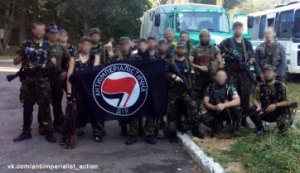
Ukrainian soldiers in Donbas with the symbol of Anti-Fascist Action – and slogan ‘Anti-Imperialist Action’.
Andriy M. (the name was changed) is one of those Kiev white-collar leftists, who after some hesitations supported Maidan last winter and in spring took a decisive stand against the reaction in Crimea and in Eastern Ukraine. His stand finally led him to the Ukrainian army and now Andriy is taking part in the ATO (Anti-Terrorist Operation) in the Donbas. Having known this, “Nihilist” [1] asked him a few questions. Republished courtesy of Zbigniew Marcin Kowalewski.
– How did you come to join the army? What unit is it?
– A very ordinary one, the 72nd Separate Mechanized Brigade. The one that was surrounded near Izvarino in July. In that time it was constantly being shot at, while suffering heavy personnel and equipment losses. Four hundred soldiers were even forced to withdraw to Russian territory, an outcome that generated a lot of media hype. Later the Ukrainian troops gained control of Savur-Mohyla barrow, liberated the surrounded brigade, and led it out of the ATO zone. In August-September near Melitopol the brigade was replenished with personnel and armored fighting vehicles. I then joined that brigade as a gunner and was mobilized in August. At the moment the brigade is again in the ATO zone.
– Could you have evaded military service?
– Technically yes, definitely I could. But already in March I went to the military commissariat and told the commander that the army can count on me. At that time Crimea was just annexed and the riots in the Donbas and Kharkov had begun. It was clear to me that a big war was coming. I was also convinced that Russian Army intrusion was a matter of a few weeks. For me the Putin regime, Russian occupation, and ideas of “Russian World” are absolutely unacceptable. Therefore it was impossible for me to remain a bystander. Then everything went a bit different than expected. Instead of regular army invasion, Putin began by using local paramilitary formations, but in reality it did not change the situation. Of course, lots of friends offered me “help” – shelter, leaving Kiev and going abroad, applying for a visa etc. I did not take such alternatives into consideration for reasons of principle.
– Do you characterize yourself as a leftist and a Marxist today?
– In respect of beliefs, a worldview – definitely yes. However, if one takes a point of view that sees Marxism as a political practice in the first place, I could be reproached that according to this criteria I am not a Marxist. I will not argue with that, but I just ask whether the Bolsheviks were Marxists when they were defending the Kerensky government from the Kornilov Revolt.
As a Marxist, I am aware of the fact that today a Ukrainian state is an unpleasant thing. There are very strong rightist conservative and nationalist tendencies there, with the power in the hands of big capital – the same as before, a powerful offensive is launched against the social component of state spending and workers’ rights. You know, as in the “socialist realist” art, the priority was depiction of a conflict between the good and the better, today in the Donbas there is a conflict between the bad and the worse. In Russia right-wing conservatism and authoritarianism are not just a tendency but full reality. The new expansionism in the sauce of the “Russian World” is a disgusting reactionary ideology that in reality is translated into war, violence, lies and hatred. In the Donbas all of them are in full bloom and trying to expand themselves. In my opinion, the main task is to stop it. Referring to the Kornilovism analogy, I will mention that a good friend of mine, a socialist, says that this war takes place between Petliuraites [2] and White Guards. This analogy is a bit lame, but in the situation when at war there is no communist side, for me as a Marxist the choice between White Guards and Petliuraites is obvious: in favor of the latter. At the same time it is evident that we are not even allies but just fellow travellers and just to the first crossroad.
– What do you think about Maidan? What was that?
– Maidan is a very complicated theme. On the one hand, it was a popular uprising and an experience of the self-organization of the masses, followed by the creation of volunteer battalions and a powerful and effective network of volunteers supporting those battalions, but on the other hand, there was an openly right-wing political wrapping. My approach to Maidan was changing from careful neutrality towards critical support following the infamous 16 January Laws. In any case, even the very right-wing wrapping was not sufficient to discredit the powerful democratic component of Maidan. In my opinion, it is enough to deserve acknowledgment. In any way, Maidan is in the past now; we live in the post-Maidan epoch and at the moment that mixture of progress and reaction, prepared on Maidan, is breaking down into its components: so much the better. It would be easier to separate the wheat from the chaff.
– What is this war for you?
– Firstly, it is a huge tragedy for millions of people – sorry for the banality. The civilian population is being disinformed, deceived and terrorized by both sides. In those rare cases, when the dialogue with the local inhabitants is held, the majority of them ask: “Why have you come armed to our land?” When you answer: “To prevent separatists and Putin’s soldiers from coming armed to our land”, they do not accept it. However, this is a real goal. There are lots of aspects of this war and I clearly see political profits gained by the Ukrainian and Russian elites – the profits generated from sufferings of local population and Ukrainian and Russian soldiers. For me personally, such phantasms as a territorial integrity or a national statehood have no meaning and I do not see them worth life and blood. However, if Ukraine lays down arms, the war will not stop but imperialist Russia will just continue its bloody expansion undisturbed. It is an aggression and the aggressor must be stopped not appeased. Unfortunately, there is no good solution here. One has to choose between the bad and the worse.
– What are Ukrainian soldiers in the East fighting for?
– Every soldier is fighting for his own reasons. For example, my colleague, a Maidanist and romantic nationalist, Sanya is fighting for his fatherland and the centuries-old Ukrainian dream of independence. A robust peasant, Misha, is fighting so that no-one from abroad tells him, his children, and grand-children what rules they should live by. An electrician Serhiy is fighting only because he was mobilized and he is very unhappy with it. He is also personally unhappy with the commissar who sent him to the slaughter instead of somebody more suitable. However all that does not prevent him from performing combat missions with dignity. Some people do not hide that they are fighting for money – due to the poverty and unemployment in civilian life, going to war has become a noteworthy alternative for a number of people. The majority of soldiers are convinced that they are fighting for Ukraine, its territorial integrity, the right to live not on orders from Kremlin, preventing “Donetsk bandits” and “commies” for good from trying to govern the country. That is the main motivation.
– It turns out that the soldiers are anticommunists and it is a mass phenomenon. How could you explain it?
– There is a great temptation to shift the entire responsibility to the Communist Party of Ukraine (KPU). The party of Petro Simonenko did really all that could have been done to make the word “communist” offensive. Years of serving the interests of oligarchs accompanied by the socialist rhetoric and last year’s explicit support for the enemy – all that leaves a trace. However, this is not only the matter of the KPU. The ancestors of numerous soldiers and officers were victims of Stalinist repressions or died during the Holodomor (extermination by famine). For each of them those things are not an abstraction or historical events but a tragedy that directly touched their families, a crime committed by the Soviet government. And through two decades the Ukrainian state propaganda machine was successfully flooding the masses with the idea that the famine, violence and executions are the essence of communism. No wonder people easily adopt it as their own viewpoint.
– Does a communist feel comfortable in such an environment?
– Of course not. But there is one good principle: “neither to cry nor to laugh but to understand”. To keep one’s cool. To notice that the hatred to communism among the masses of soldiers is not hatred toward the ideas of justice, cooperation, solidarity and freedom. On the contrary, it is hatred of the social parasitism that typifies communist party hierarchies, and hatred of the total physical, ideological and economical violence. And it is entirely compatible with sharp non-acceptance of the new post-Maidan government. For the majority of soldiers Poroshenko, Yatseniuk and Klychko are no better than Yanukovych. The timeliness of the social question has not been abolished. Certainly, today the ultra-right forces are trying to speculate with it but that is because the left in Ukraine turned out unable to play on its traditional political field.
– Is that why the left has lost in Ukraine?
– It is a complicated question. Now I am to say a handful of standard phrases about the combination of objective and subjective factors. And where did you see a victory of the left in the period of primitive accumulation and redistribution of capital? The actual left-wing class-oriented mass movement has not been able to form yet – one cannot take for the left the Soviet-conservative KPU or pale pink bourgeois socialists! Not to mention commercial and technological political projects like Borotba, which, from the very beginning, were created to fulfill completely non-leftist tasks. Those left-wing organizations that were actually trying to fulfill the proper tasks, either were organizationally too weak to grow out of little circles or turned out to be so accustomed to the certain conditions that they were not able to realize themselves outside those conditions – like for example the Direct Action [3].
– Has your approach to the Western and Russian left changed?
– It has not changed but rather definitely formed. In the West the left is characterized by rational conformism, by dogmatism or – most often – by a combination of both of those unpleasant features. They, more or less successfully, fulfill the tasks in their own countries but in respect to Ukraine their position is affected in varying degrees by adjusting their thinking on the Ukrainian situation to some of the usual dogmas and to “export” opinions of their Ukrainian contacts that very often turn out to be presenting and analyzing in bad faith Ukrainian developments. As a result, numerous Western leftists believe that there is a socialist revolution in the Donbas, that Ukraine is a fascist state and this state is drowning the popular uprising in blood on the orders from Washington. To make them change their mind is incredibly hard, even impossible. Therefore, in my view, it is easier and better to live as if there was no Western left. As for the Russian left, a huge part of it is under the impression of bygone “Soviet socialism” and the “great victory against fascism”. The Soviet Union passed away long time ago, in the Kremlin there are no people in power who defeated fascism in 1945. Meanwhile in Kiev the power is not in hands of Bandera and Shukhevytch, but the matrix is in use and people who curse the regime furiously turn out to be faithful Putinists when it comes to the issue of Ukraine. Fortunately, not all Russian left is like that, but…
– What should be done?
– To observe attentively. In no case to shut away in an ivory tower but, quite the contrary, to be in the thick of things, as close to people as possible. As a matter of fact, it is another reason why I am in the war now. As long as we have the first-hand experience of what the people of Ukraine live and breathe, we will be able to create an effective strategy and tactics. A very complicated time is coming. A right-wing consensus in the society combined with an unsolved social question can lead to a fascist coup. One should become aware of this danger and prepare for it. To educate the masses, to propose a solution to social conflicts that would be based on a class approach. That solution must be more effective than the one proposed by the right-wing national-social populism. And I have fallen into the abstract again. Let us finish the war and then we will talk about this issue in more detail, ok?
Nihilist, December 6, 2014
Translated by Katarzyna Bielińska and edited by Louis N. Proyect
[1] “Nihilist” is a web portal edited in Ukraine by anarchists and left-wing anti-authoritarian radicals who try to “combine constant theoretical search with everyday revolutionary practice”.
[2] Petliuraites was the popular name of supporters of the Ukrainian People’s Republic, formed in Kiev after the fall of the Russian Empire. It existed since January until April 1918 and since December 1918 until November 1920. It was in war both with Soviet Russia and the imperialist Great Russian White Guards. Its Commander-in-Chief and, since February 1919, its President was Symon Petliura.
[3] The Direct Action (PD) is a network of independent students’ unions, with a left-wing anti-authoritarian and syndicalist orientation, established in 2008 in Kiev and active also in some other universitary centers of the country.
Article by Bill Kerr. Reprinted with permission from his blog.
* * * *
I can certainly identify with the grief, anger and further preparation against home grown terrorist attacks in the “civilised” west. But I also think this needs to be compared with the so little understanding and commitment of what needs to be done in Syria. The problem of fundamentalist inspired terrorism can only be solved at its source. It’s the old story of do we fish the babies out of the water or make the effort to stop those who are throwing the babies in further upstream (from The Ragged Trousered Philanthropist)
The Daesh (aka ISIS, ISIL) is the monster created within the monster of Assad’s Syria.
The Syrian cartoonist, Raed Fares, survived a Daesh assassination attempt in January 2014… the would-be assassins fired at Fares 46 times. Twenty-seven bullets struck the wall behind him; 17 hit his car. Only two struck him. They shattered seven bones in his shoulder and ribs and punctured his right lung.
Assad’s brutality in the face of the Arab Spring inspired Syrian revolution has created 200,000 plus deaths and 3.5 million refugees. Today we witness so much grief and preparation for terrorism at “home”. By contrast there is little understanding and commitment of what needs to be done in Syria.
This NYT article about Raed Fares, Radio-Free Syria, is very good. It includes one section about Obama’s failure in Syria:
“Three years ago, America could have saved thousands of lives,” Bayyoush went on. To them, what they needed seemed simple in hindsight: antiaircraft missiles, airstrikes against Assad, a no-fly zone. All of these options would have offered potential solutions. Their model for U.S. intervention was Libya, where airstrikes in support of the opposition helped to depose Qaddafi. Later the country descended into civil war. Fares acknowledged that Libya was hardly a success story, yet at least, he said, the United States had intervened to protect the Libyan people. In Syria, Assad was free to systematically imprison and kill the moderate leaders the United States was now looking for. “One by one, they were disappeared,” he said.
“Can I speak?” said Hamada, who is with the Fifth Regiment of the Free Syrian Army. “I told the Americans I met in Jordan: ‘If you help us, there will be no extremism in Syria at all. If you’re too late, there will be a time when neither you nor we will have any control.’ ” According to a senior retired U.S. military leader, who asked not to be named because he is no longer in the service, the delay in backing the Free Syrian Army led to the death of moderate military leaders. “If we had helped those people earlier, it could’ve gone differently,” he said. “A lot of the good leaders are dead now. They’ve been caught between rocks and hard places and ground into dust.”
The recent strikes against ISIS in Syria frustrated the Free Syrian Army commanders on two counts. First, unlike that of the United States, the F.S.A.’s primary foe was the regime. “The regime has launched chemical attacks and many more massacres than ISIS has,” Bayyoush said. Second, they had been warning the United States against the growth of ISIS for more than a year. “A year and a half ago, ISIS started activating cells,” Hamada said. “If America had helped us in the beginning, there would be no ISIS.” But the growth of ISIS wasn’t simply America’s fault. The Free Syrian Army bore its own responsibility. “These extremist groups formed because we were weak within the Free Syrian Army,” he said.
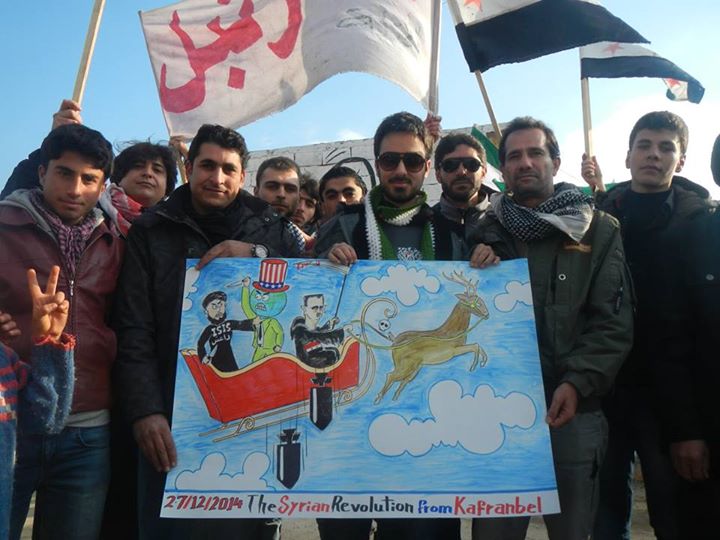
Some more Raed Fares cartoons, they are all located in one place here, Liberated Kafranbel .
The following 22 minute edited excerpt from an interview I recorded with Ted Bull (1914-1997) between 1988 and 1990 recalls Ted’s memories and reflections on the Free Speech movement in Brunswick, Melbourne, in 1933. The struggle is commemorated today by a monument in Sydney Road, Brunswick, but the lessons – the need to defend and assert free speech – remain valid.
Ted Bull was arrested on the free speech protests. As he recalls: “You’d get half a dozen words out and you’d be arrested. Not only arrested but the coppers would take you behind the Town Hall and they’d give you a bloody ‘doing over’ – and a good ‘doing over’ too”.
For overseas listeners, a “stump” in this context refers to a spot where a speaker regularly set up – usually a street corner – to speak to passers-by. Crowds would gather and this was seen as dangerous by the state at a time when communist ideas were gaining support. Also, when Ted refers to “the hook”, he means his work as a waterside worker – or ‘wharfie’ – in the days before widespread mechanisation when much of the work was manual and sacks were carried using a hook.
At the time of interview, I had no idea that someone had been shot during the free speech struggle in Brunswick, which happens to be my ‘hometown’. Ted talks about ‘Shorty’ Patullo who was shot by police and hospitalised. It was also surprising, though shouldn’t have been, to learn that in addition to the police it was die-hard Labor Party supporters who would disrupt the stumps.
The 1933 struggle is probably best remembered for the makeshift cage in which Noel Counihan (1913-1986) locked himself in Sydney Road in order to give his speech without being arrested.
The above is a 22 minute edited excerpt but the full interview runs for about 20 hours, based on a whole-of-life approach, and is available in full via the National Library of Australia’s on-line catalogue.
William Hinton was born in Chicago in 1919. He first visited China in 1937 and then in 1945 returned as a staff member with the US Office of War Information. During an eight year period, he also worked as an English teacher at a university in Shanxi and as a tractor-technician for the United Nations. He and his wife lived mostly in the village of Long Bow.
His best known book, Fanshen, documents in detail, from an on-the-ground perspective, the revolutionary process, especially land reform, in the area, based on his experiences of it. As a Marxist, he opposed the ‘capitalist roaders’ in China’s Communist Party and in 1990 wrote his critique, The Great Reversal, which is available below on-line in full. He died in the US in 2004.
From the Preface:
“June 4, 1989, stands as a stark watershed in China’s modern history. The slaughter of unarmed civilians by units of the Peoples Liberation Army as they blasted their way to Tiananmen Square illuminated the “reform” era as nothing else could. It lit up, like a bolt of cosmic lightning, the reactionary essence of China’s current leading group.
“This essence was known to many in China and to some abroad long before the lightning struck in June 1989, but most members of the Western media and academic world were too mesmerized by China’s reform rhetoric and market progress to apprehend the reality of the events unfolding before their eyes. Since privatization matched their prejudices and a consumption boom confirmed its validity, they preferred not to look too closely at the underlying currents of economic dislocation, infrastructural decay, environmental degradation, social disintegration, cultural malaise, and rising class antagonisms that threatened to unravel the fabric of Chinese society.
“Mao Zedong was far more astute. More than twenty years ago during the Cultural Revolution, he exposed Deng Xiaoping, Yang Shangkun, and most of their “hard line” colleagues as capitalist roaders. He accurately predicted that if such persons ever came to power they would transform the Communist Party into a revisionist party and finally into a fascist party and then the whole of China would change color.
“The surprising thing is not how accurate Mao’s prediction turned out to be, but rather how quickly it materialized in history.
Historian Stephen Velychenko penned this ‘open letter’ to US film-maker Oliver Stone on 1 January 2015. It is reprinted with permission of Krytyka, the ‘Thinking Ukraine’ website. Among other things, the letter points out that foreign involvement in regime change and revolution is nothing new and that includes the American people’s own revolution against tyranny and the Vietnamese national liberation struggle during the 1950s to the 1970s.
‘Things can turn into their opposite’ and we see this today with the various ‘anti-imperialists’ who long ago stood on the side of the people but who are now siding with the far-Right Russian chauvinist Putin’s slanders against Ukraine’s democratic struggle.
I am an academic historian who likes to think he has some knowledge of world events during the past centuries. I am someone who has watched and thought about some of your better films and who had the good fortune to have been in Kyiv on the Maidan in November-December 2013.
I was appalled and distressed when I read that a person of your stature had decided he would make a film about Ukraine’s ousted dictator Victor Ianukovich. What unsettled me was not your idea about interviewing a dictator on film. Documentaries about surviving ousted dictators are important and useful. What I found appalling was not only that you seem to share his interpretation of his fate, but that you seem to attach particular significance to that interpretation. You seem actually to believe Mr. Ianukovich who, understandably, like any overthrown dictator, attributes his fate to “outside forces” rather than to himself, his policies and supporters, domestic and foreign. Just like Mr. Ianukovich and Mr. Putin, you seem to think that the new government that emerged from the Maidan events 2013-14 is the product of CIA machinations, that CIA involvement was something exceptionally noteworthy, and, implicitly, that because this government is supposedly a CIA product, it has no merit or credibility.
Do you really believe Mr. Stone that in any of the great events in world history during the past centuries the intelligence services and spies of the great powers of the time were not involved? Simply noting this fact in isolation from all other events leads either to apologetics or conspiracy theories. Allow me to illustrate my point.
In so far as French secret agents were involved with the leaders of the American rebellion of 1776, some of whom were Masons, does that fact override the influence of enlightenment ideals and the interests and grievances of those who fought King George’s army? Did the presence of French spies and Masons in Philadelphia New York and Boston mean George Washington was part of a foreign plot? Does the British government’s support for Greek nationalists in the 1820s mean their anti-Turkish revolt was merely a British plot? In so far as Spanish, French and German agents supported Irish leaders in their wars against the English government, does that mean that those who fought British troops in the name of Irish independence were dupes in foreign plots? Was the 1916 Easter Rising really a failed German plot? In so far as German intelligence supported and financed the Bolsheviks in 1917-1918, does that mean the Russian revolution was simply a German plot and that those opposed to the tsar had no legitimate interests or grievances? Did covert Russian and Chinese support for Vietnam mean a sizeable proportion of the Vietnamese people had no legitimate grievances against French or American rule and that their decades long war against those governments was merely a KGB plot?
I put it to you Mr. Stone that anyone who produces a film focusing only on the participation of one particular secret service in a given event merely creates cheap propaganda – in this instance of the kind that will benefit Mr. Putin and his dictatorship. At this point, I should perhaps add that, like many others, I have a critical view of the US government and US corporations. I am well aware of the work of analysts like Chalmers Johnson, Richard Barnet, William Greider, Naomi Klein, Gregg Palast, Will Hutton, Michael Hudson, Thomas Frank and Arianna Huffington. But I am among those who do not allow their critical view of the US and corporate power to blind them to the reality of Stalinist or Putinist Russia.
In so far as I am familiar with your films they do not suggest any knowledge of or previous work on eastern Europe or Russia, let alone Ukraine on your part. This is not surprising as for many Americans, even today, Ukraine still remains a “part of Russia”, a place “far away of which we know little.” But once one decides to undertake a project related to that part of the world such intellectual indifference is no longer acceptable. Allow me therefore take the liberty to suggest that you not limit any research you might undertake to Mr. Ianukovich, his cronies and Russian advisors. Might I suggest you at least peruse Karen Dawisha’s recent book Putin’s Kleptocracy (2013) and some of Andrew Wilson’s and Timothy Snyder’s books on Ukraine.
I hope that, at this early stage, your first thoughts about your possible film on Ianukovich and his rule have been misinterpreted or misunderstood and that my remarks prove unnecessary and irrelevant. But, in as much as you do seem interested at this point in a documentary film about one of the great events of post war Europe, I hope that you will record not only the activities of the CIA in that event. I trust you will also record the role of Putin’s FSB in bringing Ianukovich to power in 2010, in controlling his government thereafter, and in the events of 2013-14. Since Mr. Putin’s government has obviously given you a visa and permission to visit Mr. Ianukovich in Russia, dare one imagine your hosts might also oblige you with access to FSB files about FSB activities?
In any case, I trust that any film you might make on Ukraine will pay due attention to the interests and grievances of Ukrainians, who, like their eastern European counterparts demonstrated in 1989, do not want to be ruled by pro-Kremlin elites and are now again, as in 1917-22, fighting a Russian invasion to prove it. I would also hope that if a director of your repute did make a documentary film about Ukraine it would not simply parrot the ideas of a reviled ousted dictator who built fortified fairy-land palaces with gold toilets in a country foul with corruption private wealth and public squalor. I would hope such a film explain that Ukrainians want no more to be controlled by Russia or Russian controlled dictators, than Latin American and Asian peoples want to be controlled by America or American controlled dictators.
It’s all the rage to be down about humanity. Public figures are forever lecturing us about our ‘eco-footprint’ and how our industrial arrogance turned what was an innocent ball of biodiversity spinning through space into a smoggy, nearly dead planet. Campaigners constantly tell us that if ebola doesn’t kill us, then AIDS probably will, or maybe it will be climate change, or perhaps it will be all that junk grub and booze and fags we stupidly consume. If a Martian visited Earth (more on Martians in a minute) and turned on the TV or opened a newspaper, he or she or it could be forgiven for thinking that human beings are little more than destroyers — of both the planet and themselves — who never do anything nice or brilliant.
But we do. Still. Even in this era of low expectations. Even when every cultural signal says, ‘Don’t explore’, ‘Don’t expand’, ‘Don’t go forth and multiply’. Even in the twenty-first century’s sludge of misanthropic thinking, the green shoots of intellectual daring find a way, and peek through. So here are 10 kickass things done by humanity in 2014.
10) We emailed a spanner into space
Yes, you read that right: human beings emailed a spanner into space. It seems like only yesterday — well, 20 years ago — that we were marvelling at the fact that we could send letters, and then photos, from our computers, across continents, in the blink of an eye, without having to wait for airplanes to deliver them. Now, NASA has emailed an actual object. How? Well, the International Space Station has a 3D printer; one of the ISS guys told NASA he needed a new socket wrench, and instead of making him wait months for it to be delivered from Earth, NASA emailed him instructions to put into the 3D printer and, lo, the exact spanner he needed came out. You know what this means? We finally have something very like teleportation, the dream of Star Trek and countless other sci-fi fantasies. The possibilities are endless. There is already talk of, at some future point, putting 3D printers on the moon that will dig into the moon’s crust and use its raw materials to print out the beginnings of human habitats. Would save us having to do the hard graft.
9) We made sperm
Yes, I know, the male section of humankind is always making sperm — but this year we made it without the benefit of sex, or our right hands, in a laboratory. Researchers at Cambridge University converted adult skin tissue into the precursors of sperm, and eggs, and are now exploring whether these precursor cells can become actual sperm and eggs. It’s like a winding back of time, a teasing out of the long-gone, most embryonic conditions of our cells, of ourselves. This research could have two potential impacts, one amazing, one almost unbelievable. The amazing one is that even the infertile might be able to breed children of an exact genetic match, their own children, through the creation of sperm and eggs from their skin cells. The almost unbelievable one is that this could represent the beginnings of mankind assuming mastery over evolution itself, no longer having to heed nature’s diktats about when the animal body may and may not multiply. Some will darkly shout ‘Brave New World!’ — I say so long as it’s all about choice, autonomy and giving people what they want, bring it on.
8) We found loads of new fossil fuels
You know all that talk of peak oil, peak gas, peak this, peak that? Turns out it was nonsense. Such nonsense that this year the oil price fell dramatically, for many varied reasons, but one of which is that there’s more oil than we thought. Some are going so far as to call ours an ‘age of abundance’. As the Financial Times said in November, ‘Ideas about peak oil seem to have been decisively refuted’. There is now thought to be 3.3 trillion barrels of oil and 22,900 trillion cubic feet of natural gas. And 1,040 billion tonnes of coal. Which is a lot. Three per cent more coal than we thought we had in 2011, in fact. Because that’s the thing: new fossil fuels are being discovered all the time. It’s no accident that all that peak bollocks was refuted this year: it’s a result, in large part, of the ‘shale revolution’, of what the FT calls ‘advances in the techniques of horizontal drilling and hydraulic fracturing’ — that is, of human endeavour. We might live in what feels like post-Enlightenment times, but we’re still doing that Enlightenment thing of ‘wresting nature’s secrets from her grasp’ (Francis Bacon). Up next: a uranium revolution?
7) We made more ‘ninja particles’
Yes, ‘ninja particles’ are as cool as they sound. As part of the explosion of research into nanomedicine — the implanting of infinitesimal machines or microbes into the body to attack disease — researchers have developed synthetic molecules that mimic our immune systems. It’s hoped these manmade molecules will one day, soon, be sent into the human body to attach themselves to certain microbes and cause those microbes to rupture — ‘as if they’d been hit by an explosive shuriken (ninja star)’, as one report in September gloriously said. These manmade ninjas could prove brilliantly deadly against antibiotic-resistant bugs and in bodies whose immune systems are rejecting newly transplanted organs. What was a Hollywood fantasy in the Eighties — Dennis Quaid being shrunk and sent into a human body in Inner Space — is now becoming a kind-of reality.
6) We found a former lake on Mars
From inner space to outer space, where in 2014 we discovered that a massive crater on Mars used to be a lake. Plucky, roving Curiosity, the wonderfully named, car-sized robot that NASA sent on a 350,000,000-mile journey to Mars in 2011, has been poking around and collecting data for boffins to analyse. And its examination of the sediment build-up in a 96-mile crater suggests this crater once held water, billions of years ago. Which means it could very well have generated life, too, even if just microbial life — Martian microbial life. Right now, as you chill in the holiday season, Curiosity is roaming the red planet, exploring a whole new mysterious world on humankind’s behalf. Next step: actual humans going where so far only a little robot has boldly gone, surely.
5) We made a lame man walk
‘And the lame shall walk’, said Christ in Matthew 11:5, boasting of his miraculous powers. We actually had to wait near-on 2,000 years for a man to make a lame man walk, and it wasn’t a Messiah who did it — it was cell-manipulating researchers. In 2010, a 40-year-old Pole was paralysed after being stabbed in the back. This year, thanks to scientists in London and surgeons in Poland, he can move his legs again and walk with the aid of a frame. The scientists took cells from his nasal cavity, which are among the most self-renewing cells in the human body, and nurtured and nourished them outside of his body before transplanting them into his spinal cord, injecting an invisible-to-the-naked-eye gaggle of cells into his spine 100 times over six months. And then — he moved his legs. It’s early days, but just imagine the possibilities if lifeless parts of the human body could be resurrected with injections.
4) We meddled with crops to make them more nutritious
To the fury of well-off, eco Westerners who never have to worry about where their next meal is coming from, mankind has been genetically modifying crops for years. This year we harvested crops genetically modified for nutritional value. Through splicing genes and patching organic data together in whole new ways — yes, yes, through ‘playing God’ — British scientists boosted a crop of camelina with Omega-3. The possibilities of these man-meddled nutrient-rich crops are endless, potentially delivering much-needed vitamins and sustenance to even the poorest of the world. One of the scientists described the research centre at which this work is done, in Hertfordshire, England, as ‘looking like Guantanamo’, all high fences, CCTV and Alsatians — a reminder that here in the West there are still many misanthropes ready and willing to destroy the fruits of mankind’s nature-defying labour.
3) We continued to wage war on poverty
When it was revealed in December that 92million Chinese people still live in poverty, Western media outlets had a field day. They overlooked the fact that, over the past 30 years, 753million Chinese have been lifted out of extreme poverty. Around the world, poverty is still a massive problem, but grinding poverty is in decline. In India, 126million have been lifted out of extreme poverty; in Indonesia, 66million. In 1990, 23.6 per cent of people in the developing world were undernourished; today, 11.8 per cent are — too many, but less. Two hundred years ago, the prototype modern miserabilist Thomas Malthus, hero to many greens, said there wasn’t enough stuff to sustain the people of Earth. There were 980million people on Earth back then. In the past 30 years more than 980million people have been lifted out of extreme poverty. Malthusians: getting shit wrong since 1798.
2) We continued to wage war on disease
Disease, nature’s violent whim, is in retreat from man’s deployment of science and technology. In December, the Lancet revealed that the global years lost as a result of killer diseases — from cancer to malaria to HIV — has been in steady and stunning decline since 1990. The list of once deadly diseases now cured by mankind, in the West at least, continues to grow: alongside tetanus, rabies, polio, yellow fever, measles and smallpox — causer of plagues of old — we may soon be able to add AIDS: manmade drugs now largely prevent HIV from becoming AIDS, meaning that this year deaths from AIDS were at their lowest since the peak of 10 years ago.
1) We landed a spacecraft on a comet
Six weeks after it happened, this still boggles the mind. A spacecraft called Rosetta, launched into the vast void 10 years ago, landed on a comet that is only 2.5 miles wide and is travelling at 24,600 miles per hour 300million miles away from Earth. As researchers at the European Space Agency that launched Rosetta said, this is like a fly landing on a speeding bullet. Why did we do this? Well, why not? And also because exploring the comet’s make-up will boost our understanding of our solar system. The comet’s composition reflects the pre-solar system stuff from which our Sun and planets were formed. Basically, we’re going back in time, exploring with machines the original raw materials of our corner of the universe. And yet, what was the big media talking point about Rosetta? That scientist guy’s shirt, which some silly media feminists found offensive: a brutal reminder of the medievalism and miserabilism that lurk in our midst even as we do spectacular things.
All this stuff — the emailing of spanners, the deployment of miniature ‘ninjas’, the robotic exploration of space — has been achieved in an era hostile to risk-taking and suspicious of mankind, in which we’re encouraged to worship at the altar of precaution and be always safe rather than sorry. So just imagine what we might achieve if we stripped way this straitjacket of anti-human thought and truly unleashed the human instinct to explore and to know. That’s what spiked will continue to devote itself to in 2015 — battling against the backward idea that humanity is a destructive force, and reviving the view of humans as controllers of the Earth, defiers of nature, and potential masters of the universe.
Brendan O’Neill is editor of spiked. Republished from 29th December Spiked with thanks.
… there have been some notable exceptions to the dominant ‘worried life’ theme of the blues. There have also been courageous bluesmen and women who used the blues defiantly in bold resistance to authority.
* * * *
See update (TomG on Paul Robeson, 29 December) below (scroll down).
“The blues … the ball ‘n’ chain around every English musician’s neck… in fact, every musician’s neck”.
So sang Eric Burdon in a blues song called “As the years go passing by”.
But does the blues music genre have to be a ball-and-chain? Sure, since the early twentieth century, blues singers have mostly expressed lament, regret and grief: discontent and despair rather than defiance and rebellion. Karl Marx’s assessment of religion as “the sigh of the oppressed creature, the heart of a heartless world, and the soul of soulless conditions” can also apply to blues music.
Yet there have been some notable exceptions to the dominant ‘worried life’ theme of the blues. There have also been courageous bluesmen and women who used the blues defiantly in bold resistance to authority.
I became hooked on blues music in my teens. My first album purchase was called ‘Soul Supply’, a compilation offering a feast of styles and artists: Ike and Tina Turner, Bobby Bland, Jimmy Witherspoon, Lowell Fulsom, Vernon Garrett, King Solomon, Little Richard and Mary Love. I wanted more from that day on.
I also loved the blues-based rock music emerging in the 1960s, mostly by white performers with powerful vocal delivery such as Eric Burdon and Chris Farlowe. They did a lot to popularize the blues and to promote black American performers to British audiences and, indeed, among northern audiences in the USA itself.
When the lyrics of blues and rock music connected overtly to the rebellious left-wing political movement to which I belonged, it was more than a bonus – it was inspirational.
Music can – and does – inspire. Do you have any to add to my list? If so, send them to me with your commentary and I’ll add them to this post.
The following are my five favourites in the black American blues genre:
1. The Bourgeois Blues – Huddy Leadbetter (1888-1949) aka ‘Leadbelly’ (1938)
This is one of the early blues songs of defiance. Sure, there is also complaint in its theme but Leadbelly identifies the class nature of racial oppression and is defiant in his desire to “spread the news all around”. “The home of the Brave / The land of the Free / I don’t wanna be mistreated by no bourgeoisie”.
The song was written in response to Leadbelly’s visit to Washington to record songs for the Library of Congress. The celebrated ethnomusicologist and field collector, Alan Lomax, had arranged the visit and with their respective wives took Leadbelly out to dinner after the sessions. Various restaurants denied them entry because the party was a mix-race one, which infuriated Lomax and Leadbelly.
In the version below, Leadbelly sings the song and relates the circumstances that led to him writing it.
Lord, in a bourgeois town
It’s a bourgeois town
I got the bourgeois blues
Gonna spread the news all around
Home of the brave, land of the free
I don’t wanna be mistreated by no bourgeoisie
Lord, in a bourgeois town
Uhm, the bourgeois town
I got the bourgeois blues
Gonna spread the news all around
Well, me and my wife we were standing upstairs
We heard the white man say “I don’t want no niggers up there”
Lord, in a bourgeois town
Uhm, bourgeois town
I got the bourgeois blues
Gonna spread the news all around
Well, them white folks in Washington they know how
To call a colored man a nigger just to see him bow
Lord, it’s a bourgeois town
Uhm, the bourgeois town
I got the bourgeois blues
Gonna spread the news all around
I tell all the colored folks to listen to me
Don’t try to find you no home in Washington, DC
`Cause it’s a bourgeois town
Uhm, the bourgeois town
I got the bourgeois blues
Gonna spread the news all around
Leadebelly also did a protest song about the case of the Scottsboro Boys, in which the Communist Party of the USA played an important role on the side of the nine black teenagers wrongly accused of rape.
2. Mannish Boy – Muddy Waters (1913-1983) (1955)
Like Huddy Leadbetter, Muddy Waters was the real deal and had known first-hand the extremes of racial and class oppression. In the hands of various white rockers who later covered the song, it became a statement of masculine sexual prowess but in 1955, when Muddy recorded it, it had a much deeper meaning as a declaration of manhood. In the deep South of Muddy Waters’ upbringing, black adult men were regularly called ‘boy’ in the racist culture. Muddy’s song asserts “I’m a man” and he even spells it out to prove the point: “Mmm-Aaa- child – Nnn – I’m a MAN!” Radical and inspirational stuff!
Ooooooh, yeah, ooh, yeah
Everythin’, everythin’, everythin’s gonna be alright this mornin’
Ooh yeah, whoaw
Now when I was a young boy, at the age of five
My mother said I was, gonna be the greatest man alive
But now I’m a man, way past 21
Want you to believe me baby,
I had lot’s of fun
I’m a man
I spell mmm, aaa child, nnn
That represents man
No B, O child, Y
That mean mannish boy
I’m a man
I’m a full grown man
I’m a man
I’m a natural born lovers man
I’m a man
I’m a rollin’ stone
I’m a man
I’m a hoochie coochie man
Sittin’ on the outside, just me and my mate
You know I’m made to move you honey,
Come up two hours late
Wasn’t that a man
I spell mmm, aaa child, nnn
That represents man
No B, O child, Y
That mean mannish boy
I’m a man
I’m a full grown man
Man
I’m a natural born lovers man
Man
I’m a rollin’ stone
Man-child
I’m a hoochie coochie man
The line I shoot will never miss
When I make love to a woman,
She can’t resist
I think I go down,
To old Kansas Stew
I’m gonna bring back my second cousin,
That little Johnny Cocheroo
All you little girls,
Sittin’out at that line
I can make love to you woman,
In five minutes time
Ain’t that a man
I spell mmm, aaa child, nnn
That represents man
No B, O child, Y
That mean mannish boy
Man
I’m a full grown man
Man
I’m a natural born lovers man
Man
I’m a rollin’ stone
I’m a man-child
I’m a hoochie coochie man
Well, well, well, well
Hurry, hurry, hurry, hurry
Don’t hurt me, don’t hurt me child
Don’t hurt me, don’t hurt, don’t hurt me child
Well, well, well, well
Nina Simone was never one to hide her politics and was an activist as well as a brilliant pianist and singer. She took part in major struggles such as the march from Selma to Montgomery (Alabama’s capital) in 1965. At the conclusion of the march, she performed her song, “Mississippi Goddam” to a crowd of 40,000 civil rights activists. She had written the song in 1963 in response to the murder in Mississippi of activist Medgar Evers, and the bombing in Alabama of the 16th Street Baptist Church which killed four black girls.
I love the call-and-response – “Do it slow!” or “Go slow!” – which accentuates the reality that the movement had reached a new level of urgency and struggle in which gradualism had passed.
The song was banned from airplay in some southern states, supposedly because of the use of “goddam”.
Alabama’s gotten me so upset
Tennessee made me lose my rest
And everybody knows about Mississippi Goddam
Alabama’s gotten me so upset
Tennessee made me lose my rest
And everybody knows about Mississippi Goddam
Can’t you see it
Can’t you feel it
It’s all in the air
I can’t stand the pressure much longer
Somebody say a prayer
Alabama’s gotten me so upset
Tennessee made me lose my rest
And everybody knows about Mississippi Goddam
This is a show tune
But the show hasn’t been written for it, yet
Hound dogs on my trail
School children sitting in jail
Black cat cross my path
I think every day’s gonna be my last
Lord have mercy on this land of mine
We all gonna get it in due time
I don’t belong here
I don’t belong there
I’ve even stopped believing in prayer
Don’t tell me
I tell you
Me and my people just about due
I’ve been there so I know
They keep on saying “Go slow!”
But that’s just the trouble
“do it slow”
Washing the windows
“do it slow”
Picking the cotton
“do it slow”
You’re just plain rotten
“do it slow”
You’re too damn lazy
“do it slow”
The thinking’s crazy
“do it slow”
Where am I going
What am I doing
I don’t know
I don’t know
Just try to do your very best
Stand up be counted with all the rest
For everybody knows about Mississippi Goddam
I made you thought I was kiddin’
Picket lines
School boy cots
They try to say it’s a communist plot
All I want is equality
for my sister my brother my people and me
Yes you lied to me all these years
You told me to wash and clean my ears
And talk real fine just like a lady
And you’d stop calling me Sister Sadie
Oh but this whole country is full of lies
You’re all gonna die and die like flies
I don’t trust you any more
You keep on saying “Go slow!”
“Go slow!”
But that’s just the trouble
“do it slow”
Desegregation
“do it slow”
Mass participation
“do it slow”
Reunification
“do it slow”
Do things gradually
“do it slow”
But bring more tragedy
“do it slow”
Why don’t you see it
Why don’t you feel it
I don’t know
I don’t know
You don’t have to live next to me
Just give me my equality
Everybody knows about Mississippi
Everybody knows about Alabama
Everybody knows about Mississippi Goddam
4. A change is gonna come – Sam Cooke (1931-1964) (1964)
Okay, blues aficionados may argue that Sam Cooke‘s song is more rhythm-and-blues than blues but, as Chuck Berry once said, “It’s all meat on the same bone”. And, like Nina Simone’s “Mississippi Goddam”, “A change is gonna come” became an anthem of the civil rights movement. It is notable for its optimism, at a time when police and troopers in the southern states in particular were using brutal force and mass arrests to deter the movement and its leaders.
I was born by the river in a little tent
Oh, and just like the river I’ve been running ever since
It’s been a long, a long time coming
But I know a change gon’ come, oh yes it will
It’s been too hard living, but I’m afraid to die
Cause I don’t know what’s up there beyond the sky
It’s been a long, a long time coming
But I know a change gon’ come, oh yes it will
I go to the movie and I go down town
Somebody keep telling me don’t hang around
Its been a long, a long time coming
But I know a change gon’ come, oh yes it will
Then I go to my brother
And I say, “Brother, help me please.”
But he winds up knockin’ me
Back down on my knees
There been times when I thought I couldn’t last for long
But now I think I’m able to carry on
It’s been a long, a long time coming
But I know a change gon’ come, oh yes it will
5. Vietnam Blues – J B Lenoir (1929-1967) (1966)
JB Lenoir, like Nina Simone, was a prolific musician who openly supported the civil rights struggle. And like Nina Simone, he took a stand against US involvement in the war in Vietnam early on. His song, “Vietnam Blues”, may have influenced John Lee Hooker’s “I don’t wanna go to Vietnam” recorded three years later. Both make a point about the US making war in Vietnam when its own people, especially black Americans, were in fairly dire straits.
Two of Lenoir’s albums “Alabama Blues” and “Down in Mississippi” mostly consist of political songs, including “Eisenhower Blues” which the record company made him change and reissued as “Tax Payer Blues”.
The songs above arose from actual life experience and struggle and inspired commitment to progress. Are there more recent examples that readers know of?
The following is from TomG (thanks Tom)
Old Man River (Show Boat) is no Blues song and Paul Robeson no Blues singer, but if you’re after a rebel song then the changes Robeson made to Hammerstein’s original lyrics fits the bill.
The lyrics are reproduced here twice, the first being Hammerstein’s, the second Robeson’s. The changes he made are transformative.
Dere’s an ol’ man called de Mississippi;
Dat’s de ol’ man dat I’d like to be!
What does he care if de world’s got troubles?
What does he care if de land ain’t free?
Ol’ Man River,
Dat Ol’ Man River
He mus’ know sumpin’ But don’t say nuthin’,
He jes’ keeps rollin’,
He keeps on rollin’ along.
He don’t plant taters,
He don’t plant cotton,
An’ dem dat plants ’em
Is soon forgotten,
But Ol’ Man River,
He jes’ keeps rollin’ along
You an’ me, we sweat an’ strain,
Body all achin’ an’ racked wid pain –
Tote dat barge!
Lif’ dat bale!
Git a little drunk,
An’ you land in jail…
Ah gits weary
An’ sick of tryin’;
Ah’m tired of livin’
An skeered of dyin’,
But Ol’ Man River,
He jes’ keeps rollin’ along
Revised lyrics:
There’s an ol’ man called de Mississippi;
That’s the ol’ man I don’t like to be!
What does he care if the world’s got troubles?
What does he care if the land ain’t free..
Ol’ Man River,
That Ol’ Man River
He mus’ know sumpin’ But don’t say nuthin’,
He jes’ keeps rollin’,
He keeps on rollin’ along.
He don’t plant taters,
He don’t plant cotton,
An’ dem dat plants ’em
Is soon forgotten,
But Ol’ Man River,
He jes’ keeps rollin’ along
You an’ me, we sweat an’ strain,
Body all achin’ an’ racked wid pain –
Tote that barge and
Lift that bale,
You show a little grit and
You lands in jail…
But I keeps laffin’ instead of cyrin’
I must keep fightin’;
Until I’m dyin’
And Ol’ Man River,
He just keeps rollin’ along
The following is reprinted under Creative Commons Attribution License. It originally appeared on Christmas Day at the excellent blog, Open Borders – the Case. The writer, Michelangelo Landgrave, is an economics graduate student at California State University, Long Beach, USA.
* * * *
Ladies, gentlemen, and elves. I am here before you today in favor of prosecuting the individual known as Santa Claus for immigration crimes against our sovereign nation.
Every year on the eve of December 24th Santa Claus enters our nation for temporary employment. He enters without a valid visa or even entering through a designated port of entry. The defendant and his supporters do not contest any of these claims.
Supporters of Santa Claus note that his migration is brief and non permanent. This is not however sufficient to waive prosecution of his case. A substantial number of other illegal aliens enter our nation for a brief time in order to work, save, and return home. It is unclear why, if these aliens are not pardoned, this individual should receive special treatment.
Australia
Australian citizens protesting Santa Claus’ annual invasion of their sovereign nation. “Stop the sleds” indeed.
Santa Claus’ crimes are especially heinous when one considers the vast number of goods he transports into our nation without proper documentation or paying tariffs. Santa Claus hires large numbers of foreigners year round to produce toys and other goods. He pays these foreigners well below the prevailing wage in our nation and does not extend to them basic labor rights. Through unfair competition practices Santa Claus has put countless of our nation’s firms and their employees out of business. Every toy received from Santa Claus is a toy not bought from a native mom and pop store. Santa Claus is not merely an illegal alien, but a smuggler and a slave driver as well.
Some of you might have concerns about prosecuting Santa Claus as he is considered a religious figure in some circles. Our nation is not an unreasonable one and several visas exist for religious workers to enter lawfully. That Santa Claus has not bothered to apply for such a visa shows that he does not respect our nation’s sovereignty to control our borders. Furthermore our nation’s government, secular in nature, cannot afford to provide special exemption to individuals based on religion alone. To do so would be recognizing some religions over others and encourage social strife.
Others may object to prosecuting to Santa Claus on the basis of the limited resources that our nation has to prosecute immigration violators. Here I concede that our resources are limited and we must on occasion elect to prosecute with cost efficiency in mind. This is not however the situation with Santa Claus. Every year our defense establishment tracks his movement from the North Pole across the globe. This has been done for over six decades. It is difficult for me to believe that we do not have the resources to capture Santa Claus and bring him into justice for his flagrant violation of our laws.
Ladies, gentlemen and elves it brings me no pleasure to make the case for prosecuting Santa Claus. The man gave me several toys throughout my childhood. My heart wishes that Santa Claus could be forgiven, but the law is the law. I wish there were an alternative, truly I do, but there is not.