Are property rights essential to prosperity and liberty? The ‘No’ case.

This is a presentation by socialist economist David McMullen at a Melbourne Argument debate at the Royal Oak Hotel, North Fitzroy, Melbourne, on February 8, 2017. His opponent was Ted Lapkin, a former adviser in the Abbott government.

Private Property Rights are Essential not only to Economic Prosperity but to Political Liberty – The No Case

February 12, 2017 via Different Wavelength

* * * *

When looking at economic prosperity and political liberty, the private property rights we are concerned about are the ownership rights of the capitalist class over the means of production or productive assets. We are not arguing about private property rights over items of consumption. So I acknowledge everyone’s right to their own toothbrush.

What I want to contend is that in the future we will get by very nicely without private ownership of the means of production. We will do this by creating a class free society where the means of production are socially rather than privately owned. This will free the economy of the many shackles placed on it by capitalism and at the same time create a society that requires the fullest political freedom for its proper functioning.This future system is generally referred to as communism.

OK why do I take this singularly unpopular position which everyone knows has been totally discredited? Well, I subscribe to the Marxist view that capitalism creates the conditions for this new more advanced system.In a nutshell, capitalism eliminates the need for the profit motive and hence the need for its own existence. It does this through the creation of modern industry and technology which open up the prospect of universal prosperity, and of robots and computers doing all the work that we really don’t want to do. Under these new conditions we can begin to imagine people working because they like what they are doing and they want to contribute, while at the same time being happy with an equal share of an increasing level of prosperity. In other words we can see social ownership having a totally different and better form of motivation than the profit motive that is associated with private ownership.

This means that what was previously impossible becomes possible.Past history already tells us that sharing poverty and laborious work is impossible. You cannot create equality under those conditions. It is a utopian dream. For example, as the Middle Ages illustrate it only requires a small band of thugs who would prefer to live off everybody else’s hard work and you end up with a very nasty class society. Also when assessing the experience of the Soviet Union, and the various regimes derived from it, it is important to keep in mind their backward economic conditions as a factor in determining how things turned out there.

Now, favorable economic conditions presently only exist in the rich countries where less than 20 per cent of the world’s people reside. What about the rest of the world? It looks like it is going to take a number of generations for them to develop. It is hard to be any more definite than that. However, I would suggest that the prospects are best if there is a healthy global economy and a willingness to provide well directed economic aid and also to offer diplomatic and military assistance to those resisting the forces of tyranny and corruption.

Anyway, why do I consider that social ownership will bring greater economic prosperity and progress? There are five reasons that strike me as being particularly important.

  1. Firstly capitalist firms cannot match the work performance that would be achieved where workers unprompted want to do the job to the best of their ability.Capitalist firms have to apply various rewards and penalties to get their employees to do their bidding. However, if a job is in any way complex it becomes difficult to correctly assess how well people are doing their job. And jobs are becoming increasingly complex so this is becoming more and more of a problem.
  2. Secondly once we get rid of private ownership and private debt we will also get rid of economic crises, stock market crashes, bank collapses and extended periods of depressions or recessions that lead to unemployment and reduced production.
  3. Thirdly we will get rid of the waste of human labor that Marx called pauperization where a large number of people are thrown on the scrap heap and survive on welfare. They are not equipped to develop work skills or they are psychologically maimed from living in this society.
  4. Fourthly, we will not have capitalism’s sluggishness in terms of what are arguably the main drivers of economic progress, namely,science, research and development, and technological innovation. There are a number of reasons for capitalism’s lack of vigor in this area. If I can beg your indulgence I will list six that I am aware of. Firstly, capitalists are not interested in major technological breakthroughs that will make their present investments less valuable or even obsolete. They just want incremental improvements that increase their value. Secondly, benefits from spending on R&D are long term but capitalists tend to have a short term perspective. Thirdly because of the public good nature of new knowledge, firms cannot capture all the benefits and so underspend on it. Fourthly, where intellectual property right laws are applied, access to knowledge is restricted. Fifthly, government funding for R&D is the first thing to go when there are government budget cuts. And also there is huge wastage as researchers game the funding system and personal prestige and career take precedence over outcomes. And sixthly, capitalism generates an anti-technology and anti-science attitude among the alienated masses. People see the modern industry created by capitalism as the problem rather than capitalism itself. We have people whose livelihood is threatened by new technologies. And there are the greenies who have a romantic view of the pre-industrial past.
  5. Now the last but by no means least on my list of capitalism’s economic problems that will be overcome under communism is what economists like to call government failure.Capitalism tolerates a lot of bureaucracy and regulation.Much of it is devoted to catering to the needs of vested interests in ways that harm the economy. Vested interest is just another term for private property. And as well as this there is of course empire building by career minded bureaucrats.

OK those are my arguments for why I think that private ownership of the means of production is a fetter on the economy. Now I want to address what I think are the two main arguments against what I’ve been saying. Firstly, we are told that social ownership would require excessive centralization and secondly that you can’t change human nature.

Economists argue that all this well-intentioned motivation would come to very little because an economy based on social ownership has an inherent economic calculation problem: in the absence of market transactions between enterprises it could not have a properly functioning price system. And as a consequence social ownership would require clumsy centralized resource allocation of the kind that existed in the Soviet Union. I am not going to speculate on how economic decisions will be made in the future under communism. However, we can say that there is nothing about the non-market transfers of custody over components from producer to user enterprises that would prevent them from making decentralized decisions based on prices. Furthermore, we could hardly do a worse job of allocating investment funds than do highly fluctuating interest rates and exchange rates produced by capitalist finance. Indeed, there are good reasons for thinking that economic decision-making would be far superior to that under capitalism. To begin with, because of the absence of ownership barriers, there would be far more scope for coordination, and less scope for secrecy and deception.

Human nature and mutual regard

Now what about human nature? A society based on social ownership requires far more than simply state ownership, although that is a prerequisite. There need to fundamental changes in people’s behavior and abilities.

The behavior change can be best summed up in the expression ‘mutual regard’.You do the right thing because you want to contribute and you know that your efforts are not futile because a large and increasing section of society is doing likewise. As well as being the basis of morality and what is considered honorable it is also enlightened self-interest. By everybody serving others we are all served. This altruism is not the self-denial that Ayn Rand made it out to be.

Many would doubt the ability of rank and file workers to do the complex kinds of work required in the future. However, I would suggest that people have greatly untapped potential. There are many ways that they are presently held back or find themselves unchallenged.

The kinds of changes we are talking about here will not happen overnight. There will have to be a transition period that will take a generation or more and is generally referred to as socialism. It will take time to totally eliminate private ownership, starting with the big fish, and it will take time to move completely away from the old capitalist work incentives. And it won’t be smooth sailing. Good behavior will only win out once the good majority gain the confidence and moral courage to stand up to those who behave badly. And there will be lots of old management types trying to run things in the old way and convincing workers that the new ways are futile. So it will be touch and go for a while and we may need more than one stab at it.

Now let’s look at political liberty

With the emergence of capitalism we have seen for the first time a degree of political liberty. We have constitutions limiting the power of government, we have elections, the separation of powers, habeas corpus. These would have been unimaginable in the Middle Ages or in any other pre-capitalist society.

The main problem however is that the capitalist system tends to abandon political liberty in times of crisis. Also a big test of political freedom is our freedom to confiscate the means of production from the capitalists and convert them into social property. In the face of a serious revolutionary movement one would expect to see states of emergency, unofficial death squads, and well-resourced propaganda campaigns spreading fascism and xenophobia.

Historical accidents

What conclusions should we draw about the lack of democracy in the so-called communist bloc countries? The Soviet Union etc? The first thing to note is that we dealing with an historical accident. By virtue of some rather specific or contingent circumstances,communists found themselves in charge in countries that with few exceptions were economically and socially backward, and totally unsuited to undertaking a communist revolution. Also, the regimes did not arise as a result of popular support for communism. In the revolutions in the Soviet Union and China the primary concern of the peasant masses was nothing more than land reform. In Eastern Europe the regimes were due to the arrival of the Soviet Red Army at the end of WWII rather than popular revolutions. So I think it is safe to say that these regimes would not have survived if they had been democratic.

However, it is important to keep in mind the alternative in most cases was right-wing tyranny rather than democracy. And of course these regimes eventually lost the minimal revolutionary content they may have originally had.So their authoritarian nature could no longer be blamed on communists. Instead we just had phonies like Vladimir Putin who pretended to be communists until the collapse of the Soviet Union and we presently have people like Xi Jinping in China who still pretend to be communists. The take-home message here is that the conditions were very different from what we would expect in the future when revolutionary regimes come to power in highly developed societies on the back of widespread support for their political program.

Freedom of speech

Now, the economist Milton Friedman famously argued that freedom of speech and the emergence of diverse political groups require the decentralization of resource ownership that only capitalism can deliver.He argued that under capitalism you have the possibility of finding a rich patron. Marx and Frederick Engels and the Bolsheviks received money from anonymous benefactors as well as from robbing banks. Under social ownership, however, resources would be centralized in the hands of the very authorities that you may want to criticize. However, I would argue that with everyone having very high disposable incomes and access to the Internet you would not have to rely on central authorities providing resources. Also I do not see any insurmountable obstacles to ensuring open access for various resources needed for a vibrant political life.

I do not want to paint too rosy a picture.A revolutionary government during its initial phase may have to declare a state of emergency if there is a rebellion by supporters of the old order. Their rebellion could take the form of civil war, terrorism and sabotage, and dealing with it will not be easy. At the same time, for success, we will need the freedom to criticize those in positions of authority when they display incompetence or lack of revolutionary politics. Bottom up supervision will be a critical part of the system. Indeed, a social system that relies on people taking the initiative without external prompting, could not function if people are not able to say what they think is wrong and what they think should be done about it.

Summing up

I will now make two points to briefly sum up.

Firstly, capitalism creates the very economic conditions required for a more advanced classless society that will be based on social ownership of the means of production.

Secondly, a primary task for the present period is ensuring economic and political progress in the more backward regions of the world. For this we need a liberal global economic order, well directed economic aid, and diplomatic and military support in fighting the battle for democracy. And critical to this is beating back the nationalist anti-globalist wind that is blowing at the moment.

 

Notes on Trump (by Arthur Dent)

“If there was a left, we would be in a good position to finally rid ourselves of the pseudo-left who can be shown to espouse essentially the same anti-globalist and isolationist ideas as Trump. But in order for there to be a left, we have to be able to present a coherent economic program that explains how to unleash the productive forces of a globalized world for the benefit of the majority who only work here rather than primarily for the owners”.

* * * *

images-1

Arthur Dent – Thursday 2017-01-19

Even if I had a deep understanding of US and world politics and economics I could not hope to figure out what’s happening at the moment. We are at an important turning point in multiple processes, many of them dependent on unknowable contingencies.

But here’s an outline of some aspects that mass media analysts don’t seem to get.

The big event was Trump beating the entire Republican establishment as a complete outsider in a hostile takeover. Most attention has been directed at the subsequent defeat of the Democrats and the wailing and gnashing of teeth from their celebrities and media. But the situation on the Republican side is far more interesting.

Instead of splitting they have jointly celebrated defeating the Democrats and appear to have successfully formed a united administration. Both sides are indeed glad to be rid of the Democrat administration and can work together for reduced taxes, less regulation and some other points of agreement. It is also quite traditional for Republicans to accept budget deficits as long as they are not funding a Democrat administration. But the fact remains, President Trump has no party in Congress. They despise him and are cooperating only because they fear him.

Trump’s focus is on building his own party. If he had lost the primaries he looked like running as a third party (which he tried to do decades ago). If he had won the primaries but lost the election he would still have been at war with the Republican establishment, who could reasonably be accused of having treacherously helped the Democrats to win by attacking their own candidate. Having won, without any help from most of the Republican establishment he is now in a much stronger position to actually take over their party. If he doesn’t, they will find a way to get rid of him.

All members of the House of Representatives and one third of Senators come up for election in two years, together with State legislatures and governors. The mid-term primaries start in a year. Trump’s campaign organization has databases with more than 10 million email addresses and 2 million donors. Trump’s campaign more than doubled the numbers voting in Republican primaries (many of them former Democrats). Usually only small numbers participate in mid-term primaries and they are mainly mobilized by actual party activists – especially cronies of the local incumbents.

If Trump can keep his base mobilized over the next two years he will end up with a large party in Congress (and in the States) whether or not the Democrats regain majorities.

The media and celebrities are still helping by denouncing him as a deplorable outsider. That’s exactly what he wants to keep his base mobilized. He won because so many people are utterly sick of politically correct plastic insiders.

As far as I can make out the media actually do not get this. It is plausible that when they gave him enormous amounts of free publicity in the primaries they were consciously intending to help him beat the other candidates so that the Republicans would nominate a grotesquely deplorable candidate who would lose the election. But they actually seem to think it really matters that he has become more unpopular since the election under their onslaught. His popularity among Republican voters is what matters for the primaries and he is not harmed at all by attacks from media and celebrities.

So here’s one possible sequence of events.

Congress approves a fairly large infrastructure stimulus program and deficit as well as funding construction of a secure southern border and improved healthcare. Republican defectors would be outnumbered by Democrat collaborators.

Together with tax cuts and deregulation this has the expected effect of increasing GDP growth and thus jobs and wages at least in the short term. If Trump actually launched trade wars that could produce the opposite effect, even in the short term. But he can start lots of trade disputes that build momentum against globalism without actually initiating a trade war.

So Trump will be seen as having delivered. Many of his opponents will be removed in the primaries.

Hispanic hostility and Democrat mobilization against Trump’s immigration program won’t have much impact on Republican primaries since few Hispanic voters would register as Republicans. But this issue could win seats for Democrats at the midterm elections.

Assuming the Democrats get their act together and stop carrying on the way they are at the moment, they should be able to mount a serious campaign to win back majorities in the House and Senate at the midterm elections. But to do so they would presumably go with Trump’s trade policies, denouncing him for having not gone far enough. After all Bernie Sanders was a serious challenger to Hilary Clinton with protectionist policies (and against open borders) and Clinton actually announced opposition to the TPP in response. Arguably he could have defeated Trump.

So the result in two years could be that the US has shifted from a two party system in which both parties support globalism to a two party system in which both parties oppose globalism. If there was a Democratic majority their obstruction could be blamed for any economic decline that set in after two years.

In three years or so Trump could announce that the border was now secure enough to offer a path to citizenship for undocumented immigrants without risk of encouraging more. That could produce a significant hispanic vote for a President that had actually delivered rather than merely attempted comprehensive immigration reform.

A major world economic crisis could break out at any time. I would be surprised if it was postponed for another 8 years. So I would also be surprised if an authoritarian demagogue was not President of the USA when it does break out.

The collapse of the old parties and their plastic politicians extends far beyond the USA. Lots of people are being drawn into thinking about politics for the first time. Their first thoughts are abysmally stupid and make them vulnerable to demagogues spouting nationalism and nativism. But many will end up thinking more deeply now that they have begun thinking.

If there was a left, we would be in a good position to finally rid ourselves of the pseudo-left who can be shown to espouse essentially the same anti-globalist and isolationist ideas as Trump. But in order for there to be a left,we have to be able to present a coherent economic program that explains how to unleash the productive forces of a globalized world for the benefit of the majority who only work here rather than primarily for the owners.

Fighting on all fronts: Women’s resistance in Syria

“As the state collapsed women have often taken a leading role in supporting their communities and building alternatives to the state’s totalitarianism. Today they work as doctors, nurses and teachers in underground clinics and schools. They volunteer for the White Helmets and sacrifice their lives to pull victims of airstrikes from the ruins. They provide logistical support for armed groups and in some instances have taken up arms themselves, establishing women-only battalions. In the case of the Alawite general Zubaida Al Meeki, they have even trained Free Army fighters”.

Leila Al Shami's avatarLeila's blog

123%d8%ad%d8%b1%d8%a7%d9%8a%d9%94%d8%b1_%d8%b3%d9%88%d8%b1%d9%8a%d8%a7This was originally published in Al-Jumhuriya

As eastern Aleppo falls, pounded by regime and Russian airstrikes, and stormed by Iranian sponsored militia on the ground, one young woman risks everything to communicate to the outside world the horror of the last days in the liberated part of the city.

View original post 1,644 more words

Save Aleppo! Oh, hang on, Aleppo is not Kobani …

I like the passion and anger and the use of the term ‘left-fascists’ in the article below. But the author falls short of the obvious logical conclusion: the west, led by the US, must now intervene on the side of the people, and that means militarily. No matter what the risks, the situation cannot be allowed to continue as it is. The point has been reached where the UN has to be bypassed and a coalition of the willing brought together. The millions of refugees in Germany and Turkey and elsewhere could be given the option of forming an army of liberation, as part of an expeditionary force to liberate Syria from Assad. Sorry, but all the rage and anger, and identifying the ‘fascist-left’ is meaningless and hard to take seriously unless the option of external military intervention on the side of the Syrian people is considered and recognized as valid. Boots on the ground will also be necessary to protect the Alawite enclave once Assad is overthrown and, of course, to maintain the peace and ensure that elections are democratic and free and fair.

****

mkaradjis's avatarSyrian Revolution Commentary and Analysis

Please help the people of Aleppo, just like we helped the people of Kobani. Oh, hang on, Aleppo? Kobani? Oh, that’s right. In Kobani they were Kurds. Civilised, secular, “progressive”, feminists, even green warriors apparently. They were like “us.” “We” (western imperialists and western … “anti-imperialists”) understand them. Therefore, they deserved to be saved from ISIS beasts, said the imperialist leaders, and their “anti-imperialist” echo in unison. Aleppo? Facing a fascistic enemy that has massacred twenty times as many people as ISIS fascists could ever manage, is not full of Good Kurds. It is full of Arabs. And we all know what western imperialist leaders, the far-right, neo-Nazis, Trumpists, racists, and “left-wing anti-imperialists” think of Arabs, especially when they live in Syria. They are all backward, blood-thirsty, barbaric, “jihadis” and “head-choppers,” *all* of the above categories tell us, yes, the left-fascists just as emphatically as any of the others. So…

View original post 1,462 more words

Is capitalism the best system on offer?

“In place of the old bourgeois society, with its classes and class antagonisms, we shall have an association, in which the free development of each is the condition for the free development of all” – Karl Marx

* * * *

This is the text of a talk given by David McMullen at the Monthly Argument on Wednesday October 19, at The Royal Oak Hotel, Fitzroy. David is the author of Bright Future.

Is capitalism the best system on offer?

As you are well aware we presently live under the capitalist system where the means of production are owned primarily by a small ruling class. Now is this system the best on offer? My answer to the question is no. However, the journey to the better alternative is going to be a tortuous process. This alternative is the very opposite of capitalism. It is a classless society where the means of production are socially owned, and it has usually been called communism.

Now how does this alternative claim to be better? It claims to be better than capitalism on the grounds that it would allow the individual to fully develop and thrive under conditions of mutual regard rather than the dog eat dog world of capitalism.

However, for such a society two things are required. These are (1) a very high level of economic development and (2) the successful completion of a rocky period of revolutionary transition during which we fundamentally transform ourselves and our relations with each other.

The first of these – a very high level of economic development – allows us to eliminate poverty and toil, and this is absolutely critical if we are going to dispense with the profit motive. This is because it opens up the possibility of people working because they like what they are doing and they want to contribute, while at the same time being happy with an equal share of an increasing prosperity. While it is possible to imagine people sharing prosperity and enjoyable work, it is not possible to imagine people sharing poverty and toil. The Middle Ages shows us that it only requires a small band of thugs who would prefer to have a lot more than everybody else and you have a very nasty class society. Also the experience of the Soviet Union, and the various regimes derived from it, shows what happens when you try and go beyond capitalism under backward economic conditions.

In the rich countries we have reached an economic level where it is possible to imagine everyone enjoying something approaching toil free prosperity. However, what about the rest of the world where most people live? What are the prospects there? The middle income countries such as China and India should start approaching fair levels of development in a generation or so if they maintain a reasonable growth rate. On the other hand the poorest countries where most people live will need to begin, and sustain, a growth takeoff similar to India and China in order to get to out of their present poverty later this century.

Many raise doubts about the possibility of achieving global economic prosperity. They either say that everyone having high and increasing living standards is impossible because of resource limits to growth or because capitalism’s disregard for the environment will lead to ecological collapse and a very bleak future.

The limits to growth view is based on a number of notions: (1) that minerals become too difficult to extract as we have to dig deeper or rely on lower grades of mineral ore. As a result capital becomes increasingly devoted to extraction and this leaves less and less for the rest of the economy. (2) Economic growth necessarily creates an increasing waste stream that the natural environment can no longer cope with. (3) Increasing food production will ultimately deplete the soil. I think there is ample evidence technological advances can solve those sort of problems. I dealt with this issue at length at the debate in June. It is available online as is this talk.

Now is capitalism going to completely trash the environment because of its shortsighted search for profits? I think we can expect quite a lot of trashing of forests and pollution of air and water as the poorer countries develop. However, countering that is the fact that newer technologies tend to be cleaner and as countries get richer there is increasing political pressure to reduce environmental damage and remedy past damage.

As for CO2 emissions. They are very unlikely to be brought down to the levels that people are talking about. We are pretending to do something while achieving very little. The Europeans have made a lot of noise but are reneging on all their promises. India and China are continuing to build coal power plants at a cracking pace. China is also building quite a few in other countries. Germany and Japan are building more coal power plants because of their stupid decision to get out of nuclear power.

There are two strategies for significantly reducing CO2. The first would involve a massive total switch to renewable and nuclear power in coming decades. However, because these technologies are far more expensive than fossil fuels it is not going to happen. Keep in mind that it would require massive subsidies to the less developed countries who have made it clear that they are not going to abandon much cheaper fossil fuels unless compensated. These countries are already consuming more than half the world’s energy and the percentage will soon be a lot higher.

The second strategy is to to implement a massive research and development program aimed at providing energy options that greatly close the cost gap with fossil fuels. This would be far cheaper than the first strategy. And it is a strategy that Bill Gates is promoting with only modest success. And it is the strategy I support.

For the moment I am noncommittal on the level of threat to the environment that is posed by capitalism’s failure to act on CO2 emissions. Views on the subject range from little impact to a runaway greenhouse effect that would put the human race in a very sticky position.

Now on that rather uncertain note, let’s move on to the second requirement if we are to achieve a classless, collectively owned society. As said at the beginning, we have to complete a very rocky period of revolutionary transition during which we fundamentally transform ourselves and our relations with each other.

While getting rid of the capitalists and installing a revolutionary government will be a protracted and tortuous business, it will not be enough. We also require an entire historical period of struggle to make the transition from a society based on profit to one based on mutual regard. This will have many ups and downs and may possibly include major defeats.

The central thing here is a struggle with a new bourgeoisie that is bound to emerge after the revolution because you can’t immediately eliminate the old division of labor. For some time society will still have a lot of hierarchy, and all levels of government including the very top will be full of phonies pretending to be revolutionaries and also revolutionaries who become corrupted by power. This new group proved irresistible in the Soviet Union and its derivative regimes. To counter this it will be critical to have a revolutionary mass movement that can push back against it.

There is also a struggle with people at all levels of society who are slow to adopt the behavior and thinking of mutual regard. This will require people to have the moral courage, self-confidence and social skills to stand up to problematic behavior. At the moment we tend to knuckle under or run away from a problem. The principle of mutual regard can be summed up as – I will go out of my way for others and others do likewise, and we all share in the better outcome that results. It is enlightened self-interest because our welfare depends on the welfare of others. And we mustn’t forget the direct satisfaction that we get from helping others and contributing to the general good.

I rather like this paragraph from the Communist Manifesto dealing with this subject:

In place of the old bourgeois society, with its classes and class antagonisms, we shall have an association, in which the free development of each is the condition for the free development of all.

Finally, a very important point to make is that the less that capitalism has modernized societies the harder the task of transition will be. Pre-capitalist societies are really awful and people’s heads are full of even more crap than modern people. In these societies the average person is ignorant and uneducated. They are servile and accepting of the idea that some people are superior to others, and have a right to push everyone else around. There is no conception of democracy or individual liberty. The individual is tied down by obligations and loyalties to groups such as extended family, clan and tribe. And women are completely subordinate to men. It is virtually impossible to imagine creating a classless society on the basis of this kind of culture.

So to sum up.

Firstly, a society more advanced than capitalism requires a high level of economic development, what is sometimes called post-scarcity.
Secondly, this new society requires more than simply installing a revolutionary government and dispossessing the capitalists. There is an entire historical period when ordinary people will have to push back against the opponents of the revolution and thoroughly internalize the new morality of mutual regard.
And thirdly, on a more mundane note, there needs to be a massive increase in research and development spending in order to develop the new energy technologies that economic growth requires.

Hasn’t communism already failed?

There is a thoroughly entrenched view that the experience of revolutions during the 20th century shows that communism has failed. It is true. There was a failure. However, it was not of communism, but rather of an attempt to sustain a path towards it when its preconditions were absent.

Another section from Rescuing the message of The Communist Manifesto

* * * *

There is a thoroughly entrenched view that the experience of revolutions during the 20th century shows that communism has failed. It is true. There was a failure. However, it was not of communism, but rather of an attempt to sustain a path towards it when its preconditions were absent. Russia in 1917 and virtually all the “communist” regimes established mid-century were essentially backward pre-capitalist societies. Most people were peasants rather than proletarians, and they were more interested in land for the tiller than social ownership. There was little modern industry and thinking was more medieval than modern. They had not passed through the capitalist stage, which is necessary for a successful communist revolution. As the experience of other backward countries shows, even getting capitalism off the ground under these circumstances is hard enough, let alone a society that aims to supersede it.

This peculiar state of affairs arose because the bourgeoisie was too weak, cowardly or treacherous to carry out its own tasks. Instead, in the first half of the 20th century, communists found themselves at the head of both anti-feudal modernist revolutions and patriotic resistance to fascist aggression and occupation.

After World War II, the Bolshevik regime in the Soviet Union was joined  by a host of other countries in what became ‘the socialist camp’. It included China, Vietnam and Yugoslavia where their own revolutionary forces had taken power, and eastern and central Europe and northern Korea where regimes were established by virtue of Soviet military occupation in the aftermath of the defeat of Germany and Japan. So, by historical accident communists found themselves burdened with the task of raising their societies out of social and economic backwardness. They had to perform the work of capitalism. They had to create an industrial base and a trained workforce virtually from scratch. The “failure of communism” was a consequence of the tardiness, perhaps even failure, of capitalism.


“It is true. There was a failure. However, it was not of communism, but rather of an attempt to sustain a path towards it when its preconditions were absent.”


Under these conditions the move in a communist direction could only be quite limited and eventually proved unsustainable. They took important preliminary steps but did not achieve the real substance. Industry was placed under state ownership which meant that capitalist industry was expropriated and the new accumulation of private wealth thwarted. At the same time there was a degree of economic security for workers. The system was described as socialism, the first stage on the road to communism. However, the weakness of the proletariat placed severe limits on what could be achieved. With a couple of exceptions in central Europe, it only began to become a significant section of society with the industrialization that followed the revolution. Proletarians were former peasants engaged mainly in the low paid toil that you would expect at this stage of development. They were simply not ready to be a ruling class. There was not the basis for a society based on mutual regard. Enthusiasm and unprompted initiative was limited in these harsh conditions and so there was a heavy reliance on material incentives and top down command with all kinds of perverse results. The freedom and democracy required for the full development of the proletariat was not possible given the intensity of external and internal opposition and the weakness of the revolutionary forces.

Because most work was arduous and repetitive manual labor, and the education level and background of the typical worker left them ill-equipped for involvement in the mental aspects of production, there was a minority who did the thinking and deciding. These were the managers, engineers and officials – generally referred to as ‘cadres’. Members of this elite had a vested interest in entrenching their privileged position and were unlikely to encourage an invasion of their domain as workers became more skilled and educated, and industry more mechanized, nor to willingly start to take upon themselves a share of the more routine forms of labor.

Once career, income and position are the primary impulse, economic results take a second place to empire building, undermining rivals, promoting loyal followers, scamming the system and concealing one’s poor performance from superiors. The opportunity for workers to resist these developments was limited by the lack of freedom and the culture of subordination which drains away confidence and the courage to act. This culture can be very strong even in the absence of political tyranny as we can see in any “liberal” capitalist society. At the same time, one can imagine that, under these conditions, rank and file workers with special abilities or talents would tend to be more interested in escaping the workers’ lot by becoming one of the privileged rather than in struggling against it.


“… after a crash industrialization in the 1930s, the Soviet Union was able to defeat the fascist Axis powers through the largest military mobilization in human history. This is something for which the world should be eternally grateful.”


Mao Zedong, the head of the Chinese Communist Party until his death in 1976, referred to this process, once fully entrenched and endorsed at the top, as capitalist restoration and those encouraging it as revisionists and capitalist roaders. The Chinese Cultural Revolution that he led in the late 1960s was an attempt to beat back this trend. However, that revolution was sabotaged and defeated, and the capitalist roaders were able to seize supreme power in China after his death.

The Soviet Union and similar regimes in Eastern Europe ended up as a distinctive type of dead-end economically, politically and socially, and their demise in 1989-90 is one of the celebrated advances of the late 20th century. At the same time, by discarding much of the empty and dysfunctional formal shell of socialism and operating more like normal capitalist economies, both China and Vietnam have managed to achieve considerable economic development in recent decades. Cuba is now beginning to take this route. The monstrosity in North Korea survives throught mass terror and the support of the Chinese. All these regimes are an affront to freedom and democracy, and will share the same fate as those in other countries where the capitalist “Communist Parties” have already been overthrown.


“This peculiar state of affairs arose because the bourgeoisie was too weak, cowardly or treacherous to carry out its own tasks. Instead, in the first half of the 20th century, communists found themselves at the head of both anti-feudal modernist revolutions and patriotic resistance to fascist aggression and occupation.”


Notwithstanding this grim picture, there were still some significant achievements. In a large part of the world, landlords and feudal relations were swept from the countryside. Industrialization was raised from a very low base and generally outperformed the backward countries in the capitalist camp. Most importantly, after a crash industrialization in the 1930s, the Soviet Union was able to defeat the fascist Axis powers through the largest military mobilization in human history. This is something for which the world should be eternally grateful.

The dilemma faced by 20th century communists was anticipated by Engels in the following passage from chapter 6 of The Peasant War in Germany, published in 1850:

The worst thing that can befall a leader of an extreme party is to be compelled to take over a government in an epoch when the movement is not yet ripe for the domination of the class which he represents and for the realization of the measures which that domination would imply. What he can do depends not upon his will but upon the sharpness of the clash of interests between the various classes, and upon the degree of development of the material means of existence, the relations of production and means of communication upon which the clash of interests of the classes is based every time. What he ought to do, what his party demands of him, again depends not upon him, or upon the degree of development of the class struggle and its conditions. He is bound to his doctrines and the demands hitherto propounded which do not emanate from the interrelations of the social classes at a given moment, or from the more or less accidental level of relations of production and means of communication, but from his more or less penetrating insight into the general result of the social and political movement. Thus he necessarily finds himself in a dilemma. What he can do is in contrast to all his actions as hitherto practised, to all his principles and to the present interests of his party; what he ought to do cannot be achieved. In a word, he is compelled to represent not his party or his class, but the class for whom conditions are ripe for domination. In the interests of the movement itself, he is compelled to defend the interests of an alien class, and to feed his own class with phrases and promises, with the assertion that the interests of that alien class are their own interests. Whoever puts himself in this awkward position is irrevocably lost.

*****

This discussion of the “failure of communism” in backward countries certainly does not imply that the process of communist revolution would be easy in countries that have reached the developed stage of capitalism. While capitalism has created conditions that make communism possible, there is nothing automatic about it. Indeed it will require an entire epoch of struggle to make the transition to a society based on mutual regard rather than profit. There cannot be any notion of ‘socialism’ that does not see it as a revolutionary transition that is prone to capitalist restoration. The initial threat from the old bourgeoisie is followed by a threat from a new bourgeoisie emerging among cadres, who wave the red flag in order to oppose it.

The initial period of the revolution will have many problems. A large number of people will  be hostile, neutral or lukewarm in their support. New revolutionary governments will be far less experienced than their opponents, and will face many difficulties getting into power and holding onto it. The old management cannot be dispensed with overnight and will be in a position to sabotage output and efforts to change things. Defeat could result from revolutionaries making mistakes or the counter-revolution recovering from temporary disarray.

There has to be a fundamental change in human behavior and the way society operates. The bourgeoisie, and the habits and ways of thinking of its society will prove tenacious, and the proletariat will have to transform itself in the struggle against them.

We will have to learn new ways and cast off old ones. We will have to unlearn passive, submissive and weak-spirited habits engendered by capitalism, and develop the new morality of mutual regard and steadfast resistance to the old forms of behavior. Mutual regard is enlightened self-interest where everyone does the right thing knowing that a large and increasing section of society is doing the same. It will be the basis of morality and what is honorable. We will all share in the ‘pool’ of greater prosperity and good-will that results. Such a culture is totally at odds with capitalism where the rich exploit everyone else and a large number of people are simply thrown on the scrap heap.

Critical for success is the emergence of a large and increasing number of people who see the revolutionary transformation of the conditions around them as a prime mission in life.

Freedom from want and toil – and the capitalist social revolution

From the Communist Manifesto Project‘s pamphlet: Rescuing the Message.


* * * *


Freedom from want and toil

The industrial revolution that began over two centuries ago is transforming the material conditions of life in ways that make capitalism obsolete. In the most developed regions of the world it is providing something approaching a modest level of material abundance and removing much of the necessary toil from work. These conditions make it possible to contemplate social ownership where the motivation is no longer profit, or some reward derived from it, but rather mutual regard and the satisfaction obtained from labor.

At the moment, the rich countries are home to only 15-20 per cent of the world’s population. However, the middle income countries such as China, India, Mexico, Turkey and Brazil could well achieve high levels of development over the next two or three generations, while the poorer half of the world should catch up later this century or early in the next. The pace of development will depend on a range of factors including the prevalence of political crises, wars and economic depressions.

With increasing productivity under capitalism, a stage is reached where an equal share of the social product ceases to be shared poverty. Under less developed conditions, the prospect of shared hunger and distress impels those who are in a position to do so to exploit others through plunder, slavery, serfdom or the ownership of the means of production. However, as the average share begins to promise an increasing degree of prosperity, the imperative to fare better than others diminishes. Marx and Engels make this point in part II, section 5 of The German  Ideology:

… this development of productive forces … is an absolutely necessary practical premise, because without it privation, want is merely made general, and with want the struggle for necessities would begin again, and all the old filthy business would necessarily be restored …

Under developed capitalism, mechanization and automation have done much to reduce the odious or toilsome nature of work. Pick and shovel work and carrying heavy loads are things of the past and much of the remaining menial and routine work in the manufacturing and service sectors will be automated in the next generation. The work we are left with will be primarily intellectual in nature and potentially interesting and challenging.

“With increasing productivity under capitalism, a stage is reached where an equal share of the social product ceases to be shared poverty.”

Some doubt the ability of workers to keep up with the requirements of the new work. Certainly capitalism leaves a lot of workers behind and on the scrap heap. Nevertheless, the level of training of workers is higher than ever and should increase over time. In developed countries about a quarter of young proletarians graduate from university and a similar proportion have other forms of training.

We can also expect improved ability to perform complex work in a future communist society as many of the conditions that cause stunted development are eliminated. These include lack of family support, peer pressure to under-perform and an inadequate education system. Social ownership will end the isolation of education from production and other activities, so uniting learning and doing. Workers will help each other to learn. We will also benefit from an increasing understanding of human development and what causes learning difficulties. And over the longer term we can expect to see artificial improvements through mind-enhancing drugs, genetic engineering (induced evolution) and brain link-ups to computers.

The Capitalist Social Revolution

The dominance of capitalist market relations brings a social as well as an industrial revolution. The outcome is frightful in many ways but vastly better than what it replaces. In particular, the revolution casts off many ancient shackles and replaces them with weaker capitalist ones.

Proletarians are employees not slaves or serfs. As wage workers they only have a contractual arrangement for part of the day with their capitalist master and are free to move from one job to another. Their boss, unlike the peasants’ lord, is probably not the local political chief or magistrate.

Their position in the labor market also frees them from subordination to the extended family, tribe or local community. It provides economic independence and the opportunity to physically escape from these sources of oppression and conservatism.

“Their position in the labor market also frees them from subordination to the extended family, tribe or local community. It provides economic independence and the opportunity to physically escape from these sources of oppression and conservatism.”

The new market-based class relations also raise women from their age old subordinate position. The nuclear family replaces the extended family as the economic unit so that women only have to deal with their freely chosen husband and not his relatives. Then comes the independence of employment for a wage. The changing conditions plus struggles by women lead to the removal of legal discrimination, new divorce laws and various forms of government child support. Even the nuclear family becomes optional. These changes cut away much, although not all, of the legacies of women’s oppression and create the conditions where men and women can begin to understand their differences and similarities, and better meet their mutual needs.

The emergence of capitalism has been accompanied by the bourgeois democratic revolution that brings equality before the law, freedom of speech and assembly, due process and constitutional rule. People now expect these political conditions and feel aggrieved by their absence. They could not imagine being ruled by the bejewelled thugs of earlier times. This provides space for the proletariat to organize itself and for a revolutionary movement to emerge and develop. Although when the capitalists feel sufficiently threatened they dispense with these arrangements. This may involve goons and death squads, a state of emergency,  a military coup or the coming to power of a fascist tyrant. However, such drastic measures cannot permanently put the genie back in the bottle and they are bound to provoke resistance.

Overcoming both submissive and oppressive behavior will be at the core of the struggle for communism.  Individuals will require the boldness to stand up to people who act in a harmful manner either to them or to others, while expecting other people to submit to you is completely at odds with a culture of mutual regard. Overcoming the submissive and oppressive forms of behavior found under capitalism will prove difficult enough. Having to at the same time overcome their far more extreme pre-capitalist forms would be unimaginably difficult.

The experience of constant flux experienced under capitalism is also important for communism. Pre-capitalist societies are static. The way of life in your old age is the same as that in your youth. In keeping with this there are set and unchanging ways of thinking and general acceptance of how things are. Under capitalism there is constant change and increasing uncertainty in the conditions of life and the prevailing ways of thinking. It then becomes possible for people to look at where they are and where they are going. This is expressed well in The Communist Manifesto as follows:

All fixed, fast-frozen relationships, with their train of venerable ideas and opinions, are swept away, all new-formed ones become obsolete before they can ossify. All that is solid melts into air, all that is holy is profaned, and men at last are forced to face with sober senses the real conditions of their lives and their relations with their fellow men.

Rescuing the Communist Manifesto

Karl Marx once said that he was not a Marxist. That was in the 1870s, according to his comrade Frederick Engels writing in 1890. Apparently, Marx found the French Marxists particularly embarrassing. Today, he would find nearly all of them so.

The Communist Manifesto Project has released a 16 page pamphlet, Rescuing the message of The Communist Manifesto: the revolutionary role of capitalism, with a view to rescuing Marxism from the ‘Marxists’ and offering a view of what it means in this century.

Here’s a sampler:

“At the moment when inquiring minds seek to learn about communism they will encounter a range of appalling nonsense from various tiny groups claiming to be communist or Marxist. Some support the regimes in Cuba and China, and there are even the occasional North Korea supporters. The absurd regime in Venezuela inspires many of them. They all cling onto the once true but now outdated view that US imperialism is the main problem in the world today. They oppose external support for the Arab battle for democracy and hold the mainstream view that regime change in Iraq has been a disaster and the fascist Baath Party should have been left in power. These groups never talk about how capitalism is creating the conditions for communism but simply whine about how terrible the system is, and often do this in a reactionary way particularly in their opposition to “corporate globalization” and acceptance of green views on virtually everything. They rarely talk about and scarcely understand communism, and they simply see it as something in never-never land rather than their real purpose. So communism will have to be rediscovered in the face of all kinds of claptrap. This will have to be done by the now very young or the yet to be born. For anyone older it would require too much of a break from their entrenched ways of thinking”.


Brexit, Trumpism, Sanders, and the Decrepit State of Capitalism: Against Political Determinism

images capitalism
“Neo-liberalism” has become an excuse by many who self-identify as left-wing to avoid confronting the reality of capitalism as the source of economic stagnation. It’s as though a return to Keynesianism is some kind of answer. There’s nothing new in this situation, as leftists influenced by Marxism have always rejected social democratic (in the sense of labour parties) efforts to keep the zombie system alive.

The following article is a good one for making this point but also for discussion and debate.

* * * *

The following article by  Michael Rectenwald is published with permission of With Sober Senses, the on-line publication of Marxist Humanist Initiative.

* * * *

There’s a basic article of faith in leftist thought, held especially dearly by most among the U.S. left. It is so entrenched and so seldom challenged that it has attained the status of myth, an unquestioned origin story on par with the Book of Genesis, as the latter must have been regarded within Christendom during the Middle Ages.

The myth goes like this: During the 1980s, Ronald Reagan and Margaret Thatcher, two arch right-wing and highly potent politicians, rose to power in their respective nations, the U.S. and the U.K. They thereafter began to institute what was for the vast majority a vile and destructive political and economic scheme: “neoliberalism.” Previous to the instalment of this neoliberal scheme, the working class had experienced relative economic improvement, and capitalists seemed happy too (as if we care). But suddenly, and seemingly without cause (although the failure of Keynesianism was apparent in the unprecedented stagflation of the 1970s), these evil political twins, prompted by wizards who formalized the approach, introduced the nefarious ideology of neoliberalism to the world. As cruel and heartless representatives of the capitalist class (which, indeed, they were), they and their supporters caused the Fall from the supposed Paradise of Keynesian reformism that had preceded them. In this mythological version of reality, neoliberalism is understood merely as a set of essentially unwarranted and unusually brutal policies, an ideological and political formation that was hatched in the brains of evil masterminds conspiring in right-wing think tanks, concocted to dupe and punish the vast majority for the benefit of the rich and powerful.

This narrative sounds cartoonish or religious in character, but only because it is – not because I have made it so. It is a typical leftist personification of world-historical forces in lieu of an actual analysis within political economy. It amounts to what I have elsewhere called “political reductionism,” which is similar to whatAndrew Kliman has referred to as “political determinism.” Kliman describes political determinism as such: “They [Keynesians and social democrats] think that the capitalists [and/or their political representatives] control capitalism––not the other way around––so that the system can become something it’s not once different people with different priorities assume control of it.” Thus, if only such people as Reagan and Thatcher had never been elected, or better yet, had never been born …

The mythological version of neoliberalism is invoked daily, and most recently in response to such events and political developments as Brexit, Trumpism, and the unprecedented political (albeit thwarted) success of the “socialist” Bernie Sanders. According to journalist Glenn Greenwald, the “leave” outcome of the Brexit referendum registers what should be an expected response to decades of neoliberal policies foisted on the masses by the EU and the British political elite. Along the same lines, Michael Hudson argues, “the whole withdrawal from Europe means withdrawing from austerity… The rejection of eurozone austerity is, essentially, a rejection of the neoliberal plan that the TTIP is supposed to be the capstone of.” Similarly, in the U.S., the appeal of Donald Trump is due at least partially to his feigned and misleading championing of U.S. working-class interests, a working class which, Trump suggests, has been made redundant by lopsided and globalist trade deals and outsourcing/off-shoring, and reduced to the precarity of part-time and/or Uberized piece-meal work or permanent unemployment. As Trump, Sanders, and the left blogosphere see it, these dire consequences are all due to the choices of neoliberal politicos, especially Reagan, the Bushes, and Bill and Hillary Clinton. Indeed, Bernie Sanders’s entire presidential campaign can be summed up simply as: “just say no to neoliberalism.” The “political revolution” that he heralds effectively amounts to a reversal of neoliberal policies and their replacement by progressive ones. According to Sanders, the entire economic fiasco that we have been enduring has been the result of a series of political and policy decisions that have been disastrous for working Americans.

What’s the problem with this narrative, you ask? After all, didn’t Reagan actually begin the defeat of unionism with the breaking of the Professional Air Traffic Controllers Organization’s strike on August 5, 1981, thereby effectively inaugurating the long period of neoliberalism that we have been enduring ever since? Didn’t Bill Clinton, the arch neoliberal Democrat, sign NAFTA into law in 1993, a trade agreement that eviscerated labor and environmental protections, while costing millions their jobs? Didn’t Clinton also repeal the Glass–Steagall Act in 1999, thereby supposedly eventuating the massive financial crisis of 2008, the effects of which we are still reeling from to this day? In short, didn’t political agents actually institute neoliberal policies, policies that continue to disenfranchise and oppress us? And shouldn’t we elect as President someone like Bernie Sanders, Jill Stein, or another leftist, who would reverse these policies? Finally (this part of the story is optional in some circles), hasn’t the capitalist class made a killing over the past forty-plus years, while they simply ignored (or some may say, enjoyed) the stagnant wages of the vast majority, the widening gap in income, and the rising tide of poverty? Isn’t there a huge and growing pie from which the majority simply have been excluded to a greater and greater extent? In the short term, don’t we simply need to get a bigger slice and then (perhaps) talk about the whole pie later on?

The problem with this story is that while grossly exaggerating the impact of policies and trade agreements, it excludes a key underlying and primary causative factor of the current instability and malaise. This key factor is necessary not only for diagnosing but also for addressing the conditions that we face today. Keynesian reformers and social democrats, including Bernie Sanders, are either utterly unaware of, attempt to blithely ignore, or otherwise contest this factor. But its existence and effects are undeniable and its implications are enormous. That is, excluded from the standard leftist narrative of neoliberalism is the following: the underlying, decrepit state of capitalism over the past forty-plus years, and the unlikely prospects for a return to robust economic growth in the foreseeable future.

Few thinkers, even among Marxists, seem willing to tell the working class this fundamental fact, and it surely is not going to be acknowledged by major political office holders or campaigners, whose careers depend upon the belief that their particular nostrums or plans will remedy the crisis. Yet neither Trump with his protectionism nor Sanders with his so-called socialism can restore the economy (in the U.S. or beyond) to post-war levels of growth, the kind of growth upon which their promises depend. Likewise, their policies and plans would not ameliorate the conditions of the vast majority. As long as the economic system is capitalism, profit will be the driving factor, and the predicament of capitalism has precisely to do with a loss of confidence in the profitability of investment.

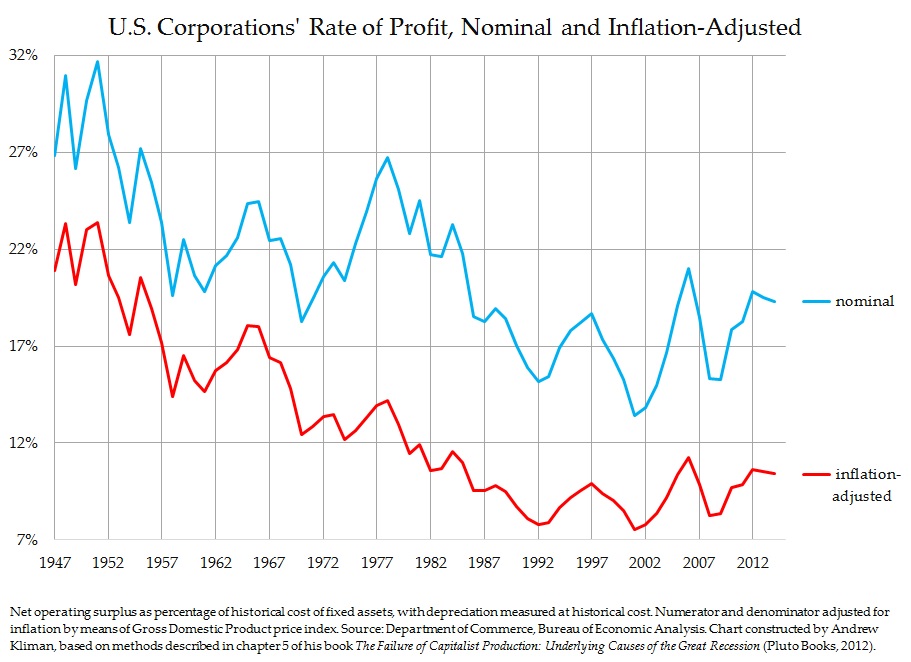
In 1973, an already sluggish world economy bore the immediate effects of the oil-price hike. Although the rate of profit temporarily rose as a result of the inflation brought about by the rise in the price of oil, it resumed its longer-term downward trend after a few years. That trend has continued, with spikes and dips in the interim, to this day. Marx’s law of the tendency of the rate of profit to fall had always been in effect since the inception of industrial capitalism, but since this point in history, insufficient countervailing factors have been available to offset the tendency. Because profit is the driving force of capitalist production, the only incentive for undertaking it and the only long-term source of funds for productive investment, we face unstable and grim economic conditions and prospects. Given the low yields in profit, an effective productive investment boycott has ensued, and since the mid-70s, the worldwide rate of growth has been approximately halved. While there have been relative booms and busts in the interim, these have been due largely to short-term, financially-driven bubbles, and perhaps the introduction of new markets and newly super-exploited labor forces. Nevertheless, the economy has never returned to post-war boom levels.


Rectenwald article graph, rvsd, 7.4.16


The decades after World War II and those after 1975 reveal strikingly different situations for the world economy, and thus utterly different prospects for Keynesian or social-democratic interventions. Since the mid-70s, as Kliman notes, “the rate of investment (capital accumulation) has fallen and never recovered, debt burdens have increased markedly relative to income, growth of GDP, industrial production, employees’ compensation, and public infrastructure investment were all much slower than during the postwar boom, the average duration of unemployment was higher and the problem of workers dropping out of the labor market was more serious, and there were many, many more burst bubbles and banking, debt, and currency crises.”

Ignoring or blithely unaware of this economic reality, leftists mistakenly imagine that “neoliberalism” has merely been the desideratum of wicked politicians, who under the influence of their Wall Street and corporate donors, have maliciously manufactured current economic conditions. But the reverse is actually the case; neoliberalism is a set of policies and an ideology that the ruling class and their political proxies developed in response to the underlying and enduring economic malaise of capitalism. That is, underlying economic conditions have been the driving force of neoliberalism, not politics and ideology. And neoliberalism has not solved the problems that it inherited from Keynesianism. Indeed, history has illustrated time and time again that the various rightist and leftist reformist political or policy programs formulated to resolve the problems produced by capitalism are inadequate to the task.

Unfortunately, for sundry reasons, what has happened in the ideological ambit of left politics amounts to a divorce, a divorce of the “political” from the “economy” in the field of political economy. Rather than the so-called “vulgar Marxist” economic determinism of yore, what we have today has been aptly termed political determinism. Political determinism is the belief that the economy is driven by politics and ideology, rather than the other way around. As long as political determinism prevails on the left, the left’s vision will be myopic and its recommendations will be utterly flawed and useless. Isn’t it about time to tell the working class the truth?

* * * *

*Michael Rectenwald is a professor in Global Liberal Studies at New York University. He is the author ofNineteenth-Century British Secularism: Science, Religion and Literature (Palgrave Macmillan, 2016), primary editor of Global Secularisms in a Post-Secular Age (De Gruyter, 2015), and primary author ofAcademic Writing, Real World Topics (Broadview Press, 2015). His essays have appeared in numerous periodicals and anthologies, including the British Journal for the History of Science, Endevour, and George Eliot in Context (Cambridge University Press, 2013).

How the Syrian revolution has transformed me (Budour Hassan)

The following is reprinted from Budour Hassan’s blog Random Shelling.

Comments welcome.

* * * *


The world revolves around Palestine, or so I thought until 2011.

The Palestinian cause, I argued, was the litmus test for anyone’s commitment to freedom and justice. Palestine was the one and only compass that must guide any Arab revolution. Whether a regime is good or bad should be judged, first and foremost, based on its stance from the Palestinian cause. Every event should somehow be viewed through a Palestinian lens. The Arab people have failed us, and we inspired the entire world with our resistance.


Yes, I called myself internationalist. I claimed to stand for universal and humanist ideals. I blathered on and on about breaking borders and waging a socialist revolution.

But then came Syria, and my hypocrisy and the fragility of those ideals became exposed.


When I first heard the Syrian people in Daraa demand a regime reform on 18 March 2011, all I could think about, subconsciously, was: “If the Egyptian scenario happens in Syria, it would be a disaster for Palestine.”

I did not think about those who were killed by the regime on that day. I did not think of those arrested or tortured.

I did not think about the inevitable crackdown by the regime.

I did not greet the incredibly courageous protests in Daraa with the same elation and zeal I felt during the Tunisian, Egyptian, Bahraini, Yemeni, and Libyan uprisings.

All I could muster was a sigh of suspicion and fear.

“Assad is a tyrant and his regime is rotten,” I thought to myself, “but the subsequent results of its fall might be catastrophic for Palestine and the resistance.” That sacred axis of resistance meant to me back then much more than the Syrian lives being cut short by its defenders.

I was one of those whose hearts would pound when Hassan Nasrallah appeared on TV. I bookmarked loads of YouTube videos of his speeches and teared up while listening to songs glorifying the resistance and its victories.

And while I supported the demands of the Syrian protesters in principle, I did so with reluctance and it was a conditional support. It was not even solidarity because it was so selfish and always centered around Palestine.

I retweeted a blog post by an Egyptian activist calling on Syrians to carry Palestinian flags, in order to “debunk” regime propaganda. The Syrian people took to the streets defending the same universal ideals that I claimed to stand for, yet I was incapable of viewing their struggle outside my narrow Palestinian prism. I claimed to be internationalist while prioritizing Palestinian concerns over Syrian victims. I shamelessly took part in the Suffering Olympics and was annoyed that Syrian pain occupied more newspaper pages than Palestinian pain. I was too gullible to notice that the ordeals of both Syrians and Palestinians are just footnotes and that the breaking news would become too routine, too dull and unworthy of consumption in the space of few months.

I claimed to reject all forms of oppression while simultaneously waiting for the head of a sectarian militia to say something about Syria and to talk passionately about Palestine.


The Syrian revolution put me on trial for betraying my principles. But instead of condemning me, it taught me the lesson of my life: it was a lesson given with grace and dignity.

It was delivered with love, by the women and men dancing and singing in the streets, challenging the iron fist with creativity, refusing to give up while being chased by security forces, turning funeral processions into exuberant marches for freedom, rethinking ways to subvert regime censorship; introducing mass politics amidst unspeakable terror; and chanting for unity despite sectarian incitement; and chanting the name of Palestine in numerous protests and carrying the Palestinian flag without needing a superstar Egyptian blogger to ask them to do so.

It was a gradual learning process in which I had to grapple with my own prejudices of how a revolution should “look like,” and how we should react to a movement against a purportedly pro-Palestinian regime. I desperately tried to overlook the ugly face beneath the mask of resistance worn by Hezbollah, but the revolution tore that mask apart. And that was not the only mask torn apart, many more followed. And now the real faces of self-styled freedom fighters and salon leftists were exposed; the long-crushed Syrian voices emerged.

How can one not be inspired by a people rediscovering their voices, transforming folk songs and football chants into revolutionary chants? How can one not be taken aback by protests choreographed in front of tanks?


The Syrian geography was much more diverse and rich than that promoted by the regime and the official narrative collapsed as Syrians from the margins reconstructed their own narratives. The Syrian rainbow had many more colors than those permitted by the regime. And Syrians could raise their voices in places other than football stadiums, using their famous victory chant in public squares and streets to curse Hafez al-Assad, the “eternal leader.”


If Hafez al-Assad’s name could only be whispered with trembles before 2011, people at last could vociferously curse him and his son, shaking both the physical as well as the symbolic hegemony of this dynasty to its foundations.


I could not remain neutral as Syrians redefined the feasible and stretched the boundaries of people power, albeit briefly, during those early months of fatal hope.

Wouldn’t remaining impartial have been an act of treason to anything I claimed to stand for? How could I possibly read out Howard Zinn’s quote “You cannot be neutral on a moving train” to those sitting on the fence on Palestine, while I was doing the same on Syria? The Syrian revolution crumbled the fence from under me. I rediscovered my voice thanks to the mass mobilization I witnessed in Syria. I would listen to clips from Syrian protests, memorize their chants, and repeat them in Palestinian protests. Thinking of the fearlessness of Syrians would immediately make my voice louder and help make me overcome any slight semblance of fear.


You do not choose the nationality into which you were born but you don’t have to be bound by its shackles.

My Syrian identity, my sense of belonging to the Syrian revolution, was not forced onto me. I chose to adopt it. I never stepped foot in Syria. It was not until 2013 that I first met a Syrian not from the Occupied Golan Heights in the flesh, face to face. My main way of connecting with Syrians was and remains through social media and Skype. Yet, I couldn’t help but feel Syrian and completely identify with the struggle.

Until 2011, my talk about breaking borders and internationalist solidarity was but a soundbite, mere rhetorics. Thanks to the Syrian uprising, I finally understood what solidarity is really about.


I always expected people to support the Palestinian cause without imposing conditions, without preaching or lecturing, without dictating. When the Syrian uprising erupted, I acted exactly like those armchair preaches demanding a jasmine revolution from Palestinians, constantly asking us about the New Gandhi and MLK. But as the revolution went on, I could finally comprehend the true meaning of solidarity from below, a solidarity that is unconditional yet also critical. I saw how people like martyr Omar Aziz applied horizontal self-governance in some of the more conservative and traditional neighborhoods, and I learned from his model.

I learned the meaning of communal solidarity and Palestinian-Syrian togetherness from the Palestinian residents of Daraa refugee camp: they risked their lives to smuggle bread and medicine and break the siege on the rising city of Daraa. It was not just a humanitarian act; it was a political statement and the beginning of the formation of an identity, that of the Palestinian-Syrian revolutionary.


Khaled Bakrawi, a Palestinian refugee from Yarmouk, and Zaradasht Wanly, a Syrian youngster from Damascus, were both injured by Israeli occupation forces during “return marches” to the Golan Heights in 2011. Both Khaled and Zaradasht were murdered by the Syrian regime: the former was killed under torture, the latter was shot dead during a peaceful protest.


Syrians marched in solidarity with Gaza amid the rubble of their houses destroyed by Syrian regime air strikes. The Syrian Revolutionary Youth put out posters against the ethnic cleansing of Palestinians in the Naqab when most of the group’s members were in hiding, jails, exile, or graves.

Such is the solidarity of the oppressed which Syrians turned from rhetorics to practice. How can one not admire it?


If the Second Intifada in October 2000 shaped the political consciousness and national identity of an 11-year-old girl who had just left her tiny village to move to the city; the first wave of the Syrian revolution in March 2011 rebirthed a woman making her more confident steps in Jerusalem. Jerusalem, my city, the one I chose to call home, could not by any means be liberated by the oppressors of my people, of Syrians. Jerusalem’s spirit cannot be hijacked by those bombing a hospital carrying its name.

Far from struggling to reconcile my Palestinian and Syrian identity layers, The Syrian uprising made me even more committed to the struggle for Palestinian liberation: the liberation of the land from the occupier and the liberation of the cause from dictators and bandwagoners.


And while I parted company with people I once regarded comrades because of their support for the Syrian regime, I also gained new, lifelong friendships that have imbued my world with warmth and strength.


I owe so much to the Syrian revolution, which re-created me. I have no status or self-importance or willingness to speak on behalf of anyone, let alone on behalf of the Palestinian people, but I personally owe an apology to the Syrian people. I should have never hesitated in supporting their just cause. I should have never privileged geopolitical concerns over Syrian lives; and I should have never been so naively deceived by the propaganda of the resistance axis.

I owe an apology to a people who, for decades, were trodden upon, silenced, and humiliated in the name of my own cause; to a people whose only encounter with “Palestine” was in a prison dungeon carrying this name; the people who were blamed and mocked for being so docile yet when they did rise up, they were abandoned.

I owe an apology to a people who are blamed for a carnage committed against them, just as we have been, and who have been betrayed by an opposition pretending to represent them, just as we have been, too. I owe an apology to a people cynically called upon to bring an alternative to the Assad regime and Islamists while bombs and missiles fall on their heads. Those same people asking “Where is the alternative?” ignore that Syrians who were ready to offer a progressive vision have either been jailed, killed or displaced by the regime.

One would think that Palestinians know the cynicism behind the question of alternatives that they wouldn’t pose it to another oppressed people fighting to build everything from scratch.


Yet despite contradictions, Palestinians and Syrians do share the same yearning for freedom, the same burning desire to live in dignity and the dream to walk in the streets of the Old City of Damascus and the Old City of Jerusalem.

The road we shall cross to get there, though, is not the one that the regime and Hezbollah saturated with Syrian corpses, but one paved with the hands of Palestinian and Syrian freedom fighters: by people who know that their freedom is always incomplete without the freedom of their sisters and brothers.