Daesh, the (pseudo) Left, and the Unmaking of the Syrian Revolution

“The role of socialists is not to counterpose themselves to democratic revolutions, which gave rise (in Egypt) to the first democratic government, and (in Syria) to emancipatory projects such as networks of local councils against the existing state, but to take the democratic side against tyranny”.

My response: WHY for heaven’s sake does this even have to be stated?

The reason is because of the general failure to understand that ‘socialists’ who side with tyrants are not worthy of the name, and that the pseudo-left which has been dominant for decades needs to be called out. I wish the reviewer had used that term rather than seeming to accept that one can oppose democratic revolution and still be on the left.
9780992650964-cov-front-sml


The following book review is published with permission of Syria Solidarity UK.

* * * *

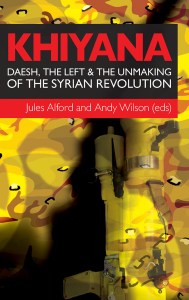
Khiyana: Daesh, the Left, and the Unmaking of the Syrian Revolution, ed. Jules Alford and Andy Wilson, published by Unkant, London.

Review by Clara Connolly

This book should be required reading for every leftist, as an antidote to the growing mountain of ignorant comment on the subject of Syria. The title Khiyana (betrayal) is an accusing cry; the book is a trenchant denunciation of the Western Left for its abandonment of the principles of internationalism and solidarity in favour of an alignment with the ‘anti imperialist’ camp, a hangover from the geo-politics of the Cold War.

Assad An-Nar, like most of the authors, situates himself on the Marxist left, and his prefatory chapter could be considered a direct response to Tariq Ali’s infamous dismissal of the Arab Spring in What is a Revolution? (Guernica, Sept. 2013). He sets his critique in the context of the changing nature of revolution in an age of global neoliberalism, where post colonial states are collapsing because neoliberal policies have slashed the limited social protections they used to offer. In this world, he says, the principles of self emancipation and of collective and democratic struggle are ‘ideas in search of a subject.’ Ideas about democracy, socialism, and anti-imperialism used to run in the same direction, but now they are counterposed.

With the collapse of the progressive moment of secular Arab nationalism, Islamist organisations like the Muslim Brotherhood can rise beyond identity/sectarian politics in resistance to tyranny. Though not necessarily opposed to neoliberalism, they are the voice of those who are excluded from its benefits. Hezbollah’s current role in Syria shows that such movements can swing between revolution and counter revolution without moving in a socialist direction.

The role of socialists is not to counterpose themselves to democratic revolutions, which gave rise (in Egypt) to the first democratic government, and (in Syria) to emancipatory projects such as networks of local councils against the existing state, but to take the democratic side against tyranny. Instead the left has responded by either supporting their favourite dictatorships (the neo Stalinists) or by re-hashing theories of ‘permanent revolution,’ i.e. insisting that revolutions can only end in socialism or defeat (the Trotskyists). Yes, he says, a democratic revolution is possible in these countries, but the outcomes are uncertain; the socialist left, while recognising its marginal role, should not condemn itself to irrelevance by denouncing the struggles for democracy because they are not socialist. Instead he urges the left to make the ‘democratic wager,’ in hope that the outcomes lead to more collective forms of struggle. There is little to lose for socialists, he believes, since neoliberalism has led worldwide to the fatal weakening of working class self-organisation.

The subsequent chapters examine and demolish the standard left myths about the Syrian revolution: the ‘jihadist’ nature of the ‘rebels’; the selective anti imperialism which admires Rojava but has no time for similar experiments in local democracy elsewhere in Syria; the role of regional imperialisms like Iran and Russia in propping up a monstrous regime; and above all the lies and distortions peddled by the institutional left (Stop the War Coalition, and the éminence grise of left journalism like Patrick Cockburn, Robert Fisk, and Seymour Hersh) who place the national interests of states they consider to be in the ‘axis of resistance’ above solidarity with the struggles of the oppressed in those countries.

In a short review I can refer only to two further articles in the core of the book; but I cannot resist a passing mention of the glorious satirical piece by M Idrees Ahmad, The Anti-Imperialist Guide to Inaction in Syria. Anyone familiar with debate on Syria will recognise the strategies he lists: ‘Don’t defend Assad, attack his opponents; sympathise selectively; functional doubt where straight denial is risky; defend peace and sovereignty; champion the minorities; talk about ISIS, not Assad; talk about refugees but not the cause of flight,’ etc. Most of these strategies are shared with the establishment and the extreme Right.

Mark Boothroyd describes the responses of Stop the War Coalition (STWC) to Syria, in a case study that echoes the critique in the preface. It has consistently viewed developments through its relation to the US and the UK. In a multi polar world system with competing imperialisms, it persists in viewing events through the prism of the Cold War. The agency of Syrians is erased altogether.

In 2013, STWC opposed the proposed intervention of the UK and when this proposal was defeated in Parliament, it claimed victory; but Boothroyd claims that if the West had really wanted to intervene in Syria it would have done so—its actual strategy is to let the country bleed. I think he underestimates the power of popular protest in democratic countries, and the degree to which STWC was able to tap into post Iraq war weariness. But he is right in pointing out that STWC has missed a trick in failing to expose the real cruelties of the Western role.

In its weaker response to the 2015 intervention against ISIS, STWC has consistently refused to allow oppositional Syrians on its platforms—who have opposed the Coalition campaign against ISIS as useless and counter-productive, but have also proposed more positive measures for the protection of Syrian civilians. Once again, its failure to listen to Syrians has weakened its moral stance even in its own terms—in opposing its own Government.

It could have been different, he believes: the anti war movement could have risen beyond its current ethnocentric, isolationist positions to meet the challenge of changing times, and been a movement to build solidarity with the revolutions in the Middle East.

In The Rise of Daesh in Syria, Sam Charles Hamad attacks the myth of Saudi funding and support for Daesh; instead, in a detailed study, he convincingly shows their deadly rivalry despite their similar ideologies. He demonstrates the origins of Daesh in post invasion Iraq, and its nurture by the sectarian regimes in Iraq and Syria. He shows, by tracing its sources of income, how it is self sustaining. Finally he argues that the current tactics of the west, in fighting Daesh from the air but hampering the oppositions in their fight against the sectarian regimes of Assad and Maliki, are counter-productive. And the left’s narrative is complicit in this.

The book, and particularly its opening chapter, is weakened by a failure to examine more closely such terms as ‘democracy’ and ‘emancipation,’ given their ambivalent history among Marxists; and to analyse the demands of the revolution—Freedom Justice and Dignity—in more detail. This is particularly the case since there is little discussion of class, and no accounts of the role of women in the Syrian revolution, nor of the role of Western women’s peace groups or feminists in relation to Syria. My own recent experience of organising solidarity events with Syrian women suggests that the hostility to, and silencing of, Syrian voices is much less prevalent among feminist organisations than in the left as a whole. The ‘democratic wager’ which is urged upon us might be weighted more favourably with the inclusion of women activists, within Syria and in the West.
When the impossible becomes the inevitable: my memory of the struggle against apartheid

I retired from work, at the Museum of Australian Democracy at Old Parliament House, Canberra, Australia, last week. The following is my final blog post as an on-going Public Service employee.

Feel free to add a comment at the museum’s blog site.

imagesmandela

On reflecting on the campaign of solidarity in Australia with the South African oppressed people, it reinforced my view that identifying with, and supporting, the oppressed and those struggling for freedom, is a core left-wing value. It was not just on the issue of South African apartheid that we did this, but on Vietnam too. The left supported the Vietnamese people against US imperialism, just as we supported the South African people against the apartheid regime. Other examples are our solidarity with the Czech and Polish rebels.

It is incomprehensible to me that people and groups that do not support the Syrian people in their struggle against the Assad regime can be in any sense left-wing, no matter how they self-identify and no matter what ‘left’ sounding slogans they shout.

Anyway, here is my final blog post at work.

* * * *

The museum’s Memories of the Struggle exhibition highlights the part played by Australians in solidarity with South Africans against the apartheid regime. It resonates with scores of thousands of us who actively took part in the struggle as grass-roots activists.

From the late 1960s and for most of the 1970s, I was one such activist in Melbourne. I lived and breathed the kind of left-wing politics that opposed apartheid and supported regime change and democratic aspiration there. If I wasn’t printing out and handing out leaflets about it, and sometimes writing them, I was attending working-bees where people designed and made placards and banners for street protests. And, there was hardly a demonstration on the issue in Melbourne that I didn’t attend. To me, it was part of a global revolutionary struggle. (The same applies to the Vietnam War, which loomed larger because of the policy of conscription for the war, and the greater violence against the Vietnamese).

Of course, not all of the Australian opponents of apartheid identified with the left and only a small minority were communists like me. It’s worth noting that while nearly everyone opposed the apartheid system in principle back then, there was strong opposition to Nelson Mandela, who was seen as a communist and a terrorist. He was certainly close to the South African Communist Party and his Spear Movement struck terror into the hearts of the fascists running the regime. To be opposed to apartheid in principle was fine, but to want to do something about it in practical solidarity was ‘going too far’.


Fast forward several decades and in 1994 Mandela is the elected and acclaimed President of a new era in South Africa, one free of apartheid and one in which all people have equal voice in elections. Despite serving 27 years in prison, he properly urges reconciliation rather than revenge. What a man! Governments whose leaders were not forthcoming with solidarity when it was needed now applaud him. The Australian governments of Whitlam, Fraser and Hawke are among the proud exceptions. Celebrities like Michael Jackson and Elizabeth Taylor pose for photos with him. How things change.

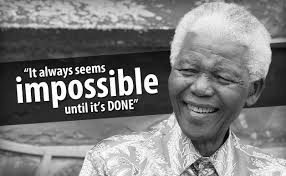
That’s what happens when you have History on your side. When the reactionaries, who can seem so powerful, are revealed as the paper tigers that they essentially are. If proof is needed of the maxims that ‘the people make history’, and that ‘wherever there is repression there is resistance’, then South Africa under apartheid provides it. At times, it seemed a hopeless uphill battle. But don’t they all? Until they are won. And then what once seemed impossible suddenly seems inevitable.

When Mandela was released from prison in February 1990, I was so thrilled and overwhelmed that, after my regular fitness run up Mount Ainslie, which rises 800 metres above Canberra, I wanted to repeat the run immediately. I was on such a ‘high’ and carried along by the adrenalin of Mandela’s release and the excitement of South Africa’s prospects as a democracy. Thereafter, running up and down Mount Ainslie twice without stopping became my ‘Mandela Run’.

Their victory was our victory – and my victory too.


Fast forward again, and around 2010 I find myself pondering Mandela’s future. He is now in his early 90s and I feel an urge to write to him, to let him hear from an Australian activist, rather than a leader or celebrity.

I want to share some anecdotes with him – things I experienced directly – and I want to ask him for an autographed photo as a memento.

Sorry, but I can’t find a copy of my letter to him. But from memory, it told him of the following.

At my university in the early 1970s, we had a Chancellor who was on the board of Imperial Chemical Industries which, among other things, manufactured explosives and munitions in South Africa. A mass meeting of a thousand students demanded his resignation. Eventually we won and the Chancellor resigned before his term expired. But what a struggle. We occupied the Administration Building, blockaded the Council members, held mass meetings at least twice a week. And the authorities cracked down severely on us for our lawlessness. Or was it for our effectiveness? John Gorton as Prime Minister had declared that “We shall tolerate dissent so long as it is ineffective”. The student ring-leaders were identified, arrested, fined, suspended from university, lost our Education Department studentships and three of us – yours truly included – gaoled at Pentridge, without sentence or rights of appeal – for contempt of court. (It’s not easy being red).

I wanted Nelson Mandela to know that, in the west, our movement was not just about ‘sex and drugs and rock music’, as it has been condescendingly displayed in popular culture, but about real struggle, repression and resistance. Just as we brought the Vietnam War home in our protests, so too we related the oppression of the apartheid system to our own local targets whenever possible.

I wanted Mandela to know of the police violence deployed by State governments against anti-apartheid protestors. The petite university student, a young girl with whom I was friendly, being thrown face first into a pole by a burly policeman three times her size. The blood pouring from her smashed nose. The State Secretary of the Labor Party in Victoria having a baton thrust into his eye and nearly losing the eye. We knew we were in for a hiding whenever the police started removing their identification badges from their uniforms. Some of the worst police violence I have witnessed took place on protests against apartheid. They were clearly on orders to intimidate us, and batons and boots were their main weapon. But it didn’t work. We knew that the repression we experienced was minor compared to that of our brothers and sisters in South Africa.

I was arrested on one of the demonstrations and convicted of assaulting police. My only regret is that I am unable to explain on official forms that ask whether one has any criminal convictions that my crime was to try to stop a policeman pulling down an anti-apartheid banner held by the front line of a street march. I pushed him with force from behind. Technically: guilty. C’est la vie: c’est la lutte.

I wanted Mandela to know of the funny things too. Like the way in which one of my mates in Brunswick, who worked with my dad in a factory, would come to my place before a demo and we’d listen to Eric Burdon’s album, ‘Every one of us’. It featured an interview with an African-American ex-serviceman talking about racism. It inspired us in our passion, reinforced the sense that we were part of an international movement, and lifted our morale as ‘soldiers’ in a struggle.

And there was the time we tried to stop the Springbok rugby team – when Bob Hawke to his great credit as President of the ACTU intervened against the team’s visit. The police were brutal that day in 1971 but the thousands of assembled protestors at Olympic Park were determined to run onto the field and stop the game. The police cordon around the oval was holding out until it was broken when a group of police moved together to arrest people. I was standing with a comrade who saw the opportunity and said to me, “Quick, Barry! We can jump the fence onto the oval!” We ran forward, together, but at the last moment I lost my nerve. My poor comrade leapt onto the oval only to be grabbed by police. That comrade, incidentally, was Ian MacDonald, later to become a Minister in the State Government of New South Wales.


So I told all this, and more, to Nelson Mandela – ‘Comrade Mandela’ – in my letter.

After a month or so, I received a reply. It was from his secretary, who said that Mandela was now too frail to keep up with such correspondence and no longer sent out autographed photos.

However, the letter had been read to him in full.

And he had liked it.

To me, that was all that mattered.

Syria: links

free syria flag

Nothing much happening at Strange Times so I’m hoping to kick-start some new links to information and analysis – and discussion – about Syria.

Hoping to set this up as a separate page soon. But for now… contributions welcome.

Just to start things off:

  • The ceasefire, which some people regarded as doomed to failure before it had even started, has been working, in the main, for nearly six weeks now. It has provided breathing space, with parts of Syria under rebel control able to commence reorganisation of their localities. For the first time in years, Syrians have been able to take to the streets again demanding the regime’s overthrow. Some humanitarian aid is getting through where needed, but this is still a problem area in places where the regime is obstructing aid delivery – and further isolating itself (and strengthening the case for miltiary intervention on the side of the pro-democratic forces).
  • Assad is increasingly isolated, with Putin looking for a way out and supporting the UN transitional plan; a plan that means the end of Assad’s rule.
  • The next round of talks might happen within a week. The co-ordinator for the Higher Negotiation Committee has said that there is no international will, especially from the US, which means that the rebels continue to want greater international involvement and support, especially from the US.
  • As the talks progress and the regime remains more intransigent and isolated, the need for some form of military ‘boots on the ground’ will become more acceptable as a way of resolving the situation and allowing the transition’s timetable to be followed in an effective way. A ‘coalition of the willing’ will be required to ensure that the terms of the transition are enforced, and that the Syrian people will be able to assert their sovereignty in free and fair democratic elections as aimed for in the timetable.


* * * * * *

Why ‘Earth Hour’ is silly

We should not be demonising electricity — we should be celebrating it.

download

With thanks to Spiked for permission to republish this article by John Slater.

On 19 March every year, millions of people in developed countries spend 60 minutes of their lives reeling in collective guilt over the evil of fossil fuels. But when people turn off the lights for Earth Hour, they only hold a candle to their own ignorance.

Earth Hour is exactly the type of feel-good event today’s environmentalists seem to relish. It provides a ready-made opportunity for people to flaunt their social conscience by denouncing industrialisation, electricity, fossil fuels and the other ‘excesses’ that make 21st-century life worth living.

But what these candle-waving, middle-class do-gooders forget are the 1.3 billion people who will spend all of 19 March in the dark – not out of some desire to be close to nature, but because that’s how they spend every other day of the year.

How long without electricity would today’s Earth Hour enthusiasts last before their warm inner glow turned to despair?

Perhaps if people were forced seriously to contemplate life off the grid, they’d come to accept the empirical fact that nothing has done more to advance the plight of humanity than cheap, reliable electricity.

The problem with Earth Hour isn’t that burning candles actually emits more carbon than using a lightbulb, nor that large numbers of households simultaneously going dark disrupts the power grid and actually increases emissions.

No, the problem with Earth Hour is that it makes a villain out of electricity provision, the very thing that’s allowed humanity to rise out of abject poverty and reach the standard of living we enjoy today. So, since you probably won’t hear it anywhere else, here are just a few of the tremendous benefits of cheap, reliable electricity:

It feeds the world
Worldwide poverty is at its lowest rate in human history.

his is in large part because of the modern methods of mass food production that depend on cheap electricity. Industrial farming practices, including irrigation, mass food storage and transport, would all be impossible if environmentalists had their way. In the Middle Ages over 90 per cent of Europe’s workforce worked on farms; today, less than five per cent does. This has freed millions of people from backbreaking labour to develop their own skills and talents, which in turn have enriched our lives.

And once this mass-produced food reaches our homes, it is electricity that allows us to cook it quickly and safely, without exposing ourselves to health risks from chronic smoke inhalation. Two million people in developing countries still die each year from noxious fumes caused by traditional indoor heating and cooking practices. This gives some insight into what cheap electricity has meant for human welfare.

It saves lives
Electricity has made possible the advances and wide availability of modern medicine, from vaccines to antibiotics and surgery.

According to the World Health Organisation, the measles vaccine alone has saved over 17million lives worldwide since 2000. This wouldn’t have happened had there not been cheap, electrically powered refrigeration for the storage and transportation of the vaccine.

It creates prosperity
As Bjorn Lomborg, author of The Skeptical Environmentalist, points out, the electricity available to people in wealthy countries is roughly the equivalent of having 56 servants working for you in pre-industrial times. It’s easy to forget this if you have the luxury of boiling a cup of tea and sitting down to watch a digitally recorded episode of MasterChef once your annual 60 minutes of environmental self-flagellation is up. But for the people of, say, Liberia or South Sudan or Sierra Leone, every hour is Earth Hour. Life is short and illness often deadly. People spend most of their waking hours fighting a neverending struggle for basic necessities like food and shelter.

There is no doubt that our prosperity has come at a cost to the natural world. But if we care about making the world a better place, the last thing we should be doing is turning off the lights. If what we want is a genuine accommodation with Mother Nature, we should be concentrating humanity’s collective energies on finding cleaner and cheaper ways of sustaining modern life, not harking back to some pre-industrial fantasy.

Contrary to the delusions of eco-pessimists, cheap electricity is exactly the kind of innovation we need more of. London’s air quality today is the best it’s been since coal became a common fuel for lime burners in the early Middle Ages. Why? Because thanks to electricity, factories are no longer run on coal power. Nor do households have to burn it to cook and stay warm.

The idea that human progress actually helps the environment flies in the face of everything today’s environmental zealots hold dear. In their eyes, humanity must repent for daring to industrialise. That means putting an end to the wealth and material excess that characterise our daily lives.

If people are actually interested in saving the planet, they’d be better off lighting their houses with electricity, not mourning human progress in the dark.

John Slater is a Young Voices Advocate, and an Australian writer based in Washington DC. Follow him on twitter, @JohnSlater93.

Opening the borders – is it really unpopular?

The notion of opening borders is no longer a fringe idea of those on the Marxist Left and classical liberal Right. It has been implemented by Europe’s power-house and, to her great credit, Germany’s Chancellor Merkel is standing by her policy. And recent state elections and opinion polls show that the German people are not repudiating her. 

open borders x


* * * *

The Christian Democrat Chancellor of Germany, Angela Merkel, opened Germany’s borders to more than a million asylum seekers, mostly those fleeing the barrel bombs of the fascist regime in Syria.

The recent elections in three German states resulted in a new right-wing party, the AfD (Alternative fur Deutschland) which opposes the ‘open borders’ policy, receiving 25% of the vote in one electorate, 15% and 12% in the other two.

Googling ‘Merkel’ and ‘elections’, the headlines overwhelmingly suggest this is a defeat for Merkel’s open borders policy: a “disaster” for her. She has been “punished” by the voters for her open borders’ stance. So say the media headlines.

Yet further examination of the actual results in the three electorates – Saxony-Anhalt, Rhineland-Palatinate and Baden-Wuerttenberg – indicate that the results are a defeat for those who claimed the new party represents the silent majority.

In the elections, opponents of Merkel’s policy had their chance to test public opinion. And the result shows that they are marginal, averaging less than 15% of the vote.

It is true that the Christian Democrats, Merkel’s party, were defeated in Baden-Wuerttenberg. But they lost to the Green Party, which supported Merkel’s policy. Yes, they lost in Rhineland-Palatinate to the Social Democrats but the Christian Democrat candidate, Julia Klockner, stood as an opponent of her party leader’s open borders stance. The Social Democrat candidate was more favourably disposed to it.

In Saxony-Anhalt, the AfD did well with a quarter of the vote, but Merkel’s party came first with only a minor reduction in the Christian Democrat vote.

Moreover, opinion polls find that Merkel’s popularity hovers around the 50% mark. Currently, her approval rating is 54%.

A poll of voters about refugee policy in the three electorates found that Merkel’s approval rating is 58% in Rhineland-Palatinate, 54% in Baden-Wuerttenberg and 43% in Sachsen-Anhalt.

So, here we have a Chancellor who has shown that borders can be opened and, despite the inevitable chaos, the masses do not run from that Chancellor and her policy in anger and fear. Only a minority does that.

What Merkel has done is to change the paradigm of the debate over immigration and borders. Not just in Germany but everywhere.

The notion of opening borders is no longer a fringe idea of those on the Marxist Left and classical liberal Right. It has been implemented by Europe’s power-house and, to her great credit, Chancellor Merkel is standing by her policy. And the German people are not repudiating her.

She understands that ‘they’ are ‘us’ and ‘we’ are ‘they’, and that sharing the chaos does not preclude supporting measures to tackle the problem at its main source: the Assad regime.

She recently said that a million people is not many when you consider that Europe’s population is 500 million. The pity is that other governments are closing their borders rather than sharing the chaos caused by barrel bombs in a not-too-distant land.

Syria – Partial ceasefire has saved lives, but still a long way to go…

It will inevitably require boots on the ground to enforce a more complete ceasefire and for the transition to free and fair elections in Syria late next year.

* * * *

The following is from the Syria Campaign.

Dear Friend,

“Can you hear that? … It’s the birds singing…” That’s what one of the rescue heroes of the White Helmets said over the radio on the first day of the partial ceasefire in Syria.

Over the past few days there have been dozens of violations of this break in the fighting. We’ve been reporting sniper fire, barrel bombs and Russian air raids.[1] But while the violence has not stopped, it has reduced. And that means innocent civilians that would otherwise have been killed in the extreme carnage of Syria are still alive today. In short, the partial ceasefire has saved lives.

But right now the ceasefire is extremely fragile and it’s not just the violence that endangers it.

A key part of the agreement negotiated by the US and Russia was that aid would be delivered to areas under horrific ‘starvation sieges’ at the start of the ceasefire. This hasn’t been honoured. The Assad regime which is denying access to 99% of those under siege in Syria continues to block aid trucks.[2] Apart from a few small deliveries by the UN to some areas, the vast majority of those going hungry have seen nothing. In one of the worst hit towns, Daraya, many are on the very edge of starvation.

The continued denial of aid to besieged areas is a major breach of the ceasefire and threatens the whole agreement.

But there is something we can do. Tomorrow, in less than 24 hours, the most powerful countries in the world that make up the international “Humanitarian Task Force” on Syria will meet in Geneva to negotiate aid delivery.

These are diplomats and politicians that respond to public scrutiny and together have sway over the Assad regime. If they feel the pressure from the world outside their negotiation room, they will push harder to get this aid in. It’s the best hope of keeping this fragile ceasefire alive.

Take a moment to sign this urgent petition to the Humanitarian Task Force to ensure aid delivery to besieged areas like Daraya today. Let them know we’re watching:

http://act.thesyriacampaign.org/sign/save-ceasefire/

In solidarity,

James

NOTES

[1] We’ve been monitoring possible violations of the ceasefire at www.syriaceasefiremonitor.org

[2] Read more about the situation of sieges in Syria at http://www.breakthesieges.org

Syria’s bourgeois-democratic revolution and the need for boots on the ground.

I share the following view by the Antiwar Committee in Solidarity with the Struggle for Selfdetermination but the important question is how can any decisions arising from the negotiations be enforced and maintained without a military force on the ground that is committed to enforcing and maintaining the transition.

The question of ‘boots on the ground’ needs to be tackled pro-actively by the governments and the UN that established the opportunity presented by the coming negotiations.

Boots on the ground that are sympathetic to the Syrian people would make delivery of humanitarian supplies more likely on the scale that is required.

Apart from needing to protect Syrians from the likes of Daesh, a military coalition on the ground (and backed by air support) will be necessary to guarantee that people can vote freely and to protect the Assad loyalists among the Alawite community once he is tossed out.

Comments welcome.


11055328_621048241328691_7043512423930289502_o


* * * *


We support efforts by the High Negotiations Committee of the Syrian Opposition to negotiate a political settlement which will lead to a transitional governing body, and to human rights for all, rule of law, and democracy for Syria. Given the scale of documented atrocities carried out by the Assad regime, it follows that such a process must bring an end to regime rule.

We further support the demand by the High Negotiations Committee that the international community implement in full the humanitarian provisions of UN Security Council Resolution 2254 prior to negotiations.

The current Geneva III Conference has begun against a background of escalating Russian and regime bombardment of populated areas and civilian infrastructure, escalating starvation sieges, and ongoing mass detention and torture of political prisoners.

UN Security Council Resolution 2254, which set out the international endorsement for these talks, called on the parties to “allow immediate, humanitarian assistance to reach all people in need, in particular in all besieged and hard-to-reach areas, release any arbitrarily detained persons, particularly women and children,” and demanded the full implementation of the long list of unenforced Security Council resolutions on Syria: 2139 (2014), 2165 (2014), 2191 (2014) and any other applicable resolutions.

Resolution 2254 further demanded “that all parties immediately cease any attacks against civilians and civilian objects as such, including attacks against medical facilities and personnel, and any indiscriminate use of weapons, including through shelling and aerial bombardment.”

These items are the express will of the Security Council and as such are not for negotiation between parties. The international community should never preside over a process where humanitarian relief is allowed to be used as a card in political negotiation.

As long as the international community fails to enforce its own resolutions, the Syrian people can have little faith in the peace process. If the international community can’t deliver baby milk to besieged areas, how can they be trusted to deliver free and fair elections?

For peace talks to succeed, the international community must implement the humanitarian provisions of its own UN Security Council Resolution 2254 in full

The battle for democracy

David McMullen wrote a very good post last month at his new site, Different Wavelength, and has given me permission to republish it below.

Among the best sites for keeping tabs on democratic progress or otherwise are:

Freedom House

Human Rights Watch

Reporters without borders

Amnesty International

Electronic Frontiers

Transparency International

(Let me know of any that should be added to the list!)

* * * *


We have had quite a bit of progress on the democratic front in recent decades although there are still some very big and serious challenges.

Let us look first at the progress. Latin America is no longer run by military dictators and they are becoming the exception in sub-Saharan Africa. Then of course there is eastern Europe where most countries are now democracies.

However, the picture is still pretty grim when we consider the continuing extent of tyranny.

In Russia, democracy is more formality than substance and most the other states of the former Soviet Union are rather dodgy or downright nasty.

China is a police state. Dissidents are jailed. The Internet as we know it does not exist. Lots of western news sites are blocked. There is no Facebook, Twitter or YouTube. And they employ an army of censors taking down anything taboo. And by the way, North Korea only exists because of Chinese support.

Then we have the Middle East. It has more than its fair share of tyrannies and authoritarian governments. At the risk of seeming perverse, I would suggest that the present civil war in Syria could indeed be a bright spot on the democratic front. This will depend on the Western powers recognizing that their inevitable intervention can only end the civil war if it brings democracy.

* * * *


Marx’s moral theory (via Bill Kerr)

Thanks to Bill Kerr for permission to republish this.

****

HUMAN ESSENCE

If there is such as thing as human essence and we can discover what it is then that will go a long way towards developing a moral theory.

Human nature is part biological, part social and not religious. Religion is something to be explained rather than believed. This includes modern religions such as Nature worship (currently popular) and Marx worship (currently marginalised).

Humans have both needs and powers. Obviously, it follows that we are both needy and powerful and both of these aspects of being human need to be explored further.

The biological and social parts are connected or interact dialectically. It would be an error to see them in isolation from each other.

Fundamental biological needs include eating, drinking, habitation, clothing, sexuality …

Biological and Social. Humans produce their own existence / material life through social labour. Our biology allows this, eg. Opposable thumb, upright posture frees the hand, large brain. This separates us from other animals. Compared to other animals we are self conscious and wilful to a qualitatively different degree. Although we originate as part of nature, with our social labour we oppose nature. Our productivity is also imaginative. We imaginatively and self consciously transform nature and in that process also transform ourselves. This is a teleological process. Humans imagine new forms of the material and self and then through social labour bring that imagination into reality. This is human essence.

THE GUIDING MORAL PRINCIPLE

The guiding moral principle is to do whatever is required for the human flourishing of rich individuals, to dynamically expand human powers for all humans. Human flourishing is not original to Marx but Marx built on the best available ideas that came before him, those of Aristotle.

Marx and Engels were more aware than Aristotle about the role of social labour in this enrichment process. After all, Aristotle lived in a slave society. Refer Engels, The Part Played by Labour in the Transition from Ape to Man. In communist society there would not be a division of labour based around the supply and demand of the labour market. In a world where production for the needs of all is established then each individual would be free to pursue their own perceived interests.

PHILOSOPHICAL STANCE

The philosophical stance here is to investigate what is distinctive about humans (biologically and socially) and from that basis to articulate what a good or rich life is.

ONTOLOGY

Be clear about where our moral principles come from. Being determines consciousness. Matter is philosophically prior to ideas.

The theory is philosophically materialist. It starts from real people and real conditions. It ascends from earth to heaven, not descends from heaven to earth.

But, once we are in heaven how do we get back down to earth again? The only way is to make a detailed study of society in all its aspects. Mode of production, division of labour, social classes, Is there a surplus and who controls it?, the history of knowledge, current issues, individual self knowledge. There is a lot to know! The desirable actions that promote the best human nature at any point in history depends on the depth and perspicacity of such an analysis.

CAPITALISM and ALIENATION

Capitalist limitations. For the capitalist, because they own the means of production, the workers life activity becomes a mere use value. In general, workers have no direct stake in the products they produce. Temporary niche solutions may be possible for individual workers but overall work loses it human character. In class society, the economy operates as a thing more or less outside of human control. If there is no profit to be made then production grinds to a halt. There maybe poorly understood economic laws. But the best that could be said of capitalism is that it is a highly unstable system in which the future well being of the workers who make it is uncertain and problematic.

Capitalism gives labour a bad feel (alienation) and production a bad name. Under capitalism humans are alienated from their essence, their living social labour, since the capitalists own the means of production and determines which products are made and who owns those products.

The capitalist economy is an unstable monster, poorly understood, difficult to manage and continually spinning out of control. Workers are alienated from the products they produce. Creative people who produce things of beauty (some artists, some writers, some teachers etc) are often not seen or appreciated as typical workers, rather they are marginalised workers looking for a niche to survive in a system that systematically undermines them. Or a handful may become megastar celebrities who play a significant role in entertaining the masses. Moreover, many believe today that capitalist production is despoiling the environment at an alarming rate. I think there is some truth to this latter charge, although I also see talk of environmental Armageddon as exaggerated and a distraction from the main wrongs of our society.

These issues in combination (production for profit not human need) give production itself a bad name. Human essence, social labour, life’s prime want, is reduced to being a wage plug, without a real say in the overall progression of society.

Rather than saving the planet (the current “left” mainstream zeitgeist) we need to focus more on how to liberate the social productive forces, human essence, in all their real power and beauty. A power and beauty which is obscured by the ugliness of capitalism.

NATURAL NATURE

The natural world is the world created by humans, who are part of nature, as well as the world that existed before humans. The natural world is not “green” insofar as that suggests a world not touched by humans. Such a world no longer really exists on Earth. In a post natural world (aka the anthropocene) our needs will be created more by what we make than the natural world that exists independently of what we make.

As society evolves our tastes, including our basic biological tastes, become more sophisticated: “the forming of the 5 senses is a labour of the entire history of the world” (source)

THE SCOPE OF MORAL THEORY

A moral theory has to somehow account for all human moral thinking, good and bad, angelic and evil, noble and perverse, optimistic and pessimistic. But Marx’s moral theory is (intentionally?) thin. It does not claim or suggest that humans are any of essentially selfish, altruistic, competitive, fallen, vicious etc. Is this a feature or a bug? In my view Marx is right about the essentials but there is a lot of stuff that is not covered. Marx analyses the deep structure of capitalist society but there are important issues that lie more on the surface (eg. the dark and deep emotions such as love, grief, anger) that strongly motivate individual actions but are left hanging. Hence, many people find that other moral philosophers and novelists address their needs more directly.

UTOPIANS and OTHER ALTERNATIVES

Utopians make the error of promoting general moral principles in the abstract, without regard to the current real state of society, without assessing the social forces at play. They are not realistic. Mere moral persuasion in favour of a better society is inadequate / doesn’t work.

There are many alternative moral theories. For example Plato (Iris Murdoch provides a modern interpretation), Stoic, Christian (various branches), Kantian, Utilitarian (Bentham and JS Mill provide different interpretations), feminism / women’s liberation, Buddhism (meditation and mindfulness are currently popular), existentialism, libertarianism, animal liberation, Sufism (adopted by Doris Lessing after her disillusion with communism), pragmatism (Dewey, Putnam), the liberal Capabilities approach of Amartya Sen and Martha Nussbaum.

All of these need to be critically examined since what is correct only emerges clearly from a critique of such alternatives. At this stage I would say that none of these alternatives share with Marx the view that human essence is the conscious production of our existence / material life through social labour. Moreover, they tend to be indifferent to the analysis that the main current problems are generated by capitalism.

INDIVIDUALS and SOCIAL CLASS

Humans are self conscious, intelligent, purposive, active, self directed. But this doesn’t mean we can negate the so called “external world” (only external to humans, who are a part of nature, so not really external to nature in that broader sense of the word) or history.

Human individuality (as distinct from herd or tribal mentality) emerges historically from the bourgeois revolution against feudal relations (when it was “natural” to obey a preordained superior such as a lord or king). Herds are not good at shopping, whereas individuals are. But just as individuality emerges strongly in the capitalist era, you would expect it to also change dramatically in a post capitalist society.

In class society, social class is a more important determiner of who we are than individuality as such. Individuals pick their personalities, interests, work etc. from what is available socially (including the cutting edge, futuristic and off beat, quirky trends) at the time. The idea that we are free, autonomous individuals is more part of capitalist mythology or ideology than reality.

HISTORY

Morality is historically contingent. What is moral in one historical period becomes immoral in another. The central issue is doing whatever is required to maximise the human flourishing of rich individuals in the given time and place.

For example, in the French revolution the rising bourgeois class overthrew feudal relations, got rid of divine rule by the King etc. In that historical period bourgeois right coincided with the needs of the proletariat as well. But at a later date the bourgeois class held things back, became reactionary, used social labour for their own ends, promoted an economic system which went through periodic crises and still does. At that point the revolution to continue human liberation and the liberation of the productive forces must be picked up by the proletariat, sooner or later.

Given the views expressed here about ontology (materialists need to deeply investigate reality) and history (morality is historically contingent) it follows that to work out the best moral – political actions requires some hard work. No one said it would be easy.

TRANSITION FROM CAPITALISM TO COMMUNISM (SOCIALISM)

The productive forces developing within bourgeois society create the material conditions (preconditions?) for the solution to the problem of the antagonism of the individuals social conditions of existence. Big is beautiful, not small is beautiful (the latter from EF Schumacher). Not because capitalism is beautiful but because big, centralised production prepares the way for socialism.

COMMUNISM

Marx is grounded, not utopian. In The German Ideology, Marx rejects the idea of communism as “an ideal to which reality will have to adjust itself”, rather he sees it as “the real movement which abolishes the present state of things”

This is pretty much the opposite of what most people today believe about communism, that it is idealistic and unrealistic.

From a moral perspective the aim is to bring together social being (human existence as it is) with social essence (human existence as it ought to be). As the contradiction between the individual and the social diminishes then the need for morality to maintain social cohesion would also diminish. All the conditions for rich individuality would be met by society. Eventually, morality might disappear altogether. If everyone’s needs were being met through the basic social structure then wouldn’t concepts such as selfishness or altruism lose their meaning?

SOME THINGS MISSING FROM THIS ACCOUNT OF MARX’S MORAL THEORY

There are many important issues missing from both the theory and practice of Marxism in this account. I have a preliminary list but will leave that to another time. No doubt if you have read this far you are both interested in this topic and will have your own unanswered questions. This will require far more discussion.

REFERENCE:

I have done a lot of reading on this topic but won’t attempt a detailed bibliography at this stage. But I will mention one reference which to me is a stand out, a PhD thesis by Vanessa Wills titled Marx and Morality(pdf 269pp) who has read and understood all of Marx IMHO.

My dad Loreto York, Pastor Doug Nicholls and Brunswick’s Mayoral Ball 1973

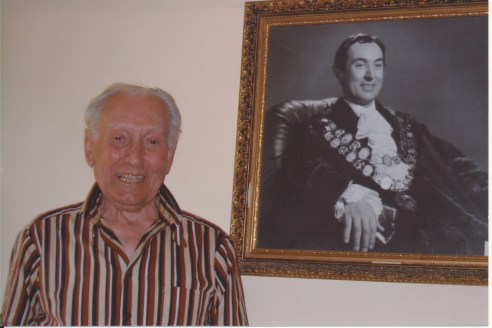
Loreto York, 2006, with portrait of himself as Mayor in 1972 ack Barry York

Loreto (‘Larry’) York, 2006, with photo of himself as Mayor of Brunswick in 1972.

****

My father, Loreto, would have turned 98 today. Sadly, he died in 2009 – but lived a healthy life for 90 years (save for his months of decline).

Loreto with his mother in Malta c1936 001

Loreto Meilak with his mother, Loretta, in Malta, c1936. (My dad changed his name to York in 1947 while in London with the RAF).

He was born in Malta in 1918, joined the Royal Air Force there during the Second World War, and ended up in London with the RAF after the War, where he met and married my mother, a Londoner ‘born within the sound of Bow-Bell’ named Olive Turner.

I was born there in 1951 and was three when my parents migrated to Melbourne, Australia.

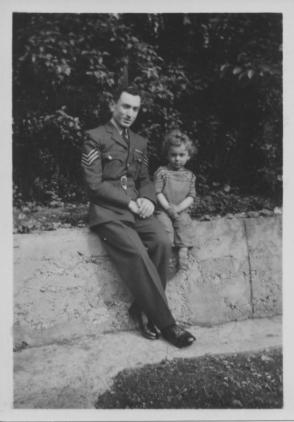
Loreto in RAF uniform and his son Barry c1954 at 15 Plympton Ave, Brondesbury, London jpeg

My dad in RAF uniform, with me, prior to being demobilized and migrating to Melbourne in 1954.


Apart from a brief stint as a mail sorter in the GPO, my father worked in factories all his working life in Melbourne. Radicalised by the experience of the anti-fascist war, especially by communist and socialist English and Scottish airmen he met while on service in the Middle East and Africa, he followed both the British Labour Party and the Communist Party while in uniform in London. (He was demobbed in 1953).

In Australia, he was shop steward in a couple of factories where he worked in the cosmetics industry and he eventually joined the Australian Labor Party. Back then, the ALP was the mainstream socialist party. (Hard to believe, I know).

A charismatic person who was self-taught (he had only four years of formal education in Malta) and who graduated with distinction from the ‘University of Poverty, War and Struggle’, he spoke several languages and this made him a huge asset to the Bruswick branch of the Labor Party.

As a family we had settled in Brunswick in 1954 and, after a couple of years in several different boarding houses, purchased our own place in Shamrock Street, West Brunswick, in 1956. I was there for nearly 30 years – my parents for about 40.

My father became active in local government politics in the 1960s and was elected to the Brunswick Council. Unlike the other Labor Councillors, he could speak Italian, Maltese, Arabic, some Greek and German and smatterings of other languages that were common in the significant migrant city.

In 1972, he became Mayor of the City of Brunswick – the first Maltese Mayor of an Australian city and the first ‘non-Anglo’ ‘non-Celtic’ Mayor of multicultural Brunswick. I should point out, too, that back then, being Mayor was not a paid position. There was a small allowance to cover costs but my dad had to continue working five days a week in the factory.

As he explains in the excerpt from a lengthy oral history interview I recorded with him in 1989/1990, he was involved in the Vietnam protest demonstrations and regarded himself as ‘progressive’. He felt strongly about Aboriginal issues and supported equal opportunity for all Australians. I have a childhood recollection of him exclaiming after watching a television documentary about Albert Namatjira: “They call this a democracy!” And: “How can there be poverty in a land with such vast natural resources?!”

In Melbourne back then, Pastor Doug Nicholls was the ‘face’ of Aboriginal Australia in the media. (That’s how I remember it, at any rate). He used to come to my school, Northcote High, and speak to us students at morning assemblies. He was quiet, understated, smartly dressed and very eloquent and persuasive. Above all, he was a man of enormous dignity, with no suggestion of victimhood.

The Brunswick Mayoral Ball of 1973

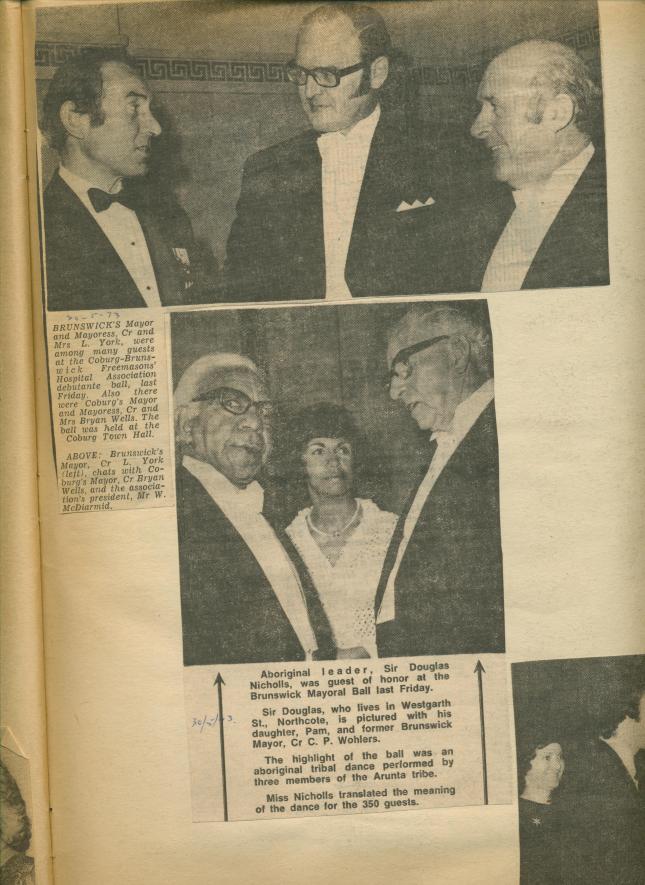
My parents admired him, as did most people, and when in 1973 my dad had to organise the traditional Mayoral Ball, he decided it would be a good opportunity to make a gesture in support of the Aboriginal cause and against racism. He arranged for a group of Indigenous dancers to perform – and he invited Pastor Doug to be special guest of honour, leading the official party into the hall.

As far as we knew at that time, no other Council had invited Aboriginal dancers to such a function. His decision to have Pastor Doug lead the official guests into the Brunswick Town Hall ballroom meant that he had to override the objections of the Town Clerk who, rightly, pointed out that it would breach Protocol (which stipulated that the order of entry into the ballroom by the official guests had to be led by the Governor (if attending), then Parliamentarians, then the RSL (of which my dad was a member), Councillors, etc.)

In the oral history excerpt, my dad is restrained in his description of how he insisted that Pastor Doug lead the official party. He told me at the time, and many times later, how he responded to the Town Clerk’s insistence that Protocol could not be broken, by saying: “I’m the f*&#ing Mayor and if I f*&#ing want Pastor Doug to lead the official f*&#ing party then it will f*&#ing happen!” (I’m told that the ‘f’ word was commonly used by members of the Royal Air Force during the War, and that is no doubt where he learned it). My dad had a theatrical side to his character, and relished re-enacting his response to the Town Clerk, even decades later when in his 80s. (His story-telling often took the form of highly animated re-enactment).

Dad's scrap album Pastor Doug Nicholls 1973 001

Pastor Doug Nicholls at the Brunswick Mayoral Ball in 1973 – newscuttings from my parents’ scrapbook.


My dad had a big impact on me in terms of awareness of the world, passionate opposition to injustice, interest in ideas, sympathies for socialism and communism and, above all, in terms of his spirit of irreverence and rebelliousness.

I hope you enjoy the oral history excerpt, commemorating, as it does, two of history’s good guys.


****