covid-19 – Third Wave

According to Victoria’s Chief Health Officer there is now a “minimal risk” of a third wave.

There are two senses in which that could be true:

  1. The decision to open up may have been taken at an optimal time. Only a few days earlier the CHO said frustration was at “boiling point” as he confronted a baying pack of journo jackals foaming at the mouth against a 24 hour delay to actually look at the most recent test data before capitulating to business, media and national government demands for an immediate opening. Perhaps he thinks that any benefits of further delay would be outweighed by the outcome being a clear cut victory for the denialists as the State government and public health authorities were eventually forced to back down by local and national government pressure. He might believe that by choosing a moment when a significant outbreak had just been successfully contained, with zero cases after thousands of test results, the wave of relief and confidence may well be optimal for not losing control when it does again become necessary to impose restrictions in order to prevent a third wave. He might also be right about that.
  2. The risk in Victoria might now be less than in any other State or Territory of Australia. Apart from New Zealand, that is about as good as it gets for comparable countries. In most of the world there is no possibility of actually eliminating community transmission (“mystery cases”) before a vaccine. There is no debate about that. It is hard enough trying to avoid collapse of the European and North American hospital intensive care systems in the face of the obvious difficulties of locking down early and long enough to avoid being overwhelmed. Prolonging a lockdown in the hope of eliminating “mystery” cases would be seen by nearly all “experts” as an absurd fantasy. Again, the CHO could be right about the risk being “minimal” in that sense. But being perched on a slightly less explosive powder keg than the rest is not especially comforting. Almost the entire population of every State is still completely susceptible and the more confident they are in contact tracing the more complacent they will get.

But there is a third sense which I doubt that the CHO or anyone that knows what they are talking about could possibly believe and yet will be widely believed by many people.

Most people who don’t expect a third wave believe it will be prevented by greatly enhanced contact tracing combined with other changes since the first wave including enhanced community awareness of the need for physical distancing, masks etc, serious regulation of workplaces and enhanced capacity for testing, isolation and treatment.

The CHO could not possibly believe the risk is now “minimal” in that sense. But others will assume that is what he is saying.

Not long ago Victoria had a roadmap with a target of:

“no new cases for 28 days and no active cases (state-wide) and no outbreaks of concern in other States and Territories.”

That is a reasonable description of the conditions for “minimal” risk of a third wave. The remaining risk would be that some subsequent sporadic isolated outbreak (as in New Zealand) might get out of control (prevented in NZ by an immediate lockdown when the first cases were detected, not by relying on contact tracing). In China measures to maintain elimination of mystery cases have so far included testing EVERYONE in three large cities.

I thought, but did not write, that this target was not intended seriously. If it had been serious the hardest stage 4 lockdown would have been maintained until it was achieved. The planned relaxation at the end of October would inevitably result in progress slowing down drastically so that the November target could not be achieved.

In fact the target was openly abandoned when the revised roadmap was published on 18 October.

So the CHO knows perfectly well what is actually required to minimize the risk in that third sense and knows that it has not been achieved. That is what he means when he stresses that it isn’t over until there is a vaccine.

According to all the editorial bloviating, everyone must cooperate to intensify their vigilance in order to stay open.

Since that is logically impossible it logically implies that there will be a third wave. It is simply illogical to expect any other result from opening up while there is still ANY community transmission bubbling away. Appealing for everybody to do the right thing is as effective a strategy as the power of prayer..

The CHO does not seem to know how to explain the situation to others and to rally support.

Neither do I. That is why I have not been writing.

In my view the media has been quite successful in convincing most people that the solution is contact tracing. Since they were demanding an early opening after the first wave they could not have admitted that contact tracing inevitably gets overwhelmed if you don’t lockdown quickly enough and stay locked down until mystert cases are eliminated. The State government could and should have admitted that its failure to respond to the rising mystery cases by locking down was the critical factor that turned ordinary ineptitude over Hotel Quarantine into a “State of Disaster”.

Explaining that is critical for ensuring that the next lockdown comes quickly enough to avoid a third wave that could be bigger than the second (which was far short of overwhelming the hospital ICU capacity, unlike the current situation elsewhere).

The biggest danger I see is from contact tracing. They now have a capacity to delay a necessary general lockdown for quite a long time by locking up a large proportion of contacts and contacts of contacts. That does not significantly increase the capacity to trace and isolate the upstream sources of new cases. That becomes much harder when things are opened up so the proportion of “mystery cases” can be expected to grow from the present very low level of about 1 every 5 days. From such a low level the growth will be slow for a long time. But when it starts growing fast again it will take much longer to eliminate than it would have if they had finished the job this time.

New Zealand’s contact tracing capacity was exceeded at only 100 cases per day in March. That is what forced them to lockdown quickly and hard. Their success came entirely from locking down quickly, not from contact tracing.

The same campaign that forced abandonment of the roadmap in mid-October is likely to prolong ignoring a slow growth in “mystery cases” and pretending that it can be reversed by intensified contact tracing and isolation of only downstream cases.

I will try to write something persuasive later.

Meanwhile I am just getting this off my chest as another half-baked article.

Notes on Trump 50 – Final Debate

I haven’t been following US elections closely but I did watch both debates and both competing “town halls”.

Moderator was vastly more competent in final debate.

Biden again did not collapse in a heap, which is about all he needs to do to beat Trump at this stage

But this time Trump, with the help of the mute button, did avoid actively undermining himself. He again came over as running against the political establishment, which was easy given that the Democrats picked Biden.

I would say Trump’s position slightly improved (as it has been doing for the past week with Rasmussen polls before the debate showing nearly even approval and disapproval among likely voters, peaking at 52% approval on October 22). The election is still about Trump and neither the pro nor anti-Trump sides have much hope of, nor interest in winning over people on the other side. Nor are there many genuinely undecided to win over.

https://www.rasmussenreports.com/public_content/politics/trump_administration/trump_approval_index_history

What really matters is who actually votes in the swing states. That is much harder to predict.

I would guess that Trump’s aim was to reduce the number of Republicans who don’t bother to vote because they despise his “character” and increase the number of black and latino Democrats who don’t bother to vote because they know the Democrat establishment politicians don’t actually deliver.

Buried underneath irrelevant data about what others think, this poll suggests Trump succeeded in that:

https://projects.fivethirtyeight.com/trump-biden-debate-poll/

Slightly more Trump supporters indicated that their likelihood of voting had increased and slightly more Trump opponents indicated that their likelihood of voting had decreased.

The outcome is now less certain than it was before the debate. While it is reasonable to assume a majority vote against Trump and the polls up to now indicate swing States will deliver a substantial Electoral College majority as well, the details matter in each State and it would be hard to be certain even if following very closely.

One interesting feature is shown by articles at above Rasmussen site. In swing States Democrats are overwhelmingly more likely to vote early than Republicans and a very large proportion of registered voters are voting early.

That makes it less likely that an apparent victory for Trump on election day could be subsequently reversed as results of disputed postal voting come in later. Assuming Trump loses, he will still dominate the Republican primaries and the USA will still have a large, mass based mainstream far right party claiming the election was stolen from them. But that claim will be far more intensely believed by Trump supporters if their defeat was not confirmed on the night, but only after postal votes.

If on the other hand Trump wins a majority in the Electoral College, or more dramatically in an election thrown by Republican State legislatures and Supreme Court to the House of Representatives voting by State delegations, the Democrat implosion would be even more spectacular than four years ago when they started ranting about the Kremlin.

Notes on Trump 49 – And the winner is — President Pelosi or President Pompeo?

As explained in Notes 48, Trump’s strategy is to keep disputing postal votes until the December 8 deadline so that Biden has less than 270 electoral college votes. With some help from Republican State legislatures and governors as well as Vice-President Pence presiding in the joint session counting the votes, this could end up throwing the election to the House of Representatives voting by State delegations. If Republicans still have a majority of representatives in 26 States then Trump wins.

See also the links in comments to Notes 48 and also the complex legal details:

https://lawecommons.luc.edu/cgi/viewcontent.cgi?article=2719&context=luclj

A plausible outcome would be a Democrat majority in the House of Representatives withdrawing from the joint session in protest at Pence rejecting disputed votes from Democrat Electors in a swing State and preventing the vote by State delegations occurring at all, so no new President could be inaugurated when the terms of Trump and Pence expire at noon on January 20.

Under Congressional legislation for Presidential succession, the next in line as Acting President would automatically be the Speaker of the House, Nancy Pelosi, or her replacement elected by the Democratic majority that take their seats on January 6.

So of course we now have an article in the Wall Street Journal explaining that the legislation on Presidential succession is unconstitutional as the Constitution requires succession by an “Officer”, implicitly an officer of the United States Executive Branch, while the Speaker of the House is an officer of the legislative branch. Consequently the next in line turns out to be the Secretary of State, Republican Pompeo who is, as required, an officer of the Executive branch.

Equally naturally the article is by a Republican.

https://www.wsj.com/articles/a-winding-constitutional-path-from-trump-to-pence-to-pompeo-11601677891

OPINION COMMENTARY
A Winding Constitutional Path From Trump to Pence to Pompeo
The president is sick, so here’s a review of the laws governing succession.

Although presented as about succession in the event of Trump dying from covid-19, it is actually about the planned disputed election battles in the Supreme Court.

Less naturally, the Republican author is John Yoo, best kown for his legal memos in support of torture in the “War on Terror”:

https://en.m.wikipedia.org/wiki/John_Yoo

An opposing analysis, with links to earlier legal arguments is here:

https://reason.com/2020/10/03/do-professors-akhil-and-vikram-amar-still-think-the-presidential-succession-act-is-unconstitutional/

The indications may just be aimed at giving the Democrats and the liberal media something to get hysterical about, and/or to keep up morale amongs Trumpists that they still have some hope.

The level of dysfunctionality involved in this stuff is quite spectacular. A notorious war criminal would not have been chosen to write the legal analysis if the Wall Street Journal had somebody more credible available.

But unless Biden gets a big enough landslide for the result to be clear without postal votes on November 3, it looks like there will be a protracted battle.

It seems unlikely that the fight would be just among lawyers.

Notes on Trump 48 – unknown unknowns

I posted my first “Notes on Trump” when he was first inaugurated, January 20, 2017

Notes on Trump (by Arthur Dent)

That had this important caveat:

“Even if I had a deep understanding of US and world politics and economics I could not hope to figure out what’s happening at the moment. We are at an important turning point in multiple processes, many of them dependent on unknowable contingencies.”

One of those unknowable contigencies turned out to be covid-19. A second has been Trump catching it.

While I got many things wrong, my central analysis has held up well for nearly four years:

“Trump’s focus is on building his own party. If he had lost the primaries he looked like running as a third party (which he tried to do decades ago). If he had won the primaries but lost the election he would still have been at war with the Republican establishment, who could reasonably be accused of having treacherously helped the Democrats to win by attacking their own candidate. Having won, without any help from most of the Republican establishment he is now in a much stronger position to actually take over their party. If he doesn’t, they will find a way to get rid of him.”

“Assuming the Democrats get their act together and stop carrying on the way they are at the moment, they should be able to mount a serious campaign to win back majorities in the House and Senate at the midterm elections. But to do so they would presumably go with Trump’s trade policies, denouncing him for having not gone far enough. After all Bernie Sanders was a serious challenger to Hilary Clinton with protectionist policies (and against open borders) and Clinton actually announced opposition to the TPP [Trans Pacific Partnership] in response. Arguably he could have defeated Trump. So the result in two years could be that the US has shifted from a two party system in which both parties support globalism to a two party system in which both parties oppose globalism. If there was a Democratic majority their obstruction could be blamed for any economic decline that set in after two years.”

In a comment to that first post, on March 25, 2017 I wrote:

“66. BTW the saga doesn’t end if Democrats get a House majority in 2018. Trump would still end up with a large party in the House of Representatives and it would be very hard for Democrats to get a majority in the Senate because most of the vacancies are for seats currently held by Democrats (and in States won by Trump). By 2020 it would not be unreasonable to expect a 3 or 4 way contest for President with splits in at least one and probably both of the current two parties. If, as seems plausible, no candidate gets an absolute majority in the Electoral College the election gets thrown to the House of Representatives. Even if Trump opponents have a large majority in both the Electoral College and the House, the House votes by State delegations in electing a President (1 vote for each State decided by the majority among Reps from that State). In 2016 Trump won in 30 states. If the Electoral College is deadlocked he only needs 26 States in 2020. I see no reason to assume that opponents would defeat his candidates for a majority of seats in the House in enough of the States that he won in 2016.”

The Democrats never did recover from their heads exploding with insane conspiracy theories about the Kremlin and contemptible pleas for the intelligence agencies to mount a coup d’etat. Trump still looked set to win until covid-19.

I was wrong about the splits. The GoP just capitulated completely to Trumpists and the Democrats “united” behind a zombie candidate from the party establishment, despised by most of their base.

But there is still a way Trump could win, and it is still about the House of Representatives voting by State delegations. Here’s today’s ABC report on it:

After the vote on November 3, the states have until December 14 to settle any disputes over the election result.

That’s when the state “electors” meet to report their results. If the result is still in dispute in any state at that time, the electoral college votes for that state aren’t allocated and the rest are counted up.

The magic number of electoral college votes is 270.

If neither candidate hits that number, the matter goes to Congress for a vote in the House of Representatives, with one vote per state.

There are 50 states, so someone needs to get to 26 votes in the House to win.

This is not really a time when holding the majority of seats in the House of Representatives matters.

The sole Congressman for Alaska — who happens to be a Republican — would get to cast one vote. The entire delegation from California — which has 45 Democrats — would also have to combine for a single vote.

Currently, there are 26 states where Republicans have more members of Congress than Democrats.

In other words, if enough electoral college votes are disputed for long enough, the President is almost certain to retain power.

I don’t know whether that scenario could actually work out, or what impact the second unknowable contigency of Trump getting covid-19 will have. But if Trump survives he will certainly have achieved his goal of being leader of a large far right party in militant opposition to a corrupt and bankrupt liberal establishment that has already capitulated to his isolationist populism and has no credible policies.

Whether he is President or not, the absence of any left makes that dangerous.

Resisting state violence and asserting the right to protest: the Waterdale Road marches, Melbourne 1970

Barry York

Fifty years ago, on 11 September 1970, a group of 70 students at La Trobe University assembled on their campus for a protest march against the American war in Vietnam. I was one of the organisers. It was an unusual protest march in that its route was along a suburban street in West Heidelberg, Waterdale Road, which ran off the campus grounds. The street consisted of a light industrial section and residences, including housing commission homes.

The 70 of us were a motley crew of Maoists, anarchists, and Christians and our objective was to march five kilometres to the Ivanhoe shopping centre, give out leaflets promoting the second Vietnam Moratorium scheduled for the 18th September, and then march back to the campus. The first Moratorium, on 8 May that year, had been a resounding success, with about 100,000 participants in Melbourne.

History is full of surprises, twists and turns. We had no idea that our poorly attended, local, march would become a cause celebre – thanks entirely to the violent, repressive, behaviour of the police.

The march had not progressed very far when police cars arrived and blocked the street. A plain-clothed Special Branch policeman jumped out and gave the order: “Batons! Break it up!” The police laid into us, not just with batons but with fists and boots too. We tried to flee back to the campus and made it to a wide paddock (today the asphalted carpark of Chisholm College) but the police pursued us on foot and in their cars.

It was a shocking and frightening experience and I think it’s to our great credit that we were not intimidated. Instead, we rallied in the central square of the campus and, with our trusty megaphone, informed students who gathered from the library, cafeteria and colleges about what had just happened.

****

A general meeting resolved to organize another march along Waterdale Road, this time from Northlands shopping centre, two kilometres away, to the campus. We figured that the police would let us march, given that we were marching to the campus. We were not out to block the street and welcomed independent observers, such as the university chaplain, Ian Parsons.

The second march, attended by about 400 students, took place on 16th September, and on this occasion the media were also in attendance. Everything seemed fine – until we came to a section of the street that narrows at the industrial area just before the campus.

There is no doubt that the police had made a decision to attack the demonstration at that part of the route. They were well prepared with larger numbers and with particular student leaders as their targets. In a letter to the dailies, Ian Parsons expressed his ‘disgust at the behavior of the police’.

A conservative group, the Moderate Student Alliance, reported that, ‘There had been absolutely no provocation’.

The inspector in charge of the police riot, Platfuss, told a reporter: “They got some baton today and they’ll get a lot more in the future”.

Such violence on the part of the state was not new to those of us who, by 1970, were seasoned protestors. But what was surprising was that it was so openly political. They could have just let us march back to the campus, as we had nearly completed the route. Instead, they waited in ambush just a block from the university grounds. Nineteen students were arrested that day, on 16th September, and many were punched, kicked, batoned and injured by police.

Another surprising, and worrying, aspect was the use of guns to make arrests. I know of no other protest marches of the Vietnam period in Australia where police made arrests at gunpoint.

Again, we sought refuge by running to the campus but again the police pursued us. I was running across the paddock slightly ahead of a comrade, who I will call ‘Peter G’, when suddenly I heard the exclamation “Stop or I’ll shoot!” I glanced back and in the distance saw a policeman aiming something in our direction. I kept running but Peter G stumbled and was arrested.

Larry Abramson was arrested at gunpoint before the march had scattered. He describes what happened in the brief audio excerpt accompanying this article.

It is with a sense of pride that I recall how we again refused to be intimidated. A huge student general meeting resolved to organize a third march, an assertion of our free speech and right to protest.

The third march, on 23 September, received wide support and included representatives of trade unions. About 800 people marched defiantly along Waterdale Road, to the campus. The police were fully prepared to attack, with two busloads of constables, two carloads of Special Branch and mounted troopers. But they had clearly been given orders from on high not to do so.

On the third march, as we approached the campus, we took over the whole width of the street. The police tried to move us over but we stood our ground. The power of the people had won something vital to democracy, something that is not guaranteed in any laws but must be asserted: the right to march.

(Originally published on the blog of the Museum of Australian Democracy, Canberra)

Addendum:

Here are three youtube compilations respectively about the first, second and the third Waterdale Road demonstrations: https://www.youtube.com/watch?v=ZLr7ac1Ht-s

The first march, on 11 September 1970, proved to be a ‘single spark’
The second march took place on 16 September 1970
The third march was a win for students and workers and the right to march

Reflections on my trip to China in 1971, and the eventual victory of the ‘capitalist roaders’

China 1971

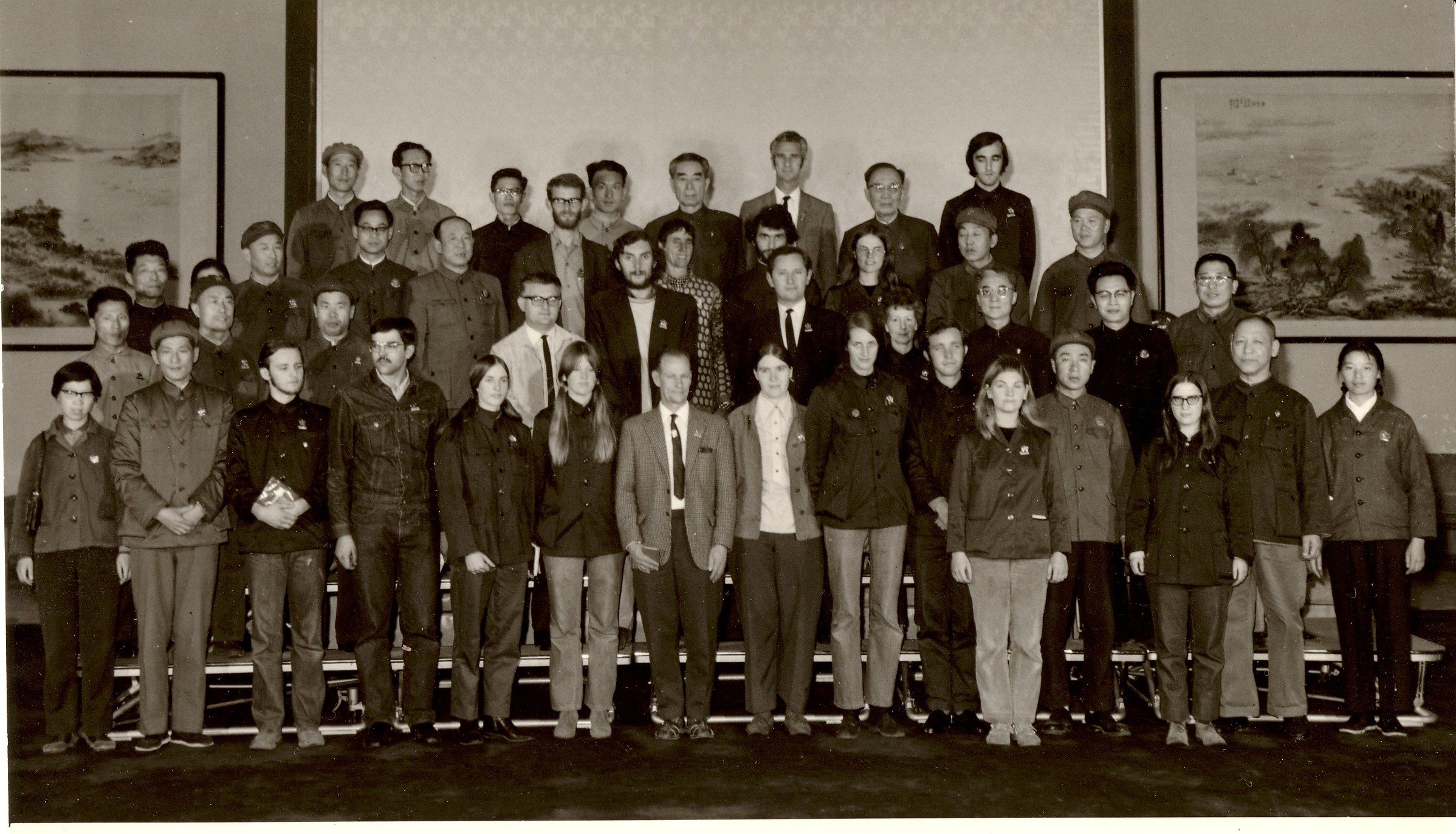
An old comrade and friend recently wrote some of his reflections on his trip to China in 1978. This prompted me to write about my own time there, a month in May 1971. I was one of 19 Australians on a delegation organized by the Australia-China Friendship Society. Our aim was to promote the campaign for the establishment of diplomatic relations with China. Nearly all of us were sympathetic to the Chinese revolution, and a core was Maoists. The tour leader was the communist leader of Melbourne’s wharfies, Ted Bull. He often called in Jim Bacon and I for discussions on the trip, which makes me think we were his ‘deputies’.

My friend’s account of China in 1978, when he went there, makes me realize how quickly things can change. I must say that I disagree with his assessment of Deng Xiaoping as a ‘great man’. I take the opposite view, and shall explain why in relation to the features in China that attracted and inspired me back then, in 1971.

****

My memories of the 1971 trip remain strong for a number of reasons. Firstly, during the 1970s, I gave talks and showed my slides about the trip on more than a hundred occasions. I only had a cheap ‘plastic’ camera but took 400 photographic slides. Incidentally, I was never stopped from taking photos over there.

In 1971, there was great interest in ‘Red China’ in Australia and it was sensational for any Australian to have ventured beyond ‘the Bamboo Curtain’. I remember a neighbor in my street in Brunswick asking, with great concern, as to whether I was worried that they might not let me out. I explained to the neighbor that China wanted a more open relationship with the world and that it was the Australian government that had placed tight restrictions on ordinary people travelling there.

During the 1980s and 1990s, I continued to show my slides but much less frequently. I last showed them about five years ago when some Chinese friends of a friend were visiting Australia and my friend told me the visitors would love to see slides of their homeland from way back in 1971. Their reactions to my commentary and slides suggested that ‘the past (really) is a foreign country – they do things differently there’. The visitors were very loyal to the current philosophy and policies of the Chinese Communist Party and had a kind of nostalgic attachment to the Mao period.

A few years prior to that I had shown the slides to one of the mums at the local school. My wife had told her that I had been to China and met Zhou Enlai. This young mum, whose parents were Chinese and had lived through the Cultural Revolution, was thrilled to meet me and to see the slides. She was gushing with enthusiasm to meet someone who had actually shaken the hand of the late Premier. Born years after Zhou’s death, she none the less gushed: “We Chinese LOVE Premier Zhou!”

My memories were also kept alive by an oral history project I recorded for the National Library in 2013 in which I interviewed several of those who were on the 1971 trip. Their memories and reflections, from the perspective of ‘now’, were fascinating and revived more of my own recollections. Later, I persuaded the Library to allow me to record the memories of members of the Australian table tennis team – the ‘ping-pong diplomats’ – who we met in Beijing in May 1971. It was another fascinating project. One of the players described to me the difference in the attitude of the everyday people in the eastern bloc, where he had also competed in table tennis, and those in China. The vibe of enthusiasm in China was a marked contrast, he told me, to the drabness and crushing sense of alienation in East Germany and other Soviet bloc countries.

I could relate to what he said because, wherever we went in China, the vibe in the streets was one of friendliness, happiness, engagement and curiosity. Perhaps all this was staged, but there were times when it couldn’t have been – such as when Jim Bacon and I told our guides in Shanghai that we wanted to go shopping and that we were confident we could manage on our own without a guide or interpreter. It is a humorous but insightful anecdote that I always tell with my slide show (but too long and complicated to take up space here). We were more or less mobbed by the locals, many of who sported Mao badges and all of whom seemed very happy people. I can imagine their vibe was not terribly different to that in other revolutionary societies, including the unleashing of enthusiasm during and immediately after the English civil war and the period in America when the British were defeated and Washington elected unanimously by the Congress as the first President.

Anyway all this has kept the memories alive for me.

****

Like my old friend, I was keen to see socialism in action. I had read a fair bit of theory and there were detailed accounts by westerners like the American communist William Hinton who had spent long periods living there among the peasants and workers, poet Rewi Alley and novelist Han Suyin, and scholarly works by Joan Robinson, professor of economics at Cambridge University. It was Robinson’s book on the cultural revolution, published in 1968, that influenced me in terms of the Maoist view of the relationship between the economic base of a society and its superstructure. The deterministic brand of Marxism that saw the relationship as a one-way street was rejected by Mao and developed into a nuanced understanding that the superstructure, the culture, customs, and habits, can impact on the base of a society with such power as to turn it into its opposite (ie, under socialism, restoring capitalist social relations of production).

The source of the regressive impact was not ‘socialist’ but feudalist. In terms of ‘custom’ etc that reflects and in turn pushes the ongoing development of socialism, we are talking of a lengthy process (which is why Mao spoke of the need for many cultural revolutions). Feudalism was collectivist because there was no other choice: the individual, rights, and expectations being severely constrained. And it was this cultural drag that was able to present aspects of itself as ‘socialist’. The communists were waging a struggle on two fronts – against feudal ideas and practices (the latter of these especially because they can present themselves as ideologically free zones) and the emerging bourgeois ones that were also able to present themselves as revolutionary (and to the degree they were anti-feudal, they were).

Thus, it made sense to wage ‘cultural revolution’ against those in the communist party who sought to perpetuate bourgeois values of selfishness over serving the people, competitiveness over cooperation, and personal acquisition of great wealth, as a virtue. The much-promoted slogan for the socialist ethic at the time was ‘Serve the people’.

I could readily relate to this distinctively Maoist outlook for two main reasons: I was very much the “Arts” type and into subjectivity. I was easily moved by music, film and poetry. I loved expressing myself through writing and art and music. Mao emphasized human agency in the materialist dialectic. Marx had dealt with the power of subjectivity in the interaction between base and superstructure in footnotes – Mao pushed it centre-stage at a time when socialism was being built in China. Secondly, I felt part of a youth rebellion in the late 1960s. It took many forms, from rock music to opposition to censorship and rejection of notions of obedience. I grew my hair long. One day, walking along my street in Brunswick, a bloke in a Holden drove by, slowed down, and yelled out, “Get a haircut, ya poofta!” From that day on, I pledged to myself I’d be a ‘long hair’. (Even now, when Nature has placed a prohibition on me doing so, I at least like to grow a pony-tail). This ‘youth revolt’ was global and, as in China, we were challenging the old assumptions and the old ways. So, I went to China in 1971 very keen to see this playing out.

William Hinton’s book, ‘Fanshen’, based on his life with a commune, was a very detailed description of daily routines under conditions of land redistribution and ‘New Democracy’, with power placed in the hands of the people through revolutionary committees – similar to Russia’s earlier soviets – in which workers and peasants could directly elect their managers and recall them at any time by popular vote. These committees elected representatives to higher bodies and, in turn, they elected representatives still higher up. But the beauty of the revolutionary committee system, to me, was that the workers and peasants had a real say in the economic direction of their local community and the bigger society. It was the exact opposite power structure to that in Australia and other capitalist societies where, at best, you might have a corporation appointing a union boss to a board of management.

So, I was keen to see how these revolutionary committees worked.

****

I won’t go into detail here – I could write much more about all this – but I’ll list five principal features of China’s revolutionary life that inspired me and that I experienced during May 1971.

  1. The revolutionary committees. We met with cadres from two such committees (from memory) and one that I remember clearly (again, thanks to the slide showings) was based in a rolling stock and locomotive factory. The workers had produced surplus stock and the revolutionary committee convened a mass meeting to decide what the workers wanted to do with the surplus. We were told they decided to donate it to the government of Tanzania, where a railway was being built. The socialist ethic of ‘serving the people’ was not nationalistic but based on international solidarity. I returned to Melbourne and to La Trobe University with an almost evangelical zeal to convey what I knew about the revolutionary committees. One of our student demands was for ‘student power’. We even had to struggle for a student representative on the governing body of the university – indeed, in 1969, I received my first penalty for political protest on the campus when I was ‘severely reprimanded’ for being part of a deputation that ‘invaded’ the Council chambers during a Council meeting to demand student representation. We also wanted students to have the right to observe Council meetings.


  1. Big Character Posters. These were, in a sense, the Internet of the day. While the Cultural Revolution was dying down in 1971, with Mao concerned about the ultra-leftists and violence between the various ‘true Maoist’ factions, the Big Character posters were apparent in schools and streets. These were forms of grass-roots expression, usually expressing local grievances and/or criticizing capitalist-roaders within the communist party. The posters were something that anyone could do – hence my analogy with the Internet.


  1. Who needs a Navy? I’ll never forget meeting with party cadres and discussing the military threats to China from the Soviet social-imperialists (the Ussuri River border being a dangerous hot spot where fighting had broken out in 1969) and from the US imperialists in Indo-China and the Pacific. We were told that China’s military strategy was entirely defensive and based on the Peoples Liberation Army and civil defense. My ears pricked up when mention was made of a coastal naval defense force. I asked, “Why doesn’t China have a conventional Navy – why just a small coastal guard?” The reply, which I’ll never forget, was that “China does not need a Navy because we have no intention of expanding our interests beyond China. We shall never become imperialist! Only imperialists need a large powerful Navy!”


  1. Social ownership of property and poverty/progress. When Marx spoke of ‘private property’ he meant the means of production, not one’s spectacles or shoes. China’s communes were based on collective ownership of land once owned by individuals and formerly run in pursuit of maximizing the profit to the landlords. Socialism is social ownership of means of production. When that is lost, then you no longer have socialism. The grass-roots’ enthusiasm that I saw in China, and that people like William Hinton, Han Suyin and Rewi Alley wrote about based on experience living there, confirmed to me that society does not need greed or the pursuit of individual profit as a motivator for innovation. I saw things that were indicators of progress, especially in housing and, at the same time, I also saw a level of poverty that did not exist anywhere in Australia’s regions and cities. This was not disillusioning, though, because I knew, from works like Edgar Snow’s ‘Red Star over China’, what conditions had been like for the peasants pre-1949, when they had to eat bark off trees or hand over their children to landlords in lieu of rent. We met elderly folk who recalled the bad old days, usually with tears, and who described how their personal lives had changed for the better. Yes, they could have been party stooges, reciting by rote what the party bosses were forcing them to say. If that were the case, then China had some truly magnificent actors, individuals worthy of Academy awards. They seemed very genuine to me.


On the topic of progress, I’ll relate an episode when we visited a waterfront. With the assistance of an interpreter, Ted Bull was invited to speak to the Chinese waterside workers. Ted began by telling them that conditions on the wharves in Melbourne were superior to what he had seen in China. I was rather surprised by his frankness. He explained that this had been achieved by struggle, hard struggle, over many decades. He said that they had to struggle because the waterside workers were more or less ‘owned’ for the period of their labour by the ship owners and other capitalists. He told the Chinese workers that the big difference in China was that they had much greater ‘ownership’ of themselves as a class and could thus progress through struggle of a different kind, such as the struggle to develop better ways of improving safety on the job and better ways of innovating and producing stuff. He hardly needed to point out that socialist China had begun from a far less developed starting-point.


5    Politics in command – It is right to rebel!  In 1971, there were still signs of revolutionary enthusiasm such as big character posters and anti-imperialist and anti-racism billboards. Whenever we met with cadres, they were intensely political – politics was in command. The politics was based on dialectical understanding – the cadres often spoke about the on-going struggle between the two lines within the communist party. The notion of rebellion as a positive value struck me – but I may have been projecting my own values onto the situation. One would have to live there for many years to grasp anything like that – as William Hinton did. In 1971 I was living and breathing politics as an activist at La Trobe University, and had been since 1968/69. A highly politicized society strikes me as an engaged one: a participatory democracy. Apathy and cynicism are tantamount to surrender. Our struggles at La Trobe had no room for either.


****


Those five features, whether accurate or not, and whether a product of idealised rose-coloured glasses or not, struck me as essentials of socialism, of the dictatorship of the proletariat (ie, the replacement of the rule by the 0.1% with the rule of the 99.9%); things that would really take off with even greater success under conditions of advanced industrial capitalism. There was occasionally theoretical discussion in Melbourne about whether it was possible to ‘jump’ mature capitalist development from a semi-feudal society into socialism. At the time, I believed it was possible.


But each of those five features was gradually reversed following the coup – ‘regime change’ – after Mao’s death in 1976. And this leads me to why I have no time at all for Deng Xiaoping, the architect of ‘capitalism with Chinese characteristics’.


****


At the time of the coup in China, I merely followed the party line, the CPA(ML) line. I’d been like that for too many years – an obedient follower rather than a critical reflective thinker, researcher and debater. That was the negative of my experience for most of the 1970s. Dogmatism, group think, formula-thinking, failure to investigate and think for myself… and worst of all: obedience. I may have still called myself a ‘Maoist’ but I was far from being one. Of course, to rebel within the CPA(ML) was not easy and had bad personal consequences, especially if you were dependent on a social life based around others who also tended to have become dogmatic and obedient. (I could write a book about this period).


To the extent that I did think about it in the late 1970s and early 1980s, I regarded the rise of Deng as a positive move; something along the lines of Lenin’s New Economic Policy and the beginning of a modernization process (something Mao had wanted and which was clearly needed) rather than a regime change ushering in a completely different path. I would have agreed with the idea that Deng was a ‘great man’. The ‘Gang of Four’, I speculated (in the absence of any investigation or evidence), were ultra-leftists who put sloganeering above economic development. Closer to home, we had the Red Eureka Movement, who supported the Gang of Four – and (nearly) everyone in the party knew they were ‘no good’ and heaven help you if you suggested, even mildly, that they might have had a few good points. And, further, their ‘leader’, Albert Langer, was a CIA agent –a definite fact according to Duncan Clarke and other veterans. Of course, it was nonsense (and I’m ashamed to say I went along with such nonsense, for too long).


My doubts about Deng were slow to develop and I was able to question what had happened more freely after I resigned from the party late in 1980 or early 1981. I opened my mind to different possibilities about him and followed events in China more closely. And listened to the range of opinions and analyses on offer.


Something that struck me as strange was that the western media, almost unanimously, praised Deng and admired him. This usually doesn’t happen to genuine communists while they are alive. They are usually vilified and demonized by the capitalist press. But, no, Deng was almost heroic to some pro-capitalist western outlets: he was ‘opening up’ China’s economy by facilitating a market aspect. Well, I figured, maybe that is needed. Let’s see.


Then, in the early 1980s, I learned that the revolutionary committees had been disbanded in 1978 – not by the workers and peasants but from above. The revolutionary committees had formed the backbone of China’s New Democracy for more than a decade. No wonder the capitalist media was glowing in their admiration for Deng. In 1982, I also read about how the Chinese regime had banned the Big Character posters. This was done as part of the revision of the Constitution no less. Apparently, genuine rebellious types in China were using the posters to challenge the corruption that grew with the new market direction. Defiantly, other rebellious types revived them seven years later and, despite being unlawful, they became ubiquitous during the June Fourth protests in 1989.


It seemed to me that China under Deng’s influence might be going down the capitalist road as had happened in the Soviet Union but it didn’t preoccupy me as an issue. I was now living and studying in Sydney, enjoying life more, and this issue only arose for me through my reading of ‘Vanguard’ and newsletters of the Red Eureka Movement and occasional contact with former and current party members who wanted to talk about it.


I was easily influenced by others during the 1980s but I had at least started thinking again. I suppose ‘confused’ would be the best word to describe myself at that time. I’d read damning stuff about ‘the real Mao’ and been influenced by that, and then a counterpoint would come along and I’d feel okay about him again. The western media rightly portrayed Deng in contradistinction to Mao. They got that right. Either way, I still adhered to the values embodied in those five features of China in 1971 that impressed me so much. I still believed that socialism could work and offered something better, more innovative and productive, less alienating, more democratic and more conducive to the development of the full human being, than capitalism.


Then came another clanger for Deng in my eyes. “To get rich is glorious”. Really? Glorious? What happened to the socialist ethic: Serve the people? In 1986 in a Sixty Minutes interview, Deng did not deny saying that but tried to justify it by claiming he meant “For society to get rich is glorious”. In the context of the widening of the market economy under the reforms he supported, it was entirely plausible that what he meant was individuals getting rich was glorious. This is certainly supported by his other claim: “Let some people get rich first”.


And what was happening to the communist slogan, ‘Keep politics in command’? According to Deng, it was a case of “It doesn’t matter whether the cat is black or white so long as it catches mice”.

SAY WHAT??!!


****


During the 1980s, I had friends who visited China. Gone were the days of the early 1970s when the tourist industry was barely developed over there (which actually meant a greater degree of freedom for tourists, as I found in 1971). In the 1980s, the tourist industry was becoming large and sophisticated, and more controlled. Anecdotal evidence from my friends indicated that there had been a profound cultural change in China, reflecting the development of market capitalism. My friends would complain about how on every street corner in Beijing or Nanjing or wherever, someone was trying to sell you something. Everyone, they said, seemed to be out to make a fast buck. “To get rich is glorious”!


Still, around the mid-1980s, I still wouldn’t have felt confident to argue with anyone about all this. But then, in 1989, something happened to clinch it all: a ghastly massacre of young students and workers who had occupied Tiananmen Square to protest against government corruption. In rolled the tanks. And even the corpses were crushed.


A perennial question for any leftist confronted me: whose side was I on? Against the insistence of a handful of party loyalists (who struck me as increasingly eccentric) that it was all a foreign plot, I sided with the rebels, the protestors, the courageous ones, the ones without the tanks, the ‘long hairs’. And it wasn’t only because some sang ‘The Internationale’. It was because their cause was just, and their suppression despicable and completely unjust. (The Waterdale Road demonstrations from La Trobe University in 1970, which were violently attacked by police who made two arrests at gunpoint, were a pleasant afternoon tea party by comparison).


In my eyes, Deng – who was chairman of the central military commission in 1989 and had argued for swift military intervention – was clearly a social-fascist. Mao would have described him as such.


Marxist William Hinton’s book, ‘The Great Reversal: the privatization of China, 1978-1989’ provides an abundance of evidence and elaboration for all the above. He lived and worked there for many years, including during the 1980s.


On the Cultural Revolution, I recommend Mobo Gao’s ‘The battle for China’s past’ and Dongping Han’s ‘The unknown Cultural Revolution: life and change in a Chinese village’ for evidence-based alternatives to the mainstream understanding promoted through the media and universities.


*************************************************

covid-19 Senior Constable Vogon of Fitzroy Police Station

This afternoon at 16:16 I had a 12’27” call to Fitzroy Police Station to inform the Sergeant about the conduct of a Senior Constable whose name was not Vogon.

The call was handled professionally so I hope the problem will be dealt with. I was asked at the end whether I would like to be called back with any follow up. I said that would not be necessary as I am merely informing the Sergeant about behaviour that should be confirmed by the other officer present and would be likely to be part of on an ongoing pattern. But I am available to provide evidence if needed.

These notes are not about the call but concern the incident I was calling about, while the facts are still fresh, in case there is need to assist further. I have added humorous embellishments for the benefit of other readers.

A little after 15:30 pm this afternoon I was sitting at a table in a public park close to my current accommodation eating a cookie and reading channel 9 Entertainment’s daily newspaper. My face visor and walking stick were clearly visible on the table, as was the cookie.

I saw two police officers approaching and put on both the visor and an N75 mask in view of the likelihood that they intended to come close enough to speak to me and therefore too close. They did.

One of them introduced himself as a Vogon seconded from the Vogon constructor fleet to assist the Murdoch press in discrediting the Victorian police. He did this by requesting that I remove my face mask so that he would be able to hear me speak clearly.

I’m not sure that I emphasized that clearly enough in conversation with the Sergeant. Just think about the newspaper headlines in “The Sun”. Dictator Dan’s police patrol public parks demanding that people remove their face masks! This isn’t some ordinarily incompetent bullying SC, but somebody quite “special”. He is either being paid to provoke people or he cannot help himself.

He made this quite breaktaking request in the manner of an exceptionally polite Vogon. I had no difficulty in suppressing my amusement and responding politely that I would keep my mask on and he would be able to understand anything I said.

My best guess is that he had been rather looking forward to lecturing me about the need to have my mask on and then exercising “leniency” by just giving me a warning and felt frustrated about my having put the mask on before he arrived, jumped to the conclusion that I had done so to avoid the lecture rather than because I would do so before conversing with anybody at all and was just too dumb to figure out some less bizarre opening remark.

A much less plausible theory is that if I had removed the mask he could then have delivered the lecture and issued an infringement notice that would inevitably be challenged. That would require actual collaboration from the other officer. I saw no sign of that. There was no direct intervention by the other officer. Whoever was senior, it would not be unusual for officers to avoid intervention against each other in public despite bizarre behaviour. It is interesting to encounter one officer behaving like SC Vogon, but two actually supporting each other in asking people to remove their masks so they could issue infringment notices for not wearing them seems a lot less likely.

Anyway, the other police officer avoided any potential escalation of the absurdity by professionally asking for my name, address and date of birth. I mentioned that I walked to and from the park for exercise, wore my mask only when entering shops and had removed the visor for eating. I was told that they were looking for somebody else involved in an incident nearby who matched my description. I complied, with the request, also mentioning that my name was not the same on my driver’s licence and that I was very young at the time of my birth and was only repeating what I had been told since.

SC Vogon stood further back while this was proceeding. I would guess this is standard infection control procedure and it was certainly welcome.

But when the other officer had finished and was prepared to leave he stepped forward and took over, demanding to know why I was in the park. I responded that I had already given the other officer the information required. He said that there were only four valid reasons to be out and I was required to leave immediately. I told him that I had downloaded and was thoroughly familiar with the CHO directions of July 19 and was in full compliance with those directions.

“Stay At Home Directions (Restricted Areas) (No 3):

  1. Leaving premises for exercise or outdoor recreation
    (1) Note 1. …Examples: Outdoor recreation includes sitting in a park…”

SC Vogon said that he was requiring me to pack up and leave immediately and that if I did not do so he would issue an infringement notice. I said that I would be making a formal complaint about him and would not be leaving until he provided his name and number. He did so before leaving and his Sergeant now has them.

If the other officer is truthful the Sergeant will know that SC Vogon engaged in two criminal offences:

  1. Abusing his membership of the Police Force to demand removal of the face mask of a person he knew to be over 70 and especially vulnerable to covid-19. Nobody stupid enough to go around asking anybody at all to remove their face masks in response to a directive requiring face covering should remain in the police force.
  2. Threatening to issue an infringement notice to a person sitting in a park by themselves, knowing that he had no authority to do so whatever. Nobody up themselves enough to go around doing that should remain in the police force.

I am in favour of rigorously enforcing public health directions in a pandemic emergency. Doing so requires removing saboteurs like SC Vogon from the police force.

It would be surprising if this behaviour is not part of a pattern that others can confirm and that any random Sergeant in any police station would want to stop.

So I am leaving it to the internal administrative processes.

But if there is some subsequent inquiry as to why SC Vogon was not dismissed before he caused real damage, my contemporaneous notes of what was known to his Seargeant about him as of today will be available.

covid-19 – Strategic Direction – “No Community Transmission”

https://www.health.gov.au/news/australian-health-protection-principal-committee-ahppc-statement-on-strategic-direction

“Our strong public health advice is to pursue no community transmission, which many areas of the country have achieved. A goal of no community transmission has been a part of our suppression strategy from the start of the pandemic. AHPPC recommends that this now be more strongly pursued.

This involves knowing that single cases will occur. Success will rely on finding new cases early and stopping chains of transmission. If new chains appear, it is important to quickly find, contain and stop them.”

That statement on July 24 is worth reading carefully in full. Taken at face value it implies a strategic switch to “Elimination” despite being worded to obscure that. The wording avoids objections from the media campaign against Elimination, that Australia cannot be completely shut off so there will inevitably be some new chains.

Accountability for the previous policy and the pathetic claim that elimination of community transmission has been “a part of our suppression strategy from the start” can be left until later. It would be sufficient if the Chief Health Officers of the AHPCC now know that opening up while there was still community transmission in the largest States was a blunder even if they don’t want to spell it out.

But eliminating community transmission does require that WHEN (not “if”) new chains of transmission appear the capacity exists to “quickly find, contain and stop them”.

Acquiring that capacity requires first acknowledging that it does not currently exist. Instead of wording intended to obscure that and pretend continuity from the start it requires open and frank explanation of the difficulties and mobilization of the resources needed to overcome them.

On the same day, the following came:

“National Cabinet agreed to a new set of data and metrics to ensure that the Commonwealth, states and territories all have access to transparent up-to-date jurisdictional data on contact tracing, tracking and other metrics to ensure health system capacity. This will better help guide the public health response and support the coordination of efforts by the Commonwealth, states and territories…

National Cabinet recommitted to the suppression strategy to address COVID-19. The goal remains suppression of COVID-19 until a point in time a vaccine or effective treatments are available, with the goal of no local community transmission.”

https://www.pm.gov.au/media/national-cabinet-24jul20

Presumably the obscure wording from the AHPPC is intended to assist “National Cabinet” sliding in “the goal of no local community transmission” while proclaiming it has “recommitted” to the “suppression strategy” that produced a surge in community transmission.

In updates to my post of 31 March I pointed out that Australia had no serious modelling capability as demonstrated by the release of toy models supposedly representing “the science” guiding policy:

covid-19 Four Corners looks back – ignores urgent need for Quarantine accommodation

In April I provided some links about contact tracing KPIs here:

covid-19 Roadmap to Recovery

Despite this I was reassured by news (Update 6) that the need for quarantine accommodation to isolate at least people known to be infected so that they would not infect others in their household had been endorsed by the Tasmanian AMA and would inevitably percolate through to government action.

Now I know that did not happen. The necessary preparations to cope with the much larger numbers that now need to be isolated (including contacts and others waiting for test results) simply have not been made in the months since. Even infected Aged Care residents are being kept in their existing residences to infect others and police were used to confine confirmed cases in the “vertical cruise ships” instead of escorting them to quarantine accommodation to prevent infecting others in their cramped “public housing”.

There are large numbers unemployed and an enormous amount of work for them to do. Apart from lots of front line workers that need to be trained in proper use of PPE while testing, isolating etc there are many other tasks such as ensuring adequate ventilation of essential workplaces. Mobilizing the public has not even begun.

Recent announcements make it clear the situation with modeling is far worse than I thought. Not only do they not have the capability for models to guide policy but they do not even have metrics for the Key Performance Indicators that need to be monitored for acquiring the necessary data for models. I thought they just didn’t want to release the sort of KPIs that New Zealand released because of their hostility to public scrutiny. The National Cabinet announcement indicates that the various governments did not even have adequate “data on contact tracing, tracking and other metrics” themselves!

On the positive side they will now get those metrics, which is a necessary step towards actually being able to carry out any policy whatever, whether it is called “Suppression” or “Elimination”.

It ought to be self evident that there has been a breakdown in contact tracing from the massive blow out in numbers of cases “under investigation”.

Instead of a plan to deal with the problem we got a speech from the Premier of Victoria complaining that 90% of people who were confirmed as infected did not get tested within 3 days of having symptoms and more than half of those tested did not isolate themselves while waiting for test results. The three lags between symptom onset and testing, results of tests and full isolation are absolutely critical KPI metrics that should have been monitored continuously.

The links I provided showed that pre-clinical transmission before people even develop symptoms can be about 90% of the minimum necessary to generate an epidemic in the absence of restrictions. Isolating an infected person within 24 hours of developing symptoms may not be fast enough. Hence the need for continuous tracking and automatic notification of contacts. But currently test results are taking an “average” of two days (with many taking far longer and difficulty prioritizing correctly). Adding 3 days for getting tested means five days of transmission without isolation, which is most of the usual infectious period. That means failure to “quickly find, contain and stop them”.

Today’s speeches about the latest record breaking numbers did at least have a start at preparing for the possible imminent further blow out in numbers. Training reserves of ambulance drivers is an essential step to prepare for large numbers of paramedics being unavailable due to isolation together with an increase in cases. Using paramedics already in isolation to help with contact tracing also makes sense. Likewise beds are being prepared etc.

What makes contact tracing possible is the fact that stage 3 restrictions sharply reduce the numbers of contacts that each infected person has.

Those restrictions were not first introduced until the very same day the Grand Prix was about to start with tens of thousands of spectators. Large crowds mean there is simply no way to trace the people an infected spectator came into contact with. The point of restricting “gatherings” to two people is to enable contact tracing. That worked in the first wave but has not been sufficient to suppress the second wave.

Most developed countries gave up contact tracing as already too difficult at much lower numbers than Victoria is still attempting to handle, so it isn’t that the Victorian Public Health officers are not working hard enough.

It just isn’t possible to keep up with the case load at the current level of social distancing restrictions. That was clear when the numbers continued to increase after locking down several suburbs to stage 3 and it remains clear two weeks after locking down the whole of Melbourne to stage 3. The AMA called for a move to stage 4 about a week ago.

Any plan has to start with shutting things down to the point where contact tracing can keep up. If governments won’t do it, local Committees of Public Safety will have to step forward.

The difficulty pointed out by Victoria’s Chief Health Officer is that most of the current transmission is connected with essential workplaces that would remain open in a “stage 4” lockdown. That increases the urgency of drastic measures to reorganize those workplaces as well as a more thorough lockdown elsewhere. But instead it has resulted in simply hoping that masks will turn out to be sufficient. They might, but wait and see is not a proactive policy for dealing with an outbreak when flying blind without adequate statistics about what happened weeks ago.

A policy of “wait an see” whether quaranting individual suburbs of a large metropolis could work merely allowed the case load to double.

The current plan is to “wait and see” the results of mandatory masks. But we already know the first two weeks of stage 3 restrictions has not stopped exponential growth and is close to overwhelming the test and trace capability. We also know that the original source of seeding has been cut off by diverting incoming travellers from Melbourne while quarantine hotels are tightened up.

That means the continued growth of cases is entirely local. The fact that numbers “under investigation” has blown out means most of that continued growth in local cases is “community transmission”. It doesn’t really matter if those numbers are eventually epidemiologically linked to a known local outbreak when the link is made too late to actually do much isolating either upstream or downstream.

Instead of waiting to see, a pro-active policy would be to do whatever it takes to bring the effective Reproduction number well below 1 and keep it as low as feasible until “No Community Transmission”.

Such a policy must be spelled out sharply as a break with the past, not obscured to avoid offending the pro-death advocates of sacrificing lives to save asset values for the owners.

The current situation is that most public discussion is basically uninformed about epidemics and contact tracing.

See for example the comment on my last article:

“The growth is not exponential and I suspect R0 is around 1, or less, given the extensive testing going on. Here is a graph” (linked to a search on Bing)

According to both the current Victorian guidelines (v23, July 10) and the National guidelines (SoNG 3.4) :

“Estimates for the basic reproductive number (R0) of SARS-CoV-2 range from 2–4, with R0
for confined settings, e.g. cruise ships, at the higher end of this range. Estimates of the
effective reproductive number (Reff) vary from between settings and at different time points
are dependent on a range of factors, including, public health interventions such as isolation,
quarantine and physical distancing to limit close contact between people (5, 6).”

Reference to R0 instead of Reff indicates that the person making the comment could not possibly have an informed opinion as to whether the growth was exponential, even if they were looking at accurate current figures and were able to notice when the graph they are looking at is simply a Bing bungle.

Suffice to say that there were 0 new daily cases at the start of June, rising to a record of 459 before the end of July.

Technically that is an infinite rather than merely exponential increase. But a glance at the actual curves for the first and second waves in Victoria enables anybody with their eyes open to see that the second is already much larger and still growing faster than the “exponential” period of the first wave.

Many people have their eyes firmly shut. This does not prevent them from pontificating about what they “suspect” after looking up “trends” in Bing.

https://www.dhhs.vic.gov.au/coronavirus-covid-19-daily-update

https://www.covid19data.com.au/victoria

It makes sense for conservatives to keep their eyes firmly shut and just hope things will sort themselves out. Conservatives naturally have faith that the authorities know best. There is no need for conservatives to propose detailed measures for mobilizing people to deal with problems. Simply thank them for staying home. “They also serve who only stand and wait”.

But anybody on the left will have less faith in the authorities and will be studying what needs to be done to mobilize people to tackle the problem. It is ludicrous to pretend to have confidence that people will transform capitalist society after an economic crisis while not being interested in concrete policies for dealing with a health crisis and just demanding that governments Eliminate the problem without proposing how to do so.

covid-19 – Do panic?

As far as I can make out there is no current plan for containing the second wave in Victoria. The effective reproduction rate is clearly still above 1, two weeks after returning to stage 3 restrictions but no plans to lower it have been announced.

The continued exponential growth is not unexpected since cases in the second wave are driven by “community transmission” from sources that remain unknown after contact tracing and consequently cannot be isolated. The first wave was mainly seeded from overseas and was contained with only a low level of untraceable community transmission remaining. Contact tracing was able to keep up when contacts were restricted by stay at home orders. But with restrictions lifted while transmission continued it is much harder to suppress the second wave. It is likely to require stronger restrictions as well as take longer, but no such plans have been announced yet.

The Australian Medical Association called for stage 4 restrictions nearly a week ago:

https://mobile.abc.net.au/news/2020-07-17/coronavirus-australia-live-news-covid-19-victoria-nsw/12464550

Instead of a plan there were three announcements today:

  1. First, there was an announcement about a future announcement. There will soon be an announcement about paying people who cannot afford to stay away from work while waiting for test results so that they can afford to do so. Obviously necessary but there is no more reason to expect workers in precarious jobs to quickly change their responses as a result than there is to expect a governent to take such an obviously necessary measure less than 3 months after a pandemic begins.
  2. Second, instead of a plan there was announcement today that the government is concerned that 90% of people who get tested because of having symptoms are waiting 3 days from onset of symptoms and half of those tested are not remaining isolated while waiting for results.

That does drive transmissions since it is well established people are most infectious for the few days immediately before and after onset of symptoms. The successful response to that has been extensive health monitoring and testing with immediate isolation in separate facilities, as in China (including HK and Taiwan). No other response has been shown to work.

Nobody has ever claimed that mere speeches at press conferences could possibly have a major impact on the predictable and expected delay between symptom onset and testing nor on the likelihood of people isolating themselves when they have got tested as a result of appeals to do so rather than with an expectation that they actually have the disease.

  1. Third, instead of a plan there is an incoherent press release about face coverings (with an exception to encourage people breathing heavily as they run past others to continue doing so). This press release has not even been turned into an enforcable “direction” but has been accompanied by a $200 penalty for “failing to comply with a requirement in relation to a face covering”.

https://www.dhhs.vic.gov.au/face-masks-covid-19

https://www.legislation.vic.gov.au/as-made/statutory-rules/public-health-and-wellbeing-amendment-further-infringement-offences

Recommendations to use cloth face masks were accompanied by instructions on how to sew one yourself on 20 July:

Click to access Design%20and%20preparation%20of%20cloth%20masks%2010%20July.pdf

Actually organizing supplies of cloth masks, should be easy compared with supplies of effective PPE such as P2 or N95 disposable masks. Instead, national stockpiles of PPE are being released to hospitals and aged care facilities to cope with the inevitable supply chain difficulties resulting from panic buying by the public in response to a panic announcement that use of masks would be compulsory from midnite tonight.

Cloth maks are of course even less effective than the surgical masks that health and aged care workers have been stuck with. They simply don’t adequately prevent aerosol transmission in confined spaces. Recent evidence indicates such aerosol transmission is more significant than previously thought.

Being in the same room as a confirmed case for more than two hours already makes one a “close contact” subject to mandatory 14 days quarantine. That was true when aerosol transmission was considered less important. Confined spaces encourage droplet transmission both direct from face to face and via face to hand to surfaces to hands to faces. Cloth masks and ordinary surgical masks can both reduce droplet transmission and should have been made compulsory in all confined spaces long ago (with cloth masks as merely a “better than nothing” expedient while supplies of disposable surgical masks were ramped up).

But a serious response to evidence that aerosol transmission is more important than previously thought cannot involve either cloth masks or standard surgical masks. It would require very strict controls enforcing effective PPE both on public transport and in workplaces (including schools) since crowding people into both results in breathing each others aerosols in confined spaces. That is radically inconsistent with the national policy of opening up the economy instead of first eliminating community transmission. It would involve prohibiting the use of cloth masks or surgical masks and requiring the correct use of effective diisposable PPE (N95 or P2 masks or Positive Air Pressure Respirators).

Mandatory cloth masks have been openly introduced in both the UK and USA to to reassure people that it is safe to go to work and school and shopping when it isn’t.

The stated reason for following the catastrophically stupid UK and US policies here is in response to a Lancet article published:June 01, 2020:

“Physical distancing, face masks, and eye protection to prevent person-to-person transmission of SARS-CoV-2 and COVID-19: a systematic review and meta-analysis”

https://doi.org/10.1016/S0140-6736(20)31142-9

That article did systematically review a large number of previous publications and confirmed the well known fact that PPE is essential in health care settings. It did not shed any light whatever on the public policy issue of whether mandatory cloth masks would have greater benefits in making people more situationally aware and increase compliance with physical distancing and hygiene measures or whether it would do more harm by tending to reassure people that it is safe to enter crowded public transport, workplaces and shops etc. In healthcare settings cloth masks are used only when supplies of proper PPE are unavailable.

It is inherenty difficult to be sure about the effects outside healthcare settings. The evidence actually available is confounded by the likelihood that people who do wear masks when they are not mandatory are more cautious generally and therefore less likely to give or receive infection. The UK government may find people are not as reasssured as they hope.

But the only serious medical advice is that WHEN you are unable to maintain physical distancing AND you don’t have effective PPE, a cloth mask is better than nothing. Presenting that as though using cloth masks can substitute for greater restriction of physical distancing is purely cynical.

The Lancet study had no relevant information about likely effects of mandatory use. In fact it listed only one paper that was actually about Covid-19 and was not about healthcare settings. All the rest were either about other coronaviruses or about healthcare settings. The relevant paper was:

“High transmissibility of COVID-19 near symptom onset”.

medRxiv 2020; published online March 19:

https://doi.org/10.1101/2020.03.18.20034561

The title accurately describes the content. That title is the most important fact about COVID-19 that distinguishes it from other pandemics.

The implications of that fact are starting to sink in.

A debate is now starting about whether to attempt Elimination instead of the obviously failed current strategy. (The term “Eradication” should be avoided as impossible until a global vaccine whereas Elimination might be possible with strict border controls for island countries like Australia and New Zealand).

If it does turn out that the current second wave in Victoria is entirely or even just largely from strains of the virus that were not in circulation before the ending of stage 3 restrictions that will be fairly conclusive evidence of the bankruptcy of current policies to “Adapt and Control” (and claim to “Suppress”).

It would imply that elimination was feasible in Victoria since the previously existing small levels of community transmission had been eliminated in Victoria just as in New Zealand, Western Australia, Tasmania etc. It would also imply that the “slow and careful lifting of restrictions” was in fact completely fragile since it had been able to rapidly produce a second wave.

Unfortunately advocates of an elimination strategy are not explaining clearly how hard it will be and what sort of measures are required.

Elimination first requires greatly prolonging restrictions for enough weeks and months after zero cases per day until there have been no new cases outside quarantine isolation for a month or so. Pretending that would be quick or avoiding the issue only helps opponents.

Pretending that Elimination would not be fragile and require major preparations against another epidemic is even more helpful to opponents. It is blindingly obvious that with the large majority of the population still fully susceptible to infection and an announcement that the virus is not circulating at all the conditions would be ideal for “normal” behaviour to resume and so for any new outbreak to become another epidemic exactly as before.

The following are necessary to prevent subsequent sporadic occasional clusters becoming outbreaks and then epidemics during the long period in which the overwhelming majority of the population remains susceptible because there is no vaccine:

  1. Tight quarantine isolation. That lesson has probably been learned although still not applied to “contacts” and people “waiting test results”. Absurdly, people considered likely to be infectious are still being encouraged to isolate at home and infect their households. I thought that idiocy was over when the AMA in Tasmania recommended medi-hotels and the Commonwealth Health Minister indicated being open to it. But it isn’t over. Police were used to confine infected people in “vertical cruise ships” to their cramped large households rather than escort them to safe quarantine accommodation.
  2. Massive continuous testing, especially for all workers in contact with the public (shops and schools as well as healthcare etc). That requires serious industrial effort to deploy test workers, equipment and supplies. Pooled tests can immediately expand the numbers by an order of magnitude without waiting for more equipment and supplies, but it still requires a major workforce for which there does not seem to be any current plan. More than an order of magnitude increase is required for continuous testing so large long term investments are necessary for capacity to produce equipment and supplies as well as to train staff. This should also be part of an effort to help other countries in a less fortunate situation.
  3. Rapid contact tracing. Basically not possible without mandatory use of tracking devices. Targets for manual contact tracing within 24 hours are not being achieved during stage 3 restrictions and could not possibly be achieved once restrictions are lifted following Elimination. It is unclear whether achieving those 24 hour targets would be sufficient to stop another outbreak anyway. Instant contact tracing is achievable only with mandatory tracing devices.

Manipulating people to “opt in” to trusting governments with mass surveillance was a cynical ploy rejected by a substantial majority. The tracking must be switched off whenever it is NOT a public health emergency and switched on only during sporadic outbreaks for the purpose of rapidly suppressing them.

To Topple or not to Topple? … That is the question…

Contradictions lead forward. Statues and other symbolic representations need to expose contradictions, not ignore them – or worse, be made unaware of them. We need to ask questions.

220px-SaddamStatue

(by Tom Griffiths)

A few weeks ago I posted on Facebook a ‘shooting from the hip’ response, reproduced in part at the foot of this post, to the then new wave of statue toppling and attempted statue toppling occurring in the States and the UK, events that were riding the wave generated by the BLM movement and the murder of George Floyd. Not for the first time my guiding spirit in this response was Bertlot Brecht and his poem Questions From A Worker Who Reads, a poem that ‘accompanied’ me on a visit to Toronto Museum.

My gripe then, as it is now, is not so much the fate of individual statues – some ask to go, others to be daubed, scribbled upon or otherwise improved, while others ask for company to have their story told more honestly or completely. My gripe is how the story, events and processes of history remain distorted and misunderstood. And by misunderstood I not only mean in effect, through ignorance, but also through deliberate misrepresentation. This is not simply about who gets wiped from the account, but is about those not even considered important enough to be a part of the account in the first place – Brecht’s builders and masons responsible for the Chinese wall, for Babylon, the Seven Gate of Thebes …And if you are feeling bridled at women not making the account here, this too is another part of the missing story.

Churchill once wrote that history is written by the victor. Aside from the fact that he would and could say that, his individual history and his inherited history of being a ‘card carrying’ member of the British ruling class giving him what I could term bragging rights, he could also have added: and by those who rule or do the ruler’s bidding. Because ‘victor’ not only applies militarily, to interpretive cum ideological spoils of war, but more pervasively to the interpretive and ideological spoils of class warfare, the internal social dramas characteristic of all written history.

There is nothing to be gained in condemning these omissions – what’s happened has happened and the water we once poured into the wine cannot be drained off again, as Brecht once put it – but we need to understand them (to ask questions) to understand the social and economic forces that enabled, or forced, the great majority of people to be pushed off stage, or not even invited on it in anything other than the most servile and ‘meaningless’ of roles. I say ‘meaningless’ with a sense of irony because without them, without Caesar’s cook, Lima’s mason’s, the builders of the Chinese wall etc there would have been no stage for the ruling classes and associated flunkies to perform and preen themselves on in the first place. In saying this I do not intend to gloss over or deny the role or capabilities of particular individuals in history. I do suggest however that they and their achievements need to be seen in context and the context I am focussing on is the enabling, and in this sense the central role of the ignored, the hindmost.

One of the things about modernity is that it allows/enables these formerly ignored players to stick their heads above the parapet and begin to be noticed, both in terms of their emerging individuality and their contributions in all spheres of life. Do we condemn their wiping from the historical record in times past? No, we seek to understand history, the forces at play, what was possible and what needed to be fought for and achieved by future generations. Do we condemn their being ignored, downplayed or written out of recent history or of current events? Yes we do.

So, within this brief contextual framework let me first look at what we should/could do with statues that carry symbolic weight before ending by looking at a late C20th example of how history can be brought to life, enabling the complexities and emergent currents of class related struggle to be displayed in statue form, a form that not only remembers the hindmost, but honors them. And it is worth remembering here that this is not simply about the past, be that distant or recent, because in one hundred, three hundred, a thousand years hence, we will be history and the same questions will not only apply to us then, but, knowing that, apply to us now.

Let’s Topple…?

Above I suggested that some deserve and need to go and I will nominate a few to demonstrate the point. That being said it is not whether they need to go so much as the manner in which they go, a distinction I think is important.. Allow me to demonstrate the point with several examples, including one of a figure I admire. I will start with the most current and work my way back.

John Colston

From being an obscurity outside of Bristol to being catapulted to international infamy in the space of a topple and a dispatch into the river, the British 18thC slave trader’s statue is now where campaigners have long wanted it to be – gone. But not entirely gone. Retrieved from the river the statue’s destiny is now likely to lie as a museum exhibit where curators will have the opportunity of letting viewers know why and how the statue ended up before them. For inspiration on how to make this opportunity transformative they would be hard pressed to go past an exhibit I saw in Toronto Museum (see link above) of three century old native American figures in traditional garb (representatives of a bye gone and defeated past) radically transformed by the addition of a power drill, a camera and tripod and an ipod and the following caption,

“We do not want to be depicted in the way we were when we were first discovered in our homeland in North America. We do not want museums to continue to present us as something from the past. We believe we are very, very much here now and we are going to be very important in the future.”

Let us hope the Bristol curators are up to the task; if not, another campaign beckons.

While this is probably where Colston will end up, another option exists. Following Colston’s long overdue demise a resin statue of a black protester was put in his place and then removed by local authorities. It depicted a young black protester, her clenched fist raised. See Spiked article Who Would Black Lives Matter Erect a Statue To. This figure, or something like it, represents a big improvement on both Colston and on nothing at all. But it is incomplete. The irony here – and it’s a big one – is that what is needed to complete this public square statement is Colston’s statue, toppled and at the feet of the protester. This would tell a much more compelling and accurate story and would be a far more powerful statement.

The Arab Spring and the Toppling of Tyrants

While the Arab Spring has been stalled, remaining very much unfinished business, the statues of three former dictators, two of whom, Saadam Hussein and Gadaffi had been deposed, the other, al-Assad, sadly, dying in office before he could be overthrown, were toppled. Good riddance to bad rubbish we can say. But, so far as the statues are concerned, is that all there is to it? Or, rather, should that be all there is to it? Should they just be melted down or reduced to rubble and consigned to landfill or can they, as fallen idols, be used for progressive purposes (in dialectical jargon, be turned into their opposite)? My inclination would be to use them in an ongoing, symbolic and educative way. Left where they fell (bespattered, disfigured, pissed on….) they would send two clear messages, one to other tyrants, or those so inclined – “This is what awaits you” – the other a message of hope to the oppressed or to those who may become so, and that that hope is to be realized through resistance and rebellion – “It is right to rebel”.

Lenin Falls

In May 1991, following the overthrow of Ethiopian dictator Mengistu Miriam, a large statue of Lenin, the leader of the Russian Revolution, was toppled with enthusiastic crowd support. Lenin is a historical figure I admire, but his revolutionary spirit and acumen has long since been ignored and his figure, actual in the case of statues, ‘expropriated’ or used to prop up fake revolutionary regimes. The statue had to go and had Lenin been around at the time he would have been urging the crowd on.

The Lincolns, the Douglas’, the Churchills, the…

The above examples belong to the obvious/easy to justify category, blatant examples of political propaganda in the service of tyranny. The Confederacy lauding statues belong in the same category – reactionary propaganda pieces erected to support the Jim Crow segregationist laws in the formerly Confederate States, after the Civil War. Politically they are low hanging fruit and if existing authorities in the UK and the US are too laggard to act they effectively invite others to act in their place. But these are not the ones that stir my interest that much precisely because of their being low hanging. It is the ire, the rage (fey or genuine) aroused by statues of Lincoln, Ulysses S Grant et al in the US, Churchill in the UK (or their equivalents anywhere) that is really interesting and which open up possibilities that Brecht’s questioning worker would have approved of.

The thing about any work of art – statues in this case – that either depicts a figure or an event, is what it intends to communicate to the observer. This includes whatever the artist or commissioning body wants to portray or whatever is portrayed in addition to (or in spite of) this. And this can become more clouded, or lost entirely, as time passes, a point not lost on Brecht’s worker. In my ‘farcebook’ post I cited a statue of Winston Churchill as an example. A heroic figure in the war against Fascism, (“… we will fight them on the beaches…we will never surrender.”) certainly. And this is the figure portrayed. The problem with this is not that this aspect is untrue, but that it is one dimensional, it does not portray anything like the “whole truth”, as former slave and abolitionist Frederick Douglass put it, in relation to the Lincoln statue. It is not without reason that the coal miners of Wales and England remembered Churchill with hatred. How does history remember them, or more to the point how does history remember and portray his relationship with the miners specifically and workers generally? Varied answers can be found in libraries and online if one searches, but what about in the public square where he now stands? “History will be kind to me for I intend to write it”, he wrote. And while others have written with a different bent (there has been some very good British historiography written) it is his depiction in the public square that interests me, and in that place Churchill needs the bronzed company of coal miners, of the Welsh Tonypandy ‘rioters’, of the 1926 strikers, of those who had no confidence in Churchill to ‘manage the peace’ after WW2. To treat their histories as separate is to grant Churchill the privilege of writing history and to dismiss and demean the Welsh and English workers by so doing. This is a contemporary example of workers, the ‘not the right kind of chaps’, being written out of history as this relates to the statue’s narrative.


The situation in the States is just as, if not more interesting, for there not only are statues valorizing the Confederacy coming down (and about time too) but the Emancipation Memorial in Lincoln Park, Washington is now fenced off from attempts to pull it down. This statue, depicting Lincoln standing beside a former slave, kneeling and with chains broken, was dedicated in 1876 by Frederick Douglass, former slave and abolitionist. Douglass’ view of the statue was extraordinarily astute and prescient. The statue failed to expose what Douglass termed the “whole truth”,  that enslaved men and women had resisted and rebelled, enlisted and taken up arms to fight for their own freedom. A few decades down the track, as revolutions swept through Russia, and  later China, we would call this a failure to identify and focus upon the developing aspect of the contradiction. .

His solution, nearly 150 years ago, was not that the statue needed removing, but that a partially true story needed completion. Archer Alexander, the freed slave who was the model beside Lincoln, needed to be seen having finished what he’d begun, standing as Lincoln’s equal. Nor need he be alone. The depiction in the statue is a moment of synthesis and being such it heralds the opening up of new and higher levels of struggle. Former slaves and activists like Douglass and Charlotte Scott, the woman whose idea it was and whose philanthropy began the campaign for the statue in the first place, are figures who straddle both sides of the emancipatory divide and should be seen standing with Alexander. But so could others who inherited the baton they passed on. Those who immediately come to my mind include Paul Robeson, Langston Hughes, Richard Wright, Rosa Parks, Mohammed Ali, Martin Luther King …. activists and fighters all. All are linked to the Emancipation Memorial and all have thrown into the ring invaluable contributions to an ongoing, emergent “whole truth”.

The “whole truth” involves a mighty big cast  many of whom are lost to us as individuals and who require symbolic representation.and I am aware that, in a numerical sense a single public square or park will have its limits with choices needing to be made no matter one’s political inclinations. But that should be a challenge that excites, not inhibits. …

Truth that aspires to the “Whole Truth”

Frederick Douglass had remarked, in his constructive criticism of the Emancipation Memorial, that no single statue could portray the “whole truth”. The sculptors, participants and supporters of Wrath of the Serfs, a series of 106 life size clay sculptures, completed in 1975, of serf life in Tibet – repression through to rebellion – were clearly reading from the same page when it came to portraying the “whole truth” through sculpture. The works were done by sculptors from the College of Fine Arts of the Central May Seventh Academy of Arts in Peking, a teacher from the Lu Hsun Art College of Shenyang and art workers of Tibet. Their ‘brief’ was to expose the evil of the old Tibetan regime and acclaim the serfs’ heroic struggle. There is a striking parallel here between this acclamation, the focus on the serf’s own role in struggling for liberation and Douglass’ astute criticism of the Liberation Memorial were the role played by slaves in their own liberation is not focussed upon and remains ambiguous (the former slave’s chains are broken, but by whom?).

The figures portrayed in Wrath of the Serfs,  are striking in their dynamism and their fidelity to lived experience. Aside from the skill level of the sculptors the main reason for this can be found in the preparation undertaken prior to the work being done. This “included more than 5,000 kilometres of travel inside Tibet for the purpose of study and investigation. The artists listened to the angy condemnation of past sufferings by a hundred liberated serfs, asked for suggestions from former poor and lower-middle peasants and herdsmen and improved their works on this basis.” There are two things we should note about this. The first is its unremarkableness – of course one would conduct research and were possible speak to those who not only represent the subject matter, but actually were the subject matter, Tibetan serfdom only being formally abolished in 1959. The second is its remarkableness, the fact that for the first time Tibetan serfs were considered important enough to be empathised with, to be listened to, to have their experiences valued and for them to be elevated to play the leading role in the drama of their former lives. Brecht’s hindmost were now the foremost.

Concluding remarks

I have gone to the bother of writing this because there is something simultaneously impressive and disturbing about the current spate of statue toppling. The concluding comments of my facebook post in late June summed this up and I will end this post with remarks I made following Brecht’s Questions From A Worker Who Reads.

So many questions indeed. Statue toppling/defacing on the one hand, and confused cum paralysed responses by authorities on the other. It’s also a reflection of serious historical ignorance, crap politics and an inability to deal with, let alone be aware of contradiction. (BTW, statues of contemporary creeps like Saddam Hussein deserved to be toppled). Churchill was right to say that history is written by the victors and Brecht more right (utterly right, actually) to draw our attention to those ignored, forgotten or deemed unworthy of attention (those he elsewhere referred to as the hindmost).

Spitting the dummy and demanding obliteration is actually the worst option, Talibanesque in fact. It not only removes or wipes clean the historical slate – and whatever else history is, it is never a clean slate – it out does the Churchillian ‘line’ by the proverbial country mile. It does this because every statue or other symbolic representation contains its opposite.

This is the truth that Brecht was getting at. Removal, wiping the slate clean, actually succeeds in doing what even the punciest, most egocentric or reactionary statue fails to do – it totally removes the unacknowledged, the exploited etc. along with the figure being revered. So a better solution needs to be found than ditching everything. I actually like the idea of – using statues as an example – bringing the hidden figures into the open in direct ‘communication’ with, for example, Churchill. The coal miners hated Churchill so their irate and critical presence would help onlookers ask questions. But he was also an important figure in the fight against Fascism and this aspect also needs open acknowledgement, not separately, but together.

Contradictions lead forward. Statues and other symbolic representations need to expose contradictions, not ignore them – or worse, be made unaware of them. We need to ask questions.