ANALYSIS OF THE UKRAINE WAR, 2026

Bill Kerr

Q&A format:

  • What is the situation on the battlefield?
  • What hard problems does Ukraine face?
  • What are Ukraine’s main strategic objectives?
  • What is Russia’s official position?
  • What are the Russian political and economic problems and can they overcome them?
  • What is the mood of the Russian people?
  • Why is Trump behaving badly with respect to Ukraine?
  • Are Europe and NATO doing enough?
  • Where are the peace proposals headed?
  • Predictions
  • Final words

What is the situation on the battlefield?

The situation changes everyday. To keep up to date follow some of the links here to regular commentators such as Chuck Pfarrer or Ben Hodges. But the general situation and trends are fairly clear as we approach the 4th year of the Russian invasion on February 24, 2022.

Russia made some early significant gains but were then beaten back. They underestimated Ukraine massively and their apparent superiority on paper was revealed to be technologically and militarily corrupt, incompetent and inefficient. Most people thought Russia would win quickly but it was not to be. Ukraine has a strong tradition of technological innovation and military production. Previously, they were an important supplier of Russian components and armaments.
Image

Listen to the real experts, with military background who study the situation daily (Pfarrer, Hodges, Petraeus). When it comes to Ukraine you can’t trust the John Mearsheimer types sample here, who are not actually paying attention, misread the situation and only look for information which correlates with their pre existing world view (that Big Powers determine history). By the way, that world view was disproved by the outcome of the Vietnam war.

Russia has a gangster leader, Putin, which spawns a gangster army with all the limitations that follow from that.

This is explained in detail by Chuck Pfarrer, a former Navy SEAL, sample link here. Russia cannot win due to incompetence, actually military malpractice, of their commanders, from Putin down. They don’t care how many Russians are killed. Putin only wants to hear that a new city has been captured. No one dares to tell the truth to Putin. There is lack of respect for the enemy. Competent Russian leaders are dismissed for standing up for their troops (“constant frontal attacks are not working”, the same mistakes repeated continually). Some Russian troops have become non compliant. African mercenaries and ex prisoners are “disposable”, sent off on meat assaults.

Pfarrer’s analysis is confirmed by Ben Hodges, a former commanding general, United States Army Europe.

David Petraeus, former US lead general in both Iraq and Afghanistan, recently said that the biggest misconception of the war is that Russian success is inevitable. He has high praise for Ukraine’s “incredible achievements” in drone warfare, sinking 35% of Russia’s Black Sea fleet and other initiatives. Ukraine has been very innovative and changed the nature of modern warfare by its extensive use of unmanned systems.

Nevertheless, it is overall a war of attrition with neither side able to obtain a decisive upper hand, yet.

Putin thinks Russia can out suffer their enemies but given the extent of their casualties and the resolve of the Ukrainians, then, provided sufficient support keeps flowing from the Coalition of the Willing, this may turn out to be an illusion.

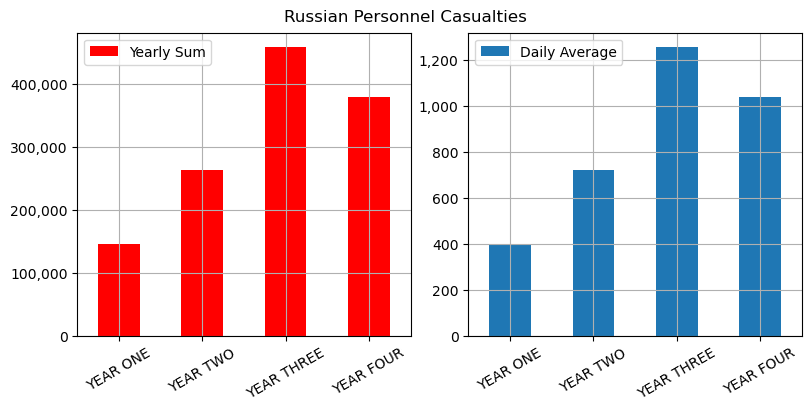
Russian casualties are enormous. On average, there are 1000 Russian casualties per day. Russia achieves minimal territorial advances at enormous cost, eg. Pokrovsk (250,000 casualties). Ragnar Gudmundsson estimates 227 Russian casualties for each sq km gained. Click on “Area gains” on the sidebar. Ragner’s site provides a very comprehensive statistical overview of the state of the war.

Ukraine casualties figure are not revealed by Ukraine. One estimate from Ragnar Gudmundsson’s site citing The Economist in November 2024 was that Ukraine military deaths ranged from 60-100,000. Russian estimated casualty figure at the date was 740,400 so given that 26% of those were deaths, the Russian death figure is roughly 192,000. So, if these figures are accurate the Russian:Ukraine death ratio is somewhere between 3:1 to 2:1.
What hard problems does Ukraine face?

  1. Russia is bigger
  • Russia has a bigger population than Ukraine: 3.5 times (142 million versus 39 million)
  • Russia’s economy is 11 times larger than Ukraines: 2.17 trillion versus 191 billion
  • they were reputed to have the world’s 2nd strongest military (a claim which looks ridiculous now) with the 3rd largest military budget
  • military spending is 3 times larger than Ukraines: 145 billion (6.3% GDP) v 54 billion (28% GDP)
  • some European countries were dependent on Russian and oil imports (Germany, Netherlands, Turkey, Poland, Finland …)
 COUNTRYPOPULATIONECONOMYMILITARY SPENDING
Russia142 million2,195 billion1456 billion
Ukraine39 million1,456 billion541 billion

Ukraine can only match this with reliable financial, military and humanitarian support from the Coalition of the Willing. Financial aid has been undermined by Trump since his election but according to Petraeus (see below) Europe has stepped up sufficiently to maintain Ukraine for at least another two years.

  1. Ukraine’s AWOL problem

It is confirmed at the highest level that Ukraine has huge AWOL problems:

“Ukraine estimates that 200,000 of its soldiers are absent without official leave (AWOL), meaning they have left their positions without permission to do so, the country’s new Defense Minister Mykhailo Fedorov revealed on Wednesday.

Speaking in the Ukrainian Parliament ahead of the vote that confirmed him as the new defense chief, Fedorov also said some 2 million Ukrainians are “wanted” for avoiding military service. ”

Ukraine’s manpower crisis emerges as a strategic vulnerability

Clearly, this is serious, but does not appear decisive given the stepped up use by Ukraine of unmanned systems. Their troops are better trained, better equipped and far better led than the Russians.

  1. Russian attacks on civilians

The sheer volume of Russian attacks on civilian targets (hospitals, schools) and infrastructure is a problem. Electricity infrastructure is under attack continuously. Winter temperatures are well below zero. Read this account on winter life in Kyiv by the editor of the Kyiv Independent.

Ukraine does need more help from its allies in the domain of air and ballistic defence capabilities.

  1. Zelensky has political troubles

Recently one of Zelensky’s top aides was removed on alleged financial corruption issues.

This source (read this link!)shows that Ukrainians believe that government corruption is a huge long term problem in their country (85%) but that confidence in their military is very strong (90%) and that support for Zelensky remains high (67%) although it has decreased from the Feb 2022 start of the war (85%)

What are Ukraine’s main strategic objectives?

As noted above Ukraine is winning on the battlefield, conceding some territory in exchange for massive Russian casualties.

Ukraine has demonstrated superior technological mastery, particularly with drones. Zelensky says that 80% of Russian targets are destroyed by drones.

Importantly, Ukraine attacks Russian infrastructure, especially oil & gas & occasionally a fleet of bombers or a General in Moscow. One of their main aims is to destroy the money making and war fuelling Russian oil and gas infrastructure. They have had some tremendous success in this and Russia has had to adapt by importing gasoline from Belarus.

Ukraine successfully invaded Russian territory near Kursk (and held it for months) and Belgorad. This diverted Russian troops from the front line. In response Russia used troops from North Korea.

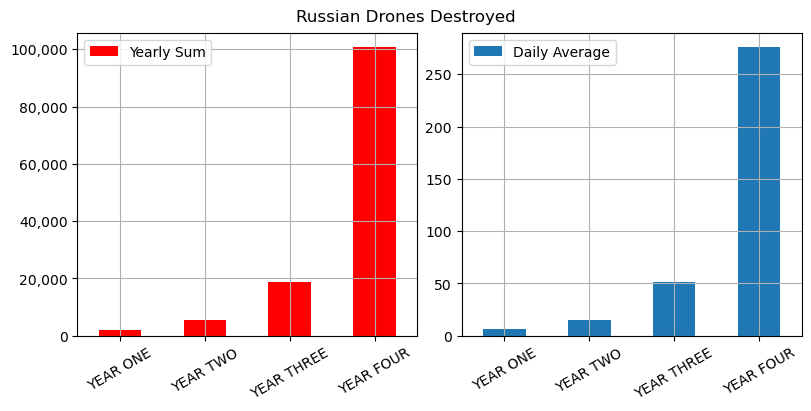
In 2025 there was a massive increase in drone usage by both sides. See graph below. Sometimes the Russians have been innovative, eg with fibre optic drones, but overall Ukraine is ahead. Drones are the new artillery and add tremendous potency to the infantry.
Neither side appears to have airforce superiority. According to this article, neither side dominates due to effective air defense systems, including drones. The air defence system on both sides is sufficient to keep fighters and bombers at a distance. On the front line drones have largely replaced them.

Russia employs glide bombs on city / civilian attacks to devastating effect. Ukraine has F16s from various countries.

According to one expert Russian’s can’t deploy their weapons, the battle zone is too wide, resulting in an extensive grey zone. Ukraine has better weapons all around, eg. the Archer from Sweden and the Caeser from France.

Ukraine’s innovative military doctrine continues to evolve rapidly. The trend is that Ukraine becomes stronger and Russia becomes weaker.

These trends are confirmed by a recent statement from Ukraine’s General Syrskyi:

The active front line stretches about 1200 km; the kill zone extends 15-20 km in depth.

Enemy strength is around 712,000 personnel, but casualty levels exceed Russia’s ability to replenish forces…

Work continues to increase the effectiveness of drones in air defense. Plans include redistributing functions between surface-to-air missile forces and a new branch of forces responsible for protecting critical infrastructure

Drones account for roughly 60% of all firepower on the front; artillery accounts for about 40%. In infantry firefights, Ukrainian soldiers prevail over the enemy in about 90% of engagements …”

What is Russia’s official position?

Russia has been consistent and unchanging in their demands. The following points were made by Russian Security Council Chairperson Dmitry Medvedev on February 1, 2026 ([link[(https://www.criticalthreats.org/analysis/russian-offensive-campaign-assessment-february-2-2026)):

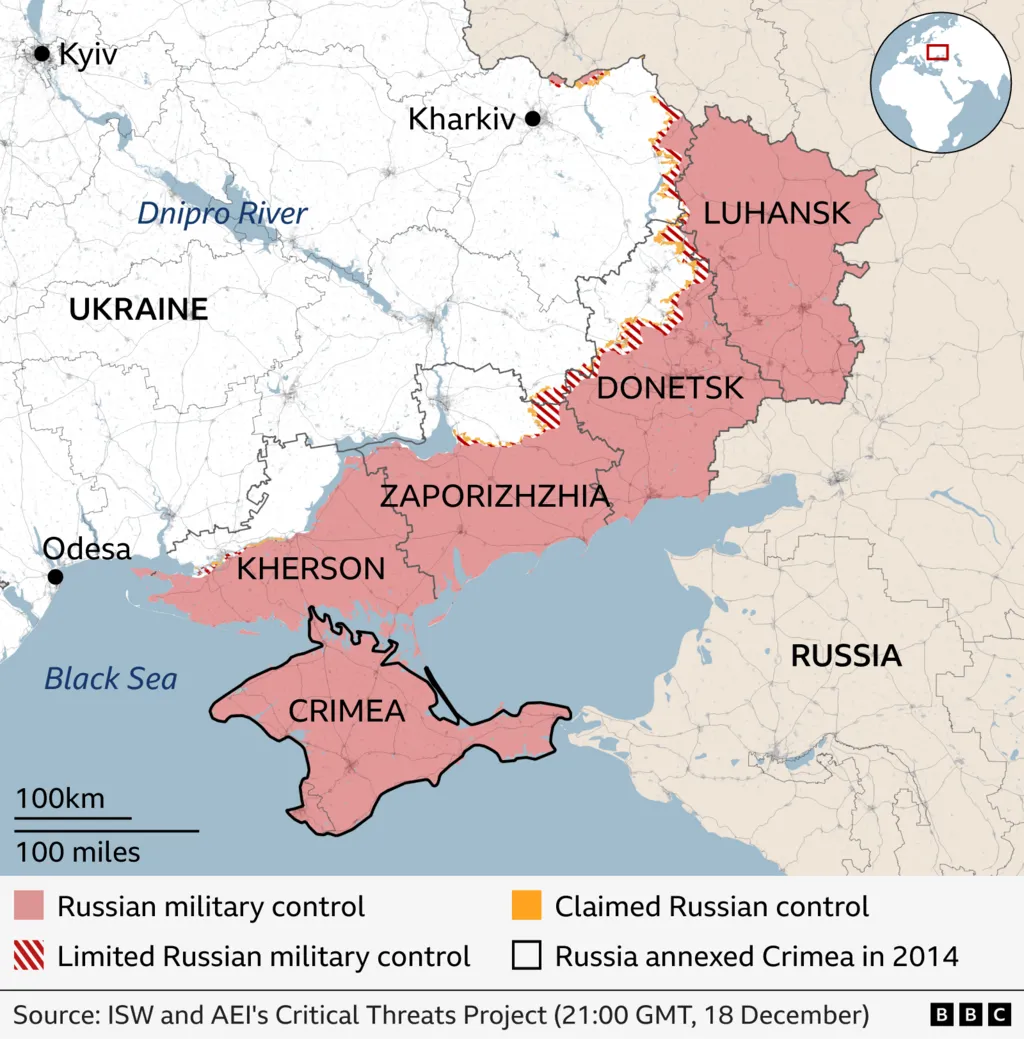
  • Ukraine must cede Luhansk, Donetsk, Zaporizhia, and Kherson oblasts (see the map at the start)
  • Ukraine has to demilitarize
  • the Ukraine government are Nazis and so that government has to be replaced with a pro-Russian government
  • compared the current conflict with Ukraine to the second world war with Russia defending the state and the Russian people
  • those in Russia who are indifferent to Russian soldiers on the front, who are unwilling to help their own state, and who “lack basic patriotism” are Russia’s “internal enemies.”
  • rejected proposals from the British and French-led Coalition of the Willing to station foreign troops on Ukrainian territory as part of postwar security guarantees for Ukraine.
  • the risk of a global nuclear exchange is high, Russia will use nukes if the fate of Russia is at stake
  • Finland has dismantled Russian-Finnish relations

What are the Russian political and economic problems and can they overcome them?

As noted above Putin doesn’t want to hear the truth which puts him at a disadvantage. Periodically, those who question Putin fall out of windows or suffer a plane crash or a gaol sentence.

Putin faces internal dissent. For example, General Igor Girkin created the “Club of Angry Patriots” to save Russia from what he said was the danger of systemic turmoil due to military failures in Ukraine and jostling in the elite to eventually succeed Putin. He was then sentenced to 4 years in gaol. (source)

Russia has militarised their economy (more than 6% military spending of GDP in Feb 2025 and rising) and the Russian people are suffering. How big are their economic troubles and can Putin manage it?

Russia influence is collapsing on many fronts internationally (Venezuela, Syria, Transnistria, Black Sea, with trouble brewing in Iran and Chechnya). Nevertheless, Russia maintains some currently supportive allies: North Korea, Georgia, Cuba, China, Belarus.

Russian nukes are paper tigers. He periodically threatens to use them but can never find a way that might help him achieve his goals. This still seems to frighten some European leaders.

What is the mood of the Russian people?

Some insights from Elvira Barry:

With Putin as leader Russia is in decline. Their population is shrinking and their technology is outdated, the education system and health care are all in trouble. Many who are well educated have left the country. Elvira Barry divides up the opinions of the people in this way. The dreams of:

  • the imperialists argue that the west wants to destroy Russia. They want a powerful, militarised Russia
  • the survivors long for a return to the pre-war days. They are apolitical but if pressed: “Ask them who they support and they will confidently say ‘Putin made the country strong”
  • the reformers want a properly functioning democracy. They face enormous obstacles here with the current regime of censorship

She moves on to talk about the opinions of the leaders of other countries. This varies from deep distrust to pragmatic support. The consensus here is that Russia is a declining but dangerous power.

Why is Trump behaving badly with respect to Ukraine?

Like everyone else I’m unsure of the answer to this question.

Trump’s stated surface position is that war is bad for business and he is good at stopping wars around the world

The previous Biden administration supplied billions of dollars of arms to Ukraine but with significant restrictions. The weapons could only be used within Ukraine territory. Their dithering policy was avoid a dangerous escalation. A background worry is that a dangerous escalation or a Ukraine victory might lead to tactical nukes being used.

This fear of where the nukes will end up seems to be a strong motivator in both the Biden and Trump administrations. Neither want Putin to fall.

Early in the piece Trump and Vance had a confrontation with Zelensky and said “Zelensky has no cards”. Perhaps Trump listens to bad advice about the real situation in the war or perhaps that was blather.

Trump has been critical of Europe for not pulling their weight in NATO and for their trading policies. These criticisms are legitimate.

Trump policy can be partly explained in terms of his preoccupation with money. He moved onto attempting to do a rare earths deal with Ukraine and is ok with Ukraine buying American weapons through Europe.

One interpretation is that Trump accepts Ukraine as part of Russia’s legitimate sphere of influence. His focus will be on keeping America strong in the Western hemisphere and stepping back from a global role it pursued previously. But Trump is hard to fathom. His recent move against Venezuela and possible future move against Iran creates huge problems for Putin.

Are Europe and NATO doing enough?

Zelensky, at Davos, angrily criticised Europe for their slowness.

Following on from Russia’s militarisation and America’s strategic withdrawal Europe is stepping up but this is uneven and slow.

Finland joined NATO in 2023 and Sweden in 2024.

According to Ben Hodges Germany, Finland and Romania (and perhaps others) have grasped the need to increase their military preparation.

David Petraeus presents a positive picture. He says the recent decision by the EU to provide 105 billion dollars equivalent (zero interest loan which doesn’t have to be repaid prior to Russian reparations) to Ukraine will solve their problems for the next couple of years and double their production of drones and the Flamingo cruise missile (which have a longer range – 3000 km – than the US tomahawk cruise missile, very significant capabilities).

As Ukraine has become smarter with their technological innovation and production, so has Europe.

Strong NATO voices are emerging. Canadian PM Mark Carney speech as Davos 2026 called for the middle powers to step up now that the US as a big power could no longer be trusted.

Sometimes it seems that frozen Russian assets are finally heading for Ukraine (through the efforts of EU Ursula von der Leyen) but this is an on again / off again story.

Europe’s combined financial contribution to Ukraine is roughly equivalent to what was supplied previously by the US.

Europe could do much more. For example the Russian oil carrying shadow fleet is vulnerable to NATO forces in the Baltic but Europe allows them to continue. But that would be up high on the escalation ladder.

Where are the peace proposals headed?

Trump has initiated peace proposals. Zelensky cooperates and inputs into this process but Putin doesn’t.

Ukraine has presented its own 20-point peace plan to the US, to counter the initial American plan which was heavily favouring Russia.

Finland PM Stubb recently said there was “full agreement between Ukraine, US and Europe” but I’m not sure what he meant by this. Britain and France are prepared to put in front line trip wire troops if a peace agreement is reached (rejected by Russia, see above).

There is little evidence that the war will end soon through these pathways. Although both sides have big problems in continuing, it is unlikely that either will abandon their declared aims.

Predictions

  • The Russian Ukraine war will continue throughout 2026. The only real hope of that not happening is an internal Russian coup against Putin.
  • Ukraine will continue to strengthen, Russia will continue to weaken.
  • Europe will strengthen their spine.
  • If Trump takes out Iran then that is a huge rewrite of the geo-political map. One outcome is that Iran will switch from a Russian ally to a Ukraine ally.

Final words

“Wherever there is oppression, there is resistance. Countries want independence, nations want liberation and the people want revolution—this has become the irresistible trend of history. All nations, big or small, should be equal; big nations should not bully the small and strong nations should not bully the weak.” source

References

  • See links to Ben Hodges, Chuck Pfarrer and David Petraeus in the article. Follow them for regular, accurate updates.
  • Ragnar Gudmundsson daily updates comprehensive statistics about the war daily here
  • Ukraine Government information and data here

the fake news and Rudy Giuliani… from Bill Kerr blog

Bill Kerr has asked me to share this from his blog ‘Viral Metamorphosis’…

* * * * * *

Did you think that the Trump legal team presenting their opening statement of their preliminary findings and goals about the Presidential election on November 3rd would be reported objectively?

What we received from the main stream media was a shit storm of abuse directed mainly at Rudy Giuliani. Here are some of the headlines:

The Washington Post: Rudy Giuliani’s post-election meltdown starts to become literal

CNN: Fact-checking Giuliani and the Trump legal team’s wild, fact-free press conference

Politico: Giuliani and fellow Trump lawyers crank out conspiracies as legal challenges implode

Financial Times: ‘Crazy’ allegations by Trump legal team prompt Republican rebukes

The Western Star: Trump lawyers’ wild, sweaty press conference

A few of the reports drew attention to Giuliani’s hair dye running down his face. Imagine the mindset of reporters who focus on that when evidence of massive election fraud is being outlined.

Back home one of the ABC News 24 “informative” pop ups reads “Donald Trump maintains false claim he wins the election”.

In my opinion the main problem is not Donald Trump. The attempts by the main stream media to manipulate our thinking is a much bigger problem. Rudy Giuliani is far, far more credible in the way he presents information than they are.

I invite you to watch the 90 minute presentation by the Trump legal team and make up your own mind: Rudy Giuliani and Trump Campaign Officials Hold News Conference at the RNC

How will this play out over the next few weeks? The most credible source I’ve found so far is Scott Adams, the Dilbert guy, who runs a daily entertaining / analytical podcast mainly (but not only) about this issue: here

Understanding America?

Via Bill Kerr’s blog https://billkerr2.blogspot.com/2020/10/understanding-america.html

It was an enormous surprise 4 years ago when Trump was elected. Another surprise was that this was predicted by Michael Moore. Btw Moore is again warning not to count our chickens before they hatch. What then arose was a need to explain this. After a little research I thought I had discovered reasonable explanations:

  1. The elephant curve, that middle America was either making no progress or going backwards economically. They were angry and voted for an angry outsider from the political establishment, Trump.
  2. The Democrat candidate, Hilary, was a pathetic self serving liberal who promoted identity politics and eschewed class politics.

At the time I felt Michael Hudson was on the right track in calling for a break up of the Democratic Party. His analysis, along with the late David Graeber, identified the central problem that both Parties were and are captive to Wall Street.

Over those four years as a casual, part time observer of American politics I felt those two explanations were sufficient to explain what was going on.

Four years later, is there a need to update this analysis? I have been searching and now think I know a little more.

Russia gate, based on flimsy evidence, was a failure of the Democrats to face the main reason why they lost, namely that their candidate and policies served the elite and would not improve the situation of middle America.

BLM is a race based movement with some legitimate claims but does not clearly identify the key issue in America, namely, the dire economic situation of the growing precariat.

China. Niall Ferguson, when interviewed by Coleman Hughes, identified the main good thing that Trump has done: clearly identified China as a real and growing danger to the world

Joe Biden is in cognitive decline and his political history shows he is either a scumbag (eg. with regard to the whistle blowers Snowden and Assange) or a non entity. The Democrats could have appointed a moderate reformer like Bernie Sanders. They chose not to which indicates they have learnt nothing new of value over the past 4 years.

The Lincoln Project, Republicans who are anti Trump, do make occasional entertaining videos but are dishonest in the way they promote Biden.

Institutions such as the New York Times and Universities have by and large been taken over by the woke movement who believe such things as:

  • Democrats lost last time because of Russian interference
  • Russia remains an existential threat to US democracy
  • Free speech has some importance but anti racism is far more important
  • Only fascists, nazis, white supremists, terrorists and racists support Trump
  • Assange belongs in prison because he helped Trump last time

Now the social media giants (twitter, facebook) have yielded to the pressure and are censoring their feed in support of Biden. The fearless, free press, where is it?

The culture war against a main stream media that has long stopped trying to tell the truth will have to go on whoever wins the election.

There are people in America, outside the main stream media, who make sense to me. I describe them as just informed citizens, of varying political allegiance, who have the blinkers off, are passionate about finding the truth and have growing numbers of supporters. Here are some of their names: Michael Hudson, Glen Loury, Coleman Hughes, John McWhorter, Glen Greenwald, Niall Ferguson, Matt Taibbi, Joe Rogan

The current choice, in the words of Matt Taibbi and Katie Halper, is between one bowl of shit and two bowls of shit. Coleman Hughes is supporting Joe Biden since he feels it might lead to a less deranged left wing as opposed to a more deranged left wing (if Trump wins). Take your pick.

If you think the above is on the right track and want to hear it better argued then watch this interview of Glen Greenwald by Joe Rogan:

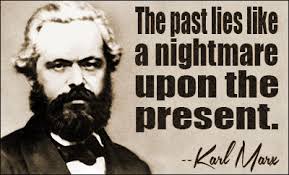
We need Marx!

images

Arise, you independent artists!
Arise, fair users great and small!

Those evil cartels and their jurists
Have, through their exploits, chained you all!
(To the tune of “The Internationale”)

* * * * * *

The following, written by Bill Kerr, originally appeared in 2005 at LastSuperpower. The context was a challenge at a blog called Harry’s Place to discuss whether Marx and Engels are still relevant in the C21st.

* ** * * *

We need Marx and Engels because they understood things and said some things better than anyone else has since. It’s important to read the original because people who call themselves Marxists have always been in violent disagreement with what it means. If you don’t read the original then you have no chance of working it out for yourself.

Communism has had bad press following the failures of the Soviet Union, China etc. It’s seen as a dull grey world, with no variety in the shops, controlled by faceless, heartless apparatchiks- freedom of thought and expression is not allowed. At one time (the 1930s- WW1, The Great Depression, fascism in Spain destroyed faith in capitalism) it was fashionable to be communist or fellow traveller, but nowadays it is definitely not fashionable.

Personally, I draw these insights from the Manifesto, which help me understand the world today:

  • Capitalism is progressive relative to feudalism/ religious fundamentalism

It’s far better to live in our bourgeois democracy than to live under the rule of fascist Saddam or the religious fundamentalism of the Taliban.

Marx was very clear about the historical progressiveness of capitalism, a point also made by Marcus [who was one of the contributors at Harry’s Place blog] with this quote:

The bourgeoisie historically has played a most revolutionary part. The bourgeoisie, wherever it has got the upper hand, has put an end to all feudal, patriarchal, idyllic relations, It has pitilessly torn asunder the motley feudal ties that bound man his “natural superiors:, and has left no other nexus between the people than naked self-interest, than callous “cash payment”. It has drowned out the most heavenly ecstasies of religious fervour, of chivalrous enthusiasm, of philistine sentimentalism, in the icy water of egotistical calculation. It has resolved personal worth into exchange value and in place of the numberless indefeasible chartered freedoms, has set up that single, unconscionable freedom — Free Trade.

  • The melting, dynamic vision of capitalism and progress

The bourgeoisie cannot exist without constantly revolutionising the instruments of production, and thereby the relations of production, and with them the whole relations of society. Conservation of the old modes of production in unaltered form, was on the contrary, the first condition of existence for all the earlier industrial classes. Constant revolutionising of production, uninterrupted disturbance of all social conditions, everlasting uncertainty and agitation distinguish the bourgeois epoch from all earlier ones. All fixed, fast-frozen relations, with their train of ancient and venerable prejudices and opinions, are swept away, all new-formed ones become antiquated before they can ossify. All this is solid melts into air, all that is holy of profaned, and man is at last compelled to face with sober senses his, real conditions of life, and his relations with his kind.

http://www.marxists,org/archive/marx/works/1848/communist-manifesto/cho1.htm

 * * * * * *

We live in a world where things change, everything changes due to the continual development of productive forces and scientific progress. This provides the material basis for the elimination of poverty and a feeling of optimism and excitement about the future.

‘All that is solid melts into air’ is also the title of a great book about modernity and modern interpretation of Marx and others, by Marshall Berman, which I would highly recommend. Here’s a quote from Berman:

To be modern is to live a life of paradox and contradictions. It is to be overpowered by the immense bureaucratic organizations that have the power to control and often destroy all communities, values, lives; and yet to be undeterred in our determination to face these forces, to fight to change their world and make it our own. It is to be revolutionary and conservative; alive to new possibilities for experience and adventure, frightened by the nihilistic depths to which so many modern adventures lead, longing to create and to hold on to something real even as everything melts. We might even say that to be fully modern is to be anti-modern: from Marx’s and Dostoevsky’s time to our own, it has been impossible to grasp and embrace the modern worlds potentialities without loathing and fighting against some of its palpable realities. No wonder then that, as the great modernist and anti-modernist Kierkegaard said, the deepest modern seriousness must express itself through irony. Modern irony animates so many great works of art and thought over the past century; at the same time, it infuses millions of ordinary peoples lives. This book aims to bring these works and these lives together, to restore the spiritual wealth of modernist culture to the modern man and woman in the street, to show how, for all of us, modernism is realism. (pp 13- 14)

  • Productive forces are held back by capitalist productive relations

After praising capitalism for developing the productive, Marx and Engels then tear it down because the property relations of capitalism periodically (boom and bust) produces slow down and crisis:

                 The productive forces of the disposal of society no longer tend to further the development of the conditions of bourgeois property; on the contrary, they have become too powerful for these conditions, by which they are fettered, and so soon as they overcome these fetters, they bring disorder into the whole of the bourgeois society; endanger the existence of bourgeois property. The conditions of the bourgeois society are too narrow to comprise the wealth created by them.

The dominant productive relations today in western society are boss/worker. No thinking person much likes working for a boss but it’s what we have to do to survive.

The point about boss/worker relations is that they are anachronistic, they hold back the further rapid development of the productive forces. Workers hold back and do not work at their full capacity, initiative and creativity. In a society where the workplace nexus between people (is) naked self-interest (and) callous “cash payments” it makes no sense to give it your best shot.

The real communist critique of capitalism is that capitalism social relations – boss/worker relations – holds back in the rapid development of productive forces.

For example, the dominance of Microsoft holds back the rapid development of  either superior or potentially superior software development such as the Linux operating system, which has been developed out of gift culture. We seem to have very significant groups of the open source software developers today who practise communist principles from each according to his ability, to each according to his needs- without even realising or connecting to the source.

This surfaced in a recent exchange between Bill Gates and his open source critics after Gates said:

               There are some new modern-day sort of communists who want to get rid of the incentive for musicians and moviemakers and software makers under various guises.

This led to a flurry of design activity in the open source/creative commons community, who renamed themselves “creative communists” and developed a series of red flags and logos in response to the gibe:

 One Gates critic has even adapted the words of ‘The Internationale’ as an anthem for the freedom of information movement.

‘The Free Culture Internationale’

(Lyrics by Andrew Mike (2005) To the tune of “The Internationale” by Pierre Degaytre, 1888)

Arise, you independent artists!

Arise, fair users great and small!

Those evil cartels and their jurists
Have, through their exploits, chained you all!

But we have thought up a new system,

To make the fairer through and through;

Right now, they say, “We’ll never miss them,”

But one day soon, they’ll say “We do!”

So Bill Gates calls us commies,

But he can’t stand the sight

Of information freedom,

Reform of copyright!

So we go on creating,

Joyous and full of mirth,

For our great newborn copyleft

Shall shine upon the earth!

The spirit of communism as envisaged by Marx is alive and well in the open source community but perhaps because communism has such a bad name and Marx is little read by software developers they have not made the connection.

4) Atheism, materialism, facing reality abandoning the hopeful, sentimental approach

The Communist revolution is the most radical rupture with traditional relations; no wonder that its development involved the most radical rupture with traditional ideas.

Before capitalism the rulers of society were the religious rulers.

With the development of science our Universe became far more interesting and beautiful place than anything envisioned by religion.

Atheism is strong in the Manifesto through its exposure of religious hypocrisy, as the transition was made into a society dominated by money. The Manifesto is an invitation to think for ourselves and to reject artificial soothings of religion.

Once again the most articulate exposures of these sorts of views comes from people like Richard Dawkins, who don’t personally identify with communism but who nevertheless show the relevance of the views expressed by Marx in 1848.


* * * * * *

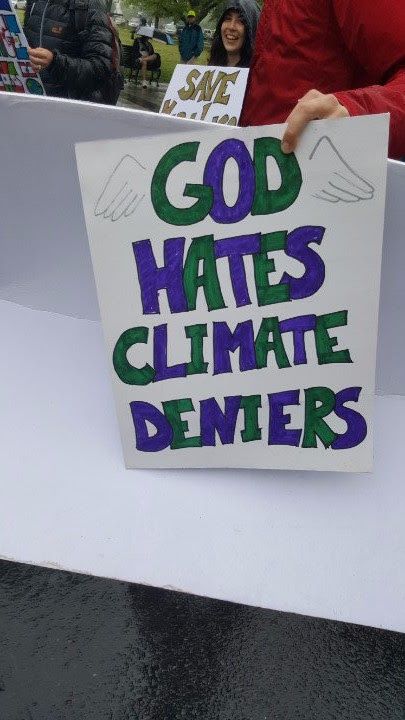
Beware of dogmatic claims (alarmists, deniers), be sensitive to the uncertainty and complexity of the climate science issue – Judith Curry’s STATEMENT TO THE COMMITTEE ON SCIENCE, SPACE AND TECHNOLOGY OF THE UNITED STATES HOUSE OF REPRESENTATIVES


18157498_10211569986878010_6618473679123794158_n

Hmmmm….

* * * *

Judith Curry STATEMENT TO THE COMMITTEE ON SCIENCE, SPACE AND TECHNOLOGY OF THE UNITED STATES HOUSE OF REPRESENTATIVES
Hearing on Climate Science: Assumptions, Policy Implications and the Scientific Method
29 March 2017

* * * *

Here is Judith Curry’s statement.

Judith A. Curry is an American climatologist and former chair of the School of Earth and Atmospheric Sciences at the Georgia Institute of Technology. Her research interests include hurricanes, remote sensing, atmospheric modeling, polar climates, air-sea interactions, and the use of unmanned aerial vehicles for atmospheric research. She is a member of the National Research Council’s Climate Research Committee.

She earned her PhD degree in Geophysical Sciences from the University of Chicago in 1982.

* * * *

This is from Bill Kerr’s blog.

Science is an iterative process of multi hypothesis formation, collecting data and testing that data against the variety of hypotheses

Beware of dogmatic claims (alarmists, deniers), be sensitive to the uncertainty and complexity of the climate science issue

Explanation of the how and why we have got to a bad place in climate science (page 11, extract below)

There is a war on science – not from Trump but from within the science establishment itself (page 12, extract below):

How and why did we land between a rock and a hard place on the issue of climate science?

There are probably many contributing reasons, but the most fundamental and profound reason is arguably that both the problem and solution were vastly oversimplified back in the early 1990’s by the UNFCCC, who framed both the problem and the solution as irreducibly global in terms of human-caused global warming. This framing was locked in by a self-reinforcing consensus-seeking approach to the science and a ‘speaking consensus to power’ approach for decision making that pointed to a single course of policy action – radical emissions reductions.

The climate community has worked for more than two decades to establish a scientific consensus on human-caused climate change, prematurely elevating a hypothesis to a ruling theory. The IPCC’s consensus-seeking process and its links to the UNFCCC emissions reduction policies have had the unintended consequence of hyper-politicizing the science and introducing bias into both the science and related decision making processes. The result of this simplified framing of a wicked problem is that we lack the kinds of information to more broadly understand climate variability and societal vulnerabilities. The politicization of climate science has contaminated academic climate research and the institutions that support climate research, so that individual scientists and institutions have become activists and advocates for emissions reductions policies. Scientists with a perspective that is not consistent with the consensus are at best marginalized (difficult to obtain funding and get papers published by ‘gatekeeping’ journal editors) or at worst ostracized by labels of ‘denier’ or ‘heretic.’

Policymakers bear the responsibility of the mandate that they give to panels of scientific experts. In the case of climate change, the UNFCCC demanded of the IPCC too much precision where complexity, chaos, disagreement and the level current understanding resists such precision. Asking scientists to provide simple policy-ready answers for complex matters results in an impossible situation for scientists and misleading outcomes for policy makers. Unless policy makers want experts to confirm their preconceived bias, then expert panels should handle controversies and uncertainties by assessing what we know, what we don’t know, and where the major uncertainties lie….

War on Science
With the advent of the Trump administration, concerns about ‘war on science’ have become elevated, with a planned March for Science on 22 April 2017. Why are scientists marching? The scientists’ big concern is ‘silencing of facts’. This concern apparently derives from their desire to have their negotiated ‘facts’ – such as the IPCC consensus on climate change – dictate public policy. These scientists also fear funding cuts and challenges to the academic scientific community and the elite institutions that support it.

The ‘war on science’ that I am most concerned about is the war from within science – scientists and the organizations that support science who are playing power politics with their expertise and passing off their naïve notions of risk and political opinions as science. When the IPCC consensus is challenged or the authority of climate science in determining energy policy is questioned, these activist scientists and organizations call the questioners ‘deniers’ and claim ‘war on science.’ These activist scientists seem less concerned with the integrity of the scientific process than they are about their privileged position and influence in the public debate about climate and energy policy. They do not argue or debate the science – rather, they denigrate scientists who disagree with them. These activist scientists and organizations are perverting the political process and attempting to inoculate climate science from scrutiny – this is the real war on science.

Marx’s moral theory (via Bill Kerr)

Thanks to Bill Kerr for permission to republish this.

****

HUMAN ESSENCE

If there is such as thing as human essence and we can discover what it is then that will go a long way towards developing a moral theory.

Human nature is part biological, part social and not religious. Religion is something to be explained rather than believed. This includes modern religions such as Nature worship (currently popular) and Marx worship (currently marginalised).

Humans have both needs and powers. Obviously, it follows that we are both needy and powerful and both of these aspects of being human need to be explored further.

The biological and social parts are connected or interact dialectically. It would be an error to see them in isolation from each other.

Fundamental biological needs include eating, drinking, habitation, clothing, sexuality …

Biological and Social. Humans produce their own existence / material life through social labour. Our biology allows this, eg. Opposable thumb, upright posture frees the hand, large brain. This separates us from other animals. Compared to other animals we are self conscious and wilful to a qualitatively different degree. Although we originate as part of nature, with our social labour we oppose nature. Our productivity is also imaginative. We imaginatively and self consciously transform nature and in that process also transform ourselves. This is a teleological process. Humans imagine new forms of the material and self and then through social labour bring that imagination into reality. This is human essence.

THE GUIDING MORAL PRINCIPLE

The guiding moral principle is to do whatever is required for the human flourishing of rich individuals, to dynamically expand human powers for all humans. Human flourishing is not original to Marx but Marx built on the best available ideas that came before him, those of Aristotle.

Marx and Engels were more aware than Aristotle about the role of social labour in this enrichment process. After all, Aristotle lived in a slave society. Refer Engels, The Part Played by Labour in the Transition from Ape to Man. In communist society there would not be a division of labour based around the supply and demand of the labour market. In a world where production for the needs of all is established then each individual would be free to pursue their own perceived interests.

PHILOSOPHICAL STANCE

The philosophical stance here is to investigate what is distinctive about humans (biologically and socially) and from that basis to articulate what a good or rich life is.

ONTOLOGY

Be clear about where our moral principles come from. Being determines consciousness. Matter is philosophically prior to ideas.

The theory is philosophically materialist. It starts from real people and real conditions. It ascends from earth to heaven, not descends from heaven to earth.

But, once we are in heaven how do we get back down to earth again? The only way is to make a detailed study of society in all its aspects. Mode of production, division of labour, social classes, Is there a surplus and who controls it?, the history of knowledge, current issues, individual self knowledge. There is a lot to know! The desirable actions that promote the best human nature at any point in history depends on the depth and perspicacity of such an analysis.

CAPITALISM and ALIENATION

Capitalist limitations. For the capitalist, because they own the means of production, the workers life activity becomes a mere use value. In general, workers have no direct stake in the products they produce. Temporary niche solutions may be possible for individual workers but overall work loses it human character. In class society, the economy operates as a thing more or less outside of human control. If there is no profit to be made then production grinds to a halt. There maybe poorly understood economic laws. But the best that could be said of capitalism is that it is a highly unstable system in which the future well being of the workers who make it is uncertain and problematic.

Capitalism gives labour a bad feel (alienation) and production a bad name. Under capitalism humans are alienated from their essence, their living social labour, since the capitalists own the means of production and determines which products are made and who owns those products.

The capitalist economy is an unstable monster, poorly understood, difficult to manage and continually spinning out of control. Workers are alienated from the products they produce. Creative people who produce things of beauty (some artists, some writers, some teachers etc) are often not seen or appreciated as typical workers, rather they are marginalised workers looking for a niche to survive in a system that systematically undermines them. Or a handful may become megastar celebrities who play a significant role in entertaining the masses. Moreover, many believe today that capitalist production is despoiling the environment at an alarming rate. I think there is some truth to this latter charge, although I also see talk of environmental Armageddon as exaggerated and a distraction from the main wrongs of our society.

These issues in combination (production for profit not human need) give production itself a bad name. Human essence, social labour, life’s prime want, is reduced to being a wage plug, without a real say in the overall progression of society.

Rather than saving the planet (the current “left” mainstream zeitgeist) we need to focus more on how to liberate the social productive forces, human essence, in all their real power and beauty. A power and beauty which is obscured by the ugliness of capitalism.

NATURAL NATURE

The natural world is the world created by humans, who are part of nature, as well as the world that existed before humans. The natural world is not “green” insofar as that suggests a world not touched by humans. Such a world no longer really exists on Earth. In a post natural world (aka the anthropocene) our needs will be created more by what we make than the natural world that exists independently of what we make.

As society evolves our tastes, including our basic biological tastes, become more sophisticated: “the forming of the 5 senses is a labour of the entire history of the world” (source)

THE SCOPE OF MORAL THEORY

A moral theory has to somehow account for all human moral thinking, good and bad, angelic and evil, noble and perverse, optimistic and pessimistic. But Marx’s moral theory is (intentionally?) thin. It does not claim or suggest that humans are any of essentially selfish, altruistic, competitive, fallen, vicious etc. Is this a feature or a bug? In my view Marx is right about the essentials but there is a lot of stuff that is not covered. Marx analyses the deep structure of capitalist society but there are important issues that lie more on the surface (eg. the dark and deep emotions such as love, grief, anger) that strongly motivate individual actions but are left hanging. Hence, many people find that other moral philosophers and novelists address their needs more directly.

UTOPIANS and OTHER ALTERNATIVES

Utopians make the error of promoting general moral principles in the abstract, without regard to the current real state of society, without assessing the social forces at play. They are not realistic. Mere moral persuasion in favour of a better society is inadequate / doesn’t work.

There are many alternative moral theories. For example Plato (Iris Murdoch provides a modern interpretation), Stoic, Christian (various branches), Kantian, Utilitarian (Bentham and JS Mill provide different interpretations), feminism / women’s liberation, Buddhism (meditation and mindfulness are currently popular), existentialism, libertarianism, animal liberation, Sufism (adopted by Doris Lessing after her disillusion with communism), pragmatism (Dewey, Putnam), the liberal Capabilities approach of Amartya Sen and Martha Nussbaum.

All of these need to be critically examined since what is correct only emerges clearly from a critique of such alternatives. At this stage I would say that none of these alternatives share with Marx the view that human essence is the conscious production of our existence / material life through social labour. Moreover, they tend to be indifferent to the analysis that the main current problems are generated by capitalism.

INDIVIDUALS and SOCIAL CLASS

Humans are self conscious, intelligent, purposive, active, self directed. But this doesn’t mean we can negate the so called “external world” (only external to humans, who are a part of nature, so not really external to nature in that broader sense of the word) or history.

Human individuality (as distinct from herd or tribal mentality) emerges historically from the bourgeois revolution against feudal relations (when it was “natural” to obey a preordained superior such as a lord or king). Herds are not good at shopping, whereas individuals are. But just as individuality emerges strongly in the capitalist era, you would expect it to also change dramatically in a post capitalist society.

In class society, social class is a more important determiner of who we are than individuality as such. Individuals pick their personalities, interests, work etc. from what is available socially (including the cutting edge, futuristic and off beat, quirky trends) at the time. The idea that we are free, autonomous individuals is more part of capitalist mythology or ideology than reality.

HISTORY

Morality is historically contingent. What is moral in one historical period becomes immoral in another. The central issue is doing whatever is required to maximise the human flourishing of rich individuals in the given time and place.

For example, in the French revolution the rising bourgeois class overthrew feudal relations, got rid of divine rule by the King etc. In that historical period bourgeois right coincided with the needs of the proletariat as well. But at a later date the bourgeois class held things back, became reactionary, used social labour for their own ends, promoted an economic system which went through periodic crises and still does. At that point the revolution to continue human liberation and the liberation of the productive forces must be picked up by the proletariat, sooner or later.

Given the views expressed here about ontology (materialists need to deeply investigate reality) and history (morality is historically contingent) it follows that to work out the best moral – political actions requires some hard work. No one said it would be easy.

TRANSITION FROM CAPITALISM TO COMMUNISM (SOCIALISM)

The productive forces developing within bourgeois society create the material conditions (preconditions?) for the solution to the problem of the antagonism of the individuals social conditions of existence. Big is beautiful, not small is beautiful (the latter from EF Schumacher). Not because capitalism is beautiful but because big, centralised production prepares the way for socialism.

COMMUNISM

Marx is grounded, not utopian. In The German Ideology, Marx rejects the idea of communism as “an ideal to which reality will have to adjust itself”, rather he sees it as “the real movement which abolishes the present state of things”

This is pretty much the opposite of what most people today believe about communism, that it is idealistic and unrealistic.

From a moral perspective the aim is to bring together social being (human existence as it is) with social essence (human existence as it ought to be). As the contradiction between the individual and the social diminishes then the need for morality to maintain social cohesion would also diminish. All the conditions for rich individuality would be met by society. Eventually, morality might disappear altogether. If everyone’s needs were being met through the basic social structure then wouldn’t concepts such as selfishness or altruism lose their meaning?

SOME THINGS MISSING FROM THIS ACCOUNT OF MARX’S MORAL THEORY

There are many important issues missing from both the theory and practice of Marxism in this account. I have a preliminary list but will leave that to another time. No doubt if you have read this far you are both interested in this topic and will have your own unanswered questions. This will require far more discussion.

REFERENCE:

I have done a lot of reading on this topic but won’t attempt a detailed bibliography at this stage. But I will mention one reference which to me is a stand out, a PhD thesis by Vanessa Wills titled Marx and Morality(pdf 269pp) who has read and understood all of Marx IMHO.

Iceland: a different vision (Bill Kerr)

In a world where the internet and governments are becoming less free the Icelandic visionaries see an opportunity to promote freedom as a nation building exercise

Never waste a good crisis (advice to those in other countries)

countries need to update their outdated constitutions

be clear about what you need to do and how to do it

catch the spirit of the nation by listening to the people

radical change only happens during crisis, at other times people become too complacent

* * * *

Thanks to Bill Kerr for permission to republish this post:

Iceland: a different vision

After hearing that the Pirate Party has become the most popular political party in Iceland (one source) I’ve been searching for information which explains how this happened.

What accounts for the difference in the way Iceland is developing politically?

The video at the top of this page, “From the Hell of the Crisis to the Paradise of Journalism” (1 hour 13 minutes) provides a dramatic and informative introduction to what has been happening in Iceland since the economic crisis of 2008 to the near present.

Alternatively, the paper on this page, Beyond WikiLeaks: The Icelandic Modern Media Initiative and the Creation of Free Speech Havens (pdf 24 pp), provides a written down version of similar information.

SUMMARY OF THE VIDEO:

“We were not separated from the majority of men by a boundary, but simply by another mode of vision. Our task was to represent an island in the world, a prototype perhaps, or at least a prospect of a different way of life”
– Herman Hesse. “Demian”

A particularly severe Banking crisis in 2008

Icelandic citizens in response held a weekly kitchen revolution outside parliament with clear demands (the Government, the Bankers and Monetary authorities should resign). These goals were achieved. Unlike other countries those responsible were punished.

A new government constitution was developed initially through crowd sourcing of 1000 citizens randomly (direct democracy) to develop it

The media was held complicit in not spotting the weakness of the Banks

Wikileaks helped by publishing information about corruption in those same Banks at that time

The Bank involved took legal steps to suppress that information – but this resulted in making things worse for them

In response the opportunity was taken by visionary leadership to launch a freedom of information revolution

One aim is transparent government, to move from secrecy by default to transparency by default

A large section of the video goes into detail of the FOI legislation, under nine subheadings. Also see Progress Report for detail

In a world where the internet and governments are becoming less free the Icelandic visionaries see an opportunity to promote freedom as a nation building exercise

Never waste a good crisis (advice to those in other countries)

countries need to update their outdated constitutions

be clear about what you need to do and how to do it

catch the spirit of the nation by listening to the people

radical change only happens during crisis, at other times people become too complacent

Remote hopelessness (via Bill Kerr blogspot)


Thanks to Bill Kerr for permission to republish the following post from his Bill Kerr blogspot.

* * * *

I watched Remote Hope on 4 Corners. In some respects it was quite a good expose about how bad things have become but it still didn’t drill down deep enough into the fundamental basis of the problem or interview those who have thought deeply about it and grappled with a solution.

Tony Abbott (“lifestyle choices”) and Colin Barnett (“put yourself in my shoes”) have both shot themselves in the foot and are easy targets. But what is needed is not a free kick of unpopular politicians but an honest description of the problem and some deep thought about a solution.

Some good people have thought deeply about the issue of remote indigenous community dysfunction: Peter Sutton, Noel Pearson, Marcia Langton, Bess Price and Stephanie Jarrett, to name a few. They are the whistle blowers and they blew the whistle a long time ago. Noel Pearson’s essay Our Right to Take Responsibility was delivered in 2000. Why didn’t the ABC interview these people?

I thought some of the people interviewed were very good in describing the problem:

  • the Broome mayor, Graeme Campbell
  • John Hammond, the Perth Lawyer, who supported some shut downs of dysfunctional communities
  • Anthony Watson who plans to camp on Cable Beach, inconveniencing tourists, and bringing a real problem to the attention of Australians
  • Karl O’Callaghan, the WA police commissioner, was good, pointing out facts (sex abuse 10 times higher than anywhere else), supporting closures of dysfunctional communities and even providing an emotional response, that he couldn’t sleep at night, whether rhetorical or not, it was correct
  • Susan Murphy right at the end, we can’t keep giving handouts

I thought Tammy Solonec of Amnesty International was terrible, talking about human rights in the abstract, not based on any analysis of reality.

The best attempt at a solution so far is that proposed by Noel Pearson and his Family Responsibility Commission. See the article by Catherine Ford about that, Great Expectations: Inside Noel Pearson’s social experiment.

Admittedly nothing about this issue is going to easy. But the problem came about due to bad policy that superficially looked like humane policy. Equal wages led to indigenous unemployment. Welfare led to alcohol and drug abuse and child abuse. The bad policy has dragged on for many years after it was pointed out. Nevertheless, bad policy can be corrected. Of course, it is too late for many but correction of bad policy offers real hope which can grow over time for some.

Kerry O’Brien said right at the end that there was no easy solution but still the puzzle is why they didn’t put Noel Pearson on who has come up with a hard solution. I think the ABC is more interested in easy hits on Abbott and Barnett than proposing a real solution. See my earlier article, The closure of remote indigenous communities, for links to the ideas of Marcia Langton and Stephanie Jarret on this issue.

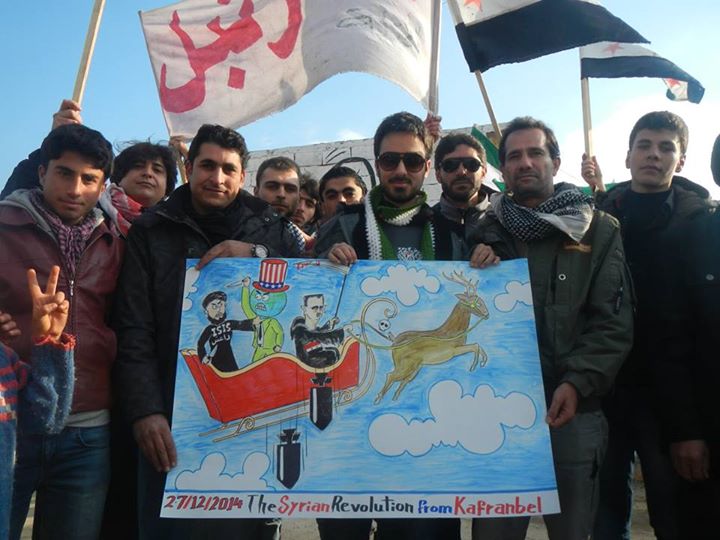
Weep for Charlie … but also pay more attention to Syrian cartoonist, Raed Fares

Article by Bill Kerr. Reprinted with permission from his blog.

* * * *

I can certainly identify with the grief, anger and further preparation against home grown terrorist attacks in the “civilised” west. But I also think this needs to be compared with the so little understanding and commitment of what needs to be done in Syria. The problem of fundamentalist inspired terrorism can only be solved at its source. It’s the old story of do we fish the babies out of the water or make the effort to stop those who are throwing the babies in further upstream (from The Ragged Trousered Philanthropist)

The Daesh (aka ISIS, ISIL) is the monster created within the monster of Assad’s Syria.

The Syrian cartoonist, Raed Fares, survived a Daesh assassination attempt in January 2014… the would-be assassins fired at Fares 46 times. Twenty-seven bullets struck the wall behind him; 17 hit his car. Only two struck him. They shattered seven bones in his shoulder and ribs and punctured his right lung.

assad barrel bombs

Assad’s brutality in the face of the Arab Spring inspired Syrian revolution has created 200,000 plus deaths and 3.5 million refugees. Today we witness so much grief and preparation for terrorism at “home”. By contrast there is little understanding and commitment of what needs to be done in Syria.

This NYT article about Raed Fares, Radio-Free Syria, is very good. It includes one section about Obama’s failure in Syria:

“Three years ago, America could have saved thousands of lives,” Bayyoush went on. To them, what they needed seemed simple in hindsight: antiaircraft missiles, airstrikes against Assad, a no-fly zone. All of these options would have offered potential solutions. Their model for U.S. intervention was Libya, where airstrikes in support of the opposition helped to depose Qaddafi. Later the country descended into civil war. Fares acknowledged that Libya was hardly a success story, yet at least, he said, the United States had intervened to protect the Libyan people. In Syria, Assad was free to systematically imprison and kill the moderate leaders the United States was now looking for. “One by one, they were disappeared,” he said.

“Can I speak?” said Hamada, who is with the Fifth Regiment of the Free Syrian Army. “I told the Americans I met in Jordan: ‘If you help us, there will be no extremism in Syria at all. If you’re too late, there will be a time when neither you nor we will have any control.’ ” According to a senior retired U.S. military leader, who asked not to be named because he is no longer in the service, the delay in backing the Free Syrian Army led to the death of moderate military leaders. “If we had helped those people earlier, it could’ve gone differently,” he said. “A lot of the good leaders are dead now. They’ve been caught between rocks and hard places and ground into dust.”

The recent strikes against ISIS in Syria frustrated the Free Syrian Army commanders on two counts. First, unlike that of the United States, the F.S.A.’s primary foe was the regime. “The regime has launched chemical attacks and many more massacres than ISIS has,” Bayyoush said. Second, they had been warning the United States against the growth of ISIS for more than a year. “A year and a half ago, ISIS started activating cells,” Hamada said. “If America had helped us in the beginning, there would be no ISIS.” But the growth of ISIS wasn’t simply America’s fault. The Free Syrian Army bore its own responsibility. “These extremist groups formed because we were weak within the Free Syrian Army,” he said.

Some more Raed Fares cartoons, they are all located in one place here, Liberated Kafranbel .