Daesh, the (pseudo) Left, and the Unmaking of the Syrian Revolution

“The role of socialists is not to counterpose themselves to democratic revolutions, which gave rise (in Egypt) to the first democratic government, and (in Syria) to emancipatory projects such as networks of local councils against the existing state, but to take the democratic side against tyranny”.

My response: WHY for heaven’s sake does this even have to be stated?

The reason is because of the general failure to understand that ‘socialists’ who side with tyrants are not worthy of the name, and that the pseudo-left which has been dominant for decades needs to be called out. I wish the reviewer had used that term rather than seeming to accept that one can oppose democratic revolution and still be on the left.
9780992650964-cov-front-sml


The following book review is published with permission of Syria Solidarity UK.

* * * *

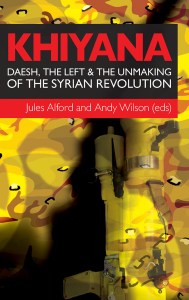
Khiyana: Daesh, the Left, and the Unmaking of the Syrian Revolution, ed. Jules Alford and Andy Wilson, published by Unkant, London.

Review by Clara Connolly

This book should be required reading for every leftist, as an antidote to the growing mountain of ignorant comment on the subject of Syria. The title Khiyana (betrayal) is an accusing cry; the book is a trenchant denunciation of the Western Left for its abandonment of the principles of internationalism and solidarity in favour of an alignment with the ‘anti imperialist’ camp, a hangover from the geo-politics of the Cold War.

Assad An-Nar, like most of the authors, situates himself on the Marxist left, and his prefatory chapter could be considered a direct response to Tariq Ali’s infamous dismissal of the Arab Spring in What is a Revolution? (Guernica, Sept. 2013). He sets his critique in the context of the changing nature of revolution in an age of global neoliberalism, where post colonial states are collapsing because neoliberal policies have slashed the limited social protections they used to offer. In this world, he says, the principles of self emancipation and of collective and democratic struggle are ‘ideas in search of a subject.’ Ideas about democracy, socialism, and anti-imperialism used to run in the same direction, but now they are counterposed.

With the collapse of the progressive moment of secular Arab nationalism, Islamist organisations like the Muslim Brotherhood can rise beyond identity/sectarian politics in resistance to tyranny. Though not necessarily opposed to neoliberalism, they are the voice of those who are excluded from its benefits. Hezbollah’s current role in Syria shows that such movements can swing between revolution and counter revolution without moving in a socialist direction.

The role of socialists is not to counterpose themselves to democratic revolutions, which gave rise (in Egypt) to the first democratic government, and (in Syria) to emancipatory projects such as networks of local councils against the existing state, but to take the democratic side against tyranny. Instead the left has responded by either supporting their favourite dictatorships (the neo Stalinists) or by re-hashing theories of ‘permanent revolution,’ i.e. insisting that revolutions can only end in socialism or defeat (the Trotskyists). Yes, he says, a democratic revolution is possible in these countries, but the outcomes are uncertain; the socialist left, while recognising its marginal role, should not condemn itself to irrelevance by denouncing the struggles for democracy because they are not socialist. Instead he urges the left to make the ‘democratic wager,’ in hope that the outcomes lead to more collective forms of struggle. There is little to lose for socialists, he believes, since neoliberalism has led worldwide to the fatal weakening of working class self-organisation.

The subsequent chapters examine and demolish the standard left myths about the Syrian revolution: the ‘jihadist’ nature of the ‘rebels’; the selective anti imperialism which admires Rojava but has no time for similar experiments in local democracy elsewhere in Syria; the role of regional imperialisms like Iran and Russia in propping up a monstrous regime; and above all the lies and distortions peddled by the institutional left (Stop the War Coalition, and the éminence grise of left journalism like Patrick Cockburn, Robert Fisk, and Seymour Hersh) who place the national interests of states they consider to be in the ‘axis of resistance’ above solidarity with the struggles of the oppressed in those countries.

In a short review I can refer only to two further articles in the core of the book; but I cannot resist a passing mention of the glorious satirical piece by M Idrees Ahmad, The Anti-Imperialist Guide to Inaction in Syria. Anyone familiar with debate on Syria will recognise the strategies he lists: ‘Don’t defend Assad, attack his opponents; sympathise selectively; functional doubt where straight denial is risky; defend peace and sovereignty; champion the minorities; talk about ISIS, not Assad; talk about refugees but not the cause of flight,’ etc. Most of these strategies are shared with the establishment and the extreme Right.

Mark Boothroyd describes the responses of Stop the War Coalition (STWC) to Syria, in a case study that echoes the critique in the preface. It has consistently viewed developments through its relation to the US and the UK. In a multi polar world system with competing imperialisms, it persists in viewing events through the prism of the Cold War. The agency of Syrians is erased altogether.

In 2013, STWC opposed the proposed intervention of the UK and when this proposal was defeated in Parliament, it claimed victory; but Boothroyd claims that if the West had really wanted to intervene in Syria it would have done so—its actual strategy is to let the country bleed. I think he underestimates the power of popular protest in democratic countries, and the degree to which STWC was able to tap into post Iraq war weariness. But he is right in pointing out that STWC has missed a trick in failing to expose the real cruelties of the Western role.

In its weaker response to the 2015 intervention against ISIS, STWC has consistently refused to allow oppositional Syrians on its platforms—who have opposed the Coalition campaign against ISIS as useless and counter-productive, but have also proposed more positive measures for the protection of Syrian civilians. Once again, its failure to listen to Syrians has weakened its moral stance even in its own terms—in opposing its own Government.

It could have been different, he believes: the anti war movement could have risen beyond its current ethnocentric, isolationist positions to meet the challenge of changing times, and been a movement to build solidarity with the revolutions in the Middle East.

In The Rise of Daesh in Syria, Sam Charles Hamad attacks the myth of Saudi funding and support for Daesh; instead, in a detailed study, he convincingly shows their deadly rivalry despite their similar ideologies. He demonstrates the origins of Daesh in post invasion Iraq, and its nurture by the sectarian regimes in Iraq and Syria. He shows, by tracing its sources of income, how it is self sustaining. Finally he argues that the current tactics of the west, in fighting Daesh from the air but hampering the oppositions in their fight against the sectarian regimes of Assad and Maliki, are counter-productive. And the left’s narrative is complicit in this.

The book, and particularly its opening chapter, is weakened by a failure to examine more closely such terms as ‘democracy’ and ‘emancipation,’ given their ambivalent history among Marxists; and to analyse the demands of the revolution—Freedom Justice and Dignity—in more detail. This is particularly the case since there is little discussion of class, and no accounts of the role of women in the Syrian revolution, nor of the role of Western women’s peace groups or feminists in relation to Syria. My own recent experience of organising solidarity events with Syrian women suggests that the hostility to, and silencing of, Syrian voices is much less prevalent among feminist organisations than in the left as a whole. The ‘democratic wager’ which is urged upon us might be weighted more favourably with the inclusion of women activists, within Syria and in the West.
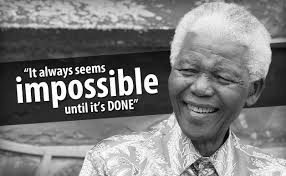
When the impossible becomes the inevitable: my memory of the struggle against apartheid

I retired from work, at the Museum of Australian Democracy at Old Parliament House, Canberra, Australia, last week. The following is my final blog post as an on-going Public Service employee.

Feel free to add a comment at the museum’s blog site.

imagesmandela

On reflecting on the campaign of solidarity in Australia with the South African oppressed people, it reinforced my view that identifying with, and supporting, the oppressed and those struggling for freedom, is a core left-wing value. It was not just on the issue of South African apartheid that we did this, but on Vietnam too. The left supported the Vietnamese people against US imperialism, just as we supported the South African people against the apartheid regime. Other examples are our solidarity with the Czech and Polish rebels.

It is incomprehensible to me that people and groups that do not support the Syrian people in their struggle against the Assad regime can be in any sense left-wing, no matter how they self-identify and no matter what ‘left’ sounding slogans they shout.

Anyway, here is my final blog post at work.

* * * *

The museum’s Memories of the Struggle exhibition highlights the part played by Australians in solidarity with South Africans against the apartheid regime. It resonates with scores of thousands of us who actively took part in the struggle as grass-roots activists.

From the late 1960s and for most of the 1970s, I was one such activist in Melbourne. I lived and breathed the kind of left-wing politics that opposed apartheid and supported regime change and democratic aspiration there. If I wasn’t printing out and handing out leaflets about it, and sometimes writing them, I was attending working-bees where people designed and made placards and banners for street protests. And, there was hardly a demonstration on the issue in Melbourne that I didn’t attend. To me, it was part of a global revolutionary struggle. (The same applies to the Vietnam War, which loomed larger because of the policy of conscription for the war, and the greater violence against the Vietnamese).

Of course, not all of the Australian opponents of apartheid identified with the left and only a small minority were communists like me. It’s worth noting that while nearly everyone opposed the apartheid system in principle back then, there was strong opposition to Nelson Mandela, who was seen as a communist and a terrorist. He was certainly close to the South African Communist Party and his Spear Movement struck terror into the hearts of the fascists running the regime. To be opposed to apartheid in principle was fine, but to want to do something about it in practical solidarity was ‘going too far’.


Fast forward several decades and in 1994 Mandela is the elected and acclaimed President of a new era in South Africa, one free of apartheid and one in which all people have equal voice in elections. Despite serving 27 years in prison, he properly urges reconciliation rather than revenge. What a man! Governments whose leaders were not forthcoming with solidarity when it was needed now applaud him. The Australian governments of Whitlam, Fraser and Hawke are among the proud exceptions. Celebrities like Michael Jackson and Elizabeth Taylor pose for photos with him. How things change.

That’s what happens when you have History on your side. When the reactionaries, who can seem so powerful, are revealed as the paper tigers that they essentially are. If proof is needed of the maxims that ‘the people make history’, and that ‘wherever there is repression there is resistance’, then South Africa under apartheid provides it. At times, it seemed a hopeless uphill battle. But don’t they all? Until they are won. And then what once seemed impossible suddenly seems inevitable.

When Mandela was released from prison in February 1990, I was so thrilled and overwhelmed that, after my regular fitness run up Mount Ainslie, which rises 800 metres above Canberra, I wanted to repeat the run immediately. I was on such a ‘high’ and carried along by the adrenalin of Mandela’s release and the excitement of South Africa’s prospects as a democracy. Thereafter, running up and down Mount Ainslie twice without stopping became my ‘Mandela Run’.

Their victory was our victory – and my victory too.


Fast forward again, and around 2010 I find myself pondering Mandela’s future. He is now in his early 90s and I feel an urge to write to him, to let him hear from an Australian activist, rather than a leader or celebrity.

I want to share some anecdotes with him – things I experienced directly – and I want to ask him for an autographed photo as a memento.

Sorry, but I can’t find a copy of my letter to him. But from memory, it told him of the following.

At my university in the early 1970s, we had a Chancellor who was on the board of Imperial Chemical Industries which, among other things, manufactured explosives and munitions in South Africa. A mass meeting of a thousand students demanded his resignation. Eventually we won and the Chancellor resigned before his term expired. But what a struggle. We occupied the Administration Building, blockaded the Council members, held mass meetings at least twice a week. And the authorities cracked down severely on us for our lawlessness. Or was it for our effectiveness? John Gorton as Prime Minister had declared that “We shall tolerate dissent so long as it is ineffective”. The student ring-leaders were identified, arrested, fined, suspended from university, lost our Education Department studentships and three of us – yours truly included – gaoled at Pentridge, without sentence or rights of appeal – for contempt of court. (It’s not easy being red).

I wanted Nelson Mandela to know that, in the west, our movement was not just about ‘sex and drugs and rock music’, as it has been condescendingly displayed in popular culture, but about real struggle, repression and resistance. Just as we brought the Vietnam War home in our protests, so too we related the oppression of the apartheid system to our own local targets whenever possible.

I wanted Mandela to know of the police violence deployed by State governments against anti-apartheid protestors. The petite university student, a young girl with whom I was friendly, being thrown face first into a pole by a burly policeman three times her size. The blood pouring from her smashed nose. The State Secretary of the Labor Party in Victoria having a baton thrust into his eye and nearly losing the eye. We knew we were in for a hiding whenever the police started removing their identification badges from their uniforms. Some of the worst police violence I have witnessed took place on protests against apartheid. They were clearly on orders to intimidate us, and batons and boots were their main weapon. But it didn’t work. We knew that the repression we experienced was minor compared to that of our brothers and sisters in South Africa.

I was arrested on one of the demonstrations and convicted of assaulting police. My only regret is that I am unable to explain on official forms that ask whether one has any criminal convictions that my crime was to try to stop a policeman pulling down an anti-apartheid banner held by the front line of a street march. I pushed him with force from behind. Technically: guilty. C’est la vie: c’est la lutte.

I wanted Mandela to know of the funny things too. Like the way in which one of my mates in Brunswick, who worked with my dad in a factory, would come to my place before a demo and we’d listen to Eric Burdon’s album, ‘Every one of us’. It featured an interview with an African-American ex-serviceman talking about racism. It inspired us in our passion, reinforced the sense that we were part of an international movement, and lifted our morale as ‘soldiers’ in a struggle.

And there was the time we tried to stop the Springbok rugby team – when Bob Hawke to his great credit as President of the ACTU intervened against the team’s visit. The police were brutal that day in 1971 but the thousands of assembled protestors at Olympic Park were determined to run onto the field and stop the game. The police cordon around the oval was holding out until it was broken when a group of police moved together to arrest people. I was standing with a comrade who saw the opportunity and said to me, “Quick, Barry! We can jump the fence onto the oval!” We ran forward, together, but at the last moment I lost my nerve. My poor comrade leapt onto the oval only to be grabbed by police. That comrade, incidentally, was Ian MacDonald, later to become a Minister in the State Government of New South Wales.


So I told all this, and more, to Nelson Mandela – ‘Comrade Mandela’ – in my letter.

After a month or so, I received a reply. It was from his secretary, who said that Mandela was now too frail to keep up with such correspondence and no longer sent out autographed photos.

However, the letter had been read to him in full.

And he had liked it.

To me, that was all that mattered.

Syria: links

free syria flag

Nothing much happening at Strange Times so I’m hoping to kick-start some new links to information and analysis – and discussion – about Syria.

Hoping to set this up as a separate page soon. But for now… contributions welcome.

Just to start things off:

  • The ceasefire, which some people regarded as doomed to failure before it had even started, has been working, in the main, for nearly six weeks now. It has provided breathing space, with parts of Syria under rebel control able to commence reorganisation of their localities. For the first time in years, Syrians have been able to take to the streets again demanding the regime’s overthrow. Some humanitarian aid is getting through where needed, but this is still a problem area in places where the regime is obstructing aid delivery – and further isolating itself (and strengthening the case for miltiary intervention on the side of the pro-democratic forces).
  • Assad is increasingly isolated, with Putin looking for a way out and supporting the UN transitional plan; a plan that means the end of Assad’s rule.
  • The next round of talks might happen within a week. The co-ordinator for the Higher Negotiation Committee has said that there is no international will, especially from the US, which means that the rebels continue to want greater international involvement and support, especially from the US.
  • As the talks progress and the regime remains more intransigent and isolated, the need for some form of military ‘boots on the ground’ will become more acceptable as a way of resolving the situation and allowing the transition’s timetable to be followed in an effective way. A ‘coalition of the willing’ will be required to ensure that the terms of the transition are enforced, and that the Syrian people will be able to assert their sovereignty in free and fair democratic elections as aimed for in the timetable.


* * * * * *

The battle for democracy

David McMullen wrote a very good post last month at his new site, Different Wavelength, and has given me permission to republish it below.

Among the best sites for keeping tabs on democratic progress or otherwise are:

Freedom House

Human Rights Watch

Reporters without borders

Amnesty International

Electronic Frontiers

Transparency International

(Let me know of any that should be added to the list!)

* * * *


We have had quite a bit of progress on the democratic front in recent decades although there are still some very big and serious challenges.

Let us look first at the progress. Latin America is no longer run by military dictators and they are becoming the exception in sub-Saharan Africa. Then of course there is eastern Europe where most countries are now democracies.

However, the picture is still pretty grim when we consider the continuing extent of tyranny.

In Russia, democracy is more formality than substance and most the other states of the former Soviet Union are rather dodgy or downright nasty.

China is a police state. Dissidents are jailed. The Internet as we know it does not exist. Lots of western news sites are blocked. There is no Facebook, Twitter or YouTube. And they employ an army of censors taking down anything taboo. And by the way, North Korea only exists because of Chinese support.

Then we have the Middle East. It has more than its fair share of tyrannies and authoritarian governments. At the risk of seeming perverse, I would suggest that the present civil war in Syria could indeed be a bright spot on the democratic front. This will depend on the Western powers recognizing that their inevitable intervention can only end the civil war if it brings democracy.

* * * *


War? Huh! What is it good for?! Over-throwing Fasc-ism! Say it again! Victory over fascism – 70th anniversary

“I have always believed and I still believe that it is the Red Army that has torn the guts out of the filthy Nazis”.
—Winston Churchill, Speech in the House of Commons, October 1944

* * * *

Awesome groove but bullshit lyrics

May 8 and May 9 marks Victory Days for Europe and the former Soviet Union and is commemorated around the world.

In Australia, the 70th anniversary of this world-historic event did not receive the recognition it deserved. Yet World War One, an inter-imperialist conflict in which the working classes had no real interest, has been a prominent part of television, radio and print-media diet.

The centenary of Gallipoli received scores of millions of dollars in government funding, beginning with the Gillard Labor Government’s provision of $83 million funding for it.

How the world would have been had Hitler and the Axis powers won is too horrendous to contemplate, but it took a terrible toll to defeat them.

In that struggle, Stalin and the Soviet Union played the lead role.

I’m not usually into speculative history, but I sometimes wonder how differently things would have developed had Britain and France agreed to Stalin’s pleas for ‘collective security’ against Hitler’s rise. This would have required collective action in the advent of German aggression. Sadly, the British ruling class at that time hoped that Hitler would keep to his promise to ‘turn east’ in keeping with the ‘lebenstraum’ agenda advocated in ‘Mein Kampf’.

All that can be done now is to ensure that VE Day and Soviet Victory Day continue to be commemorated and that the lessons about the nature of fascism and the need to defend democracy be learned.

The Allied victory in World War Two shows that there is such a thing as just war – war is not “futile” – and it is a momentous mistake to turn a blind eye to, or appease, fascist regimes.

It is ironic indeed that Russian President Putin, himself bearing so many characteristics of a fascist, is trying to attach himself to the anti-fascist Stalin and the Great Patriotic War while embarking upon imperialist aggression in the Ukraine.

Lest we forget the toll of the greatest anti-fascist struggle:

419,000 Americans died
451,000 Britons died
28,000,000 Soviets died.

The Axis deaths exceeded ten million.

In the world today, fascistic regimes such as that of al-Assad in Syria are just as deserving of overthrow as were Hitler, Mussolini and Franco. There are particular similarities with the latter – the rise of fascist dictatorship in Spain in the 1930s – when the international Left called for intervention by the West to restore the elected Republican government.

Only the Soviet Union took military action against Franco. Stalin provided the Republicans with between 634 and 806 planes, 331 and 362 tanks, and 1,034 and 1,895 artillery pieces. Not to do it would have meant leaving the Republicans open to massacre. Nazi Germany and Fascist Italy were certainly aiding the Franco regime, with Germany supplying powerful air and armoured units, while the British and French governments retained their policy of non-intervention.

Perhaps the finest way to honour the war dead is to ensure victory for the democratic forces in Syria and those elsewhere around the world fighting tyranny. To do this, to support our brothers and sisters fighting fascist regimes, may require war, military intervention.

Sometimes, only war can defeat fascism. Tragically, it is good for something.

* * * *

The Syrian Freedom Charter: Which side are you on?

The Assad regime in Syria tries hard to conflate the democratic resistance to its fascist rule with the Daesh (ISIS) terrorists. The Syrian Freedom Charter is the latest proof of Assad’s slander. It is a national unity document based on tens of thousands of face-to-face interviews with Syrians, in every governorate of the country, about what kind of society they want. Meanwhile the ‘anti-imperialism’ of the so-called western left serves well the US administration’s Ditherer-in-Chief in failing to effectively support the pro-democracy anti-fascist forces. A genuine left-wing position is no different today than it was in the 1960s: we oppose the oppressors who drop barrel bombs on the people and we stand with the oppressed. We understand that ‘Wherever there is repression, there is resistance’.

As the old folk song put it: Which side are you on?

* * * *

Democratic Revolution, Syrian Style's avatarالثورة الديمقراطية، الطراز السوري DEMOCRATIC REVOLUTION, SYRIAN STYLE

“The Syrian Freedom Charter is a national unity document based on tens of thousands of face-to-face interviews with Syrians, in every governorate of the country, about what kind of society they want. Over the course of a year, a team of over 100 activists assembled by FREE-Syria and the Local Coordination Committees (LLC) of Syria, completed more than 50,000 surveys.”— (Danny Postel, Pulse Media)

flag

View original post 454 more words

Are you Progressive Except for Syria? Take the handy test here!

Are you Progressive Except for Syria? Take the handy test here! Reprinted with permission of Wewritewhatwelike Written by Mary Rizzo.


11026000_779426898808194_4074548925708639184_n


* * * *

We have all already heard of the phenomenon of PEP (Progressive Except on Palestine), in which those who consider themselves progressives (liberals in the USA) or leftists are pretty liberal on every single issue except the Israeli-Palestinian conflict. But, their syndrome has been pointed out and diagnosed fully. A lot of them justify this position by saying that supporting the government of Israel is a liberal position. Their problems are not our problem… they need help that we surely can’t provide.

However, there is another phenomenon far more worrisome because it involves those who are Progressive ALSO for Palestine, and that is the case of PES (Progressive Except on Syria). Those who are afflicted by this malady feel safety in numbers, because they are in fact the majority of non-Palestinian supporters of Palestine. They will actually USE the argument of Palestine as justification of their support of Assad, even though his regime has a terrible record regarding Palestinians, (as did that of his father). They will argue that support of Assad is a progressive (liberal) leftist value. Whether it’s called “selective humanitarianism” “double standards” or “hypocrisy”, it is a dangerous and insidious disease and should be cured. Here is a little test to discover if perhaps YOU are afflicted with this mental illness.

Do you perhaps suffer from PES without being aware of it? Fear no more! We’re happy to provide you a self-diagnosis test with simple YES / NO replies so that you can discover your own hypocritical stance, and hopefully, be on the path to the cure.

Did you protest or complain about the unfairness of the USA elections for any reason but believe that Assad won a landslide victory in free and fair elections?

Do you think that Assad is fighting terrorism?

Do you think that the Palestinian cause is being defended by Assad?

Do you believe that the war in Syria is all about foreign aggression “due to their national and pan-Arab stances” and is not a people’s uprising? In fact, you think the whole Arab Spring has got to be “exposed” as an imperialist, western plot.

Do you think that the Intifada in Palestine is legitimate and that the uprising in Syria is manufactured (while of course saying so having been paid guest to Assad’s presidential palace)?

Do you think that the Palestinian cause is being defended by Hezbollah even when they target and kill Palestinian refugees and ignore the growing tensions between Palestinian refugees in Lebanon and Hezbollah?

Do you condemn religiously-inspired militias such as ISIS and Al Nusra when they commit murder and use violence against civilians but have not condemned Hezbollah when it commits murder and uses violence against civilians?

Do you think that it was a good idea for the Popular Front for the Liberation of Palestine – General Command (PFLP-GC) to shoot on the Palestinians who mourned those killed on Naksa Day 2011?

Have you called Gaza “the world’s largest open-air prison” but don’t agree with the UNHCR claim that Syria’s war “is more brutal and destructive than the wars in Afghanistan and Iraq, and has turned into the worst humanitarian disaster since the end of the cold war.”?

Have you endorsed or thought a No Fly Zone was a good idea for Gaza but reject it as Imperialist meddling or a bid to save Al Qaeda if it’s done in Syria?

Do you condemn the Palestinians tortured to death in Israeli prisons (since 1967, a total of 72 Palestinians have been tortured to death) but have not condemned the 200 Palestinians tortured to death in Syrian prisons since 2011? You naturally probably don’t know about the at least 2100 Syrians who were tortured to death inside these prisons.

Do the at least 10,000 bodies of prisoners in Syrian regime prisons that were ordered to be catalogued by the regime mean nothing to you since you don’t have details on what the reasons for their deaths could be?

Do you call for release of political prisoners from Israeli jails but do not call for the release of the tens of thousands of political prisoners in Syrian jails?

Have you actually asked for money to bring Gazan children to make a protest for the NFZ but think that asking for a NFZ in Syria is a bid to help Al Qaeda?

Do you think Al Qaeda and ISIS are Mossad / CIA inventions?

Do you protest against the death penalty in the USA: Executions in 2014, 35, but don’t do the same for Iran: executions in 2014, Between 721 and 801 at least.

Do you think it is wrong for the US to provide Israel with armaments because it engages in war crimes but at the same time, think it is justified for Russia to provide the Syrian regime with armaments and military experts because “it’s war against NATO”?

Do you condemn Israel’s “extra judicial killing” but claim that Assad must do everything he needs to maintain power because blocking his actions in any way, even by condemning them “… could end up ousting Assad. It would mean replacing him with pro-Western stooge governance. It would eliminate another Israeli rival. It would isolate Iran. It would be disastrous for ordinary Syrians.”

Have you ever praised Assad’s government because it is secular, or “fighting the enemy of the West”: because after all, you only see the alternatives being Assad or the “Islamic Fundamentalists”?

Did you support Haniyeh and Meshaal until they started waving the Syrian revolution flag?

Do you erroneously refer to the Syrian revolution flag as the “French Mandate Flag” ignoring that even the Assad regime celebrated it as the Independence flag each “Evacuation (Independence) Day on 17 April to celebrate the resistance against the French colonialists?

Do you know the names of at least one Palestinian dissident/political writer but don’t know any Syrian ones?

Do you call the opposition to Assad “Western-backed rebels” either from a Pro-Israel or Pro-Iran standpoint?

Did you protest for Palestinian detainees and even know their names but not do the same for Palestinian detainees in Syrian’s prisons?

Do you know the name of at least one minor arrested or killed by Israel but don’t know the name of at least one minor arrested or killed by the Assad regime?

You have protested against the racist and discriminatory Apartheid Wall and checkpoints in Israel/Palestine but you have nothing much to say about Syrian military checkpoints and sniper-lined checkpoints?

Did you get angry when a US newspaper used a photo of Iraqi deaths, claiming they were Syrian, but when Palestinian supporters use Syrian ones, it’s “illustrating the suffering in Gaza”?

You have protested against Israeli use of phosphorus bombs but you have nothing much to say about the unconventional weapons use by Assad against both opposition fighters and civilians such as barrel bombs and chemical weapons?

Are you critical of the US for intervening in affairs of other countries but think it’s normal for Iran and Russia to be sending troops into Syria to help the regime?

You would never consider Palestine compromising with Israel but you believe that the opposition must compromise with the regime in Syria.

Do you condemn the Saudi monarchy and refer to them as Wahhabis, Salafis, etc., but refuse to recognise that Iran is a theocracy?

Do you think that Assad is simply doing everything he can to protect the minorities in his country?

Do you call the Israeli occupation of Palestine ethnic cleansing but do not speak out against the regime-driven massacres in Syria that are ethnically based?

Do you refer to the Assad regime, Hezbollah and Iran as the “Axis of Resistance” even when they don’t react to Israeli attacks on them?

Do you think the following two statements are both true?

a. Dissent in the United States is patriotic.
b. Protesting in Syria is an assault on the State and needs to be quelled.

Do you think the following two statements are true?
a. Pepper spraying protesters in the USA is a violation of human rights.
b. The Syrian regime has to use whatever force it deems necessary against protesters, because they protesters have violent intentions.

Do you think that Israel must be brought to the ICC for crimes against humanity but think that the Syrian regime should not?

Do you condemn the USA vetoes on the UN Security Council in favour of Israel but praise the Russian and Chinese ones in favour of Assad both to stop sanctions and to prohibit ICC investigation including three Chinese vetoes on Syria alone out of eight total vetoes in their history?

Do you think the following statements are both true?
a.Calling a U.S. citizen anti-American or un-American for being critical of the US government is ridiculous, knee-jerk, unintelligent and actually incorrect.
b.People who are critical of Assad are closet or overt imperialists and want US control over the region.

You do not believe that Russia is an imperialist state while you are certain that Syria is an anti-imperialist state defending itself against imperialist onslaught.

Do you think that Erdogan is seeking to dominate politics in the region in an attempt to restore what was once the Ottoman Empire or even think the US is trying to establish an Islamic State but support Iranian domination and the Shi’a Crescent?

Have you signed petitions against companies such as Soda Stream and Coca-cola but not against weapons provider, the Russian monopoly Rosoboronexport or even the western companies providing the Syrian and Iranian regimes with surveillance equipment that they use against dissidents and opposition?

Do you call innocent victims killed by American drones or victims of war crimes but consider the Syrians and Palestinians killed by Syrian bombs and chemical weapons collateral damage?

Do you reject the USA/UK “War on Terror” but believe that Assad has a right to use whatever means possible to kill whoever he considers as a terrorist in Syria and that Syria is a sovereign nation fighting Al Qaeda?

Have you mentioned the Blockade on Gaza in conversations and know it is illegal and a crime against humanity but don’t feel the same about the Blockade on Yarmouk?

Do you respond to criticism of Assad by pointing out USA human rights violations?

You know the name of USA civilians killed by cops or vigilantes, but you don’t know the name of a single Syrian victim of torture in the Assad prisons.

You have protested for the closure of Gitmo, but you don’t raise your voice or even one eyebrow over the Syrian Torture Archipelago in which “The systematic patterns of ill-treatment and torture [in the 27 detention facilities run by Syrian Intelligence] that Human Rights Watch documented clearly point to a state policy of torture and ill-treatment and therefore constitute a crime against humanity.” Moreover, you don’t want to notice that Syria’s government has been cooperating with the CIA extensively in renditions and the torture programme.

You think that Israel should not have nuclear capacity but that Iran should have nuclear capacity. Extra points if you support Non-Proliferation. Super extra points if you participated in any No Nukes events in the West or signed any such petitions, super extra and mega extra points if you are against nuclear power.

You believe that the Palestinian struggle is about human rights but the Syrian protests were sectarian and religious-oriented, driven by people who wanted to overthrow and overtake power illegitimately if not in fact manufactured by the West?

Do you believe it’s normal for the Syrian constitution to be amended every time that it serves the Assad family but the US Constitution is sacred and especially no amendments should be made to limit gun possession whether you detest the US government or think it should basically call all the shots around the world?

Do you think that Jews protesting the Israel government are noble people who are fighting for human rights and justice while any Syrian protesting the Assad regime are in cahoots with the Israeli government.

Do you believe that, “We must not in any way call for the removal of President Assad unless he commits acts of terror against us. Assad’s government has committed no such act, thus rendering it criminal for foreign governments to undermine the Syrian regime. You either stand for national sovereignty, or against it. The choice is yours.” While at the same time have supported efforts from the liberals or conservatives to have Obama impeached?

Do you believe that foreign countries helping the Palestinians militarily to win against Israel is legitimate but helping Syrians win against Assad is meddling and think that “any further intervention in Syria would be for U.S. interests, like weakening an ally of Iran, and would encourage Assad’s allies to step up their armament shipments. The carnage would continue, and perhaps increase.”?

Do you reject claims that the involvement of Iran and Russia in favour of Assad is meddling?

Do you think that the entire Syrian war is for the purpose of the US weakening Syria so that it can pursue its own interests in the region but ignore the fact that Russia has enormous interests in Syria that are far more evident?

Have you ever found yourself denying Assad had chemical weapons but also applauding the Syrian regime’s decision to hand them over to Russia as a strong gesture towards peace?

How many questions did you answer YES to?

Between 1 and 5? You are headed towards selective humanitarianism, or even are afflicted with Western Privilege Syndrome!

Between 6 and 10? You are dangerously using double standards and believe that human rights aren’t something universal, but allow your ideological or dogmatic prejudices to influence your ethical judgement!

Over 10? You are a dyed in the wool Hypocrite! Maybe you should avoid “current events” altogether, you have no understanding of what human rights and justice mean, you should wash your mouth out before you ever speak about human rights for Palestinians or anyone.