Freedom from want and toil – and the capitalist social revolution

From the Communist Manifesto Project‘s pamphlet: Rescuing the Message.


* * * *


Freedom from want and toil

The industrial revolution that began over two centuries ago is transforming the material conditions of life in ways that make capitalism obsolete. In the most developed regions of the world it is providing something approaching a modest level of material abundance and removing much of the necessary toil from work. These conditions make it possible to contemplate social ownership where the motivation is no longer profit, or some reward derived from it, but rather mutual regard and the satisfaction obtained from labor.

At the moment, the rich countries are home to only 15-20 per cent of the world’s population. However, the middle income countries such as China, India, Mexico, Turkey and Brazil could well achieve high levels of development over the next two or three generations, while the poorer half of the world should catch up later this century or early in the next. The pace of development will depend on a range of factors including the prevalence of political crises, wars and economic depressions.

With increasing productivity under capitalism, a stage is reached where an equal share of the social product ceases to be shared poverty. Under less developed conditions, the prospect of shared hunger and distress impels those who are in a position to do so to exploit others through plunder, slavery, serfdom or the ownership of the means of production. However, as the average share begins to promise an increasing degree of prosperity, the imperative to fare better than others diminishes. Marx and Engels make this point in part II, section 5 of The German  Ideology:

… this development of productive forces … is an absolutely necessary practical premise, because without it privation, want is merely made general, and with want the struggle for necessities would begin again, and all the old filthy business would necessarily be restored …

Under developed capitalism, mechanization and automation have done much to reduce the odious or toilsome nature of work. Pick and shovel work and carrying heavy loads are things of the past and much of the remaining menial and routine work in the manufacturing and service sectors will be automated in the next generation. The work we are left with will be primarily intellectual in nature and potentially interesting and challenging.

“With increasing productivity under capitalism, a stage is reached where an equal share of the social product ceases to be shared poverty.”

Some doubt the ability of workers to keep up with the requirements of the new work. Certainly capitalism leaves a lot of workers behind and on the scrap heap. Nevertheless, the level of training of workers is higher than ever and should increase over time. In developed countries about a quarter of young proletarians graduate from university and a similar proportion have other forms of training.

We can also expect improved ability to perform complex work in a future communist society as many of the conditions that cause stunted development are eliminated. These include lack of family support, peer pressure to under-perform and an inadequate education system. Social ownership will end the isolation of education from production and other activities, so uniting learning and doing. Workers will help each other to learn. We will also benefit from an increasing understanding of human development and what causes learning difficulties. And over the longer term we can expect to see artificial improvements through mind-enhancing drugs, genetic engineering (induced evolution) and brain link-ups to computers.

The Capitalist Social Revolution

The dominance of capitalist market relations brings a social as well as an industrial revolution. The outcome is frightful in many ways but vastly better than what it replaces. In particular, the revolution casts off many ancient shackles and replaces them with weaker capitalist ones.

Proletarians are employees not slaves or serfs. As wage workers they only have a contractual arrangement for part of the day with their capitalist master and are free to move from one job to another. Their boss, unlike the peasants’ lord, is probably not the local political chief or magistrate.

Their position in the labor market also frees them from subordination to the extended family, tribe or local community. It provides economic independence and the opportunity to physically escape from these sources of oppression and conservatism.

“Their position in the labor market also frees them from subordination to the extended family, tribe or local community. It provides economic independence and the opportunity to physically escape from these sources of oppression and conservatism.”

The new market-based class relations also raise women from their age old subordinate position. The nuclear family replaces the extended family as the economic unit so that women only have to deal with their freely chosen husband and not his relatives. Then comes the independence of employment for a wage. The changing conditions plus struggles by women lead to the removal of legal discrimination, new divorce laws and various forms of government child support. Even the nuclear family becomes optional. These changes cut away much, although not all, of the legacies of women’s oppression and create the conditions where men and women can begin to understand their differences and similarities, and better meet their mutual needs.

The emergence of capitalism has been accompanied by the bourgeois democratic revolution that brings equality before the law, freedom of speech and assembly, due process and constitutional rule. People now expect these political conditions and feel aggrieved by their absence. They could not imagine being ruled by the bejewelled thugs of earlier times. This provides space for the proletariat to organize itself and for a revolutionary movement to emerge and develop. Although when the capitalists feel sufficiently threatened they dispense with these arrangements. This may involve goons and death squads, a state of emergency,  a military coup or the coming to power of a fascist tyrant. However, such drastic measures cannot permanently put the genie back in the bottle and they are bound to provoke resistance.

Overcoming both submissive and oppressive behavior will be at the core of the struggle for communism.  Individuals will require the boldness to stand up to people who act in a harmful manner either to them or to others, while expecting other people to submit to you is completely at odds with a culture of mutual regard. Overcoming the submissive and oppressive forms of behavior found under capitalism will prove difficult enough. Having to at the same time overcome their far more extreme pre-capitalist forms would be unimaginably difficult.

The experience of constant flux experienced under capitalism is also important for communism. Pre-capitalist societies are static. The way of life in your old age is the same as that in your youth. In keeping with this there are set and unchanging ways of thinking and general acceptance of how things are. Under capitalism there is constant change and increasing uncertainty in the conditions of life and the prevailing ways of thinking. It then becomes possible for people to look at where they are and where they are going. This is expressed well in The Communist Manifesto as follows:

All fixed, fast-frozen relationships, with their train of venerable ideas and opinions, are swept away, all new-formed ones become obsolete before they can ossify. All that is solid melts into air, all that is holy is profaned, and men at last are forced to face with sober senses the real conditions of their lives and their relations with their fellow men.

Rescuing the Communist Manifesto

Karl Marx once said that he was not a Marxist. That was in the 1870s, according to his comrade Frederick Engels writing in 1890. Apparently, Marx found the French Marxists particularly embarrassing. Today, he would find nearly all of them so.

The Communist Manifesto Project has released a 16 page pamphlet, Rescuing the message of The Communist Manifesto: the revolutionary role of capitalism, with a view to rescuing Marxism from the ‘Marxists’ and offering a view of what it means in this century.

Here’s a sampler:

“At the moment when inquiring minds seek to learn about communism they will encounter a range of appalling nonsense from various tiny groups claiming to be communist or Marxist. Some support the regimes in Cuba and China, and there are even the occasional North Korea supporters. The absurd regime in Venezuela inspires many of them. They all cling onto the once true but now outdated view that US imperialism is the main problem in the world today. They oppose external support for the Arab battle for democracy and hold the mainstream view that regime change in Iraq has been a disaster and the fascist Baath Party should have been left in power. These groups never talk about how capitalism is creating the conditions for communism but simply whine about how terrible the system is, and often do this in a reactionary way particularly in their opposition to “corporate globalization” and acceptance of green views on virtually everything. They rarely talk about and scarcely understand communism, and they simply see it as something in never-never land rather than their real purpose. So communism will have to be rediscovered in the face of all kinds of claptrap. This will have to be done by the now very young or the yet to be born. For anyone older it would require too much of a break from their entrenched ways of thinking”.


Brexit, Trumpism, Sanders, and the Decrepit State of Capitalism: Against Political Determinism

images capitalism
“Neo-liberalism” has become an excuse by many who self-identify as left-wing to avoid confronting the reality of capitalism as the source of economic stagnation. It’s as though a return to Keynesianism is some kind of answer. There’s nothing new in this situation, as leftists influenced by Marxism have always rejected social democratic (in the sense of labour parties) efforts to keep the zombie system alive.

The following article is a good one for making this point but also for discussion and debate.

* * * *

The following article by  Michael Rectenwald is published with permission of With Sober Senses, the on-line publication of Marxist Humanist Initiative.

* * * *

There’s a basic article of faith in leftist thought, held especially dearly by most among the U.S. left. It is so entrenched and so seldom challenged that it has attained the status of myth, an unquestioned origin story on par with the Book of Genesis, as the latter must have been regarded within Christendom during the Middle Ages.

The myth goes like this: During the 1980s, Ronald Reagan and Margaret Thatcher, two arch right-wing and highly potent politicians, rose to power in their respective nations, the U.S. and the U.K. They thereafter began to institute what was for the vast majority a vile and destructive political and economic scheme: “neoliberalism.” Previous to the instalment of this neoliberal scheme, the working class had experienced relative economic improvement, and capitalists seemed happy too (as if we care). But suddenly, and seemingly without cause (although the failure of Keynesianism was apparent in the unprecedented stagflation of the 1970s), these evil political twins, prompted by wizards who formalized the approach, introduced the nefarious ideology of neoliberalism to the world. As cruel and heartless representatives of the capitalist class (which, indeed, they were), they and their supporters caused the Fall from the supposed Paradise of Keynesian reformism that had preceded them. In this mythological version of reality, neoliberalism is understood merely as a set of essentially unwarranted and unusually brutal policies, an ideological and political formation that was hatched in the brains of evil masterminds conspiring in right-wing think tanks, concocted to dupe and punish the vast majority for the benefit of the rich and powerful.

This narrative sounds cartoonish or religious in character, but only because it is – not because I have made it so. It is a typical leftist personification of world-historical forces in lieu of an actual analysis within political economy. It amounts to what I have elsewhere called “political reductionism,” which is similar to whatAndrew Kliman has referred to as “political determinism.” Kliman describes political determinism as such: “They [Keynesians and social democrats] think that the capitalists [and/or their political representatives] control capitalism––not the other way around––so that the system can become something it’s not once different people with different priorities assume control of it.” Thus, if only such people as Reagan and Thatcher had never been elected, or better yet, had never been born …

The mythological version of neoliberalism is invoked daily, and most recently in response to such events and political developments as Brexit, Trumpism, and the unprecedented political (albeit thwarted) success of the “socialist” Bernie Sanders. According to journalist Glenn Greenwald, the “leave” outcome of the Brexit referendum registers what should be an expected response to decades of neoliberal policies foisted on the masses by the EU and the British political elite. Along the same lines, Michael Hudson argues, “the whole withdrawal from Europe means withdrawing from austerity… The rejection of eurozone austerity is, essentially, a rejection of the neoliberal plan that the TTIP is supposed to be the capstone of.” Similarly, in the U.S., the appeal of Donald Trump is due at least partially to his feigned and misleading championing of U.S. working-class interests, a working class which, Trump suggests, has been made redundant by lopsided and globalist trade deals and outsourcing/off-shoring, and reduced to the precarity of part-time and/or Uberized piece-meal work or permanent unemployment. As Trump, Sanders, and the left blogosphere see it, these dire consequences are all due to the choices of neoliberal politicos, especially Reagan, the Bushes, and Bill and Hillary Clinton. Indeed, Bernie Sanders’s entire presidential campaign can be summed up simply as: “just say no to neoliberalism.” The “political revolution” that he heralds effectively amounts to a reversal of neoliberal policies and their replacement by progressive ones. According to Sanders, the entire economic fiasco that we have been enduring has been the result of a series of political and policy decisions that have been disastrous for working Americans.

What’s the problem with this narrative, you ask? After all, didn’t Reagan actually begin the defeat of unionism with the breaking of the Professional Air Traffic Controllers Organization’s strike on August 5, 1981, thereby effectively inaugurating the long period of neoliberalism that we have been enduring ever since? Didn’t Bill Clinton, the arch neoliberal Democrat, sign NAFTA into law in 1993, a trade agreement that eviscerated labor and environmental protections, while costing millions their jobs? Didn’t Clinton also repeal the Glass–Steagall Act in 1999, thereby supposedly eventuating the massive financial crisis of 2008, the effects of which we are still reeling from to this day? In short, didn’t political agents actually institute neoliberal policies, policies that continue to disenfranchise and oppress us? And shouldn’t we elect as President someone like Bernie Sanders, Jill Stein, or another leftist, who would reverse these policies? Finally (this part of the story is optional in some circles), hasn’t the capitalist class made a killing over the past forty-plus years, while they simply ignored (or some may say, enjoyed) the stagnant wages of the vast majority, the widening gap in income, and the rising tide of poverty? Isn’t there a huge and growing pie from which the majority simply have been excluded to a greater and greater extent? In the short term, don’t we simply need to get a bigger slice and then (perhaps) talk about the whole pie later on?

The problem with this story is that while grossly exaggerating the impact of policies and trade agreements, it excludes a key underlying and primary causative factor of the current instability and malaise. This key factor is necessary not only for diagnosing but also for addressing the conditions that we face today. Keynesian reformers and social democrats, including Bernie Sanders, are either utterly unaware of, attempt to blithely ignore, or otherwise contest this factor. But its existence and effects are undeniable and its implications are enormous. That is, excluded from the standard leftist narrative of neoliberalism is the following: the underlying, decrepit state of capitalism over the past forty-plus years, and the unlikely prospects for a return to robust economic growth in the foreseeable future.

Few thinkers, even among Marxists, seem willing to tell the working class this fundamental fact, and it surely is not going to be acknowledged by major political office holders or campaigners, whose careers depend upon the belief that their particular nostrums or plans will remedy the crisis. Yet neither Trump with his protectionism nor Sanders with his so-called socialism can restore the economy (in the U.S. or beyond) to post-war levels of growth, the kind of growth upon which their promises depend. Likewise, their policies and plans would not ameliorate the conditions of the vast majority. As long as the economic system is capitalism, profit will be the driving factor, and the predicament of capitalism has precisely to do with a loss of confidence in the profitability of investment.

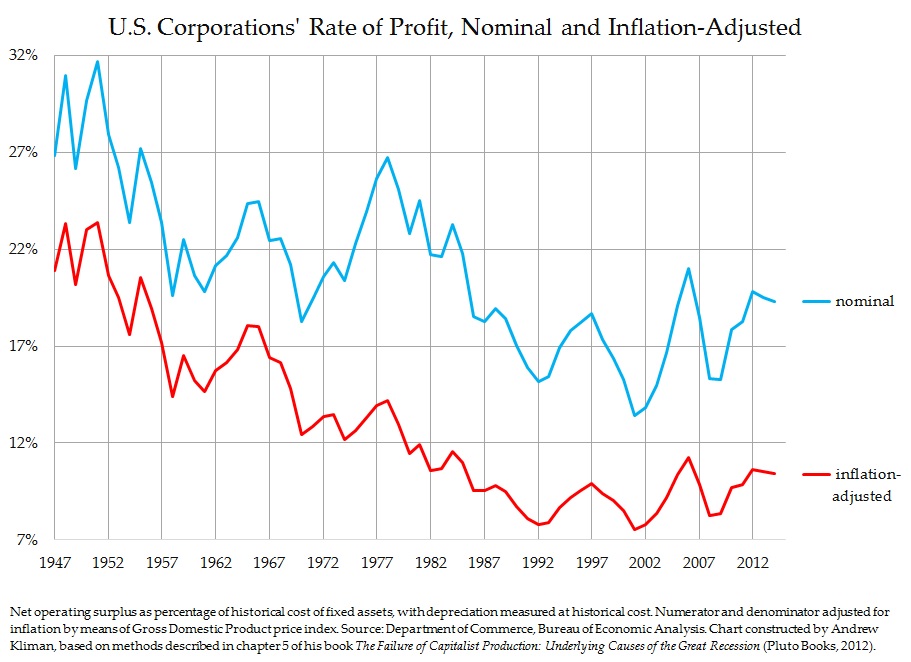
In 1973, an already sluggish world economy bore the immediate effects of the oil-price hike. Although the rate of profit temporarily rose as a result of the inflation brought about by the rise in the price of oil, it resumed its longer-term downward trend after a few years. That trend has continued, with spikes and dips in the interim, to this day. Marx’s law of the tendency of the rate of profit to fall had always been in effect since the inception of industrial capitalism, but since this point in history, insufficient countervailing factors have been available to offset the tendency. Because profit is the driving force of capitalist production, the only incentive for undertaking it and the only long-term source of funds for productive investment, we face unstable and grim economic conditions and prospects. Given the low yields in profit, an effective productive investment boycott has ensued, and since the mid-70s, the worldwide rate of growth has been approximately halved. While there have been relative booms and busts in the interim, these have been due largely to short-term, financially-driven bubbles, and perhaps the introduction of new markets and newly super-exploited labor forces. Nevertheless, the economy has never returned to post-war boom levels.


Rectenwald article graph, rvsd, 7.4.16


The decades after World War II and those after 1975 reveal strikingly different situations for the world economy, and thus utterly different prospects for Keynesian or social-democratic interventions. Since the mid-70s, as Kliman notes, “the rate of investment (capital accumulation) has fallen and never recovered, debt burdens have increased markedly relative to income, growth of GDP, industrial production, employees’ compensation, and public infrastructure investment were all much slower than during the postwar boom, the average duration of unemployment was higher and the problem of workers dropping out of the labor market was more serious, and there were many, many more burst bubbles and banking, debt, and currency crises.”

Ignoring or blithely unaware of this economic reality, leftists mistakenly imagine that “neoliberalism” has merely been the desideratum of wicked politicians, who under the influence of their Wall Street and corporate donors, have maliciously manufactured current economic conditions. But the reverse is actually the case; neoliberalism is a set of policies and an ideology that the ruling class and their political proxies developed in response to the underlying and enduring economic malaise of capitalism. That is, underlying economic conditions have been the driving force of neoliberalism, not politics and ideology. And neoliberalism has not solved the problems that it inherited from Keynesianism. Indeed, history has illustrated time and time again that the various rightist and leftist reformist political or policy programs formulated to resolve the problems produced by capitalism are inadequate to the task.

Unfortunately, for sundry reasons, what has happened in the ideological ambit of left politics amounts to a divorce, a divorce of the “political” from the “economy” in the field of political economy. Rather than the so-called “vulgar Marxist” economic determinism of yore, what we have today has been aptly termed political determinism. Political determinism is the belief that the economy is driven by politics and ideology, rather than the other way around. As long as political determinism prevails on the left, the left’s vision will be myopic and its recommendations will be utterly flawed and useless. Isn’t it about time to tell the working class the truth?

* * * *

*Michael Rectenwald is a professor in Global Liberal Studies at New York University. He is the author ofNineteenth-Century British Secularism: Science, Religion and Literature (Palgrave Macmillan, 2016), primary editor of Global Secularisms in a Post-Secular Age (De Gruyter, 2015), and primary author ofAcademic Writing, Real World Topics (Broadview Press, 2015). His essays have appeared in numerous periodicals and anthologies, including the British Journal for the History of Science, Endevour, and George Eliot in Context (Cambridge University Press, 2013).

Daesh, the (pseudo) Left, and the Unmaking of the Syrian Revolution

“The role of socialists is not to counterpose themselves to democratic revolutions, which gave rise (in Egypt) to the first democratic government, and (in Syria) to emancipatory projects such as networks of local councils against the existing state, but to take the democratic side against tyranny”.

My response: WHY for heaven’s sake does this even have to be stated?

The reason is because of the general failure to understand that ‘socialists’ who side with tyrants are not worthy of the name, and that the pseudo-left which has been dominant for decades needs to be called out. I wish the reviewer had used that term rather than seeming to accept that one can oppose democratic revolution and still be on the left.

9780992650964-cov-front-sml


The following book review is published with permission of Syria Solidarity UK.

* * * *

Khiyana: Daesh, the Left, and the Unmaking of the Syrian Revolution, ed. Jules Alford and Andy Wilson, published by Unkant, London.

Review by Clara Connolly

This book should be required reading for every leftist, as an antidote to the growing mountain of ignorant comment on the subject of Syria. The title Khiyana (betrayal) is an accusing cry; the book is a trenchant denunciation of the Western Left for its abandonment of the principles of internationalism and solidarity in favour of an alignment with the ‘anti imperialist’ camp, a hangover from the geo-politics of the Cold War.

Assad An-Nar, like most of the authors, situates himself on the Marxist left, and his prefatory chapter could be considered a direct response to Tariq Ali’s infamous dismissal of the Arab Spring in What is a Revolution? (Guernica, Sept. 2013). He sets his critique in the context of the changing nature of revolution in an age of global neoliberalism, where post colonial states are collapsing because neoliberal policies have slashed the limited social protections they used to offer. In this world, he says, the principles of self emancipation and of collective and democratic struggle are ‘ideas in search of a subject.’ Ideas about democracy, socialism, and anti-imperialism used to run in the same direction, but now they are counterposed.

With the collapse of the progressive moment of secular Arab nationalism, Islamist organisations like the Muslim Brotherhood can rise beyond identity/sectarian politics in resistance to tyranny. Though not necessarily opposed to neoliberalism, they are the voice of those who are excluded from its benefits. Hezbollah’s current role in Syria shows that such movements can swing between revolution and counter revolution without moving in a socialist direction.

The role of socialists is not to counterpose themselves to democratic revolutions, which gave rise (in Egypt) to the first democratic government, and (in Syria) to emancipatory projects such as networks of local councils against the existing state, but to take the democratic side against tyranny. Instead the left has responded by either supporting their favourite dictatorships (the neo Stalinists) or by re-hashing theories of ‘permanent revolution,’ i.e. insisting that revolutions can only end in socialism or defeat (the Trotskyists). Yes, he says, a democratic revolution is possible in these countries, but the outcomes are uncertain; the socialist left, while recognising its marginal role, should not condemn itself to irrelevance by denouncing the struggles for democracy because they are not socialist. Instead he urges the left to make the ‘democratic wager,’ in hope that the outcomes lead to more collective forms of struggle. There is little to lose for socialists, he believes, since neoliberalism has led worldwide to the fatal weakening of working class self-organisation.

The subsequent chapters examine and demolish the standard left myths about the Syrian revolution: the ‘jihadist’ nature of the ‘rebels’; the selective anti imperialism which admires Rojava but has no time for similar experiments in local democracy elsewhere in Syria; the role of regional imperialisms like Iran and Russia in propping up a monstrous regime; and above all the lies and distortions peddled by the institutional left (Stop the War Coalition, and the éminence grise of left journalism like Patrick Cockburn, Robert Fisk, and Seymour Hersh) who place the national interests of states they consider to be in the ‘axis of resistance’ above solidarity with the struggles of the oppressed in those countries.

In a short review I can refer only to two further articles in the core of the book; but I cannot resist a passing mention of the glorious satirical piece by M Idrees Ahmad, The Anti-Imperialist Guide to Inaction in Syria. Anyone familiar with debate on Syria will recognise the strategies he lists: ‘Don’t defend Assad, attack his opponents; sympathise selectively; functional doubt where straight denial is risky; defend peace and sovereignty; champion the minorities; talk about ISIS, not Assad; talk about refugees but not the cause of flight,’ etc. Most of these strategies are shared with the establishment and the extreme Right.

Mark Boothroyd describes the responses of Stop the War Coalition (STWC) to Syria, in a case study that echoes the critique in the preface. It has consistently viewed developments through its relation to the US and the UK. In a multi polar world system with competing imperialisms, it persists in viewing events through the prism of the Cold War. The agency of Syrians is erased altogether.

In 2013, STWC opposed the proposed intervention of the UK and when this proposal was defeated in Parliament, it claimed victory; but Boothroyd claims that if the West had really wanted to intervene in Syria it would have done so—its actual strategy is to let the country bleed. I think he underestimates the power of popular protest in democratic countries, and the degree to which STWC was able to tap into post Iraq war weariness. But he is right in pointing out that STWC has missed a trick in failing to expose the real cruelties of the Western role.

In its weaker response to the 2015 intervention against ISIS, STWC has consistently refused to allow oppositional Syrians on its platforms—who have opposed the Coalition campaign against ISIS as useless and counter-productive, but have also proposed more positive measures for the protection of Syrian civilians. Once again, its failure to listen to Syrians has weakened its moral stance even in its own terms—in opposing its own Government.

It could have been different, he believes: the anti war movement could have risen beyond its current ethnocentric, isolationist positions to meet the challenge of changing times, and been a movement to build solidarity with the revolutions in the Middle East.

In The Rise of Daesh in Syria, Sam Charles Hamad attacks the myth of Saudi funding and support for Daesh; instead, in a detailed study, he convincingly shows their deadly rivalry despite their similar ideologies. He demonstrates the origins of Daesh in post invasion Iraq, and its nurture by the sectarian regimes in Iraq and Syria. He shows, by tracing its sources of income, how it is self sustaining. Finally he argues that the current tactics of the west, in fighting Daesh from the air but hampering the oppositions in their fight against the sectarian regimes of Assad and Maliki, are counter-productive. And the left’s narrative is complicit in this.

The book, and particularly its opening chapter, is weakened by a failure to examine more closely such terms as ‘democracy’ and ‘emancipation,’ given their ambivalent history among Marxists; and to analyse the demands of the revolution—Freedom Justice and Dignity—in more detail. This is particularly the case since there is little discussion of class, and no accounts of the role of women in the Syrian revolution, nor of the role of Western women’s peace groups or feminists in relation to Syria. My own recent experience of organising solidarity events with Syrian women suggests that the hostility to, and silencing of, Syrian voices is much less prevalent among feminist organisations than in the left as a whole. The ‘democratic wager’ which is urged upon us might be weighted more favourably with the inclusion of women activists, within Syria and in the West.

Marx’s moral theory (via Bill Kerr)

Thanks to Bill Kerr for permission to republish this.

****

HUMAN ESSENCE

If there is such as thing as human essence and we can discover what it is then that will go a long way towards developing a moral theory.

Human nature is part biological, part social and not religious. Religion is something to be explained rather than believed. This includes modern religions such as Nature worship (currently popular) and Marx worship (currently marginalised).

Humans have both needs and powers. Obviously, it follows that we are both needy and powerful and both of these aspects of being human need to be explored further.

The biological and social parts are connected or interact dialectically. It would be an error to see them in isolation from each other.

Fundamental biological needs include eating, drinking, habitation, clothing, sexuality …

Biological and Social. Humans produce their own existence / material life through social labour. Our biology allows this, eg. Opposable thumb, upright posture frees the hand, large brain. This separates us from other animals. Compared to other animals we are self conscious and wilful to a qualitatively different degree. Although we originate as part of nature, with our social labour we oppose nature. Our productivity is also imaginative. We imaginatively and self consciously transform nature and in that process also transform ourselves. This is a teleological process. Humans imagine new forms of the material and self and then through social labour bring that imagination into reality. This is human essence.

THE GUIDING MORAL PRINCIPLE

The guiding moral principle is to do whatever is required for the human flourishing of rich individuals, to dynamically expand human powers for all humans. Human flourishing is not original to Marx but Marx built on the best available ideas that came before him, those of Aristotle.

Marx and Engels were more aware than Aristotle about the role of social labour in this enrichment process. After all, Aristotle lived in a slave society. Refer Engels, The Part Played by Labour in the Transition from Ape to Man. In communist society there would not be a division of labour based around the supply and demand of the labour market. In a world where production for the needs of all is established then each individual would be free to pursue their own perceived interests.

PHILOSOPHICAL STANCE

The philosophical stance here is to investigate what is distinctive about humans (biologically and socially) and from that basis to articulate what a good or rich life is.

ONTOLOGY

Be clear about where our moral principles come from. Being determines consciousness. Matter is philosophically prior to ideas.

The theory is philosophically materialist. It starts from real people and real conditions. It ascends from earth to heaven, not descends from heaven to earth.

But, once we are in heaven how do we get back down to earth again? The only way is to make a detailed study of society in all its aspects. Mode of production, division of labour, social classes, Is there a surplus and who controls it?, the history of knowledge, current issues, individual self knowledge. There is a lot to know! The desirable actions that promote the best human nature at any point in history depends on the depth and perspicacity of such an analysis.

CAPITALISM and ALIENATION

Capitalist limitations. For the capitalist, because they own the means of production, the workers life activity becomes a mere use value. In general, workers have no direct stake in the products they produce. Temporary niche solutions may be possible for individual workers but overall work loses it human character. In class society, the economy operates as a thing more or less outside of human control. If there is no profit to be made then production grinds to a halt. There maybe poorly understood economic laws. But the best that could be said of capitalism is that it is a highly unstable system in which the future well being of the workers who make it is uncertain and problematic.

Capitalism gives labour a bad feel (alienation) and production a bad name. Under capitalism humans are alienated from their essence, their living social labour, since the capitalists own the means of production and determines which products are made and who owns those products.

The capitalist economy is an unstable monster, poorly understood, difficult to manage and continually spinning out of control. Workers are alienated from the products they produce. Creative people who produce things of beauty (some artists, some writers, some teachers etc) are often not seen or appreciated as typical workers, rather they are marginalised workers looking for a niche to survive in a system that systematically undermines them. Or a handful may become megastar celebrities who play a significant role in entertaining the masses. Moreover, many believe today that capitalist production is despoiling the environment at an alarming rate. I think there is some truth to this latter charge, although I also see talk of environmental Armageddon as exaggerated and a distraction from the main wrongs of our society.

These issues in combination (production for profit not human need) give production itself a bad name. Human essence, social labour, life’s prime want, is reduced to being a wage plug, without a real say in the overall progression of society.

Rather than saving the planet (the current “left” mainstream zeitgeist) we need to focus more on how to liberate the social productive forces, human essence, in all their real power and beauty. A power and beauty which is obscured by the ugliness of capitalism.

NATURAL NATURE

The natural world is the world created by humans, who are part of nature, as well as the world that existed before humans. The natural world is not “green” insofar as that suggests a world not touched by humans. Such a world no longer really exists on Earth. In a post natural world (aka the anthropocene) our needs will be created more by what we make than the natural world that exists independently of what we make.

As society evolves our tastes, including our basic biological tastes, become more sophisticated: “the forming of the 5 senses is a labour of the entire history of the world” (source)

THE SCOPE OF MORAL THEORY

A moral theory has to somehow account for all human moral thinking, good and bad, angelic and evil, noble and perverse, optimistic and pessimistic. But Marx’s moral theory is (intentionally?) thin. It does not claim or suggest that humans are any of essentially selfish, altruistic, competitive, fallen, vicious etc. Is this a feature or a bug? In my view Marx is right about the essentials but there is a lot of stuff that is not covered. Marx analyses the deep structure of capitalist society but there are important issues that lie more on the surface (eg. the dark and deep emotions such as love, grief, anger) that strongly motivate individual actions but are left hanging. Hence, many people find that other moral philosophers and novelists address their needs more directly.

UTOPIANS and OTHER ALTERNATIVES

Utopians make the error of promoting general moral principles in the abstract, without regard to the current real state of society, without assessing the social forces at play. They are not realistic. Mere moral persuasion in favour of a better society is inadequate / doesn’t work.

There are many alternative moral theories. For example Plato (Iris Murdoch provides a modern interpretation), Stoic, Christian (various branches), Kantian, Utilitarian (Bentham and JS Mill provide different interpretations), feminism / women’s liberation, Buddhism (meditation and mindfulness are currently popular), existentialism, libertarianism, animal liberation, Sufism (adopted by Doris Lessing after her disillusion with communism), pragmatism (Dewey, Putnam), the liberal Capabilities approach of Amartya Sen and Martha Nussbaum.

All of these need to be critically examined since what is correct only emerges clearly from a critique of such alternatives. At this stage I would say that none of these alternatives share with Marx the view that human essence is the conscious production of our existence / material life through social labour. Moreover, they tend to be indifferent to the analysis that the main current problems are generated by capitalism.

INDIVIDUALS and SOCIAL CLASS

Humans are self conscious, intelligent, purposive, active, self directed. But this doesn’t mean we can negate the so called “external world” (only external to humans, who are a part of nature, so not really external to nature in that broader sense of the word) or history.

Human individuality (as distinct from herd or tribal mentality) emerges historically from the bourgeois revolution against feudal relations (when it was “natural” to obey a preordained superior such as a lord or king). Herds are not good at shopping, whereas individuals are. But just as individuality emerges strongly in the capitalist era, you would expect it to also change dramatically in a post capitalist society.

In class society, social class is a more important determiner of who we are than individuality as such. Individuals pick their personalities, interests, work etc. from what is available socially (including the cutting edge, futuristic and off beat, quirky trends) at the time. The idea that we are free, autonomous individuals is more part of capitalist mythology or ideology than reality.

HISTORY

Morality is historically contingent. What is moral in one historical period becomes immoral in another. The central issue is doing whatever is required to maximise the human flourishing of rich individuals in the given time and place.

For example, in the French revolution the rising bourgeois class overthrew feudal relations, got rid of divine rule by the King etc. In that historical period bourgeois right coincided with the needs of the proletariat as well. But at a later date the bourgeois class held things back, became reactionary, used social labour for their own ends, promoted an economic system which went through periodic crises and still does. At that point the revolution to continue human liberation and the liberation of the productive forces must be picked up by the proletariat, sooner or later.

Given the views expressed here about ontology (materialists need to deeply investigate reality) and history (morality is historically contingent) it follows that to work out the best moral – political actions requires some hard work. No one said it would be easy.

TRANSITION FROM CAPITALISM TO COMMUNISM (SOCIALISM)

The productive forces developing within bourgeois society create the material conditions (preconditions?) for the solution to the problem of the antagonism of the individuals social conditions of existence. Big is beautiful, not small is beautiful (the latter from EF Schumacher). Not because capitalism is beautiful but because big, centralised production prepares the way for socialism.

COMMUNISM

Marx is grounded, not utopian. In The German Ideology, Marx rejects the idea of communism as “an ideal to which reality will have to adjust itself”, rather he sees it as “the real movement which abolishes the present state of things”

This is pretty much the opposite of what most people today believe about communism, that it is idealistic and unrealistic.

From a moral perspective the aim is to bring together social being (human existence as it is) with social essence (human existence as it ought to be). As the contradiction between the individual and the social diminishes then the need for morality to maintain social cohesion would also diminish. All the conditions for rich individuality would be met by society. Eventually, morality might disappear altogether. If everyone’s needs were being met through the basic social structure then wouldn’t concepts such as selfishness or altruism lose their meaning?

SOME THINGS MISSING FROM THIS ACCOUNT OF MARX’S MORAL THEORY

There are many important issues missing from both the theory and practice of Marxism in this account. I have a preliminary list but will leave that to another time. No doubt if you have read this far you are both interested in this topic and will have your own unanswered questions. This will require far more discussion.

REFERENCE:

I have done a lot of reading on this topic but won’t attempt a detailed bibliography at this stage. But I will mention one reference which to me is a stand out, a PhD thesis by Vanessa Wills titled Marx and Morality(pdf 269pp) who has read and understood all of Marx IMHO.

Marx Supported Capitalist Globalization

Even the most rabid anti-communists acknowledge that Karl Marx got it right in his understanding and prediction of ‘globalization’, how the economies of the world would industrialise and become increasingly integrated.


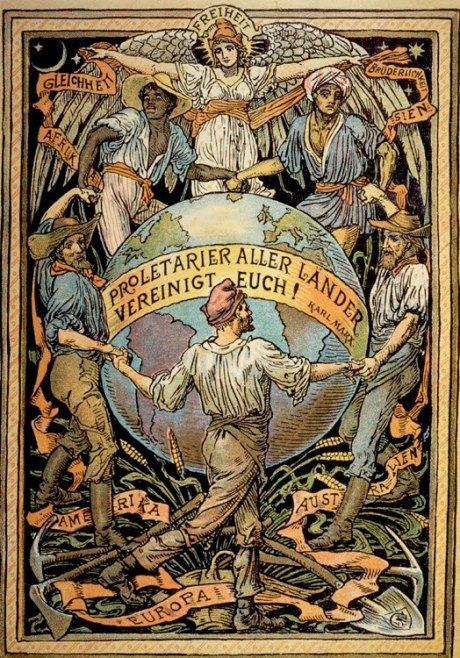
proletarians-walter-crane


“All that is solid melts into air” applies to the nation state as much as to the old feudal system that was overturned by the revolutionary bourgeoisie. Then, as now, reactionaries fought hard to keep things ‘solid’ but leftists welcome the globalizing changes that bring human beings closer together through amazing technological advances in transport and telecommunications.

There is an Index that follows the patterns of globalisation in our time: DHL Global Connectedness Index.

David McMullen has just added a new article to the Communist Manifesto Project that shows how Marx supported globalisation. Thanks to David for permission to republish it here.

****

Today’s “Marxists” share with the rest of the pseudo left an opposition to capitalist, indeed any, globalization. This puts them totally at odds with Marx. The following quote from The Communist Manifesto leaves no doubt about Marx’s pro position:

The bourgeoisie has through its exploitation of the world market given a cosmopolitan character to production and consumption in every country. To the great chagrin of Reactionists, it has drawn from under the feet of industry the national ground on which it stood. All old-established national industries have been destroyed or are daily being destroyed. They are dislodged by new industries, whose introduction becomes a life and death question for all civilised nations, by industries that no longer work up indigenous raw material, but raw material drawn from the remotest zones; industries whose products are consumed, not only at home, but in every quarter of the globe. In place of the old wants, satisfied by the production of the country, we find new wants, requiring for their satisfaction the products of distant lands and climes. In place of the old local and national seclusion and self-sufficiency, we have intercourse in every direction, universal inter-dependence of nations. And as in material, so also in intellectual production. The intellectual creations of individual nations become common property. National one-sidedness and narrow-mindedness become more and more impossible, and from the numerous national and local literatures, there arises a world literature.

The bourgeoisie, by the rapid improvement of all instruments of production, by the immensely facilitated means of communication, draws all, even the most barbarian, nations into civilisation. The cheap prices of commodities are the heavy artillery with which it batters down all Chinese walls, with which it forces the barbarians’ intensely obstinate hatred of foreigners to capitulate. It compels all nations, on pain of extinction, to adopt the bourgeois mode of production; it compels them to introduce what it calls civilisation into their midst, i.e., to become bourgeois themselves. In one word, it creates a world after its own image.

Then in a letter to Engels of October 8 1858 he wrote:

The proper task of bourgeois society is the creation of the world market, at least in outline, and of the production based on that market. Since the world is round, the colonisation of California and Australia and the opening up of China and Japan would seem to have completed this process.

In his other writings, Marx supported Europe’s colonial conquests, the “process” that got globalization going. In his view Europe was the only source of capitalism which in turn was the necessary precursor of communism. Support for this historical necessity did not prevent him from expressing his disgust at the barbarity and hypocrisy of the Europeans as they went about this conquest nor was he impressed with the tardy pace at which the old societies were being replaced by the new. What he was doing was recognizing that capitalism has a dialectical or contradictory nature. Only capitalism can create the conditions for its own demise. You have to support it in order to oppose it. In “The British Rule in India” New York Daily News of June 25, 1853, he wrote:

These small stereotype forms of social organism [autonomous villages] have been to the greater part dissolved, and are disappearing, not so much through the brutal interference of the British tax-gatherer and the British soldier, as to the working of English steam and English free trade. Those family-communities were based on domestic industry, in that peculiar combination of hand-weaving, hands-spinning and hand-tilling agriculture which gave them self-supporting power. English interference having placed the spinner in Lancashire and the weaver in Bengal, or sweeping away both Hindoo spinner and weaver, dissolved these small semi-barbarian, semi-civilized communities, by blowing up their economical basis, and thus produced the greatest, and to speak the truth, the only social revolution ever heard of in Asia.

Now, sickening as it must be to human feeling to witness those myriads of industrious patriarchal and inoffensive social organizations disorganized and dissolved into their units, thrown into a sea of woes, and their individual members losing at the same time their ancient form of civilization, and their hereditary means of subsistence, we must not forget that these idyllic village-communities, inoffensive though they may appear, had always been the solid foundation of Oriental despotism, that they restrained the human mind within the smallest possible compass, making it the unresisting tool of superstition, enslaving it beneath traditional rules, depriving it of all grandeur and historical energies. We must not forget the barbarian egotism which, concentrating on some miserable patch of land, had quietly witnessed the ruin of empires, the perpetration of unspeakable cruelties, the massacre of the population of large towns, with no other consideration bestowed upon them than on natural events, itself the helpless prey of any aggressor who deigned to notice it at all. We must not forget that this undignified, stagnatory, and vegetative life, that this passive sort of existence evoked on the other part, in contradistinction, wild, aimless, unbounded forces of destruction and rendered murder itself a religious rite in Hindostan. We must not forget that these little communities were contaminated by distinctions of caste and by slavery, that they subjugated man to external circumstances instead of elevating man the sovereign of circumstances, that they transformed a self-developing social state into never changing natural destiny, and thus brought about a brutalizing worship of nature, exhibiting its degradation in the fact that man, the sovereign of nature, fell down on his knees in adoration of Kanuman, the monkey, and Sabbala, the cow.

England, it is true, in causing a social revolution in Hindostan, was actuated only by the vilest interests, and was stupid in her manner of enforcing them. But that is not the question. The question is, can mankind fulfil its destiny without a fundamental revolution in the social state of Asia? If not, whatever may have been the crimes of England she was the unconscious tool of history in bringing about that revolution.

In “The Future Results of British Rule in India” New York Daily News of August 8, 1853, he wrote:

England has to fulfill a double mission in India: one destructive, the other regenerating – the annihilation of old Asiatic society, and the laying of the material foundation of Western society in Asia.

He expressed a similar view when writing about Britain’s beastly treatment of China. So that in “Revolution in China and In Europe”, New York Daily News, June 14, 1853 we read:

It is almost needless to observe that, in the same measure in which opium has obtained the sovereignty over the Chinese, the Emperor and his staff of pedantic mandarins have become dispossessed of their own sovereignty. It would seem as though history had first to make this whole people drunk before it could rouse them out of their hereditary stupidity.

and then:

All these dissolving agencies acting together on the finances, the morals, the industry, and political structure of China, received their full development under the English cannon in 1840, which broke down the authority of the Emperor, and forced the Celestial Empire into contact with the terrestrial world. Complete isolation was the prime condition of the preservation of Old China. That isolation having come to a violent end by the medium of England, dissolution must follow as surely as that of any mummy carefully preserved in a hermetically sealed coffin, whenever it is brought into contact with the open air.

In an article published in the Deutsche-Brüsseler-Zeitung No. 7, January 23, 1848, Engels expressed his delight at America’s victory in the war with Mexico and the conquest of California, Texas and areas in between. In their footnotes the editors at Progress Press in Moscow try to make out that both Engels and Marx later took a different view. They cite an 1861 article by Marx called “The Civil War in North America”. Here Marx mentions how expansionism at the time was driven by the slave owners. Although he makes no actual mention of the Mexican-American War. In hindsight we can see that one good thing about the annexations was that they contributed to the outbreak of the Civil War which the slave-owners went on to lose. Their attempt to spread slavery to the new territories was the last straw. And we can now say without fear of contradiction that capitalist development greatly benefited from the switch in sovereignty. Here is a link to the 1861 article. It is no use on the Mexican-American War but it is a very illuminating exposition of the expansionist threat posed by the slave states and a very good argument against British “neutrality”.

Marx was quite unsupportive of rebellions by reactionary or backward elements in colonial societies. These included the Taiping Rebellion in China and the Indian Mutiny.

In “Chinese Affairs” Die Presse, No. 185, July 7, 1862, Marx has nothing positive to say about the Taiping Rebellion that rocked southern China from 1850 to 1864

They have no slogans. They are an even greater abomination for the masses of the people than for the old rulers. They seem to have no other vocation than, as opposed to conservative stagnation, to produce destruction in grotesquely detestable forms, destruction without any nucleus of new construction.

“Marxists” have tried to tell a different tale. Over at The Marx and Engels Internet Archive they have a section entitled Articles on China 1853 – 1860. It has other articles that deal with rebellion but not the Die Presse article for copyright reasons. In their introduction they paint the Taiping in glowing colors:

At the same time, the Taiping rebellion broke out in 1850 and attacked the status quo Confucianist Manchu Dynasty — which had ruled since 1644. The rebellion was based in social revolutionary ideas of equality and was popular among the masses. It abolished private property, established sexual equality, and banned drugs (from alcohol to opium). By 1853, it dominated much of SE China. It would not be until 1864 that the Taiping capital of Nanking was captured by the imperial Manchu government.

Progress Press also have this rather gratuitous footnote in Volume I of Capital:

In 1850-64, China was swept by an anti-feudal liberation movement in the form of a large-scale peasant war, the Taiping Revolt.

The fairly uncontroversial Wikipedia entry on the Taiping Rebellion gives a far less flattering picture.

There is also an attempt to paint the Indian Mutiny as a national liberation movement. The Soviet Foreign Languages Publishing House in 1959 brought out a collection of articles by Marx on the Indian Mutiny entitled The First Indian War of Independence, 1857-1859. Also the The Marx and Engels Internet Archive has a web page entitled The First Indian War of Independence (1857-1858)
Marx does not explicitly repudiate the Mutiny in the way that he did in the case of the Taiping Rebellion. However, the total absence of any explicit statement of support is just as telling. He is very concerned to expose British military incompetence and brutality. He is also pleased by the financial and political strain it is placing on Britain. But that is as far as it goes. It is hard to imagine him supporting a pack of princes who wanted to reinstate the Mogul empire after what we know about his view on the role of the British in India.

The editors of Progress Press were also embarrassed by an article by Engels called “French Rule in Algeria” (The Northern Star January 22 1848). Here he wrote:

Upon the whole it is, in our opinion, very fortunate that the Arabian chief has been taken. The struggle of the Bedouins was a hopeless one, and though the manner in which brutal soldiers, like Bugeaud, have carried on the war is highly blameable, the conquest of Algeria is an important and fortunate fact for the progress of civilisation. The piracies of the Barbaresque states, never interfered with by the English government as long as they did not disturb their ships, could not be put down but by the conquest of one of these states. And the conquest of Algeria has already forced the Beys of Tunis and Tripoli, and even the Emperor of Morocco, to enter upon the road of civilisation. They were obliged to find other employment for their people than piracy, and other means of filling their exchequer than tributes paid to them by the smaller states of Europe. And if we may regret that the liberty of the Bedouins of the desert has been destroyed, we must not forget that these same Bedouins were a nation of robbers,—whose principal means of living consisted of making excursions either upon each other, or upon the settled villagers, taking what they found, slaughtering all those who resisted, and selling the remaining prisoners as slaves. All these nations of free barbarians look very proud, noble and glorious at a distance, but only come near them and you will find that they, as well as the more civilised nations, are ruled by the lust of gain, and only employ ruder and more cruel means. And after all, the modern bourgeois, with civilisation, industry, order, and at least relative enlightenment following him, is preferable to the feudal lord or to the marauding robber, with the barbarian state of society to which they belong.

Progress Press in its footnotes refers to this resistance as a liberation struggle. They also then claim that in an 1844 article Engels had made commendable noises about the resistance and that an article “Algeria” written for the New American Encyclopaedia in 1857 reverses the position expressed in the 1848 article. There is nothing in either article that can be construed in this way. An editor’s footnote to the latter article claims that the relevant material was left out by the encylcopaedia editors and this is conformed by a letter from Engels to Marx on 22 September 1857. The letter shows nothing of the sort. The reader is invited to read those three pieces to make up their own mind.

These views of Marx are not at odds with support by communists for the 20th century anti-colonial movement. By that stage the movement was primarily lead by western educated elements who sought to modernize their countries rather than take them backwards. Although there were some oddities such as Mahatma Gandhi, and independence brought many monsters like Idi Amin in Uganda and Mobutu in Zaire, and the whole process was badly affected by the Cold War.

Marx was no green

The Communist Manifesto Project has just published an article titled ‘Was Marx a green?‘ I’m republishing it below, with gratitude to the writer David McMullen.

In reading a draft of the piece, these thoughts came to mind:

In Mao’s critique of Stalin’s Economic Problems in the USSR Mao says Stalin is wrong to believe that human development is restricted by natural laws. Mao asserts that humans can work out ways to overcome these laws:

(Stalin) 2. Leaving aside astronomical, geological, and othersimilar processes, which man really is powerless to influence, even if he has come to know the laws of their development. . . . (Mao response) 2. This argument is wrong. Human knowledge and the capability to transform nature have no limit. Stalin did not consider these matters developmentally. What cannot now be done, may be done in the future.

To me, this kind of thinking – this spirit – was what attracted me to Maoists in the Left in Melbourne back in the late 1960s. They were the ones drawing critically from previous socialist experience, rather than rejecting it out of hand, and they were the ones really placing human conscious activity centre-stage and understanding the inter-relationship between economic base and cultural superstructure.

Marxists have always wanted progress and revolution and Karl Marx supported capital ‘p’ Progress in his time ­ but those who try to reinvent him as a green steady­-statist reverse his progressive and revolutionary nature and turn him into his opposite.

­As for the town and country divide, Engels nails the distinction between those greens (or ‘utopians’, in his time) who value small-scale craft-based life over the advances brought about by the C19th Industrial Revolution, despite its immediate grimness. In the Introduction to The Condition of the working class in England (1845) he talks about the much healthier, more humane, way of life in feudal rural England but says, no!, it sucks because in such a pre-industrial village and family based way of life, the people’s horizons were so limited. They were ‘comfortable in their silent vegetation’:

Before the introduction of machinery, the spinning and weaving of raw materials was carried on in the workingman’s home. Wife and daughter spun the yarn that the father wove or that they sold, if he did not work it up himself. These weaver families lived in the country in the neighbourhood of the towns, and could get on fairly well with their wages, because the home market was almost the only one and the crushing power of competition that came later, with the conquest of foreign markets and the extension of trade, did not yet press upon wages. There was, further, a constant increase in the demand for the home market, keeping pace with the slow increase in population and employing all the workers; and there was also the impossibility of vigorous competition of the workers among themselves, consequent upon the rural dispersion of their homes. So it was that the weaver was usually in a position to lay by something, and rent a little piece of land, that he cultivated in his leisure hours, of which he had as many as he chose to take, since he could weave whenever and as long as he pleased. True, he was a bad farmer and managed his land inefficiently, often obtaining but poor crops; nevertheless, he was no proletarian, he had a stake in the country, he was permanently settled, and stood one step higher in society than the English workman of today.

So the workers vegetated throughout a passably comfortable existence, leading a righteous and peaceful life in all piety and probity; and their material position was far better than that of their successors. They did not need to overwork; they did no more than they chose to do, and yet earned what they needed. They had leisure for healthful work in garden or field, work which, in itself, was recreation for them, and they could take part besides in the recreations and games of their neighbours, and all these games — bowling, cricket, football, etc., contributed to their physical health and vigour. They were, for the most part, strong, well-built people, in whose physique little or no difference from that of their peasant neighbours was discoverable. Their children grew up in the fresh country air, and, if they could help their parents at work, it was only occasionally; while of eight or twelve hours work for them there was no question.

What the moral and intellectual character of this class was may be guessed. Shut off from the towns, which they never entered, their yarn and woven stuff being delivered to travelling agents for payment of wages — so shut off that old people who lived quite in the neighborhood of the town never went thither until they were robbed of their trade by the introduction of machinery and obliged to look about them in the towns for work — the weavers stood upon the moral and intellectual plane of the yeomen with whom they were usually immediately connected through their little holdings. They regarded their squire, the greatest landholder of the region, as their natural superior; they asked advice of him, laid their small disputes before him for settlement, and gave him all honour, as this patriarchal relation involved. They were “respectable” people, good husbands and fathers, led moral lives because they had no temptation to be immoral, there being no groggeries or low houses in their vicinity, and because the host, at whose inn they now and then quenched their thirst, was also a respectable man, usually a large tenant-farmer who took pride in his good order, good beer, and early hours. They had their children the whole day at home, and brought them up in obedience and the fear of God; the patriarchal relationship remained undisturbed so long as the children were unmarried.

The young people grew up in idyllic simplicity and intimacy with their playmates until they married; and even though sexual intercourse before marriage almost unfailingly took place, this happened only when the moral obligation of marriage was recognised on both sides, and a subsequent wedding made everything good. In short, the English industrial workers of those days lived and thought after the fashion still to be found here and there in Germany, in retirement and seclusion, without mental activity and without violent fluctuations in their position in life. They could rarely read and far more rarely write; went regularly to church, never talked politics, never conspired, never thought, delighted in physical exercises, listened with inherited reverence when the Bible was read, and were, in their unquestioning humility, exceedingly well-disposed towards the “superior” classes. But intellectually, they were dead; lived only for their petty, private interest, for their looms and gardens, and knew nothing of the mighty movement which, beyond their horizon, was sweeping through mankind. They were comfortable in their silent vegetation, and but for the industrial revolution they would never have emerged from this existence, which, cosily romantic as it was, was nevertheless not worthy of human beings. In truth, they were not human beings; they were merely toiling machines in the service of the few aristocrats who had guided history down to that time. The industrial revolution has simply carried this out to its logical end by making the workers machines pure and simple, taking from them the last trace of independent activity, and so forcing them to think and demand a position worthy of men.

Anyway, here is David McMullen’s article, with which I basically agree.

Marx Was No Green
There are Greens who espouse an “ecological Marxism” and claim that if Marx was around today he would support organic agriculture and a steady state economy based on renewable resources that provides everyone with “sufficiency”. In such an economy the poor and rich countries would converge, with the former increasing somewhat and the latter shrinking a lot. The most notable exponent of this view is John Bellamy Foster, the editor of The Monthly Review. (We will call him JBF for short.) He goes through the writings of Marx and tortures them until they deliver a green essence.
JBF draws our attention to a number of Marx’s views that you could use to start building a case that he was a Green. Marx was concerned about the destruction of natural stocks of fertile soil, forests and fish needed by future generations. He also commented on how consumption often included frivolities that reflected people’s alienation rather than real needs and that human thriving requires more than increased consumption. JBF also correctly points out that when Marx talked about mastering nature he did not mean destroying it but mastering its laws and harnessing it accordingly. However, from here on the case begins to unravel.

JBF tries to extract greenness from the fact that Marx was a materialist who believed we lived in a material world where we depended on plants and animals for food, water to drink and air to breath. This is a long stretch.

The greening of Marx of course requires JBF to explain away how Marx and Engels talked about communism unleashing the productive forces. He claims this thoroughly ungreen viewpoint was confined to their youthful less mature writings. This is not true as these quotes from the 1870s attest:

Let us take, first of all, the words “proceeds of labor” in the sense of the product of labor; then the co-operative proceeds of labor are the total social product.
From this must now be deducted: First, cover for replacement of the means of production used up. Second, additional portion for expansion of production [emphasis added]. Third, reserve or insurance funds to provide against accidents, dislocations caused by natural calamities, etc.
Marx, Critique of the Gotha Programme, 1875
The expansive force of the means of production bursts the bonds that the capitalist mode of production had imposed upon them. Their deliverance from these bonds is the one precondition for an unbroken, constantly accelerated development of the productive forces, and therewith for a practically unlimited increase of production itself. Nor is this all. The socialised appropriation of the means of production does away, not only with the present artificial restrictions upon production, but also with the positive waste and devastation of productive forces and products that are at the present time the inevitable concomitants of production, and that reach their height in the crises. Further, it sets free for the community at large a mass of means of production and of products, by doing away with the senseless extravagance of the ruling classes of today and their political representatives. The possibility of securing for every member of society, by means of socialised production, an existence not only fully sufficient materially, and becoming day by day more full, but an existence guaranteeing to all the free development and exercise of their physical and mental faculties — this possibility is now for the first time here, but it is here.
Engels, Anti-Duhring, 1877
JBF also has to misconstrue Marx’s constant reference to the fact that capitalists are compelled by the forces of competition to accumulate  in order to survive, by suggesting that he actually disapproved of the process. For Marx the plowing back of much of the surplus value rather than spending it all on extravagant consumption was what made capitalism superior to previous societies where there was a compulsion to stagnate. It is what delivered economic and social progress.
Under communism, the robust development of the productive forces will lead both to the qualitative improvements in output and also to the use of increasing amounts of energy and materials. This would occur not just through accumulation but also through greater investment in research and development and through making each generation of plant and equipment better than the last. It is not hard to imagine the uses. Increased automation will require millions of robots. People will want ready access to various recreation facilities such as gyms, gardens, artificial ski slopes, master chef kitchens, laboratories, workshops and research facilities. The requirements of an increasing population will also have to be considered. While the population is expected to plateau and then decline later this century, under communism you would expect it to start rising again as the burden of having children will be much less. We need large emergency facilities to deal with super-volcanoes and tsunamis. We will need to prepare for the effects of major climate change such rising sea levels and eventually the next ice age.  Major space programs will among other things protect us from meteors and allow us to start moving off the planet in order to explore, settle and exploit extraterrestrial resources. It will be a long time before we run out of things to do with iron, steel, glass etc. This increasing production under communism will proceed with an on-going decoupling from impacts on the environment. We will see food produced with less and less use of land and water, and the industrial waste streams in extraction, production and disposal cleaned up and reduced.

JBF’s pièce de résistance is to pick up on Marx’s analysis of the contradiction between town and country. In the separation of town and country, Marx was concerned about two things. Firstly it stunted the brains of those in the country and ruined the physical health of those in city. Secondly it meant a break in the nutrient cycle as human waste and food scraps were not returned to the farm but instead dumped in rivers and oceans. This transfer of people from the land to cities was an inevitable part of capitalist development. Capitalist farming needed less workers and the cost to the soil and to workers of concentrating the latter in the cities was of no concern to industrial capitalists.

However, these problems are being resolved without having to spread the population evenly over the landscape. High density living in large cities can now be quite healthy and comfortable. Living in the countryside no longer means being cut off from the world given modern modes of transport and communications. This modern transport can also truck in fertilizer, be it human waste, animal manure or the synthetic kind that is now produced in abundance. Indeed, the present concern is excessive nutrients and resulting emissions into ground water or the atmosphere. The best hope for dealing with this under present capitalist conditions is through increased regulation and better management including greater adoption of precision farming.

The organic farming favored by JBF would just make things worse for the environment. It does not allow the use of synthetic fertilizer and so requires rotations that include nitrogen fixing legumes that are simply plowed back into the soil. So a world of organic agriculture would require far more land being assigned to farming to get the same net crop and less for forests and other natural uses. Magically getting the 7 billion people presently on the planet to become vegetarians would reduce the land pressure given that crops consumed directly provide humans with more calories than if they are fed to animals first. However, that would be undone later this century when we have 2 or 3 billion extra mouths to feed.
It is very important that red and green are seen as being at total odds. Humanity and the environment require economic progress and communism is impossible without it. The sooner we have a vocal Marxism supporting economic growth, and un-green things such as nuclear power and genetic engineering, the better
* * * *

REFUTING ‘ANTI IMPERIALIST’ MYTHS: A Review of Bill Warren’s Imperialism, Pioneer of Capitalism.

This article by David McMullen was originally published in September 1993 in the journal “Red Politics”.There was also discussion of the review at the lastsuperpower site in 2006.


****
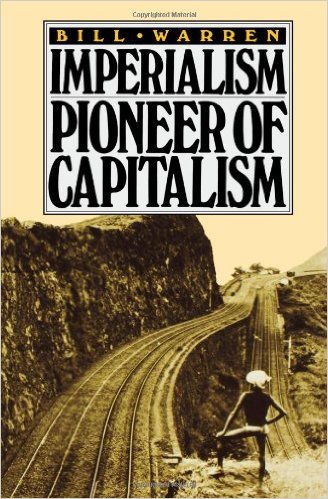
51SpzR9yL9L._SX326_BO1,204,203,200_


Bill Warren’s book, Imperialism, Pioneer of Capitalism, performs a useful service by refuting much of the mythology that the left has embraced in the name of ‘anti- imperialism’. However, on the other hand, he manages to create his own brand of confusion. He does this, firstly, by blaming Lenin’s Imperialism the Highest Stage of Capitalism for many of the left’s erroneous views.

And secondly, he is so busy extolling the historical mission of capitalism, that no effort is devoted to discussing how capitalism is an obstacle to human development and is becoming increasingly obsolete. Neverthelsee, despite these shortcomings it is the myth shattering quality of the book that predominates.

Warren begins by reminding us of the basics of a Marxist attitude to capitalism:

(a) It is an advance in all respects on earlier forms of society.

(b) It develops the productive forces and society generally, so creating the necessary material or objective conditions for future communist society. This development also generates the contradictions which lead to capitalism’s revolutionary overthrow.

The following passage from the Communist Manifesto that Warren quotes (Warren 1980, p 11) says it all.

The bourgeoisie cannot exist without constantly revolutionizing the instruments of production, and thereby the relations of production, and with them the whole relations of society. Conservation of the old modes of production in unaltered form, was, on the contrary, the first condition of existence for all earlier industrial classes. Constant revolutionizing of production, uninterrupted disturbance of all social conditions, everlasting uncertainty and agitation distinguish the bourgeois epoch from all earlier ones. All fixed, fact-frozen relations, with their train of ancient and venerable prejudices and opinions, are swept away, all new-formed ones becomes antiquated before they can ossify. All that is solid melts into air, all that is holy is profaned, and man is at last compelled to face with sober senses his real condition of life, and his relations with his kind. (Marx and Engels, 1968, pp 34-5.)

This approach to capitalism is at total variance to that prevailing in the “left’, The usual practice is to bemoan the development of capitalist productive relations and productive forces, and to cherish the things that capitalism is destroying. A few examples might clarify this point.

(1) Increased economic concentration and the destruction of the petty bourgeoisie. A classic case of the left’s response is its bemoaning such things as agribusiness, supermarkets and fastfood chains.

(2) The increasing internationalisation of capital and the division of labor, which increases human intercourse on a world scale and lays the basis for a global society. This is denounced for destroying our independence and national heritage and placing us at the mercy of the multinationals.

(3) The destruction of cherished skills by new technologies (cherished, that is, by trendy left sociologists). To a Marxist, technological development is eliminating the technical division of labor which is the material basis of class society. In other words we are moving to a situation where you will have an educated and versatile workforce, on the one hand, and on the other hand, processes of production in which all types of activities can be performed equally by all members of the workforce.

(4) The erosion of traditional culture and social bonds. Traditional life tends to be romanticized, compared with soulless modern living We have lost something. On the other hand, to a Marxist the neuroses and instability of modern life are infinitely superior to the narrow mindless certainty and security of days gone by.

So given that capitalism is a social advance and creates the conditions for social revolution, how are we to view European colonial expansion into pre-capitalist societies?

Warren cites, by way of example, Marx’s recognition of the historically progressive role of Britain’s penetration of India.

England, it is true, in causing a social revolution in Hindoostan, was actuated by the vilest interests, and was stupid in her manner of enforcing them. But that is not the question. The question is, can mankind fulfill its destiny without a fundamental revolution in the social state of Asia? If not, whatever may have been the crimes of England, she was the unconscious tool of history in bringing about the revolution. (S. Avineri (ed.) pp 93-94.)

Not long afterwards, Marx wrote as follows:

England has to fulfill a double mission in India: one destructive, the other regenerating – the annihilation of old Asiatic society, and the laying of the material foundations of Western society in Asia (S. Avineri (ed.) pp 132.)

On the destruction side, they broke up or seriously undermined much of the existing social fabric and pre- capitalist modes of production. On the construction side, political unity was greatly enhanced by the British sword (mainly in the hands of local recruits), telegraph and railways, and embryonic industrialization began to emerge.

It is appropriate that the anti-colonial struggles of the twentieth century have not simply been directed at expelling the foreign oppressor. Rarely was the struggle simply one of returning to the days before colonial rule. For example, the struggle for independence in India was not directed at restoring the Mogul empire and independence in Africa did not mean returning to tribal hunter gathering or slash and burn societies.

In some cases such as in China, the revolution was directed at the total destruction of the traditional conditions that predated colonialism such as the remnants of feudalism. Even where independence from colonialism was not accompanied by fundamental social revolutions, the essential aspect of decolonisation was the establishment of a modern state, and the first steps towards a modern economy.

In the case of Czarist Russia, the modern industrial sector, which spawned the proletariat in the two decades prior to 1914, was primarily the product of foreign investment. At no stage did the Bolsheviks target this foreign ownership as something to be abhorred, an interesting point in the light of the economic nationalist position adopted by most of the Australian left.

To quote Warren:

Between 1896 and 1900 a quarter of all new companies formed were foreign, and by 1900 foreign capital accounted for 28% of the total. By 1914 the proportion had risen to 33%. Foreign capital controlled 45% of Russia’s oil output, 54% of her iron output, 50% of her chemical industry, 74% of her coal output. More than half of the capital of the six leading banks of the country – themselves controlling nearly 60% of all banding capital and nearly half of all bank deposits – was foreign (Warren 1980, p 46.)

The position commonly adopted by the left is to deny that capitalism is fulfilling its historical function in the developing countries. We are told that capitalism is not developing the productive forces nor is it destroying pre-capitalist conditions. The LDCs are supposedly being underdeveloped by the world capitalist system. A major part of Imperialism, Pioneer of Capitalism is devoted to refuting these views. The linchpin of these views is the modern theory of imperialism, dependency and underdevelopment. Typical of the theorists in this area are Paul Baran, Andre Gunder Frank and Samir Amin.

We are told that the people of the Third World have been getting progressively worse off during the modern era (ie since the industrial revolution) and have generally experienced a socio-economic and cultural regression. Capitalism has developed, and continues to do so, in a contradictory fashion, which generates at the same time development in the centre and underdevelopment in the periphery.

The implication is that it is fruitless to expect underdeveloped countries to repeat the stages of economic growth passed through by modern developed capitalist economies whose classical capitalist development arose out of pre-capitalist and feudal society. Hence, the historical role of capitalism in these countries is finished, or at a dead end. It is argued, moreover, that the achievement of political independence has not significantly improved prospects of development in the periphery.

A number of arguments are put forward to support the above position. Warren picks out three as being particularly important.

(a) A drain of economic surplus from periphery to centre is said to arise from the flow of profits from foreign investment in the periphery back to the metropolitan country, and from unequal exchange in trade.

Warren points out “that for such a drain to retard economic development it must be an absolute drain not simply an unequal transaction that nevertheless leaves both sides better off than before …”. For example, the comparison that people make between profit outflow and capital inflow tends to be very misleading. Surplus extraction under capitalism is not comparable to the plunder practiced by the empires of antiquity.
Foreign investment creates the surplus (with the help of local labor of course) before it extracts it; and it does this by developing the productive forces. You can certainly criticise the form taken by foreign investment and trade, and argue that Third World countries would gain if they were better organised. What you cannot argue is that the wealth of Third World countries is being depleted.

Closely related to this surplus gain concept is the idea that developed countries are better off than others because they have more than their share of the world’s resources. In other words the reason why we have better plumbing than people in Bangladesh is because we have more than our share of the world’s supply of pipes and trained plumbers.

Or to put it more generally, there is a fixed quantity of some substance called prosperity and the more that goes to one lot of people the less there is for everybody else. This is a total failure to understand economic development as a process of economic accumulation. Its most negative effect is the implication that the interests of people in the developed and underdeveloped world are at loggerheads.

(b) The ‘traditional’ division of labor between centre and periphery countries whereby the former produce manufactured goods and the latter primary goods, is seen to be imposed by the centre on the periphery and is a source of its backwardness.

Warren argues that the validity of the argument rests on two assumptions, which he sets out to refute. These are first that there was a possible and desirable alternative line of development to primary-product, export-lead growth in the backward countries concerned; and second, that the initial emphasis on the export of primary products actually erected serious impediments to subsequent diversification, especially along the lines of industrialisation.

(c) Imperialism or centre/periphery relations are said to encourage the preservation of precapitalist modes of production. This is discussed at two levels. First, there is the case where capitalist production at one point encourages pre-capitalist production at another point (eg, cotton production based on slavery). Here Warren correctly argues that the destructive force of capitalist relations would far outweigh any conserving tendencies.

Second, there is the claim that imperialism has tended to ally itself with local feudalism at the expense of progressive bourgeois forces. Warren replies thatthis is largely undercut by the almost universal willingness of feudal classes to transform themselves, at least partly, into capitalist industrialisers once conditions are ripe. Where

Warren falls short on this question in failing to emphasise that a thoroughly bourgeois revolution would far more successfully unleash capitalist development.

At a more general and theoretical level Warren attacks dependency theory on a number of grounds.

To begin with it is a static view. While a change in form over time tends to be conceded, the possibility of declining dependency is precluded. Moreover, changes in the centres of power is inadequately allowed for.

The theory is ahistorical in that it assumes the following:

(a) that there were latent suppressed historical alternatives to the development that actually took place; (b) that the failure of alternatives to materialise was primarily the result of external imposition (colonial policy).

The theory is metaphysical in that it basically explains social phenomenon in terms of external causes, rather than as an interaction of both internal and external factors. (Mao spoke of external factors as the conditions of change and internal factors as the basis of change.) Dependency theorists would, for example, explain a country’s backwardness by the fact that foreign capital is only invested in enclaves or cash crops.

A more sensible approach would perhaps be to see cause and effect running the other way – because the country is backward these industries are the only opportunities for investment. The backwardness would then be explained essentially by internal factors, namely a social system and mode of production significantly inferior to, or historically less advanced than, capitalism in developed countries.

Dependency theory has a strong thread of nationalist utopia, which establishes a set of thoroughly dubious criteria of what is good and what is detrimental. The first blossoms of bourgeois society are denounced simply as imperialist cultural penetration (coca cola culture) serving the interests of the mutinationals and reinforcing dependent status.

There is also the concept of articulated economy. Every country has to have its own steel industry, for example. It is argued that if you do not have the full range of industries you are trapped into some narrow and enslaving international division of labor.

This last point touches on a major area of confusion, namely, the distinction between dependence and interdependence. Warren says:

Since national economies are becoming increasingly interdependent, the meaning of dependence is even more elusive, not to say mystical.(Warren, 1980, p 182)

In fact with the increasing importance of international trade and capital movement, it is often the case that dependence on trade and foreign investment is a sign of economic development.

The last section of Warren’s book provides extensive evidence that considerable economic development has occurred in the Third Word during the post-war period. It has been meteoric in comparison with that in western countries. The western countries took centuries to emerge from the Middle Ages and eventually achieve an industrial takeoff in the nineteenth century.

On Lenin’s views of imperialism

In Warren’s opinion, the more recent theories of imperialism, such as underdevelopment and dependency are best regarded as post-war versions of the views expressed by Lenin in Imperialism, the Highest Stage of Capitalism,or at any rate stemming, or continuing, from where he left off. Warren also claimed that in this book Lenin was espousing views that were at variance with his earlier writings on the Narodniks and the role of capitalist development in Russia.

Here Warren is skating on thin ice. Much of his case rests on Lenin’s use of particular words, especially ‘moribund’, ‘stagnant’ and ‘parasitic’. By ‘moribund’, Lenin is referring to the increasing obsolescence of capitalism, exemplified most starkly by two world wars and economic crises of the sort that hit in the 1930s and will hit again in the future. He is not saying that social and economic development ceases.

In his use of the word, ‘stagnation’, Lenin is not saying that capitalism is no longer revolutionising the productive forces – a proposition that would obviously be wrong. He is referring to its increasing tardiness relative to a communist organisation of production – the productive forces are outgrowing the capitalist mode of production.
Warren tries to equate Lenin’s description of monopoly capital and imperialist countries as parasitic with the crude “surplus drain’ view . However, Lenin is not denying that the export of capital develops the productive forces in recipient countries; he is just saying that the centralisation in the ownership of capital shows up geographically.

Places such as London and New York have a far higher than average proportion of the world’s bloodsuckers; they tend to be richer and their ‘portfolios’ span the world. When Lenin explicitly discussed the impact of imperialism on the then colonies, he said that it was developing the productive forces. Warren unjustifiably shrugs this off as lip service to Marxist orthodoxy.

Warren had a number of other criticisms of Lenin’s position. However, they are not central to our present discussion. He claims (a) that capital exports have not increased in signifcance, (b) that Lenin espoused underconsumptionism and (c) that inter-imperialist rivalry was based on trade rather than competing capital. These and other issues could perhaps be looked at on some other occasion in a fuller discussion of Lenin’s book.

Bibliography
Amin, S., Accumulation on a World Scale, New York, Monthly Review Press, 1974.

Avineri, S., ed., Karl Marx on Colonialism and Modernisation, New York, Anchor Books, 1969. Frank, A. G., Capitalism and Underdevelopment in LatinAmerica, Harmondsworth, Penguin Books, 1971.

Greene, F., The Enemy, Notes on Imperialism and Revolution, London, Jonathon Cape, 1970. One of the more readable and also more appalling renderings of the ‘anti-imperialist’ position.

Lenin, VI, ‘On the So-Called Market Question’ Collected Works, Vol. 1, Moscow, 1963.

———– ‘The economic content of Narodism and the criticism of it in Mr Struve’s book’, Collected Works, Vol. 7, Moscow, 1963.

———–, Imperialism: the Highest Stage of Capitalism, Peking, Foreign Language Press.

Marx, K., Pre-Capitalist Economic Formations, London, Lawrence and Wishart, 1964.

———– and Engels, F., Manifesto of the Communist Party, Peking, Foreign Language Press, 1968.

Warren, W., Imperialism and capitalist industrialisation, in New Left Review (1973).

———–, Imperialism and Neo-Colonialism, British and Irish Communist Organisation (March 1977).

———–, Nations and corporations, in Times Literary Supplement, 1 November 1977..

———–, Poverty and prosperity in Times Literary Supplement, 12 December 1975.

———–, Imperialism, Pioneer of Capitalism, Verso, 1980, 274 p.

Hasn’t Communism Already Failed? (More from The Communist Manifesto Project)

There is a lot to be done on the democratic front. This includes:

supporting freedom of speech and assembly, government transparency, right to due process and freedom from government harassment and surveillance;

helping neutralize any emerging fascists trends;

struggling for a democratic political culture within the communist movement that effectively deals with controlling personalities, sycophants and attempts to close down critical thinking;

being better than others at exposing the folly of professional politicians;

proposing changes to the constitution and system of representation that would open up politics to greater scrutiny and participation;

and showing how vested economic interests under capitalism have a corrupting effect on government.

(More from The Communist Manifesto Project)

****

There is a thoroughly entrenched view that the experience of revolutions during the 20th century shows that communism has failed. There was indeed a failure. However, it was not of communism, but of an attempt to sustain a path towards it when its preconditions were absent. Russia in 1917 and China in 1949 were essentially backward pre-capitalist societies. Most people were peasants rather than proletarians, and they were more interested in land for the tiller than social ownership. There was little modern industry and thinking was medieval. They had not passed through the capitalist stage, which is required for a successful communist revolution. As the experience of other backward countries shows, even getting capitalism off the ground under these circumstances is hard enough, let alone a society that is supposed to supersede it.

This peculiar state of affairs arose because the bourgeoisie was too weak, cowardly or treacherous to carry out its own tasks. Instead, communists found themselves at the head of both anti-feudal modernist revolutions and patriotic resistance to fascist aggression and occupation. The Bolshevik regime in the Soviet Union was joined after World War II by a host of other countries in what became ‘the socialist camp’. It included China, Vietnam and Yugoslavia that had taken power with their own revolutionary forces, and eastern and central Europe and northern Korea where regimes were established by virtue of Soviet military occupation in the aftermath of the defeat of Germany and Japan. So, by historical accident communists found themselves burdened with the task of raising their societies out of social and economic backwardness. They had to perform the work of capitalism. They had to create an industrial base and trained work force virtually from scratch. The “failure of communism” was a consequence of the failure of capitalism.

Under these conditions the move in a communist direction could only be quite limited and proved unsustainable. They took important preliminary measures but did not achieve the real substance. Industry was placed under state ownership which meant that capitalist industry was expropriated and the new accumulation of private wealth prevented. At the same time there was a degree of economic security for workers. The system was described as socialism, the first stage on the road to communism. However, the weakness of the proletariat placed severe limits on what could be achieved. With some minor exceptions in Europe, it only began to become a significant section of society with the industrialization that followed the revolution. Proletarians were former peasants engaged mainly in the low paid toil that you would expect at this stage of development. They were simply not ready to be a ruling class. There was not the basis for a society based on mutual regard. Enthusiasm and unprompted initiative was limited in the harsh conditions and so there was a heavy reliance on material incentives and top down command with all kinds of perverse results. The freedom and democracy required for the full development of the proletariat was not possible given the intensity of external and internal opposition and the weakness of the revolutionary forces. Conditions also dictated a heavy reliance on a “revolutionary vanguard”.

Because most work was arduous and repetitive manual labor, and the education level and background of typical workers left them ill-equipped for involvement in the mental aspects of production, there was a minority who did the thinking and deciding. These were the managers, engineers and officials – generally referred to as ‘cadres’. Members of this elite had a vested interest in entrenching their privileged position and were unlikely to encourage an invasion of their domain as workers became more skilled and educated, and industry more mechanized, nor to willingly start to take upon themselves a share of the more routine forms of labor.

Once career, income and position are the primary impulse, economic results take a second place to empire building, undermining rivals, promoting loyal followers, scamming the system and concealing one’s poor performance from superiors. The opportunity for workers to resist these developments was limited by the lack of freedom and the culture of subordination which drains away confidence and the courage to act. This can be very strong even in the absence of political tyranny as we can see in any liberal capitalist society. At the same time, one can imagine that any rank and file worker with special abilities or talents would tend to be more interested in escaping the workers’ lot by becoming one of the privileged rather than struggling against them.

Mao Zedong, the head of the Chinese Communist Party until his death in 1976, referred to this process, once fully entrenched and endorsed at the top, as capitalist restoration and those encouraging it as revisionists and capitalist roaders. The Chinese Cultural Revolution that he led in the late 1960s is the only attempt to beat back this trend. However, that revolution was sabotaged and defeated, and the capitalist roaders were able to seize supreme power in China after his death.

The Soviet Union and like regimes in Eastern Europe represented a distinctive type of dead-end economically, politically and socially, and their demise in 1989-90 is one of the celebrated events of the late 20th centuries. By discarding much of the empty and dysfunctional formal shell of socialism and operating more like normal capitalist economies both China and Vietnam have managed to achieve considerable economic development in recent decades. Cuba is now beginning to take this route. The monstrosity in North Korea relies on mass terror and the support of the Chinese. All these regimes are an affront to freedom and democracy, and must be overthrown.

Notwithstanding this grim picture, there were still some significant achievements. In a large part of the world landlords and feudal relations were swept from the countryside. Industrialization was raised from a very low base and generally outperformed the backward countries in the capitalist camp. Most importantly, after a crash industrialization in the 1930s, the Soviet Union was able to defeat Nazi Germany. This is something for which the world should be eternally grateful.

The dilemma faced by 20th century communists was anticipated by Engels in the following passage from chapter 6 of The Peasant War in Germany, published in 1850:

The worst thing that can befall a leader of an extreme party is to be compelled to take over a government in an epoch when the movement is not yet ripe for the domination of the class which he represents and for the realization of the measures which that domination would imply. What he can do depends not upon his will but upon the sharpness of the clash of interests between the various classes, and upon the degree of development of the material means of existence, the relations of production and means of communication upon which the clash of interests of the classes is based every time. What he ought to do, what his party demands of him, again depends not upon him, or upon the degree of development of the class struggle and its conditions. He is bound to his doctrines and the demands hitherto propounded which do not emanate from the interrelations of the social classes at a given moment, or from the more or less accidental level of relations of production and means of communication, but from his more or less penetrating insight into the general result of the social and political movement. Thus he necessarily finds himself in a dilemma. What he can do is in contrast to all his actions as hitherto practised, to all his principles and to the present interests of his party; what he ought to do cannot be achieved. In a word, he is compelled to represent not his party or his class, but the class for whom conditions are ripe for domination. In the interests of the movement itself, he is compelled to defend the interests of an alien class, and to feed his own class with phrases and promises, with the assertion that the interests of that alien class are their own interests. Whoever puts himself in this awkward position is irrevocably lost.

What is to be Done?

At the moment when inquiring minds seek to learn about communism they will encounter a range of appalling nonsense from various tiny groups claiming to be communist or Marxist. Some support the regimes in Cuba and China, and there are even the occasional North Korea supporters. The absurd regime in Venezuela inspires many of them. They all cling onto the once true but now outdated view that US imperialism is the main problem in the world today, and for this reason some even see a good side to Daesh, Al Qaeda and the Taliban. They all share the mainstream view that regime change in Iraq has been a disaster and the fascist Baath Party should have been left in power. These groups never talk about how capitalism is creating the conditions for communism but simply whine about how terrible the system is, and often do this in a reactionary way particularly in their opposition to “globalization” and acceptance of green views on virtually everything. They rarely talk about and scarcely understand communism, and they simply see it as something in never-never land rather than their real purpose.

It will be up to the now very young or yet to be born to rediscover communism. For older people it would require too much of a break from their entrenched ways of thinking. Only then can we expect to see the beginnings of a communist movement.

As well as understanding and conveying the ultimate aims of communism and social ownership, with its elimination of market relations and the full development of the individual, they will also need to come to grips with how we get there. This has a number of phases. Listing them in reverse chronological order they are: the period of revolutionary transition when we shake off all the “muck of the ages”; the initial phase of the revolution, day one so to speak; and the here and now.

On the transition phase it will be particularly important to understand the tenacity of the bourgeoisie and old bad habits and thinking, and the need for the proletariat to transforms itself in the struggle. The new society cannot be created overnight. A vigorous mass movement will be critical for the transition because a passive population means certain defeat at the hands of a new bourgeoisie. In this context there would need to be a firm rebuttal to any idea of ‘socialism’ that is not seen as a revolutionary transition stage on the road to communism. There has to be a fundamental change in human behavior and the way society operates. It is that or capitalism. Any halfway stage has to proceed to communism or revert to capitalism.

During the initial phase, one of the first tasks of the revolution will be the neutralization of the bourgeoisie by expropriating their assets. This could be done fairly quickly and would not have to await more fundamental changes in economic arrangements. It could be achieved with a 100 per cent wealth tax on all wealth over a certain level. All the company stock, bonds, bank deposits and other income earning assets belonging to the bourgeoisie would become the property of the state. This would in an instant drastically reduce their economic and political power. People in executive positions would simply be instructed to keep doing their job under threat of dismissal. Some capable executives are indeed capitalists so some concessions may need to be made to them if they are prepared to cooperate.

During the pre-revolutionary period there are many matters that the communist movement will need to deal with. It is important to connect with those resisting the various symptoms of the existing order because they would be among the more amenable to communist ideas and there is much to be achieved in the here and now that is necessary for communism.

There is a lot to be done on the democratic front. This includes: supporting freedom of speech and assembly, government transparency, right to due process and freedom from government harassment and surveillance; helping neutralize any emerging fascists trends; struggling for a democratic political culture within the communist movement that effectively deals with controlling personalities, sycophants and attempts to close down critical thinking; being better than others at exposing the folly of professional politicians; proposing changes to the constitution and system of representation that would open up politics to greater scrutiny and participation; and showing how vested economic interests under capitalism have a corrupting effect on government.

People are seeking remedies to the various ills of the present system. They seek the alleviation of poverty, better healthcare and education. While helping to pursue improvements in the here and now communists would be there explaining the limitations of what can be achieved under the system. They would not simply be demanding the same things but in a more militant in tone. Their central focus would not be on denouncing governments for under-spending in these areas or for pursuing this policy or that. Rather, they would stress that only communism can ensure jobs and economic security and explain how it would lead to better healthcare and education through the fundamental changes in human behavior.

Communists must advocate rapid scientific advance and denounce capitalism for its tardiness in this area. It is critical to both our ability to thrive on this planet and to create the material conditions for communism. In the process they will have to lock horns with the green opponents of “technofix” who think that science just creates new problems. For the greens, the “solution” is less consumption and a population collapse.

Communists will need to be vocally demanding that the international bourgeoisie do far more to further what Marx called the bourgeois democratic revolution. Their tardiness in this area is legendary. For example, if a communist movement existed at this very moment it would be vigorously demanding that the powers that be quickly sort out the appalling situation in Syria and Iraq. Their failure to give effective assistance to the legitimate rebel forces in Syria meant that Daesh was able to thrive with appalling results. US President Barak Obama’s inaction in the early phase of the Syrian civil war should be condemned as should that country’s ongoing underwriting of Israeli oppression of the Palestinians. Generally we should be demanding that our rulers do everything possible to re-spark the Arab Spring.

Part of the problem is a prevailing pacifism both within the ruling class and society at large. A communist movement would be particularly concerned that the liberal democracies retain their military supremacy and stay well ahead of Russia and China. A large defense reserve should play a role, and would ensure that professionals are not the only ones with military training.

The Communist Manifesto Project – opposing the ‘reactionists’. Some annotations.

“The bourgeoisie, historically, has played a most revolutionary part” – Karl Marx 1848

Marx considered capitalism revolutionary, an advance on all previous societies. Most contemporary “Marxists” and the pseudo left more broadly either disagree or are highly ambivalent… For example, they bemoan “corporate globalization” and believe that the very far from complete process of economic development is ecologically unsustainable and we need to revert to a something “simpler”. Marx refers to these people as “reactionists”.

(Via The Communist Manifesto Project)


communist-manifesto


****

Annotations

These are some comments to consider while reading The Communist Manifesto. Most of them highlight the many instances where Marx’s views are contrary to those of present-day “Marxists”. Marx is referred to as the writer here. While Engels was a co-author, the final writing was the work of Marx.

Chapter 1: Bourgeois and Proletarians

“The bourgeoisie, historically, has played a most revolutionary part.”

Marx then goes on to elaborate on this point in the subsequent 11 paragraphs. He considered capitalism revolutionary, an advance on all previous societies. Most contemporary “Marxists” and the pseudo left more broadly either disagree or are highly ambivalent. They do not see the capitalist transformation of the economy and society as the launching pad for communism. Rather, the society they want requires a retreat from this process. For example, they bemoan “corporate globalization” and believe that the very far from complete process of economic development is ecologically unsustainable and we need to revert to a something “simpler”. Marx refers to these people as “reactionists”.

” We see then: the means of production and of exchange, on whose foundation the bourgeoisie built itself up, were generated in feudal society. At a certain stage in the development of these means of production and of exchange, the conditions under which feudal society produced and exchanged, the feudal organisation of agriculture and manufacturing industry, in one word, the feudal relations of property became no longer compatible with the already developed productive forces; they became so many fetters. They had to be burst asunder; they were burst asunder.”

So the transition from capitalism to communism will not be unique. As well as the transition from feudalism to capitalism there was also the transition from hunter-gathering to agriculture based society. In each case there was a total change in thinking and doing – “human nature”.

” For many a decade past the history of industry and commerce is but the history of the revolt of modern productive forces against modern conditions of production, against the property relations that are the conditions for the existence of the bourgeois and of its rule. ”

Marx goes on to cite capitalist economic crises as a prime example of the system’s obsolescence. Some claim that crises are not inevitable under capitalism. However, the evidence seems to suggest that they can only be delayed and at the cost of making them worse.

Other economic failings of the system include its slowness to innovate [see here] and its inability to tap the enthusiasm and initiative of workers [see here].

” Owing to the extensive use of machinery, ……. according to their age and sex.”

This is an accurate description of machine tending where work becomes confined to simple repetition. However, this should not be taken to be Marx’s overall assessment of work under capitalism. In Capital Vol. I Chapter Fifteen Section 9, he has two paragraphs that gives his general view of the labor process under capitalism. These are quoted in full below.

“Modern industry never looks upon and treats the existing form of a process as final. The technical basis of that industry is therefore revolutionary, while all earlier modes of production were essentially conservative. [225] By means of machinery, chemical processes and other methods, it is continually causing changes not only in the technical basis of production, but also in the functions of the labourer, and in the social combinations of the labour-process. At the same time, it thereby also revolutionises the division of labour within the society, and incessantly launches masses of capital and of workpeople from one branch of production to another. But if modern industry, by its very nature, therefore necessitates variation of labour, fluency of function, universal mobility of the labourer, on the other hand, in its capitalistic form, it reproduces the old division of labour with its ossified particularisations.We have seen how this absolute contradiction between the technical necessities of modern industry, and the social character inherent in its capitalistic form, dispels all fixity and security in the situation of the labourer; how it constantly threatens, by taking away the instruments of labour, to snatch from his hands his means of subsistence, [226] and, by suppressing his detail-function, to make him superfluous, we have seen, too, how this antagonism vents its rage in the creation of that monstrosity, an industrial reserve army, kept in misery in order to be always at the disposal of capital; in the incessant human sacrifices from among the working-class, in the most reckless squandering of labour-power and in the devastation caused by a social anarchy which turns every economic progress into a social calamity. This is the negative side. But if, on the one hand, variation of work at present imposes itself after the manner of an overpowering natural law, and with the blindly destructive action of a natural law that meets with resistance [227] at all points, modern industry, on the other hand, through its catastrophes imposes the necessity of recognising, as a fundamental law of production, variation of work, consequently fitness of the labourer for varied work, consequently the greatest possible development of his varied aptitudes. It becomes a question of life and death for society to adapt the mode of production to the normal functioning of this law. Modern Industry, indeed, compels society, under penalty of death, to replace the detail-worker of to-day, grappled by life-long repetition of one and the same trivial operation, and thus reduced to the mere fragment of a man, by the fully developed individual, fit for a variety of labours, ready to face any change of production, and to whom the different social functions he performs, are but so many modes of giving free scope to his own natural and acquired powers.

“One step already spontaneously taken towards effecting this revolution is the establishment of technical and agricultural schools, and of “écoles d’enseignement professionnel,” in which the children of the working-men receive some little instruction in technology and in the practical handling of the various implements of labour. Though the Factory Act, that first and meagre concession wrung from capital, is limited to combining elementary education with work in the factory, there can be no doubt that when the working-class comes into power, as inevitably it must, technical instruction, both theoretical and practical, will take its proper place in the working-class schools. There is also no doubt that such revolutionary ferments, the final result of which is the abolition of the old division of labour, are diametrically opposed to the capitalistic form of production, and to the economic status of the labourer corresponding to that form. But the historical development of the antagonisms, immanent in a given form of production, is the only way in which that form of production can be dissolved and a new form established. “Ne sutor ultra crepidam” — this nec plus ultra of handicraft wisdom became sheer nonsense, from the moment the watchmaker Watt invented the steam-engine, the barber Arkwright, the throstle, and the working-jeweller, Fulton, the steamship. [228]”

“226.
“You take my life
When you do take the means whereby I live.”
Shakespeare.

227. A French workman, on his return from San-Francisco, writes as follows: “I never could have believed, that I was capable of working at the various occupations I was employed on in California. I was firmly convinced that I was fit for nothing but letter-press printing…. Once in the midst of this world of adventurers, who change their occupation as often as they do their shirt, egad, I did as the others. As mining did not turn out remunerative enough, I left it for the town, where in succession I became typographer, slater, plumber, &c. In consequence of thus finding out that I am fit to any sort of work, I feel less of a mollusk and more of a man.” (A. Corbon, “De l’enseignement professionnel,” 2ème ed., p. 50.)

228. John Bellers, a very phenomenon in the history of Political Economy, saw most clearly at the end of the 17th century, the necessity for abolishing the present system of education and division of labour, which beget hypertrophy and atrophy at the two opposite extremities of society. Amongst other things he says this: “An idle learning being little better than the learning of idleness…. Bodily labour, it’s a primitive institution of God…. Labour being as proper for the bodies’ health as eating is for its living; for what pains a man saves by ease, he will find in disease…. Labour adds oil to the lamp of life, when thinking inflames it…. A childish silly employ” (a warning this, by presentiment, against the Basedows and their modern imitators) “leaves the children’s minds silly,” (“Proposals for Raising a Colledge of Industry of all Useful Trades and Husbandry.” Lond., 1696, pp. 12, 14, 18.)”

The basic message is that despite the tendency for capitalism to impose a narrow division of labor, the objective conditions of modern industry limit the extent they can do that.

This view is very much at odds with Braverman’s Labor and Monopoly Capital, The Degradation of Work in the Twentieth Century. This book has had a very unfortunate influence of how people on the left view the labor process under capitalism. It claims that capitalism tends to increasingly degrade work and deskill workers. The present situation totally refutes this view given that 15-20 per cent of the workforce have university degrees and a larger number have vocational training. If it were true that capitalism was simply reducing the workforce to automatons, it would be hard to see how they could ever get rid of, and then manage without, the bourgeoisie. For a full refutation of Braverman see Deskilling Debunked.

” The various interests and conditions of life within the ranks of the proletariat are more and more equalized, in proportion as machinery obliterates all distinctions of labour, and nearly everywhere reduces wages to the same low level. ”

While proletarians are no longer mainly machine tenders, the point about equalization is still quite valid.
The wage disparity among the vast majority of workers is not enough to generate major differences in material conditions of life. There is a mass mainstream, with perhaps 10 per cent at the top and 10 per cent at the bottom living in different worlds. This is important from the point of view of overall solidarity and individuals identifying with most other people. The way that the vast bulk of people think of themselves as ‘middle class’ is one reflection of this.

” Finally, in times when the class struggle nears the decisive hour, the progress of dissolution going on within the ruling class, in fact within the whole range of old society, assumes such a violent, glaring character, that a small section of the ruling class cuts itself adrift, and joins the revolutionary class, the class that holds the future in its hands. Just as, therefore, at an earlier period, a section of the nobility went over the bourgeoisie, so now a portion of the bourgeoisie goes over to the proletariat, and in particular, a portion of the bourgeois ideologists, who have raised themselves to the level of comprehending theoretically the historical movement as a whole.”

Now most members of the intelligentsia are part of the proletariat. They come from proletarian families and works for a salary. Unfortunately, because of their employee status most are hacks working in the service of the bourgeoisie. This includes the pseudo left in the social sciences who have done much to stifle young inquiring minds. Under these circumstances independent thinkers with independent means would be most valuable.

” Of all the classes that stand face to face with the bourgeoisie today, the proletariat alone is a really revolutionary class. The other classes decay and finally disappear in the face of Modern Industry; the proletariat is its special and essential product.”

In modern capitalist societies the vast majority of people are members of the proletariat. They are either wage or salary earners or on welfare. They have no means of production of their own. The capitalists are a tiny minority and the petty bourgeoisie comprise around 10 per cent. The proletariat is revolutionary because it has no interest in the present system and can do without the bourgeoisie. For more on the modern proletariat go here.

“All the preceding classes that got the upper hand sought to fortify their already acquired status by subjecting society at large to their conditions of appropriation. The proletarians cannot become masters of the productive forces of society, except by abolishing their own previous mode of appropriation, and thereby also every other previous mode of appropriation. They have nothing of their own to secure and to fortify; their mission is to destroy all previous securities for, and insurances of, individual property.

“All previous historical movements were movements of minorities, or in the interest of minorities. The proletarian movement is the self-conscious, independent movement of the immense majority, in the interest of the immense majority. The proletariat, the lowest stratum of our present society, cannot stir, cannot raise itself up, without the whole superincumbent strata of official society being sprung into the air.”

The proletariat has to own all the means of production in common. Parceling them out to separate groups of workers would simply bring you back to capitalism.

” The modern labourer, on the contrary, instead of rising with the process of industry, sinks deeper and deeper below the conditions of existence of his own class. He becomes a pauper, and pauperism develops more rapidly than population and wealth. And here it becomes evident, that the bourgeoisie is unfit any longer to be the ruling class in society, and to impose its conditions of existence upon society as an over-riding law. It is unfit to rule because it is incompetent to assure an existence to its slave within his slavery, because it cannot help letting him sink into such a state, that it has to feed him, instead of being fed by him. Society can no longer live under this bourgeoisie, in other words, its existence is no longer compatible with society.”

This is still indeed the case for a significant section of the proletariat. A pauper is someone who cannot support them-self. In the present context that means being on the dole or invalid pension. Pauperism occurs because capitalism fails to ensure that everyone is equipped with the abilities required for the workforce and also leaves many people the psychological casualties of a dog eat dog society.

Chapter 2: Proletarians and Communists

“In the national struggles of the proletarians of the different countries, they point out and bring to the front the common interests of the entire proletariat, independently of all nationality.’

A lot of the pseudo left demand protection from “cheap foreign labor”.

“Communistic abolition of buying and selling”
This means no more markets. Most “Marxists” have gone to water on this and agree with the bourgeoisie that it is impossible. For a discussion of how communism would thrive without markets go here.

” The proletariat will use its political supremacy to wrest, by degree, all capital from the bourgeoisie, to centralise all instruments of production in the hands of the State,i.e., of the proletariat organised as the ruling class; and to increase the total productive forces as rapidly as possible.”

This is totally at odds with the green anti-growth view that is now so widely held.

” In place of the old bourgeois society, with its classes and class antagonisms, we shall have an association, in which the free development of each is the condition for the free development of all.”

Another way of expressing this is to say – each person’s free development depends on the free development of everyone else. This is obvious if you think about how difficult it would be to fully thrive if those around you are hopelessly inadequate.

Chapter 3: Socialist and Communist Literature

​In this chapter Marx lists the various types of “anti -capitalism” that prevailed at that time. A new list for the present time needs to be prepared. There will be significant similarities and they will be as equally reactionary.

Chapter 4: Position of the Communists in Relation to the Various Existing Opposition Parties

This chapter looks at immediate tasks for communists at that time. At the present moment the big issue is the Arab Spring. This revolution, no matter however totally bourgeois, is in the interest of the proletariat and people, both of the region and internationally. The major capitalist powers must be placed under the greatest possible pressure to do all they can assist, including militarily. The “Marxists” and other pseudo leftists have done all they can to oppose this and are a total disgrace.