ANALYSIS OF THE UKRAINE WAR, 2026

Bill Kerr

Q&A format:

  • What is the situation on the battlefield?
  • What hard problems does Ukraine face?
  • What are Ukraine’s main strategic objectives?
  • What is Russia’s official position?
  • What are the Russian political and economic problems and can they overcome them?
  • What is the mood of the Russian people?
  • Why is Trump behaving badly with respect to Ukraine?
  • Are Europe and NATO doing enough?
  • Where are the peace proposals headed?
  • Predictions
  • Final words

What is the situation on the battlefield?

The situation changes everyday. To keep up to date follow some of the links here to regular commentators such as Chuck Pfarrer or Ben Hodges. But the general situation and trends are fairly clear as we approach the 4th year of the Russian invasion on February 24, 2022.

Russia made some early significant gains but were then beaten back. They underestimated Ukraine massively and their apparent superiority on paper was revealed to be technologically and militarily corrupt, incompetent and inefficient. Most people thought Russia would win quickly but it was not to be. Ukraine has a strong tradition of technological innovation and military production. Previously, they were an important supplier of Russian components and armaments.
Image

Listen to the real experts, with military background who study the situation daily (Pfarrer, Hodges, Petraeus). When it comes to Ukraine you can’t trust the John Mearsheimer types sample here, who are not actually paying attention, misread the situation and only look for information which correlates with their pre existing world view (that Big Powers determine history). By the way, that world view was disproved by the outcome of the Vietnam war.

Russia has a gangster leader, Putin, which spawns a gangster army with all the limitations that follow from that.

This is explained in detail by Chuck Pfarrer, a former Navy SEAL, sample link here. Russia cannot win due to incompetence, actually military malpractice, of their commanders, from Putin down. They don’t care how many Russians are killed. Putin only wants to hear that a new city has been captured. No one dares to tell the truth to Putin. There is lack of respect for the enemy. Competent Russian leaders are dismissed for standing up for their troops (“constant frontal attacks are not working”, the same mistakes repeated continually). Some Russian troops have become non compliant. African mercenaries and ex prisoners are “disposable”, sent off on meat assaults.

Pfarrer’s analysis is confirmed by Ben Hodges, a former commanding general, United States Army Europe.

David Petraeus, former US lead general in both Iraq and Afghanistan, recently said that the biggest misconception of the war is that Russian success is inevitable. He has high praise for Ukraine’s “incredible achievements” in drone warfare, sinking 35% of Russia’s Black Sea fleet and other initiatives. Ukraine has been very innovative and changed the nature of modern warfare by its extensive use of unmanned systems.

Nevertheless, it is overall a war of attrition with neither side able to obtain a decisive upper hand, yet.

Putin thinks Russia can out suffer their enemies but given the extent of their casualties and the resolve of the Ukrainians, then, provided sufficient support keeps flowing from the Coalition of the Willing, this may turn out to be an illusion.

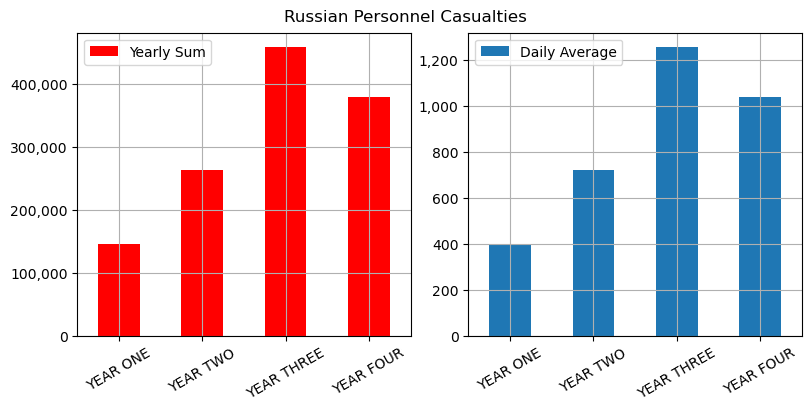
Russian casualties are enormous. On average, there are 1000 Russian casualties per day. Russia achieves minimal territorial advances at enormous cost, eg. Pokrovsk (250,000 casualties). Ragnar Gudmundsson estimates 227 Russian casualties for each sq km gained. Click on “Area gains” on the sidebar. Ragner’s site provides a very comprehensive statistical overview of the state of the war.

Ukraine casualties figure are not revealed by Ukraine. One estimate from Ragnar Gudmundsson’s site citing The Economist in November 2024 was that Ukraine military deaths ranged from 60-100,000. Russian estimated casualty figure at the date was 740,400 so given that 26% of those were deaths, the Russian death figure is roughly 192,000. So, if these figures are accurate the Russian:Ukraine death ratio is somewhere between 3:1 to 2:1.
What hard problems does Ukraine face?

  1. Russia is bigger
  • Russia has a bigger population than Ukraine: 3.5 times (142 million versus 39 million)
  • Russia’s economy is 11 times larger than Ukraines: 2.17 trillion versus 191 billion
  • they were reputed to have the world’s 2nd strongest military (a claim which looks ridiculous now) with the 3rd largest military budget
  • military spending is 3 times larger than Ukraines: 145 billion (6.3% GDP) v 54 billion (28% GDP)
  • some European countries were dependent on Russian and oil imports (Germany, Netherlands, Turkey, Poland, Finland …)
 COUNTRYPOPULATIONECONOMYMILITARY SPENDING
Russia142 million2,195 billion1456 billion
Ukraine39 million1,456 billion541 billion

Ukraine can only match this with reliable financial, military and humanitarian support from the Coalition of the Willing. Financial aid has been undermined by Trump since his election but according to Petraeus (see below) Europe has stepped up sufficiently to maintain Ukraine for at least another two years.

  1. Ukraine’s AWOL problem

It is confirmed at the highest level that Ukraine has huge AWOL problems:

“Ukraine estimates that 200,000 of its soldiers are absent without official leave (AWOL), meaning they have left their positions without permission to do so, the country’s new Defense Minister Mykhailo Fedorov revealed on Wednesday.

Speaking in the Ukrainian Parliament ahead of the vote that confirmed him as the new defense chief, Fedorov also said some 2 million Ukrainians are “wanted” for avoiding military service. ”

Ukraine’s manpower crisis emerges as a strategic vulnerability

Clearly, this is serious, but does not appear decisive given the stepped up use by Ukraine of unmanned systems. Their troops are better trained, better equipped and far better led than the Russians.

  1. Russian attacks on civilians

The sheer volume of Russian attacks on civilian targets (hospitals, schools) and infrastructure is a problem. Electricity infrastructure is under attack continuously. Winter temperatures are well below zero. Read this account on winter life in Kyiv by the editor of the Kyiv Independent.

Ukraine does need more help from its allies in the domain of air and ballistic defence capabilities.

  1. Zelensky has political troubles

Recently one of Zelensky’s top aides was removed on alleged financial corruption issues.

This source (read this link!)shows that Ukrainians believe that government corruption is a huge long term problem in their country (85%) but that confidence in their military is very strong (90%) and that support for Zelensky remains high (67%) although it has decreased from the Feb 2022 start of the war (85%)

What are Ukraine’s main strategic objectives?

As noted above Ukraine is winning on the battlefield, conceding some territory in exchange for massive Russian casualties.

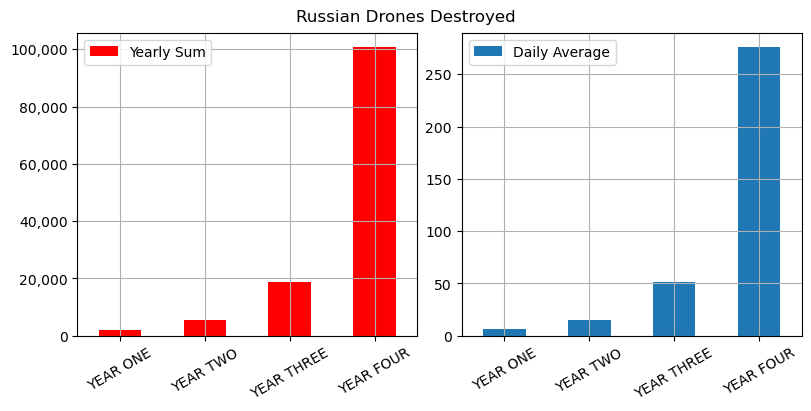
Ukraine has demonstrated superior technological mastery, particularly with drones. Zelensky says that 80% of Russian targets are destroyed by drones.

Importantly, Ukraine attacks Russian infrastructure, especially oil & gas & occasionally a fleet of bombers or a General in Moscow. One of their main aims is to destroy the money making and war fuelling Russian oil and gas infrastructure. They have had some tremendous success in this and Russia has had to adapt by importing gasoline from Belarus.

Ukraine successfully invaded Russian territory near Kursk (and held it for months) and Belgorad. This diverted Russian troops from the front line. In response Russia used troops from North Korea.

In 2025 there was a massive increase in drone usage by both sides. See graph below. Sometimes the Russians have been innovative, eg with fibre optic drones, but overall Ukraine is ahead. Drones are the new artillery and add tremendous potency to the infantry.
Neither side appears to have airforce superiority. According to this article, neither side dominates due to effective air defense systems, including drones. The air defence system on both sides is sufficient to keep fighters and bombers at a distance. On the front line drones have largely replaced them.

Russia employs glide bombs on city / civilian attacks to devastating effect. Ukraine has F16s from various countries.

According to one expert Russian’s can’t deploy their weapons, the battle zone is too wide, resulting in an extensive grey zone. Ukraine has better weapons all around, eg. the Archer from Sweden and the Caeser from France.

Ukraine’s innovative military doctrine continues to evolve rapidly. The trend is that Ukraine becomes stronger and Russia becomes weaker.

These trends are confirmed by a recent statement from Ukraine’s General Syrskyi:

The active front line stretches about 1200 km; the kill zone extends 15-20 km in depth.

Enemy strength is around 712,000 personnel, but casualty levels exceed Russia’s ability to replenish forces…

Work continues to increase the effectiveness of drones in air defense. Plans include redistributing functions between surface-to-air missile forces and a new branch of forces responsible for protecting critical infrastructure

Drones account for roughly 60% of all firepower on the front; artillery accounts for about 40%. In infantry firefights, Ukrainian soldiers prevail over the enemy in about 90% of engagements …”

What is Russia’s official position?

Russia has been consistent and unchanging in their demands. The following points were made by Russian Security Council Chairperson Dmitry Medvedev on February 1, 2026 ([link[(https://www.criticalthreats.org/analysis/russian-offensive-campaign-assessment-february-2-2026)):

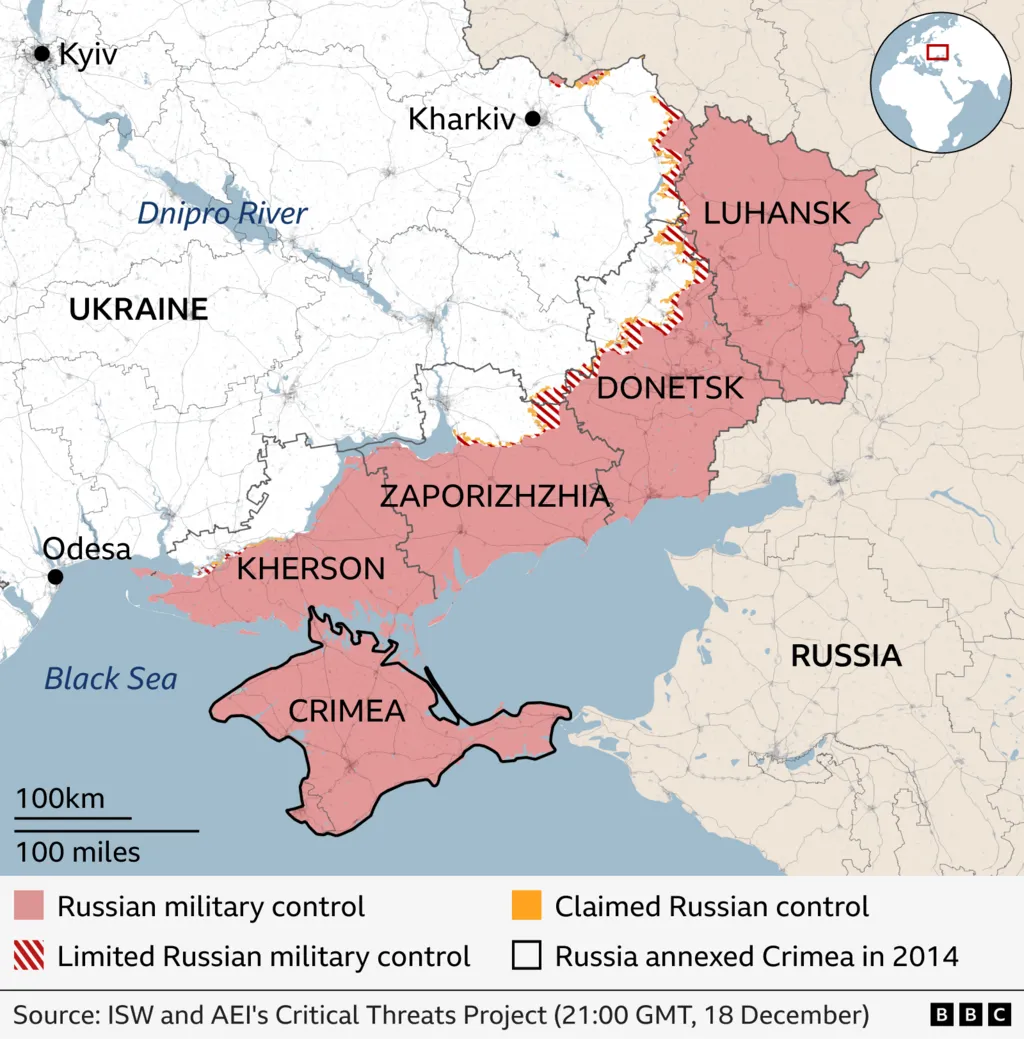
  • Ukraine must cede Luhansk, Donetsk, Zaporizhia, and Kherson oblasts (see the map at the start)
  • Ukraine has to demilitarize
  • the Ukraine government are Nazis and so that government has to be replaced with a pro-Russian government
  • compared the current conflict with Ukraine to the second world war with Russia defending the state and the Russian people
  • those in Russia who are indifferent to Russian soldiers on the front, who are unwilling to help their own state, and who “lack basic patriotism” are Russia’s “internal enemies.”
  • rejected proposals from the British and French-led Coalition of the Willing to station foreign troops on Ukrainian territory as part of postwar security guarantees for Ukraine.
  • the risk of a global nuclear exchange is high, Russia will use nukes if the fate of Russia is at stake
  • Finland has dismantled Russian-Finnish relations

What are the Russian political and economic problems and can they overcome them?

As noted above Putin doesn’t want to hear the truth which puts him at a disadvantage. Periodically, those who question Putin fall out of windows or suffer a plane crash or a gaol sentence.

Putin faces internal dissent. For example, General Igor Girkin created the “Club of Angry Patriots” to save Russia from what he said was the danger of systemic turmoil due to military failures in Ukraine and jostling in the elite to eventually succeed Putin. He was then sentenced to 4 years in gaol. (source)

Russia has militarised their economy (more than 6% military spending of GDP in Feb 2025 and rising) and the Russian people are suffering. How big are their economic troubles and can Putin manage it?

Russia influence is collapsing on many fronts internationally (Venezuela, Syria, Transnistria, Black Sea, with trouble brewing in Iran and Chechnya). Nevertheless, Russia maintains some currently supportive allies: North Korea, Georgia, Cuba, China, Belarus.

Russian nukes are paper tigers. He periodically threatens to use them but can never find a way that might help him achieve his goals. This still seems to frighten some European leaders.

What is the mood of the Russian people?

Some insights from Elvira Barry:

With Putin as leader Russia is in decline. Their population is shrinking and their technology is outdated, the education system and health care are all in trouble. Many who are well educated have left the country. Elvira Barry divides up the opinions of the people in this way. The dreams of:

  • the imperialists argue that the west wants to destroy Russia. They want a powerful, militarised Russia
  • the survivors long for a return to the pre-war days. They are apolitical but if pressed: “Ask them who they support and they will confidently say ‘Putin made the country strong”
  • the reformers want a properly functioning democracy. They face enormous obstacles here with the current regime of censorship

She moves on to talk about the opinions of the leaders of other countries. This varies from deep distrust to pragmatic support. The consensus here is that Russia is a declining but dangerous power.

Why is Trump behaving badly with respect to Ukraine?

Like everyone else I’m unsure of the answer to this question.

Trump’s stated surface position is that war is bad for business and he is good at stopping wars around the world

The previous Biden administration supplied billions of dollars of arms to Ukraine but with significant restrictions. The weapons could only be used within Ukraine territory. Their dithering policy was avoid a dangerous escalation. A background worry is that a dangerous escalation or a Ukraine victory might lead to tactical nukes being used.

This fear of where the nukes will end up seems to be a strong motivator in both the Biden and Trump administrations. Neither want Putin to fall.

Early in the piece Trump and Vance had a confrontation with Zelensky and said “Zelensky has no cards”. Perhaps Trump listens to bad advice about the real situation in the war or perhaps that was blather.

Trump has been critical of Europe for not pulling their weight in NATO and for their trading policies. These criticisms are legitimate.

Trump policy can be partly explained in terms of his preoccupation with money. He moved onto attempting to do a rare earths deal with Ukraine and is ok with Ukraine buying American weapons through Europe.

One interpretation is that Trump accepts Ukraine as part of Russia’s legitimate sphere of influence. His focus will be on keeping America strong in the Western hemisphere and stepping back from a global role it pursued previously. But Trump is hard to fathom. His recent move against Venezuela and possible future move against Iran creates huge problems for Putin.

Are Europe and NATO doing enough?

Zelensky, at Davos, angrily criticised Europe for their slowness.

Following on from Russia’s militarisation and America’s strategic withdrawal Europe is stepping up but this is uneven and slow.

Finland joined NATO in 2023 and Sweden in 2024.

According to Ben Hodges Germany, Finland and Romania (and perhaps others) have grasped the need to increase their military preparation.

David Petraeus presents a positive picture. He says the recent decision by the EU to provide 105 billion dollars equivalent (zero interest loan which doesn’t have to be repaid prior to Russian reparations) to Ukraine will solve their problems for the next couple of years and double their production of drones and the Flamingo cruise missile (which have a longer range – 3000 km – than the US tomahawk cruise missile, very significant capabilities).

As Ukraine has become smarter with their technological innovation and production, so has Europe.

Strong NATO voices are emerging. Canadian PM Mark Carney speech as Davos 2026 called for the middle powers to step up now that the US as a big power could no longer be trusted.

Sometimes it seems that frozen Russian assets are finally heading for Ukraine (through the efforts of EU Ursula von der Leyen) but this is an on again / off again story.

Europe’s combined financial contribution to Ukraine is roughly equivalent to what was supplied previously by the US.

Europe could do much more. For example the Russian oil carrying shadow fleet is vulnerable to NATO forces in the Baltic but Europe allows them to continue. But that would be up high on the escalation ladder.

Where are the peace proposals headed?

Trump has initiated peace proposals. Zelensky cooperates and inputs into this process but Putin doesn’t.

Ukraine has presented its own 20-point peace plan to the US, to counter the initial American plan which was heavily favouring Russia.

Finland PM Stubb recently said there was “full agreement between Ukraine, US and Europe” but I’m not sure what he meant by this. Britain and France are prepared to put in front line trip wire troops if a peace agreement is reached (rejected by Russia, see above).

There is little evidence that the war will end soon through these pathways. Although both sides have big problems in continuing, it is unlikely that either will abandon their declared aims.

Predictions

  • The Russian Ukraine war will continue throughout 2026. The only real hope of that not happening is an internal Russian coup against Putin.
  • Ukraine will continue to strengthen, Russia will continue to weaken.
  • Europe will strengthen their spine.
  • If Trump takes out Iran then that is a huge rewrite of the geo-political map. One outcome is that Iran will switch from a Russian ally to a Ukraine ally.

Final words

“Wherever there is oppression, there is resistance. Countries want independence, nations want liberation and the people want revolution—this has become the irresistible trend of history. All nations, big or small, should be equal; big nations should not bully the small and strong nations should not bully the weak.” source
References

  • See links to Ben Hodges, Chuck Pfarrer and David Petraeus in the article. Follow them for regular, accurate updates.
  • Ragnar Gudmundsson daily updates comprehensive statistics about the war daily here
  • Ukraine Government information and data here

European Far Right are Russian Quislings

We need to strongly oppose pacifist opposition to European re-armament. The latter is urgent and essential to defeating Russian fascist aggression in Ukraine and to thwarting the far Right in Europe who will oppose it under a range of popular slogans. 

My old comrade and friend David McMullen puts it very well in his substack, which you may like to support:

European Far Right are Russian Quislings

This ought to be stressed over anything else

Continue reading

Zelenskyy tells it like it is…

Global Cooperation Davos 2025: Special Address by Volodymyr Zelenskyy, President of UkraineJan 21, 2025

This article is part of:World Economic Forum Annual MeetingUkraine’s president Volodymyr Zelenskyy warns in his special address to Davos that Europe can’t afford to be second or third in line for its allies.

Continue reading

A CALL FOR AN INTERNATIONAL DEMOCRATIC MOVEMENT AGAINST AUTHORITARIANISM AND NEO-FASCISM

(An anti-fascist ‘international democratic movement’ is the order of the day and I’m happy to share this statement signed by David Mackenzie and Ken Mansell who were activists in solidarity with the Vietnamese during the American war in Vietnam. I don’t know why the term ‘Left’ is applied to the individuals/groups critiqued in the statement. It is not possible to be an apologist for and/or supporter of Putin and also be left-wing. The need to popularize the concept ‘pseudo-left’ cannot be separated from the building of an international anti-fascist movement in solidarity with people fighting for democracy).

Continue reading

The fascists in Russia’s hybrid army

There’s an old saying about the thief who cries thief in order to distract attention from himself. The same applies to the supporters of Russian imperialism and the Putin regime. They have been quick to take on board Putin’s propaganda that paints the Ukraine independence struggle as a fascist one, yet far-right parties received a much smaller vote in the Ukrainian elections than do similar parties, some of which are neo-fascist, in western Europe and the UK. Also, a cursory survey of the websites of such far-right parties reveals sympathy for the “anti-fascist” Putin. Far right and fascist groups both in Russia and throughout Europe are backing the so-called Donetsk and Luhansk ‘People’s Republics’ (DPR/LPR) in word and deed.

– c21styork

* * *

The following is from Paul Canning and is reprinted for non-commercial reuse under aAttribution-Share Alike 3.0 Unported Creative Commons license.

Type ‘fascist Ukraine’ into Google and the first dozens of results all refer to the Ukrainian government and those forces fighting the Donbas separatists.

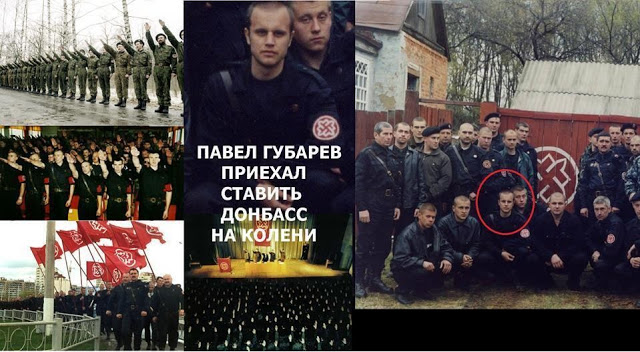
You will be hard pressed to find any references to the presence of fascists in Russia’s hybrid army in Ukraine. Ones like those pictured above in an astonishing piece of detective work by Dajey Petros.

Petros is a Dutch blogger who has been doing great work using similar tools to those employed by Eliot Higgins’ Bellingcat. Taking content from social media and using various tools to tell a story from it – like the story of the Russian missile which shot down the Malaysian Boeing.

Far right and fascist groups both in Russia and throughout Europe are backing the so-called Donetsk and Luhansk ‘People’s Republics’ (DPR/LPR) in word and deed. They are raising money for them, despite the sanctions. They hold mass rallies and other events. They send representatives to the Donbas to endorse the ‘Republics’. And they send Russians – and sometimes other Europeans – to join the fighting. All with the tacit approval of the Kremlin.

Gubarev

That approval was most sharply on display in March when Europe and Russia’s far right groups came together in a conference in St Petersberg. It was organised by the Rodina party whose leader is a Russian Deputy Prime Minister.

The event’s star was Alexei Milchakov, the leader of the ‘Rusich’ group of rebel fighters. Milchakov is infamous for photographs of him with a Nazi flag and a puppy he had allegedly killed. He has also posed in front of the dead bodies of Ukrainian soldiers.

Naming the separatist fascists

Many fascists were involved in setting up the DPR/LPR, such as Pavel Gubarev, the self-proclaimed first ‘People’s Governor of Donetsk’. His press secretary, Aleksander Kriakov, was described by Donetsk city Chief Rabbi Pinchas Vishedski as “the most famous anti-Semite in the region.”

When separatists took over TV broadcasting towers last year they boasted that:

Here, from Sloviansk, we are inflicting a powerful information conceptual blow to the biblical matrix … to Zionist zombie broadcasting.

They then presented a lecture by former Russian Conceptual Party Unity leader Konstantin Petrov, who the European Association for Jewish Culture (EAJC) describe as a “anti-Semitic neo-pagan national-Stalinist sect.”

In March last year Josip Zisels, Chair of the Association of Jewish Organizations and Communities in Ukraine, noted that pro-Russian organisations’ websites “have published many anti-Semitic materials which were meant to instigate hatred against the Maidan as being allegedly inspired by the Jews.”

Former DPR Prime Minister Aleksandr Borodai was a writer for the Russian fascist newspaper Zavtra. He opened the DPR’s first foreign ‘consulate’ on the premises of the Moscow branch of the Eurasian Youth Union (EYU), the youth wing of the Eurasia Party, headed by fascist ideologue Aleksandr Dugin. Dugin has openly called for genocide against Ukrainians.

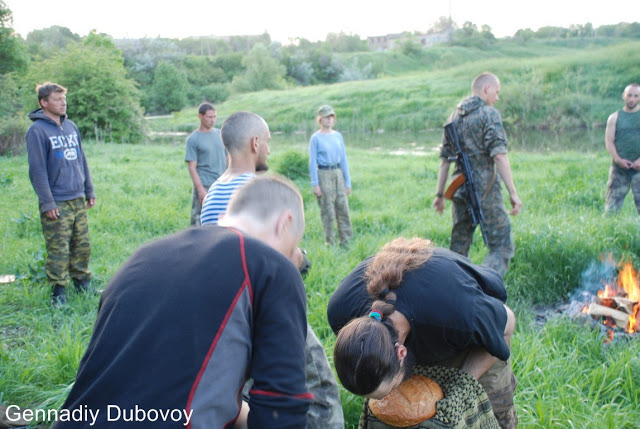
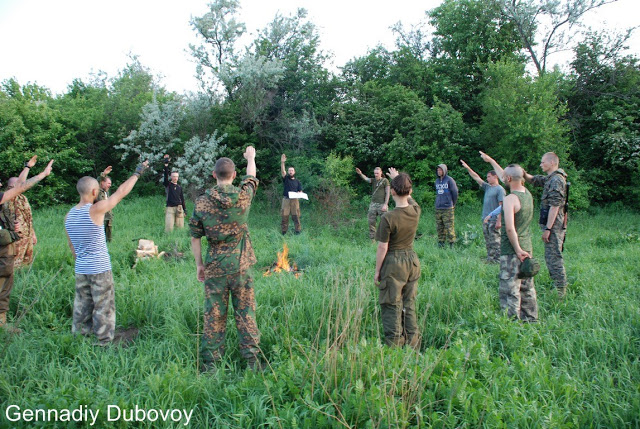
Another prominent Russian fascist in the Donbas is Gennadiy Dubovoy, whose colleagues are shown in the top and left photos participating in some sort of bizarre Nazi ritual. (See lots more whacky photos.)

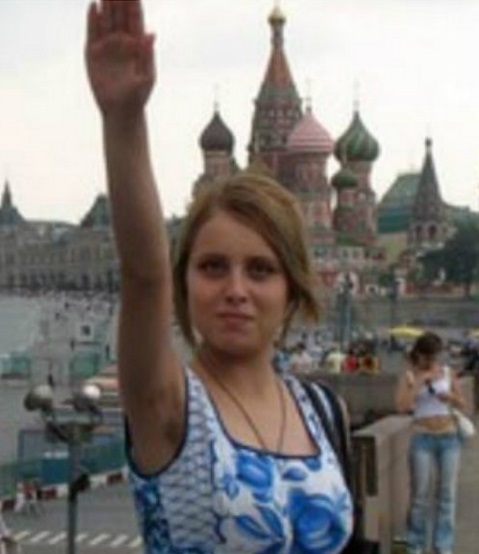
Yuli Kharlamova

Participating in the ritual are several women and one is Yuli Kharlamova, a presenter on the Russian TV channel ANNA- News and an FSB (Russian security services) agent.

There are many other individual as well as organised Russian fascists who have been documented from social media engaged in leading roles among the separatists. As Petros puts it “in Russia’s [hybrid] army the Nazis structurally and openly belong to the core and they train others.” Not only that but Russian soldiers who have been captured have been found to have Nazi tattoos.

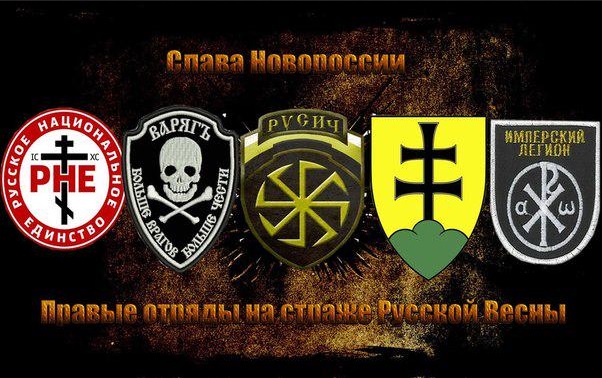
Here are the patches for five fascist militias in that separatist hybrid army (there are others):

And according to the expert on the far-right in Europe Anton Shekhovtsov there is evidence that proves that “Russian fascist organisations have been heavily infiltrating and instigating pro-Russian separatist movements in South-Eastern Ukraine” before the Maidan.

The real politics of the DPR/LPR

The UK has an organisation supported by leading lights in the so-called and unfortunately influential ‘Stop The War Coalition’ which claims that the DPR/LPR are socialists fighting fascists, but when the DPR/LPR organised sham elections last November socialists and communists were excluded.

The DPR constitution has the Russian Orthodox Church of the Moscow Patriarchate as the official religion. The Ukrainian Orthodox Church of the Kyivan Patriarchate, Ukrainian Greek Catholic Church, Roman Catholics, and Protestants, are officially regarded as ‘anti-Russian’ and have been actively persecuted.

According to a separatist recruitment video:

This war is a religious war. For Banderist money, agents of the Vatican, splitters, heretics fight against us, all of them traitors to Christ. And that’s why this war is a religious one.

The constitution also says that “any forms of perverted unions between people of the same sex are not acknowledged and will be prosecuted.”

The separatists running DPR/LNR have the documented support of only 18% of locals.

A further sign of the real politics of the separatists is shown by how anti-semitism fuels their infighting.

And in February, at a press conference, the leaders of the DPR/LPR, Zakharchenko and
Plotnitsky, ended their interview with anti-Semitic remarks.

Zakharchenko said: “I can’t remember, that at any time in Ukrainian history, cossacks were ruled by, well, not exactly those people, who ever carried a sword. Jews…”
Plotnitsky, (interrupting, grinning): “There is a video on Youtube ‘When the Jewish Cossacks have risen’, let them watch it”. Zakharchenko: “It’s not Jewish Cossacks, it’s miserable representatives of a great people, but they never ruled over cossacks. Taras Bulba and Taras Shevchenko would be turning in their graves because of such rulers in Ukraine.”

Abraham H. Foxman, National Director of the Anti-Defamation League (ADL), said that “those watching understood very well that this was an anti-Semitic appeal.”

This climate is being encouraged by Russian television, the only TV available in the ‘People’s Republics’, who during last year’s Ukrainian elections, accused leading candidates of being Jews.

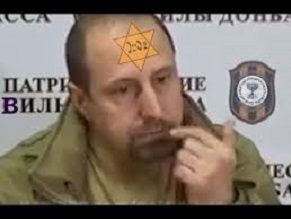
Antisemitic meme against Alexander Khodakovsky, DPR ‘Security Council’ secretary

The lies about fascism in Ukraine

Human rights and Jewish groups both say that Russian claims, including by Putin himself, of rampant antisemitism, even ‘pogroms’, in Ukraineare not correct. Some of the incidents they recorded may actually have been orchestrated by Russian secret services, such as one which took place in July in Lviv.

The reality is that Ukraine has one of the lowest levels of anti-Semitic incidents in all of Europe, according to Josef Zissels, General Council Chairman of the Euro-Asian Jewish Congress.

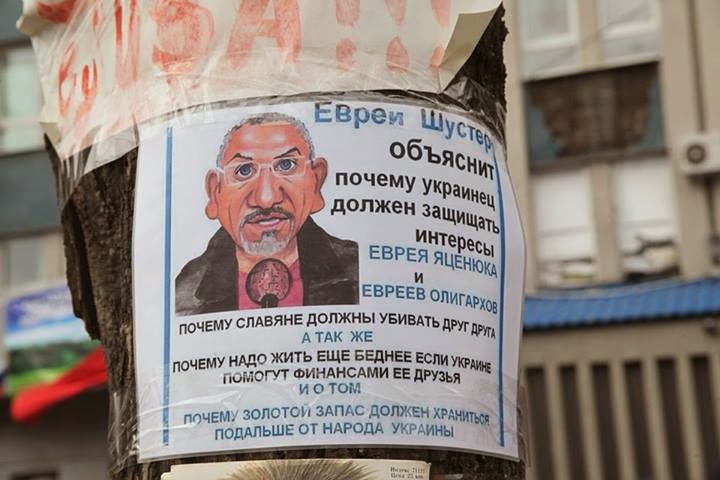
An antisemtic poster distributed in Luhansk during the initial unrest. It reads “Jew Shuster [Savik Shuster, Kyiv-based TV presenter] will explain why Ukrainians must defend the interests of Jew [Prime Minister Arseniy] Yatsenyuk and Jewish oligarchs. Why Slavs must kill each other.”

Researchers of Ukrainian nationalism issued a collective statement last March saying that the Maidan was a liberationist, and not extremist, mass action of civil protest. It condemned reporting which “misrepresents the role, salience and impact of Ukraine’s far right within the protest movement.”

Left forces in Ukraine have also consistently spoken out at the mischaracterisation of the Maidan revolution as a ‘fascist coup’, however their voices have been drowned by the Kremlin propaganda machine and its Western sympathisers – as well as by much of the mainstream reporting.

Dmitry Mrachnik (a member of the Ukrainian Autonomous Workers Union) is here extremely blunt!

The claim that fascists control Ukraine is propaganda by Putin. To those anarchists and left-wingers who believe Putin’s propaganda about a fascist regime in Ukraine and who support Russia I say:

Take a deep breath, gormless half-wits. For many years Russia has already had something like the kind of fascism which Ukraine is accused of. Anyone who supports fascists who save a neighbouring country from fascists must be either pretty stupid or completely devoid of any conscience.

The propaganda about Ukraine being ‘fascist’ directly fuels violence. It is consistently cited as a reason for those joining the DPR/LNR. This does not mean that the growth of nationalism in Ukraine should not be a concern.

Says Halya Coynash of Kharkiv Human Rights Protection Group:

Ukraine’s leaders have laid themselves open to criticism over the role of the Azov volunteer battalion, with its neo-Nazi leaders and probably members, as well as the more extreme elements in Right Sector and VO Svoboda. A few individuals such as Andriy Biletsky and Ihor Mosiychuk have won seats in Parliament, while others have received questionable appointments on the basis of their bravery in defending Ukraine. There are legitimate concerns about their role beyond the battlefield, as well as doubts about their motives as the recent conflict in Mukacheve has demonstrated.

All this is a gift for Kremlin propaganda, but it still does not justify broad claims about Ukrainian society. Ukraine’s two far-right parties did very badly in last year’s presidential and parliamentary elections, and no evidence exists that voters support anti-Semitic or xenophobic views. Now in Parliament, Biletsky reportedly claims that stories about his neo-Nazi and white supremacist views is all Russian slander. The denial is unconvincing, but it is telling that he sees the need to make it.

It is unlikely, she says that the Kremlin will “abandon its propaganda arsenal” and she warns about “fakes, manipulation, and total fabrication.”

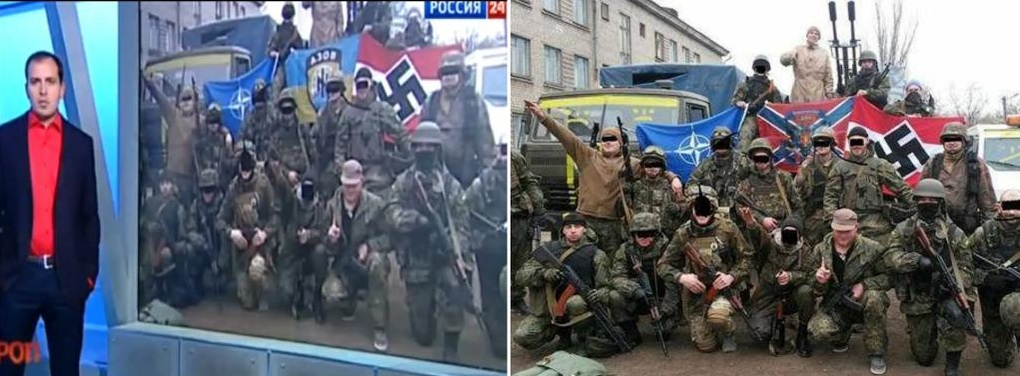
Petros uncovered one such manipulation last year. A member of the now famous Ukrainian Azov battalion, whose members undoubtedly do include fascists, had posted a photo of his battalion posing with a Swastika flag. Petros proved it was a photoshopped fake, the original had no Nazi flag in it. Nevertheless here it was on Russian primetime TV news …

It is entirely right that Western media should report, as the BBC’s leading news show ‘Newsnight’ did recently, on the far right in Ukraine. What is wrong is that the presence of fascists in powerful positions among the separatists is being totally ignored.

Western journalists often say that they strive for ‘balance’. Well, where is it? On this issue they are doing what the Russians do – only report one part of one story.

INTERVIEW WITH A UKRAINIAN MARXIST AND SOLDIER FIGHTING IN THE DONBAS (from Ukraine Solidarity Campaign)

“In Russia right-wing conservatism and authoritarianism are not just a tendency but full reality”.

Reprinted with permission from ukrainesolidaritycampaign in Donbas, January 12, 2015

* * * *

anti-imperialist-action

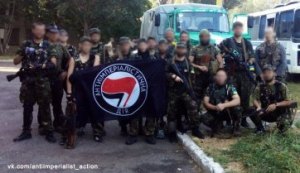
Ukrainian soldiers in Donbas with the symbol of Anti-Fascist Action – and slogan ‘Anti-Imperialist Action’.

Andriy M. (the name was changed) is one of those Kiev white-collar leftists, who after some hesitations supported Maidan last winter and in spring took a decisive stand against the reaction in Crimea and in Eastern Ukraine. His stand finally led him to the Ukrainian army and now Andriy is taking part in the ATO (Anti-Terrorist Operation) in the Donbas. Having known this, “Nihilist” [1] asked him a few questions. Republished courtesy of Zbigniew Marcin Kowalewski.

– How did you come to join the army? What unit is it?

– A very ordinary one, the 72nd Separate Mechanized Brigade. The one that was surrounded near Izvarino in July. In that time it was constantly being shot at, while suffering heavy personnel and equipment losses. Four hundred soldiers were even forced to withdraw to Russian territory, an outcome that generated a lot of media hype. Later the Ukrainian troops gained control of Savur-Mohyla barrow, liberated the surrounded brigade, and led it out of the ATO zone. In August-September near Melitopol the brigade was replenished with personnel and armored fighting vehicles. I then joined that brigade as a gunner and was mobilized in August. At the moment the brigade is again in the ATO zone.

– Could you have evaded military service?

– Technically yes, definitely I could. But already in March I went to the military commissariat and told the commander that the army can count on me. At that time Crimea was just annexed and the riots in the Donbas and Kharkov had begun. It was clear to me that a big war was coming. I was also convinced that Russian Army intrusion was a matter of a few weeks. For me the Putin regime, Russian occupation, and ideas of “Russian World” are absolutely unacceptable. Therefore it was impossible for me to remain a bystander. Then everything went a bit different than expected. Instead of regular army invasion, Putin began by using local paramilitary formations, but in reality it did not change the situation. Of course, lots of friends offered me “help” – shelter, leaving Kiev and going abroad, applying for a visa etc. I did not take such alternatives into consideration for reasons of principle.

– Do you characterize yourself as a leftist and a Marxist today?

– In respect of beliefs, a worldview – definitely yes. However, if one takes a point of view that sees Marxism as a political practice in the first place, I could be reproached that according to this criteria I am not a Marxist. I will not argue with that, but I just ask whether the Bolsheviks were Marxists when they were defending the Kerensky government from the Kornilov Revolt.

As a Marxist, I am aware of the fact that today a Ukrainian state is an unpleasant thing. There are very strong rightist conservative and nationalist tendencies there, with the power in the hands of big capital – the same as before, a powerful offensive is launched against the social component of state spending and workers’ rights. You know, as in the “socialist realist” art, the priority was depiction of a conflict between the good and the better, today in the Donbas there is a conflict between the bad and the worse. In Russia right-wing conservatism and authoritarianism are not just a tendency but full reality. The new expansionism in the sauce of the “Russian World” is a disgusting reactionary ideology that in reality is translated into war, violence, lies and hatred. In the Donbas all of them are in full bloom and trying to expand themselves. In my opinion, the main task is to stop it. Referring to the Kornilovism analogy, I will mention that a good friend of mine, a socialist, says that this war takes place between Petliuraites [2] and White Guards. This analogy is a bit lame, but in the situation when at war there is no communist side, for me as a Marxist the choice between White Guards and Petliuraites is obvious: in favor of the latter. At the same time it is evident that we are not even allies but just fellow travellers and just to the first crossroad.

– What do you think about Maidan? What was that?

– Maidan is a very complicated theme. On the one hand, it was a popular uprising and an experience of the self-organization of the masses, followed by the creation of volunteer battalions and a powerful and effective network of volunteers supporting those battalions, but on the other hand, there was an openly right-wing political wrapping. My approach to Maidan was changing from careful neutrality towards critical support following the infamous 16 January Laws. In any case, even the very right-wing wrapping was not sufficient to discredit the powerful democratic component of Maidan. In my opinion, it is enough to deserve acknowledgment. In any way, Maidan is in the past now; we live in the post-Maidan epoch and at the moment that mixture of progress and reaction, prepared on Maidan, is breaking down into its components: so much the better. It would be easier to separate the wheat from the chaff.

– What is this war for you?

– Firstly, it is a huge tragedy for millions of people – sorry for the banality. The civilian population is being disinformed, deceived and terrorized by both sides. In those rare cases, when the dialogue with the local inhabitants is held, the majority of them ask: “Why have you come armed to our land?” When you answer: “To prevent separatists and Putin’s soldiers from coming armed to our land”, they do not accept it. However, this is a real goal. There are lots of aspects of this war and I clearly see political profits gained by the Ukrainian and Russian elites – the profits generated from sufferings of local population and Ukrainian and Russian soldiers. For me personally, such phantasms as a territorial integrity or a national statehood have no meaning and I do not see them worth life and blood. However, if Ukraine lays down arms, the war will not stop but imperialist Russia will just continue its bloody expansion undisturbed. It is an aggression and the aggressor must be stopped not appeased. Unfortunately, there is no good solution here. One has to choose between the bad and the worse.

– What are Ukrainian soldiers in the East fighting for?

– Every soldier is fighting for his own reasons. For example, my colleague, a Maidanist and romantic nationalist, Sanya is fighting for his fatherland and the centuries-old Ukrainian dream of independence. A robust peasant, Misha, is fighting so that no-one from abroad tells him, his children, and grand-children what rules they should live by. An electrician Serhiy is fighting only because he was mobilized and he is very unhappy with it. He is also personally unhappy with the commissar who sent him to the slaughter instead of somebody more suitable. However all that does not prevent him from performing combat missions with dignity. Some people do not hide that they are fighting for money – due to the poverty and unemployment in civilian life, going to war has become a noteworthy alternative for a number of people. The majority of soldiers are convinced that they are fighting for Ukraine, its territorial integrity, the right to live not on orders from Kremlin, preventing “Donetsk bandits” and “commies” for good from trying to govern the country. That is the main motivation.

– It turns out that the soldiers are anticommunists and it is a mass phenomenon. How could you explain it?

– There is a great temptation to shift the entire responsibility to the Communist Party of Ukraine (KPU). The party of Petro Simonenko did really all that could have been done to make the word “communist” offensive. Years of serving the interests of oligarchs accompanied by the socialist rhetoric and last year’s explicit support for the enemy – all that leaves a trace. However, this is not only the matter of the KPU. The ancestors of numerous soldiers and officers were victims of Stalinist repressions or died during the Holodomor (extermination by famine). For each of them those things are not an abstraction or historical events but a tragedy that directly touched their families, a crime committed by the Soviet government. And through two decades the Ukrainian state propaganda machine was successfully flooding the masses with the idea that the famine, violence and executions are the essence of communism. No wonder people easily adopt it as their own viewpoint.

– Does a communist feel comfortable in such an environment?

– Of course not. But there is one good principle: “neither to cry nor to laugh but to understand”. To keep one’s cool. To notice that the hatred to communism among the masses of soldiers is not hatred toward the ideas of justice, cooperation, solidarity and freedom. On the contrary, it is hatred of the social parasitism that typifies communist party hierarchies, and hatred of the total physical, ideological and economical violence. And it is entirely compatible with sharp non-acceptance of the new post-Maidan government. For the majority of soldiers Poroshenko, Yatseniuk and Klychko are no better than Yanukovych. The timeliness of the social question has not been abolished. Certainly, today the ultra-right forces are trying to speculate with it but that is because the left in Ukraine turned out unable to play on its traditional political field.

– Is that why the left has lost in Ukraine?

– It is a complicated question. Now I am to say a handful of standard phrases about the combination of objective and subjective factors. And where did you see a victory of the left in the period of primitive accumulation and redistribution of capital? The actual left-wing class-oriented mass movement has not been able to form yet – one cannot take for the left the Soviet-conservative KPU or pale pink bourgeois socialists! Not to mention commercial and technological political projects like Borotba, which, from the very beginning, were created to fulfill completely non-leftist tasks. Those left-wing organizations that were actually trying to fulfill the proper tasks, either were organizationally too weak to grow out of little circles or turned out to be so accustomed to the certain conditions that they were not able to realize themselves outside those conditions – like for example the Direct Action [3].

– Has your approach to the Western and Russian left changed?

– It has not changed but rather definitely formed. In the West the left is characterized by rational conformism, by dogmatism or – most often – by a combination of both of those unpleasant features. They, more or less successfully, fulfill the tasks in their own countries but in respect to Ukraine their position is affected in varying degrees by adjusting their thinking on the Ukrainian situation to some of the usual dogmas and to “export” opinions of their Ukrainian contacts that very often turn out to be presenting and analyzing in bad faith Ukrainian developments. As a result, numerous Western leftists believe that there is a socialist revolution in the Donbas, that Ukraine is a fascist state and this state is drowning the popular uprising in blood on the orders from Washington. To make them change their mind is incredibly hard, even impossible. Therefore, in my view, it is easier and better to live as if there was no Western left. As for the Russian left, a huge part of it is under the impression of bygone “Soviet socialism” and the “great victory against fascism”. The Soviet Union passed away long time ago, in the Kremlin there are no people in power who defeated fascism in 1945. Meanwhile in Kiev the power is not in hands of Bandera and Shukhevytch, but the matrix is in use and people who curse the regime furiously turn out to be faithful Putinists when it comes to the issue of Ukraine. Fortunately, not all Russian left is like that, but…

– What should be done?

– To observe attentively. In no case to shut away in an ivory tower but, quite the contrary, to be in the thick of things, as close to people as possible. As a matter of fact, it is another reason why I am in the war now. As long as we have the first-hand experience of what the people of Ukraine live and breathe, we will be able to create an effective strategy and tactics. A very complicated time is coming. A right-wing consensus in the society combined with an unsolved social question can lead to a fascist coup. One should become aware of this danger and prepare for it. To educate the masses, to propose a solution to social conflicts that would be based on a class approach. That solution must be more effective than the one proposed by the right-wing national-social populism. And I have fallen into the abstract again. Let us finish the war and then we will talk about this issue in more detail, ok?

Nihilist, December 6, 2014

Translated by Katarzyna Bielińska and edited by Louis N. Proyect

[1] “Nihilist” is a web portal edited in Ukraine by anarchists and left-wing anti-authoritarian radicals who try to “combine constant theoretical search with everyday revolutionary practice”.
[2] Petliuraites was the popular name of supporters of the Ukrainian People’s Republic, formed in Kiev after the fall of the Russian Empire. It existed since January until April 1918 and since December 1918 until November 1920. It was in war both with Soviet Russia and the imperialist Great Russian White Guards. Its Commander-in-Chief and, since February 1919, its President was Symon Petliura.
[3] The Direct Action (PD) is a network of independent students’ unions, with a left-wing anti-authoritarian and syndicalist orientation, established in 2008 in Kiev and active also in some other universitary centers of the country.

Open Letter to Oliver Stone – by Stephen Velychenko (Krytyka) 1 January 2015

Historian Stephen Velychenko penned this ‘open letter’ to US film-maker Oliver Stone on 1 January 2015. It is reprinted with permission of Krytyka, the ‘Thinking Ukraine’ website. Among other things, the letter points out that foreign involvement in regime change and revolution is nothing new and that includes the American people’s own revolution against tyranny and the Vietnamese national liberation struggle during the 1950s to the 1970s.

‘Things can turn into their opposite’ and we see this today with the various ‘anti-imperialists’ who long ago stood on the side of the people but who are now siding with the far-Right Russian chauvinist Putin’s slanders against Ukraine’s democratic struggle.

As Lenin said: “Russian Socialists who fail to demand freedom of secession for Finland, Poland, the Ukraine, etc., etc.—are behaving like chauvinists, like lackeys of the blood-and-mud-stained imperialist monarchies and the imperialist bourgeoisie”. This applies not only to ‘Russian socialists’.

– C21styork

AN OPEN LETTER TO OLIVER STONE

Dear Mr. Stone,

I am an academic historian who likes to think he has some knowledge of world events during the past centuries. I am someone who has watched and thought about some of your better films and who had the good fortune to have been in Kyiv on the Maidan in November-December 2013.

I was appalled and distressed when I read that a person of your stature had decided he would make a film about Ukraine’s ousted dictator Victor Ianukovich. What unsettled me was not your idea about interviewing a dictator on film. Documentaries about surviving ousted dictators are important and useful. What I found appalling was not only that you seem to share his interpretation of his fate, but that you seem to attach particular significance to that interpretation. You seem actually to believe Mr. Ianukovich who, understandably, like any overthrown dictator, attributes his fate to “outside forces” rather than to himself, his policies and supporters, domestic and foreign. Just like Mr. Ianukovich and Mr. Putin, you seem to think that the new government that emerged from the Maidan events 2013-14 is the product of CIA machinations, that CIA involvement was something exceptionally noteworthy, and, implicitly, that because this government is supposedly a CIA product, it has no merit or credibility.

Do you really believe Mr. Stone that in any of the great events in world history during the past centuries the intelligence services and spies of the great powers of the time were not involved? Simply noting this fact in isolation from all other events leads either to apologetics or conspiracy theories. Allow me to illustrate my point.

In so far as French secret agents were involved with the leaders of the American rebellion of 1776, some of whom were Masons, does that fact override the influence of enlightenment ideals and the interests and grievances of those who fought King George’s army? Did the presence of French spies and Masons in Philadelphia New York and Boston mean George Washington was part of a foreign plot? Does the British government’s support for Greek nationalists in the 1820s mean their anti-Turkish revolt was merely a British plot? In so far as Spanish, French and German agents supported Irish leaders in their wars against the English government, does that mean that those who fought British troops in the name of Irish independence were dupes in foreign plots? Was the 1916 Easter Rising really a failed German plot? In so far as German intelligence supported and financed the Bolsheviks in 1917-1918, does that mean the Russian revolution was simply a German plot and that those opposed to the tsar had no legitimate interests or grievances? Did covert Russian and Chinese support for Vietnam mean a sizeable proportion of the Vietnamese people had no legitimate grievances against French or American rule and that their decades long war against those governments was merely a KGB plot?

I put it to you Mr. Stone that anyone who produces a film focusing only on the participation of one particular secret service in a given event merely creates cheap propaganda – in this instance of the kind that will benefit Mr. Putin and his dictatorship. At this point, I should perhaps add that, like many others, I have a critical view of the US government and US corporations. I am well aware of the work of analysts like Chalmers Johnson, Richard Barnet, William Greider, Naomi Klein, Gregg Palast, Will Hutton, Michael Hudson, Thomas Frank and Arianna Huffington. But I am among those who do not allow their critical view of the US and corporate power to blind them to the reality of Stalinist or Putinist Russia.

In so far as I am familiar with your films they do not suggest any knowledge of or previous work on eastern Europe or Russia, let alone Ukraine on your part. This is not surprising as for many Americans, even today, Ukraine still remains a “part of Russia”, a place “far away of which we know little.” But once one decides to undertake a project related to that part of the world such intellectual indifference is no longer acceptable. Allow me therefore take the liberty to suggest that you not limit any research you might undertake to Mr. Ianukovich, his cronies and Russian advisors. Might I suggest you at least peruse Karen Dawisha’s recent book Putin’s Kleptocracy (2013) and some of Andrew Wilson’s and Timothy Snyder’s books on Ukraine.

I hope that, at this early stage, your first thoughts about your possible film on Ianukovich and his rule have been misinterpreted or misunderstood and that my remarks prove unnecessary and irrelevant. But, in as much as you do seem interested at this point in a documentary film about one of the great events of post war Europe, I hope that you will record not only the activities of the CIA in that event. I trust you will also record the role of Putin’s FSB in bringing Ianukovich to power in 2010, in controlling his government thereafter, and in the events of 2013-14. Since Mr. Putin’s government has obviously given you a visa and permission to visit Mr. Ianukovich in Russia, dare one imagine your hosts might also oblige you with access to FSB files about FSB activities?

In any case, I trust that any film you might make on Ukraine will pay due attention to the interests and grievances of Ukrainians, who, like their eastern European counterparts demonstrated in 1989, do not want to be ruled by pro-Kremlin elites and are now again, as in 1917-22, fighting a Russian invasion to prove it. I would also hope that if a director of your repute did make a documentary film about Ukraine it would not simply parrot the ideas of a reviled ousted dictator who built fortified fairy-land palaces with gold toilets in a country foul with corruption private wealth and public squalor. I would hope such a film explain that Ukrainians want no more to be controlled by Russia or Russian controlled dictators, than Latin American and Asian peoples want to be controlled by America or American controlled dictators.

Respectfully yours

Stephen Velychenko

Krytyka