Syria: links

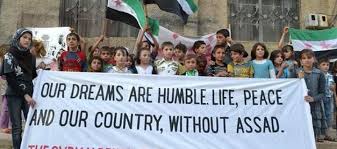
free syria flag

Nothing much happening at Strange Times so I’m hoping to kick-start some new links to information and analysis – and discussion – about Syria.

Hoping to set this up as a separate page soon. But for now… contributions welcome.

Just to start things off:

  • The ceasefire, which some people regarded as doomed to failure before it had even started, has been working, in the main, for nearly six weeks now. It has provided breathing space, with parts of Syria under rebel control able to commence reorganisation of their localities. For the first time in years, Syrians have been able to take to the streets again demanding the regime’s overthrow. Some humanitarian aid is getting through where needed, but this is still a problem area in places where the regime is obstructing aid delivery – and further isolating itself (and strengthening the case for miltiary intervention on the side of the pro-democratic forces).
  • Assad is increasingly isolated, with Putin looking for a way out and supporting the UN transitional plan; a plan that means the end of Assad’s rule.
  • The next round of talks might happen within a week. The co-ordinator for the Higher Negotiation Committee has said that there is no international will, especially from the US, which means that the rebels continue to want greater international involvement and support, especially from the US.
  • As the talks progress and the regime remains more intransigent and isolated, the need for some form of military ‘boots on the ground’ will become more acceptable as a way of resolving the situation and allowing the transition’s timetable to be followed in an effective way. A ‘coalition of the willing’ will be required to ensure that the terms of the transition are enforced, and that the Syrian people will be able to assert their sovereignty in free and fair democratic elections as aimed for in the timetable.


* * * * * *

Opening the borders – is it really unpopular?

The notion of opening borders is no longer a fringe idea of those on the Marxist Left and classical liberal Right. It has been implemented by Europe’s power-house and, to her great credit, Germany’s Chancellor Merkel is standing by her policy. And recent state elections and opinion polls show that the German people are not repudiating her. 

open borders x


* * * *

The Christian Democrat Chancellor of Germany, Angela Merkel, opened Germany’s borders to more than a million asylum seekers, mostly those fleeing the barrel bombs of the fascist regime in Syria.

The recent elections in three German states resulted in a new right-wing party, the AfD (Alternative fur Deutschland) which opposes the ‘open borders’ policy, receiving 25% of the vote in one electorate, 15% and 12% in the other two.

Googling ‘Merkel’ and ‘elections’, the headlines overwhelmingly suggest this is a defeat for Merkel’s open borders policy: a “disaster” for her. She has been “punished” by the voters for her open borders’ stance. So say the media headlines.

Yet further examination of the actual results in the three electorates – Saxony-Anhalt, Rhineland-Palatinate and Baden-Wuerttenberg – indicate that the results are a defeat for those who claimed the new party represents the silent majority.

In the elections, opponents of Merkel’s policy had their chance to test public opinion. And the result shows that they are marginal, averaging less than 15% of the vote.

It is true that the Christian Democrats, Merkel’s party, were defeated in Baden-Wuerttenberg. But they lost to the Green Party, which supported Merkel’s policy. Yes, they lost in Rhineland-Palatinate to the Social Democrats but the Christian Democrat candidate, Julia Klockner, stood as an opponent of her party leader’s open borders stance. The Social Democrat candidate was more favourably disposed to it.

In Saxony-Anhalt, the AfD did well with a quarter of the vote, but Merkel’s party came first with only a minor reduction in the Christian Democrat vote.

Moreover, opinion polls find that Merkel’s popularity hovers around the 50% mark. Currently, her approval rating is 54%.

A poll of voters about refugee policy in the three electorates found that Merkel’s approval rating is 58% in Rhineland-Palatinate, 54% in Baden-Wuerttenberg and 43% in Sachsen-Anhalt.

So, here we have a Chancellor who has shown that borders can be opened and, despite the inevitable chaos, the masses do not run from that Chancellor and her policy in anger and fear. Only a minority does that.

What Merkel has done is to change the paradigm of the debate over immigration and borders. Not just in Germany but everywhere.

The notion of opening borders is no longer a fringe idea of those on the Marxist Left and classical liberal Right. It has been implemented by Europe’s power-house and, to her great credit, Chancellor Merkel is standing by her policy. And the German people are not repudiating her.

She understands that ‘they’ are ‘us’ and ‘we’ are ‘they’, and that sharing the chaos does not preclude supporting measures to tackle the problem at its main source: the Assad regime.

She recently said that a million people is not many when you consider that Europe’s population is 500 million. The pity is that other governments are closing their borders rather than sharing the chaos caused by barrel bombs in a not-too-distant land.

Syria’s bourgeois-democratic revolution and the need for boots on the ground.

I share the following view by the Antiwar Committee in Solidarity with the Struggle for Selfdetermination but the important question is how can any decisions arising from the negotiations be enforced and maintained without a military force on the ground that is committed to enforcing and maintaining the transition.

The question of ‘boots on the ground’ needs to be tackled pro-actively by the governments and the UN that established the opportunity presented by the coming negotiations.

Boots on the ground that are sympathetic to the Syrian people would make delivery of humanitarian supplies more likely on the scale that is required.

Apart from needing to protect Syrians from the likes of Daesh, a military coalition on the ground (and backed by air support) will be necessary to guarantee that people can vote freely and to protect the Assad loyalists among the Alawite community once he is tossed out.

Comments welcome.


11055328_621048241328691_7043512423930289502_o


* * * *


We support efforts by the High Negotiations Committee of the Syrian Opposition to negotiate a political settlement which will lead to a transitional governing body, and to human rights for all, rule of law, and democracy for Syria. Given the scale of documented atrocities carried out by the Assad regime, it follows that such a process must bring an end to regime rule.

We further support the demand by the High Negotiations Committee that the international community implement in full the humanitarian provisions of UN Security Council Resolution 2254 prior to negotiations.

The current Geneva III Conference has begun against a background of escalating Russian and regime bombardment of populated areas and civilian infrastructure, escalating starvation sieges, and ongoing mass detention and torture of political prisoners.

UN Security Council Resolution 2254, which set out the international endorsement for these talks, called on the parties to “allow immediate, humanitarian assistance to reach all people in need, in particular in all besieged and hard-to-reach areas, release any arbitrarily detained persons, particularly women and children,” and demanded the full implementation of the long list of unenforced Security Council resolutions on Syria: 2139 (2014), 2165 (2014), 2191 (2014) and any other applicable resolutions.

Resolution 2254 further demanded “that all parties immediately cease any attacks against civilians and civilian objects as such, including attacks against medical facilities and personnel, and any indiscriminate use of weapons, including through shelling and aerial bombardment.”

These items are the express will of the Security Council and as such are not for negotiation between parties. The international community should never preside over a process where humanitarian relief is allowed to be used as a card in political negotiation.

As long as the international community fails to enforce its own resolutions, the Syrian people can have little faith in the peace process. If the international community can’t deliver baby milk to besieged areas, how can they be trusted to deliver free and fair elections?

For peace talks to succeed, the international community must implement the humanitarian provisions of its own UN Security Council Resolution 2254 in full

Care about refugees? Listen to them. Syrians are primarily fleeing Assad!

First survey (of Syrian refugees in Germany) shows Syrians are fleeing from Assad, not Isis. Nearly all want to go home. Republished from the diary.thesyriacampaign.org
 

11223757_969190529791016_4362445843417374564_o


Syrian refugees don’t want to stay in Europe. But unless politicians start listening to why they’re fleeing and what needs to happen for them to go home, many more will come.
 
 
Here are six key results from the first ever survey of Syrian refugees in Europe (full results below):
 
1. Most Syrians are fleeing from Assad, not Isis

Contrary to what you might read in the papers, it’s not the media-grabbing brutality of Isis that most people are fleeing from. It’s the much larger scale, state organised violence of the Assad regime that is driving most people from their homes.

70% are fleeing the violence of the Assad regime and its allies (32% Isis, 18% Free Syrian Army, 17% Al Nusra, 8% Kurdish forces).

2. Most fear arrest or kidnap by the Assad regime

All armed groups have been involved in detention and disappearances in Syria, but none to the extent of Bashar al-Assad’s government, as thousands of leaked images of torture in state prisons prove.

86% say kidnapping or arrest was a threat to their personal safety. 77% of them fear it from the Assad regime, 42% Isis, 18% Al Nusra, 13% Free Syrian Army and 8% Kurdish forces.

3. Nearly all Syrians want to go home

It might seem that the people struggling in boats across perilous waters or jumping over barbed wire fences really want to be in Europe. But they don’t. Syrians want to go home to the country they know and love. The problem is with the violence raging they can’t.

Only 8% said they’d want to stay in Europe indefinitely

4. Assad needs to go for Syrians to return home

While Russia and others are asking countries to unite with Assad to fight Isis, it’s important to note that the majority of Syrian refugees will not go back while he remains in power. Syria needs peace and an end to dictatorship.

52% said that Bashar al-Assad would need to leave power before they would return home

5. Stopping the barrel bombs would help more stay in Syria. Much more than increased aid
Stop the barrel bombs with a no-fly zone

The vast majority of refugees said they feared Assad’s barrel bombs – the improvised metal barrels packed with explosive and scrap metal that government helicopters drop from miles up in the sky onto civilian neighbourhoods.

These barrel bombs and other aerial attacks are the number one killer of civilians in Syria – the barrels alone have killed more than 2,000 children since the UN banned them in 2014. They routinely destroy hospitals, schools and homes. Syrians living under the barrel bombs find it difficult to forget the terror, even once they have fled to safety.

To stop the refugees pouring over Syria’s borders we have to stop the bombs. More aid isn’t the answer.

73% said barrel bombs were a threat to their personal safety. 58% said a no-fly zone would help more stay in Syria, only 24% said the same for increased aid.

6. The cause of today’s situation is Assad’s military response to peaceful demonstrations

So much has changed in the last four and a half years in Syria yet still an overwhelming majority of Syrian refugees hold Bashar al-Assad responsible for today’s events. According to most of those surveyed, Assad’s decision to use military force against peaceful protesters demanding freedom and dignity in 2011 is the cause of today’s violence.

79% said it was the Bashar al-Assad’s military response to the demonstrations that led most to the situation today.

What should Europe do?
To reduce the number of Syrian refugees to Europe and to help create the conditions for their return, European politicians should:

1. Enforce a stop to the bombs. There are various initiatives from no-fly zones, no-bombing zones and safe zones which while all different in their implementation, would prevent the biggest killer of civilians in Syria today: Bashar al-Assad’s aerial attacks and barrel bombs. Europe needs to get serious about stopping the bombs.

2. Push for a peaceful transition of power away from Assad. There is no military solution to the conflict and there is international agreement that a transition to a new government is the only way to end the violence. The longer that takes, the more people will be driven from their homes.

It goes without saying that Europe should open its borders to those fleeing war – that’s a human imperative.

European leaders need to realise that unless they do more to constrain the violence of the Assad regime and make more effort to stop the war, the waves of refugees will not stop. The UN has predicted another million will be displaced in Syria before Christmas, and that was before Russia joined in the fighting.

To solve the refugee crisis, we have to stop the Syria crisis.


This survey interviewed 889 Syrians living in Germany between 24 September 2015 and 2 October 2015 using a standardised questionnaire. Interviews were held in 12 centres housing arriving refugees, other refugee accommodation and refugee registration points in Berlin, Hanover, Bremen, Leipzig and Eisenhüttenstadt. Researchers from the Berlin Social Science Center were involved in the conception, implementation and evaluation of the survey. Full results are available here.

Syria: the facts and figures – the Syria Campaign

As Europe struggles to deal with a surge in refugees, attention is now shifting to Syria where most people are coming from. But what is the violence they’re fleeing?

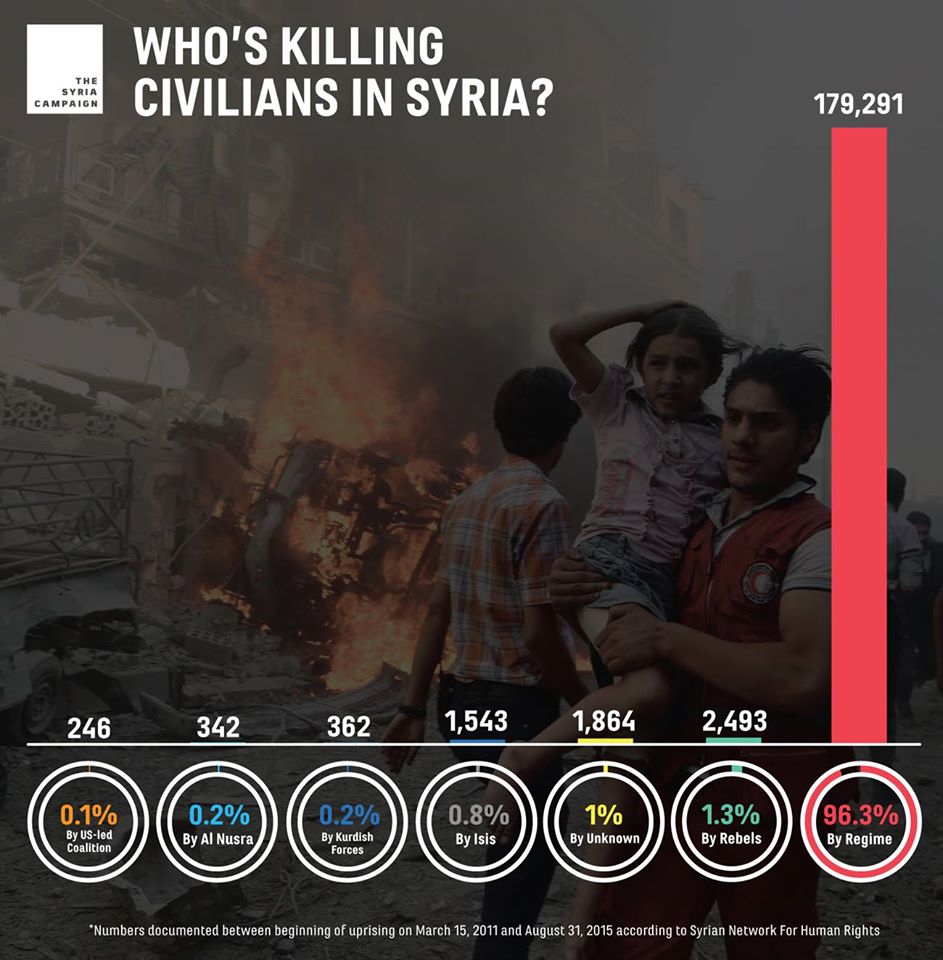
Many assume that Isis is doing most of the killing, which is partly why so many countries are now talking about bombing Isis in Syria. But the truth is different – and shocking. The vast majority of Syrian civilians killed – more than 95% according to human rights groups – have been killed by the regime of Bashar al-Assad.

Have a look at the data from the Syrian Network for Human Rights [1]:

12017617_910929855665695_3506046935164010625_o

Lots of people respond with astonishment when they see these figures, mostly because they don’t fit with their existing picture of the conflict. Some even say the numbers are lying. They’re not. While no monitoring group claims to have perfect data since their methodology and sources all differ, there appears to be agreement about the proportion of civilians killed by the Assad regime. [2]

So why do so many of us have such a bad understanding of where the violence is coming from?

Part of the answer may lie in how we hear about the conflict in Syria. The media talks about it increasingly as a “civil war”, a phrase that conjures up images of messy chaos, of various similarly-matched sides fighting each other. Likewise, the United Nations and well-meaning NGOs diligently criticise “all parties to the conflict” which promotes a perception of equal sides – or some sort of balance.

But there’s something else too. Part of the answer may lie in the disproportionate obsession with Isis. Our news is full of stories of Isis horror and brutality, but the larger scale state repression of the Bashar al-Assad regime seems to slip by mostly unreported.

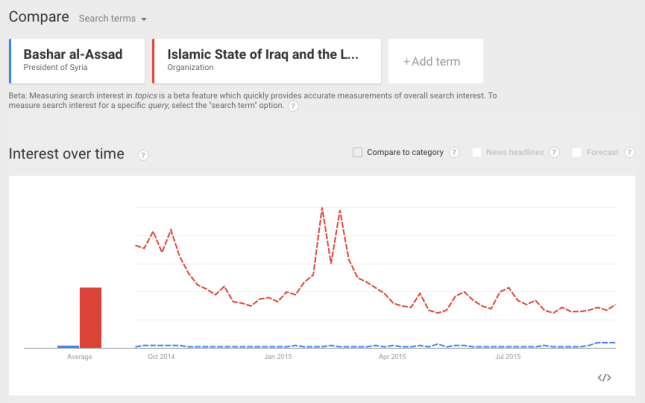
Have a look at Google Trends for news over the past year:google_trend_assad_2

Google Trends: Assad vs Isis

There was 43 times more interest in Isis than there was in Bashar al-Assad. And that’s taking in global internet users.

When we filter by United States only, we get an error message:

“Bashar al-Assad wasn’t searched for often enough to appear on the chart. Try selecting a longer time period.”

Same goes for the UK, France and Germany.

Astonishing. Together we have collectively airbrushed the biggest perpetrator of human rights violations out of the the Syrian conflict – Bashar al-Assad.

Why has the world chosen to ignore Assad’s crimes? Is it because he claims to be a secular leader? Is it because he is clean shaven and wears a suit? Is it because we don’t realise that by ignoring these crimes by the regime, we are becoming recruiting cheerleaders for Isis? [3]

Whatever the reason, the obsession with Isis over Assad bears no relation to their respective levels of violence.

The implications of this skewed focus are serious.

Right now the UK government is debating intervening in Syria to strike Isis. [4] Australia has just started anti-Isis strikes too. [5] France is about to join.[6] Russia has moved a heavy deployment of fighter jets and tanks into Syria to fight alongside Assad. [7] Russia has just days ago agreed to coordinate with Israel on its Syria operations. [8]

And yet nobody, nobody, is doing anything to curtail the biggest killer in Syria by far – the Assad regime and its air war on civilians.

As the United Nations envoy to Syria, Staffan de Mistura said, it is “totally unacceptable that the Syrian airforce attacks its own territory in an indiscriminate way, killing its own citizens. The use of barrel bombs must stop. All evidence shows that the overwhelming majority of the civilian victims in the Syrian conflict have been caused by the use of such indiscriminate aerial weapons.” [9]

All efforts at stopping the violence in Syria will fail unless we understand where it is coming from. The story of the data is unarguable – if we want to stop the killing of civilians in Syria we have to address the Assad regime.

What can you do?

Arm those around you with the facts. Share this with your friends and family.

We have used data from the Syrian Network of Human Rights to put together more infographics, on children, medical workers and media activists. You can view and share them here:

https://diary.thesyriacampaign.org/whats-happening-to-civilians-in-syria/

It’s crucial that we get the story right.

James Sadri – The Syria Campaign

[1] http://sn4hr.org/

[2] Nine months ago, data from a separate human rights organisation, the Violations Documentation Center, revealed an almost identical proportion of civilian killing by the regime – 95%.

[3] http://soufangroup.com/tsg-intelbrief-assads-atrocities-continue/

[4] http://www.ft.com/cms/s/0/84184f06-5e05-11e5-a28b-50226830d644.html

[5] http://www.rt.com/news/315150-australia-raaf-syria-mission

[6] http://www.dailymail.co.uk/news/article-3225008/France-prepares-airstrikes-against-ISIS-begins-reconnaissance-missions-terror-targets-Syria.html

[7] http://time.com/4043955/russia-syria-latakia-28-aircraft-assad-isis/

[8] http://www.aljazeera.com/news/2015/09/russia-coordinate-syria-military-actions-israel-150922045752894.html

[9] http://www.un.org/apps/news/story.asp?NewsID=51011#.VfAUos6x47w

——————————————————————————–

The Syria Campaign is building an open, global movement working for a peaceful future for Syria. We are people from all over the world who are coming together to tackle what the UN has described as “the greatest humanitarian tragedy of our time”.

‘Fairness and Accuracy in Reporting’ serves up more lies on Syria

Reblogged with permission of Bill Weinberg and his World War 4 Report.


syria banner

“Leftist” (sic) shilling for fascist dictator Bashar Assad reaches new levels of deception in an entry from one Adam Johnson of Fairness and Accuracy in Reporting (FAIR), perversely entitled “Down the Memory Hole: NYT Erases CIA’s Efforts to Overthrow Syria’s Government.” The chutzpah of invoking Orwell in his title is downright Orwellian, as his distortions reveal the very name “Fairness and Accuracy in Reporting” to be pure doublethink. Wedded to the persistent pseudo-left hallucination of a US campaign to destabilize Assad, Johnson gripes: “This past week, two pieces—one in the New York Times detailing the ‘finger pointing’ over Obama’s ‘failed’ Syria policy, and a Vox ‘explainer’ of the Syrian civil war—…didn’t just omit the fact that the CIA has been arming, training and funding rebels since 2012, they heavily implied they had never done so.” So what is Johnson’s evidence that the CIA has been doing this? In defense of his claim, he links to articles in (funny) the New York Times, The Guardian,Der Spiegel and the Washington Post. But if you bother actually click on the links (perish the thought), you’ll find that none of them quite back up Johnson’s assertions…

The Times story, from March 24, 2013, says nothing about the US “training” or “funding” the rebels—only a “secret airlift of arms and equipment.” If this support was ever “secret,” it wasn’t for very long. The very next month, John Kerry was openly boasting of US support for the Syrian rebels at an Istanbul meeting—although it is questionable how much of the promised aid actually reached the rebels. And by the end of 2013, Kerry had announced a cut-off of “non-lethal” aid to the FSA. National Security Advisor Susan Rice later stated that “lethal aid” had continued—but emphasized that it was in the interests of “counterterrorism”; that is, fighting ISIS, not Assad. (Haaretz, June 7, 2014)

The Guardian story (March 8, 2013) says nothing about the CIA, only “Western” training of Syrian rebels in Jordan. Actually read the story (persih the thought) and it turns out to be the British and the French, and the whole thing is based on anonymous sources. The only indirect reference to the CIA is the following line: “A Jordanian source familiar with the training operations said: ‘It’s the Americans, Brits and French with some of the Syrian generals who defected. But we’re not talking about a huge operation.'”

The story from Der Spiegel (the actual link is to a March 10, 2013 Reuters story citing Der Spiegel) is essentially a recapitulation of The Guardian’s claims, and concludes: “The reports could not be independently verified.”

The Washington Post story (June 12, 2015) actually reports that Congress was moving to cutCIA aid to the rebels. Again citing unnamed or fuzzy sources, the account claims the CIA has spent around $1 billion over the past “several years” to arm and train Syrian rebels—but emphasizes again that the primary enemy is ISIS, not Assad.

So of Johnson’s four sources, it is only the last that vaguely backs up his claim. And he leaves out two salient facts: that the aid is primarily directed against the jihadists who Assad is also fighting, not Assad; and that it is coming to an end.

Johnson does mention the far less ambitious but better publicized Pentagon program to train Syrian rebels, admitting it has been an “abysmal failure.” He doesn’t mention (as we have) that the fighters trained under this program amount to a whopping 54—of whom only 37 were still actually in combat last time we checked back in August. Nor does he mention (as we have) that rebels have refused to participate in the training program because of the Pentagon’s insistence that they do not use their training to fight Assad—only ISIS.

After this subterfuge, Johnson goes on to gripe that the Sept. 13 New York Times story fails to mention the CIA training program. Distortions, eh? Cast the beam from thine own eye, Adam.

He closes with the usual sickening bogus neutrality:

As the military build-up and posturing in Syria between Russia and the United States escalates, policy makers and influencers on this side of the Atlantic are urgently trying to portray the West’s involvement in Syria as either nonexistent or marked by good-faith incompetence. By whitewashing the West’s clandestine involvement in Syria, the media not only portrays [sic] Russia as the sole contributor to hostilities, it absolves Europe and the United States of their own guilt in helping create a refugee crisis and fuel a civil war that has devastated so many for so long.

Oh really, Johnson? How many of the refugees are fleeing the FSA, as opposed to Assad’srelentless aerial bombadment and ISIS sectarian cleansing? A case can be made that it is the West’s failure to meaningfully support the rebels—without condescending conditions that they don’t fight Assad—that has led to the disaster in Syria. The notion that “the West” is to blame for the refugees is literally echoing Assad’s propaganda. See CNN Sept. 16 (“Syria’s Bashar al-Assad: West is to blame for refugee crisis”).

In fact, even ISIS is a distant second to Assad as the aggressor the refugees are fleeing. An account based on refugee interviews on the German website Qantara quotes one refugee in its headline: “Stop Assad’s bombs, then we’ll go back.” A salient passage:

Indeed, the key reason for displacement in Syria is not IS, but Assad. The regime’s air force is killing at least seven times as many people as IS. This “terror from the air”, as it is referred to by civil groups, is destroying all those areas controlled by rebels—both moderate and Islamist. The aid organisation Doctors Without Borders reported that in August “heavy bombardments were carried out on 20 consecutive days in besieged Eastern Ghouta” where it is supporting 12 provisional underground clinics… One in every four victims—whether dead or injured—was a child under the age of five.

But you would get no sense of that from the ironically named Fairness & Accuracy in Reporting. This is the same FAIR, recall, that was eager to jump on utterly dubious claimsthat the rebels and not the Assad regime were behind the Ghouta chemical attack. Now it is plugging the utterly fictional notion of a “CIA Effort to Overthrow Syria’s Government.” Bunk. On the contrary, the US is tilting to Assad, viewing ISIS as the greater and common enemy. This is a betrayal of the Syrian revolution, which is ultimately even counter-productive to the aim of fighting ISIS. Telling the secular and pro-democratic forces they must accept rule under one tyrant is hardly conducive to a strong resistance against a rival gang of fascists.

Why does the increasingly reactionary FAIR continue to have any legitimacy whatsoever?

Second Anniversary of The Ghoutal Chemical Attack: Assad’s fascist regime must be overthrown

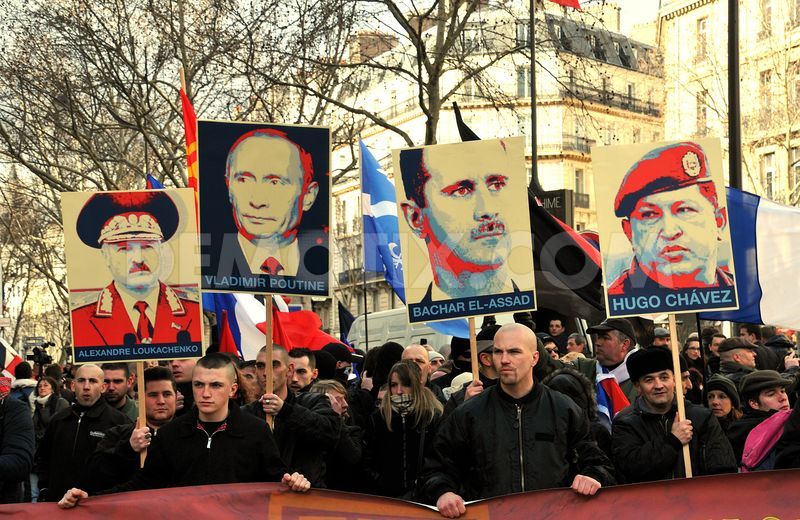
1359839008-nationalist-demonstration-against-globalism-and-imperialism--paris_1766972
Extreme right-wing protestors in Europe with portraits of those they support

The Assad fascist regime is responsible for extreme human rights violations in Syria today. More than 220,000 people have been killed, 10 million people – half the country – have been forced from their homes, hundreds of thousands of political prisoners have been detained and 640,000 are living under brutal sieges without regular access to food, water or medicines. In September last year, the US-led coalition invaded Syrian airspace to bomb Daesh (ISIS) positions; yet a blind eye is turned when Assad’s aircraft bomb civilian populations and the revolutionary democrats from the same airspace, killing many more than Daesh.

* * * *

From Planet Syria: Two years ago on 21st August 2013 the world was focused on Syria after the government of Bashar al-Assad used Sarin on civilians in the worst chemical attack for a quarter of a century. (Since the Halabjah chemical attacks by the Saddam Hussein regime in 1988).

The world feigned outrage. Obama said a red line had been crossed.

But today the chemical attacks continue. Chlorine is routinely used in barrel bomb attacks on civilian neighborhoods. But it’s not the chemicals that are killing most people, it’s the bombs themselves.

Here are 5 things everyone should know about what is happening in Syria today:

1. The Assad regime is killing 7 times more civilians than Isis.

2. More than 11,000 barrel bombs made of scrap metal and high explosive have been rolled out of regime helicopters onto hospitals, homes and schools since the UN banned them. They are the biggest killer of civilians. They drive extremism.

3. These barrel bombs are the leading cause of displacement, forcing refugees to cross the Mediterranean and other borders.

4. Many of the barrel bombs are dropped on areas under siege. More than half a million people in Syria live in areas with no access to food, water or medicine since 2013, including the areas of Ghouta that were targeted by the sarin gas attacks in the same year.

5. The international anti-Isis coalition is flying in the same airspace where many of these barrel bombs are dropped, choosing to look the other way.

On the occasion of the second anniversary of the chemical attack on Ghouta, a suburb of Damascas, the National Coalition of Syrian Revolution and Opposition Forces has issued this statement:

It was a declared crime whose details and elements are well-known to everyone, whether they admitted it or not. They know the only party that does not lack the ability, the authority or the criminal will required to commit such a massacre, which is the Assad regime. They also fully aware that the regime has all the means of production, assembly and delivery of chemical weapons that were the tools of this this crime. They know the perpetrator by name, and also the names of the top regime officials who were involved with him. They know how he committed this crime and how he handed, with the utmost shamelessness, the murder weapon.

Two years have passed since the crime of the century, but the perpetrator is still at large. The families of 1,507 victims killed are still looking around for an international response equivalent to the size of the crime committed against their loved ones. And yet not a single measure has been taken to prevent the repetition of this crime. Death stills looms large over the head of Syrians, armed with every means of killing, ranging from knives and cleavers to barrel bombs, Scud missiles and chemical weapons. The Syrian Network for Human Rights documented 125 regime breaches of UN Security Council resolution 2118 and 56 breaches of UNSC resolution 2209 which criminalizes the military use of chlorine gas.

While we in the Syrian Coalition renew calls on the UN Security Council to shoulder its responsibilities in maintaining security and peace in Syria, and to take immediate action to stop the crimes against humanity and violations and to ensure that criminals are held accountable, we deplore the indifference of the international community which continues to deal with the blood of Syrians as a bargaining chip, a means to settle scores and exhaust opponents.

Having paid heavily for the sake of achieving our goals, we Syrians are now fully aware that we have to fight this battle relying only on the resolve of rebel fighters. Indeed, unity, rejecting discord, commitment to the principles of the revolution are the only guarantee of victory and liberating Syria from the Assad regime and its thuggish repressive security apparatuses and of the establishment of democratic rule which is bases on pluralism, justice and the rule of law.

We ask for Mercy for our fallen heroes, recovery for the wounded, and freedom for detainees.
Long live Syria and its people, free and with honor.

Assad’s strategy: don’t fight Daesh; direct it

The left has a proud history of opposition to fascism and indeed is the most reliable anti-fascist group politically. It is a puzzle as to how and why what passes for ‘left wing’ today can either be so neutral toward the Assad regime or adopt the entirely crypto-fascist slogan ‘Hands off Syria’. The puzzle is explained, in my opinion, by the fact that the left is more than a self-identifying label. It has a real content, defined by history, practice and theory. If someone tells you that western military involvement on the side of the Syrian people against the regime would be a disaster for the region, just ask the fundamental question: “A disaster for whom?” To those who beat their chests warning that US imperialism is out to dominate the region and that that claim somehow should mean leaving the unarmed populus to Assad’s barrel bombs, just tell them: “Your anti-imperialism is worthless if it ends up putting you on the side of the regional dictators who are oppressing and massacring the people as we speak”.

I wish to thank the good people at NOW. for permission to publish this article by Haid Haid, who is a program manager at the Heinrich Böll Stiftung’s office in Beirut. He tweets @HaidHaid22

c21styork

* * * *

 images

Assad is trying to turn his problems into opportunities by helping ISIS (Daesh; ISIL) choose what’s in his own best interests and allowing ISIS easier access to some areas than to others.

“Reports indicate that the regime is making air-strikes in support of#ISIL‘s advance on #Aleppo, aiding extremists against Syrian population,” the US Embassy in Syria tweeted on 1 June. Similar reports were published by other regional and international media outlets when ISIS made an unexpected and successful move against rebel groups north of Aleppo, disrupting their recent momentum.

To many of those who have been closely following what’s happening in Syria, this might not come as a surprise. Assad has avoided confronting ISIS, as they both benefit from one another. ISIS degrades and eliminates rebel groups that would otherwise be fighting Assad, and Assad’s regime presents itself to the West as the only local partner that can fight the terrorist group. This—at least publicly—unspoken agreement was broken in June last year after ISIS announced its caliphate. It seems, however, that the same arrangement is back on the table with some amendments due to recent developments.

Game changer Palmyra

Seizing Palmyra gave ISIS the advantage of many new strategic options, which will most likely change the dynamics of the armed conflict in Syria. The strategic location of Palmyra has allowed ISIS to cut the regime’s supply line to Deir Ezzor, and it opens the possibility of capturing other strategic locations, such as the Shaer gas and oil field. The broad desert has given them many alternative roads to various areas of Syria to expand and enforce their presence there; eastern Ghouta and eastern Qalamoun, rural Hama, rural Homs and rural Sweida. Capturing Palmyra was a game changer not only for ISIS but for the regime as well. Just consider the big number, and high symbolic value, of Assad regime losses on various fronts; the fear of the next rebels attack; the continued draining of resources (locally and regionally); the withdrawal of Iraqi militias who have returned home to fight; and the division in strategies between Assad and Iran—the former still trying to control all provincial centers, the latter restricting itself to areas considered useful within Iranian strategy.

Revised strategy

These developments have pushed Assad and his allies to find ways to cut down their losses and to conserve resources. It seems that Assad has found a way to turn his problems into opportunities by giving ISIS access to areas controlled by the rebels in order to drain their resources as they fight away from the regime, and he does so even if this costs him more territory. In Aleppo, for example, ISIS could advance through regime-controlled areas, including As-Safirah or Kweires Air Base, given the importance of these locations and due to pressure on the regime by other rebels groups in Idleb, combined with rumors that an Aleppo battle will be launched, which has made the regime even weaker. Even though capturing air bases might be considered its most important strategic goal, ISIS instead decided to intensify its attacks on areas controlled by rebels along the Suran-Mare axis in rural Aleppo. The regime also intensified its attacks on areas that have helped ISIS advance and control new villages. These developments forced many rebel groups, including members of the Army of Conquest coalition, to mobilize their forces and move them to prioritize fighting ISIS over the regime—at least in Aleppo.

The regime might also help ISIS to enforce its presence in eastern Ghouta, which will help the regime completely besiege Ghouta and engage rebels in another fight. Some recent reports mentioned that the regime has been busy transporting equipment from Al-Seine Airbase to Ad-Dumayr Airbase, which Assad’s opponents interpret as an evacuation plan. If this is the case, it could mean that the regime is either trying to conserve resources, or is scared that it might lose the air base, or both, which in any case will give ISIS access to eastern Ghouta. The same thing could also apply in eastern Qalamoun, Ar-Ruhaybah and Jayrud, to enforce their presence there and to keep the opposition busy in the fight against it.

US inaction

While the air force of the American-led coalition played a large role in defeating ISIS in Kobani, it didn’t react to ISIS’s latest attack on rebel-held areas, which gave ISIS the opportunity to move its forces freely. Many rebel leaders complained publically about the lack of US interest in helping them defeat ISIS in Syria, though it’s now apparent the US administration knows of the cooperation between Assad and ISIS. Sarcastically, activists started wondering if the US Air Force didn’t strike ISIS because Assad had crowded up the sky striking rebel groups. Maybe sarcasm is the only way that many Syrians, and to some extent non-Syrians, are able to understand US policy towards fighting ISIS.

* * * *

UK Election: Solidarity with Syria needed

Over 67,000 British civilians were killed in the Second World War. Around 40,000 of them were killed by air raids…. Today, more civilians have been killed in Syria than were killed in Britain in World War Two. The vast majority of them have been killed by the Assad regime: over 95% according to records collected by the Violations Documentation Center in Syria. (From Syria Solidarity UK)

* * * *

Over 67,000 British civilians were killed in the Second World War. Around 40,000 of them were killed by air raids.

When Hitler’s air force attacked, pilots from several other nations joined in defending Britain, including experienced fighter pilots from Poland and Czechoslovakia: the 303 “Kościuszko” Polish Fighter Squadron was amongst the most successful squadrons fighting in the Battle of Britain.

Today, more civilians have been killed in Syria than were killed in Britain in World War Two. The vast majority of them have been killed by the Assad regime: over 95% according to records collected by the Violations Documentation Center in Syria.

Today, no international pilots have come to defend Syrian civilians from Assad’s attacks. The US-led coalition is intervening in Syria, but not against Assad. He is free to bomb cities and towns and villages with Russian-supplied helicopters andIranian jet aircraft. Two in five of all civilians killed last year were killed by Assad’s air attacks. Over half the women and children killed in 2014 were killed by Assad’s air force.

This month marks 70 years since Anne Frank was killed in the Holocaust. TheAnne Frank Declaration is intended to draw from her life lessons for the present, not just memories of the past. It says:

Anne Frank is a symbol of the millions of innocent children who have been victims of persecution. Anne’s life shows us what can happen when prejudice and hatred go unchallenged.

Because prejudice and hatred harm us all, I declare that:

  • I will stand up for what is right and speak out against what is unfair and wrong
  • I will try to defend those who cannot defend themselves
  • I will strive for a world in which our differences will make no difference – a world in which everyone is treated fairly and has an equal chance in life

Many leading British politicians have signed this Declaration, including David Cameron and Ed Miliband, but when we look at their actions on Syria, we have to ask how well they are living up to their pledge.

On the last day of Parliament, the Coalition Government announced that they were joining the US-led effort to train Syrians to fight ISIS. Earlier it was reported that if re-elected the Conservatives intended to join US-led strikes against ISIS in Syria. Whatever the merits of these policies, they contained nothing to defend Syrian civilians from their greatest threat: the Assad regime. Assad and his allies are responsible for over 95% of killings of civilians. Assad’s forces continue to target civilians with barrel bombs, chlorine bombs, and Scud missiles.

The legal basis for joining US-led strikes against ISIS in Syria would be collective defence of the Republic of Iraq, not the humanitarian defence of Syrian civilians. It would not live up to David Cameron’s promise to “defend those who cannot defend themselves.” For that he would have to back action to stop Assad bombing civilians.

As for how well Ed Miliband is living up to his promise: Since he signed the Anne Frank Declaration, Ed Miliband has been talking about his August 2013 decision to block joint UK-US action in response to the Assad regime’s mass killing of civilians with Sarin chemical weapons. But in his telling of the story there was no mention of the men, women, and children poisoned. In his telling there was no mention of standing up to Assad, only of standing up to Obama.

Ed Miliband said that his decision in August 2013 proved that he is “tough enough” to be prime minister: “Hell yes.” Many of his supporters seem to agree, and “Hell yes” t-shirts have been produced, celebrating Ed Miliband’s toughness in helping get a mass-murdering regime off the hook.

Not that those supporters see it in quite that way. Jamie Glackin, Chair of Scottish Labour, denied that there was any connection between Ed Miliband’s “hell yes” phrase and the August 2013 chemical attack: “It’s got nothing to do with that. At all.”

But it has everything to do with that. Ed Miliband’s chosen anecdote to show toughness was to point to the time he prevented action against a mass-murdering dictatorship, one that gave refuge to a key Nazi war criminal, that has tortured its citizens on an industrial scale, that is inflicting starvation siegeson hundreds of thousands of people, that has driven half of the population from their homes, four million of them driven out of the country as refugees, and that has continued killing civilians in their tens of thousands since Ed Miliband said “no” to action.

Anne’s life shows us what can happen when prejudice and hatred go unchallenged.

When asked about the consequent events in Syria, Ed Miliband avoided taking any responsibility. “It’s a failure of the international community,” he said. But we are the international community. The UK is a key member of the international community, one of only five permanent members of the UN Security Council, and one of only three functioning democracies amongst those five. When Ed Miliband blocked UK action, the consequences were critical.

I will try to defend those who cannot defend themselves.

Anne Frank was 15 years old when she was killed in the Holocaust. You can read more about her at the Anne Frank Trust, and  at the Anne Frank House museum.

According to a November 2013 report by the Oxford Research Group, Stolen Futures: The hidden toll of child casualties in Syria, 128 children were recorded amongst the killed in the Ghouta chemical attack: 65 girls and 63 boys.

Something of two of those girls, Fatima Ghorra, three years old, and her sister, Hiba Ghorra, four years old, is told by Hisham Ashkar here.

The names of 54 of the girls killed are listed by the Violations Documentation Center in Syria. For some, clicking on a name will give a little more information, such as a photograph of one in life, or in death, or their age.

The Syrian Freedom Charter: Which side are you on?

The Assad regime in Syria tries hard to conflate the democratic resistance to its fascist rule with the Daesh (ISIS) terrorists. The Syrian Freedom Charter is the latest proof of Assad’s slander. It is a national unity document based on tens of thousands of face-to-face interviews with Syrians, in every governorate of the country, about what kind of society they want. Meanwhile the ‘anti-imperialism’ of the so-called western left serves well the US administration’s Ditherer-in-Chief in failing to effectively support the pro-democracy anti-fascist forces. A genuine left-wing position is no different today than it was in the 1960s: we oppose the oppressors who drop barrel bombs on the people and we stand with the oppressed. We understand that ‘Wherever there is repression, there is resistance’.

As the old folk song put it: Which side are you on?

* * * *

Democratic Revolution, Syrian Style's avatarالثورة الديمقراطية، الطراز السوري DEMOCRATIC REVOLUTION, SYRIAN STYLE

“The Syrian Freedom Charter is a national unity document based on tens of thousands of face-to-face interviews with Syrians, in every governorate of the country, about what kind of society they want. Over the course of a year, a team of over 100 activists assembled by FREE-Syria and the Local Coordination Committees (LLC) of Syria, completed more than 50,000 surveys.”— (Danny Postel, Pulse Media)

flag

View original post 454 more words