
This is an excellent statement but I wish the term ‘pseudo-left’ had been used instead of ‘left’ for those who effectively side with Putin fascism and Russian aggression against the Ukrainian resistance. The conclusion is spot on: Any call for peace that does not include the demand for Russian withdrawal from Ukrainian territories is disingenuous.
Continue readingAuthor Archives: c21styork
‘Mother’ Nature is punishing us with Covid? Call Child Protection!
Tom Griffiths
******
“In a tribal society in which ‘everyone knows’ that you need to sacrifice a goat to have a healthy baby, you make sure you sacrifice a goat. Better safe than sorry.” – Daniel Dennett (Breaking the spell: religion as a natural phenomenon, 2006)
******
The world is now well into the third year of Covid and how we have dealt with it is a mixed bag. Scientifically we have ticked quite a few boxes with research and treatment responses being rapid, ongoing and impressive. The political and policy responses, nationally and internationally, are less impressive due to varied approaches, all ostensibly following the same scientific advice. Regardless of this, governments have taken the pandemic and its impacts – health, social and economic – seriously and negatively.
Continue readingFifty years ago – gaolings, resistance and a win

Barry York (republished from ‘Overland’ literary journal )
Fifty years ago, on 4 August 1972, three La Trobe University students—Fergus Robinson, Brian Pola and myself—were released from Pentridge Prison after serving, respectively, four months, three months and six weeks. Hardly any other political prisoners of that period in Australia had served such lengthy terms, with the exception of some of the draft resisters. This was an extraordinary and unprecedented case of political repression.
Continue readingVideo of panel discussion on Marxism and Anarchism
This is the video of the panel discussion of Marxism and Anarchism organised by the Platypus Affiliated Society on 30 July 2022.
Continue readingMelbourne Panel Discussion – Marxism and Anarchism – Saturday 30th July
Saturday July 30th, the Melbourne chapter of the Platypus Affiliated Society will be hosting a Panel Discussion on “Marxism and Anarchism: Radical Ideologies Today”, at Trades hall in Carlton, Melbourne, starting at 1pm AEST.
—
It seems that there are still only two radical ideologies: Anarchism and Marxism. They emerged out of the same crucible – the Industrial Revolution, the unsuccessful revolutions of 1848 and 1871, a weak liberalism, the centralization of state power, the rise of the workers movement, and the promise of socialism. They are the revolutionary heritage, and all significant radical upsurges of the last 150 years have returned to mine their meaning for the current situation. In this respect, our moment seems no different.
Continue readingTwilight of the American Left – from Unherd
This essay by Park Macdougal is reprinted from ‘Unherd’
“The most vulgar, simplistic view of the Left — that dissolves all the supposed distinctions between centrists, liberals, leftists, socialists, communists into one homogenous Democratic blob — happens to be correct.” So writes Benedict Cryptofash, an anonymous Twitter user and self-described “anti-leftist” whose other theoretical contributions include “the Left and Right are fake and gay” and “only libtards care about policy”.
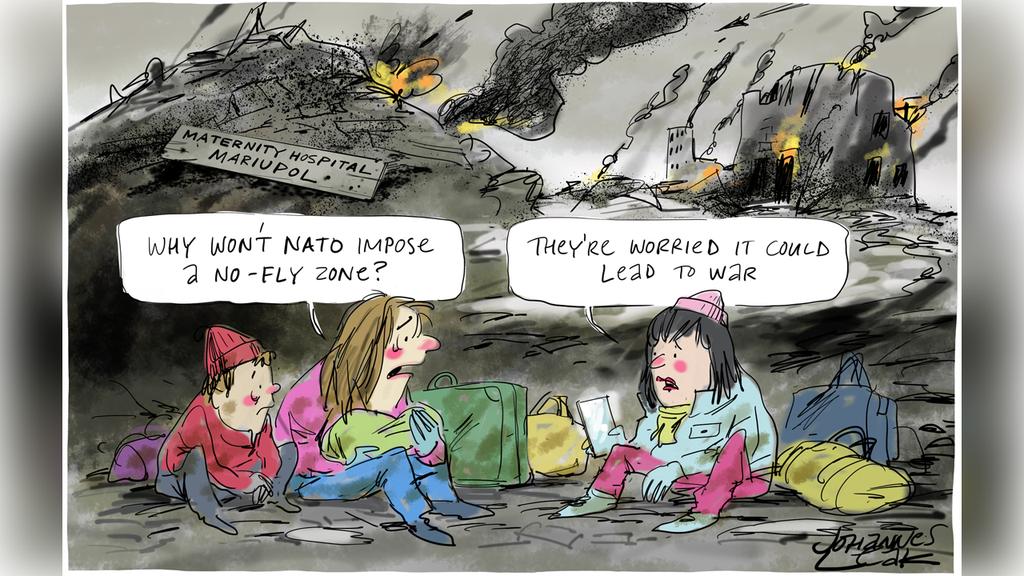
Continue readingNO FLY ZONE! Solidarity with Ukraine!
‘An alien association’: Master of Arts thesis on Maoism and the Communist Party of China 1971-1977
The late John Herouvim wrote a Master of Arts thesis at La Trobe University in 1983, drawing on wide and meticulous research and interviews with Communist Party of Australia (ML) members and former members. The former members included veterans of the working class struggle such as Clarrie O’Shea, Bill Wilson and Marj Broadbent. Most of the interviewees were still members and requested anonymity but they wanted to speak because of their growing disillusionment with that party.
I only recently came upon a copy of the completed thesis. It hasn’t previously been scanned, to the best of my knowledge.
I am yet to read it properly but recall having a few differences with John, such as his use of the term ‘ultra left’ too loosely. At the time he was researching it, there were a few social-fascist types who tried to stop his progress. John purchased a large steel safe, like a fridge, in which he kept his notes and drafts. He told me once that the safe would even survive a bomb blast. Thank heavens, it was never put to that test.
Ted Hill, the party chairman, wasn’t happy about John’s research and declined to cooperate with him but I remember John telling me that Hill offered him unrestricted access to the archives of a small trade union should he drop the project and focus on a history of that union instead. Presumably, the party had strong influence in that union, whose name I forget.
The thesis is now an historical document about a party and period that, in my view today, represented the decline of the left. I didn’t articulate my frustrations in that way at the time but quit organisationally in late 1980 or early 1981 and had no problems with being interviewed by John for his thesis. I was in the esteemed company of Clarrie O’Shea, after all.
Nearly four decades on, I have scanned the thesis and share it here (in four parts).
****
Soylent Green and the reactionary Malthusians
Karl Marx didn’t mince words when it came to the Rev. Thomas Malthus, the ‘pastor of the Poor House’. Marx described him as “the greatest destroyer of all hankerings after a progressive development of humanity” and “a shameless sycophant of the ruling classes“.
(Apart from that, he wasn’t too bad, though!)
In 1968, Paul Erlich’s book, ‘The Population Bomb’, revived Mathusian dystopianism and, surprisingly, was embraced by some people who regarded thermselves as on the Left. Yet in emphasizing population growth and limited resources as the source of problems, the neo-Malthusians overlooked the capitalist mode of production and the structures of class power.
In the C19th, in blaming ‘too many people’ as the source of poverty, Malthus was indeed committing “a libel on the human race” and offering “apologia for the poverty of the working classes”.
The Canberra Times recently published my article below. It had been gestating for a long time and the movie ‘Soylent Green‘ prompted me to write something, given that the dystopian sci-fi film is set in our year: 2022. The movie came out nearly 50 years ago.
My article in The Canberra Times took up a full page, so I definitely can’t complain about the generous word length. However, had I had more words, I would have included at least three more references
First, a personal memory: In the mid-1990s, I was at a party at a friend’s place overlooking the Georges River in Sylvania Heights, Sydney, and the eminent palaeontologist and climate alarmist, Tim Flannery, was among the guests. We had known each other, briefly, at La Trobe University around 1973 or 1974, and struck up a conversation. Tim was very much concerned about population growth, believing that Australia was already over-populated. He told me that the optimum population for Australia was seven million people. I pointed out that that figure approximated the population in 1947 and asked whether he really wanted an Australia of the 1947 type. He seemed not to have thought of it like that, in terms of society, before.
I would also have liked to add more examples of very popular dystopian sci-fi films that have helped create a disempowering doom-and-gloom ethos and that were proven completely wrong in how they saw the future. A powerful example is the original ‘Mad Max‘. The filmmakers in 1979 were so freaked out by the oil crisis of 1973 that they set Mad Max in the ‘wasteland’ of 1985!
Thirdly, it’s worth noting that the Internet Movie Data Base lists the top 500 dystopian sci-fi films – which means there are many more than that. They really are a cultural phenomenon.
****
Science fiction stories had a big impact on my early political development. I liked the ones that dealt with ‘the impossible’ that was nonetheless potentially possible. Unlike fantasy, which never interested me with its dragons and other mythical creatures and impossible scenarios, sci-fi had a basis in science and innovation. Stories and films about space travel, planetary exploration and colonisation of other planets thrilled me; they seemed beyond possibility back then but I loved to fantasize about a future in which they would be part of life. Later, I was influenced by ideas about how society itself could be reshaped into something much better and, through Marxism, came to a rudimentary understand about the forces that were retarding such progress and those that were pushing things forward.
It’s very rare to find progressive sci-fi in mainstream cinema today. An exception in the mainstream was the movie ‘The Martian‘ which came out in 2015. I really enjoyed the way it showed how humans can overcome obstacles imposed by Nature, in this case the apparently uninhabitable planet Mars. Human ingenuity, wit, courage, innovation and spirit combine to ‘conquer’ Nature. The stranded astronaut survives to tell the tale.
****
Anyway, here is my article…
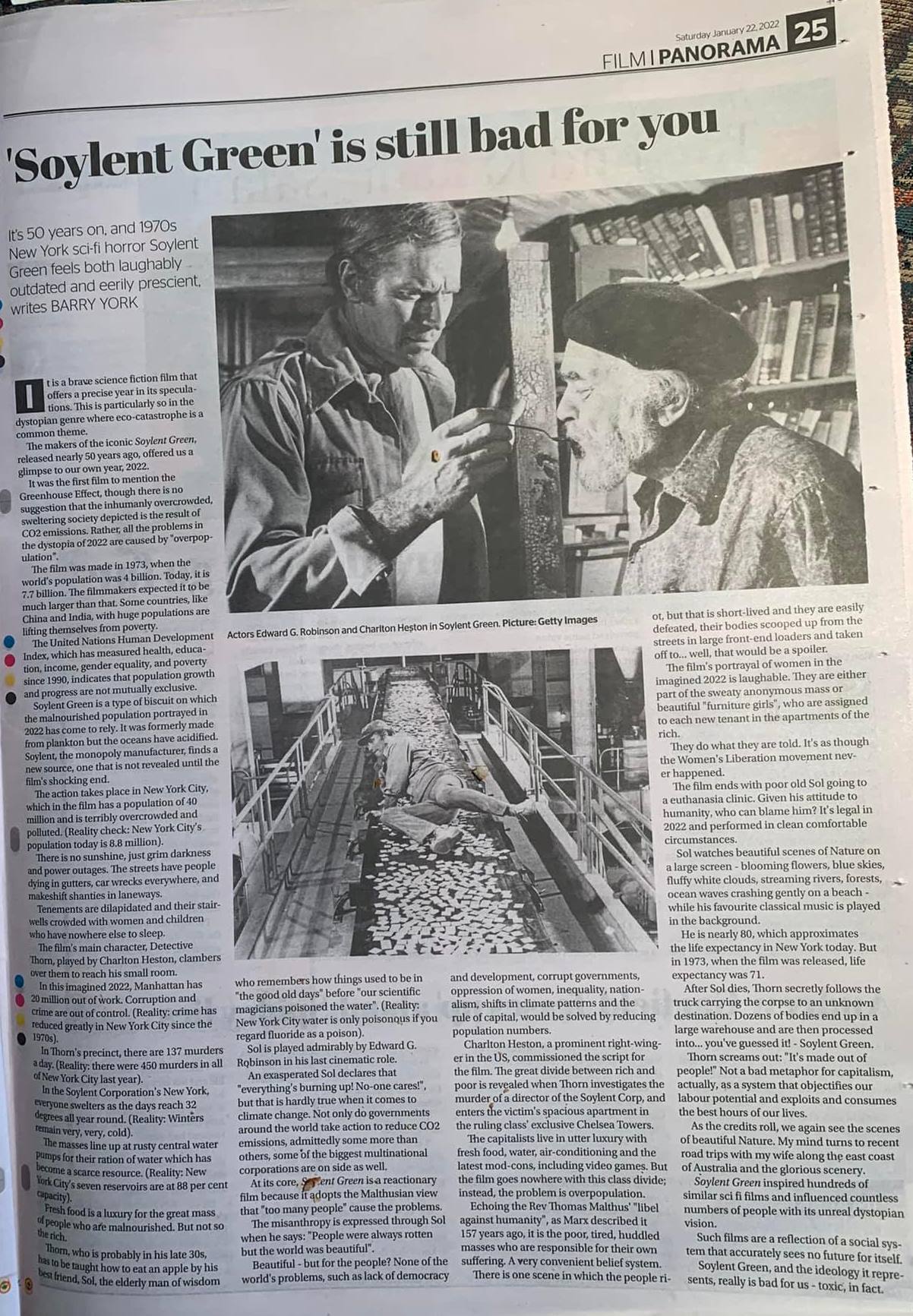
‘SOYLENT GREEN’ IS STILL BAD FOR YOU – 50 YEARS ON
Barry York
It is a brave science fiction film that offers a precise year in its speculations. This is particularly so in the dystopian genre where eco-catastrophe is a common theme.
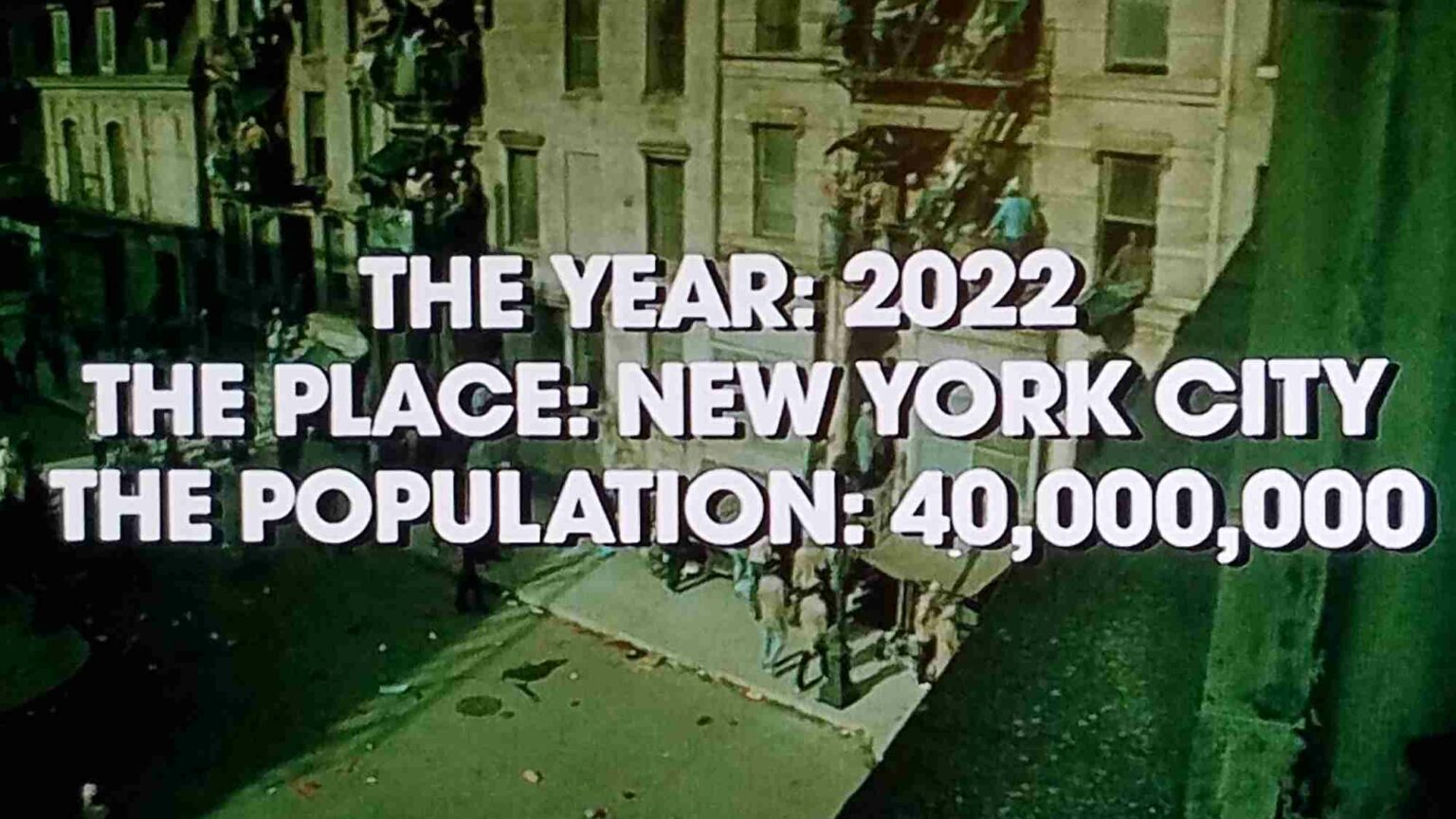
The makers of the iconic ‘Soylent Green’, which was released nearly 50 years ago, offered us a glimpse to our own year, 2022. It was the first film to mention the Greenhouse Effect, though there is no suggestion that the inhumanly overcrowded, sweltering, society depicted is the result of CO2 emissions. Rather, all the problems in the dystopia of 2022 are caused by ‘overpopulation’.
The film was made in 1973 when the world’s population was 4 billion. Today, it is 7.7 billion. The filmmakers’ expected it to be much larger than that. Some countries, like China and India, with huge populations are lifting themselves from poverty. The United Nations Human Development Index, which has measured health, education, income, gender equality, and poverty since 1990, indicates that population growth and progress are not mutually exclusive.
Soylent Green is a type of biscuit on which the malnourished population portrayed in 2022 has come to rely. It was formerly made from plankton but then the oceans acidified. Soylent, the monopoly manufacturer, finds a new source, one that is not revealed until the film’s shocking end.
The action takes place in New York City, which in the film has a population of 40 million and is terribly overcrowded and polluted. (Reality check: New York City’s population today is 8.8 million). There is no sunshine, just grim darkness and power outages. The streets have people dying in gutters, car wrecks everywhere, and makeshift shanties in laneways. Tenements are dilapidated and their stairwells crowded with women and children who have nowhere else to sleep. The film’s main character, Detective Thorn, played by Charlton Heston, clammers over them to reach his small room.
In this imagined 2022, Manhattan has two million out of work. Corruption and crime are out of control. (Reality: crime has reduced greatly in New York City since the 1970s). In Thorn’s precinct, there are 137 murders a day. (Reality: there were 450 murders in all of New York City last year).
In the Soylent Corporation’s New York, everyone swelters as the days reach 32 degrees all year round. (Reality: Winters remain very, very, cold). The masses line up at rusty central water pumps for their ration of water which has become a scarce resource. (Reality: New York City’s seven reservoirs are at 88% capacity).
Fresh food is a luxury for the great mass of people who are malnourished. But not so the rich. Thorn, who is probably in his late 30s, has to be taught how to eat an apple by his best friend, Sol, the elderly man of wisdom who remembers how things used to be in ‘the good old days’ before ‘our scientific magicians poisoned the water’. (Reality: New York City water is only poisonous if you regard fluoride as a poison). Sol is played admirably by Edward G. Robinson in his last cinematic role.
An exasperated Sol declares that ‘Everything’s burning up! No-one cares!’, but that is hardly true when it comes to climate change. Not only do governments around the world take action to reduce CO2 emissions, admittedly some more than others, but some of the biggest multinational corporations are on side as well.
At its core, Soylent Green is a reactionary film because it adopts the Malthusian view that ‘too many people’ cause the problems. The misanthropy is expressed through Sol when he says: ‘People were always rotten but the world was beautiful’. Beautiful – but for the people?! None of the world’s problems, such as lack of democracy and development, corrupt governments, oppression of women, inequality, nationalism, shifts in climate patterns and the rule of capital, would be solved by reducing population numbers.
Charlton Heston, a prominent right-winger in the US, commissioned the script for the film. The great divide between rich and poor is revealed when Thorn investigates the murder of a director of the Soylent Corp and enters the victim’s spacious apartment in the ruling class’ exclusive Chelsea Towers. The capitalists live in utter luxury with fresh food, water, air-conditioning and the latest mod-cons, including video games. But the film goes nowhere with this class divide; instead, the problem is overpopulation. Echoing the Rev Thomas Malthus’ ‘libel against humanity’, as Marx described it 157 years ago, it is the poor, tired, huddled masses who are responsible for their own suffering. A very convenient belief system.
There is one scene in which the people riot but that is short-lived and they are easily defeated, their bodies scooped up from the streets in large front-end loaders and taken off to… well, that would be a spoiler.
The film’s portrayal of women in the imagined 2022 is laughable. They are either part of the sweaty anonymous mass or beautiful ‘furniture girls’, who are assigned to each new tenant in the apartments of the rich. They do what they are told. It’s as though the Women’s Liberation movement never happened.
The film ends with poor old Sol going to a euthanasia clinic. Given his attitude to Humanity, who can blame him? It’s legal in 2022 and performed in clean comfortable circumstances. Sol watches beautiful scenes of Nature on a large screen – blooming flowers, blue skies, fluffy white clouds, streaming rivers, forests, ocean waves crashing gently on a beach – while his favourite classical music is played in the background.
He is nearly eighty, which approximates the life expectancy in New York today. But in 1973, when the film was released, life expectancy was seventy-one.
After Sol dies, Thorn secretly follows the truck carrying the corpse to an unknown destination. Dozens of bodies end up in a large warehouse and are then processed into… you’ve guessed it! – Soylent Green. Thorn screams out: ‘It’s made out of people!’ Not a bad metaphor for capitalism, actually, as a system that objectifies our labour potential and exploits and consumes the best hours of our lives.
As the end credits roll, we again see the scenes of beautiful Nature. My mind turns to recent road trips with my wife along the east coast of Australia and the glorious scenery.
Soylent Green inspired hundreds of similar sci fi films and influenced countless numbers of people with its unreal dystopian vision. Such films are a reflection of a social system that accurately sees no future for itself.
Soylent Green, and the ideology it represents, really are bad for us – toxic, in fact.
Pandemic – what kind of society?
(The following article by Paul Komesaroff appeared in The Age on 15 January. I’m running it here without permission in order to promote further discussion. Please read it at the original AGE site and make comments there too)
January 15, 2022
Now that the disaster is upon us we can start to analyse how it happened.
I am a frontline health worker, lying listlessly in bed battling an infection with the Omicron variant. My illness has provided me with the opportunity to reflect on our current predicament and what lessons can be learnt from it.
Healthcare workers have been pushed to the limit by the crisis.
We do need to be clear, however: this is a true disaster. Unprecedented numbers of people have been admitted to our hospitals, which are now full. Deaths are mounting rapidly. Ambulances sit in line for hours waiting to discharge their sick patients to overrun emergency departments. Patients with serious non-COVID illnesses, like heart attacks and cancers, struggle to find doctors to treat them.
In the health services up to 10 per cent of workers are away sick, and many, unable to cope with the stress, have given up and resigned. Food and other essential services are failing. The frantic determination to avoid lockdowns has produced a de facto lockdown, more intense than the official ones because of its unplanned, chaotic nature and the absence of safety nets.
Admittedly, not all the news is bad. Even if the vaccines are imperfect at preventing infections and hospitalisations, they do greatly reduce the risk of death – and they may well have saved my life. Healthcare staff – doctors and nurses, young and old – are working tirelessly, often to the point of exhaustion, in heroic efforts to keep the system going.
But it is still a disaster. How did we get here? For nearly two years we had struggled to work together and protect each other. In Victoria, respected political and public health leadership provided reliable information and a determined and clearly argued plan. There were lapses – like hotel quarantine – that were subjected to ruthless public scrutiny, but overcoming the challenges and setbacks heightened the sense of solidarity and mutual caring.
But then it all unravelled. It seemed quick but in reality the forces had been in play all along. An unrelenting campaign to undermine the collective purpose, to oppose all restrictions, had worn away at confidence in public health measures. Campaigns of disinformation and conspiracy theories stimulated the rise of fringe Trump-like groups. The incessant talk about how injunctions to support the vulnerable were in reality a device to undermine prized individual “freedoms” hit home.
A concerted effort by the federal government, supported by the NSW government, attacked the few strategies that had been shown to work. Ballooning numbers in NSW quickly led to the spread of infections across the country.
Then, exactly as Omicron emerged, as health workers looked on with incredulity and horror, even the most minimal remaining restrictions were lifted.
It was widely acknowledged that this decision would produce disastrous consequences and would need quickly to be reversed. And it was true: the disaster happened and the restrictions were reversed. But the damage had been done and the effects were irreversible.
The policy that produced this decision was not the result of simple incompetence. It embodied a fully coherent, and carefully articulated, ethical world-view, on which we as a society now need to make a decision.
The “let it rip” strategy is a potent statement that health and human life should be held to be of little value; that individual “freedom” is directly opposed to collective action and mutual care; and that our society is richer and better if we and our governments repudiate responsibility to weaker members, to those fleeing persecution, and to future generations.
Through the clouds of my delirium I fancy that this understanding of society as a war of all against all had long been discredited. I imagine that most of us have become aware that freedom is enhanced when the structures of mutual support and opportunity remain intact. I muse that there is abundant evidence that the safety of our children and grandchildren can only be assured if we work collectively and co-operatively to protect and care for each other and for our planet.
The reality is that we are in the middle of a war – not just against the “invisible enemy” of the virus but also a new culture war, or more precisely, an ethics war. What is at stake is the vision we wish to have for our society: is it that of a collection of individuals opposed to each other, where security is limited to the powerful and the privileged?
Or is it of a world of shared values, where collective resources can be applied to those in most need, where each of us is prepared from time to time to defer our own comfort to assist and care for our fellow citizens?
In my fevered state, waiting for my clearance from infection control to return to the fray, I try to remind myself of the heroism of the young doctors, nurses and other essential workers. But I am not confident about the outcome.
Professor Paul Komesaroff is a Melbourne physician, ethicist and writer.
 C21st Left