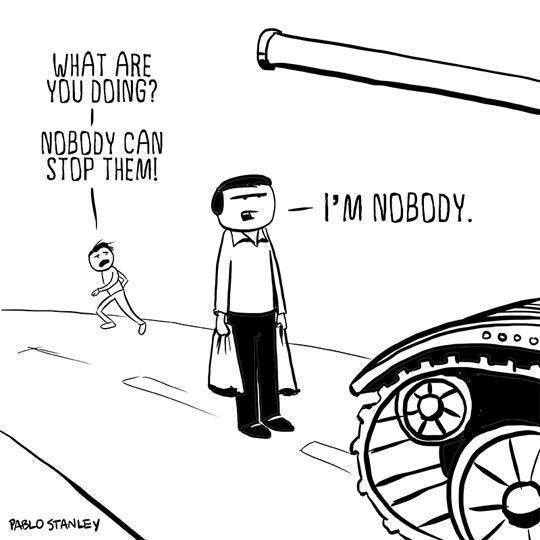
Persecution of Marxist students in Beijing – where there is repression, there is resistance!

Where there is repression, there is resistance – Mao.

‘Qiu disappeared April 29.

‘State security agents seized him that day from Beijing’s outskirts, his classmates say. Qiu’s offense? He was the leader of the Marxist student association at the elite Peking University, a communist of conscience who defied the Communist Party of China.

‘Over the past eight months, China’s ruling party has gone to extraordinary lengths to shut down the small club of students at the country’s top university. Peking University’s young Marxists drew the government’s ire after they campaigned for workers’ rights and openly criticized social inequality and corruption in China.

‘That alone was provocative. In recent years, China’s leaders have been highly sensitive to rumblings of labor unrest as the sputtering economy lays bare the divides between rich and poor — fissures that were formed, and mostly overlooked, during decades of white-hot growth’.

* * * *

June 4th marks the 30th anniversary of the day on which troops entered Tiananmen Square and opened fire upon protestors. It was an outcome of the restoration of capitalism in China, the victory of the ‘capitalist roaders’ within the Communist Party that Mao had warned against and led struggle against.

The idea that things can turn into their opposite is a very challenging one, but it is true.

The violent repression at Tiananmen Square is proof that the Communist Party was no longer revolutionary, no longer socialist but a case of ‘capitalism without democracy’.

The Chinese parliament currently has about a hundred billionaires among its delegates, most are nominally ‘communists’. https://www.cnbc.com/2017/03/02/chinas-parliament-has-about-100-billionaires-according-to-data-from-the-hurun-report.html

Maoists and other pro-democracy dissidents are imprisoned and now ‘disappear’ at the hands of state authorities. https://monthlyreview.org/commentary/on-december-24-2004-maoists-in-china-get-three-year-prison-sentences-for-leafleting/

https://www.scmp.com/news/china/policies-politics/article/2125541/chinese-scholars-sign-open-letter-calling-release

https://www.washingtonpost.com/world/asia_pacific/if-i-disappear-chinese-students-make-farewell-messages-amid-crackdowns-over-labor-activism-/2019/05/25/6fc949c0-727d-11e9-9331-30bc5836f48e_story.html?fbclid=IwAR0SOnpzbmRBUyB6j3uYJ02PkAALeAyxGtqV03hzPrWuQVK6sb6eHMr8hmQ&utm_term=.4e004ccb1811

The people, however, understand revolutionary change and their own socialist revolution is within living memory.

Where there is repression, there is resistance.

* * * *

Photo of statue at York University, Canada, commemorating the resistance of students and workers in Tiananmen Square.

The dialectical relationship between ‘I’ and ‘We’ – critical response to Michael D. Yates’ ‘Can the working class change the world?’

In the real world we live in – and never more so than in the modern era – it is not the “I” and the “We” but the I/We balance and how this has changed with economic and social development across the span of history.

Thanks to Tom Griffiths for the following article.

* * * *

Last year Michael D. Yates, the Editorial Director of Monthly Review Press had his new book ‘Can the working Class Change the World?’ published. It was received, in leftist circles at least, to popular acclaim.

I came upon the book by accident as I was looking for something to give my son. Given my concerns about the relationship between the revolutionary left and the individual I consulted the Index and sure enough, an entry “individualism, under capitalism” directed me to pp 140-41. As it turned out the preceding three pages pp 137-39 were relevant contextually to what Yates concluded as the necessity of the working class waging “its own war against the I and for the We.”

The ambiguity contained in this conclusion and the manner in which the preceding pages framed it is highly problematic, exposing  as it does a pseudo Marxist and ahistorical understanding of the I/We balance and a frankly reactionary position of what this balance should look like if the working classes were in the driver’s seat. Beneath this ambiguity is an ambivalence about individuality per se that borders on hostility. Lukes’ ‘Individualism’ (1973) has done us a favor here as has MacPherson’s ‘The Political Theory of Possessive Individualism’ (1962). The latter details the development, based on need, of theories of the individual that justified the development and ascendance of capitalist property relations in the struggle to break free from feudal constraints. The former, riding on the back of modernity’s achievements, illustrated that individuality and individualism comes in a variety of shapes and sizes (well it/they would, wouldn’t they) some consistent with capitalist property relations and others not consistent. It takes a very selective reading of Marx to not get this. My thoughts on this form the substance of this piece and I should thank Yates for motivating me to post them.

But I would like to firstly clarify what are we talking about when we speak of the I/We balance. The contradiction between the “I” and the “We” – the individual and the family group/community/society, is transhistorical, predating the development of classes and going back to the dawn of human existence. Engels had this to say: “Impressive as the people of this epoch may appear to us, they differ in no way from one another, they are still bound, as Marx says, to the umbilical cord of the primordial community.”

What Engels and Marx were drawing attention to was the binding, caused not by choice, but by the harshness of circumstance, circumstance that did not allow the development of difference. This describes a frozen antithesis, any movement in the contradiction being glacial and occuring over centuries or millenia rather than decades. It has only been in the modern era that this frozen dialectic has melted and the relationship between the “I” and the “we” has not only become dynamic, but has been seen to become so.

* * * *

So let me look at the context and justification Yates provides for us, a context that I can most generously describe as a ‘softening up’ process and less generously as manipulative. He begins under a chapter sub heading, “The “I” and the “We”, and takes us on a folksy recount of a holiday spent with his wife at Point Reyes National Seashore in California. En route they passed through an agricultural area where “we choked on the pesticides … the air was so fouled we couldn’t see the mountains not far to the east.” This may be accurate enough of course but we are being led along a path where the destination is ….well, let’s read on. After references to Tom Joad and Francis Drake (he landed at Point Reyes in 1579 for ship repairs) he introduces us to the native population, the Miwok, the descendents of whom still inhabit the area. The Miwok “were gatherers and hunters, living peacefully in a land of great abundance.” James and Graziani’s California Indian Warfare paint a more nuanced picture pointing out, and providing evidence, that the word “peaceful” is an ambiguous term. Yes, the Miwok were generally a peaceful people but inter and intra tribal conflict were, shall we say, not unknown as was the stealing and raping of women. Indeed a rare surviving record of a war song eulogises this feature: “Leaders, let us go out to war! Let us go and capture a pretty girl.” Cherry picking, we need remind ourselves, is not an activity confined to orchardists.

“Once the Europeans came…” the balance was destroyed. “Disease and extreme culture shock killed most of them” while our lust for land and gold took most of the rest. As he points out “The Miwoks’ “we” was no match for the white man’s “I”. One sidedness in any field of human endeavour always distorts and I make no claim of immunity, but Yates’ agenda blindsides him as he embraces (and promotes) a romanticised account of tribal and pre-modern life. Approvingly, he quotes the view of a contemporary Miwok, Kathleen Smith, who holds that her people have lived in “physical and spiritual balance” without feeling the need to go somewhere else for 8,000 years. This “requires restraint, respect, knowledge and assurance of one’s place in the world.” Not to mention a practical inability, borne of the historical constraints they lived under, to be aware, let alone assured, of any alternative.

* * * *

Idealising the past has a long history, of course. We saw it, for example, in the decades preceding the English Revolution and during the revolutionary decades themselves, where it was common for numerous radical voices to look to,  and promote, the Arcadian myth of jolly Olde England before the imposition of the Norman Yoke. As we now know they were marching into the future looking backwards, an understandable reaction given that they were at the dawn of the capitalist and modern era, territory that we have become a lot more familiar with. What was baffling novelty then is no longer baffling. So why, I ask rhetorically, does Yates feel the need to promote a Miwok (or native Indian) Arcadian myth while simultaneously presenting himself as a Marxist and historical materialist?

Once booked into the hostel the reader is subjected to more ‘softening up’. He describes a ‘conversation’ with an east coast law student that degenerated into a lecture, by him, about how California was a monument to waste. In response to her puzzlement he turned his fire onto agriculture, a field of production, she believed, California to be a world leader in. This, the student was to discover, was a view, be it true or not, that would have been best kept to herself.

“This set me off on a lecture about dams, stolen water, subsidized land and water, massive use of pesticides, polluted air and water and exploited farm workers. Measured in terms of energy in and energy out, or in terms of the costs imposed on society by California’s “factories in the fields” the state’s agriculture is not as productive as the Miwok’s gathering and hunting”.

Unsurprisingly she retreats into the next room and, somewhat abashed, Yates follows a few minutes later to “make amends for lecturing her”.

In TV game shows this would be a “but wait, there’s more” moment and Yates does not disappoint. On hearing that she is a law student he seizes the opportunity to tell her (note how the only one doing much listening is her) what a Law Professor tells first years: that lawyers had to learn to be vicious by being treated viciously, a process beginning at law school. After a terse response from her to the effect that at least everyone was on the same playing field, “The woman never spoke to me again.” But Yates is not done. Over the period of his stay he observes her behaviour, concluding that she was oblivious to anyone else’s needs and he and his wife “listened, in amazement as she flirted with a German man” and how “she skillfully led the conversation to her desired outcome” an outcome that enabled her to bask in the glory of the medal she had won at the Beijing Olympics. He paints her, in other words, as a narcissist, an example of the “I” the working class needs to wage war against. Indeed he ends this section with a view of her that is as uncharitable as it is undialectical: Her studies will see her “become firmly and permanently frozen in the “I” and cut off forever from the “we””. Leaving to one side for the moment his view that the “I” is a frozen antithesis, whether she is narcissistic or not is difficult to call because of the way Yates inserts himself in the ‘drama’ and how he needs her to be as he depicts her. In the world of psychotherapy there is a term, projective identification, that describes an unconscious phantasy in which aspects of the self are split off from oneself and attributed to another. In plain language, Yates is telling us a lot more about himself than he realises. In my judgement there is at least as much evidence to suggest that Yates is describing as aspect of himself as there is evidence that the student is a narcissist and doomed to be a frozen “I” cut off permanently from the virtuous “we”.

* * * *

Whether Yates’ hypothesis about his Olympian acquaintance (or mine about him so far as that goes) holds water, his folksy tour has brought us to the kernel of his position, contained in the slightly less than two pages the index had drawn me to. “CAPITALISM IS A SYSTEM of stark individualism” (presumably the high case was to ensure we got the point that capitalism is a system). He goes on to say that “the primary institutions of capitalist society work in concert to inculcate the “I” in everyone, with the corollary that the “we” is detrimental to human welfare…For capitalism to end the “I” must be suppressed and the “we” must come to the fore”.

If he means bourgeois individualism, the kind of individualism that rests upon the individual’s right to own capital – and by extension to exploit the labor of others – and the particular distortions of individualism and individuality that come with this, he should say so. But he doesn’t, opting instead for the more ambiguous I/we dichotomy where, from my viewpoint, he persists in digging a hole for himself. Suppressing the “I” and valorising the “we”, he suggests, “would sound strange to gatherers and hunters who inhabited the earth for almost the entirety of human existence. They had no word for “I” and saw no difference between themselves and the natural world around them. Their lives hinged on cooperation and sharing, and their rituals and institutions helped to ensure that these were maintained. For them the earth was the commons, the property of all. They managed their existence in ways harmonious with nature and kept the earth’s metabolism in balance with their own.” Now what was it that Engels was saying?

This is pretty standard Greenie fare with a touch of Gaia thrown in, the “I” disappearing into a romanticised past and embracing an equally romanticised “we”. But to suggest this is  revolutionary, a representation of Marxism and a synthesising pathway, is not only nonsense, it is reactionary nonsense, for while he is correct to assert that our clan and tribal forebears had no word for “I” and that their lives hinged on cooperation and sharing, the ‘decisions’ he is implying they made, were in no sense free.

It is all very well for him to have a crack at the legal student, hypothesising that she was entering  a frozen “I” zone but what he describes here is an actual frozen antithesis that covered millenia and kept people, the “we’s” and the, at best, nascent “I’s” held fast within rigid and unforgiving constraints. Whether they realised it or not, they were trapped, their relationship with the natural world being precarious at best. What they did realise was that their task was one of survival and that the “we”, the family, clan or tribe, were survival units. As for the individual, the “I”, for millenia the water was simply too close to the gunnels for the individual to emerge, let alone be able to develop, stand up and rock the boat. And we can’t have the boat being rocked by unruly elements now, can we?!

Harmony was imposed by the strictures and violence of Nature, whose ‘metabolism’ by the way, insisted upon obedience. This was backed up by our own use of violence and by the development and ubiquitous use of shame as a social regulator. In this regard Hobbes’ pithy description of the natural state of humankind before the emergence of central governments as ‘solitary, poor, nasty, brutish, and short’.’ was – and remains – much closer to the mark than Yates. It bears repeating that the first struggle for freedom was freedom from danger, the freedom to survive. For the individual this meant complete identity with the social unit.  The reason for the strength of this tie was simple – these are the groups from which the individual could expect help and protection when in dire need. The catch was also simple. There was no room to cherry pick the aspects of this system that one likes and discard the rest. There was nowhere else to go. The struggle, then, to wrest ourselves free from nature and to sever the umbilical cord, was contingent upon survival. It was upon this basis that the individual was able to emerge and is still in the process of emerging in the underdeveloped world.

* * * *

The antithesis has taken a long time to melt and we should certainly be grateful to our forebears for figuring out how to survive because our being here depended on it. This, however, is not an argument to go back, to refreeze. If we are to genuinely respect and thank our ancestors for the sacrifices they made – and they were innumerable and big – we need to move on, take the opportunities provided and seek new ones. Anything less would, in my view, be patronising and, frankly, insulting.

The embracing of the idea that traditional groups or societies (the more ‘natural’ or undeveloped the better) lived in a harmonious balance with Nature is our contemporary version of Arcadian myth and its emergence is not simply a sign of ideological crisis, although that is certainly a part of it. Strangely, perhaps, it is also a sign of our success, for at no stage in our history have we been as free from the clutches of the natural world than we are now. We have lifted ourselves above, and hence separated ourselves from, abject dependence to a more robust and, dare I say it, equal relationship. The whip that Nature’s metabolism cracks may well compel harmony but our nature has shown itself to be not so compliant. As Goethe’s Faust put it “Once I stand still I shall be a slave.” and it is not in our nature to be slaves. When Faust was weaving his magic it was a moribund feudalism that was being put to the sword. From at least the 20thC, before this in most of the West, we have had, or should have had, other targets in mind. With this Yates would agree; capitalism has got to go. But if he thinks that this involves getting rid of the “I”, the continued development of the individual, he is dreaming.

As mentioned above Yates called this section “The “I” and the “We”, setting them up in lifeless opposition. Given the pages that followed his title accurately reflected content. In the real world we live in – and never more so than in the modern era – it is not the “I” and the “We” but the I/We balance and how this has changed with economic and social development across the span of history. From a historical materialist point of view this is not only developmental, but an unfolding dialectical process. During the Stone Age, for example, the meaning of ‘we’ was single layered and, as Yates correctly points out, there was no word for “I”, although he lets slide by, or fails to realise, that this was so because there was no ‘room’ or capacity for the “I” to exist. If Yates wishes to promote this, or something like it, as a ‘lifestyle’ to aspire to, he is welcome to it, but he will have Buckley’s chance in convincing the rest of us – the modern “I’s” and the modern “we’s” to tag along, either voluntarily or under coercion.  

In modern societies ‘we’ has many layers including, of course, class, as well as many layers within and between classes. This many layered aspect is significant because it is both a reflection of, and in turn an enhancer, of individual expression and development. Our  ‘we-ness’ now extends in a multitude of ways formerly unimaginable. Norbert Elias sums up the significance of the options this development opens up in his The Society of Individuals: “From a certain age the individual can usually withdraw from the family [or group] without forfeiting his or her chances of physical or social survival.” In other words, there is somewhere else to go. But more than this – and this is something that Yates seems not to get at all – not only are there loads of somewhere elses to go to, there are loads of someone elses to go to, or find, as well.

Unlike the “frozen I” that Yates imagines (and needs in order to support his anti “I” distortions) the development of the individual in modern societies is necessarily accompanied by the development of society itself, of, compared to any previous social formation, a multiplicity of choices in how we can be ‘we’ as well as ‘I’. ‘We’ relationships are no longer necessarily permanent and inescapable, no longer confined to family or small community and hence no longer an inescapable impediment to the development of who we choose to relate with and how we choose to do it. Elias adds that “…in combination with a reduction in the power differential (not to be confused with equality of power), the greater variability of relationships forces individuals to take a kind of repeated inventory, a test of relations which is at the same time a test of themselves. They have to ask themselves more often: how do we stand in relation to each other? As the forms of relationship across the whole spectrum, including those between men and women and children and parents, are comparatively variable, or at least not inescapable, their exact form is increasingly the responsibility of the individual partners.” Individuals being increasingly responsible for the type and form of their relationships …? Now we can’t have that, can we? Well, not if the “we” is a Yates “we” in any case.

At least on this reading Yates seems unable to understand that as the “we” develops and becomes more complex, so too does the “I”. Each contains the other and it is important that revolutionary movements, if they are to reemerge, understand this and struggle to overcome a longstanding uncertainty cum ambivalence about the place and role of the individual, be that within groups/parties, the working classes broadly or society as a whole. It is not as if Marxism is a stranger to this aspect – I give examples below – although if one were to confine oneself to much of what passes itself off as the real deal, one could be forgiven for missing this.

* * * *

One of China’s Gang of Four, Wang Hung-wen, commented during the 10th Congress of the CPC that “A true communist must act without any selfish considerations and dare to go against the tide, not fearing either removal from his post, expulsion from the party, imprisonment, divorce nor guillotine.” As a young man at the time I was impressed by the comment but it was not until much later that I came to realise how profoundly radical it was and how relevant to the substance of this post. Yes, he was addressing a Congress, a great big political “we” and through media, broad sections of the Chinese population, an even bigger “we”. But within that context he was aiming his comments at the “I”, at the individual communist or communist sympathiser. In my view, it is only possible to swim against the tide, to be able or prepared to do as Wang suggests, if you are an autonomous individual prepared to put the interests of self aside and stand up, alone if necessary, and take come what may. In fancier jargon we can call this, appropriately, taking personal responsibility for one’s actions and the consequences they invite. It should be noted that part of this responsibility lies in seeking unity in organisational form with others, but is not confined solely to it, as Wang was fully aware.

The Turkish poet and communist Nazim Hikmet spent 18 years of his adult life in gaol for his political activities and the last 13 years of his life in exile. Much of his best poetry was written ‘inside’. A few lines from two of these will suffice: From It’s This Way: “It’s this way/being captured is beside the point/ the point is not to surrender.” And from Galloping Full Tilt from Furthest Asia: “To live free and single like a tree/and in fraternity like a forest/this longing is ours.”

The Czech communist Julius Fucik, captured by the Nazis in 1942 and executed in 1943, wrote on single scraps of paper, smuggled out of prison, what was to become Report from the Gallows. George Lukacs remarked that the ‘New Man’ appears most powerfully and richly in it and it is an extraordinary testament and example of what Wang was getting at. It can still be found on internet bookshops and I would advise readers to find it.

And lastly, going back a little further to the English Revolution (no, not the ‘Glorious’ one, but the real one) there is the example of the Digger Gerrard Winstanley, the most radical voice of the time, as well as being about 200 years ahead of it, who said, circa 1650, “Freedom is the man who turns the world upside down, and he therefore maketh many enemies.” He knew what he was talking about.

There will of course be many other examples and I have only cited these because they were (are) all in my head. What unites them all, what has them singing from the same song sheet, is that they demonstrate the dynamic between the “I” and the “we”, that the development of them as exemplary individuals was enhanced by their engagement in and commitment to the cause of revolution, to the “we”. This was not only where they found themselves, it was where they made themselves. In other words we unite or seek unity on the basis of our pre existing – and valued – individuality, not in spite of, or in opposition to it. Unity (or ‘weness’) of this type, is an expression of our individuality. It does not lose itself in the ‘we’ but finds itself at a higher level of expression. It is a synthesising process of development in other words and it is this feature that is absent from Yates’ understanding of both the “I” and the “we”. His is not a model that speaks of the future.

When asked by a journo where the best place to find comedy was, Australian comedian Barry Humphries, better known, perhaps, as Dame Edna Everage, replied “under one’s nose”. It is good advice and has far broader application than just comedy for this too is where to look for the future, or its seeds, and we would do well to take heed. Looking where Yates is looking will get us nowhere.


* * * * *

Some fighting words for International Women’s Day


atlantic

The Russian Revolution began on International Women’s Day of February 23, 1917 (according to the Julian calendar, March 8 in the West). After the revolution and the winning of suffrage by women, Soviet Russia adopted ‘Working Women’s Day’ as an official holiday in 1917. The move was instigated by the world’s first woman to be a minister of state, Alexandra Kollontai, and by Lenin.

In 1920, Kollontai said:

‘The 8th of March is a historic and memorable day for the workers and peasants, for all the Russian workers and for the workers of the whole world. In 1917, on this day, the great February revolution broke out. It was the working women of Petersburg who began this revolution; it was they who first decided to raise the banner of opposition to the Tsar and his associates. And so, working women’s day is a double celebration for us’.

At the turn of the C20th, Lenin, as a Marxist, understood the progressive transformative aspects of developing capitalism, in the context of a largely feudal society:

‘Large-scale machine industry, which concentrates masses of workers who often come from various parts of the country, absolutely refuses to tolerate survivals of patriarchalism and personal dependence, and is marked by a truly contemptuous attitude to the past.

‘It is this break with obsolete tradition that is one of the substantial conditions which have created the possibility and evoked the necessity of regulating production and of public control over it. In particular, speaking of the transformation brought about by the factory in the conditions of life of the population, it must be stated that the drawing of women and juveniles into production is, at bottom, progressive. It is indisputable that the capitalist factory places these categories of the working population in particularly hard conditions, and that for them it is particularly necessary to regulate and shorten the working day, to guarantee hygienic conditions of labour, etc.; but endeavours completely to ban the work of women and juveniles in industry, or to maintain the patriarchal manner of life that ruled out such work, would be reactionary and utopian.

‘By destroying the patriarchal isolation of these categories of the population who formerly never emerged from the narrow circle of domestic, family relationships, by drawing them into direct participation in social production, large-scale machine industry stimulates their development and increases their independence, in other words, creates conditions of life that are incomparably superior to the patriarchal immobility of pre-capitalist relations.” (The Development of Capitalism in Russia – V.I. Lenin)

The earliest (unofficial) observance of the day, known as Working Woman’s Day, occurred in New York in 1909, under the auspices of the Socialist Party of America.

International Women’s Day became a global event in 1975, when it was adopted by the United Nations.

In March 1921, Lenin wrote that,

‘…under capitalism the female half of the human race is doubly oppressed. The working woman and the peasant woman are oppressed by capital, but over and above that, even in the most democratic of the bourgeois republics, they remain, firstly, deprived of some rights because the law does not give them equality with men; and secondly—and this is the main thing—they remain in household bondage”, they continue to be “household slaves”, for they are overburdened with the drudgery of the most squalid, backbreaking and stultifying toil in the kitchen and the family household’.

Much has been achieved by women since then, pretty much everywhere (save for societies that still have feudal and tribalist cultures and property relations), though the ‘survivals of patriarchalism’, as Lenin put it, also are to be found pretty much everywhere and still need to be exposed and defeated.

Helen Reddy’s song, ‘I am Woman’ (1971), became an anthem for the 1970s women’s liberation movement in many countries. It is defiant, stirring and confident – with no hint of victimhood ideology. It remains a great anthem, into the twenty-first century. The Bolsheviks would have approved.

I am woman, hear me roar
In numbers too big to ignore
And I know too much to go back an’ pretend
‘Cause I’ve heard it all before
And I’ve been down there on the floor
No one’s ever gonna keep me down again
Oh yes, I am wise
But it’s wisdom born of pain
Yes, I’ve paid the price
But look how much I gained
If I have to, I can do anything
I am strong
(Strong)
I am invincible
(Invincible)
I am woman
You can bend but never break me
‘Cause it only serves to make me
More determined to achieve my final goal
And I come back even stronger
Not a novice any longer
‘Cause you’ve deepened the conviction in my soul
Oh yes, I am wise
But it’s wisdom born of pain
Yes, I’ve paid the price
But look how much I gained
If I have to, I can do anything
I am strong
(Strong)
I am


Twilight Zone Trump

Politics today frequently makes me think I’m in the Twilight Zone. The words were made famous by a television anthology series that I loved in the 1960s and continue to re-watch today (on DVD). It dealt with bizarre and fantastic themes, often in a social realist setting and with a twist at the end.

Rod Serling, the show’s creator and main writer, was a small ‘l’ liberal. He was progressive on some key issues in the 1950s and 1960s, such as civil liberties and opposition to racism, and opposition to the US war in Vietnam. I’ve read a few biographies about him and he was an internationalist, cosmopolitan, opponent of tyrants and supporter of basic democracy: all values that Trump opposes. Serling would be in the globalist camp today.

This meme is too good not to share…

Serling on Trump meme


Reminder of the spirit

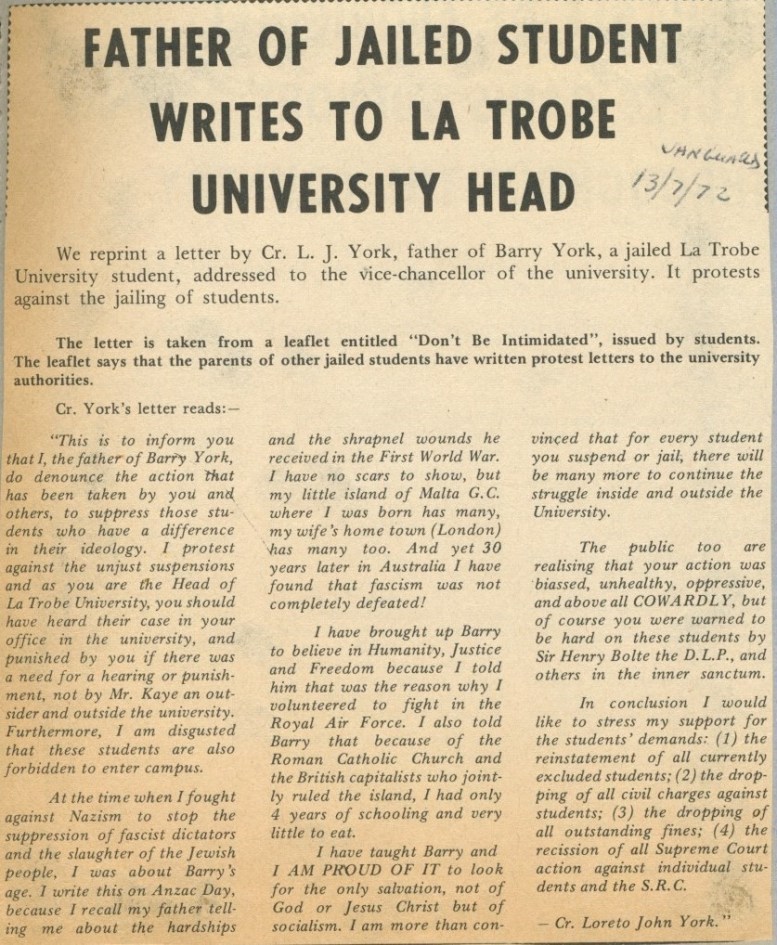
Here’s something from my old files, from 1972, when Fergus Robinson and Brian Pola and I were imprisoned at Pentridge Gaol in Melbourne for contempt of the Supreme Court of Victoria.

I love the spirit in which my father, Loreto, wrote it – and the fact that he wrote it at all.


loreto york letter to vice chancellor myers, published in vanguard 13 july 1972

Word meanings and the left

We shouldn’t be so squeamish about terms originally developed, adapted or appropriated by religious minds as they sought to explain external reality and human experience. Granting religion defacto monopoly rights over words like spirit, effectively allowing them to turn appropriation into expropriation, is another matter.


images

James Brown was the Godfather of Soul.


Word meanings and the left

By TomG

The following thoughts on word meanings originated from a written or online comment contained in communication between old comrades some twenty years ago. I transcribed my response, filing it away on the cloud, many years later but the issues raised remain pertinent, hence this post. The disagreement was over a discomfort or ambivalence with the word ‘spirit’, and no, we were not talking about a stiff drink.

I have forgotten the precise gripe that this word raised – it will have had something to do with religious or idealist connotations – but I have not forgotten my irritation with the gripe and my liking of the word’s ambiguity, containing as it did the germ of all its definitions, idealist or materialist, secular or religious. Contradictions aplenty. And contradictions, how they emerge and relate to one another in their development, is supposed to be something we are both in favour of and up to speed with.

Two things in particular struck me about this:

1. What words mean, how we understand and use them, is developmental. Spirit, always about human vitality, human essence, be that defined idealistically or materialistically, was first thought of by the ancient Greeks to be about the breath. Not a bad stab at it given the constraints they operated under and not devoid of contradiction either. Was spirit extrinsic or intrinsic? did it come from within or without? delivered to us or created by us? As we know it then came to be predominantly associated with, indeed exclusively appropriated, by religion in its uses and interpretations. Since the scientific revolution of the 17thC and the Enlightenment of the 18thC, the tide has turned and by the 20thC non religious uses and interpretations were becoming common and predominant, liberated from the religious constraints spirit had suffered under.

2. The other thing is its identification with consciousness, about what is vital, quintessential, in people. So, what is consciousness? This is certainly something that, historically, has been seen to involve not just cognition, but notions of soul, spirit and heart. Use of the word ‘heart’ has been long liberated, and we probably have Harvey’s work in the 17thC on circulation of blood to thank for this. We all can and do, use ‘heart’ figuratively, without any angst or confusion. The same applies to ‘soul’ and ‘spirit’ although for reasons I have only recently bothered to think about these continue to cause squeamishness among some radical circles. Recent advances in the neurosciences have added substantial weight to the materialist view advanced by Feuerbach in the 1830’s and it’s about time that the radical cum revolutionary left caught up. “The spirit develops together with the body, with the sense. …whence the skull, whence the brain, thence also the spirit; whence an organ, thence also its functioning. The spirit is in the head.”

We shouldn’t be so squeamish about terms originally developed, adapted or appropriated by religious minds as they sought to explain external reality and human experience. Granting religion defacto monopoly rights over words like spirit, effectively allowing them to turn appropriation into expropriation, is another matter. Given that we have no problems about expropriation in other areas, we should have no qualms about re-expropriating here. (By the way, Shakespeare was a master at appropriating novel and common vernacular and his is a good example to follow). The word ‘fuck’ is a prime example and I don’t know anyone who is without sin, and happily so, in using it freely. Indeed it has now become respectable (almost) and we hear it uttered on radio and TV shows daily. Adapting language, actually developing language, is something people have been doing forever and we shouldn’t be shy about it.
Soul and faith are two words that carry heavy religious baggage, soul denoting the seat of our corporeal self and faith denoting acceptance, in the absence of any evidence, of God’s divine providence. How else could God move in mysterious ways, I say unto you?

But in the real, material world, populated by the proverbial common man or woman and in particular by the common adolescent or young adult, word use and adaptation reflects the dynamism we associate with the modern world, with modernity itself. And the old, original (if that’s what they were) religious meanings? Seriously, they’re terminal and on life support and I see little point in radicals – genuine or even pseudo – playing a role in keeping the life support switched on. Let me give three examples of what I’m talking about:

1. “Today’s music ain’t got no soul; give me that old time rock and roll.” belts out Bob Seeger and it’s pretty clear that he’s not referring to what the God botherers mean.

2. And what about Rubber Soul, courtesy of The Beatles? Try as I may I fail to detect God’s ineffable presence.

3. Faith’s principle meaning is now confidence or trust in a person or thing. While this is somewhat ambiguous, containing as it does contradiction, we identify with that aspect that reflects social being and scientific understanding. It is on this basis that we can say that we have faith in the masses (don’t we?), in the general direction of historical development, in scientific method, and that among the numerous ‘revolutionary’ grouplets or sects there will be a higher percentage of killjoys than among the general population etc

As mentioned above the meaning of words change and new ones invented, language being subject to similar developmental pressure and opportunities that are at play generally. The left’s distancing itself of words like spirit has not stopped this; it has only stopped our engagement with it and, more tellingly, with the throb of life associated with it. ‘Out there’, among the throng of real life inhabited by the working classes that we purportedly identify with, people engage with this process, be they conscious of this or not. It’s what gives etymologists a job.

We do not need to be etymologists of course but we can certainly take a leaf out of their book and be open to, and engage with, the ongoing process of how word usage and meaning changes. This is happening anyway and will continue to do so whether or not we engage with it ourselves. I just think it’d be a good idea for us to be conscious of and open to this process. While not a big deal in itself (no, we don’t have to lose sleep on where words may be heading) it is symptomatic of something that we should be losing sleep over: do we move with the times, consciously, trying to effect speed and direction, or do we stay behind the pack, whining about the packs backwardness and kidding ourselves that our position is actually in front?

When the state is unjust, citizens may use justifiable violence

The following is written from a classical liberal point of view but one does not have to be a liberal to agree with the conclusions. It brings to mind some of the thinking, and arguments, we had on the left back in the late 1960s and early 1970s when police routinely framed and/or beat people up on political demonstrations with a view to thwarting the developing mass movement and growing influence of revolutionary socialist ideas.

Article republished from Aeon under Creative Commons, written by Jason Brennan

* * * *

If you see police choking someone to death – such as Eric Garner, the 43-year-old black horticulturalist wrestled down on the streets of New York City in 2014 – you might choose to pepper-spray them and flee. You might even save an innocent life. But what ethical considerations justify such dangerous heroics? (After all, the cops might arrest or kill you.) More important: do we have the right to defend ourselves and others from government injustice when government agents are following an unjust law? I think the answer is yes. But that view needs defending. Under what circumstances might active self-defence, including possible violence, be justified, as opposed to the passive resistance of civil disobedience that Americans generally applaud?

Civil disobedience is a public act that aims to create social or legal change. Think of Henry David Thoreau’s arrest in 1846 for refusing to pay taxes to fund the colonial exploits of the United States, or Martin Luther King Jr courting the ire of the authorities in 1963 to shame white America into respecting black civil rights. In such cases, disobedient citizens visibly break the law and accept punishment, so as to draw attention to a cause. But justifiable resistance need not have a civic character. It need not aim at changing the law, reforming dysfunctional institutions or replacing bad leaders. Sometimes, it is simply about stopping an immediate injustice­. If you stop a mugging, you are trying to stop that mugging in that moment, not trying to end muggings everywhere. Indeed, had you pepper-sprayed the police officer Daniel Pantaleo while he choked Eric Garner, you’d have been trying to save Garner, not reform US policing.

Generally, we agree that it’s wrong to lie, cheat, steal, deceive, manipulate, destroy property or attack people. But few of us think that the prohibitions against such actions are absolute. Commonsense morality holds that such actions are permissible in self-defence or in defence of others (even if the law doesn’t always agree). You may lie to the murderer at the door. You may smash the windows of the would-be kidnapper’s car. You may kill the would-be rapist.

Here’s a philosophical exercise. Imagine a situation in which a civilian commits an injustice, the kind against which you believe it is permissible to use deception, subterfuge or violence to defend yourself or others. For instance, imagine your friend makes an improper stop at a red light, and his dad, in anger, yanks him out of the car, beats the hell out of him, and continues to strike the back of his skull even after your friend lies subdued and prostrate. May you use violence, if it’s necessary to stop the father? Now imagine the same scene, except this time the attacker is a police officer in Ohio, and the victim is Richard Hubbard III, who in 2017 experienced just such an attack as described. Does that change things? Must you let the police officer possibly kill Hubbard rather than intervene?

Most people answer yes, believing that we are forbidden from stopping government agents who violate our rights. I find this puzzling. On this view, my neighbours can eliminate our right of self-defence and our rights to defend others by granting someone an office or passing a bad law. On this view, our rights to life, liberty, due process and security of person can disappear by political fiat – or even when a cop has a bad day. In When All Else Fails: The Ethics of Resistance to State Injustice (2019), I argue instead that we may act defensively against government agents under the same conditions in which we may act defensively against civilians. In my view, civilian and government agents are on a par, and we have identical rights of self-defence (and defence of others) against both. We should presume, by default, that government agents have no special immunity against self-defence, unless we can discover good reason to think otherwise. But it turns out that the leading arguments for special immunity are weak.

Some people say we may not defend ourselves against government injustice because governments and their agents have ‘authority’. (By definition, a government has authority over you if, and only if, it can oblige you to obey by fiat: you have to do what it says because it says so.) But the authority argument doesn’t work. It’s one thing to say that you have a duty to pay your taxes, show up for jury duty, or follow the speed limit. It is quite another to show that you are specifically bound to allow a government and its agents to use excessive violence and ignore your rights to due process. A central idea in liberalism is that whatever authority governments have is limited.

Others say that we should resist government injustice, but only through peaceful methods. Indeed, we should, but that doesn’t differentiate between self-defence against civilians or government. The common-law doctrine of self-defence is always governed by a necessity proviso: you may lie or use violence only if necessary, that is, only if peaceful actions are not as effective. But peaceful methods often fail to stop wrongdoing. Eric Garner peacefully complained: ‘I can’t breathe,’ until he drew his last breath.

Another argument is that we shouldn’t act as vigilantes. But invoking this point here misunderstands the antivigilante principle, which says that when there exists a workable public system of justice, you should defer to public agents trying, in good faith, to administer justice. So if cops attempt to stop a mugging, you shouldn’t insert yourself. But if they ignore or can’t stop a mugging, you may intervene. If the police themselves are the muggers – as in unjust civil forfeiture – the antivigilante principle does not forbid you from defending yourself. It insists you defer to more competent government agents when they administer justice, not that you must let them commit injustice.

Some people find my thesis too dangerous. They claim that it’s hard to know exactly when self-defence is justified; that people make mistakes, resisting when they should not. Perhaps. But that’s true of self-defence against civilians, too. No one says we lack a right of self-defence against each other because applying the principle is hard. Rather, some moral principles are hard to apply.

However, this objection gets the problem exactly backwards. In real life, people are too deferential and conformist in the face of government authority. They are all-too-willing to electrocute experimental subjects, gas Jews or bomb civilians when ordered to, and reluctant to stand up to political injustice. If anything, the dangerous thesis – the thesis that most people will mistakenly misapply – is that we should defer to government agents when they seem to act unjustly. Remember, self-defence against the state is about stopping an immediate injustice, not fixing broken rules.

Of course, strategic nonviolence is usually the most effective way to induce lasting social change. But we should not assume that strategic nonviolence of the sort that King practised always works alone. Two recent books – Charles Cobb Jr’s This Nonviolent Stuff’ll Get You Killed (2014) and Akinyele Omowale Umoja’s We Will Shoot Back (2013) – show that the later ‘nonviolent’ phase of US civil rights activism succeeded (in so far as it has) only because, in earlier phases, black people armed themselves and shot back in self-defence. Once murderous mobs and white police learned that black people would fight back, they turned to less violent forms of oppression, and black people in turn began using nonviolent tactics. Defensive subterfuge, deceit and violence are rarely first resorts, but that doesn’t mean they are never justified.Aeon counter – do not remove

Jason Brennan

This article was originally published at Aeon and has been republished under Creative Commons.

Assassinations of Raed Fares and Hammoud al-Jneid – the democratic revolution continues

Raed Fares best one

The assassination of Syrian democratic revolutionaries Raed Fares and Hammoud al-Jneid in Kafr Nabl was very bad and sad news. Raed was an icon of the people’s uprising, especially in Kafr Nabl, from where he ran an alternative anti-regime, anti-Daesh, radio station called ‘Radio Fresh‘.

It had received US funding until five months ago when President Trump stopped the US government’s $200 million in ‘stablilization aid’ to Syrian civil society organisations and humanitarian groups, including Radio Fresh. (Which must have pleased the anti-US-interventionist pseudo-left).

I followed Raed Fares on facebook over the years. Images of his satirical cartoons and political banners went viral. They had a distinct style and could be savage in their mocking of the regime and of the west’s failure to effectively support the revolutionaries.

There’s a lot of muck on social media but also great stuff, like the photos of Raed’s cartoons and banners, usually held up by groups of men in Kafr Nabl.

I’m republishing below a letter seeking support for Radio Fresh, to allow it to keep going.

Also, I’ve been gathering images of some of Raed’s work and share them here, after the letter below. My favourite is the one linking the Syrian uprising to the bigger picture of democratic revolution beyond Syria.

* * * *

46703909_2016080171818746_6291268078000930816_n


Dear friends,

I am still reeling from the news of Raed Fares’s assassination on Friday. The heartbreak and collective grief so many Syrians and people around the world share at his loss are almost unbearable. But with every hour that passes it becomes more obvious what we need to do. We need to keep his work alive, we need to keep Radio Fresh on the air and power the work of the hundreds of journalists and activists he trained.

As a prominent civil society leader and media activist, Raed knew his life was in imminent danger, especially in his last weeks. His work was always very dangerous and he knew that both the Syrian regime and Al-Qaeda’s thugs wanted him dead. However he was determined to stay in his hometown of Kafranbel and continue his work. Fearing he might be assassinated, he gave instructions to his loyal students about how to continue what he had built. Radio Fresh would continue. The United Revolutionary Bureaus he set up would continue.

I’ve had many conversations over the last couple of days with Raed’s kids and his team. No one is giving up. Everyone wants to continue what Raed started — he made it clear that that’s what he would’ve wanted.  

Raed launched a campaign to fund Radio Fresh three months before his death when international aid was cut to the project. His family and colleagues have called on us to do everything we can to continue the campaign, fund his work and keep Raed’s dream of independent radio alive.

Please donate now to keep Radio Fresh on the air, and share the link with all your friends.

Radio Fresh is an independent radio station in northwest Syria that resists both Assad and extremist groups. Raed considered Radio Fresh an essential service to the community – its brave reporters discussed local issues, investigated cases of injustice, and held authorities to account. They even warned the community of incoming airstrikes.

When he survived his first assassination attempt by an armed group in Idlib in January 2016, Raed posted this to Facebook:

“Freedom is an idea, and an idea cannot die

Fresh is an idea, and an idea cannot die

Ideas cannot die, people die, and we will stay here so the pain goes away

Oh my homeland, of sacrifices

I cannot thank enough those who stood in solidarity, and letters cannot do justice to my emotions, all I can say is: You are the Revolution, and the Revolution saved its children”

Let’s put our support now behind the hundreds of journalists and activists trained by Raed and let’s help continue their critical work. The extremists will not defeat his indomitable will.

Donate now to keep Radio Fresh on the air.

Raed’s death is huge loss to humanity, to everyone everywhere who believes in freedom, democracy and equal rights for all. The only way to honour him is to continue his incredible work.

Thank you.

Yours,

Kenan Rahmani


47102133_10155667190817676_5950903228441821184_o


download

skynews-syria-poster_4497328

0fc61fb4-62b4-4a02-b807-7f5e4de39244

9f664319-b06d-481e-b146-d2f89e199871_16x9_788x442


* * * *

‘For America to Live, Europe Must Die’ – existential torpor versus modernity’s melting dialectic (a critique of the reactionary outlook of the late North American Indian activist Russell Means)

Russell Means was a prominent and divisive North American Indian activist, artist, writer (ironic given what he has to say about writing below) and actor who died in 2012. He first came to widespread prominence for his role in the Wounded Knee uprising in 1973. The speech below ‘For America to Live, Europe Must Die’ was given in 1980 and is broadly representative of his views. Visit the Wikipedia page here and follow links for more detailed information. The speech, apparently his best known, was given before several thousand people who had assembled from all over the world for the Black Hills International Survival Gathering, in the Black Hills of South Dakota.

It was forwarded to me by Barry asking my opinion of it and my response was immediate. I was working in Alice Springs at the time and in two nights after work I fired back my comments, contained in the text of the speech. This was certainly a more convenient way for me to respond as I was able to use the framework of the speech without having to develop a separate framework that would have been required by an article. But it also kept the response more lively and in direct contact with what Means was saying; more concrete I guess. Means was clearly a very intelligent and passionate activist and my argument with him, if I can put it that way, is over what road to take as we respond to the challenges thrown up by capitalism and modernity’s melting dialectic more generally. His being divisive is not the problem (we could actually do with more). What divisiveness is over is another matter entirely. Nearly forty years down the track the issues raised by him remain current.

* * * *

(Thanks to Tom Griffiths for this article).

* * * *

Russell Means’ article is in plain font. Tom’s responses are in italics.

* * * *

The only possible opening for a statement of this kind is that I detest writing. The process itself epitomizes the European concept of “legitimate” thinking; what is written has an importance that is denied the spoken. My culture, the Lakota culture, has an oral tradition, so I ordinarily reject writing. It is one of the white world’s ways of destroying the cultures of non-European peoples, the imposing of an abstraction over the spoken relationship of a people.


An inauspicious opening salvo that sets the scene pretty nicely for what follows, not least his romanticisation of traditional culture (here tribal) and his confusion about the abstract and the concrete.


So what you read here is not what I’ve written. It’s what I’ve said and someone else has written down. I will allow this because it seems that the only way to communicate with the white world is through the dead, dry leaves of a book. I don’t really care whether my words reach whites or not. They have already demonstrated through their history that they cannot hear, cannot see; they can only read (of course, there are exceptions, but the exceptions only prove the rule). I’m more concerned with American Indian people, students and others, who have begun to be absorbed into the white world through universities and other institutions. But even then it’s a marginal sort of concern. It’s very possible to grow into a red face with a white mind; and if that’s a person’s individual choice, so be it, but I have no use for them. This is part of the process of cultural genocide being waged by Europeans against American Indian peoples’ today. My concern is with those American Indians who choose to resist this genocide, but who may be confused as to how to proceed.


Well, learning how to write and learning how to use writing as a tool/weapon is a good place to start. It’s not the writing; people have been historically keen to learn and ruling classes, until modernity had matured a little, equally keen to deny them that opportunity. Whose side are you on? His reference to cultural genocide is plainly wrong if we understand by culture something that is living and it being a user’s guide to finding one’s way through the maze of social existence. If we see it as something fixed and eternal then his claim has validity, although then the idea of a requiem might be more appropriate. His view differs radically from American Indian voices I became aware of when visiting Toronto recently. In the Toronto Museum was an extraordinary exhibit of three traditional Indian figures, ‘residents’ of the museum for over a century, transformed by the addition of a power drill, a camera tripod and an ipod. Beneath it was this explanation:

‘We do not want to be depicted in the way we were when we were first discovered in our homeland in North America. We do not want museums to continue to present us as something from the past. We believe we are very, very much here now and we are going to be very important in the future’.


(You notice I use the term American Indian rather than Native American or Native indigenous people or Amerindian when referring to my people. There has been some controversy about such terms, and frankly, at this point, I find it absurd. Primarily it seems that American Indian is being rejected as European in origin–which is true. But all the above terms are European in origin; the only non-European way is to speak of Lakota–or, more precisely, of Oglala, Brule, etc.–and of the Dineh, the Miccousukee, and all the rest of the several hundred correct tribal names).


I don’t have a problem with this paragraph. The term he favours – American Indian and the terms he rejects all have the benefit of drawing multiple tribal backgrounds into a unity. In this it is much like nationality. Within this unity however there is difference, or diversity and I don’t have an issue with that being acknowledged.


(There is also some confusion about the word Indian, a mistaken belief that it refers somehow to the country, India. When Columbus washed up on the beach in the Caribbean, he was not looking for a country called India. Europeans were calling that country Hindustan in 1492. Look it up on the old maps. Columbus called the tribal people he met “Indio,” from the Italian in dio, meaning “in God.”)


I know I’m being picky, but he argues against himself here – he, we, know this because  we can not only read the maps, but the historical record.


It takes a strong effort on the part of each American Indian not to become Europeanized. The strength for this effort can only come from the traditional ways, the traditional values that our elders retain. It must come from the hoop, the four directions, the relations: it cannot come from the pages of a book or a thousand books. No European can ever teach a Lakota to be Lakota, a Hopi to be Hopi. A master’s degree in “Indian Studies” or in “education” or in anything else cannot make a person into a human being or provide knowledge into traditional ways. It can only make you into a mental European, an outsider.


And what is wrong with an outsider? Tribalism and small community thinking generally do not trust outsiders. Small group paranoia aids survival when our dependence and domination by the external environment prevents or limits our ability to be open and to trust. If you want to live with your head stuck up a dark and malodorous hole…


I should be clear about something here, because there seems to be some confusion about it. When I speak of Europeans or mental Europeans, I’m not allowing for false distinctions. I’m not saying that on the one hand there are the by-products of a few thousand years of genocidal, reactionary, European intellectual development which is bad; and on the other hand there is some new revolutionary intellectual development which is good. I’m referring here to the so-called theories of Marxism and anarchism and “leftism” in general. I don’t believe these theories can be separated from the rest of the of the European intellectual tradition. It’s really just the same old song.


Yes and no. They emerge from the same song sheet but music is then developed and its constraints transcended. He is exposing his non dialectical way of thinking – he doesn’t need the word, although he is clearly familiar with it, he needs the idea of how and why things change internally.


The process began much earlier. Newton, for example, “revolutionized” physics and the so-called natural sciences by reducing the physical universe to a linear mathematical equation. Descartes did the same thing with culture. John Locke did it with politics, and Adam Smith did it with economics. Each one of these “thinkers” took a piece of the spirituality of human existence and converted it into code, an abstraction.


Good grief, as if how he talks about spirituality is not an abstraction! The ‘code’, the abstractions he accuses Descartes et al of making were no match for his whopper, a damn sight more useful and, dare I say it, closer to the concrete.


They picked up where Christianity ended: they “secularized” Christian religion, as the “scholars” like to say–and in doing so they made Europe more able and ready to act as an expansionist culture. Each of these intellectual revolutions served to abstract the European mentality even further, to remove the wonderful complexity and spirituality from the universe and replace it with a logical sequence: one, two, three. Answer!


This is nonsense. He is suggesting, bluntly, that the “wonderful complexity and spirituality from the universe” under medievalism, or the Dark Ages, or under slave owning societies, traditional players all of them according to his criteria (and mine too actually) was better than what we have and can realistically achieve or aspire to today. Reactionary is a polite description, nutty more to the point.


This is what has come to be termed “efficiency” in the European mind. Whatever is mechanical is perfect; whatever seems to work at the moment–that is, proves the mechanical model to be the right one–is considered correct, even when it is clearly untrue. This is why “truth” changes so fast in the European mind; the answers which result from such a process are only stopgaps, only temporary, and must be continuously discarded in favor of new stopgaps which support the mechanical models and keep them (the models) alive.


All that is solid old chap, all that is solid… He craves for the certainty of eternal truths and when we consider this in relation to social relations, including family relations, he is eulogising a trap, especially if you are female.


Hegel and Marx were heirs to the thinking of Newton, Descartes, Locke and Smith. Hegel finished the process of secularizing theology–and that is put in his own terms–he secularized the religious thinking through which Europe understood the universe. Then Marx put Hegel’s philosophy in terms of “materialism,” which is to say that Marx despiritualized Hegel’s work altogether. Again, this is in Marx’ own terms. And this is now seen as the future revolutionary potential of Europe. Europeans may see this as revolutionary, but American Indians see it simply as still more of that same old European conflict between being and gaining. The intellectual roots of a new Marxist form of European imperialism lie in Marx – and his followers’ – links to the tradition of Newton, Hegel and the others.


This “conflict” is a false antithesis. As he uses this purported contradiction “being” is seen as being static, rather than dynamic, a form of existential torpor. And his use of “gaining” is a ruse employed because it can be seen as having negative, materialist connotations. He uses it to dismiss the idea and promise of development – economic, social or personal. Replace “gaining” with “improvement”, also a word denoting growth, reread his ’contradiction’ and note the different vibe given off.


Being is a spiritual proposition. Gaining is a material act. Traditionally, American Indians have always attempted to be the best people they could. Part of that spiritual process was and is to give away wealth, to discard wealth in order not to gain. Material gain is an indicator of false status among traditional people, while it is “proof that the system works” to Europeans. Clearly, there are two completely opposing views at issue here, and Marxism is very far over to the other side from the American Indian view. But let’s look at a major implication of this; it is not merely an intellectual debate.

The European materialist tradition of despiritualizing the universe is very similar to the mental process which goes into dehumanizing another person.


The reality is actually in inverse proportion and the comparison he promotes is fraudulent. He is right of course that the materialist spirit has despiritualized, ie, demystified the universe. It does so by reeling in understanding from its hiding place beyond the clouds, where it was the property of the gods, onto the ground and hence within our grasp. Tribalism certainly encourages the dehumanization of ‘other’. Modernity does not. Since when is understanding the richness and possibilities present in “another person”, indeed, all of us, “dehumanizing”? As Berman observes in his tribute to Times Square the one nice thing about American imperialism is that it embraced everybody. “Despiritualizing the universe”, as he puts it, is making the universe and us in it, explicable. Seeking answers, pushing the limits and transcending, rather than being trapped inside boundaries, makes us active players, not spiritual zombies.


And who seems most expert at dehumanizing other people? And why? Soldiers who have seen a lot of combat learn to do this to the enemy before going back into combat. Murderers do it before going out to commit murder. Nazi SS guards did it to concentration camp inmates. Cops do it. Corporation leaders do it to the workers they send into uranium mines and steel mills. Politicians do it to everyone in sight. And what the process has in common for each group doing the dehumanizing is that it makes it all right to kill and otherwise destroy other people. One of the Christian commandments says, “Thou shalt not kill,” at least not humans, so the trick is to mentally convert the victims into non-humans. Then you can proclaim violation of your own commandment as a virtue.


If there is a trick here he is the one playing it, although I suspect the trick is being played on him too. When the Old Testament God was taking a breather from smoting this tribe and that he issued the Commandments to his select tribe. “Thou shalt not kill” was an instruction to not kill one’s own. As for the others, follow my example… Christianity deserves praise here because it broadened the Old Testament definition of human and tribe to include everyone. Jared Diamond speaks of precisely the same traditional dehumanizing of other tribes in the New Guinea Highlands (The World Until Yesterday)


In terms of the despiritualization of the universe, the mental process works so that it becomes virtuous to destroy the planet. Terms like progress and development are used as cover words here, the way victory and freedom are used to justify butchery in the dehumanization process. For example, a real-estate speculator may refer to “developing” a parcel of ground by opening a gravel quarry; development here means total, permanent destruction, with the earth itself removed.


I’ll let the hyperbole go through to the keeper, but what he is doing is humanizing the planet and dehumanizing us.


But European logic has gained a few tons of gravel with which more land can be “developed” through the construction of road beds. Ultimately, the whole universe is open–in the European view–to this sort of insanity.


Yes, openness is what it’s about. In one sense he is highlighting the contradiction between the politics of the ‘House’ (or tepee in his case) and the politics of the ‘Street’, closed versus open systems of intercourse. The philosophers he holds a grudge against haven’t despiritualized the world, they have demystified it. This is the high end of town version of what general human intercourse does and it enriches us – materially and spiritually, in the process. What’s not to like? And as for his ‘satisfaction’ being only measured ‘in terms of gaining material’ he not only articulates a lot of pre capitalist thinking, but greenie and pseudo thinking. Good grief, could there be a link? He employs a common sleight of hand here by focussing our attention on only the narrowest impacts and drivers behind capitalist accumulation – profit, exploitation and destruction – the former going only to the capitalist, the middle referring to ‘mother’ earth and humanity and the latter also to dear old mum and the human spirit. (He is reducing human spirit to a form of miserablism, no fun at all). Some of this is true – capitalists do exploit nature and human labour – but he dismisses altogether the accrued benefits of this through increased social wealth and the social, cultural and personal development that this enables. By only highlighting the destructive and venal aspects he opens a wide door for the sort of moral posturing that is rife these days among the pseudos and greenies. For him I suspect it is much more than posturing, more a reflection of a genuine existential crisis or funk. Whichever, we cannot excuse his solutions.

One of the problems he has, and it’s a biggie, is his essential inability to shift between what systems jargon calls different level thinking. A sociological or group perspective as opposed to an individual or personal perspective, what we ‘see’ or experience and the conclusions we draw when inhabiting each level is an example we would immediately recognize. Norbert Elias uses the example of the pilot and the swimmer to explain the tension (advantages/disadvantages) between different level thinking. The latter has the advantage of being above, seeing the overall picture, whether the swimmers are heading toward rough water or dangerous currents or not, whether their direction leads to safety or danger. The swimmer cannot see this, but what he/she can see and experience and what the pilot cannot is what is useful/possible in the immediate situation, what the affect of the currents/tidal pull is on a personal or small group level and what can be done about that in the immediate (or here and now). Revolutionaries, especially ones that have fealty to Marxism, need to be able to swim and fly at the same time. Russell was stuck on the ground, gazing skywards and as we now know, thanks to those wretched scientists and philosophers, the light from the sky reflects a distant past; this is why he is able to romanticize it.


Most important here, perhaps, is the fact that Europeans feel no sense of loss in all this. After all, their philosophers have despiritualized reality, so there is no satisfaction (for them) to be gained in simply observing the wonder of a mountain or a lake or a people in being. No, satisfaction is measured in terms of gaining material. So the mountain becomes gravel, and the lake becomes coolant for a factory, and the people are rounded up for processing through the indoctrination mills Europeans like to call schools.

But each new piece of that “progress” ups the ante out in the real world. Take fuel for the industrial machine as an example. Little more than two centuries ago, nearly everyone used wood–a replenishable, natural item–as fuel for the very human needs of cooking and staying warm. Along came the Industrial Revolution and coal became the dominant fuel, as production became the social imperative for Europe. Pollution began to become a problem in the cities, and the earth was ripped open to provide coal whereas wood had always simply been gathered or harvested at no great expense to the environment. Later, oil became the major fuel, as the technology of production was perfected through a series of scientific “revolutions.” Pollution increased dramatically, and nobody yet knows what the environmental costs of pumping all that oil out of the ground will really be in the long run. Now there’s an “energy crisis,” and uranium is becoming the dominant fuel.


While not confined to this paragraph I detect a lot of envy here (envy is a primitive emotion and seeks to destroy what it cannot have). He is in good company of course, it is pretty rampant in pseudo circles. I think it is a displacement of feelings of disappointment and failure many of us have felt but only a few of us have owned and taken responsibility for. I do not mean that we have ‘caused’ the malaise, although we have certainly been part of it. The malaise is ours, that is the left’s, and not the systems (its problems, contradictions remain, requiring a synthesizing resolution). Rather than spitting the dummy and pointing our collective finger only at the perfidious 1% we need to shake off our dependence on those we make theoretical gods (avoiding responsibility) and understand that we have some work to do.

Above I said that envy seeks to destroy what it cannot have. Jealousy at least aspires to possession. Rather than acknowledging his confusion and existential angst he rationalizes it by blaming the system totally and romanticizing the past. It saves him from thinking his predicament through. This is a pity because he was obviously an intelligent man.


Capitalists, at least, can be relied upon to develop uranium as fuel only at the rate which they can show a good profit. That’s their ethic, and maybe they will buy some time. Marxists, on the other hand, can be relied upon to develop uranium fuel as rapidly as possible simply because it’s the most “efficient” production fuel available. That’s their ethic, and I fail to see where it’s preferable. Like I said, Marxism is right smack in the middle of European tradition. It’s the same old song.


Yep, it’s part of the European song sheet, but with an improved score.


There’s a rule of thumb which can be applied here. You cannot judge the real nature of a European revolutionary doctrine on the basis of the changes it proposes to make within the European power structure and society. You can only judge it by the effects it will have on non-European peoples. This is because every revolution in European history has served to reinforce Europe’s tendencies and abilities to export destruction to other peoples, other cultures and the environment itself. I defy anyone to point out an example where this is not true.  


Happy to pick up the gauntlet. We defy anyone to venerate the old ways once they become familiar with what traditional life was actually like, still is in some places,  for individuals – women particularly – by reading memoirs by people like Ayaan Hirsi Ali, Phoolan Devi among others or anthropological accounts by people like Jared Diamond. What they will see – if they so wish – are accounts by or about people who have emerged from traditional settings or settings in the earlier stages of transition where, so to speak, the plane has barely left the tarmac.

The destruction he cites was real but it was first and foremost ideological, the destruction of those venerable ideas, as Marx put it, that proclaimed and enforced the belief that nothing different was either possible or permissible.


So now we, as American Indian people, are asked to believe that a “new” European revolutionary doctrine such as Marxism will reverse the negative effects of European history on us. European power relations are to be adjusted once again, and that’s supposed to make things better for all of us. But what does this really mean?

Right now, today, we who live on the Pine Ridge Reservation are living in what white society has designated a “National Sacrifice Area.” What this means is that we have a lot of uranium deposits here, and white culture (not us) needs this uranium as energy production material. The cheapest, most efficient way for industry to extract and deal with the processing of this uranium is to dump the waste by-products right here at the digging sites. Right here where we live. This waste is radioactive and will make the entire region uninhabitable forever. This is considered by the industry, and by the white society that created this industry, to be an “acceptable” price to pay for energy resource development.


Note the sleight of hand – not capitalists or their proverbial lackeys, not bourgeois governments, but ALL of us. He turns a good point about dumping into an attack on all people of European background. It’s so slack it doesn’t even qualify as racist (which he was not in any case).


Along the way they also plan to drain the water table under this part of South Dakota as part of the industrial process, so the region becomes doubly uninhabitable. The same sort of thing is happening down in the land of the Navajo and Hopi, up in the land of the Northern Cheyenne and Crow, and elsewhere. Thirty percent of the coal in the West and half of the uranium deposits in the United States have been found to lie under reservation land, so there is no way this can be called a minor issue.


Correct on this one.


We are resisting being turned into a National Sacrifice Area. We are resisting being turned into a national sacrifice people. The costs of this industrial process are not acceptable to us. It is genocide to dig uranium here and drain the water table–no more, no less.

Now let’s suppose that in our resistance to extermination we begin to seek allies (we have). Let’s suppose further that we were to take revolutionary Marxism at its word: that it intends nothing less than the complete overthrow of the European capitalists order which has presented this threat to our very existence. This would seem to be a natural alliance for American Indian people to enter into. After all, as the Marxists say, it is the capitalists who set us up to be a national sacrifice. This is true as far as it goes.

But, as I’ve tried to point out, this “truth” is very deceptive. Revolutionary Marxism is committed to even further perpetuation and perfection of the very industrial process which is destroying us all. It offers only to “redistribute” the results–the money, maybe–of this industrialization to a wider section of the population.


Yes and no. Yes to his first two sentences, no to his third. Marxists do not aim to level downwards, but upwards. We do not take wealth from the capitalists, but their capital. This is then used to create more socially beneficial wealth and the benefits of that are ‘passed around’.


It offers to take wealth from the capitalists and pass it around; but in order to do so, Marxism must maintain the industrial system. Once again, the power relations within European society will have to be altered, but once again the effects upon American Indian peoples here and non-Europeans elsewhere will remain the same. This is much the same as when power was redistributed from the church to private business during the so-called bourgeois revolution. European society changed a bit, at least superficially, but its conduct toward non-Europeans continued as before. You can see what the American Revolution of 1776 did for American Indians. It’s the same old song. song.


Revolutionary Marxism, like industrial society in other forms, seeks to “rationalize” all people in relation to industry–maximum industry, maximum production. It is a doctrine that despises the American Indian spiritual tradition, our cultures, our lifeways.


“Despise’ is too visceral, but I’ll let it pass. Do we ‘despise’ if we see it as a permanent resting place, a veritable burying ground for human aspiration and progress? Certainly. As something that can, like the rest of us, develop quantitatively and qualitatively? Certainly not; we respect the individuals and people too much to sacrifice them on a mythologized and idealized altar.


Marx himself called us “precapitalists” and “primitive.” Precapitalist simply means that, in his view, we would eventually discover capitalism and become capitalists; we have always been economically retarded in Marxist terms. The only manner in which American Indian people could participate in a Marxist revolution would be to join the industrial system, to become factory workers, or “proletarians,” as Marx called them. The man was very clear about the fact that his revolution could only occur through the struggle of the proletariat, that the existence of a massive industrial system is a precondition of a successful Marxist society.


He has this roughly right, but it is his failure to get dialectics, either intellectually or viscerally that sees him fantasize about the either/or – losing one, idealized and good permanent existential state to another bad and demonized existential state.


I think there’s a problem with language here. Christians, capitalists, Marxists. All of them have been revolutionary in their own minds, but none of them really means revolution. What they really mean is continuation. They do what they do in order that European culture can continue to exist and develop according to its needs.


He is onto something here. Much of what calls itself revolutionary – including things we have been involved with, has not really been able (has not desired?) to see past capitalism in either its economic or social relations. In this sense a % of what he is railing against are things we rail against too. And, paying respect to his reference to language, let’s toss in revisionism and mechanical materialism in their numerous manifestations.


So, in order for us to really join forces with Marxism, we American Indians would have to accept the national sacrifice of our homeland; we would have to commit cultural suicide and become industrialized and Europeanized.


Cultural suicide? This needs to be confronted. Cultures – any of them – that do not change to reflect the conditions and challenges of contemporary life – die. Their ‘permanence’ reflects a relationship between humans and their environment that is static, or nearly so. Cultures redeem themselves, if I can put it that way, by being adaptive and with only a little effort they can also maintain links with their past. But in this relationship between the past and the present we serve the present, not the past.


At this point, I’ve got to stop and ask myself whether I’m being too harsh. Marxism has something of a history. Does this history bear out my observations? I look to the process of industrialization in the Soviet Union since 1920 and I see that these Marxists have done what it took the English Industrial Revolution 300 years to do; and the Marxists did it in 60 years. I see that the territory of the USSR used to contain a number of tribal peoples and that they have been crushed to make way for the factories. The Soviets refer to this as “the National Question,” the question of whether the tribal peoples had the right to exist as peoples; and they decided the tribal peoples were an acceptable sacrifice to the industrial needs. I look to China and I see the same thing. I look to Vietnam and I see Marxists imposing an industrial order and rooting out the indigenous tribal mountain people.


As Marxists we can look at this and accept valid criticisms of the ‘how’, but not about the ‘whether’.


I hear the leading Soviet scientist saying that when uranium is exhausted, then alternatives will be found. I see the Vietnamese taking over a nuclear power plant abandoned by the U.S. military. Have they dismantled and destroyed it? No, they are using it. I see China exploding nuclear bombs, developing uranium reactors, and preparing a space program in order to colonize and exploit the planets the same as the Europeans colonized and exploited this hemisphere. It’s the same old song, but maybe with a faster tempo this time.


This is a dummy spit. His placing planets uninhabited by anything, except maybe microbes, on the same level as earth inhabited by real people and a bunch of near and not so near rellies gives the game away. He is lost (willingly it seems) in a fog of idealized abstractions. Has he any idea about the real circumstances and conditions of the peasants et al he so casually dismisses? It is the system – or his view of it – that he focuses on, not actual people.


The statement of the Soviet scientist is very interesting. Does he know what this alternative energy source will be? No, he simply has faith. Science will find a way. I hear revolutionary Marxists saying that the destruction of the environment, pollution, and radiation will all be controlled. And I see them act upon their words. Do they know how these things will be controlled? No, they simply have faith. Science will find a way. Industrialization is fine and necessary. How do they know this? Faith. Science will find a way. Faith of this sort has always been known in Europe as religion. Science has become the new European religion for both capitalists and Marxists; they are truly inseparable; they are part and parcel of the same culture. So, in both theory and practice, Marxism demands that non-European peoples give up their values, their traditions, their cultural existence altogether. We will all be industrialized science addicts in a Marxist society.


Well the track record gives a basis for this faith – a faith based in evidence I hasten to add – and the capitalists have shown a remarkable capacity to get on top of these ever emergent issues.


I do not believe that capitalism itself is really responsible for the situation in which American Indians have been declared a national sacrifice. No, it is the European tradition; European culture itself is responsible. Marxism is just the latest continuation of this tradition, not a solution to it. To ally with Marxism is to ally with the very same forces that declare us an acceptable cost.


This too gives the game away. While Marxism is certainly part of the European tradition his letting capitalism off the hook indicates that he is opposed to development full stop.


There is another way. There is the traditional Lakota way and the ways of the American Indian peoples. It is the way that knows that humans do not have the right to degrade Mother Earth, that there are forces beyond anything the European mind has conceived, that humans must be in harmony with all relations or the relations will eventually eliminate the disharmony. A lopsided emphasis on humans by humans–the Europeans’ arrogance of acting as though they were beyond the nature of all related things–can only result in a total disharmony and a readjustment which cuts arrogant humans down to size, gives them a taste of that reality beyond their grasp or control and restores the harmony. There is no need for a revolutionary theory to bring this about; it’s beyond human control. The nature peoples of this planet know this and so they do not theorize about it. Theory is an abstract; our knowledge is real.


Assert away. The real knowledge he valorizes is real knowledge that fitted and that emerged (was won) from a particular past. He elevates it to an abstraction, an idealized one at that, cut adrift from real, contemporary life.


Distilled to its basic terms, European faith–including the new faith in science–equals a belief that man is God.


Sounds good to me, we made him after all. Making man a god (and knocking down the Gods in the process) is a progressive yearning and achievement. It is an inherent part of overcoming a near complete and passive dependency on nature. Modernity has given us the means to dispose of them and place ourselves centre stage. Along the way there has been pushback, a cultural drag that sees us make ‘gods’ of leaders and ‘makers and shakers’ (he cites some) and we transfer our dependency – or, at least, too much of it – onto them. Phil Court’s pithy description of this, made in the late 70’s – “Follow me and you need never think again” has been etched in my mind ever since.


Europe has always sought a Messiah, whether that be the man Jesus Christ or the man Karl Marx or the man Albert Einstein. American Indians know this to be totally absurd. Humans are the weakest of all creatures, so weak that other creatures are willing to give up their flesh that we may live. Humans are able to survive only through the exercise of rationality since they lack the abilities of other creatures to gain food through the use of fang and claw.

But rationality is a curse since it can cause humans to forget the natural order of things in ways other creatures do not. A wolf never forgets his or her place in the natural order. American Indians can. Europeans almost always do. We pray our thanks to the deer, our relations, for allowing us their flesh to eat; Europeans simply take the flesh for granted and consider the deer inferior.


There is a poetic beauty to this prose and its creative impulse should not be dismissed, but let us not confuse the beauty of words with science which has a beauty and majesty of its own.


After all, Europeans consider themselves godlike in their rationalism and science. God is the Supreme Being; all else must be inferior.


This is childish. Creatures do not willingly give us their flesh, nor do they see us as weak and pity us. The wolf and the deer are not capable of making rational choices. A wolf does not choose to accept the natural order. To do so it would need to, and be capable of, appreciating alternatives. Wile E Coyote our wolf is not. He does not get hold of ACME goodies as he unhatches his diabolical (and tragically flawed)  plans to catch the Road Runner. He/she obeys instinct or dies (a fate that may await anyway). Russell is running with an animistic mysticism that belongs to the childhood of our social evolution. Such thinking may have provided succour in our earlier days but time, us with it, has moved on. And need I add that in the process of moving on we have used plenty of fang and claw. The prose he uses reflects an early grappling with trying to make sense of the world and our place in it. It helped with the overriding task of survival. There is no point at all in looking for higher level explanations unless we have the time and opportunity to do so. When we do not, spending time is a waste of time and may undermine our ability to survive.


All European tradition, Marxism included, has conspired to defy the natural order of all things.


Quite so, that’s why we love it. As Gerrard Winstanley, the most radical voice of the English Revolution observed, “Freedom is the man who turns the world upside down, and he therefore maketh many enemies.”


Mother Earth has been abused, the powers have been abused, and this cannot go on forever. No theory can alter that simple fact. Mother Earth will retaliate, the whole environment will retaliate, and the abusers will be eliminated. Things come full circle, back to where they started. That’s revolution. And that’s a prophecy of my people, of the Hopi people and of other correct peoples.


The spirituality so enamoured by him is, compared to the spirituality made possible by modernity, impoverished. It leaves us as dependent children. I much prefer to stand up with and join my fellows.


American Indians have been trying to explain this to Europeans for centuries. But, as I said earlier, Europeans have proven themselves unable to hear.


Oh we’ve heard all right and not just from American Indians. Many such voices were raised during medieval times across Europe resisting change and wanting to keep people ‘spiritually enriched’ and in their place. That’s why we’ve moved on.


The natural order will win out, and the offenders will die out, the way deer die when they offend the harmony by over-populating a given region. It’s only a matter of time until what Europeans call “a major catastrophe of global proportions” will occur. It is the role of American Indian peoples, the role of all natural beings, to survive. A part of our survival is to resist.


He is right here – at least much of the time. Survival is the name of the game and has been since year dot – ask the wolf. But where is abundance, thriving (and I’m thinking more culturally/spiritually than materially although they are connected)? Without these survival is also a trap that holds us tight and it has taken our forebears millennia of struggle, suffering  and resilience to break free from its constraints.


We resist not to overthrow a government or to take political power, but because it is natural to resist extermination, to survive. We don’t want power over white institutions; we want white institutions to disappear. That’s revolution.


American Indians are still in touch with these realities–the prophecies, the traditions of our ancestors. We learn from the elders, from nature, from the powers. And when the catastrophe is over, we American Indian peoples will still be here to inhabit the hemisphere. I don’t care if it’s only a handful living high in the Andes. American Indian people will survive; harmony will be re-established. That’s revolution.


No, it’s nihilism.


At this point, perhaps I should be very clear about another matter, one which should already be clear as a result of what I’ve said. But confusion breeds easily these days, so I want to hammer home this point. When I use the term European, I’m not referring to a skin color or a particular genetic structure. What I’m referring to is a mind-set, a worldview that is a product of the development of European culture. People are not genetically encoded to hold this outlook; they are acculturated to hold it. The same is true for American Indians or for the members of any culture.


This is a good point and one our current ‘right on’ identity set could take notice of. Indeed he is miles ahead of them and I have a sneaking feeling he saw them coming.


It is possible for an American Indian to share European values, a European worldview. We have a term for these people; we call them “apples”–red on the outside (genetics) and white on the inside (their values). Other groups have similar terms: Blacks have their “oreos”; Hispanos have “Coconuts” and so on. And, as I said before, there are exceptions to the white norm: people who are white on the outside, but not white inside. I’m not sure what term should be applied to them other than “human beings.”

What I’m putting out here is not a racial proposition but a cultural proposition. Those who ultimately advocate and defend the realities of European culture and its industrialism are my enemies. Those who resist it, who struggle against it, are my allies, the allies of American Indian people. And I don’t give a damn what their skin color happens to be. Caucasian is the white term for the white race: European is an outlook I oppose.


In spite of the generally reactionary nature of the speech his discrimination here is well made.


The Vietnamese Communists are not exactly what you might consider genetic Caucasians, but they are now functioning as mental Europeans. The same holds true for Chinese Communists, for Japanese capitalists or Bantu Catholics or Peter “MacDollar” down at the Navajo Reservation or Dickie Wilson up here at Pine Ridge. There is no racism involved in this, just an acknowledgment of the mind and spirit that make up culture.

In Marxist terms I suppose I’m a “cultural nationalist.” I work first with my people, the traditional Lakota people, because we hold a common worldview and share an immediate struggle. Beyond this, I work with other traditional American Indian peoples, again because of a certain commonality in worldview and form of struggle. Beyond that, I work with anyone who has experienced the colonial oppression of Europe and who resists its cultural and industrial totality. Obviously, this includes genetic Caucasians who struggle to resist the dominant norms of European culture. The Irish and the Basques come immediately to mind, but there are many others.


His working at ground level (or should that be sea level?) is essentially correct. Where do correct ideas come from after all? It is his failure to link this with an abstract that springs from, and in turn speaks to, the present and future that leaves him stranded on the docks after the ship has well and truly sailed.


I work primarily with my own people, with my own community. Other people who hold non-European perspectives should do the same. I believe in the slogan, “Trust your brother’s vision,” although I’d like to add sisters into the bargain. I trust the community and the culturally based vision of all the races that naturally resist industrialization and human extinction. Clearly, individual whites can share in this, given only that they have reached the awareness that continuation of the industrial imperatives of Europe is not a vision, but species suicide. White is one of the sacred colors of the Lakota people–red, yellow, white and black. The four directions. The four seasons. The four periods of life and aging. The four races of humanity. Mix red, yellow, white and black together and you get brown, the color of the fifth race. This is a natural ordering of things. It therefore seems natural to me to work with all races, each with its own special meaning, identity and message.


The ‘natural order of things’ for most of our species time has been clan and tribalism and very ‘in house’. This has engendered separatism, or perhaps more accurately, justified it. Trust and mutual reliance was ‘in house’ and outsiders, the ‘other’, were mistrusted or feared. This is what modernity has helped us overcome. It is ironic and a pity that this progressive aspect he holds is swamped and almost lost in a reactionary covering.


But there is a peculiar behavior among most Caucasians. As soon as I become critical of Europe and its impact on other cultures, they become defensive. They begin to defend themselves. But I’m not attacking them personally; I’m attacking Europe. In personalizing my observations on Europe they are personalizing European culture, identifying themselves with it.


Yes they are – and with good reason because key components of the individualizing synthesis have been hard wired.


By defending themselves in this context, they are ultimately defending the death culture. This is a confusion which must be overcome, and it must be overcome in a hurry. None of us has energy to waste in such false struggles.

Caucasians have a more positive vision to offer humanity than European culture. I believe this. But in order to attain this vision it is necessary for Caucasians to step outside European culture–alongside the rest of humanity–to see Europe for what it is and what it does.


Contradictions are not resolved (synthesised) by stepping outside of them. Or as Blake put it in Heaven and Hell “Without Contraries is no progression”. But the synthesising process here is a subjective one – we have to want to do it rather than having it done for us.


To cling to capitalism and Marxism and all other “isms” is simply to remain within European culture. There is no avoiding this basic fact. As a fact, this constitutes a choice. Understand that the choice is based on culture, not race.


Well, he is making a choice too, but I take his essentially correct point. We are choosing to move forward and just because ‘beyond here there be dragons’ is no reason to go backwards.


Understand that to choose European culture and industrialism is to choose to be my enemy. And understand that the choice is yours, not mine.

This leads me back to address those American Indians who are drifting through the universities, the city slums, and other European institutions. If you are there to resist the oppressor in accordance with your traditional ways, so be it. I don’t know how you manage to combine the two, but perhaps you will succeed. But retain your sense of reality. Beware of coming to believe the white world now offers solutions to the problems it confronts us with. Beware, too, of allowing the words of native people to be twisted to the advantages of our enemies. Europe invented the practice of turning words around on themselves. You need only look to the treaties between American Indian peoples and various European governments to know that this is true. Draw your strength from who you are.


This is a fair enough point and could be taken from any self help manual – which means it is easily transformed into the sententious. The problems presented by the treaties are not merely hedges in their maze, impassable barriers, but present opportunities too, not to be given, but to be fought for. Solutions and progress are to be found, in other words, on the arena. Going off in a high dudgeon is no solution.


A culture which regularly confuses revolt with resistance, has nothing helpful to teach you and nothing to offer you as a way of life. Europeans have long since lost all touch with reality, if ever they were in touch with who you are as American Indians.


This hints to me of a hostility to revolution and here I am meaning social rather than political revolution.


So, I suppose to conclude this, I should state clearly that leading anyone toward Marxism is the last thing on my mind. Marxism is as alien to my culture as capitalism and Christianity are. In fact, I can say I don’t think I’m trying to lead anyone toward anything. To some extent I tried to be a “leader,” in the sense that the white media like to use that term, when the American Indian Movement was a young organization. This was a result of a confusion I no longer have. You cannot be everything to everyone. I do not propose to be used in such a fashion by my enemies. I am not a leader. I am an Oglala Lakota patriot. That is all I want and all I need to be. And I am very comfortable with who I am.


I am not so sure that he was comfortable with who he was – or perhaps became. By all means dismiss Marxism; a lot of crap has been associated with it and he may well have been disillusioned with the crap as we are too. But the tone of his speech speaks of defeat, disillusion, even despair, leading to withdrawal and a full scale retreat. Whatever we may think of this, it is not where the future lies. For this we should direct our sights to the statement provided by those North American Indians behind the Ontario Museum exhibit.