If Bertolt Brecht were in Alice (Springs)…

download

Many thanks to Tom Griffiths for this excellent poem.

For overseas’ readers, Alice Springs is a town in central Australia. The population is about 24,000, of which 18% is Indigenous. The town has very serious crime problems and is the ‘murder capital of Australia’. Domestic violence is especially bad.

The level of domestic violence in Aboriginal communities has been described as “out of control” by the Northern Territory Coroner. Women are taking the lead in calling for an end to violence.

Tom has been working in Alice with a family violence program run out of Tangentyere Council. The group program is for anyone but is overwhelmingly attended by men from the town camps or public housing. It addresses men and women of all ages who want to draw a line in the sand. The need on the ground and the adaptation of the original reminds us that art (of whatever form) must strive to do more than reflect reality, but must strive to change it.


Praise of Learning

Learn the simplest things. For you

Whose time has already come

It is never too late.

Learn your ABC’s, it is not enough,

But learn them! Do not let it discourage you,

Begin! You must know everything!

You must take over the leadership.


Learn man in gaol

Learn woman in the camps

Learn child roaming the streets

Seek out the school, you who are homeless!

Sharpen your wits, you who shiver!

Hungry man, hungry woman, reach for the book: it is a weapon.

You must take over the leadership.


Don’t be pushed around sister

Don’t be humbugged brother

Stand by your children parents

Stand up for yourself

And for others

You must take over the leadership.


Don’t be afraid to ask brother!

Don’t be won over sister,

See for yourself!

What you don’t know yourself,

You don’t know.

Add up the reckoning.

It is you who must pay it.

Put your finger on each item,

Ask: how did this get here?

You must take over the leadership.


* * * * * *

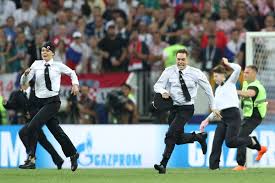
World Cup Pussy Riot protest – ‘the heavenly policeman’

download (1)

A few hours ago, four members of Pussy Riot ran onto the soccer field during the World Cup final match, to protest against the Putin regime. They have been arrested.

They are very brave and their demands, as expressed on facebook after the protest, deserve support.

Youtube has apparently taken down a video of the protest, put up by Pussy Riot, due to copyright complaints by FIFA. But here is other footage:

https://www.youtube.com/watch?v=FWg7cKeJHUc


My only gripe with the Pussy Riot demands is that there is no mention of Russia’s military aggression in Syria, no demand for an end to Russian military adventures.

Still, the other demands deserve the support of every leftist worthy of the label.

Here’s what they put on their facebook page:

Today is 11 years since the death of the great Russian poet, Dmitriy Prigov. Prigov created an image of a policeman, a carrier of the heavenly nationhood, in the russian culture.

The heavenly policeman, according to Prigov, talks on the two-way with the God Himself. The earthly policeman gets ready to disperse rallies. The heavenly policeman gently touches a flower in a field and enjoys Russian football team victories, while the earthly policeman feels indifferent to Oleg Sentsov’s hunger strike. The heavenly policeman rises as an example of the nationhood, the earthly policeman hurts everyone.

The heavenly policeman protects baby’s sleep, the earthly policeman persecutes political prisoners, imprisons people for “reposts” and “likes”.

The heavenly policeman is the organizer of this World Cup’s beautiful carnival, the earthy policeman is afraid of the celebration. The heavenly policeman carefully watches for obeying the game rules, the earthly policeman enters the game not caring about the rules.

The FIFA World Cup has reminded us of the possibilities of the heavenly policeman in the Great Russia of the future, but the earthly policeman, entering the ruleless game breaks our world apart.

When the earthly policeman enters the game, we demand to:

1. Let all political prisoners free.
2. Not imprison for “likes”.
3. Stop Illegal arrests on rallies.
4. Allow political competition in the country.
5. Not fabricate criminal accusations and not keep people in jails for no reason.
6. Turn the earthly policeman into the heavenly policeman.


* * * * * *

‘Freedom. Down with the regime. Your turn, Doctor’

These young blokes are true heroes. I hope they survive and thrive in a democratic Syria. A single spark can start a prairie fire!

2681015796

(Photo of them in 2011, after arrest and torture)

From eNCA:

“Your turn, Doctor.” Seven years after scribbling the anti-Assad slogan that sparked Syria’s war, activists-turned-rebels Moawiya and Samer Sayasina are bracing for a regime assault on their hometown of Daraa.

They were just 15 when they and friends, inspired by the Arab Spring revolutions they saw on television, daubed a groundbreaking message on one of the southern city’s walls in the spring of 2011.

“We’d been following the protests in Egypt and Tunisia, and we saw them writing slogans on their walls like ‘Freedom’ and ‘Down with the regime’,” said Moawiya, now 23.

“We got a can of spray paint and we wrote ‘Freedom. Down with the regime. Your turn, Doctor’,” referring to President Bashar al-Assad, a trained ophthalmologist.

Within two days, security forces stormed their homes and detained the boys, who are unrelated but share a common family name.

“They tortured us to find out who had provoked us to write it,” Moawiya said.

The teenagers’ detention prompted a wave of angry protests demanding their release, in what many point to as the spark to Syria’s nationwide uprising.”

The rest of the report can be read here.


* * * * * *

A Genuine Left Would Support Western Civilisation – by David McMullen

First published at On Line Opinion

… western civilisation is no longer western. It is global and a far better term is modernity. By the end of this century we can expect it to have totally supplanted all pre-existing conditions, even in the most backward regions. This will be a jolly good thing too.

* * * * * *

The pseudo-left wants to stop a multi-million-dollar donation by the conservative Ramsay Centre for Western Civilisation to the Australian National University for a new course on Western civilisation. According to the heads of the staff and student unions at the university it is racist to prioritize western history or culture. It mustn’t be “privileged”.

I guess we are supposed to look back lovingly at all those civilisations that crumbled in the face of the western onslaught, for example, Czarist Russia, Qing China, Mughal India, Ottoman MENA and Aztec Mesoamerica. And then of course there were the remnants of hunter-gathering society that lived in harmony with nature, and from whom we can learn so much, so we are told.

Of course, western civilisation is no longer western. It is global and a far better term is modernity. By the end of this century we can expect it to have totally supplanted all pre-existing conditions, even in the most backward regions. This will be a jolly good thing too.

Western history should indeed be prioritized over other history because that is where modernity began. The history of other regions is still important, but mainly in order to understand how their traditional cultures are an obstacle to modernity.

By studying western history, we get to understand how the connection between the economic, social and political transform the way be live.

The collapse of the Roman Empire is a good place to start. That’s when things slowly began to get interesting. Under the dead hand of Rome, innovation had been forbidden or a matter of indifference. But with the “Dark Ages” came something of a technological revolution in comparison. For the first time we saw the harnessing of horse-power with the adoption of the saddle, stirrups, horse shoes, bridle, horse collar and tandem harness. Water and wind mills sprang up everywhere.  The cranks and gears used in mills would become the basis of modern machinery. Lock gates in rivers and streams appeared for the first time. There were ships that could sail into the wind. And in the meantime, the church was doing a good job preserving literacy for a later time when it could be put to good use.

We gradually saw the spread of the market. This was assisted by the political fragmentation of Europe where the local thugs (sorry, lords) did not have their own raw materials for weapons and finery, and also of course by the development of ocean going sailing ships.

However, the feudal conditions became a fetter that could only be broken by the development of capitalist property relations. Small scale production could not meet the demand of the growing markets. Production carried out with the cooperation of large numbers of workers using machinery replaced small scale individual production. Steam power for machines and locomotion replaced wind and water.

This new economic system was compatible with, indeed required, more freedom of thought and action by the individual. A totally new society sprung up.

Studying the emergence of the modern world also gives an appreciation of how progress can be a messy thing.

When Martin Luther undermined a pillar of the feudal order, the Catholic Church, the achievement did not come cheaply. Notably, the subsequent religious wars killed off a quarter or more of the population of central Europe and half the male population of Germany.  About the same time, we had The English Civil War. This was critical to the creation of modern Britain but was a protracted bloodbath and lead to the death of 40 percent of the population of Ireland. Then it took a century of mucking about for the French Revolution to replace the old feudal regime with a respectable bourgeois one.

And nearer to the present we have seen the rocky road out of feudalism achieved in the former Czarist empire, China and eastern Europe. In the 1940s, we had to resist fascism’s attempt to roll back history, and that struggle cost millions of lives. So, if you think change seems pretty messy in the Middle East at the moment just look back at modern history.

The Ramsay Centre for Western Civilisation will of course want modernity to stop at capitalism. They are aptly called conservative. In their view, not only are capitalist property relations superior to older forms but attempts to move beyond them are bound to be a tragic folly. Exhibit one is the failed attempts in the 20th century to create post-capitalist societies on the back of totally unsuitable pre-capitalist conditions. Exhibit two is the doubtful results of “socialist” tinkering under capitalism. That sort of evidence would not get past a committal hearing but it has wide acceptance.

We then have the revolutionary wing of western civilisation that I belong to. Modernity in its preliminary capitalist form is a vast advance on everything else past or present and lays the conditions for the next stage. We should welcome its global spread.

In a letter to Engels of October 8 1858 Marx wrote: “The proper task of bourgeois society is the creation of the world market, at least in outline, and of the production based on that market. Since the world is round, the colonisation of California and Australia and the opening up of China and Japan would seem to have completed this process.” He was being rather optimistic but his point of view is clear. And notice the reference to Australia. No black armband there. (You may like to check out more Marx at the Marx Engels Archive.)

While capitalism is an advance it is still the exploitation of the many by the few.  But as luck would have it capitalism is an incubator of the next stage, a classless society based on social ownership of the means of production. Capitalism turns most people into workers with no vested interest in capitalism; it unshackles our brains from pre-capitalist, traditional junk; and it creates a level of economic development that makes it possible to imagine equality because it would no longer be a case of sharing want and toil.

We can expect a messy transition. To start with those who want change will be confused about what they want and how to get there while those opposed to change will have a very clear idea on both counts and years of practice. But let’s hope the transition is not as tortuous as the transition from feudalism to capitalism.

However, that is for the future. At the moment there is no revolutionary movement nor any support for revolution. For now, fully entrenching and advancing the present capitalist stage of modernity is the priority. There are still large regions of the world where backwardness and tyranny reign supreme.  MENA is a priority area from the point of view of lifting tyranny from people’s backs. Then in the long hall we have Sub-Saharan Africa. It is the most backward region and has a huge and growing population. Possibly a third of people will live there by century’s end.

Unfortunately, there seems to be an alignment of toxic trends hampering this process. In the US and Europe, “both sides of politics” are heavily infected by isolationism and protectionism. Europe has its disgraceful agricultural policy that adds to Africa’s misery and a limited ability to project military power.  Then we had Obama’s appalling failure to stay the course in Iraq and to intervene in a timely fashion in Syria.

And now nobody is denouncing Trump’s failure to do the right thing and occupy Syria while arranging regime change. Doing nothing is a policy fully endorsed by both the pseudo-left and the alt-right. The former all supported Saddam and now some even support Assad.

The pseudos have also built a whole movement over the last 20 years or so opposing the global spread of capitalism. And even more insidiously, they oppose economic development because it is “unsustainable”. They want the darkies to live in noble simplicity.

To get down to brass tacks, a genuine left would align itself with the neo-cons and support their re-emergence. They stand for an activist foreign policy of regime change, nation building and economic development. There needs to be military support for change where it has a chance of success. (It is worth noting here that the recent Iraqi elections have been surprisingly open notwithstanding the violent efforts of Baathists and Islamo-fascists.)  Diplomacy should be heavily focused on giving kleptocrats and tyrants a hard time.

Australia could play a special role given the failure of the Americans and Europeans. We can pressure them to act and take a much more activist military policy. Being a pipsqueak power, our contribution is limited. However, we can be good at training and deploying special forces.

* * * * * *

David McMullen lives in Melbourne and he can be found at The Communist Manifesto Project.


Good migrant/bad migrant

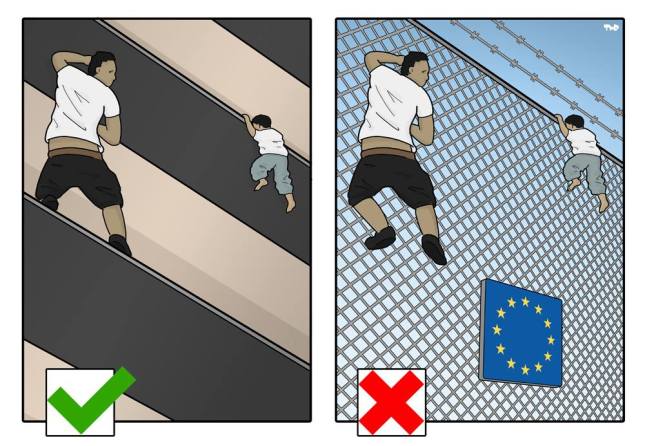
Political cartoons – also known as ‘editorial cartoons’ – can be very powerful, for good or bad causes.

This one is a stand-out for me. I came across it on facebook via a couple of pro-Syrian revolution groups.

I know that the Syrian refugee crisis will not be solved until the regime is overthrown and some kind of orderly democratic process developed with appropriate international support, but the cartoon draws attention to the hypocrisy of those elsewhere who support immigration restriction.

Had the bloke who rescued the child not been so courageous, he might have ended up deported one day – yet he is still the same human being.

33826545_10215382548061931_2108388832742211584_o


Syrian Coalition Condemns Israeli Occupation Massacre against Palestinians & Transfer of US Embassy to Jerusalem

32703914_1706692566083188_1725815183491727360_o
https://buff.ly/2rSD7Tl

The Syrian Coalition condemns the horrific massacre that was committed by the Israeli occupation against Palestinian demonstrators demanding their rights on Monday. The massacre claimed the lives of dozens of demonstrators and left hundreds more injured, including women and children.

The Coalition also reiterates its categorical rejection of the US president’s decision to recognize occupied Jerusalem as the capital of Israel and to transfer the US embassy to the city. The move violated international resolutions, most notably UN Security Council resolution 478 (1980) which condemned any attempt by Israel to annex Jerusalem.

The Coalition also denounces the continuing violations being committed by the government of the Israeli occupation against the Islamic and Christian holy sites. It stresses that nothing can justify violence, repression and crimes or grant legitimacy to occupation and mass forced displacement.

The Syrian people will always support the legitimate rights of the Palestinian people to their land and to build their independent state with Jerusalem as its capital, which will remain a Palestinian Arab land. No other party has the right to claim sovereignty over the city. It will not be long before the Palestinian people regain all their rights and achieve a just, comprehensive solution that ends violence and restores stability to the region.

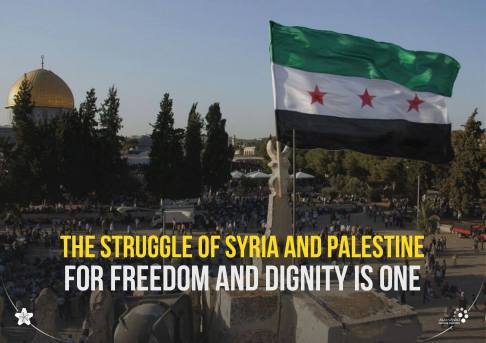
The struggle of the Syrian and Palestinian peoples for freedom and dignity is one. The resistance and resilience that the Palestinian people have shown over the past decades will always remain an example for steadfastness and patience.


* * * *

The barbarism of Assad. No more ‘kneel or starve’!

images

‘When the 2011 revolution was launched, the Assad regime had entered a new phase: It no longer hid itself behind the masque of socialism. There was no longer a need for these banners promising death to opponents under the slogan of progress and socialism, or in the name of the Baath Party. Instead, Assad’s henchmen declared a slogan summarising the dynastic essence of the regime: “Assad or we burn the country”. Here, there were no pretenses of some ideal or any form of morality. It is naked despotism, openly showing its true face. At the checkpoints set up by pro-regime militias encircling zones fleeing Assad’s supremacy, we can read another slogan: “Kneel or Starve”, a way of telling the besieged ‘either you die of hunger under the bombs or you accept the humiliation of submission.”‘

* * * * * *

Translation of ‘Assad ou le lion nu‘, the op-ed by the Syrian writer and poet Omar Kaddour, on the barbarism of the Assad regime (Assad means ‘lion’ in Arabic). Originally published in Le Monde – 11/05/2018.

Born in 1966, Omar Kaddour is a Syrian poet, novelist and journalist. He has published two collections of poems in the 1990s and four novels between 2002 and 2013, none of which have been translated. In 2014, he left Damascus for Lebanon and has lived in France since 2015.

Translation by Joey Ayoub. Republications allowed as long as you credit author and translator. (Thanks to Hummus for Thought) .


Towards mid March 2018, the regime-affiliated television station Al-Ikhbariya showed brief interviews with the inhabitants leaving Eastern Ghouta following the long military campaigns against the rebel enclave. The journalist, whose face did not appear on screen, was speaking to one of the evacuated in an accusatory manner: “People are saying that the inhabitants [of Eastern Ghouta] supported the armed factions” to which an elderly man responded “we are a poor and defenseless people”.

At the same time, a young man takes the initiative to tell his young girl to say that she is “Habiba, the ‘daughter’ of Bashar al-Assad”. But instead, the girl yelled out of anger, in a conclusive tone, to say that no, she is not the daughter of Bashar! Syrians would understand here that the man would only ask such a thing of his daughter to beg for aman (mercy) as he is of fighting age. We know that men his age, after leaving the besieged areas, are either arrested and tortured, or forced to join Assad’s forces to fight opposition groups. Syrians would also understand that for this public blunder the father, and perhaps even the girl, could pay the price.

The little Habiba reminds us of the famous tale of the Emperor’s New Clothes (known in Syria under the title of ‘the naked emperor’) by Hans Andersen because she has yet to become aware of fear and of the caution it demands. Except that in her case, we can imagine that this goes even further than for the child who yelled ‘the king is naked!’. After all, this girl has lived her whole life under the siege, barrel bombs, shells, and even chemical weapons. It is not unlikely that one of her friends or one of her relatives was killed by these weapons of mass destruction. In this context of death and famine, Habiba heard that the one responsible for their ordeal was Bashar al-Assad. Then came the day where her father asks her to declare that she is the daughter of Bashar. This is how the return to Assad’s supremacy works: accepting him despite all that he has made people endure and all that he will continue to make them endure.

In an Orwell novel

The case of Habiba, as with many others, elucidates this great paradox: portraits of Bashar excessively hanged over the ruins of the zones he has reconquered. In politics, we are supposed to avoid psychological interpretations – such as speaking of necrophiliacs. However, if we observe the discourse of the Assad regimes – both of the father and the son – we find this drunken language of destruction. I was a teenager when Hafez Al-Assad crushed the Muslim Brotherhood uprising. His troops had just committed a massacre in Hama, killing over 30,000 people, not to mention the destruction inflicted on the city.

At that moment, portraits of Assad senior invaded all of Syria’s roads. I also remember a banner that we’d see everywhere accompanied by a saying of the president which read: “There is no life in this country other than for progress and socialism”. For a long time, I thought of this banner covered in portraits of Hafez Al-Assad over the lifeless rubble. Before that, we would read another saying written by his men on walls or on banners: “I am the Baath [party in power in Syria since 1963], death to its enemies!” Here and there, the goal was to threaten adversaries with death, in the name of the party in one case, in the name of progress and socialism in another.

As it happens, I entered university in 1984, when the world was re-reading George Orwell’s 1984. I read the novel – Assad’s censorship allows the book to circulate while it banned its movie version, because it knew that readers were far fewer than viewers. Regardless, for people like me who read 1984 in Syria, the novel brought nothing new. We lived in a reality similar to what it was imagining, with Big Brother seeing everything, with his intelligence services interfering in every aspect of our existence.

That year, Hafez Al-Assad had finished destroying the Muslim Brotherhood. Now, he was busying himself imprisoning communists, including those who abandoned any opposition to support him in his war against the Brotherhood. Between 1984 and 1987, many of my leftwing friends were arrested and condemned to harsh sentences in front of special courts which didn’t allow them to defend themselves. Nevertheless, they were luckier than those who claimed to be with the Muslim Brotherhood because those were judged by “campaign” tribunals which generally chose the death penalty.

A distant relative connects me to two brothers who were arrested for belonging to the Muslim Brotherhood. No one in their family had heard of them since. They had children who grew up without knowing them. Their mother became hopeless for knowing nothing about them. And if there was a glimmer of hope, it was no doubt extinguished when ISIS/Daesh took control of Palmyra prison without anyone knowing what happened to its archives.

Like an Occupation Force.

Outside of prison, where we lived like the characters in Orwell’s novel, people abstained from doing anything that would remotely look political. If someone denounced you, even if out of personal vengeance, it could lead to your disappearance. All that was needed was for a simple quidam to accuse you of having insulted ‘the commanding father’ for your destiny to sink into a dark unknown. There is a word for that: “Al-istibaha” (the act of declaring the violation of human rights legal). In other words, the whole of society was at the mercy of a powerful elite and no one had dignity. There are no laws forbidding that group from degrading people, or killing them, or stealing their possessions. It’s an expression inherited from past wars, when conquerors allowed their soldiers to do whatever they wanted to do to the inhabitants of the cities they occupied.

Concretely, the power of Assad senior soon resembled an occupation force allowing itself to trample upon a whole population. The concept of istibaha implies that those who find themselves outside the circle of power have no rights. And if that circle abandons any responsibility in terms of public services, it considers it a form of generosity. This is how school students had to study about the ‘generosity’ of the ‘commanding father’: The fact that he brought electricity in certain villages, for example, as though it didn’t exists in homes in countries poorer than Syria. Also, when they increased the salaries of public officials, they announced it like it was a generous act by the president, as if he were paying for it from his own pocket, even though it was also accompanied by a higher rate of inflation which affected these employees  salaries.

“Kneel or Starve”

When the 2011 revolution was launched, the Assad regime had entered a new phase: It no longer hid itself behind the masque of socialism. There was no longer a need for these banners promising death to opponents under the slogan of progress and socialism, or in the name of the Baath Party. Instead, Assad’s henchmen declared a slogan summarising the dynastic essence of the regime: “Assad or we burn the country”. Here, there were no pretenses of some ideal or any form of morality. It is naked despotism, openly showing its true face. At the checkpoints set up by pro-regime militias encircling zones fleeing Assad’s supremacy, we can read another slogan: “Kneel or Starve”, a way of telling the besieged ‘either you die of hunger under the bombs or you accept the humiliation of submission.”

As the regime applies its scorched earth policy and starves the population to bring it to heel, it insists on showing that in the regions it controls, life follows its natural course. It’s not only an image sent abroad to prove the regime’s resilience. It’s only a way of bringing Syrians to accept the idea that there is nothing abnormal happening in their lives while thousands of others are crammed into internment camps and that, every day, security services tell new families of the death of a detained son with no explanation and without returning his corpse.

The standard for Assad is for its repressive machine to kill Syrians wherever it finds them. The world was made aware of the reports by ‘Caesar’ on the systemic usage of torture for the purpose of murder. It was also made aware, a year ago, of a report by the US state department of the existence of a crematorium next to Saydnaya prison. But all of that was just the tip of the iceberg compared to everything we know now and to what the Assad regime will continue to do. The regime isn’t seeking a one-off victory, but a permanent one, a victory that guarantees that no revolution will ever be able to exist. And this means a perpetual war against Syrian society.

We have a president whose legitimacy is still recognised by the world. And yet, in a speech given on the 20th of August, 2017, he said: “Yes, we lost our best youth and infrastructure which cost us a lot of money, we lost whole generations, but in return we gained a society that is sane and homogeneous.” Assad declared that losing thousands of combatants and millions of exiled creates a better society. His concept of homogeneity is inspired by the worst Nazi literature, where he also got his idea of a holocaust.

However, Assad’s victory doesn’t only consist of committing unimaginable crimes, but to make sure they become something banal even to the outside world. The more he kills Syrians, the less the international community is interesting in their tragedy. This is the criteria for his success. Indeed, in the foreign press, these killings do not make the headlines anymore, regardless of how much we talk about them. As for international efforts in favor of a democratic transition, they have practically stopped. Certain world powers which demanded Assad’s departure when he had made only a few thousand victims are now declaring their willingness to see him maintain power now that he has hundreds of thousands of victims.

Documented and filmed atrocities

Even the notion of going after Assad for his use of chemical weapons is a victory to him, as it is a humiliation to Syrians, because it implies that their lives are despised to promote a convention on the interdiction of chemical weapons. What more could we have hoped for? We have powers responsible for peace in the world, as permanent members of the Security Council, invoking the Russian veto when the life and the future of Syrians are at risk. And yet, these same powers act on their own, regardless of that veto, when Assad violates the accord on chemical weapons!

Assad also wins when his Mufti threatens Europe with suicide bombers ready for action and that these threats are realised, only for people to then say that Assad ‘only’ kills his people while ISIS is a threat to the planet! Assad also wins in becoming the first to commit so many documented and filmed atrocities in plain sight for the whole world to see, with no strong international reaction demanding that he be brought to justice.

But his biggest victory is that people now see us as characters in a terrifying tale, and that they may even be sincerely shocked by what is happening to us just as we are shocked when we read a horrible story or watch a tragic film – except that this stays within the realm of imaginary characters. If our story stopped with the little Habiba refusing to be Bashar’s daughter, we might see an optimistic end. Alas, Syrian children like Habiba will grow up, and the first leson that they will learn is that the wolf from the Little Red Riding Hood will eat them with the assistance of the gamekeeper. And it’s not impossible that in the Syrian version of the tale, the gamekeeper trains the children to call the wolf “daddy” before he devours them.

* * * * * *

See also: Occupy Syria!


* * * * * *

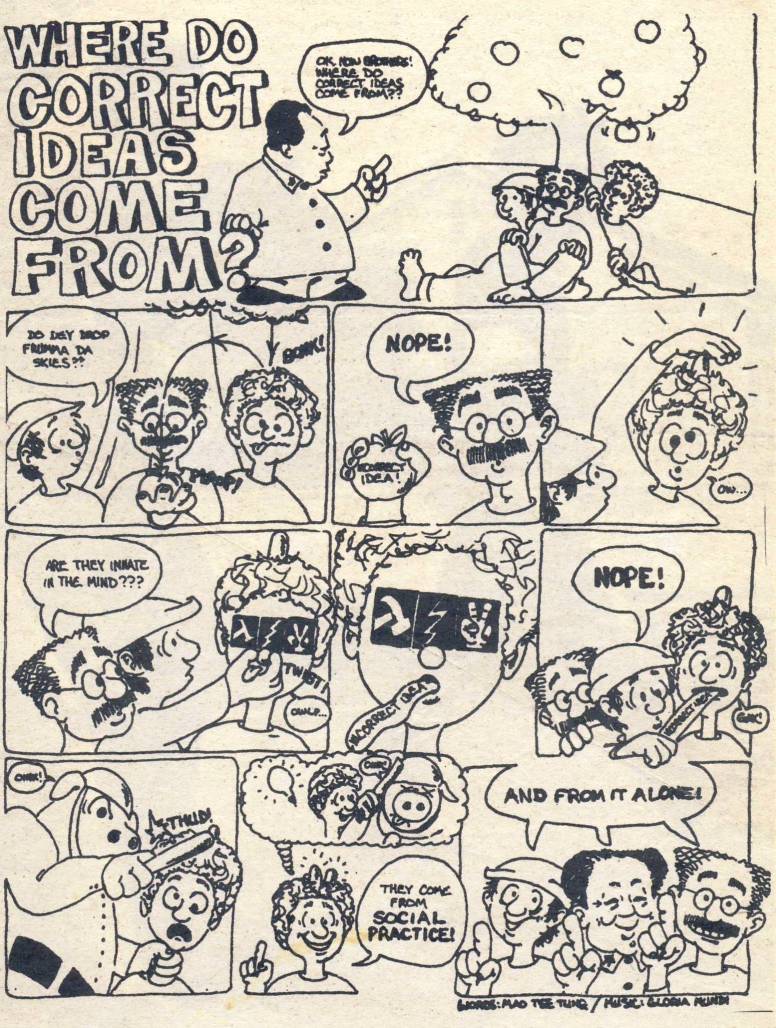
Where do correct ideas come from?

“Where do correct ideas come from? Do they drop from the skies? No. Are they innate in the mind? No. They come from social practice, and from it alone; they come from three kinds of social practice, the struggle for production, the class struggle and scientific experiment. It is man’s social being that determines his thinking”.

Scan10025

(Cartoon from ‘Rabelais’, La Trobe University SRC newspaper, 1970)

“Once the correct ideas characteristic of the advanced class are grasped by the masses, these ideas turn into a material force which changes society and changes the world. In their social practice, men engage in various kinds of struggle and gain rich experience, both from their successes and from their failures. Countless phenomena of the objective external world are reflected in a man’s brain through his five sense organs  —  the organs of sight, hearing, smell, taste and touch.

“At first, knowledge is perceptual. The leap to conceptual knowledge, i.e., to ideas, occurs when sufficient perceptual knowledge is accumulated. This is one process in cognition. It is the first stage in the whole process of cognition, the stage leading from objective matter to subjective consciousness from existence to ideas. Whether or not one’s consciousness or ideas (including theories, policies, plans or measures) do correctly reflect the laws of the objective external world is not yet proved at this stage, in which it is not yet possible to ascertain whether they are correct or not.

“Then comes the second stage in the process of cognition, the stage leading from consciousness back to matter, from ideas back to existence, in which the knowledge gained in the first stage is applied in social practice to ascertain whether the theories, policies, plans or measures meet with the anticipated success. Generally speaking, those that succeed are correct and those that fail are incorrect, and this is especially true of man’s struggle with nature. In social struggle, the forces representing the advanced class sometimes suffer defeat not because their ideas are incorrect ! but because, in the balance of forces engaged in struggle, they are not as powerful for the time being as the forces of reaction; they are therefore temporarily defeated, but they are bound to triumph sooner or later.

“Man’s knowledge makes another leap through the test of practice. This leap is more important than the previous one. For it is this leap alone that can prove the correctness or incorrectness of the first leap in cognition, i.e., of the ideas, theories, policies, plans or measures formulated in the course of reflecting the objective external world. There is no other way of testing truth. Furthermore, the one and only purpose of the proletariat in knowing the world is to change it. Often, correct knowledge can be arrived at only after many repetitions of the process leading from matter to consciousness and then back to matter, that is, leading from practice to knowledge and then back to practice. Such is the Marxist theory of knowledge, the dialectical materialist theory of knowledge.

“Among our comrades there are many who do not yet understand this theory of knowledge. When asked the sources of their ideas, opinions, policies, methods, plans and conclusions, eloquent speeches and long articles they consider the questions strange and cannot answer it. Nor do they comprehend that matter, can be transformed into consciousness and consciousness into matter, although such leaps are phenomena of everyday life. It is therefore necessary to educate our comrades in the dialectical materialist theory of knowledge, so that they can orientate their thinking correctly, become good at investigation and study and at summing up experience, overcome difficulties, commit fewer mistakes, do their work better, and struggle hard so as to build China into a great and powerful socialist country and help the broad masses of the oppressed and exploited throughout the world in fulfillment of our great internationalist duty”.

–   Mao Zedong

May 1963

These ARE our issues! ‘Srebrenica’ no more! We are all one.

images

There’s a very good article by Roy Gutman from The Daily Beast, published in February this year, about the moral underpinnings – or lack thereof – of the United Nations and the US and other powerful countries’ failure to take effective action against the massacres of the Assad regime.

The killings have gone on for many years now, from about 5,000 deaths in 2011 when the Syrian popular revolt broke out to many more thousands each year – around half a million killed so far.  More than 6 million have been displaced within Syria, and an additional 5 million have fled the country.

Gutman refers to the failure of the UN and US and allies to take effective action against the Assad regime as a ‘Srebrenica moment’.

He writes that, 23 years (in 1995) ago:

‘… the world sat mostly mute, watching events unfold in and around the small village of Srebrenica in a remote corner of eastern Bosnia. No government was ready to lift a finger to save the population of some 27,000, at least half of them displaced from other areas.

‘At a critical moment, the United Nations Protection Force  decided not to bomb Bosnian Serb forces marching on the town. That was taken as the all-clear for Gen. Radko Mladic to capture Srebrenica, expel the women and children, and exterminate the male population of some 8,000’.

In all, about 100,000 were killed during the Bosnian war but the killings were ultimately halted when a NATO force of 60,000 peace-keeping troops occupied the region. Prior to that, there had been NATO air strikes to enforce and defend ‘safe zones’. This is one of the interventions Syria has needed for several years, desperately. A No Fly Zone imposed by the US and NATO, and anyone else willing to help.

In 1994, a year prior to Srebrenica, more than half a million Rawandans were massacred over a hundred day period. Again, there was no effective intervention on the part of the powerful west. We just watched, deplored what was happening, a French military force established a ‘safe humanitarian zone’ in part of Rawanda which saved around 15,000 people, but we did nothing to stop the actual genocide.

In 2013, former US president Bill Clinton reflected on the failure of the US government (during his presidency) to intervene in the genocide as one of his main foreign policy failings. He estimated that 300,000 lives could have been saved by US military intervention.

Following such tragic events, it seemed that an internationalist sense of responsibility was developing – an understanding that ‘we are all one’, that we share a common humanity and that the massacre of people anywhere is an issue for all of us, that separation by oceans or continents is irrelevant. And most importantly, that when all else fails, such as diplomatic pressure and sanctions, military intervention can be the best humanitarian option.

In 1999, the NATO bombing campaign to protect Kosovor Albanians from ethnic cleansing did not have the approval of the United Nations but it averted a much greater bloodbath. The aim of the military campaign was to end the violence and ethnic cleansing policies of the Milosevic national-socialist government, the withdrawal of all military, police and paramilitary forces from Kosovo, the stationing of a UN peacekeeping presence in Kosovo, unconditional and safe return of all refugees and displaced persons, and the establishment of a political framework agreement for Kosovo in conformity with international law and the Charter of the UN.

The NATO led force is still there, with a strength of 4,600.

While the pseudo-left protested against the military action, in defence of ‘national sovereignty’ and against US imperialism (as though it was in any way an imperialist venture), the UN itself was moving ahead of such antiquated and pernicious thinking and in 2005 adopted in principle the ‘Responsibility to Protect’ or ‘R2P’.

R2P means:

‘The Responsibility to Protect – known as R2P – refers to the obligation of states toward their populations and toward all populations at risk of genocide and other mass atrocity crimes. R2P stipulates three pillars of responsibility:

‘Pillar One: Every state has the Responsibility to Protect its populations from four mass atrocity crimes: genocide, war crimes, crimes against humanity and ethnic cleansing.

‘Pillar Two: The wider international community has the responsibility to encourage and assist individual states in meeting that responsibility.

‘Pillar Three: If a state is manifestly failing to protect its populations, the international community must be prepared to take appropriate collective action, in a timely and decisive manner and in accordance with the UN Charter’.

R2P was and is a step in the right direction, as it openly challenges the previously sacred nation of ‘national sovereignty’.

Roy Gutman points out that Eastern Ghouta’s population is 15 times that of Srebrenica’s. While the people in Eastern Ghouta were being attacked by Syrian Army ground forces backed by Russian air power, the US had 2000 troops to the north-east fighting Daesh (ISIS). The result was that 1,700 civilians perished in Eastern Ghouta, and the regime again deployed chlorine gas and probably sarin gas against the rebel-stronghold. The city has become a wasteland, suffering more than a thousand aerial attacks. Hospitals, schools, markets, bakeries and mosques were targeted. (Hardly worth making the point, at it’s so obvious, that Daesh/ISIS has no air power, neither do the pro-democracy rebels).

Gutman quotes a US colonel, John Thomas, of the US Central Command’s public affairs office, as saying ‘CENTCOM has no part in anything in Syria other than the defeat of ISIS’.

That was the case in early February, when the article was written, but since then – two weeks ago – US president Trump called Assad an ‘Animal’ and called for his overthrow.

Daesh is largely defeated. It’s bizarre plans for a Caliphate, headquartered in Raqqa, shattered by military force in October last year. It is beaten in Mosul, Iraq, as well.

Call it what you may: internationalist solidarity against fascistic regimes, or R2P. Military intervention is urgently required to overthrow the Assad regime to end the slaughter, to allow the return of refugees and displaced Syrians, and to assist the Syrian people in building an inclusive democratic system.


* * * * * *


“We retain the dignity of the revolution’s early days” – Marcell Shehwaro

The following is written by Syrian writer, Marcell Shehwaro. I came across it this morning on a facebook page called ‘Ghouta’. She is a journalist and activist from Aleppo, and executive director of Kesh Malek, a group that ran schools in opposition-held areas of Aleppo.

Two things strike me about the post. First, the question of ‘surrender’. There is a view among some in what passes for ‘the left’ today that the Syrian people could never win their struggle against the Assad regime. It has even been put to me that they were wrong to challenge an ‘unbeatable’ regime. This view, logically, also opposes the entire Arab Spring – or, more precisely, the bourgeois democratic revolution occurring in the region. As with Iraq, the stability of fascism, with all its regime horrors, is regarded as preferable to the chaos of revolutionary democratic change, with its potential for liberation.

The writer makes it clear why surrender is not an option.

Secondly, a profound point is made in the following sentence:

‘I and my group of friends never imagined as we hid from the bullets that shot at our peaceful demonstration that we could defeat Russian planes all by ourselves’. 

Who, other than a US-led coalition, can provide the military support necessary to defeat the Russian (and Syrian regime) planes? Failure to confront this reality results in the absurd proposition that one should oppose both Russian/Iranian and US/UK/French military intervention; that the recent bombardment and destruction of a chemical weapons storage facility, a research centre and command post by the US/UK/France was morally equivalent to the death toll of about 500,000 and refugee toll (half the population), for which Russia/Assad are overwhelmingly responsible. Not to mention the destruction by aerial bombardment by the regime and Russia of vast areas of cities, towns and camps, schools, hospitals, markets, mosques, and bakeries.

Trump persists with his pledge to wash his hands of Syria but has targeted the regime in a way that Obama never did. The epithet ‘Animal Assad’, used by Trump in a tweet, is now used by the Syrian and Arab democrats.

Meanwhile, the overt far-Right and the pseudo-left take to the streets demanding ‘Hands of Syria!’

Where is the moral compass?

We find one in the Syrian voice in the following post.


* * * * * *


What if we accept Bashar Al Assad?

Let’s discuss “peacefully” that “elephant in the room”, as you say, what if we accept that Assad remains in power?

We are asked the question sometimes obliquely, and sometimes filtered through the closed circles that decide on Syrian affairs without the attendance of any Syrians. Sometimes it is brought up in ways that infantalize as if we are children who don’t dare to confront the “truth realistically”.

In the harshest times, this question is posed to us as a negotiation over the bodies of our children. Instead of the answer of “why we don’t accept that Assad remain in power” is obvious because he killed our children and the scars of their smiles are etched on our hearts. The blackmailing question becomes: He will kill your children and their smiles, why don’t you just accept him?

Excuse us for a moment! We need some time to understand this world’s logic, the world ruled by Trump, Putin and a bunch of politicians who only care about their 4-year period in office.

Hafez al-Assad has blocked us from the outside world. Now his son follows in his footsteps. The liberationists amongst us gazed towards the United Nations Charters and the Universal Declaration for Human Rights. Some of us believed that those charters mean something. When the revolution broke out, we discovered that those charters are ruined due to the misuse of the members in the U.N.’s Security Council.

Apologies for the digression. So: why don’t we accept Assad?

We wish you tell your people the “harsh truth”. We want to challenge your empty words and courtesy rhetoric. We know you mean nothing when you say things like: using chemical weapon is a red line, or Aleppo is a red line, or Assad lost his legitimacy.

The truth is that Assad is more your ally than the naïve group of dreamers that we are, believing like we do in democracy, justice and accountability.


Isn’t this the message of bombing in Idlib and Ghouta today? To convince us, “gently”, to accept a political solution—the only solution that you lectured us about—as we are being killed?

You say that we are defeated. Well, gentlemen, I and my group of friends never imagined as we hid from the bullets that shot at our peaceful demonstration that we could defeat Russian planes all by ourselves. We never thought that we can win the “war” while we were being tortured, or suffocated by chemical weapons, destroyed by shelling, rape and detention.


It may be true that we have lost. But this defeat made me aware of something I never wanted to know.

I know today the terminology of violence: The Golan cluster bombs, the difference between Sarin and Chlorine, and the new version of bunker blaster that can destroy our “safe” basements. I learned even how to pronounce these words in English.

You say we were defeated in Sochi! We were not even at Sochi. Sochi was the costume party that gathered the regime himself with you.

You have all our sympathy for the time you are forced to spend with them.
I keep digressing away from that nightmare, Bashar Assad’s ruling Syria, excuse me!

What if we “accept” that Bashar al-Assad stays in power? First, Who are “we”? The cities that are besieged and bombed, the people that must cross a thousand barriers to visit one another. Who are “we”? The refugees who fail to have a proper family reunion? Or need an official permission to breathe?

And if some of us actually accept Bashar al-Assad as president, what can we do with all those of us who are “rude” enough to reject giving up their dignity? What can we do with all those who still believe in their right to their homeland? What if mothers who buried their sons refused to believe that justice had died also? We have to let them die.

So the suggestion is that some of us surrender, so that others die in silence. Or maybe we can give you the names and coordinates of all those who oppose Bashar al-Assad, so that you and your Russian friends can ensure their disappearance?

What if some of us actually accepted that Bashar Al Assad stays in power, do you guarantee that the war will stop? That the brutal dictator won’t celebrate his victory with taste of our defeated blood?


You say that you want him to stay for a transitional period. Funny joke, this one. Do you logically believe in your power to pressure Russia and the regime?

We have asked you for years to stop the shelling. We then felt sorry for you so we minimized our demands and asked you to stop the shelling of hospitals and schools. You failed here too. For years we have asked you to send relief convoys to the besieged areas; to move the sick for a distance of 10 kilometers, or to guarantee the families’ right to know the fate of their disappeared sons , and you failed to do so. You repeatedly explained that you are failing to put pressure on “Damascus.”

What logic do you want to believe, that “You cannot stop a school bombing and you can guarantee Bashar Assad’s removal after a transitional period?”


So the offer, that you are in a shock that we are refusing is, that we have to surrender without restriction, guaranties or condition and preferably silently.


Even if that means killing those who do not give up, we have to accept.
Even if that means that the form of death going only to change from one form to another, we must accept.

Even if that means that he will rule us with iron and fire, and that our children, who will believe again in their own freedom, will may be killed by nuclear weapons this time, we must accept.
So the equation is
Whether

To accept Bashar Al Assad, surrender and die.
Or oppose Bashar Al Assad, resist and die.

We reject the whole equation then, and learn to resist the idea of choosing between death and death through thousands of borders that limit us every day.

And we retain all the anger caused by the killings of our people, who we were unable to grieve amidst the ongoing massacre, we retain the dignity of the revolution’s early days. We retain all of our memory and the choice of life. We retain the fragment of a beautiful dream we had one day to have a homeland.


* * * * * *