When the impossible becomes the inevitable: my memory of the struggle against apartheid

I retired from work, at the Museum of Australian Democracy at Old Parliament House, Canberra, Australia, last week. The following is my final blog post as an on-going Public Service employee.

Feel free to add a comment at the museum’s blog site.

imagesmandela

On reflecting on the campaign of solidarity in Australia with the South African oppressed people, it reinforced my view that identifying with, and supporting, the oppressed and those struggling for freedom, is a core left-wing value. It was not just on the issue of South African apartheid that we did this, but on Vietnam too. The left supported the Vietnamese people against US imperialism, just as we supported the South African people against the apartheid regime. Other examples are our solidarity with the Czech and Polish rebels.

It is incomprehensible to me that people and groups that do not support the Syrian people in their struggle against the Assad regime can be in any sense left-wing, no matter how they self-identify and no matter what ‘left’ sounding slogans they shout.

Anyway, here is my final blog post at work.

* * * *

The museum’s Memories of the Struggle exhibition highlights the part played by Australians in solidarity with South Africans against the apartheid regime. It resonates with scores of thousands of us who actively took part in the struggle as grass-roots activists.

From the late 1960s and for most of the 1970s, I was one such activist in Melbourne. I lived and breathed the kind of left-wing politics that opposed apartheid and supported regime change and democratic aspiration there. If I wasn’t printing out and handing out leaflets about it, and sometimes writing them, I was attending working-bees where people designed and made placards and banners for street protests. And, there was hardly a demonstration on the issue in Melbourne that I didn’t attend. To me, it was part of a global revolutionary struggle. (The same applies to the Vietnam War, which loomed larger because of the policy of conscription for the war, and the greater violence against the Vietnamese).

Of course, not all of the Australian opponents of apartheid identified with the left and only a small minority were communists like me. It’s worth noting that while nearly everyone opposed the apartheid system in principle back then, there was strong opposition to Nelson Mandela, who was seen as a communist and a terrorist. He was certainly close to the South African Communist Party and his Spear Movement struck terror into the hearts of the fascists running the regime. To be opposed to apartheid in principle was fine, but to want to do something about it in practical solidarity was ‘going too far’.


Fast forward several decades and in 1994 Mandela is the elected and acclaimed President of a new era in South Africa, one free of apartheid and one in which all people have equal voice in elections. Despite serving 27 years in prison, he properly urges reconciliation rather than revenge. What a man! Governments whose leaders were not forthcoming with solidarity when it was needed now applaud him. The Australian governments of Whitlam, Fraser and Hawke are among the proud exceptions. Celebrities like Michael Jackson and Elizabeth Taylor pose for photos with him. How things change.

That’s what happens when you have History on your side. When the reactionaries, who can seem so powerful, are revealed as the paper tigers that they essentially are. If proof is needed of the maxims that ‘the people make history’, and that ‘wherever there is repression there is resistance’, then South Africa under apartheid provides it. At times, it seemed a hopeless uphill battle. But don’t they all? Until they are won. And then what once seemed impossible suddenly seems inevitable.

When Mandela was released from prison in February 1990, I was so thrilled and overwhelmed that, after my regular fitness run up Mount Ainslie, which rises 800 metres above Canberra, I wanted to repeat the run immediately. I was on such a ‘high’ and carried along by the adrenalin of Mandela’s release and the excitement of South Africa’s prospects as a democracy. Thereafter, running up and down Mount Ainslie twice without stopping became my ‘Mandela Run’.

Their victory was our victory – and my victory too.


Fast forward again, and around 2010 I find myself pondering Mandela’s future. He is now in his early 90s and I feel an urge to write to him, to let him hear from an Australian activist, rather than a leader or celebrity.

I want to share some anecdotes with him – things I experienced directly – and I want to ask him for an autographed photo as a memento.

Sorry, but I can’t find a copy of my letter to him. But from memory, it told him of the following.

At my university in the early 1970s, we had a Chancellor who was on the board of Imperial Chemical Industries which, among other things, manufactured explosives and munitions in South Africa. A mass meeting of a thousand students demanded his resignation. Eventually we won and the Chancellor resigned before his term expired. But what a struggle. We occupied the Administration Building, blockaded the Council members, held mass meetings at least twice a week. And the authorities cracked down severely on us for our lawlessness. Or was it for our effectiveness? John Gorton as Prime Minister had declared that “We shall tolerate dissent so long as it is ineffective”. The student ring-leaders were identified, arrested, fined, suspended from university, lost our Education Department studentships and three of us – yours truly included – gaoled at Pentridge, without sentence or rights of appeal – for contempt of court. (It’s not easy being red).

I wanted Nelson Mandela to know that, in the west, our movement was not just about ‘sex and drugs and rock music’, as it has been condescendingly displayed in popular culture, but about real struggle, repression and resistance. Just as we brought the Vietnam War home in our protests, so too we related the oppression of the apartheid system to our own local targets whenever possible.

I wanted Mandela to know of the police violence deployed by State governments against anti-apartheid protestors. The petite university student, a young girl with whom I was friendly, being thrown face first into a pole by a burly policeman three times her size. The blood pouring from her smashed nose. The State Secretary of the Labor Party in Victoria having a baton thrust into his eye and nearly losing the eye. We knew we were in for a hiding whenever the police started removing their identification badges from their uniforms. Some of the worst police violence I have witnessed took place on protests against apartheid. They were clearly on orders to intimidate us, and batons and boots were their main weapon. But it didn’t work. We knew that the repression we experienced was minor compared to that of our brothers and sisters in South Africa.

I was arrested on one of the demonstrations and convicted of assaulting police. My only regret is that I am unable to explain on official forms that ask whether one has any criminal convictions that my crime was to try to stop a policeman pulling down an anti-apartheid banner held by the front line of a street march. I pushed him with force from behind. Technically: guilty. C’est la vie: c’est la lutte.

I wanted Mandela to know of the funny things too. Like the way in which one of my mates in Brunswick, who worked with my dad in a factory, would come to my place before a demo and we’d listen to Eric Burdon’s album, ‘Every one of us’. It featured an interview with an African-American ex-serviceman talking about racism. It inspired us in our passion, reinforced the sense that we were part of an international movement, and lifted our morale as ‘soldiers’ in a struggle.

And there was the time we tried to stop the Springbok rugby team – when Bob Hawke to his great credit as President of the ACTU intervened against the team’s visit. The police were brutal that day in 1971 but the thousands of assembled protestors at Olympic Park were determined to run onto the field and stop the game. The police cordon around the oval was holding out until it was broken when a group of police moved together to arrest people. I was standing with a comrade who saw the opportunity and said to me, “Quick, Barry! We can jump the fence onto the oval!” We ran forward, together, but at the last moment I lost my nerve. My poor comrade leapt onto the oval only to be grabbed by police. That comrade, incidentally, was Ian MacDonald, later to become a Minister in the State Government of New South Wales.


So I told all this, and more, to Nelson Mandela – ‘Comrade Mandela’ – in my letter.

After a month or so, I received a reply. It was from his secretary, who said that Mandela was now too frail to keep up with such correspondence and no longer sent out autographed photos.

However, the letter had been read to him in full.

And he had liked it.

To me, that was all that mattered.

Hasn’t Communism Already Failed? (More from The Communist Manifesto Project)

There is a lot to be done on the democratic front. This includes:

supporting freedom of speech and assembly, government transparency, right to due process and freedom from government harassment and surveillance;

helping neutralize any emerging fascists trends;

struggling for a democratic political culture within the communist movement that effectively deals with controlling personalities, sycophants and attempts to close down critical thinking;

being better than others at exposing the folly of professional politicians;

proposing changes to the constitution and system of representation that would open up politics to greater scrutiny and participation;

and showing how vested economic interests under capitalism have a corrupting effect on government.

(More from The Communist Manifesto Project)

****

There is a thoroughly entrenched view that the experience of revolutions during the 20th century shows that communism has failed. There was indeed a failure. However, it was not of communism, but of an attempt to sustain a path towards it when its preconditions were absent. Russia in 1917 and China in 1949 were essentially backward pre-capitalist societies. Most people were peasants rather than proletarians, and they were more interested in land for the tiller than social ownership. There was little modern industry and thinking was medieval. They had not passed through the capitalist stage, which is required for a successful communist revolution. As the experience of other backward countries shows, even getting capitalism off the ground under these circumstances is hard enough, let alone a society that is supposed to supersede it.

This peculiar state of affairs arose because the bourgeoisie was too weak, cowardly or treacherous to carry out its own tasks. Instead, communists found themselves at the head of both anti-feudal modernist revolutions and patriotic resistance to fascist aggression and occupation. The Bolshevik regime in the Soviet Union was joined after World War II by a host of other countries in what became ‘the socialist camp’. It included China, Vietnam and Yugoslavia that had taken power with their own revolutionary forces, and eastern and central Europe and northern Korea where regimes were established by virtue of Soviet military occupation in the aftermath of the defeat of Germany and Japan. So, by historical accident communists found themselves burdened with the task of raising their societies out of social and economic backwardness. They had to perform the work of capitalism. They had to create an industrial base and trained work force virtually from scratch. The “failure of communism” was a consequence of the failure of capitalism.

Under these conditions the move in a communist direction could only be quite limited and proved unsustainable. They took important preliminary measures but did not achieve the real substance. Industry was placed under state ownership which meant that capitalist industry was expropriated and the new accumulation of private wealth prevented. At the same time there was a degree of economic security for workers. The system was described as socialism, the first stage on the road to communism. However, the weakness of the proletariat placed severe limits on what could be achieved. With some minor exceptions in Europe, it only began to become a significant section of society with the industrialization that followed the revolution. Proletarians were former peasants engaged mainly in the low paid toil that you would expect at this stage of development. They were simply not ready to be a ruling class. There was not the basis for a society based on mutual regard. Enthusiasm and unprompted initiative was limited in the harsh conditions and so there was a heavy reliance on material incentives and top down command with all kinds of perverse results. The freedom and democracy required for the full development of the proletariat was not possible given the intensity of external and internal opposition and the weakness of the revolutionary forces. Conditions also dictated a heavy reliance on a “revolutionary vanguard”.

Because most work was arduous and repetitive manual labor, and the education level and background of typical workers left them ill-equipped for involvement in the mental aspects of production, there was a minority who did the thinking and deciding. These were the managers, engineers and officials – generally referred to as ‘cadres’. Members of this elite had a vested interest in entrenching their privileged position and were unlikely to encourage an invasion of their domain as workers became more skilled and educated, and industry more mechanized, nor to willingly start to take upon themselves a share of the more routine forms of labor.

Once career, income and position are the primary impulse, economic results take a second place to empire building, undermining rivals, promoting loyal followers, scamming the system and concealing one’s poor performance from superiors. The opportunity for workers to resist these developments was limited by the lack of freedom and the culture of subordination which drains away confidence and the courage to act. This can be very strong even in the absence of political tyranny as we can see in any liberal capitalist society. At the same time, one can imagine that any rank and file worker with special abilities or talents would tend to be more interested in escaping the workers’ lot by becoming one of the privileged rather than struggling against them.

Mao Zedong, the head of the Chinese Communist Party until his death in 1976, referred to this process, once fully entrenched and endorsed at the top, as capitalist restoration and those encouraging it as revisionists and capitalist roaders. The Chinese Cultural Revolution that he led in the late 1960s is the only attempt to beat back this trend. However, that revolution was sabotaged and defeated, and the capitalist roaders were able to seize supreme power in China after his death.

The Soviet Union and like regimes in Eastern Europe represented a distinctive type of dead-end economically, politically and socially, and their demise in 1989-90 is one of the celebrated events of the late 20th centuries. By discarding much of the empty and dysfunctional formal shell of socialism and operating more like normal capitalist economies both China and Vietnam have managed to achieve considerable economic development in recent decades. Cuba is now beginning to take this route. The monstrosity in North Korea relies on mass terror and the support of the Chinese. All these regimes are an affront to freedom and democracy, and must be overthrown.

Notwithstanding this grim picture, there were still some significant achievements. In a large part of the world landlords and feudal relations were swept from the countryside. Industrialization was raised from a very low base and generally outperformed the backward countries in the capitalist camp. Most importantly, after a crash industrialization in the 1930s, the Soviet Union was able to defeat Nazi Germany. This is something for which the world should be eternally grateful.

The dilemma faced by 20th century communists was anticipated by Engels in the following passage from chapter 6 of The Peasant War in Germany, published in 1850:

The worst thing that can befall a leader of an extreme party is to be compelled to take over a government in an epoch when the movement is not yet ripe for the domination of the class which he represents and for the realization of the measures which that domination would imply. What he can do depends not upon his will but upon the sharpness of the clash of interests between the various classes, and upon the degree of development of the material means of existence, the relations of production and means of communication upon which the clash of interests of the classes is based every time. What he ought to do, what his party demands of him, again depends not upon him, or upon the degree of development of the class struggle and its conditions. He is bound to his doctrines and the demands hitherto propounded which do not emanate from the interrelations of the social classes at a given moment, or from the more or less accidental level of relations of production and means of communication, but from his more or less penetrating insight into the general result of the social and political movement. Thus he necessarily finds himself in a dilemma. What he can do is in contrast to all his actions as hitherto practised, to all his principles and to the present interests of his party; what he ought to do cannot be achieved. In a word, he is compelled to represent not his party or his class, but the class for whom conditions are ripe for domination. In the interests of the movement itself, he is compelled to defend the interests of an alien class, and to feed his own class with phrases and promises, with the assertion that the interests of that alien class are their own interests. Whoever puts himself in this awkward position is irrevocably lost.

What is to be Done?

At the moment when inquiring minds seek to learn about communism they will encounter a range of appalling nonsense from various tiny groups claiming to be communist or Marxist. Some support the regimes in Cuba and China, and there are even the occasional North Korea supporters. The absurd regime in Venezuela inspires many of them. They all cling onto the once true but now outdated view that US imperialism is the main problem in the world today, and for this reason some even see a good side to Daesh, Al Qaeda and the Taliban. They all share the mainstream view that regime change in Iraq has been a disaster and the fascist Baath Party should have been left in power. These groups never talk about how capitalism is creating the conditions for communism but simply whine about how terrible the system is, and often do this in a reactionary way particularly in their opposition to “globalization” and acceptance of green views on virtually everything. They rarely talk about and scarcely understand communism, and they simply see it as something in never-never land rather than their real purpose.

It will be up to the now very young or yet to be born to rediscover communism. For older people it would require too much of a break from their entrenched ways of thinking. Only then can we expect to see the beginnings of a communist movement.

As well as understanding and conveying the ultimate aims of communism and social ownership, with its elimination of market relations and the full development of the individual, they will also need to come to grips with how we get there. This has a number of phases. Listing them in reverse chronological order they are: the period of revolutionary transition when we shake off all the “muck of the ages”; the initial phase of the revolution, day one so to speak; and the here and now.

On the transition phase it will be particularly important to understand the tenacity of the bourgeoisie and old bad habits and thinking, and the need for the proletariat to transforms itself in the struggle. The new society cannot be created overnight. A vigorous mass movement will be critical for the transition because a passive population means certain defeat at the hands of a new bourgeoisie. In this context there would need to be a firm rebuttal to any idea of ‘socialism’ that is not seen as a revolutionary transition stage on the road to communism. There has to be a fundamental change in human behavior and the way society operates. It is that or capitalism. Any halfway stage has to proceed to communism or revert to capitalism.

During the initial phase, one of the first tasks of the revolution will be the neutralization of the bourgeoisie by expropriating their assets. This could be done fairly quickly and would not have to await more fundamental changes in economic arrangements. It could be achieved with a 100 per cent wealth tax on all wealth over a certain level. All the company stock, bonds, bank deposits and other income earning assets belonging to the bourgeoisie would become the property of the state. This would in an instant drastically reduce their economic and political power. People in executive positions would simply be instructed to keep doing their job under threat of dismissal. Some capable executives are indeed capitalists so some concessions may need to be made to them if they are prepared to cooperate.

During the pre-revolutionary period there are many matters that the communist movement will need to deal with. It is important to connect with those resisting the various symptoms of the existing order because they would be among the more amenable to communist ideas and there is much to be achieved in the here and now that is necessary for communism.

There is a lot to be done on the democratic front. This includes: supporting freedom of speech and assembly, government transparency, right to due process and freedom from government harassment and surveillance; helping neutralize any emerging fascists trends; struggling for a democratic political culture within the communist movement that effectively deals with controlling personalities, sycophants and attempts to close down critical thinking; being better than others at exposing the folly of professional politicians; proposing changes to the constitution and system of representation that would open up politics to greater scrutiny and participation; and showing how vested economic interests under capitalism have a corrupting effect on government.

People are seeking remedies to the various ills of the present system. They seek the alleviation of poverty, better healthcare and education. While helping to pursue improvements in the here and now communists would be there explaining the limitations of what can be achieved under the system. They would not simply be demanding the same things but in a more militant in tone. Their central focus would not be on denouncing governments for under-spending in these areas or for pursuing this policy or that. Rather, they would stress that only communism can ensure jobs and economic security and explain how it would lead to better healthcare and education through the fundamental changes in human behavior.

Communists must advocate rapid scientific advance and denounce capitalism for its tardiness in this area. It is critical to both our ability to thrive on this planet and to create the material conditions for communism. In the process they will have to lock horns with the green opponents of “technofix” who think that science just creates new problems. For the greens, the “solution” is less consumption and a population collapse.

Communists will need to be vocally demanding that the international bourgeoisie do far more to further what Marx called the bourgeois democratic revolution. Their tardiness in this area is legendary. For example, if a communist movement existed at this very moment it would be vigorously demanding that the powers that be quickly sort out the appalling situation in Syria and Iraq. Their failure to give effective assistance to the legitimate rebel forces in Syria meant that Daesh was able to thrive with appalling results. US President Barak Obama’s inaction in the early phase of the Syrian civil war should be condemned as should that country’s ongoing underwriting of Israeli oppression of the Palestinians. Generally we should be demanding that our rulers do everything possible to re-spark the Arab Spring.

Part of the problem is a prevailing pacifism both within the ruling class and society at large. A communist movement would be particularly concerned that the liberal democracies retain their military supremacy and stay well ahead of Russia and China. A large defense reserve should play a role, and would ensure that professionals are not the only ones with military training.

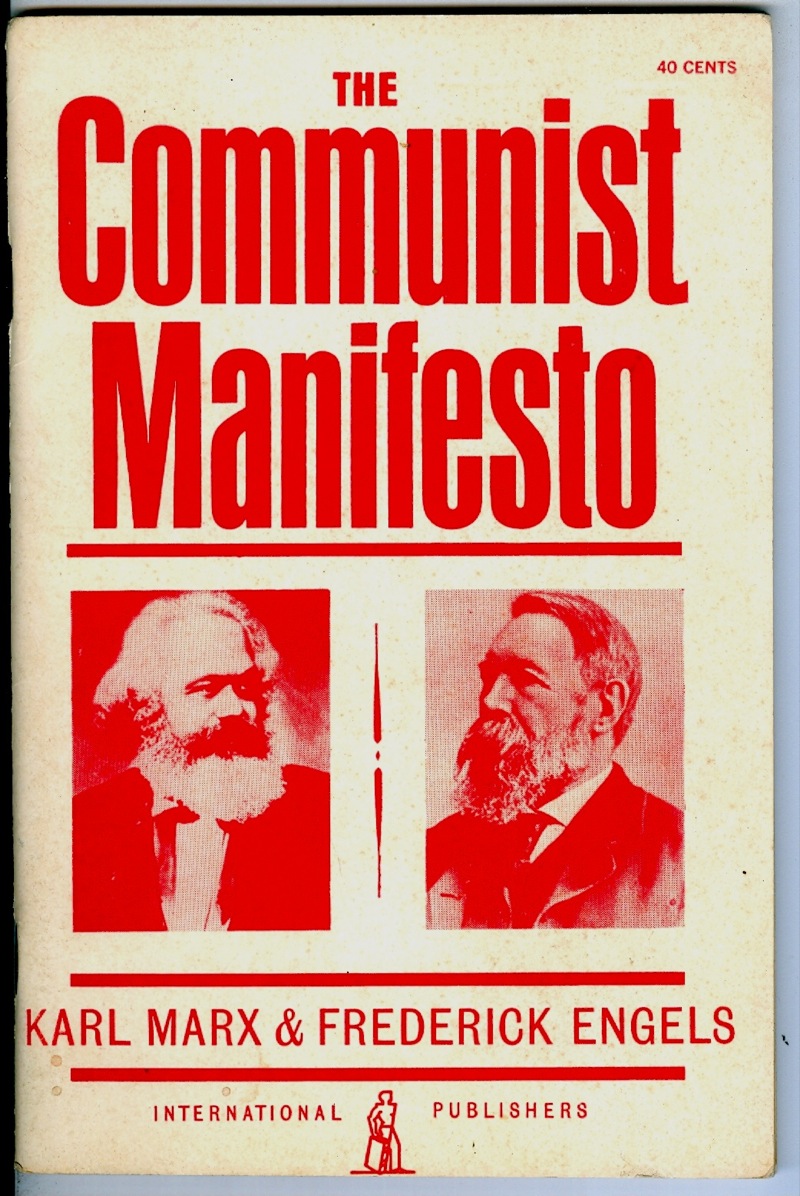
The Communist Manifesto Project – opposing the ‘reactionists’. Some annotations.

“The bourgeoisie, historically, has played a most revolutionary part” – Karl Marx 1848

Marx considered capitalism revolutionary, an advance on all previous societies. Most contemporary “Marxists” and the pseudo left more broadly either disagree or are highly ambivalent… For example, they bemoan “corporate globalization” and believe that the very far from complete process of economic development is ecologically unsustainable and we need to revert to a something “simpler”. Marx refers to these people as “reactionists”.

(Via The Communist Manifesto Project)


communist-manifesto


****

Annotations

These are some comments to consider while reading The Communist Manifesto. Most of them highlight the many instances where Marx’s views are contrary to those of present-day “Marxists”. Marx is referred to as the writer here. While Engels was a co-author, the final writing was the work of Marx.

Chapter 1: Bourgeois and Proletarians

“The bourgeoisie, historically, has played a most revolutionary part.”

Marx then goes on to elaborate on this point in the subsequent 11 paragraphs. He considered capitalism revolutionary, an advance on all previous societies. Most contemporary “Marxists” and the pseudo left more broadly either disagree or are highly ambivalent. They do not see the capitalist transformation of the economy and society as the launching pad for communism. Rather, the society they want requires a retreat from this process. For example, they bemoan “corporate globalization” and believe that the very far from complete process of economic development is ecologically unsustainable and we need to revert to a something “simpler”. Marx refers to these people as “reactionists”.

” We see then: the means of production and of exchange, on whose foundation the bourgeoisie built itself up, were generated in feudal society. At a certain stage in the development of these means of production and of exchange, the conditions under which feudal society produced and exchanged, the feudal organisation of agriculture and manufacturing industry, in one word, the feudal relations of property became no longer compatible with the already developed productive forces; they became so many fetters. They had to be burst asunder; they were burst asunder.”

So the transition from capitalism to communism will not be unique. As well as the transition from feudalism to capitalism there was also the transition from hunter-gathering to agriculture based society. In each case there was a total change in thinking and doing – “human nature”.

” For many a decade past the history of industry and commerce is but the history of the revolt of modern productive forces against modern conditions of production, against the property relations that are the conditions for the existence of the bourgeois and of its rule. ”

Marx goes on to cite capitalist economic crises as a prime example of the system’s obsolescence. Some claim that crises are not inevitable under capitalism. However, the evidence seems to suggest that they can only be delayed and at the cost of making them worse.

Other economic failings of the system include its slowness to innovate [see here] and its inability to tap the enthusiasm and initiative of workers [see here].

” Owing to the extensive use of machinery, ……. according to their age and sex.”

This is an accurate description of machine tending where work becomes confined to simple repetition. However, this should not be taken to be Marx’s overall assessment of work under capitalism. In Capital Vol. I Chapter Fifteen Section 9, he has two paragraphs that gives his general view of the labor process under capitalism. These are quoted in full below.

“Modern industry never looks upon and treats the existing form of a process as final. The technical basis of that industry is therefore revolutionary, while all earlier modes of production were essentially conservative. [225] By means of machinery, chemical processes and other methods, it is continually causing changes not only in the technical basis of production, but also in the functions of the labourer, and in the social combinations of the labour-process. At the same time, it thereby also revolutionises the division of labour within the society, and incessantly launches masses of capital and of workpeople from one branch of production to another. But if modern industry, by its very nature, therefore necessitates variation of labour, fluency of function, universal mobility of the labourer, on the other hand, in its capitalistic form, it reproduces the old division of labour with its ossified particularisations.We have seen how this absolute contradiction between the technical necessities of modern industry, and the social character inherent in its capitalistic form, dispels all fixity and security in the situation of the labourer; how it constantly threatens, by taking away the instruments of labour, to snatch from his hands his means of subsistence, [226] and, by suppressing his detail-function, to make him superfluous, we have seen, too, how this antagonism vents its rage in the creation of that monstrosity, an industrial reserve army, kept in misery in order to be always at the disposal of capital; in the incessant human sacrifices from among the working-class, in the most reckless squandering of labour-power and in the devastation caused by a social anarchy which turns every economic progress into a social calamity. This is the negative side. But if, on the one hand, variation of work at present imposes itself after the manner of an overpowering natural law, and with the blindly destructive action of a natural law that meets with resistance [227] at all points, modern industry, on the other hand, through its catastrophes imposes the necessity of recognising, as a fundamental law of production, variation of work, consequently fitness of the labourer for varied work, consequently the greatest possible development of his varied aptitudes. It becomes a question of life and death for society to adapt the mode of production to the normal functioning of this law. Modern Industry, indeed, compels society, under penalty of death, to replace the detail-worker of to-day, grappled by life-long repetition of one and the same trivial operation, and thus reduced to the mere fragment of a man, by the fully developed individual, fit for a variety of labours, ready to face any change of production, and to whom the different social functions he performs, are but so many modes of giving free scope to his own natural and acquired powers.

“One step already spontaneously taken towards effecting this revolution is the establishment of technical and agricultural schools, and of “écoles d’enseignement professionnel,” in which the children of the working-men receive some little instruction in technology and in the practical handling of the various implements of labour. Though the Factory Act, that first and meagre concession wrung from capital, is limited to combining elementary education with work in the factory, there can be no doubt that when the working-class comes into power, as inevitably it must, technical instruction, both theoretical and practical, will take its proper place in the working-class schools. There is also no doubt that such revolutionary ferments, the final result of which is the abolition of the old division of labour, are diametrically opposed to the capitalistic form of production, and to the economic status of the labourer corresponding to that form. But the historical development of the antagonisms, immanent in a given form of production, is the only way in which that form of production can be dissolved and a new form established. “Ne sutor ultra crepidam” — this nec plus ultra of handicraft wisdom became sheer nonsense, from the moment the watchmaker Watt invented the steam-engine, the barber Arkwright, the throstle, and the working-jeweller, Fulton, the steamship. [228]”

“226.
“You take my life
When you do take the means whereby I live.”
Shakespeare.

227. A French workman, on his return from San-Francisco, writes as follows: “I never could have believed, that I was capable of working at the various occupations I was employed on in California. I was firmly convinced that I was fit for nothing but letter-press printing…. Once in the midst of this world of adventurers, who change their occupation as often as they do their shirt, egad, I did as the others. As mining did not turn out remunerative enough, I left it for the town, where in succession I became typographer, slater, plumber, &c. In consequence of thus finding out that I am fit to any sort of work, I feel less of a mollusk and more of a man.” (A. Corbon, “De l’enseignement professionnel,” 2ème ed., p. 50.)

228. John Bellers, a very phenomenon in the history of Political Economy, saw most clearly at the end of the 17th century, the necessity for abolishing the present system of education and division of labour, which beget hypertrophy and atrophy at the two opposite extremities of society. Amongst other things he says this: “An idle learning being little better than the learning of idleness…. Bodily labour, it’s a primitive institution of God…. Labour being as proper for the bodies’ health as eating is for its living; for what pains a man saves by ease, he will find in disease…. Labour adds oil to the lamp of life, when thinking inflames it…. A childish silly employ” (a warning this, by presentiment, against the Basedows and their modern imitators) “leaves the children’s minds silly,” (“Proposals for Raising a Colledge of Industry of all Useful Trades and Husbandry.” Lond., 1696, pp. 12, 14, 18.)”

The basic message is that despite the tendency for capitalism to impose a narrow division of labor, the objective conditions of modern industry limit the extent they can do that.

This view is very much at odds with Braverman’s Labor and Monopoly Capital, The Degradation of Work in the Twentieth Century. This book has had a very unfortunate influence of how people on the left view the labor process under capitalism. It claims that capitalism tends to increasingly degrade work and deskill workers. The present situation totally refutes this view given that 15-20 per cent of the workforce have university degrees and a larger number have vocational training. If it were true that capitalism was simply reducing the workforce to automatons, it would be hard to see how they could ever get rid of, and then manage without, the bourgeoisie. For a full refutation of Braverman see Deskilling Debunked.

” The various interests and conditions of life within the ranks of the proletariat are more and more equalized, in proportion as machinery obliterates all distinctions of labour, and nearly everywhere reduces wages to the same low level. ”

While proletarians are no longer mainly machine tenders, the point about equalization is still quite valid.
The wage disparity among the vast majority of workers is not enough to generate major differences in material conditions of life. There is a mass mainstream, with perhaps 10 per cent at the top and 10 per cent at the bottom living in different worlds. This is important from the point of view of overall solidarity and individuals identifying with most other people. The way that the vast bulk of people think of themselves as ‘middle class’ is one reflection of this.

” Finally, in times when the class struggle nears the decisive hour, the progress of dissolution going on within the ruling class, in fact within the whole range of old society, assumes such a violent, glaring character, that a small section of the ruling class cuts itself adrift, and joins the revolutionary class, the class that holds the future in its hands. Just as, therefore, at an earlier period, a section of the nobility went over the bourgeoisie, so now a portion of the bourgeoisie goes over to the proletariat, and in particular, a portion of the bourgeois ideologists, who have raised themselves to the level of comprehending theoretically the historical movement as a whole.”

Now most members of the intelligentsia are part of the proletariat. They come from proletarian families and works for a salary. Unfortunately, because of their employee status most are hacks working in the service of the bourgeoisie. This includes the pseudo left in the social sciences who have done much to stifle young inquiring minds. Under these circumstances independent thinkers with independent means would be most valuable.

” Of all the classes that stand face to face with the bourgeoisie today, the proletariat alone is a really revolutionary class. The other classes decay and finally disappear in the face of Modern Industry; the proletariat is its special and essential product.”

In modern capitalist societies the vast majority of people are members of the proletariat. They are either wage or salary earners or on welfare. They have no means of production of their own. The capitalists are a tiny minority and the petty bourgeoisie comprise around 10 per cent. The proletariat is revolutionary because it has no interest in the present system and can do without the bourgeoisie. For more on the modern proletariat go here.

“All the preceding classes that got the upper hand sought to fortify their already acquired status by subjecting society at large to their conditions of appropriation. The proletarians cannot become masters of the productive forces of society, except by abolishing their own previous mode of appropriation, and thereby also every other previous mode of appropriation. They have nothing of their own to secure and to fortify; their mission is to destroy all previous securities for, and insurances of, individual property.

“All previous historical movements were movements of minorities, or in the interest of minorities. The proletarian movement is the self-conscious, independent movement of the immense majority, in the interest of the immense majority. The proletariat, the lowest stratum of our present society, cannot stir, cannot raise itself up, without the whole superincumbent strata of official society being sprung into the air.”

The proletariat has to own all the means of production in common. Parceling them out to separate groups of workers would simply bring you back to capitalism.

” The modern labourer, on the contrary, instead of rising with the process of industry, sinks deeper and deeper below the conditions of existence of his own class. He becomes a pauper, and pauperism develops more rapidly than population and wealth. And here it becomes evident, that the bourgeoisie is unfit any longer to be the ruling class in society, and to impose its conditions of existence upon society as an over-riding law. It is unfit to rule because it is incompetent to assure an existence to its slave within his slavery, because it cannot help letting him sink into such a state, that it has to feed him, instead of being fed by him. Society can no longer live under this bourgeoisie, in other words, its existence is no longer compatible with society.”

This is still indeed the case for a significant section of the proletariat. A pauper is someone who cannot support them-self. In the present context that means being on the dole or invalid pension. Pauperism occurs because capitalism fails to ensure that everyone is equipped with the abilities required for the workforce and also leaves many people the psychological casualties of a dog eat dog society.

Chapter 2: Proletarians and Communists

“In the national struggles of the proletarians of the different countries, they point out and bring to the front the common interests of the entire proletariat, independently of all nationality.’

A lot of the pseudo left demand protection from “cheap foreign labor”.

“Communistic abolition of buying and selling”
This means no more markets. Most “Marxists” have gone to water on this and agree with the bourgeoisie that it is impossible. For a discussion of how communism would thrive without markets go here.

” The proletariat will use its political supremacy to wrest, by degree, all capital from the bourgeoisie, to centralise all instruments of production in the hands of the State,i.e., of the proletariat organised as the ruling class; and to increase the total productive forces as rapidly as possible.”

This is totally at odds with the green anti-growth view that is now so widely held.

” In place of the old bourgeois society, with its classes and class antagonisms, we shall have an association, in which the free development of each is the condition for the free development of all.”

Another way of expressing this is to say – each person’s free development depends on the free development of everyone else. This is obvious if you think about how difficult it would be to fully thrive if those around you are hopelessly inadequate.

Chapter 3: Socialist and Communist Literature

​In this chapter Marx lists the various types of “anti -capitalism” that prevailed at that time. A new list for the present time needs to be prepared. There will be significant similarities and they will be as equally reactionary.

Chapter 4: Position of the Communists in Relation to the Various Existing Opposition Parties

This chapter looks at immediate tasks for communists at that time. At the present moment the big issue is the Arab Spring. This revolution, no matter however totally bourgeois, is in the interest of the proletariat and people, both of the region and internationally. The major capitalist powers must be placed under the greatest possible pressure to do all they can assist, including militarily. The “Marxists” and other pseudo leftists have done all they can to oppose this and are a total disgrace.

Fascism and the Left (from Red Eureka Movement, November 1980)

… scratch a “Communist” and one quite often finds a fascist underneath.

(Note: I was personally on the other side, the wrong side, during the conflict described in this article. I opposed the Red Eureka Movement. I now regret not being open-minded and rebellious and instead clinging to the safety of dogma, a close social circle and the Party Line. We all have our dark years, I suppose. The thing is to face them and keep learning…).

* * * *

A major theme in left wing propaganda is opposition to fascism. Quite often relatively moderate opponents of the left are described as “fascists”.

Yet scratch a “Communist” and one quite often finds a fascist underneath.

The regime that began with the October Revolution is now a fascist dictatorship. In China too, since the defeat of the Cultural Revolution many revolutionaries have been executed and the right to speak out freely, hold great debates, put up big character posters and so on has been officially and formally repudiated.

The degeneration of Communist Parties in power is a separate problem calling for a separate analysis. But what about the degeneration of parties holding no power?

THE CPA (ML)

Our experiences with the “Communist Party of Australia (Marxist-Leninist)” were sufficiently frightening to require some deep analysis. Almost any split is accompanied by outraged cries of “unfair” or “undemocratic” from the losing side, so it seemed undesirable to distract attention from the fundamental issues at stake by going into details of who done what to who. But another reason why we never got around to it was probably embarrassment at ever having been involved with such a sick group.

The bankruptcy of Australian nationalism as an ideology for communists is now pretty apparent, while the question of whether China has gone revisionist has been settled by open proclamations from the Chinese leadership themselves. Although Vanguard keeps coming out each week, the people behind it seem pretty discredited and there is little need to discredit them further.

In Adelaide the “Worker Student Alliance for Australian Independence” has disintegrated, along with its newspaper People’s Voice. In Melbourne the entire editorial collective of Independence Voice quit some time ago, there was no “Independence platform” at Mayday, the “Australian Independence Movement” is virtually defunct and supporters of this line have been completely routed in “Community Radio” 3CR. The Australia China Society is unable to defend the new regime in China and little has been heard from the CPA(ML) in the trade union movement either.

As a complete expression of E.F.Hill’s bankruptcy we have the suggestion in “Australian Communist”, that they want unity with us (previously described as “Soviet agents”). Hill has even signed an article proposing reunification with the CPA in “one Communist Party” (presumably because the Chinese revisionists, having recently re-united with their Italian and Yugoslav colleagues, also wish to re-establish relations with the CPA, leaving Hill out in the cold).

The thuggish behaviour of the CPA(ML) supporters in attempting to intimidate their opponents is well known. Both intellectual and physical thuggery, in 3CR and elsewhere, has become so notorious that the only “broad united front” they have been able to create has been that directed against themselves. They have also become notorious for openly preferring to ally themselves with various Nazis and other fascists against the Soviet Union rather than trying to unite the people, and especially the left, against Soviet imperialism on the basis of progressive principles. Their main political theme these days is the united front they claim to have with Malcolm Fraser,who nevertheless remains quite unaware of their existence. As for China, they openly say they would rather not talk about it, even though China was, and is, central to their whole political outlook.

These facts are mentioned, not to kick a dead horse, but to emphasise that the horse really is dead and to confirm that the additional facts about it cited below are genuine observations and not just part of some ongoing sectarian faction fight.

OTHERS TOO

The more or less open fascism of the CPA (ML) has resulted in that group being simply dismissed as “crazies”. But in fact they are only a more extreme expression of problems that exist, less overtly, throughout the left. Indeed it has been noticeable in 3CR for example, that the excuse of “keeping out the crazies”, has been used to justify appallingly manipulative and undemocratic behaviour (e.g. elected listener sponsor representatives voting against explicit directives from a large general meeting of listener sponsors). People who would be shocked and indignant about that in other contexts have made excuses for it when their own friends are doing it. Really how far is it from making excuses to acting in the same way?  And how far from there to ending up just like the “crazies” themselves?

Also the fact that China and the Chinese parrots are anti-Soviet (and Reagan, Thatcher, Fraser etc) has become an excuse to actually apologise for Soviet actions that would be called “fascist” if American was doing it.  Indeed many quite non-crazy “left liberals” have been prepared to go through the most amazing mental contortions to justify the Vietnamese occupation of Kampuchea or to minimise the significance of Soviet aggression elsewhere.  Rather than agree with “right-wingers” (like Churchill), they prefer to apologise for fascists (like Hitler).

Where was the left wing outrage (as distinct from concern) when Polish workers were being denied the elementary right to form free trade unions?  Why do “militants” in “left-wing” unions take delight in the same bureaucratic manoeuvres their opponents use to stay in power?  Why are splits in left wing groups so common and so nasty?

In Australia many other groups supposedly on the left have exhibited a personal intolerance comparable to the Chinese parrots, and also a comparable willingness to apologise for reactionary regimes in other countries, provided those regimes pay lip service to “anti-imperialist” principles. (Vietnam, Cuba, Iran, Libya… name a country that is suppressing some other country or trying to impose some medieval religion on its people and you will find a “left” group wildly enthusiastic about it.)  Scanning overseas “left” newspapers one gets the impression that narrow minded religious bigotry is pretty common, and even where it is not taken to extremes, it is still present.  No wonder so many on the “left” thought a fellow zealot like Khomeiny would be progressive for Iran.

The undemocratic tendencies of “Leninists” is a common theme in anti-Communist propaganda – from open representatives of the bourgeoisie, from Social Democrats, from Anarchists, from “Left” or “Council” Communists and what have you.  Nevertheless, attacks from our opponents should be taken seriously, and indeed have been taken seriously by the classic exponents of Marxism.

CHINESE FASCISM

This question was especially taken seriously in China and some of the material from the Chinese Cultural Revolution is very valuable for understanding the emergence of fascist tendencies among alleged “Communists”.

For example Mao Tsetung’s unpublished works, and the material criticizing Lin Piao (the “successor” who turned out to be a fascist). The Cultural Revolution was after all a direct struggle between revolutionaries and counter-revolutionaries who both purported to be part of the “left”. The concept of fighting bourgeois ideas disguised as “left” ideas was crucial to unleashing the 1960s upsurge and will be crucial again. It was necessary to challenge the “peace” ideas that were dominant in the left in the 1960s and it will be necessary to challenge the views that are dominant now – many of which are again crystallised in the eclectic mishmash of the “CPA”.

In the “gang of four’s” Peking University Journal of September 1, 1976 there is an important article on “The Bureaucrat Class and the Dictatorship of the Proletariat”:

…We must further recognise the high concentration of political and economic powers under the dictatorship of the proletariat. If the bureaucrat class succeeded in usurping power and in its restorationist conspiracies throughout the country, then it would continue to flaunt the banner of socialism, take advantage of this high concentration of political and economic powers and turn the democratic centralism of the proletariat into the fascist centralism of the bureaucrat class.

In controlling and manipulating the means of production and the product of Labor, these bureaucrats will be far more powerful than any previous exploiting classes and their political representatives, than the slave owners and feudal rulers who claimed that “all land under the sun is my territory and all people on earth are my subjects”, and than the bureaucrats and financiers in capitalist countries…In a similar vein, the present day new tsars behave much worse than the old tsars…

(Translation from Selections from People’s Republic of China Magazines No 895, American Consulate General, Hong Kong. Reprinted in Study Notes No 6, Red Eureka Movement, August 1978)

This article also goes into the question of the transformation of authority into capital and capital into authority, which is relevant to an understanding of imperialism in the West as well as in the Soviet Union and China.

Western bourgeois democratic society is heading towards an acute crisis and upheaval as another Great Depression and a Third World War develop. The outcome can be Communist Revolution or some form of fascism or social-fascism. We could face a new ruling class more powerful than the present one. It largely depends on how clear the left is on what we are fighting for and what we are fighting against and how sharply we can draw the line against perpetuating the old system of exploitation in our own practice. If the left continues to whinge about capitalism, and even oppose it from a reactionary perspective then it cannot hope to inspire people to fight for something fundamentally different.

Indeed, just as one would have to defend the national independence that Western and Third World countries have already achieved, from Soviet “socialist” imperialism, one would also have to defend the achievements already won by the bourgeois democratic revolution from attack by alleged “socialists” who want to go backwards to a more oppressive society.

DEMOCRATIC CENTRALISM

If the democratic centralism of the proletarian dictatorship can be easily transformed into the fascist centralism of the bureaucrat class in a developing socialist country, then what about democratic centralism in Leninist parties out of power? Is this an argument against democratic centralism and proletarian dictatorship, as anarchists and others insist?

The answer to this argument is that there never can be a guarantee against proletarian dictatorship turning into its opposite, and Communists in power must always be prepared for transition to underground life as Communists in opposition to capitalist roaders in power. Likewise in Communist Parties generally – one must be prepared to rebel and to be expelled for rebelling.

But if there was no democratic centralism and proletarian dictatorship then it would be quite impossible for the revolutionary ideas held only by a minority in capitalist and socialist society to be centralised and dominant and in that case the bourgeoisie holds power anyway. So weakening democratic centralism is not the answer. On the contrary, it needs to be strengthened to keep fascists out, on the same argument that the left cannot afford to be pacifist and must learn the use of arms if it doesn’t want warmongers to hold power.

Proletarian dictatorship means just that. It does not mean dictatorship over the proletariat by some bureaucrats. It means a political system in which the working class can really wield political power – something that can be achieved by workers councils led by a revolutionary party and cannot be achieved by parliamentary institutions or by milling around in confusion.

Democratic centralism also means just that. It does not mean the leadership imposing decisions on a reluctant membership. It means that the abstract “parliamentary” right which almost all organisations give their members to ultimately take decisions, is made real by conscious leadership of the decision making process to make it “from the masses, to the masses” and so make it actually work without manipulation or obstruction.

This article is not a plea for everybody to be more tolerant of everybody else. It is a call for sharper defence of our basic principles and less tolerance of attempts to undermine them. One cannot be a Communist if one is not first a democrat. The democratic revolutionaries of England, France and so on in earlier centuries had no hesitation about chopping off the heads of their aristocratic opponents and neither should we.

Fear of strengthening democratic centralism is really fear of struggle. Such fear is fully understandable in the present situation, and a lot better than blinkered complacency. But it must be overcome.

The quote from Orwell’s “Road to Wigan Pier” in “the Personal is Political” (Discussion Bulletin No 9) rang a few bells and is worth repeating:

…..”Socialism” is pictured as a state of affairs in which our more vocal Socialists would feel thoroughly at home. This does great harm to the cause. The ordinary man may not flinch from a dictatorship of the proletariat, if you offer it tactfully; offer him a dictatorship of the prigs,and he gets ready to fight.

We should be ready to fight against the dictatorship of the prigs and to do this it is necessary to understand the transformation of Communists into prigs.

ARE WE DIFFERENT?

If we take Lin Piao for example, there is no doubt that he did make contributions to the Chinese revolution before emerging as an outright fascist. The superstitious Mao cult he built up in opposition to Mao had definite roots in China’s feudal past, but also struck a chord among Western “Maoists”.

Ted Hill now appears to be nothing more than a follower of Liu Shao-chi, then Lin Piao (as a major cult advocate) then Liu Shao-chi again, or whoever may hold power in China at any given moment. But some of his analyses of revisionism,parliamentarism and trade union politics in publications like “Looking Backward; Looking Forward” are still valuable and he once made a point of opposing sacred cows and stereotypes and supporting rebellion.

Things were drastically wrong with the CPA(ML) long before we parted company and people are entitled to ask how we got mixed up with them and why we should be regarded as any different. If we are to be any different then we must analyse the thin dividing line that appears to exist between being a Marxist-Leninist or “Maoist” on the one hand, and being a lunatic or a fascist on the other.

There is little need to “expose” the CPA(ML) leadership now in view of its obvious degeneration. But the roots of current fascist attitudes do need study, so the following facts are placed on the record for our own benefit rather than for the benefit of anyone still taken in by Hill.

SOME FACTS

  1. There never was anything remotely resembling democracy within the CPA(ML). This became obvious when concrete disagreements made it necessary to have a proper discussion and take a decision. But it should have been obvious even when people thought they were in agreement.
  2. As soon as a disagreement in principle was announced “through the proper channels” etcetera, the immediate response was to launch vituperative attacks on individuals – at first surreptitiously behind their backs and then openly in Vanguard.
  3. The very idea of discussing the differences was repudiated and “security” was abused to tell people that there had been a full democratic discussion, which they just didn’t happen to be part of.
  4. As a matter of fact it turned out that no Central Committee actually existed. One member of the Red Eureka Movement discovered that he was supposed to be a CC member after wanting to express his views to the CC. This must be some sort of record in the international communist movement!
  5. Other members of the Red Eureka Movement who were both on the Central Committee and knew it , were able to expose the lie that there had been some kind of Central Committee discussion about China and that documents expressing opposition had been circulated to the Central Committee etc.
  6. Individual party members had to go outside the “channels” to get any kind of discussion and then discovered that the “channels” didn’t really exist. Now others who accepted this are finding the same situation.

7.It was not a case of discussion being suppressed arbitrarily and decisions usurped, but of there being no provision whatever for seriously discussing and reversing a policy disagreed with.

  1. This situation which existed long before it came to a head was put up with by people who would rebel strongly against similar fascist practices in any other social institution.
  2. Many people on becoming aware of it, and seeing people branded as Soviet agents etcetera, took a cynical attitude that this was wrong but not a major question of principle requiring them to take a stand.
  3. Our initial reaction to all this shit was not to launch a public struggle as in the Cultural Revolution or in accord with our own experiences in the 1960s. Instead we had great hangups about “the party” and organised semi-conspiratorially.
  4. Despite being a very small group, since breaking with the CPA(ML) leadership we have not been able to resolve internal disagreements in a civilised, let alone comradely manner, but have had two further splits. While nowhere near as bad as Hill’s, these have also involved strange behaviour that would not be tolerated in most community organisations and should not be tolerated on the left. Moreover they have occurred in a situation where we are not leading any great revolutionary struggle and no pressing life or death decision was at stake.

LIFE WASN’T MEANT TO BE EASY!

We did not fully realise it at the time, but there was little alternative to the apparent extremism of Hill’s stand because there really wasn’t any possibility of a discussion. If he had agreed to a discussion, what could he possibly have said? And if the CPA(ML) did not follow China religiously, what else could it do? We cannot blame Hill for our own naivety.

We only realised how difficult most people find it to rebel and think for themselves once we had broken with Hill and company. “Stalinists without a country” was the contemptuous Trotskyist label, and there is something in it. It really is enormously easier to at least think you know what you’re doing when there is some “socialist motherland”backing you up. (Or a “Fourth International”, a “great leader” or some other crutch).

For non-revolutionaries its fairly easy to maintain a political position sustained by one or other of the reformist currents in mainstream bourgeois society. But in a non-revolutionary society and with no back up from a revolutionary society, it requires real effort to develop a revolutionary program. How much easer it would have been if we could have forgotten that we didn’t have such a program by simply pretending to ourselves that China, or Albania or somewhere was revolutionary and that supporting them would somehow produce a revolution here. Or by pretending that if we were all more dedicated, we would figure out where we were going while getting there.

Its interesting to note how even people with no attachment to Russia, China or Albania have managed to persuade themselves that Vietnam is still worth supporting and feel a deep and personal threat to their whole ideology when this is questioned. Or how people leaving REM because it hasn’t been getting anywhere who know perfectly well what’s wrong with the political line of the Revolutionary Communist Party (USA), are nevertheless attracted by the reassuring certainty of that group’s proclamations.

“Idealism and metaphysics are the easiest things in the world, because people can talk as much nonsense as they like without basing it on objective reality or having it tested against reality. Materialism and dialectics, on the other hand, need effort. They must be based on and tested by objective reality. Unless one makes the effort, one is liable to slip into idealism and metaphysics.”(Mao Tsetung)

PRIESTS AND HORSES

Judging from overseas literature, the temptation of closed minded religious fanaticism is very strong in this situation. It provides a certainty that would otherwise be lacking and puts an end to all confusion,doubt,cynicism, liberalism and so on.

But this way out is the way out of the movement.It means joining the innumerable sects that are much better organised and disciplined than we are, and are able to get more done precisely because they do not have the “burden” of really having to think out a revolutionary line.

We did not hesitate to reject the “security” of blindly following China, Albania or anybody else so we should not regret the consequences.

One consequence is that we are in some respects more vulnerable to confusion, doubt, liberalism, cynicism and so on than other left groups that feel more confident about their (manifestly wrong!) lines. The reason horses are given blinkers is that it keeps them working away steadily without getting distracted by things they might see.Groups that have attached themselves to a foreign state, or that merely reflect a reformist current  in mainstream bourgeois ideology, have a secure basis for their activity and can work away at it for years after it has ceased to have any social relevance or has become purely reactionary.

The same can easily be true of “revolutionary” groups that feel secure, or pretend to feel secure in their “correct line”. They can whip up a great frenzy of activity, full of sound and fury, but signifying nothing. Take a look at the Communist Workers Party or the Revolutionary Communist Party (USA). On many points we would be in full agreement. They have a similar analysis of China and Albania to ours and they certainly do make a clear distinction between communist revolution and the bourgeois reformism advocated by most “revolutionaries”.

On international questions of very great significance they appear to have a fundamentally wrong analysis, But even more important, their whole approach to “correct line” politics seems alien. They are certainly not paralysed by liberalism like we are – but so what?

While confusion, doubt, liberalism, cynicism and so on persist we will remain unable to accomplish very much, including theoretical work:

“We must have faith in the masses and we must have faith in the Party. These are two cardinal principles. If we doubt these principles, we shall accomplish nothing.”(Mao Tsetung)

But the only basis for faith in the Party is confidence in the soundness of its analysis and line. Once we have grounds for such faith we will be able to accomplish something, but not before. (And of course once we do, we will again have the problem of blind faith and the potential for people to continue following a leadership that has proved itself worthy of confidence, long after it has ceased to play a progressive or revolutionary role. But then it would be at a higher stage of the spiral).

Demands that people pull themselves together, combat liberalism or what have you, will not solve the problem of lack of faith. This is an atheistic age and real communists are atheistic people. Our only God is the masses and the only basis for our faith is scientific analysis of reality.

The situation we are in calls urgently for working out where we are and where we are going. Without that , calls to press on more resolutely and with greater vigour will only result in people getting more lost.

CHIN UP, BACK STRAIGHT, EYES SHUT!

It is conservative, not revolutionary to promote “leadership”, “organisation”, “doing things”, “collective life” and so on without a clear perspective for liberating people from oppression. Defenders of the status quo habitually make such appeals and every organisation, revolutionary or not, naturally wants to be as effectively organised as possible (and most sewing circles and amateur theatrical societies are probably a lot better organised than REM). But it is quite wrong to see the organisational reflection of our confusion as the central problem instead of dealing with the confusion itself. (As for any who are not confused, they would have an even greater problem. Take off the blinkers!)

Communism is not the only ideology opposed to liberalism. Fascism opposes liberalism too. It is one thing to want to widen and deepen and ultimately transcend democracy by going beyond such mere forms as majority voting. It is quite another thing to declare that ones policies have proved their own correctness and deliberately exclude others from even a vote, let alone a real say, on the matter. Yet we have repeatedly experienced this kind of behaviour not just from enemies, but from comrades who probably really do want to be revolutionaries.

The fact that people like Lin Piao or Ted Hill could turn out to be fascists and that we could go along with a load of shit for a long time should alert us to the dangers. When people on the left start acting like people on the extreme right they must be pulled up sharply and told “You’re Ill” before the disease becomes incurable and before it spreads.

*******

REVOLUTION: Part 7 of ‘Unemployment and Revolution’ by Albert Langer. (This part, a draft, was written in 1982, a year after the first paper).

Note by C21styork: I think the earlier instalments stand up well over the 30 years since they were written but this section, on revolution, begs the questions as to why, over more than three decades, there is still no real interest in revolution in the advanced capitalist societies. The slogan ‘Smash capitalism’ was more popular back in the late 1960s when a significant minority of leftists (and the state’s intelligence agencies) did take the notion of revolution seriously – yet that was a time also of post-war economic boom. Now, in the C21st, capitalism is in decline to such an extent that the basics that are lauded by social-democrats, such as free public health and free education, can only be funded on the basis of debt. The zombie system is kept alive by government support and the ideal of the ‘free market’ is – or should be – exposed for the utopianism that it is. In places like Greece, people are angered by austerity measures, and throw rocks at banks. But that is frustration, not revolution. Meanwhile, in Australia and other advanced economies, what passes for left-wing thinking continues to obsess about the weather…

* * * *


“These days people are rightly cynical about the “policies” and “programs” of political parties, whether “revolutionary” or not. Revolutionary Leninist ideas are widely discredited by the sterility of their apparent supporters, and Marxist concepts that sum up important truths from the history of revolutionary struggle seem empty because they have been repeated so often as banalities. One hesitates therefore to use the word “program”, let alone “party”, for fear of being taken for yet another loony with pat simplistic answers to all the world’s problems”.

Part 7: Revolution

We Need a Program

Expropriating Big Business

Central Planning

Labour Policy

The Struggle for Control

Socialist Management

Investment Planning

Draft 4. August 1982

(Note: A number of comments on earlier drafts of this section have pointed to the conclusion that it really ought to be rewritten completely. However, it seems better to get the thing out, and allow others to comment as well. Please bear in mind that this was originally intended to simply round off the paper “Unemployment and Revolution”, by suggesting that revolution is a more “practical” solution to the problem of unemployment, than the various other “left” schemes to deal with it, that were analysed there. It is not intended to satisfy people’s desires for a meaningful answer to the general problem of “revolution”, but merely to say something about what a revolution could do about unemployment. Unfortunately everything, like everything else, is related to everything, as well as being a class question…, which makes it very difficult to complete an acceptable article about anything…)

In its normal state, capitalism has become an obsolete oppressive system that ought to be got rid off. A relatively small minority recognise this and are consciously anti-capitalist, but the masses continue trying to satisfy their needs within the system rather than by overthrowing it. So there is no real possibility of overthrowing that system and attempts to do so degenerate into futile reformism and/or terrorism, whatever the “revolutionary” rhetoric.

But during periods of economic crisis, the contradictions of capitalism sharpen and the possibility of actually getting rid of it arises. A substantial proportion of the population is drawn into active political struggle as they confront questions of what society is to do to get out of its impasse. There is no crisis that the ruling class could not resolve if it was allowed to, but with the masses politically active, the possibility arises of the ruling class not being allowed to, and of people taking things into their own hands.

In boom conditions, capitalism develops the productive forces at its maximum rate. That may be far slower than would be possible for a communist society, but there is no basis for comparison, so the obstruction is not so noticeable.

The “development of the productive forces” is not some abstract question. It means concretely that the wealth of society is increasing, not just materially, but also culturally and in every direction. Opportunities for development are open and people who want to better their own situation can do so by grasping those opportunities. Most workers can expect better jobs, with a higher standard of living and better conditions. Capitalists can find opportunities for profitable investment. International trade is expanding and the different nations, classes and sectional interests are fighting over their share of an expanding “cake”. Such fights may be acute, but there is always room for compromise about who benefits more, when nobody is actually asked to accept being worse off than they are already. Reforms may be fought bitterly, but there is scope for reform without shaking the whole system apart. Within a “pluralistic society”, there can still be “consensus”.

In crisis conditions all this is reversed. The cake is contracting and the fight is over who is to bear the loss. Among capitalists the fight is over who is to survive and who is to eat whom. Between capitalists and workers there is no room for compromise. Reforms become impossible and even past achievements may be rolled back. “We can’t afford these luxuries any more”. Within the working class too, there is less unity as people find themselves in “hard times” where it is “everyone for themselves”. The “social fabric” unravels, consensus breaks down and capitalist society stands revealed as based on sharply antagonistic interests.

The last major capitalist crisis was the Great Depression of the 1930’s. Subsequent economic fluctuations; including the present one, have not amounted to much more than “recessions”; so the inevitability of capitalist crisis has been forgotten until the next crisis again smashes the illusion. But even in “recession”, the sharpening of contradictions can be seen, together with the complete inability of the reformist “left” to come up with any serious alternative program. All the signs point to a gathering crisis, much deeper than the 1930’s, and the necessity for a serious revolutionary alternative opposed to trying to patch capitalism together again.

Internationally, overproduction intensifies the struggle for markets between imperialist nations as well as between individual financial groups. International conflicts that could have been resolved peacefully become intractable because the economic barriers have gone up and there is no room to manoeuvre. The “underdog” or “latecomer” imperialists can no longer hope for a place in the sun by peaceful competition in an expanding market. They can only expand at the direct expense of the established “status quo” powers and so they seek a re-division of the spoils by force. Despite its costs and risks, for them war becomes a more attractive alternative to economic collapse.

On questions of war and peace, the general “left” attitudes are perhaps even worse than the whining domestic demands that capitalists should continue running things but should do so more humanely and with less unemployment. Just as they shut their eyes to the real impossibility of continuing capitalist prosperity and “demand” a boom economy, they also shut their eyes to the real inevitability of imperialist war and “demand” peace. Pretending that the Soviet superpower is not aggressive, and that its arms build-up is not preparation for war, but a figment of Reagan’s imagination, becomes another way of avoiding the critical issues of war and revolution.

Workers have no stake in the existing imperialist division of the world nor would they have a stake in the proposed new one, they do however, have a stake in opposing aggressive predatory wars and the accompanying overt denial of national and democratic rights. (The first world war was a different situation not arising directly from an economic crisis, in which both sides had essentially similar expansionist aims). As we had to fight the fascist powers in the second world war, we would have to fight any fascist power that launched a third world war. (Although the Soviet Union still describes itself as “socialist, if it actually launched a third world war, the correct description of “social-fascist” would be more widely understood.)

If we fail to defeat social-fascist war preparations, we could be stuck with fascist domination holding up social development for decades. If we fail to organise independently around our own revolutionary program, we could be stuck with social development continuing sporadically in capitalism’s self-contradictory manner, lurching forward to the next crisis and the next war. If we get our act together, while the bourgeoisie’s act is in a mess, then we have a world to win.

All this relapse into the barbarism of crisis and war occurs as on obvious result of capitalism itself. Workers are unemployed, goods and services are unsaleable, plant capacity stands idle, and consumers are forced to do without, for no “unavoidable reason”. All that stops the continued expansion of wealth and opportunities is the capitalist system of production for private profit. All that is needed for the unemployed workers to use the idle plant to produce goods that people want and need, is a communist system of production for use instead of profit.

We Need a Program

Obviously we are not in a revolutionary crisis right now, and no question of overthrowing any western government arises immediately.

But a major economic crisis and/or a world war would certainly lead to a revolutionary crisis. The question of an alternative to capitalism will certainly be posed. Capitalism will survive if we let it. Crises can resolve the contradictions temporarily and allow a new period of expansion until the next crisis. The outcome of the 1930’s crisis was the post-war boom, not communist revolution in western countries. In retrospect this appears hardly surprising, since the Communist Parties devoted themselves to fighting fascism on a purely defensive basis, and advanced slogans like “Make the Rich Pay” that implied no intention to abolish capitalism.

In its present state of confusion, the left in advanced countries is hardly capable of even fighting fascism let alone challenging the bourgeoisie for power, let alone winning that challenge. There is even a strong tendency to be “soft” on social fascism and adopt a tolerant, apologetic or defensive attitude towards the overt denials of national and democratic rights by the Soviet Union. This can only make it easier to undermine those rights in the West as well. Certainly no movement unable to defend bourgeois democracy against (“socialist”) fascism can hope to overcome the limitations of bourgeois democracy and replace it with communism.

Fortunately however, the confusion on the left is so great there is at least a chance the existing “left” movements and ideologies will disintegrate completely before the actual crisis breaks out, and there will be room for something new and genuinely revolutionary to emerge.

The task of building a revolutionary left is at present primarily destructive – exposing and undermining the reactionary ideology of the present “left”. But we need to at least think about construction at the same time. The aim of destruction is to open the way for a revolutionary left that is fighting for progress rather than reacting against capitalism, and that is quite serious about winning political power to actually implement the social changes it is fighting for, instead of whining about the present rulers of society.

It has been said often enough that there can be no blueprints for the future because the people themselves will decide how to build the new society as they are building it. Fundamentally I agree with that, and will therefore refrain from attempting to present any blueprints. Nevertheless, it is appropriate to put forward a few ideas for discussion about what a revolutionary government might do to start building socialism. Consistent refusal to do so suggests that we are not fair dinkum about having an alternative. “No blueprints” is often a cop-out excuse for “no ideas”.

Revolutionaries need to have a “program” that is more than an analysis of the present society and a promise for the future. We need to develop a clear statement of the concrete measures a revolutionary government would aim to take, so people can decide whether or not they want to fight for a revolution. Too many “parties” talk about “revolution” in the abstract, and none at all seem to be serious about it concretely.

These days people are rightly cynical about the “policies” and “programs” of political parties, whether “revolutionary” or not. Revolutionary Leninist ideas are widely discredited by the sterility of their apparent supporters, and Marxist concepts that sum up important truths from the history of revolutionary struggle seem empty because they have been repeated so often as banalities. One hesitates therefore to use the word “program”, let alone “party”, for fear of being taken for yet another loony with pat simplistic answers to all the world’s problems.

Nevertheless, in a crisis situation, people will judge according to how the measures proposed by revolutionaries compare with those advocated by the existing regime. It will be a very real life and death question for a revolutionary party to have clear policies to deal with unemployment and similar questions. If the revolutionaries do not form a political party that aims to take power from the old regime then the old regime must continue. It will not just disappear in a burst of anarchist enthusiasm. If the revolutionary party does not propose policies that are more desirable and effective than those of the old regime, then why should anyone support a revolution? Even if there was a revolution, there would be a counter-revolution when the new regime failed to solve the problems that had discredited the old regime in the first place.

So, we need to go beyond denouncing what the existing regime is doing and start offering constructive alternatives, even though any such proposals are bound to be half-baked at this stage. Reformists will make constructive proposals as to how the present regime should deal with problems, with or without a change in the political parties administering the regime. Revolutionaries will make proposals about how a new regime, a workers’ state or “dictatorship of the proletariat”, would cope with these questions.

Only left sectarians will talk about revolution in the abstract, without having in mind anything so mundane as taking political power and running the joint. But unfortunately the “revolutionary” organisations in western countries are overwhelmingly sectarian. Their concern is to defend their own organisations and “principles” and not to make revolution. A discrete veil is usually drawn over the question of what a revolution might actually do about unemployment or anything else for that matter, because the alleged “revolutionaries” have no idea what they would do, and have not even thought about it. This does not worry them much, because they are not serious about actually establishing a new regime, but only wish to denounce the present regime more extravagantly than a “mere reformist” would denounce it.

So, let us talk about what communist revolutionaries should do, if we had the political power to do it. No doubt anarchists will disapprove, and insist that discussion of government policy implies we are bureaucrats no better than the old regime. But the choice society faces at present is between revolutionary government or counter-revolutionary government, and the road to abolishing all government lies first through establishing a revolutionary government (but certainly doesn’t end there). Therefore if we want to eventually abolish the state, we need to start exchanging views about proposed government policy now. The reformists talk about government policy because they are perfectly serious about governing, and there is nothing “unrealistic” about this intention of theirs. Revolutionaries should do so too, for exactly the same reason. Those who disdain to talk about government policy obviously have no belief in either reform or revolution, but only a slave’s inclination to whinge occasionally.

The discussion below will not go into the many problems of building a new society and transforming human nature. It will not sketch any exciting vision of how wonderful a new society could be, but will discuss the more mundane problems of what a revolutionary government could do about unemployment in a society that still had not been transformed. Obviously this is not the main point of a revolution. It would be just as boring to have a revolution simply against unemployment as it would be to have one to improve living standards. But this is an article specifically about unemployment.

In the first phase of communist society, the period generally known as “socialism”, there would still be wage labour and commodity exchange through money. It would be quite impossible to abolish these social relations left over from capitalism all at once.

People would not work if they were not paid for it, and they would grab whatever they could get if they did not have to pay for what they consumed. Production would still be geared to market exchange. Basic social relations would still be bourgeois. There would be a bourgeois society in which the bourgeoisie no longer held political power.

A revolutionary government would presumably come to power only as a direct result of a profound political and social crisis, like the last Great Depression. Very likely too, it would arise in the aftermath of a devastating world war. Either way, or both ways, the new regime would be faced with severe economic dislocation including unemployment, as well as all the problems of a regime born in civil war. So what should it do about unemployment?

Obviously a revolutionary government should not attempt to deal with unemployment by any of the methods currently proposed from the labour movement. It could not simply reduce working hours, or raise wages, or increase government spending etc. From the previous analysis we know that these measures would not work in a market economy.

“Revolution” does not mean that we would “demand” that the multinationals do this or that. It means that we, the working class or its advanced sections, take over the running of industry and make the decisions ourselves. To eliminate unemployment, a revolutionary government would have to proceed with abolishing the market economy.

That will be a long struggle and there will certainly be setbacks. The democratic revolutions in Europe were spread over hundreds of years interrupted by various wars and counter-revolutions. They culminated in the establishment of the modern imperialist powers and not some “utopia”. That result was a lot better than the medieval feudal societies that existed before. The democratic revolution was worthwhile and the sordid power struggles undermining feudal power were important. The Russian and Chinese revolutions suffered reversals too. But they, and their power struggles, were worthwhile. The coming Communist revolution will also be protracted and tortuous. But it has to start somewhere and we ought to be discussing it now.

It may seem odd to be discussing concrete economic policy for a regime that is nowhere near existing yet. But it is no more odd than the usual discussions of how to make capitalism work better, or how to retreat from it.

Expropriating Big Business

The first step towards abolishing the market economy and eliminating unemployment, would be to establish state control of the labour market by expropriating the big businesses that employ the large majority of workers. It would not be a matter of “kicking out the multi-nationals”, but of taking them over, and advancing on the basis they have already laid.

Most likely it would have to be done on an international scale. The world economy is already “transnational” and we certainly would not want to retreat from that to any kind of economic autarchy in the name of “independence”.

Expropriation of capitalist property obviously relates to what the revolution could do about many other concrete problems as well, and also relates to implementation of the maximum program, towards socialism and communism. But in an immediate sense, the state taking over most industry is not in itself socialism, but can be state capitalism. It is only a pre-condition for socialism and a pre-condition for abolishing the market economy. Nevertheless, we will not discuss other aspects of the transition to communism here.

In Australia, like other advanced capitalist countries, a very large part of the labour force, about one third, already work for the state at one level or another, or for public corporations like Telecom, or government owned corporations like Qantas. These are already state capitalist industries.

Most of the rest of the labour force is employed by large corporations, often transnationals, whose owners play hardly any direct role in administering them, but are purely passive shareholders or bondholders. These firms could be converted to state capitalism by simple decrees transferring ownership to the revolutionary government, and by the cancellation of government debts. They would remain capitalist because they would still be employing labour to use it for making profit by selling goods on the market. But expropriation without compensation would undermine the economic basis of the old bourgeoisie, and pave the way for communism. It would make the state responsible for hiring and firing the bulk of the Australian labour force, and therefore place the state in a position where it could take responsibility for employment and unemployment.

Many other workers are employed by small firms that are really little more than outside workshops for the big corporations, or “self-employed” in the same, completely dependent, situation. It would be difficult to simply establish state capitalism in these enterprises by decree. But taking over the big corporations on which they are dependent, means making them dependent on state owned enterprises. Control of the big firms would make it possible for the state to influence hiring and firing by the small firms, and so establish state control of that part of the labour market indirectly.

Naturally there is no great problem for a capitalist state to nationalise capitalist industries when it is necessary to the continued survival and development of capitalism – and no great benefit either. A revolutionary state doing it for revolutionary purposes is another matter.

The major obstacle to all this would of course be the state power of the previous regime, including local and foreign armies, navies and air forces, as well as terrorists, saboteurs etc. But we are talking about measures to be taken by a new state that rests on the power of the armed working class, so we may assume that these obstacles are being overcome through revolutionary civil and national war.

There are still a number of major economic obstacles that would persist even after victory in a revolutionary war. Let us look at a few examples.

First, the directors and top management of big industry, whether public sector or private, would side with the present ruling class against a revolutionary government. Unlike the owners as such, these people do play an important role in the actual organisation of production, and can not simply be dismissed by decree.

Second, many lower level executives, engineers, public servants and so on, who play an essential role in production, could not be relied upon by a revolutionary government, even though they have no direct stake in the other side. They see themselves, and are seen by others, as “middle class” (although their real status might be better described as upper strata of the proletariat, since their income is obtained from wage labour, not property ownership).

Third, there are substantial sectors of the economy, even in the most advanced capitalist countries, where people are still self-employed or work for small employers who do play a direct and important role in the actual organisation of production – for example, farmers, shopkeepers, professionals such as doctors, and a good deal of small manufacturing, construction and services enterprises. These could not simply be taken into government ownership be decree, nor are they all directly dependent on firms that could be. They would have to remain for some time as a “private sector” (quite different of course from the present “private sector”dominated by huge transnational corporations).

Certainly capitalism is already replacing small shopkeepers with supermarket chains, and family farms with agribusiness. Doctors will eventually be forced to work for salaries and so on. But it takes time, and a workers’ state would want to do it less blindly and destructively, and with more attention to the problems faced by the people concerned, than under capitalism.

As long as there was a private sector, relations between it and the state sector would have to be based on commodity exchange through money, and this would remain true even when privately owned businesses were being transformed into co-operatives as part of the process of socialisation. In connection with the private sector, there would still be a labour market. This would continue until the state sector was able to offer jobs doing everything that needs to be done, on terms more attractive than the private sector. That could be quite a long time.

Fourth, there are links between the ownership of bigger industries and smaller ones, and even links to the savings, superannuation and insurance funds, and housing and consumer finance, of ordinary workers and working people. We cannot simply expropriate shareholdings and assume we have hit only big capitalists.

These problems all have to be faced up to, if we are serious about solving unemployment, because we cannot solve unemployment without expropriating capitalist private property in this wholesale way. International ramifications are left aside, on the assumption that we are talking about some sort of world revolution, at least in the advanced capitalist countries together. But that whole question needs to be gone into as well.

It may be repetitive to again emphasise that eliminating unemployment requires wholesale expropriation of capitalist private property. But usually this central point is left out entirely. The “socialists” and “communists” who agitate about unemployment without focussing on this issue, must in fact be demanding a solution within capitalism. They could not possibly believe in socialism or communism, or they would mention it at least occasionally, if only in their prayers.

Central Planning

Assuming we are able to solve the above problems, how would the establishment of state capitalism allow the revolutionary government to deal with unemployment? And how could it avoid becoming some drab,boring and repressive system like East Germany?

Economically, it would be a “fairly straightforward”(!) question of subordinating the state capitalist enterprises to a unified central plan, instead of production for the market. Socially and politically, this would be part of the same process that transforms capitalist production for profit into communist production for use, and wage labour into communist labour for the common good.

Since most workers would be employees of state enterprises, “manpower planning” or rather “labour force planning” could be carried out seriously. Instead of independent hiring and firing from a pool of unemployed, there would be a planned allocation of labour. Individual workers would all be permanent employees of the public service, not liable to hiring and firing as in private industry.

At present, about 5% of the labour force are in career public services and there are also career services in some corporations like Telecom and BHP. In general these workers do not get hired and fired according to the needs of capital investment in their industries. Their firms manage such a large sector of the economy in a centralised way, that they are able to engage in labour force planning alongside their other investment planning and transfer and promote workers within the firm’s career structure. There seems no reason why similar personnel practices could not be very quickly extended from 5% of the workforce to 80% or 90%, thus establishing complete state control over the labour market. (A large section of the Japanese labour force are “permanent” employees already, with another large section being “casuals”to provide the slack necessary in a market economy).

This would not in itself eliminate unemployment, as witness the present staff ceilings and cutbacks in the public service, and the redundancies from the state sector dominated economies of the Soviet bloc and China. But it would create the minimum organisational prerequisite for the government to take responsibility for unemployment. After all, if the government is not the main employer, it is not responsible for employment, so how can it be responsible for unemployment?

As well as control of the labour market, the revolutionary government would have in its hands, all the operating revenue and profits of big industry, and therefore the decisive funds for investment. Instead of the present anarchic distribution of investment through the capital markets, there could therefore be a planned allocation through the state budget. This, and this alone, makes it possible to eliminate unemployment, simply by making full employment an essential criterion of planning. As long as firms decide their investments privately, and hire and fire accordingly, there can be no real “labour force planning”. Once investments are centrally allocated, then the labour force can be planned too.

A single central plan would co-ordinate the requirements for labour of different occupations and skills in each industry and locality, and indeed in each establishment. The plan would take into account changes in labour force participation, the education system, immigration and emigration flows etc. The same plan would allocate funds for investment, together with the labour force required by that investment.

Far from discouraging new technology, to save jobs, the plan would facilitate its speediest implementation, to provide leisure. But the same plan that provided funds for a labour saving innovation in a particular industry or establishment, would also provide for the transfer and re-training of those workers made redundant, and the investment of funds in the industry that is to employ them, or the reduction in working hours that goes together with increased productivity.

The decisive point is that things would not just be left to “sort themselves out” through the interaction of wages, prices and profit rates on investment, and the consequent formation and absorption of a pool of unemployed. No matter how much state ownership and “planning” there may be in a market economy, if production and investment decisions are at all regulated by “the market”, they must to that extent be allowed to “sort themselves out” through market movements, including unemployment.

A fundamental distinction should be recognised, between this kind of central planning, in a state owned economy, and the sort of bureaucratic planning implied by “statist” proposals mentioned earlier. Here we are not talking about government “controls” imposed on separate, privately owned enterprises from above, while those enterprises are still basically geared to employing workers to produce goods for sale at a profit on the market. We are talking about a transformation of the enterprises themselves, in which they cease to be separate entities, and become social property working to a common social plan. That involves a political struggle, by the workers in the separate enterprises and in the whole society. It implies a social revolution as profound as abolishing the ownership of slaves by slaveowners.

The same distinction should be recognised between the central planning we are talking about, and that which exists today in the Soviet bloc and China. The “economic reforms” of the 1950’s in the Soviet bloc, and more recently in China, established the same kind of relationships between central planning authorities and separate enterprises geared to the market, as were described as “statist” rather than “socialist” in section 6 above. Some forms remain similar to socialist central planning, but the content is commodity market relations and even the forms increasingly resemble those common in the west.

The injustices of slavery and serfdom were eliminated by abolishing the social institutions of slavery and serfdom themselves, not by prohibitions against maltreatment of slaves and serfs. The injustices of wage labour, including unemployment, will be eliminated by abolishing the social institution of wage labour itself, not by directions to employers to treat their workers better.

Labour Policy

The planned allocation and transfer of labour need not be bureaucratic like the present public service, although it probably would be at first. It can be made far more flexible than the freest labour market, simply by leaving enough vacancies unfilled all the time, to allow a wide choice of jobs. Industrial conscription has been required in both capitalist and socialist economies under wartime conditions, but it can never be the peacetime norm in any post-feudal society.

Under capitalism, easy job changing only occurs in boom conditions. In a planned economy it can be deliberately maintained all the time, at the expense of some loss of efficiency in the establishments that have unfilled vacancies (but with an overall gain in efficiency due to labour mobility).

Imbalances would inevitably occur, but could be corrected by revision of the plan. Apart from other miscalculations, the plan would also have to take into account unplanable variations in the demand for labour by the relatively small private sector, just as it would also have to correct for other anarchic movements in market forces generated from that sector.

Even capitalism is normally able to maintain an approximate balance between the demand and supply for labour, with only the market price mechanism as a regulator. So there seems no reason to doubt that unemployment could be rapidly abolished with central planning. This has been the case even in relatively backward socialist countries like China, where the state sector was a relatively small part of the economy compared with agricultural co-ops. Only since the widening of market relations between separate enterprises has mass unemployment become a problem there.

In advanced capitalist countries like Australia, a revolutionary government would immediately have control over a far larger state sector than either the Soviet Union or China had when they were socialist. The remaining private sector would be insignificant in comparison, so there should be little problem.

At first however, the relations between state owned enterprises would still be market relations, just as the relations between Qantas,TAA,Vicrail and the SEC are market relations today, with all the anarchy and waste that implies. The struggle to subordinate them to the plan, would be part of the struggle to solve the basic economic problems of transition to communism.

Simply directing state owned enterprises to adhere to a central labour force plan could not work while they were still basically oriented towards a market economy. If the products have to be sold on a market, and there is no market to sell more of that product, then its no good having the government telling a state owned firm to hire more workers. Those workers might just as well be paid unemployment benefits direct – their services are not required.

Labour force planning can only work to the extent that labour power is not a commodity that is purchased to produce other commodities for sale on the market. When production is being carried out by society as a whole, rather than by separate enterprises engaged in commodity exchange, then society can allocate its labour time,as well as other resources. To the extent that separate enterprises exchange their products, then they must buy their labour power too, and to the extent that labour power is bought and sold, it cannot be allocated according to a central plan.

A necessary requirement for centralised labour force planning would of course be centralised wage fixing. Enterprises could not be free to determine their own wage rates if labour is being allocated between them according to a central plan. Otherwise the allocation of labour would be influenced by wage rates as in any other market economy. At the same time, as long as people still work for wages rather than for the public good, wage incentives will be required to attract workers from one industry or occupation to another, if unemployment or other forms of coercion are not to be used.

Clearly wages and wage relativities must be fixed centrally – as though the present Arbitration system really did perform the function it purports to. But this also implies moves towards an abolition of wages as payment for the sale of labour power.

In a fully communist society, income would not depend on “wages” at all. Instead of price and wage fluctuations and unemployment, any imbalance in economic planning would simply result in shortages in facilities available for people engaged in various projects, and/or surpluses of things people do not really want. Annoying, but not a major social problem.

But even in the early stages of transition, wages could conceivably be paid directly from the central budget, together with other “welfare” income. In that case enterprises would not “hire” their labour force directly, but from an employment bureau (as occurs now with some kinds of labour such as temporary staff). The rates paid by firms to the employment bureau need have no direct relation to the combined wages and welfare payments paid out of the state budget to the workers concerned. Imbalances can result in state subsidies to employment (or penalties on it), rather than unemployment (or labour shortages).

Similar proposals have been made for capitalist governments to encourage or discourage employment by altering taxes on wages. But there is really very little scope for that when the government’s own revenue is dependant on those taxes. Moreover such adjustments could not cope with mass unemployment due to overproduction. It is a very different matter when the government revenue coincides with the whole revenue of big industry, and when central planning ensures a basic balance between production and consumption, leaving only minor deviations to be compensated.

When production is geared to social needs rather than profits, it is quite feasible to cope with increased labour productivity by simply reducing the hours of work required for given wages. Eventually, as technology continues to develop, and social attitudes change, very little work would be performed in “exchange” for wages. But from quite early on, the funds available for investment and job creation would not depend on profits, but could be allocated, just like wages and welfare payments, directly from the total revenue. Productivity increases that increase the total revenue can be used any way society wants. Cutting working hours in a non-market economy would not have the “paradoxical” effect of choking off investment and increasing unemployment due to reduced profits. Nor would increasing foreign aid or social welfare or wages have that effect. The total size of the “pie” would be the only constraint once there was no mechanism for the economy to “jam up” whenever “profits” had an insufficient slice.

With the transition from wage labour to communist labour, an increasing proportion of incomes would be based on needs (or desires), rather than payment for work (as a matter of right not charity). Correspondingly, work would have to be an increasingly voluntary activity. Wage and welfare increases, and reduction in working hours, could then be planned together with the necessary investments in consumer goods industries, with additional flexibility provided by the increasing “social wage” of”public goods”. When work has become a voluntary community service, there is of course no question of a “labour market” to require a “labour policy”.

In making the transition, it would be necessary to arrange social services, foreign aid, public benefits, wages, insurance and housing and consumer finance, as well as investment, as allocations from total revenue all at the same time. In expropriating big industry, the revolutionary government would take the whole of that revenue into its hands directly, including those “profits” previously paid out through taxation or via insurance funds to provide pensions etc.

Universal social welfare coverage financed from current revenue rather than “funds”, would compensate for most “savings” tied up in shareholdings etc, and small property owners could have their property redeemed rather than expropriated. The maximum number of people should gain from the expropriation of big industry and only a tiny minority should be losers. “Labour Policy” would have to embrace policy on these questions too.

The Struggle for Control

The social revolution required to transform capitalist enterprises into communist collectives obviously involves far more than government decrees transferring ownership. The revolution itself would have produced workers’ councils in many establishments, which would have taken over responsibility for management from the previous authorities. But that only establishes pre-conditions for the transformation, without actually solving the problem itself. Moreover, in many enterprises the workers’ councils would be weak or non-existent, or a screen behind which the old bosses are still in charge, since revolution develops unevenly.

While the left is in opposition, it seems natural to assume that all problems of control should be resolved by “decentralisation of authority”. After all, the people in charge at the top are reactionaries, so the more room there is for lower level units to determine their own affairs, the more chance there is to adopt more progressive policies in at least some places where radicals happen to be concentrated. The problems in other places, where radicals have no influence at all, are simply not worth even thinking about. Often a focus on “local” or “community” issues seems to reflect an acceptance that there is really nothing we can do about national and international issues.

With a revolutionary government in power, the situation should be reversed. The highest levels of the hierarchy should be more radical than the lower levels, and radicals at lower levels would be demanding obedience to government directives aimed at changing the social system, rather than agitating for autonomy where that would mean continuing in the old way. (Of course this can change, if the revolution is defeated and the “revolutionary government” ceases to be revolutionary – but that simply means the radicals are in opposition again – it does not mean that the whole problem could be mysteriously avoided by “decentralisation”.

Anarcho-syndicalists seem to imagine that if everybody democratically discusses everything, production units will be able to exchange their products to supply each other’s needs, and to supply consumer goods for the workers, with no more than ‘co-ordination” by higher level councils of delegates from the lower level establishments. Actually things are not so simple, and any attempt to realise that vision would only mean preserving market relations between independent enterprises, still not working to a common social plan. The concept involves a sort of “parliamentary cretinism of the workplace”, even though anarchists and syndicalists are generally well aware that the right to vote can not in itself transform bourgeois social relations into co-operative ones.

So far, modern big industry in the advanced capitalist countries, has always been based on capitalist production for profit, and nobody actually has much experience in how to run it any other way. Indeed many people allegedly on the “left” seem to be unable to conceive of it being run any other way, and dream of somehow going back to a smaller scale of production, for it to be “more human”. On the contrary, it was precisely small scale production that was suitable for capitalism, while the development of huge transnational corporations with a single management for entire sectors of the world economy, proves that the socialisation of production makes private ownership an anachronism.

The only experience we have of communist labour for the common good has been in a few “community projects” providing voluntary services to the public. Everything else is based on people working for wages under the supervision of bosses to produce commodities for sale on the market. Often voluntary community projects also end up adopting a boss system too, or remain hopelessly inefficient and get entangled in factional disputes that can not be resolved without a clear chain of authority, and in effect, “ownership”. Then they go under and reinforce the idea that capitalist production is the only system that can really work.

We should study the positive and negative lessons of the way small scale community projects and co-ops are managed, as well as studying capitalist management of big industry, in order to prepare for transforming the management of big industry. The mentality that equates “popular”, “democratic” and “co-operative” with “local” or “community” projects is a slave mentality that accepts the necessity of a bourgeois ruling class to manage big industry and the affairs of society as a whole. We do not just want to create some free space within which slaves can manage some of their own affairs, although that may sometimes be useful. We want to overthrow the slave owners and abolish slavery altogether.

If modern industry is to be run in a fundamentally different way, then essential policy and planning decisions to run it in that different way will have to be taken by somebody. Whether they are called the workers council, the revolutionary committee, or the state appointed management, somebody will have to take decisions about the sort of questions currently decided by the boards of directors and top management of BHP, the ANZ Bank, the Treasury and so on. More importantly, people will have to take decisions about economic, as well as other questions, currently resolved by the boards of directors of General Motors, ITT, the Chase Manhattan Bank, the Morgan Guarantee Company, Mitsubishi, the Central Committee of the CPSU or CPC and so on. Even more importantly, we will have to take decisions about questions which none of these bodies have the power to decide, since none of them controls the world market, either separately or together.

No amount of elections from below, directives from the revolutionary government, or consultations with the masses will change the fact that these people will be responsible for the policy decisions in industry and will have to know what they are doing. Nor would it change the fact that they are doing the job currently done by capitalists “bosses” and will have ample scope to develop into new capitalist bosses themselves (and bosses with wider and more totalitarian powers).

Most workers expect to have bosses, and that would not change overnight in a revolution. There would be a tremendous unleashing of workers initiative, but there would also be a strong tendency to retain or return to the old ways of doing things, with new bosses, or even the same old bosses, in charge. Electing new bosses does not abolish the boss system.

The big issues are not decided “on the shop floor”, to use a phrase much loved by advocates of “self management”. Capitalism is already transferring more and more authority on the shop floor to workers themselves rather than supervisors or lower level line management. This only highlights the fact that questions like unemployment are imposed by market forces outside the control of “shop floor” management, or higher management for that matter.

Elected workers’ councils would be in exactly the same position of having to lay off staff, if there is no market for the goods they produce. Revolutionaries have to raise their sights above the shop floor, to places where more important decisions are taken, and to issues on which decisions simply are not taken in a market economy, because there are no decision makers with authority over the economy as a whole, and our fate is still subject to the blind workings of economic laws beyond our control.

If we want a revolution, then left-wingers, revolutionaries, will have to take on the functions of directors and managers of big businesses, as well as government ministries. Not many genuine left-wingers and revolutionaries have any great hankering to be on the board of directors of the Reserve Bank or BHP. But if revolutionaries are not leading the workers’ councils to implement a socialist economic policy, then it can only be right-wingers, or unreliable middle-of-the-road “experts” who are doing (or sabotaging) the job of management. Indeed in socialist countries, economic management functions seem to have been breeding grounds for revisionist bureaucrats.

Just saying “the workers will do it” does not solve a thing. Who are these workers who will do it after the revolution, without discussing what they will do, before the revolution? Power will pass from the hands of the bourgeoisie to the hands of the working class, because the working class will put forward a clear cut program to rescue society from the impasse it finds itself in under bourgeois rule. Slogans simply demanding a change in power because it is “more democratic” will get nowhere. The issue of “who decides, who rules” only arises in the context of “what is to be done”.

Revolution occurs when those who presently hold power are unable to do what has to be done, and when the only way it can be done is for their opponents to take the power to do it. The most class conscious and politically conscious workers will be the ones discussing these problems beforehand, and if we do not
have any ideas, how can we expect others to?

Socialist Management

The main areas of “management” in a typical capitalist firm are production, personnel, sales and finance. Research and development is another significant area in a small proportion of enterprises.
A lot of production management has become a fairly routine function which could be readily taken over and transformed by workers’ councils. Workers should have no difficulty rapidly improving productivity over what can be achieved under a basically antagonistic system of bossing. While workers’ productivity undoubtedly improves as a result of capitalist “bossing”, the very need for that bossing is itself a demonstration of how capitalism restricts productivity. Slave productivity was increased by harsh overseers, and also by having heavy tools that were hard to break (as well as hard to use). But productivity jumped much more with the elimination of slavery.

Capitalist bossing actually tries to keep workers stupid. “You’re not paid to think” is the supervisor’s catch cry, as soon as a worker starts saying “I think…”. But in fact workers are paid to think much more than slaves, serfs or peasants would think in their work, and they get sacked if they do not think. It is just that they are not supposed to think too much. Moreover modern technology places increasing demands on workers’ intelligence and requires a more and more educated labour force in greater and greater conflict with the old techniques of capitalist bossing. Communism would resolve this contradiction and unleash workers’ intelligence in production, so that “management”, “engineering”, “research”, “science” and so forth would cease to be restricted to an elite, excluding the contributions of the vast majority. Research and development would become much more widespread, be much closer to production, and require much less “management”.

Likewise personnel management is an essentially routine function that will be made much easier by the elimination of “industrial relations” between hostile employers and employees. There should be no problem organising the recruitment, training and allocation of labour in a plan based on full employment.

Purchasing and sales management does still involve an element of capitalist “entrepreneurialism”, although the work is done by salaried employees. But it can nevertheless readily be grasped and transformed, by the employees already engaged in it, and by other workers. The flexibility and dynamism of modern capitalism can be greatly exceeded by unleashing the workers’ initiative in this area too, as well as in production, to seek out new needs and new products. Even in a state capitalist market economy, the elimination of useless competition would save a lot of trouble, with unified marketing and supply arrangements under central planning. As the “market” is abolished, the supply function would become another aspect of production planning, rather than a separate problem of “marketing”.

The weakness of supply and marketing in socialist economies has been due to the general backwardness of those economies. They are (or rather were) “socialist” only in the sense of having *had revolutionary governments determined to accelerate the transition from capitalist to communist social relations. As far as the actual level of social development is concerned, the advanced capitalist countries have already reached a higher level, and this includes a higher level of centralised management and a higher level of organisation of marketing and supply, as well as the well known higher level of productivity in most industries.

Monopoly capitalism has abolished purely commodity relations in many areas, since the “exchange” is taking place between units under the same control, while labour power, and capital itself, remains a commodity. Although commodity production has been more restricted in socialist countries, as regards labour power and capital, central control of many products was actually less developed than in advanced capitalist countries. The improvements in supply and marketing when socialist countries have restored capitalist market relations does not reflect any inherent superiority of capitalism. It reflects the superiority of free market capitalism over bureaucratically controlled capitalism. A classic cartoon shows a “socialist” factory overfulfilling its production quota for nails (measured by weight), by producing a single giant (completely useless) “nail”.

The revisionist solution is to find more rational ways for central planners to co-ordinate the factories output to social requirements – mainly by setting goals in terms of market profits rather than arbitrary physical measurements. But exactly the same problem is faced by the top managements of large corporations in advanced capitalist countries. Solutions include the establishment of separate “profit centres” within the one enterprise, so that local managers will be more sensitive to market profits rather than blindly responding to higher directives.

In both cases the problem is that there can be no substitute for the market in an economy based on commodity production. If social production is divided between separate enterprises with antagonistic interests, then they can really only be brought together through market exchange, the best measure of which is money prices. If instead they are brought together by some other form of external coercion, there will inevitably be some misallocation of resources because the quotas set do not exactly correspond to money – the only measure of social needs in a market economy.

The communist solution is to dissolve the antagonism between separate enterprises so that each is directly aiming to meet social needs as best it can, rather than responding in its own separate interests, to an external compulsion to do so. Setting quotas in terms of numbers of nails, or the price of nails, would not solve the problem (although the latter would improve it). Having a factory management (the workers themselves), who are dedicated to meeting social needs, would solve it completely, since they would interpret planning directives from a social viewpoint rather than a narrow one.

The question of centralisation and decentralisation of enterprise management, is quite separate from the question of abolishing commodity production. One may advocate more local initiative at the same time as completely abolishing market incentives. Indeed it is noticeable that in both China and the Soviet Union, revisionists have strengthened central controls over individual enterprises, at the same time as widening markets relations. Increasing bureaucratic regulation there is necessary for the same reasons that it is necessary here.

Enterprises already under bourgeois management in socialist countries show more initiative when given material incentives and market “freedom”, just as socialist enterprises lose their drive when asked to produce just for profit. Overall, supply and marketing workers in an advanced economy working for the public interest should be able to introduce new goods to meet new needs far more dynamically than where this is done only to squeeze extra profit for their employers.

“Socialism” does not imply the restricted range of products available in economically backward socialist countries any more than it implies the lower standard of living, longer working hours or lower cultural levels common in those countries as compared with advanced capitalist countries.

Backward capitalist economies in third world countries have far worse problems with shortages and misallocation of production etc than backward socialist countries have had. There is no reason to anticipate major problems with the replacement of “commerce” by unified supply and marketing arrangements in advanced industrial countries.

Although the above functions of “management” present no special problems, financial management and investment planning is still an exclusive “entrepreneurial” function of capitalists, and it is precisely this that is decisive in abolishing the market economy and eliminating unemployment. The job is done by salaried employees as well as actual capitalists, but many of the employees are accountants, lawyers, bankers, investment analysts and so on, not ordinary workers. We shall consider this problem in more detail than other “management” problems.

Investment Planning

How do you decide whether to build a steel mill, or a hospital, or a thermal or hydro-electrical power station? Not just by democratically consulting steel workers, or hospital patients, or construction workers, or delegates from all three and others concerned. There must be some definite economic criteria for decision making. It is no good just saying we will build socially useful things like schools and hospitals instead of profitable things like steel mills or power stations. You need steel to build schools and hospitals, and you need electric power to run them.

The contempt a lot of “left” intellectuals have for industrial development, let alone “finance”, reflects a lack of seriousness about really doing anything. It implies either that we expect capitalist industry to somehow produce these things for the public benefit, or we postpone social change until everything can be produced free by magic (or we reduce our living standards below the appallingly low level that capitalism has managed to achieve).

At present the only criterion according to which goods and services are produced and investments are made to produce them, is market profitability. Some public services superficially have different criteria, but the “cost-benefit analysis” they use includes interest on capital as part of the costs, and measures benefit by what would be paid for the service if it was marketable. Government funds can only be invested if the overall social rate of return is sufficient to allow payment of interest on borrowings directly, or by taxes raised from sections of the economy that have benefited indirectly. Despite loud squeals from the “private sector”, no government projects are based on expropriation. It all has to pay for itself on the market, and return interest on the funds borrowed from the private sector.

The actively functioning capitalists today are the financial managers and similar functionaries (or party officials in “socialist countries”) who are not the nominal owners of the capital they control, but carry out the social functions of the capitalist controlling it, and live it up accordingly. Both in east and west, ownership is usually mediated via various “trusts” and capitalist luxury consumption owes as much to “perks” as to direct property income.

“Private ownership of capital”, in the sense of an individual capitalist directly owning means of production, is fairly obsolete. The difficulty Trotskyists have in finding a bourgeoisie in the Soviet block and China, ought to be just as great in the west, where capital is not usually privately owned by individuals either, and is certainly not passed on legally by inheritance, when death duties can be avoided. There are important differences between being a beneficiary under a trust, or enjoying perks as an executive, in the USA, and having a senior party position in the Soviet Union. But they are not as important as the differences between the bourgeoisie and the proletariat – between those who employ or exploit labour and those who are employed or exploited.

It is a specific function of the capitalist ruling class to allocate investments. It does this rather blindly, and with colossal waste, but it does do it and whatever is wasted, is often a loss to the particular capitalists concerned, as well as to society as a whole.

If the new regime had no criteria for regulating investments there would be general chaos as each workers’ council decides what it thinks should be produced and only finds out later that it lacks the necessary inputs or their is no market for the outputs.

In fact to begin with, the old criteria of market profitability would have to be used. To some extent even some of the old personnel, familiar with finance, would have to be used also. They would be disposing of state capital rather than private capital, and getting their perks from that, as before.

Starting from the old system, it would be a long struggle before the new system was really being used for planning, and experience in the Soviet Union and China shows that there is plenty of room for reversals along the way. As long as commodity production and wage labour exists, even the complete suppression of the old bourgeoisie and its replacement by a genuinely socialist state can not prevent some cadres of that state themselves degenerating into a new bourgeoisie.

Of course the top managers and administrators who can not be bribed or coerced into co-operating can simply be replaced by the workers’ councils. But most workers do not even know what they do, let alone how to do it differently, so there will be a pretty strong tendency to continue doing things the same old way. Workers would work, bosses would boss and financiers would finance, if these categories are not systematically uprooted.

Technically, it is not hard to imagine criteria for investment planning that are not simply based on “profitability” in disguise. There is even a substantial branch of orthodox “welfare economics” devoted to the problem of production for use.[1]

But implementing new criteria means going from private production for profit to social production for social needs, and requires fundamentally changing the way things are done.[2]

About 4% of the Australian labour force work directly in the “financial industry”, apart from those doing similar work in the industries being financed. That is about half the labour force employed by the construction industry, and most of its effort is tied up with just trying to keep track of who owns what and transferring profits from one pocket to another (and to or from the taxation system), rather than actual investment planning.

The capitalist parasites are not even very good at keeping track of their own wealth, as is shown by the various multi-million dollar frauds that have been coming to light. They certainly do not do a brilliant job of investing it more wisely and frugally than public servants would, as is constantly suggested by apologists for capitalism. In fact even their investment function is carried out for them by accountants, advisers, brokers etc who receive a share of the spoils, but are not the actual owners of the capital they invest.

After a revolution these workers could be employed far more productively to ensure that resources are used as efficiently as possible and to keep track of public property so that it is not misappropriated.
There is no great technical mystery about financial work that means it could only be done by and for an old or new bourgeoisie. It just requires a major struggle.

Under slavery, public officials were necessarily slave owners. Under feudalism magistrates were necessarily landowners and under capitalism captains of industry were necessarily capitalists. But social relations change. All it needs is revolution to change them.

“Experts”

Bourgeois “experts” can work for the new owners of industry just as they used to work for the old ones, being bribed with high salaries if necessary. Or they can work for their own account, as “Nepmen” did during the “New Economic Policy” following “War Communism” in the 1920s Soviet Union. But unless the new proletarian owners at least know what they want, the “experts” cannot be forced to work in a fundamentally new way. In the long run they have to be replaced by the workers themselves, and in the short run they have to be tightly controlled by the workers councils, while the workers develop their own expertise.

In the immediate period after winning power, real control of day to day management in most enterprises would continue to be in the hands of bourgeois “experts” who know how to do it, but only know how to do it in a capitalist way. Where managerial power was not in their hands, effective management would still be paralysed to some extent by the initial incompetence of workers who are taking on unfamiliar functions. No amount of decrees giving power to the workers councils would change those facts, unless we are supposed to wait until the working class has already completely changed, before having the revolution that will change it.

There would be considerable scope for resistance to and sabotage of government economic policy. There would also be difficulty reconciling the different priorities and demands of different sections of the working class itself. Only the practical takeover by the workers could gradually change this situation, and then only with reversals and a long historical struggle, combining mass pressure from the workers councils below, and coercion and inducements from the revolutionary government above, before the dictatorship of the proletariat has really effective control of even the state sector of the economy, let alone education, culture etc.

Nevertheless, the working class in advanced capitalist countries like Australia is already literate and quite highly educated compared with the workers that took power in the Soviet Union and China. Most “experts” are not bourgeois, but just highly trained workers, perhaps with a few airs. Even the managers and engineers in overall charge of industry at present are themselves salaried employees, mostly at no great social distance from the mass of workers. Engineering is already a basically proletarian occupation. Management not yet, but headed that way.

Where the workers councils are strong, it should not be all that difficult for them to encourage or compel most managers and engineers to cooperate, and take on the functions of those that won’t. It will be more difficult where the workers councils themselves are weak, which is bound to be the case in many places, since the revolution develops unevenly. But it would hardly be impossible.

Conclusion:

The problem of abolishing unemployment by having a revolution is nowhere near as difficult as the impossible task of trying to abolish it without one! There is no need to politely cover up the absurdity of “left” schemes for dealing with unemployment within capitalism. We should say directly that these schemes are nonsense and go on to work out the realistic problems of preparing for revolution.

As the Communist Manifesto argued, we should raise the “property question” to the forefront of all immediate, practical struggles. Just how we can have a communist revolution in an advanced industrial society remains to be seen – it’s never been done before. But we should be quite clear that this is “what we are on about”.

[1] It can be proved mathematically that the capitalist pattern of investment according to the rate of profit can never lead to an efficient allocation of economic resources, and that “marginal cost pricing” amounts to a labour theory of value.
[2] The debate among allegedly “Marxist” economists about the so-called “transformation problem” relates closely to the problems Soviet bloc economies faced in allocating investments without using the traditional capitalist calculations based on an “average rate of profit”. A “rate of profit” is essential when enterprises have separate interests, and “marginal cost pricing” is only feasible when they do not. The “optimal” allocation of resources according to a central plan is not the same as the “equilibrium” possible when resources are privately owned – whether competition is “free”, “perfect” or monopolistic. “Equilibrium” situations can include unemployed labour and other resources, as long as the rate of profit is equalised and maximised.


Unemployment and Revolution (Part 3): What regulates unemployment? (written by Albert Langer in 1981)

Part 3: What regulates unemployment?

– What Do the Unemployed Actually Do?

– How Unemployment Regulates Wages

– Booms and Busts

– Wages and Class Struggle

– Union Solidarity

– Arbitration and Wage Indexation

– Capital Accumulation

– Technological Change

– Job Creation and Destruction

Somehow, the size of the pool of unemployed itself must regulate the rates of job creation and destruction. Otherwise the number of unemployed would fluctuate wildly all the time. We shall find out later how the regulation works normally, and why it is not working now. But we already know that unemployment must be some sort of regulator. The larger the pool of unemployment, the more jobs must get created and the less must get destroyed. Otherwise we cannot account for the usual balance eventually reached between these two quite independent rates.

Moreover, we know the mechanism usually tends to reach a balance with only a relatively small pool of unemployed. Therefore the mechanism must continue increasing the rate of job creation and/or reducing the rate of job destruction, as long as there is a certain amount of unemployment. It does not usually stop working with half the workforce still unemployed, just because unemployment is not still increasing.

Finally, we know that whatever this mechanism is, it does not always work. Right now, a small pool of unemployment is not balancing the rates of job creation and destruction. We await each month’s statistics with bated breath to find out whether unemployment has risen or fallen, and we usually find that it has risen. We know that periodically capitalism goes through major upheavals called economic crises, in which a large part of the labour force does get left unemployed for a long period. Our explanation of the balancing mechanism must account for that too.

Whatever the mechanism may turn out to be, we know that as long as it still is not working normally, no amount of artificial “job creation” can prevent the continuing mismatch between normal job creation and destruction from quickly recreating a large pool of unemployed. The only effective remedy for unemployment must be one that gets this balancing mechanism to work again. On this point we can agree with conservative economists. But what is the mechanism, why is it not working normally, and how can it be made to work again?

According to conservative economists the mechanism is simply that increased unemployment tends to pull down wages until it is profitable for capitalists to employ more workers. They conclude that the remedy is push down wages and increase profitability until the unemployment is absorbed.

That sounds quite plausible. If it is true, communists have no reason to deny it. We never claimed that capitalism could permanently maintain full employment without periodically pushing down wages to boost profits. Our answer would simply be that we do not feel like pushing down wages and boosting profits, thank you very much. We would prefer to abolish wages and profits and establish communism.

But a mystery remains as to why the mechanism should not be working, and why the remedy does not seem to work either! To resolve that mystery we shall first have to examine how unemployment regulates wages, and then how wages regulate employment and unemployment. We shall find that there is indeed a close connection between unemployment and wages, and between wages and job creation. But it is not as simple as the conservatives make out, it mainly works in one direction, and it does not work all the time. Most important, we shall find that we can not increase employment simply by pushing down wages. First let’s look at what the unemployed actually do to see how unemployment can regulate wages.

What Do the Unemployed Actually Do?

Under normal circumstances most of the unemployed are not just a stagnant “pool” but an active part of the “stream” moving from one job to another. They form a part of the stream that is temporarily banked up looking for outlets. They are an active part of the stream because they spend their time looking for jobs, not just rotting.

Unemployment is normally a period between jobs rather than a permanent status. When there was “full employment”, half the unemployed at any given time got jobs within four weeks. By 1978 more than a quarter had been waiting for over six months and another quarter for over three months. In a sense, one can measure how “normal” unemployment is, by its average duration, more than by the total numbers involved. It really is not a big problem if the economy is so dynamic that large numbers of people are changing their jobs each year, and they are spending a couple of weeks unemployed between each job. But it is very different when there are actually less people changing jobs than usual, but they are spending a longer time looking.

When unemployment increases slightly, it usually means that people moving from one job to another, or from school to work and so on, have to spend a longer time looking. But it does not immediately mean that a larger number of people are outside the labour force altogether.

Of course some unemployed workers do end up outside the labour force altogether, and even become permanently unemployable as a result of demoralisation. The larger the pool of unemployment, the larger the section of it that ends up stagnating instead of flowing back into employment, and the more peoples’ lives are ruined in this way.

Increasingly the unemployment we have got is taking on the features of a stagnant pool, rather than a flowing stream. This is compounded by the sharp reduction in normal labour turnover as people are reluctant to leave their old jobs unless they have new ones lined up. This stagnant unemployment is a different thing altogether from the “normal” unemployment that somehow regulates the rates of job creation and destruction. Nevertheless, we must first understand how “normal” unemployment does regulate these rates, before we can understand why the new unemployment does not.

The important thing about normal unemployment is that a larger part of the labour force is spending more time looking for work, and not that a section of the population has ceased to be part of the labour force. Hence the concept that the unemployed form a “reserve army of labour” that plays an active role in capitalist production, just as reserve armies play a vital role, and are not simply “inactive” in military battles. Some soldiers are in battle, and others are available to be deployed where required. Some workers work, and others are available to work where they are required. Both those in active service and those in reserve are necessary for things to go smoothly.

An important difference is that reserve armies of soldiers are deployed where their officers decide they are needed. With conscious military planning, reserves can be kept to a minimum and troops transferred directly from one front to another as required. Unemployed workers have no officers and are expected to find their own jobs. (Although there is now a fair bit of “manpower planning” and so forth).

The economic function of the unemployed is to look for work. Those that do not are no longer “unemployed”, but are “not in the labour force”. Those that do will normally find a job eventually. Their place in the unemployment pool may then be taken by someone else looking for employment. How long it takes, and what proportion miss out entirely, depends on the level of unemployment. But the unemployed individuals economic function does not change, their basic situation does not depend on the level of unemployment.

It is important to realise this when attempting to organise the unemployed. One reason they are very difficult to organise is that even now, most of them are not permanently unemployed – and the ones with enough initiative to get organised are also likely to get jobs quicker than average. On the other hand those that do become permanently unemployed can end up getting demoralised and dropping out of the labour force so they are no longer “unemployed” either, and are pretty hard to get involved in anything.

Let’s face it, unless things are really desperate, an individual unemployed worker can get more immediate benefit out of looking harder for a job than out of agitating against the government. The harder you look, the more chance you have of eventually getting to the front of the queue leading back into employment.

How Unemployment Regulates Wages

By looking for work, the unemployed play a vital role in the labour market. Their number determines the ease with which employers can recruit labour for expansion or replacement. That recruitment is going on all the time, even when there is a net reduction in the total number of jobs. There are always vacancies as well as people unemployed (and isolated examples of unfilled vacancies are always pointed to even though there are many times as many people looking for work as there are jobs available). The proportion of unemployed workers to job vacancies determines the average speed with which vacancies can be filled, just as it determines the average length of unemployment.

If vacancies cannot be filled fast enough any other way, then employers will bid up the price of labour by competing with each other to fill their vacancies. As in any other commodity market, this will continue until the supply of labour increases to fill the vacancies, or until the demand for labour has fallen (more likely, since the size of the labour force is relatively inflexible). The demand for labour will fall when the price has been bid up high enough, because investments that would have required more labour will cease to be profitable at the higher wage rate. So less jobs will be created and more will be destroyed. This includes of course the accelerated shift to less labour intensive production techniques.

We will examine the details shortly, but the important point to note is that unemployment only regulates wages in one direction. In fact unemployment only regulates wages when there hardly is any! As soon as there is enough unemployment to avoid a “wages explosion”, additional amounts will not significantly increase the ease with which employers can fill their vacancies.

There is no reason to believe that increased unemployment will cause employers to bid less for labour, or will cause unions to accept less. It may be that with really massive unemployment, union solidarity will be broken down. It may also be that the same slack demand for labour that has created unemployment will also make it unprofitable for employers to bid as much for labour as before. But these are both entirely separate questions. All we know for sure about unemployment as a regulator is that lack of unemployment will drive wages up and that will in turn force employment down.

This one-sided regulation is quite sufficient to explain the observed fact of a normal balance between job creation and destruction with very little unemployment. As long as markets are expanding and there is a tendency for the demand for labour to increase, that tendency will be checked by the size of the available labour force, but will permit full employment and real wages rising together with productivity.

This leaves open the question of whether other factors can also push unemployment and wages up or down and whether unemployment can coexist with high and low wages. That is as it should be, since we know that something other than the normal mechanism must account for the abnormal situation of high unemployment.

By way of contrast, the usual explanation that low wages will increase demand for labour, and high unemployment will push wages back down, explains too much. This would imply that any unemployment will correct itself, when it manifestly does not.

The usual explanation also implies that we should never expect to find increasing demand for labour alongside increasing relative wages. Yet that is exactly what has been happening with increased female labour force participation alongside equal pay.

Finally, the mechanism we have described gives no reason to believe that lowering real wages will automatically produce an increased demand for labour. All it says is that excess demand for labour (more than is available), will cause wages to go up. It does not follow that reduced wages would cause demand for labour to go up. That is also as it should be. Despite all predictions from the conservative camp, unemployment has continued rising while real wages have continued falling.

Since our unemployment regulator only explains one side of wages and unemployment, we need to look elsewhere to find what causes the abnormal movements in a crisis.

First, let us look at what happens before a crisis, namely a boom.

Booms and Busts

In a boom, real wages can even increase faster than productivity, so that the share of wages compared to profits will rise and the rate of exploitation will fall. This actually happened in the 1974 “wages explosion”. That was certainly a “boom” even though there was considerable unemployment at the time. Conversely, when demand is slack, unions have little bargaining power and the share of wages, or even the absolute level of real wages, will fall. That is happening right now.

When the economy is booming there is a general tendency for firms to increase their demand for labour power, raw materials and other inputs, in order to meet the demand for their output. This drains the pool of unemployed, reduces warehouse stocks, increases plant capacity utilisation and drives up wages and other prices. The increased demand for inputs and increased consumer spending can itself feed the boom to a certain extent, by further increasing demand.

But when the price of labour and other inputs is rising faster than the price of firms outputs, profit margins are reduced. There is then a general tendency for firms to cut back their investment and expansion, or even undertake contraction. This reduces the demand for labour and other inputs, and eventually recreates a pool of unemployed as well as stockpiles of other commodities and excess production capacities. Prices and wages are then forced back down (relatively).

These movements occur in individual sectors, but also in the economy as a whole. One firm’s inputs are another firm’s outputs and changes in demand act across the board. The balance between production, consumption and investment depends on movements in wages, prices and the rate of profit. This “balance” is always dynamic since it is precisely the imbalances that bring into play the factors for restoring a balance. Hence there is an unending succession of booms and busts in the economy as a whole and in particular sectors of it.

A problem with the above description of booms and busts is that it seems to describe a self-regulating mechanism that would automatically correct for unemployment or labour shortages by moving wage rates, or the capital intensity of investment, in the appropriate direction. So one would expect things to never get all that far out of balance. Indeed capitalism does work like that, a lot of the time, and normal “fluctuations” in the economy can be adapted to quite smoothly. But there must be more to it than that, when we have a “crisis”. Before going into that, we will look at wages, and then look at the normal balancing mechanism in more detail.

Wages and Class Struggle

Conservative economists assume that left to itself, capitalism always works smoothly, and when it does not, they therefore argue that there must be some institutional factor which is preventing prices from clearing market – for example, unions preventing wages from adjusting to the level of unemployment. Hence the calls for “wage restraint” and polemics against the unions.

To some extent this is hypocritical. Conservative economists are generally well aware that the level of wages is determined by the demand for labour, and not vice versa. They could not really believe that wages are greatly influenced by the effect of polemics against unions. They know that the only effective way to bring down wages is through reduced demand for labour, and that means increased unemployment. So it is quite illusory to talk of unemployment and “wage restraint” as alternatives. They go together.

Even though union leaderships might be very willing to go along with “wage restraint”, the employers themselves will bid up the price of labour power if there is not enough unemployment to hold it down. The propaganda for bringing down wages is really propaganda for accepting mass unemployment.

References here and elsewhere to “unemployment” holding down wages are not meant to imply that competition from the unemployed is the restraining factor. While union solidarity remains effective, there is little such competition. It would be more accurate to say “slack demand for labour” holds down wages. But generally (although not always), slack demand for labour is closely associated with unemployment. So the shorthand reference to”unemployment” is near enough.

Illusions about what determines wages are often spread from the labour movement, and especially its left wing, who sometimes picture the level of wages and conditions as primarily determined by the outcome of sharp class struggles on the shop floor.

This is certainly true to a greater extent than for other commodities. Because of the social elements in wages determination, worker militancy can effect wages more than farmer militancy can effect the price of wheat or supermarket rapaciousness can effect the price of groceries. A militant union can secure more for its members than a weak one and a militant workforce can enjoy a higher standard of living than a more servile one in a country with a comparable level of economic development.

There is an element of real bargaining, and extra-economic factors can also influence the outcome – for example fascist governments that suppress unions, or the threat of revolution. Even so, on a world scale it is clear that the level of wages corresponds very directly to the level of economic development in various countries.

Union Solidarity

The main variable in wage determination is the degree of unionisation and solidarity among the workers. If they are solid, they can get the full value of their labour power – its monopoly price. If they are not solid, they can be forced to accept anything below that – right down to minimum physical subsistence level. Unionisation has been and remains enormously important in raising workers above physical subsistence level and securing the value of their labour power. Smashing unions is still a goal for employers to force workers wages below their value and extract surplus profits.

But once unionisation is well established, unions cannot secure any more than the value of labour power. Like any other monopoly, they cannot charge what they feel like, but only “what the traffic will bear”. In this case “the traffic” is what employers will bid to secure extra labour.

In particular, the main effect of the “level of class struggle” is in determining the overall level of labour conditions for the whole nation. It has much less effect on wages in any particular industry or workplace. Even at a national level, class struggle probably has a greater impact on normal working hours and work intensity and on “social conditions” generally, than on actual wage rates.

Since there is free movement of labour between occupations and industries, the level of wages and conditions in any industry is influenced far more by the overall state of the labour market, than by the level of militancy in the particular industry. Workers in low paying industries will look for jobs in high paying ones, producing a labour shortage in the low paid industry which can only be eliminated by offering higher wages.

The bargaining position of a union also depends more on the demand for its members labour than on the dedication of its leadership. We are talking about variations a few percentage points above and below the wage rate determined by “market forces”. Failure to fight could halve wages compared to their “market” rate. But fighting harder could not double them above the market rate, because the market rate is not some arbitrary figure, but the maximum employers can be made to pay before their investment would be diverted elsewhere. Provided a union does fight, it will get more or less the market rate.

There is a parallel with land rent. Landlords can surrender part of their rent, or have it taken from them in taxes. But they cannot compel capitalists to pay a rent that will leave them with less than the average rate of profit on the capital they invest in the land. The capitalists just would not invest in that land.

Real wages have doubled in Australia since World War II, yet it is not a fundamentally different kind of society. They doubled because of economic development, not because of a sudden upsurge in militancy. Indeed the value of labour power has probably not changed very much. The increase in real wages has resulted directly from the relative cheapening of consumer goods, due to increased productivity.

Arbitration and Wage Indexation

The Australian Arbitration system provides elaborate rituals according to which wage rates are supposed to be determined by impartial judges on the basis of principles of equity. Token 24 hour strikes are an important part of those rituals and feed the illusion that wages are determined by some combination of industrial strength and skill in advocacy.

But arbitration is simply an attempt to measure the bargaining strength of the two sides, without them having to actually waste energy to prove that strength by fighting it out each time there may have been some change. The factors investigated in Arbitration Commission hearings, include the “state of the economy”, “productivity”, “capacity to pay”, “cost of living” and especially “work value” and “relativities”. These are precisely the factors that effect the market determined wage rates. The token strikes are a part of that measurement process rather than a form of real class struggle.

The Commission is trying to determine what the market wage rates objectively are. It does not “set” them. When the Commission guesses wrong, it is soon proved wrong by industrial trouble and/or over award payments and/or sectoral labour shortages or unemployment. Adjustments in the “awards” are then required.

The farce of “wage indexation” is a good illustration. When the Commission really did try to “set” wages according to uniform “guidelines”, it failed miserably. Unions and employers, and finally even the government urged it to allow wages to reflect market forces.

There is no reason to believe that the overall level of wages has been kept either artificially high or artificially low by the Arbitration Commission. The Commission itself is well aware that its centrality in the wage fixing process depends critically on how well it estimates actual labour market conditions. It has as much power to “set” wages as the Prices Justification Tribunal had to “set” (or even “justify”) prices, and less power than the Reserve Bank and the Treasury have to “set” interest rates. These institutions can help smooth things out in their respective markets, and they can stuff things up. But they cannot change the overall direction of market movements.

“Rigidities” have allegedly been introduced into the Australian wage structure by the Commission’s fixed “relativities” between occupations and skills. But this has not prevented wages moving in response to changing demands for labour, nor has it prevented labour moving in response to changing demand. It has simply ensured that the wage movements are slowed down and take the form of over award payments rather than awards. Less flexible “relativities” have encouraged more “manpower planning” to cope with shortages and surpluses of particular occupations, instead of the clumsier process of a change in relative wages having to indirectly attract labour from one occupation to another. Likewise, any “rigidity” in overall wage levels could only produce a time-lag in the effect of underlying market movements.

Leaving aside the hypocrisy, conservative economists do believe that bringing down real wages is an essential part of any program for economic recovery. They have masses of quite genuine statistics to prove that wages have increased more than productivity, the share of wages in Gross National Product has increased and so on. They rightly conclude that there is a “real wage overhang” keeping the economy out of balance, even though the purchasing power of wages may be declining.

Therefore, they see unemployment as necessary to bring down real wages, although they prefer not to emphasise that aspect, but just talk about “wage restraint”. But if more unemployment will bring down wages, why hasn’t it? Why is any “program” for economic recovery necessary at all?

The weak point in conservative arguments is that they do not explain what has changed. It is not good enough to just point out that there is a “real wage overhang” since the “wages explosion”. Why is there, and why have “market forces” not corrected it? Before answering that, we need to look at the normal adjustment mechanism in some detail.

Capital Accumulation

Capitalist production is always a process of production for the purpose of accumulating more capital. One part of profits is spent unproductively by capitalists, maintaining themselves and their retainers “in the manner to which they have become accustomed”. That can be fantastically expensive if you look at the lifestyles of Jackie Onassis and the like. But is a very small proportion of total profits, because there are very few really wealthy capitalists.

The more important part of profits is accumulated as new capital. This does not mean it goes into their pockets, or is hoarded into a pile of gold. It is invested in expanding the wealth and power of the individual capitalist, and incidentally developing the productive forces of humanity.

Capital investment means buying more labour power and raw materials to produce more goods, to be sold for more profits (some of which will allow the capitalist to “become accustomed” to an even more lavish lifestyle, and most of which will be invested to expand further). It is a process of continually expanded reproduction. If there was a fixed supply of labour and a fixed technology, this expanded reproduction would become impossible. The new capital would be trying to recruit workers already employed by the old capital, and it would have no market for its products. Only simple reproduction would be possible, with no net investment.

Even if we allow for increasing supplies of labour, a fixed technology would still only permit expanded reproduction at exactly the rate of labour force growth, with no increase in capital or output per worker.

In fact some “models” of the process of capital accumulation are based on assumptions like that. Naturally, they have not been able to explain very much about real economic growth, which always involves new technology with an increasing social division of labour and more capital and more output per worker.

Real capitalism is always expanding. Hence imperialism. Capital can expand intensively or extensively. It can expand extensively by employing more workers, even with the same technology and the same capital per worker. That is important in the third world where there are still reservoirs of peasants who are not employed as wage workers, and it has been important in pulling women out of the household and into wage labour. It also absorbs population increases.

But capitalism also expands intensively, by investing more capital per worker. This implies new technology and a development of the productive forces, and has made capitalism a far more dynamic and progressive social formation than previous ones which went on reproducing themselves without constantly revolutionising the technique of production.

The increasing organic composition of capital implies a falling rate of profit. Here is not the place for a detailed discussion of that, but it is worth mentioning that the difference in internal rates of profit between more developed and less developed countries is equalised by imperialist capital export and import.

A fuller treatment of capital accumulation should examine it internationally. This is very necessary to combat the narrow nationalist outlook so common in the Australian “left”. Suffice it to say that the unemployment we are suffering in Australia is clearly part of a worldwide problem and will require a worldwide solution. Our industries are not just “foreign owned”. They are part of an integrated world capitalist economy. We should think big.

Technological Change

At any given time, there is always a range of known techniques that can be used for production. This range is also always being extended by the discovery of new techniques, which usually involve the use of new intermediate products and hence an increasing social division of labour. But even without new inventions, there is a range of different ways of doing things, some of which will be economic while others are not.

At lower wage rates and a higher average rate of profit, a given labour intensive technique may be cheaper than a capital intensive technique for doing the same job, even though the capital intensive technique is more productive.

For example, third world countries with little capital invested in roads and so on, are forced to use more labour intensive techniques, even though the more advanced methods used in wealthier countries are already known. It can actually be cheaper to use donkeys for transport until capital is available for investment in building roads and truck plants, producing trucks, training drivers and so on. That capital will not be available until the rate of profit on that kind of investment is higher than on alternatives. As more capital is accumulated, the alternatives with higher rates of profit become saturated, the rate of profit goes down, wages go up, and eventually it becomes cheaper to use a truck. It was always more productive to do so.

One day it may be cheaper to use aircraft for regular inter-city transport. We already know how to, but truck drivers’ wages are not high enough, and the rate of profit is not low enough to justify the massive capital investment required.

Increasing returns to scale often dictate a change in technique when a market has reached a certain size. A road will then be replaced by a railway for example. The railway has greater productivity, but the capital investment required is not economic at low volumes of traffic.

Often increasing returns to scale are associated with a greater social division of labour. Special functions are split away from general purpose establishments and achieve a higher productivity while handling the greater volume. A special repair shop will only become economic with a certain level of repairs. Designs will be produced in-house until their volume permits a specialised design firm to do the job more efficiently.

An increase in the scale of operations as more capital is invested and markets expand, may not be regarded as a change in technique. But there will almost always be changes associated with it, like those mentioned above. In most industries the days are long gone when expansion simply meant that more establishments would be set up using essentially the same techniques.

This increasing social division of labour implies more interconnection between different sections of the economy. Each is producing for all, and all for each. It does not imply greater occupational specialisation. On the contrary it requires greater flexibility in the labour force as they change repeatedly from one job to another.

New capital can be invested in the same old techniques to employ more workers using the same old sort of plant to turn the same old raw materials into more of the same old products. But this is only possible if more workers are available. It always creates jobs, provided there is a market for more of the old product. But it creates no new market and assumes that for some reason the market for the old product has increased.

Otherwise new capital can only be invested in more productive techniques that allow fewer workers (usually using more fixed plant and machinery) to turn more raw materials and intermediate products into more products per worker. This destroys some of the old jobs and creates more or less new ones according to whether the output is increased faster or slower than the labour productivity is increased. That depends on how fast the market expands, which depends partly on how much the new techniques cheapen the product (relatively).

New capital intensive investment is always expanding the market, since it does relatively cheapen the product (or the old technique would continue in use), and since it creates a demand for the additional new plant and intermediate products required by the new technique. If there was no technological progress, capitalism would in fact reach the state of stagnation implied by most economic models, since there would be no expanding market for expanded reproduction.

If output is expanding slower than productivity, the result of capital intensive investment will be less workers employed in that sector of industry. If that is happening overall, the result will be an increasing pool of unemployment since more jobs are being destroyed than created. If output is expanding faster than productivity, then labour intensive investments must be expanding employment.

Job Creation and Destruction

Now we can see how a small pool of unemployment normally maintains a balance between job creation and destruction. As profits are continually being invested to become new capital, old jobs are continually being destroyed and new jobs are continually being created. The balance depends on the relative profitability of capital intensive and labour intensive production techniques in new investment.

As long as wages keep increasing at exactly the right rate to keep on gradually tipping the balance towards capital intensive techniques, investment can continue, with increasing capital per worker, even though the labour force is not growing as fast as capital is being invested (provided there is a market for the products).

Otherwise, if wages fail to grow fast enough, the existing techniques would continue being used by new investments, and this will absorb the pool of unemployed until competition for labour drives up wages and restores a balance.

If wages grow too fast, due to labour shortages, there will be a tendency to switch more rapidly to capital intensive techniques which reduce the demand for labour. Slack demand may then force wages down, but even if it does not, there will be no renewed upward pressure until the labour market has again been tightened by further accumulation.

The point is that in “normal” balance, the demand for labour is directly regulating wages so that demand equals supply. It follows that there can be no such thing as “too many workers” or “too few jobs”. The number of jobs will adapt to the number of available workers as capital accumulates. Likewise, wages will not be “too high” or “too low”. They are determined by the demand for labour. It seems then that “everything is for the best, in the best of all possible worlds”. Mass unemployment is impossible as the textbooks insist.

But this process of adaptation only applies to new capital investments. The existing capital investments can only adapt to labour shortages and surpluses, or changes in wage rates and the rate of profit, within fairly narrow limits. A steel mill cannot employ very much more or less labour according to wages rates. Its design is more or less fixed. Changes can only effect the design of new steel mills, or extensions to plant capacity, and the decision to expand steel production at all.

Lower wages will not encourage existing steel mills to hire more workers. It will only encourage designers of future steel mills to continue using more obsolete, labour intensive techniques. That will only create more jobs when, and if, an increased demand for steel causes more investment in expansion of steel mills.

Thus if there is some disturbance to the normal relationships, unemployment can increase, regardless of wage rates. Contrary to the conventional wisdom of economists, there is no automatic mechanism that would quickly restore a balance. The automatic mechanism can quickly cope with labour shortages, by choking off new labour intensive investment. But it cannot quickly cope with labour surpluses. The unemployment will be absorbed when, and only when, new investment has created new jobs, and that may take some time.

(Next instalment: Technological unemployment)

Unemployment and Revolution (Part 1) – by Albert Langer, written in 1981

Unemployment and Revolution

First published in August 1981 as an Australian Political Economy Movement conference paper by Albert Langer (Adelaide 8-9 August.1981). It was republished subsequently by the Red Eureka Movement. (REM).

It holds up very well, given that it was written more than 30 years ago.

Brief Synopsis

Conservative economists and politicians generally argue that unemployment and inflation in Australia are the result of changes in the international economy, and that Australia has to adapt to those changes or things will get even worse. They say government economic policies must promote more rapid economic growth by stimulating profits and investment at the expense of real wages and social welfare.

Labour movement opponents of the current Liberal government have proposed a series of sometimes contradictory arguments in opposition to this line. Explicitly or by implication they suggest that unemployment is at least made worse by the present government’s economic policy, and could be improved if different policies were followed. Various proposals are advanced – such as:

for shorter working hours

redistribution of wealth from the rich

protection of Australian industry

limitations on technological change

nationalisation

government job creation schemes

improvements in the lot of the unemployed

measures to stimulate economic growth without attacking living standards

and so on.

These proposals have had little impact on public opinion. Given the manifest failure of its economic policies, there has been nothing like the mobilisation against the government that might be expected.

The reason is that these proposals do not make sense. They ignore fundamental facts about how capitalism works, and about recent economic and political history.

The capitalist system is not capable of restoring full employment in any of the ways suggested from the labour movement, and it is silly to pretend that it can. The only alternative to conservative policies will be communist revolution. That alternative must be made realistic.

Introduction

Before deciding what could – and what could not – reduce unemployment, we first need to look at what causes unemployment. I am not very clear on that myself, but I still feel confident enough to reject various commonly accepted views on the subject. I will state my own provisional understanding rather baldly. Others can then point out its inadequacies, and we can go on from there.

This paper is thus a preliminary attempt, necessarily half-baked, and partly written for the purpose of self-clarification. It examines an issue that really needs to be considered in close connection with many other economic and social questions. It would have been better to have provided more facts and figures, examples and other evidence for the assertions below, as well as more explicit reference to other views. But we have to start somewhere.

Hopefully feedback will result in refinements and modifications of the arguments. Please do send comments.

Part 1. Emphasises that unemployment is specifically a problem connected with market economies. Then it gets slightly distracted to talk about science fiction and jellyfish.

Parts 2., and 3. Analyse the economic mechanisms that regulate “normal” unemployment, in order to explain the conservative arguments for “wage restraint” and why such arguments are wrong.

Part 4. Examines “technological” unemployment and shows that the increased unemployment now is not “technological”.

Part 5. Attempts an explanation of “overproduction” and “cyclical” unemployment (without great success).

Part 6.Considers various “solutions” from the labour movements, in the light of the earlier analysis, and rejects them all, but cheerfully, in view of part 7.

Part 7. Tries to give some concrete content to the idea that “the only solution is revolution”.

1. WHAT IS “UNEMPLOYMENT”

First, let us be clear about what unemployment actually means. Unemployment and employment are two sides of the same coin. Capitalism is based on wage labour. Workers sell their labour power to employers for money wages. They are “employed”, that is “used”, or “exploited”, to produce profits. They do not work for themselves, but are “employed” by others. Inherent in this is the possibility that some workers will be unable to find a buyer who is willing to purchase their labour power when it is offered for sale.

In fact unemployment is not only possible, but inevitable, in a capitalist or market economy. The labour market, like the other commodity and financial markets, is an essential mechanism regulating production and consumption by balancing supply and demand through price movements. Even at the height of prosperity there has to be some pool of unemployed for employers expanding their operations to recruit from. Otherwise they could only recruit from other employers by offering higher wages.

“Full employment” actually means “very little unemployment” – say 1% or 2% – just enough to stop a “wages explosion”. Any less unemployment than that is not “full employment” but a “labour shortage”.

The very term “market economy” implies an economy in which commodities, including labour power, may be offered for sale with no buyer. If there was a guaranteed buyer, then the transfer would be some sort of allocation, rather than a free market exchange.

So in a market economy, goods and services may be left unsold, capacities for production may be under-utilised, and workers may be unemployed. It all depends on the market – ie on whether somebody is willing to pay money for them.

For additional workers to be employed, an employer has to be able to make a profit out of employing them, by selling what they produce on the market at a price higher than their wages. If this is possible, then some employer, whether government or private, will do it. But on the other hand, if no profit can be made from employing additional workers, directly or indirectly, then they cannot be employed.

The government can pay them unemployment benefits, and it can call these benefits “wages”, but if the work done does not pay for itself on the market, it is not “employment”, and will require a continuing subsidy from revenue obtained by taxing real employment.

If there were any commodities with guaranteed buyers in a free market, then those commodities would be in short supply and their price would go up until there were no longer guaranteed buyers. That is actually what happens to wages when unemployment falls below a certain minimum. This is perfectly normal and completely unavoidable.

Most proposals for reducing unemployment lose sight of this essential fact. If it was possible to reduce unemployment by some simple measure to increase the number of jobs immediately available, then it would theoretically be possible to eliminate unemployment entirely by pursuing the same measures more vigorously.

However the basic nature of a market economy does not permit that. In fact it regenerates unemployment as part of its normal functioning. “Job creating” measures might work in some other kind of society, where work is done because a job needs doing, rather than because someone is willing to pay for it. But in a market economy, jobs are “created” by the market, and only by the market. Somebody has to pay.

In order to confirm that unemployment really is just the other side of employment and only occurs where work takes the form of wage labour, we can examine some societies which do not have a market economy.

Employment is so “normal” in our society that one tends to take it for granted and to look elsewhere for the explanation of unemployment. So it is worth reminding ourselves that employment and unemployment are characteristic features of only one kind of society – the capitalist or market economy.

Other Societies

Primitive Communism

Savage society was characterised by a primitive form of communism in which people worked together as a tribe. There were no employers and there was no question of finding or losing a job. You could starve to death, or get eaten, but you could not become unemployed. The fact that it’s quite common to hear modern society compared unfavourably with primitive society says something about how disgruntled people are with capitalism. In reality however the life of the “noble savage” (including the Australian Aboriginals) was, as Hobbes famously said, “nasty, brutish and short”. Nevertheless there was absolutely no reason why everybody in the tribe could not work at once. Unemployment was just not a possibility for people living in these societies.

Slave and feudal societies

Slave society marked a considerable improvement, for civilisation, culture and so forth. This was so even for slaves since captives were no longer killed and eaten. There was still no unemployment. Even as recently as feudal society, for most of the population there was no such thing as employment and unemployment. A peasant or serf did not have to find a job. They simply worked the land and engaged in household industry. They could suffer from wars and famines, but not from unemployment. An artisan might have difficulty selling goods, but could not become unemployed. Again, reactionary romantics, including many supposed to be “left”, often look back on the cramped, narrow lifestyle of those times, as though it was some sort of “golden age” compared with modern society.

Modern society based on wage labour has opened up much wider horizons than anything that existed before it. But unemployment is part of the deal. Nevertheless it is a good deal compared with tribalism, or slavery, or being tied to the land.

Freedom to sell one’s labour power on an open market is an enormous advance over previous social systems in which people were born into their jobs and were therefore stuck with them for life. This freedom is the basis for all other freedoms.

However the deal is no longer good enough. We want more freedom and we will have to move beyond a market economy to get it. The current concern about unemployment is just one sign that the social system we have now is no longer good enough.

Future society

In future communist society people will not work for wages, but for social needs, as was the case in primitive communist society. They will not buy their requirements in exchange for money received as wages or profits, but will be given an allocation in accordance with their needs. Again, as in primitive communist society.

Unlike primitive communist society, people will not be ruled by “necessity” but will use their knowledge of natural laws to attain freedom from the blind working of “nature” or “fate”. Work as an obligation, and consumption as a right will not need to be enforced through commodity exchange, any more than they will need to be enforced through tribal sanctions.

Distribution will be “from each according to their ability, to each according to their needs”. The state as an apparatus of coercion will wither away since the government of people will give way to the administration of things. The free development of each will be the condition of the free development of all, and the long dark ages of the pre-history of humanity will have ended.

Science Fiction

It is worth reminding ourselves that this is what the progressive movement is ultimately all about – something that often gets forgotten in the midst of day to day struggles.

Even some science fiction stories take it for granted that humanity is headed towards a sort of communistic society. Sci fi characters tend not to be looking for jobs, receiving wages, or buying things with money. In these stories people do various jobs and obtain supplies of accommodation, food, and other things they need, without buying and selling. Although social relations specific to capitalism are often imposed on sci-fi societies quite inappropriately, there is still no “private enterprise” in many of these visions of future society. Likewise “nations” often seem to disappear.

Needless to say, in such a future society there would be no question of unemployment, since there would be no labour market. Despite this there could be plenty of other problems – just check out the sci-fi literature for examples.

Further along, or for alien life-forms, the very concept of “society” gives way to a single organic whole, where there is no question of distribution “from” or “to” any separate individuals. This reminds us of the way in which single celled creatures first gathered into colonies and then evolved into jellyfish -like creatures and eventually some went on to develop into highly complex organisms.

But returning to the present millennium – communism will still not be a good enough deal once we have it! People will then be ready to demand something along the lines of “From each according to their inclination, to each according to their wildest dreams” – and other more radical proposals.

There will still be struggles and the need for revolutions. We cannot predict what new problems will arise as humanity continues transforming itself and eventually changes into, or gives way to something quite different from the present species.

But unemployment will certainly be a problem over and done with, once employment is over and done with. It is not a permanent problem and one day we will not have to worry about it, just as today in most advanced countries we do not have to worry about starvation.

Coming right back now to the present day, communism is long overdue and we still have unemployment – and it is growing. However in recent times we have actually seen examples of modern societies where unemployment was not a problem. These were societies that had consciously set out on the road towards a communist society and had begun abolishing the market economy. They had no difficulty controlling and then eliminating unemployment. This was despite the fact that they had started with extremely backward economies and first had to deal with even bigger problems such as starvation. There was not any unemployment in the Soviet Union when it was socialist, even at the height of the 1930’s Great Depression.

However today there is unemployment in some sectors of the Soviet economy and labour shortages in others (apparently with an overall labour shortage as existed in most western capitalist economies in the 1960’s.) Since Soviet economists admit there are labour shortages, there must be a labour market, and that implies the shortages will later be followed by surpluses, just as in the West.

In China the connection between a market economy and unemployment is more dramatically obvious. There was no unemployment at all in China from the 1950’s until recently. There may be arguments about how efficiently people were employed, but nobody seriously suggests there was actual unemployment.

Within a few years of the restoration and expansion of market relations (ie since 1977), mass unemployment exceeding 20 million people has become a major social problem. Previously investment was planned and regulated by a socialist state, with each enterprise responsible to the state plan and having no independent right to hire and fire. Now enterprises are “free” to take their own independent investment decisions and to hire and fire while at the same time, workers are “free” to be unemployed.

All this suggests that we must examine every proposal for reducing unemployment, according to its implications for a market economy. Unemployment is a problem specific to capitalism and it is no use looking at solutions that ignore the specific features of market economies. We need to figure out how the labour market actually works in a capitalist economy.

(Next instalment: WHAT “NORMALLY” CAUSES UNEMPLOYMENT?)

COMMUNISM and INDIVIDUALISM – A TROUBLED RELATIONSHIP

Concluding Tom’s notes…

A) Lenin On the Question of Dialectics

The relationship between the universal and the individual is just that, a relationship. When taken alone – abstracted – the universal is untrue. It is untrue because it is removed from its relationship with the individual, (its opposite) which alone is concrete. It is the relationship between each that gives each its truthfulness, its lived, actual reality.

I am reminded of Hegel’s “If something is abstract it must be untrue…” and how the communist movement has been alot more comfortable dealing or focusing on the universal – the group, class, people, nation than on the concrete – the individual. We have a problem with the individual; but if dialectics has meaning this must indicate that we also have a problem with the universal.

B) Marshall Berman

Berman’s procrustean role description also applies to the Industrial Revolution and to early periods of capitalism generally. Peasants/small farmers and land holders, rural, labourers and artisans were sucked into the factories of the Industrial Revolution and exploited mercilessly. In Dickens ‘Hard Times’ he describes these modern pegs as ‘hands’, an accurate description of that part of the body the bosses valued. Precious little space for the individual to unfold here. That’s the down side and there are clear parallels between this and pre capitalist peg fitting. The up side was seen over generations and caused by the dynamism of capitalism and the space it created for workers to organise, struggle and develop.

Two points re this:

a) the failure of most of the left to see the emergent role of the individual as a good thing; its tendency to praise in a one sided way collectivism and to associate individualism, again one sidedly, with bourgeois ideology.

b) the working class itself has made it clear through its actions and choices that it values individual growth and development and the economic development which facilitates this.

The question for communists is: do we?

Where the traditions and customs of others determine character and conduct of the individual “one of the principal ingredients of happiness” is wanting.

Marx: “liberal economy and politics generate a contradiction between the individuality of each proletarian and the condition of life forced upon him … labour.” And because the capitalist state (liberal or otherwise) reinforced and legitimised that condition, it had to go – be overthrown.

It seems to me that the conflating of that aspect of ‘liberal’ which speaks of freedom in a general political and personal sense with liberal economics (freedom of capital, of property rights and the rights of exploitation) is indicative of a major theoretical weakness and an opportunistic slide toward an authoritarian suppression of individuality. Marx and Engels were revolutionary democrats and communists. They were in the minority all their lives and much of their polemics were aimed not only at the wacky left ideas but at authoritarian ones.

xviii
The defeat of the revolutions of ‘48 generated alot of despair and from this time to the end of the 1950’s, in nearly all arguments between radicals and their opponents, both parties identified the capitalist economy and the liberal state with ‘individualism’ and equated radical aims with “a collectivism that negated individuality.”

I think he is onto something, especially “a collectivism that negated individuality”. The separation, or negation is metaphysical, one sided. Collectivism thus understood will never get anywhere in advanced capitalist societies as it attempts to negate our ‘new fangledness’. It also conflates as per para above.
The group and personal discipline necessary in a party is thus seen as coerced, a top down crushing of individuality rather than a free act from below, of authentic action undertaken by the individuals concerned, in limiting individuality, where this individuality comes into conflict with the cause or the group’s purpose. One can also identify precisely the same dynamic – and duality – in any group endeavour.

The Marxist Archive entry for collectivism is a case in point. It speaks of collectivism transcending or sublating individualism (a collectivism which does not suppress the individualism of bourgeois society). This seems confused. They get collectivism and individuality right historically and in their definition, but the socialist bit clearly gives primacy to collectivism (without individuality being suppressed) and the transcendent, or dialectical leap, only relates to collectivism. Individualism, which remains ‘bourgeois’, or consistent with the individuality that emerged under capitalism, remains unsuppressed but also untransformed. It is as though dialectics has had a senior’s moment and forgotten that individuality too, must transcend its bourgeois limits.

This ambivalence has been characteristic of ostensibly Marxist theory although not of Marx himself. The bods at the Archive clearly understand that individuality is important but are unable to understand it as dynamic.

“Liberation from the standpoint of the bourgeoisie, i.e. competition, was, of course, for the eighteenth century the only possible way of offering the individuals a new career for freer development.” Marx (SW McLellan p186)

The free development of the bourgeoisie destroyed rural communities, threw millions off the land, thereby depriving them of their livelihoods, and forced them into the hands of the bourgeoisie itself. There was nothing pretty or humane about it. Yet, as Christopher Hill shows, it was not entirely, or even principally, negative. It led, among other things, to much greater economic and productive efficiencies, less expensive and more readily available food and better clothing. It also led to the IR, the consequences of which, as O’Flinn positively observed, we are still getting used to twelve generations later.
“…private property can be abolished only on condition of an all round development of individuals, because the existing character of intercourse and productive forces is an all round one, and only individuals that are developing in an all round fashion can appropriate them, i.e. can turn them into free manifestations of their lives.” Ibid p 191

As with spirituality, we have left the field of individuality and authenticity to the right – which is why we find some of their libertarian ideas attractive (presumably this must also apply to the Spiked crew).

This 50+ year old quote from Barry Goldwater is a case in point: “Every man, both for his own individual good and for the good of society, is responsible for his own development. The choices that govern his life are choices he must make: They cannot be made by any other human being, or by a collectivity of human beings.” (The Conscience of a Conservative, 1960). It’s like Nietzsche with a southern twang.

_ _ _ _ _ _ _