‘It is only revolutions that make the heavenly spheres move’. I’m angry (Pussy Riot speech via #ImWithThebanned)

I’m angry (speech at ‪#‎ImWithTheBanned‬ )

rebellion

I’m not beautiful.
I’m not ugly.
I’m angry.

I’m really angry due to the fact that the main political institutions of my country, Russia, are the law enforcement, the army, police, intelligence agencies, and prisons. But the main political institution of my country is composed of just one man – Putin.

By working together, we can build better institutions.

I’m angry, because I do not want to live in a world where you can get sent to prison for speaking a word.

Only in prison I did finally understand how valuable words can be. If you’ve been through prison you say a word and think not only about it’s meaning and value, but about the big consequences that your words can have.

I’m angry because I know too many people that went to jail for saying words or reading a speech.

I’m angry because our governments – and not just in Russia, but in Europe as well, especially in the last weeks – still believe in the power of razor wires, fences and jails.

You are in London – you might feel that razor wires, watch towers and camp-like prisons are a universe apart from you, somewhere in Belarus, Russia or Syria. But right here in the centre of London you have Julian Assange who is spending his fourth year locked up in the embassy of Ecuador for uncovering serious war crimes to the world.

You are in London. You might think that authoritarian and conservative pigs are further away from you then you think. But they are very close – and we have to resist them with our warmth and solidarity.

You have thousands of people prepared to die daily under the wheels of trucks to cross the Eurotunnel from Calais, just because the British goverment is not creating a way to process asylum applications so that people don’t die.

Every gesture you make is meaningful, even if you are clueless about it. Every gesture you make sets rules. There is no decision you make yourself alone.

I have some great advice for politicians in authoritarian countries – what it the best way to get rid of a political enemy?

Jailing your enemy is a bad idea. He will only grow stronger and his voice will become louder. I used to never be able to do push-ups like a man. But after Putin sent me to prison I learned how to do push-ups in prison and now I can do them.

So if you are Putin and want to get rid of Pussy Riot the worst idea is to put them to prison and give them a voice. You will only make Pussy Riot stronger. If you’re the Chinese government – jailing and prosecuting Ai Weiwei means that we’ll probably be making him the best known Chinese artist alive.

I’m not beautiful.
I’m not ugly.
I’m angry.

The first person who empowered the word “Revolution” was Nicolai Copernicus.

He figured out that the earth revolves around the sun and wrote a book titled On the Revolutions of the Heavenly Spheres, which provoked shock, outbursts, and hysteria.

Burning me does not refute me, repeated Giordano Bruno as he made his way to the fire.

It is only revolutions that make the heavenly spheres move. People who ask themselves and others tough questions are responsible for progress. If there is no one asking questions, the future will be a paradise for conservatives and hell for everyone else.

I’m not beautiful.
I’m not ugly.
I’m angry

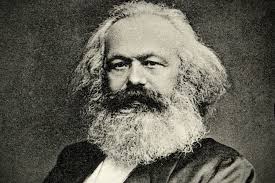
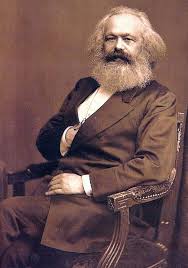
The Communist Manifesto Project

The Communist Manifesto was published in 1848. That’s a long time ago. And the communist revolutions of last century have ultimately failed. So what would a C21st version look like?

That’s the aim of an exciting new project that seeks to ‘save Marx from the Marxists’!

download

****

Here’s the preamble from the project’s draft document:

The Communist Manifesto Project, October 2015

Preamble

Marx and Engels published The Communist Manifesto in 1848 and “Marxists” have been disregarding its message ever since. It tells us how communism cannot emerge without capitalism first creating both the pre-conditions and the forces that will bring it to fulfillment. Capitalism is like the caterpillar to the communist butterfly. Communism is a consequence of capitalism and the next step in the progress of humanity

Present-day “Marxists” totally oppose this view. Their anti-capitalism is reactionary. They believe capitalism is destroying much of the past that should be preserved and is leading us down a path from which we must retreat. There are no prospects for their backward looking project and if there were it would be self-defeating because we would be simply reverting to conditions that history shows would eventually bring us back to where we are. In their day Marx and Engels had to contend with similar trends and, indeed, a section of The Communist Manifesto is devoted to them.

The message of The Communist Manifesto of course is also ignored by those for whom capitalism is the best of all possible worlds. It gets in the way of their “communism has failed” mantra which they base on abortive revolutions in backward essentially pre-capitalist regions during the 20th century. This experience in fact only confirms the message that communism can only successfully emerge from advanced capitalism.

****

Don’t let them into our country! (via Pussy Riot)

I am a facebook friend of Pussy Riot. They rock. In every way. What enormous courage to stand up to an ultra-rightwing thug like Putin. Anyway, someone wrote a piece on their facebook page about ‘open borders’. I liked the rhythm and have broken it down, restructured the text, to see if it works as a form of poetry. I reckon it does. The words and message are passionate and no-nonsense. And on the rigth side of history. That’s Pussy Riot!

****

541660_1620545048202091_1289560504930360455_n


“Don’t let them into our country!”

Why is it YOURS, though?
Some office handed you a piece of paper,
so you believe,
all innocently,
that it’s yours?
By birthright,
or bloodright, maybe?
Blood and soil?
Are you serious?
Isn’t it terrifying trying to justify yourself that way?

“Lucky me, too bad for you,”
you tell the Syrian girl
who crossed
five
national
borders
to end up in your country.

“Ha! You’re such a loser,
and I’m fucking awesome!”

That Syrian girl
crawled up
and over
a barbed-wire fence
on the Hungarian border.
She fell and broke her arm.
She got up,
but the Hungarian cops
grabbed her.
They sent her to court,
and under a new law
passed by Putin’s little buddy
Orban,
she could get up to three years in jail
for crossing the border.

“Tough luck,
but I’ve got blood and soil,”
you tell her.

Should people have the right
to choose where they’re going to live?
Some office tells you,
“Look at all those illegals swarming in!”
But can a person ever actually be
illegal?

(translated by Shelley Fairweather-Vega)

Care about refugees? Listen to them. Syrians are primarily fleeing Assad!

First survey (of Syrian refugees in Germany) shows Syrians are fleeing from Assad, not Isis. Nearly all want to go home. Republished from the diary.thesyriacampaign.org


11223757_969190529791016_4362445843417374564_o


Syrian refugees don’t want to stay in Europe. But unless politicians start listening to why they’re fleeing and what needs to happen for them to go home, many more will come.
 
 
Here are six key results from the first ever survey of Syrian refugees in Europe (full results below):
 
1. Most Syrians are fleeing from Assad, not Isis

Contrary to what you might read in the papers, it’s not the media-grabbing brutality of Isis that most people are fleeing from. It’s the much larger scale, state organised violence of the Assad regime that is driving most people from their homes.

70% are fleeing the violence of the Assad regime and its allies (32% Isis, 18% Free Syrian Army, 17% Al Nusra, 8% Kurdish forces).

2. Most fear arrest or kidnap by the Assad regime

All armed groups have been involved in detention and disappearances in Syria, but none to the extent of Bashar al-Assad’s government, as thousands of leaked images of torture in state prisons prove.

86% say kidnapping or arrest was a threat to their personal safety. 77% of them fear it from the Assad regime, 42% Isis, 18% Al Nusra, 13% Free Syrian Army and 8% Kurdish forces.

3. Nearly all Syrians want to go home

It might seem that the people struggling in boats across perilous waters or jumping over barbed wire fences really want to be in Europe. But they don’t. Syrians want to go home to the country they know and love. The problem is with the violence raging they can’t.

Only 8% said they’d want to stay in Europe indefinitely

4. Assad needs to go for Syrians to return home

While Russia and others are asking countries to unite with Assad to fight Isis, it’s important to note that the majority of Syrian refugees will not go back while he remains in power. Syria needs peace and an end to dictatorship.

52% said that Bashar al-Assad would need to leave power before they would return home

5. Stopping the barrel bombs would help more stay in Syria. Much more than increased aid
Stop the barrel bombs with a no-fly zone

The vast majority of refugees said they feared Assad’s barrel bombs – the improvised metal barrels packed with explosive and scrap metal that government helicopters drop from miles up in the sky onto civilian neighbourhoods.

These barrel bombs and other aerial attacks are the number one killer of civilians in Syria – the barrels alone have killed more than 2,000 children since the UN banned them in 2014. They routinely destroy hospitals, schools and homes. Syrians living under the barrel bombs find it difficult to forget the terror, even once they have fled to safety.

To stop the refugees pouring over Syria’s borders we have to stop the bombs. More aid isn’t the answer.

73% said barrel bombs were a threat to their personal safety. 58% said a no-fly zone would help more stay in Syria, only 24% said the same for increased aid.

6. The cause of today’s situation is Assad’s military response to peaceful demonstrations

So much has changed in the last four and a half years in Syria yet still an overwhelming majority of Syrian refugees hold Bashar al-Assad responsible for today’s events. According to most of those surveyed, Assad’s decision to use military force against peaceful protesters demanding freedom and dignity in 2011 is the cause of today’s violence.

79% said it was the Bashar al-Assad’s military response to the demonstrations that led most to the situation today.

What should Europe do?
To reduce the number of Syrian refugees to Europe and to help create the conditions for their return, European politicians should:

1. Enforce a stop to the bombs. There are various initiatives from no-fly zones, no-bombing zones and safe zones which while all different in their implementation, would prevent the biggest killer of civilians in Syria today: Bashar al-Assad’s aerial attacks and barrel bombs. Europe needs to get serious about stopping the bombs.

2. Push for a peaceful transition of power away from Assad. There is no military solution to the conflict and there is international agreement that a transition to a new government is the only way to end the violence. The longer that takes, the more people will be driven from their homes.

It goes without saying that Europe should open its borders to those fleeing war – that’s a human imperative.

European leaders need to realise that unless they do more to constrain the violence of the Assad regime and make more effort to stop the war, the waves of refugees will not stop. The UN has predicted another million will be displaced in Syria before Christmas, and that was before Russia joined in the fighting.

To solve the refugee crisis, we have to stop the Syria crisis.


This survey interviewed 889 Syrians living in Germany between 24 September 2015 and 2 October 2015 using a standardised questionnaire. Interviews were held in 12 centres housing arriving refugees, other refugee accommodation and refugee registration points in Berlin, Hanover, Bremen, Leipzig and Eisenhüttenstadt. Researchers from the Berlin Social Science Center were involved in the conception, implementation and evaluation of the survey. Full results are available here.

Russia back on the front line

Some “quick off the cuff notes” by Arthur Dent in response to The Australian’s Tom Switzer who wrote an article on 30 September titled ‘Russia back on the front line’. The notes were originally published at Strange Times. I’m running Arthur’s notes first, followed by Tom Switzer’s article.

****

1. Vivid demonstration that realists live in a parallel universe with a different “reality”. Switzer is actually quite clear that he wants to go back to the old US policy of backing the autocracies and tyrants against their people to maintain the region as a backward swamp (originally for cheap oil and anti-communism then contention with Soviet imperialism and “security” – especally Israeli security in occupying more and more territory and then sheer inertia and blind stupidity of an entire generation of the foreign policy establishment who had devoted their careers to it and persisted with it long after the collapse of the Soviet empire, the end of cheap oil and the failure of the war for Greater Israel having made Israel a strategic albatross hanging around the US neck rather than a US base in the region (the only regional power that could not join the coalition liberating Kuwait from Baathist Iraq and who had to be told their planes would be shot down if they pretended to be part of it by sending any into coalition airspace).

2. In Switzer’s alternate universe, the problem in the Ukraine is “.. the widespread Western failure to recognise an old truth of geopolitics: that a great power fights tooth and nail to protect vital security interests in its near abroad”.

In our universe there is no such Western failure. No Western government is even allowing the Ukrainian government to buy weapons to defend itself against the Russian bullying because they understand with total clarity that they have no power to confront Russian bullying behaviour in that part of the world. The facts Switzer recites about that from lessons about geopolitics drummed into him more than half a century ago are totally obvious to every policy maker and ignored only by the usual shouters.

3. In Switzer’s alternative universe “Putin fears that if Bashar al­Assad’s regime falls, Russia’s presence in western Syria and its strategic military bases on the Mediterranean will be gone.” and “Russia’s navy and advanced anti­aircraft missile systems are based along the Mediterranean. It’s likely to deploy ground troops to the eastern coast.”

In fact Russia’s navy in the Meditarranean is about the size of the US army in the Ukraine. If the Russians were imbeciles attempting what Switzer imagines they are going to do in Syria and Obama was indeed as inept and vacillating as he has successfully convinced pretty well everybody he has always been then the British, French and Turks would have both vital national interests in their near abroad and the capability to act that would compel them to stop the nonsense immediately without waiting a day longer for Obama to stop dithering.

By now Turkey would have closed the Dardanelles (not of course as a hostile act towards that deeply respected partner and Mediterranean Great Power, the Tsar of all the Russias, but simply because they were too busy dealing with the problem of two million refugees having been driven out of Syria by the Assad regime to remember to keep it open).

A few hours sailing time later, the British would have announced that their are command mines laid at Gibraltar that are currently turned on but will be turned off at the approach of any ship that is known not to be assisting anyone forcing millions of Syrians to flee Syria to Europe. Naturally this too would not be a hostile act against anybody but merely a precaution against the possible arrival of the Daesh navy, just as the Russian air to air and surface to air missiles at Latakia are to protect them from the Daesh air force. Naturally the ships of a Meditarranean Great Power like Russia would not be subject to compulsory inspection and the mines would be respecfully turned off as they went about their entirely legitmate business and if any ships of any nation were accidentally sunk by a mine that had failed to remain turned off then Her Majesty’s Government would of course pay full compensation as required by international law etc etc.

All available British and French forces would move as rapidly as possible to the British sovereign base in Cyprus not as a hostile act against anybody but merely as friendly observers of the joint naval exercises that had been announced nearby by the navies of the Russian and Austro-Hungarian empires. After those exercises were completed they would be happy to assist their partners the Russians in returning to Vladivostok via the Suez canal without any danger of becoming subject to inspection by any Arab Gulf states wanting to check whether they were helping any notorious Syrian war criminals to escape as Britain and France are rather in favour of any assistance their Russian partners might be willing to give to Syrian war criminals leaving Damascus right now and don’t really care where they end up as long as they don’t stay in Syria.

4. In Switzer’s alternate universe Putin “has sent tanks, warships, fighter jets and troops to bolster the regime, which has faced a troop shortage and loss of towns as it seeks to maintain Alawite rule over an overwhelming Sunni majority”. Pretty well everbody agrees with Switzer about that, perhaps because those who know better have no reason not to want everybody to think that at the moment.

For my part I’ll just end by saying that Switzer and others should remember what Kissinger said the word would go out about another Great Power:

“To be an enemy of America can be dangerous, but to be a friend is fatal”

****

Tom Switzer’s piece from The Australian (30 September 2015):

Since Russia’s incursion into Ukraine 18 months ago, the West has indulged in the rhetoric of moral indignation, punished Moscow with economic sanctions and treated Vladimir Putin as a pariah in world affairs. “Russia is isolated with its economy in tatters,” President
Barack Obama declared in January. “That’s how America leads — not with bluster but with persistent, steady resolve.”

Somebody forgot to tell the Russian President. Putin’s address to the UN General Assembly this week, following his lightning military deployment to Syria, marks Russia’s resurgence on the global stage. The Russians, far from being marginalised in international relations, are playing a weak hand rather skilfully and are being allowed to do so because of considerable ineptitude and vacillation on the part of the Obama administration.

The upshot is that Washington will have to take the Kremlin far more seriously in the future. This is not just because Putin’s support for the embattled Assad regime will help degrade and destroy Islamic State jihadists in a four ­year civil war that has claimed nearly 250,000 lives and displaced more than nine million people. Rather, Russia’s intervention in Syria shows how rational Moscow’s concerns over Western policy in the Middle East are, and that the Obama administration had better start treating it like the great power it still is.

After the fall of the Berlin Wall, Moscow voluntarily jettisoned the Warsaw Pact and acquiesced in the expansion of NATO and the EU on to the frontiers of the former Soviet Union. But the limits of Russia’s post ­Cold War retreat have been evident since the Western ­backed coup against a pro-Russian ally in Kiev in February last year. Putin has played hardball to protect what Russia has deemed as its sphere of influence in the Baltics long before Vladimir Lenin and Joseph Stalin appeared on the scene. And in the Middle East it is determined to protect what it perceives as its vital interests.

Putin fears that if Bashar al­Assad’s regime falls, Russia’s presence in western Syria and its strategic military bases on the Mediterranean will be gone. That is why he has sent tanks, warships, fighter jets and troops to bolster the regime, which has faced a troop shortage and loss of towns as it seeks to maintain Alawite rule over an overwhelming Sunni majority.

And by reaching an understanding with Syria as well as Iraq and Iran to share intelligence about Islamic State, Putin is positioning Russia again as a key player in the Middle East, and one that is
more willing than the West to defeat Sunni jihadists. In the process, he has exposed the shortcomings of the White House’s policy towards Syria.

Until recently, the prevailing wisdom held that the Assad regime — the nemesis of Sunni militants was on the verge of collapse, an outcome that Washington, London and Canberra had enthusiastically encouraged for much of the past four years. And although Malcolm Turnbull and Foreign Minister Julie Bishop now recognise that Assad must be part of any negotiated political
solution, the Obama administration continues to insist that any resolution of the conflict must lead to the exit of the dictator.

US Secretary of State John Kerry warns Russia’s continued support for Assad “risks exacerbating and extending the conflict” and will undermine “our shared goal of fighting extremism”. British Chancellor George Osborne goes so far as to say the West’s aim should to be to defeat both Assad and Islamic State. But given Washington’s futile attempts to destroy the Sunni jihadist network
during the past year, most seasoned observers of the Syrian crisis are entitled to think that such strategies are manifest madness.

The consequences of removing Assad would be dire. The regime would collapse and its Alawite army would crumble. Sunni jihadists such as Islamic State and al­Qa’ida’s Syrian affiliate Jabhat al­Nusra, also known as al­Nusra Front, would exploit the security vacuum and dominate all of Syria. The ethnic minorities — the Alawites, Shi’ites and Syrian Christians — would be massacred. And there would be the flight of millions more refugees into Lebanon, Jordan and Turkey.

If we are to avoid these horrific outcomes, Russia will have to play a central and positive role. It has had significant influence in Damascus during the past half century; indeed, many Syrian
military officers have received training in Moscow. Russia’s navy and advanced anti­aircraft missile systems are based along the Mediterranean. It’s likely to deploy ground troops to the eastern coast. And Moscow has recognised that notwithstanding Assad’s brutal conduct, his regime is fighting the jihadists that Western leaders repeatedly say pose a grave and present danger to the world.

Obama says the US would work with any nation to end the fighting in Syria. But to engage Russia, the West needs to change its policy approach substantially. Alas, the prevailing Russophobia in
Washington and Brussels remains a serious obstacle in the path of reaching accommodation with Moscow.

The problem in Ukraine is not related to a revival of the Soviet empire, as some hyperventilating politicians and pundits argue. The problem is the widespread Western failure to recognise an old
truth of geopolitics: that a great power fights tooth and nail to protect vital security interests in its near abroad. Take Ukraine: it is a conduit for Russian exports to Europe and covers a huge terrain
that the French and Germans crossed to attack Russia in the 19th and 20th centuries. Most Crimeans are glad to be part of the country they called home from Catherine’s rule to that of Nikita Khrushchev.

From Moscow’s standpoint, the expansion of NATO and the EU into Russia’s traditional sphere of influence, taken together with efforts to promote democracy, is akin to Moscow expanding military alliances into Central America. Some may respond by saying that Ukraine, however ethnically and politically divided it remains, has every right to join the West. But did communist Cuba have a right to seek political and military ties with the Soviet Union in 1962? Not from Washington’s perspective. Does Taiwan have a right to seek nationhood? Not from Beijing’s perspective.

This is a shame, but it is the way the world works, and always has. Not only does Putin know it, he calculates that a weak, inept and cautious Obama administration won’t push the issue despite the dire threats and warnings from congress and the Pentagon.

And so it was inevitable that the Russians would push back in the Baltics, first to secure the Crimean peninsula, the traditional home of the Russian Black Sea fleet (which Russian intelligence feared would become a NATO base), then to destabilise Ukraine with the aim of persuading Kiev’s anti ­Russian regime to protect the minority rights of ethnic Russians and maintain its status as a buffer state.

As for Syria, the problem here is not the Russians — or even Iran’s Shia crescent of Damascus, Baghdad, Hezbollah and the Yemeni rebels. After all, they’re committed to fighting Sunni jihadists. The problem is that US ­British aligned Sunni states — Turkey, Saudi Arabia and the Gulf Arabs — have aided and abetted the Sunni rebellion that has morphed into Sunni jihadism.

Yet these reactionary regimes still have the temerity to call for Assad’s ouster. Following regime change, we’re told, a US­ led coalition of Arabs and Turks can create a peaceful and prosperous Syria.

Leave aside the fact Assad’s support stems not just from Moscow and Tehran but also from Syria’s military, political and business elites, including many urban Sunnis. Assad is a brutal tyrant. He
has used chemical weapons against his own people. And he has launched relentless barrel bombs in rebel areas. But he is more popular than ever in the one ­third of Syria his regime still controls
(which happens to be the major cities and the coastland). That is largely because many know his demise would lead to widespread ethnic cleansing.

The idea that Assad’s fall would lead to something approaching a peaceful transition of power is as delusional as the neo­conservative views about Iraq and Libya in 2003 and 2011 respectively. The
downfall of Saddam Hussein and Muammar Gaddafi, it was onfidently asserted, would lead to viable democratic states. If anything, both post­Saddam Iraq and post­Gaddafi Libya are failed
states that have attracted terrorists like flies to a dying animal.

As in the case of Iraq, Syria is an artificial state and an ethnically divided society created out of the ruins of the Ottoman Empire. In both nations the invasion and civil war, respectively, have unleashed centrifugal forces that are eroding political structures and borders that have prevailed since the end of World War I.

In Iraq, the 2003 invasion ended the nation’s sectarian imbalance between the minority Sunni and majority Shia communities. Ever since, the Shia have been more interested in seeking revenge against their former Sunni tormentors than in building a nation. The result: a Sunni insurgency that has morphed into a plethora of jihadist groups, including Islamic State.

In Syria, the Arab Spring in 2011 encouraged the Sunni majority to challenge and destroy the minority Alawite regime. The result: centrifugal forces that threaten the viability of Syria as we have known it for nearly a century.

As unfashionable as it is to acknowledge, partition is the likely outcome of the civil war. According to Joshua Landis, a veteran Syria observer and director of the Centre for Middle East Studies at the University of Oklahoma, many Syrians, and Alawites in particular, privately acknowledge that the prospect of outright military victory against the Sunni militants is highly unlikely and that it would be impossible to coexist with Sunni fanatics.

For Syria, partition would most likely mean an Alawite Shia state in the regime’s western heartland and a Sunni state to the southeast. Notwithstanding statements to the contrary, this is the emerging reality on the ground.

As long as the regime endures, it at least prevents Sunni jihadists from consolidating their hold over the whole nation and creating a strategic sanctuary along Syria’s coasts.

The moral and political problems posed by Syria’s civil war during the past four years have been real and extremely difficult ones. Assad heads a brutal regime that, according to The Washington Post, has killed about seven times as many people as Islamic State in the first six months of this year.

But the cold, hard reality is that if the US and its allies are serious about defeating the Sunni jihadists, and not merely determined to feel virtuous and moralistic, we will need to tone down our
anti­Russian bombast, restore a dialogue with Putin and recognise the madness of regime change in Damascus. And if that means accommodating Putin’s power play in the Middle East, so be it.

Dialectics – what is it, what are examples of it?

KM


I learned from this philosophical discussion of dialectical materialism in 2004 when it was published at the lastsuperpower site, and thus reprint it now for readers’ consideration and comment.

****

Question “The only experience that I have with dialectics is a horrible essay that I had to write at university about Mozart and Beethoven. I’ve never really understood what dialectics means, except that it’s a great word to use when pretending to be intellectual over a cup of coffee. Most other people don’t really seem to understand the concept either, but would prefer not to admit it. I know this as I regularly drop it into conversations and no one has pulled me up on it yet.. see emperor’s new clothes post!”

Dialectics – What is it, what are examples of it?

by Keza 2004

I mentioned in The relation between materialism and idealism topic that materialist philosopher Daniel Dennett doesn’t mention the word dialectics – so in reading Dennett I’ve been looking out for what language he uses when describing concepts that are dialectical.

I’ve found one instance – he uses words like paradoxical to describe the problem and then in detailing his solution says things like, “this is not paradoxical at all”

An example is that Mother Nature / Evolution has no foresight and yet has managed to create humans who have foresight.

• Re: progress and dialectics

Posted by keza at 2004-12-28

The best laid plans of mice and men…. if practically everything that we do results in something not intended then why do we plan, why do we struggle, why do we try to move the world in a certain direction?

When Engels wrote that consciously willed actions often result in quite unintended consequences I think he was disputing the Hegelian idea that history is “the gradual realisation of ideas”. His point was that what happens in history comes about not as a direct result of abstract ideas, wishes, intentions (and so on) but is governed by ‘inner laws’ – ie what is possible (and therefore real and rational) in a given epoch. Movements don’t arise just because someone comes up with a good or bad) idea and manages to convince lots of people to follow them. Movements for change arise out of material conditions – the possibility for change is present and that opportunity is seized. The ideology in which the movement is clothed is (somewhat) secondary.

“The distinction should always be made between the material transformation of the economic conditions of production … and the legal, political, religious, aesthetic or philosophic — in short, ideological — forms in which men become conscious of this conflict and fight it out.”

Marx: Contribution to the Critique of Political Philosophy (1859)

An example is the idea of “equality” in the bourgeois democratic revolution. The idea that “all men are created equal” stood in direct opposition to the feudal belief that all men are most definitely not created equal. The growth of capitalism made it not only possible but also necessary for the idea that rulers are made rather than born to take hold. Thus on a conscious level the motivation for bourgeois revolution was belief in ‘liberty, equality and fraternity’ but at a more fundamental level, the revolution was driven by the necessity to liberate the productive forces from the constraints of feudalism. That reason (or motivation) was only dimly appreciated however.

Friedrich Engels wrote in 1893 that:

“Ideology is a process accomplished by the so-called thinker. Consciously, it is true, but with a false consciousness. The real motive forces impelling him remain unknown to him; otherwise it simply would not be an ideological process. Hence he imagines false or seeming motive forces.

I don’t think this means that bourgeois revolutionaries didn’t really believe in liberty, equality, fraternity – or that the battles they fought weren’t really for these things. We all know (except perhaps for the pseudo left) that as a result of the democratic revolution we have freedoms and rights that were hardly even dreamed of previously. However the ideas themselves weren’t the driving force – these ideas could only take hold because the material conditions were crying out for them (so to speak).

I think what bothers a lot of people is the feeling that perhaps this means that what they as individuals actually do doesn’t really matter – that somehow we are all carried along by a tide of “underlying forces” , that we are seized by ideas rather than seizing them ourselves etc etc. Engels refuted this when he said “freedom is the recognition of necessity” (Anti Duhring?) … once we come to understand “how things work” – “the rules of the game” then we do have a real chance of using our understanding to influence the course of history. Engels’ Letter to Franz Mehring in Berlin is interesting in this respect.”

He starts by pointing out that both he and Marx tended to neglect the role of ideas/ consciousness in bringing about change…

“Marx and I always failed to stress enough in our writings and in regard to which we are all equally guilty. That is to say, we all laid, and were bound to lay, the main emphasis, in the first place, on the derivation of political, juridical and other ideological notions, and of actions arising through the medium of these notions, from basic economic facts. But in so doing we neglected the formal side – the ways and means by which these notions, etc., come about – for the sake of the content. This has given our adversaries a welcome opportunity for misunderstandings and distortions…..”

and later:

“Hanging together with this is the fatuous notion of the ideologists that because we deny an independent historical development to the various ideological spheres which play a part in history we also deny them any effect upon history. The basis of this is the common undialectical conception of cause and effect as rigidly opposite poles, the total disregarding of interaction. These gentlemen often almost deliberately forget that once an historic element has been brought into the world by other, ultimately economic causes, it reacts, can react on its environment and even on the causes that have given rise to it.”

No time to write any more now!! I’ll finish with a quote I quite like though:

“Men make their own history, but they do not make it just as they please; they do not make it under circumstances chosen by themselves, but under circumstances directly encountered, given and transmitted from the past. The tradition of all dead generations weighs like an Alp on the brains of the living…. “
(Marx: The Eighteenth Brumaire of Louis Napolean)

end Keza

Posted by kerrb at 2004-12-19 01:54 AM

More about the usefulness of dialectics, being a bit more specific about it than in my previous reply to sally.

1) socialist / not socialist dialectic

A few years ago (maybe 20) I went to a debate where someone from the pro-Soviet so called communist party was arguing that the Soviet Union was still a socialist country. This person was so wrapped up in the details and scope of his argument that I could see that no single point could be made in question time that could possibly persuade him that he might be wrong. I wanted to support the case that the Soviet Union wasn’t socialist and so was racking my brains for a question that might get through, if not to the speaker, then at least to the audience.

What I thought of and asked the pro-Soviet speaker was: ” Are there any possible circumstances that might arise in the future which would persuade you that the Soviet Union was no longer socialist?”

To the amusement and bemusement of some of the audience, he replied, “No, the Soviet Union will always be socialist”

2) progressive / reactionary dialectic

I think a similar sort of point can be made to the pseudo-left in connection to the US invasion of Iraq.

In my view it’s pretty straightforward that the US has led a campaign to overthrow the fascist government of Saddam Hussein and is now proceeding to help Iraqis create a democratic government. That has to be progressive.

Because historically US Imperialism has been very reactionary, as exemplified by the Vietnam war and much more, there are now many people in the world who seem incapable of conceptualising that the US could possibly do something progressive. It’s always possible for these people to point to bad things that the US does – there is no shortage of examples.

Maybe part of the problem is that they have an ingrained black and white, non dialectic world view, which implicitly denies the very possibility that the US could do something progressive.

I’m not saying that thinking dialectically is a substitute for studying the details of processes in detail – including the details of what the Soviet Union became historically and the details of what is happening in Iraq and the Middle East. But that having the concept of dialectics (the coexistence of opposites in things) might help prevent falling into the rigid black and white thinking illustrated in the two examples above. If some people can’t even conceptualise that it might be possible for US Imperialism today to do something progressive then no amount of detail is going to change their mind about Iraq. Their thinking is dogmatically stuck at another level to do with their whole world view. I’m arguing that studying dialectics is useful because it helps us keep our minds open to these possibilities.

Here’s a paragraph from Dennett:

“One of the standard (and much needed) correctives issued to those who study evolution is the old line about how natural selection has no foresight at all. It is true, of course. Evolution is the blind watchmaker, and we must never forget it. But we shouldn’t ignore the fact that Mother Nature is well supplied with the wisdom of hindsight. Her motto might well be “If I’m so myopic, how come I’m so rich?” And while Mother Nature is herself lacking in foresight, she has managed to create things – us human beings, preeminently – who do have foresight, and are even beginning to put this foresight to use in guiding and abetting the very processes of natural selection on this planet. I occasionally encounter even quite sophisticated evolutionary theorists who find this paradoxical. How could a process with no foresight invent a process with foresight? One of the main goals of my book “Darwin’s Dangerous Idea” was to show that this is not paradoxical at all. The process of natural selection, slowly and without foresight, invents processes or phenomena that speed up the evolutionary process itself – cranes, not skyhooks in my fanciful terminology – until the souped up evolutionary process finally reaches the point where explorations within the lifetime of individual organisms can affect the underlying slow process of genetic evolution, and even, in some circumstances, usurp it.”
– Freedom Evolves, page 53

So, this illustrates that one can think dialectically without formally studying dialectics or even using the word dialectic. Dennett’s ability to do this would presumedly arise out of his deep study of the science of evolution combined with his materialistic philosophy.

In dialectical language no foresight and foresight would constitute a unity of opposites and in the process of development one can transform into the other. I think this way of looking at it is preferable to Dennet’s apparent paradox that turns out not to be a paradox.

But it’s probably more important to really study the topic deeply (in this case, evolution) than just to be able to spout the magic words. But I also believe that it’s important to study dialectics itself (Mao, Hegel etc.) because this creates an awareness or sensitivity to possibilities of things turning into their opposite that we otherwise might not even notice – it has the potential to make our thinking more fluid and flexible.

end post

Posted by kerrb at 2004-12-19

Dialectics is the co-existence of opposites in everything, nature, mind, society. I’ll explain by reference to something said in The Emperor’s New Clothes thread:

Think of all the people scared to speak in public, or scared to admit how they feel about something, or someone! I know for a fact that my private side is very different from my public face. So in my opinion this is a ‘problem’ that stretches right across the board, it’s not just in intellectual circles. People in general are afraid to speak their minds! Me too, so afraid that I don’t want to post this, but I will anyway.

What you are saying here is full of dialectics IMO. You talk about fear of speaking out and feeling compelled to speak out coexisting in your mind. Both of these opposites co-exist side by side. In some circumstances the fear might be stronger and you don’t speak. In other circumstances the compulsion to speak out might be stronger.

I think it’s fair to say that these opposite tendencies exist in everybody and so we are talking about something that is universal.

So, by contrast, what would be a non dialectical way of looking at this? We might view some people as always speaking out, the sort of people we wish would shut up sometimes. We might view other people as never speaking out, the sort of people that we don’t know what they are thinking. We might form black and white opinions about people with these extreme tendencies and as a result lose our curiosity, for example, not notice that a normally garrulous person has gone quiet in certain circumstances.

But of course there are no people like either of these two extremes. Although some people speak too much and others hardly at all these are just tendencies across the spectrum of possibilities. In reality, the two opposite tendencies coexist within everyone.

I’ve just taken one example of dialectics here from something you wrote in order to explain the idea. But whatever you are thinking about or studying I would argue that you can always conceptualise opposites that coexist within that thing. At the least I think it’s a very handy way to think about things because it can open up new ways of looking at something.

You don’t know the half of it: temperature adjustments and the Australian Bureau of Meteorology

Recently on an ABC current affairs program, favourable passing reference was made to how the Coalition’s Environment Minister, Greg Hunt, had thwarted an independent inquiry into the Australian Bureau of Meteorology’s methodology in homogenzing and assessing it historical temperature data. The term ‘conspiratorial’ was used to describe those who questioned the methodology. My ears pricked up as I had read articles by Dr Jennifer Marohasy, a biologist and former research fellow in the Centre for Plant and Water Science at Central Queensland University, and it seemed very unfair to dismiss her argument, based on evidence, as ‘conspiratorial’ (not that they named her).

Dr Marohasy is a Senior Fellow with the IPA, the Institute of Public Affairs, a right-wing think-tank. This fact does not strike me as a reason not to consider her arguments, and the evidence on which it is based, though sadly most of my friends who self-identify as left-wing certainly do so. It is a good way to avoid having to think, and is the opposite of the fine example set by Marx and Engels, who drew on the widest sources of information and argument – and relished doing so.

Comments are welcome on Dr Marohasy’s point of view which has been summarised as an article for On-Line Opinion , below.

* * * *

For the true believer, it is too awful to even consider that the Australian Bureau of Meteorology could be exaggerating global warming by adjusting figures. This doesn’t mean though, that it’s not true. In fact, under Prime Minister Tony Abbott, a panel of eminent statisticians was formed to investigate these claims detailed in The Australian newspaper in August and September 2014. The panel did acknowledge in its first report that the Bureau homogenized the temperature data: that it adjusted figures. The same report also concluded that it was unclear whether these adjustments resulted in an overall increase or decrease in the warming trend. No conclusions could be drawn because the panel did not work through a single example of homogenization, not even for Rutherglen. Rutherglen is of course in north eastern Victoria, an agricultural research station with a continuous minimum temperature record unaffected by equipment changes or documented site-moves, but where the Bureau nevertheless adjusted the temperatures. This had the effect of turning a temperature time series without a statistically significant trend, into global warming of almost 2 degrees per Century.

According to media reports last week, a thorough investigation of the Bureau’s methodology was prevented because of intervention by Environment Minister Greg Hunt. He apparently argued in Cabinet that the credibility of the institution was paramount. That it is important the public have trust in the Bureau’s data and forecasts, so the public know to heed warning of bushfires and cyclones.

This is the type of plea repeatedly made by the Catholic Church hierarchy to prevent the truth about paedophilia, lest the congregation lose faith in the church.

Contrast this approach with that by poet and playwright Henrik Ibsen who went so far as to suggest ‘the minority is always right’ in an attempt to have his audience examine the realities of 19th Century morality. Specifically, Ibsen wanted us to consider that sometimes the individual who stands alone is making a valid point which is difficult to accept because every culture has its received wisdoms: those beliefs that cannot be questioned, until they are proven in time to have been wrong. British biologist, and contemporary of Charles Darwin, Thomas Huxley was trying to make a similar point when he wrote, “I am too much of a skeptic to deny the possibility of anything.”

Mr Hunt defends the Bureau because they have a critical role to play in providing the Australian community with reliable weather forecasts. This is indeed one of their core responsibilities. They would, however, be better able to perform this function, if they used proper techniques for quality control of temperature data, and the best available techniques for forecasting rainfall. Of concern, there has been no improvement in their seasonal rainfall forecasts for two decades because they use general circulation models. These are primarily tools for demonstrating global warming, with dubious, if any skill, at actually forecasting weather or climate.

Consider for example, the Millennium drought and the flooding rains that followed in 2010. Back in 2007, and 2008, David Jones, then and still the Manager of Climate Monitoring and Prediction at the Bureau of Meteorology, wrote that climate change was so rampant in Australia, “We don’t need meteorological data to see it“, and that the drought, caused by climate change, was a sign of the “hot and dry future” that we all collectively faced. Then the drought broke, as usual in Australia, with flooding rains. But the Bureau was incapable of forecasting an exceptionally wet summer, because such an event was contrary to how senior management at the Bureau perceived our climate future. So, despite warning signs evident in sea surface temperature patterns across the Pacific through 2010, Brisbane’s Wivenhoe dam, a dam originally built for flood mitigation, was allowed to fill through the spring of 2010, and kept full in advance of the torrential rains in January 2011. The resulting catastrophic flooding of Brisbane is now recognized as a “dam release flood”, and the subject of a class action lawsuit by Brisbane residents against the Queensland government.

Indeed, despite an increasing investment in super computers, there is ample evidence that ideology is trumping rational decision making at the Bureau on key issues that really matter, like the prediction of drought and flood cycles. Because a majority of journalists and politicians desperately want to believe that the Bureau knows best, they turn away from the truth, and ignore the facts.

News Ltd journalist Anthony Sharwood got it completely wrong in his weekend article defending the Bureau’s homogenization of the temperature record. I tried to explain to him on the phone last Thursday, how the Bureau don’t actually do what they say when they homogenize temperature time series for places like Rutherglen. Mr Sharwood kept coming back to the issue of ‘motivations’. He kept asking me why on earth the Bureau would want to mislead the Australian public. I should have kept with the methodology, but I suggested he read what David Jones had to say in the Climategate emails. Instead of considering the content of the emails that I mentioned, however, Sharwood wrote in his article that, “Climategate was blown out of proportion”, and “independent investigations cleared the researchers of any form of wrongdoing”.

Nevertheless, the content of the Climategate emails includes quite a lot about homogenization, and the scientists’ motivations. For example, there is an email thread in which Phil Jones (University of East Anglia) and Tom Wigley (University of Adelaide) discuss the need to get rid of a blip in global temperatures around 1940-1944. Specifically Wigley suggested they reduce ocean temperatures by an arbitrary 0.15 degree Celsius. These are exactly the types of arbitrary adjustments made throughout the historical temperature record for Australia: adjustments made independently of any of the purported acceptable reasons for making adjustments, including site moves, and equipment changes.

Sharwood incorrectly wrote in his article that: “Most weather stations have moved to cooler areas (i.e. areas away from the urban heat island effect). So if scientists are trying to make the data reflect warmer temperatures, they’re even dumber than the sceptics think.” In fact, many (not most) weather stations have moved from post offices to airports, which have hotter, not cooler, day time temperatures. Furthermore, the urban heat island creeps into the official temperature record for Australia, not because of site moves, but because the temperature record at places like Cape Otway lighthouse is adjusted to make it similar to the record in built-up areas like Melbourne, which are clearly affected by the urban heat island.

I know this sounds absurd. It is absurd, and it is also true. Indeed, a core problem with the methodology that the Bureau uses is its reliance on “comparative sites” to make adjustments to data at other places. I detail the Cape Otway lighthouse example in a recent paper published in the journal Atmospheric Research, volume 166, page 145.

It is so obvious that there is an urgent need for a proper, thorough and independent review of operations at the Bureau. But it would appear our politicians and many mainstream media are set against the idea. Evidently they are too conventional in their thinking to consider that such an important Australian institution could now be ruled by ideology.

Syria: the facts and figures – the Syria Campaign

As Europe struggles to deal with a surge in refugees, attention is now shifting to Syria where most people are coming from. But what is the violence they’re fleeing?

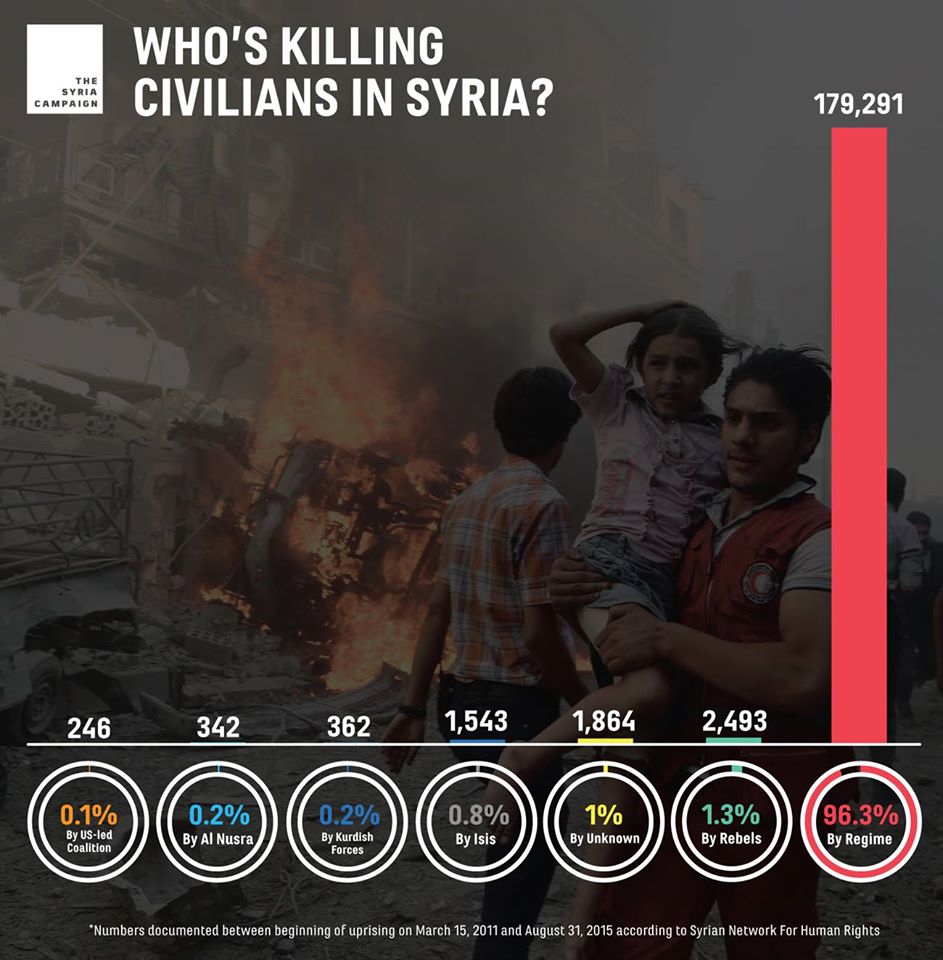
Many assume that Isis is doing most of the killing, which is partly why so many countries are now talking about bombing Isis in Syria. But the truth is different – and shocking. The vast majority of Syrian civilians killed – more than 95% according to human rights groups – have been killed by the regime of Bashar al-Assad.

Have a look at the data from the Syrian Network for Human Rights [1]:

12017617_910929855665695_3506046935164010625_o

Lots of people respond with astonishment when they see these figures, mostly because they don’t fit with their existing picture of the conflict. Some even say the numbers are lying. They’re not. While no monitoring group claims to have perfect data since their methodology and sources all differ, there appears to be agreement about the proportion of civilians killed by the Assad regime. [2]

So why do so many of us have such a bad understanding of where the violence is coming from?

Part of the answer may lie in how we hear about the conflict in Syria. The media talks about it increasingly as a “civil war”, a phrase that conjures up images of messy chaos, of various similarly-matched sides fighting each other. Likewise, the United Nations and well-meaning NGOs diligently criticise “all parties to the conflict” which promotes a perception of equal sides – or some sort of balance.

But there’s something else too. Part of the answer may lie in the disproportionate obsession with Isis. Our news is full of stories of Isis horror and brutality, but the larger scale state repression of the Bashar al-Assad regime seems to slip by mostly unreported.

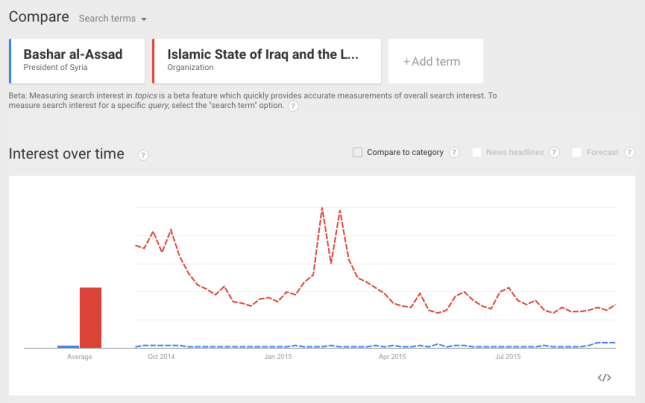
Have a look at Google Trends for news over the past year:google_trend_assad_2

Google Trends: Assad vs Isis

There was 43 times more interest in Isis than there was in Bashar al-Assad. And that’s taking in global internet users.

When we filter by United States only, we get an error message:

“Bashar al-Assad wasn’t searched for often enough to appear on the chart. Try selecting a longer time period.”

Same goes for the UK, France and Germany.

Astonishing. Together we have collectively airbrushed the biggest perpetrator of human rights violations out of the the Syrian conflict – Bashar al-Assad.

Why has the world chosen to ignore Assad’s crimes? Is it because he claims to be a secular leader? Is it because he is clean shaven and wears a suit? Is it because we don’t realise that by ignoring these crimes by the regime, we are becoming recruiting cheerleaders for Isis? [3]

Whatever the reason, the obsession with Isis over Assad bears no relation to their respective levels of violence.

The implications of this skewed focus are serious.

Right now the UK government is debating intervening in Syria to strike Isis. [4] Australia has just started anti-Isis strikes too. [5] France is about to join.[6] Russia has moved a heavy deployment of fighter jets and tanks into Syria to fight alongside Assad. [7] Russia has just days ago agreed to coordinate with Israel on its Syria operations. [8]

And yet nobody, nobody, is doing anything to curtail the biggest killer in Syria by far – the Assad regime and its air war on civilians.

As the United Nations envoy to Syria, Staffan de Mistura said, it is “totally unacceptable that the Syrian airforce attacks its own territory in an indiscriminate way, killing its own citizens. The use of barrel bombs must stop. All evidence shows that the overwhelming majority of the civilian victims in the Syrian conflict have been caused by the use of such indiscriminate aerial weapons.” [9]

All efforts at stopping the violence in Syria will fail unless we understand where it is coming from. The story of the data is unarguable – if we want to stop the killing of civilians in Syria we have to address the Assad regime.

What can you do?

Arm those around you with the facts. Share this with your friends and family.

We have used data from the Syrian Network of Human Rights to put together more infographics, on children, medical workers and media activists. You can view and share them here:

https://diary.thesyriacampaign.org/whats-happening-to-civilians-in-syria/

It’s crucial that we get the story right.

James Sadri – The Syria Campaign

[1] http://sn4hr.org/

[2] Nine months ago, data from a separate human rights organisation, the Violations Documentation Center, revealed an almost identical proportion of civilian killing by the regime – 95%.

[3] http://soufangroup.com/tsg-intelbrief-assads-atrocities-continue/

[4] http://www.ft.com/cms/s/0/84184f06-5e05-11e5-a28b-50226830d644.html

[5] http://www.rt.com/news/315150-australia-raaf-syria-mission

[6] http://www.dailymail.co.uk/news/article-3225008/France-prepares-airstrikes-against-ISIS-begins-reconnaissance-missions-terror-targets-Syria.html

[7] http://time.com/4043955/russia-syria-latakia-28-aircraft-assad-isis/

[8] http://www.aljazeera.com/news/2015/09/russia-coordinate-syria-military-actions-israel-150922045752894.html

[9] http://www.un.org/apps/news/story.asp?NewsID=51011#.VfAUos6x47w

——————————————————————————–

The Syria Campaign is building an open, global movement working for a peaceful future for Syria. We are people from all over the world who are coming together to tackle what the UN has described as “the greatest humanitarian tragedy of our time”.

‘Fairness and Accuracy in Reporting’ serves up more lies on Syria

Reblogged with permission of Bill Weinberg and his World War 4 Report.


syria banner

“Leftist” (sic) shilling for fascist dictator Bashar Assad reaches new levels of deception in an entry from one Adam Johnson of Fairness and Accuracy in Reporting (FAIR), perversely entitled “Down the Memory Hole: NYT Erases CIA’s Efforts to Overthrow Syria’s Government.” The chutzpah of invoking Orwell in his title is downright Orwellian, as his distortions reveal the very name “Fairness and Accuracy in Reporting” to be pure doublethink. Wedded to the persistent pseudo-left hallucination of a US campaign to destabilize Assad, Johnson gripes: “This past week, two pieces—one in the New York Times detailing the ‘finger pointing’ over Obama’s ‘failed’ Syria policy, and a Vox ‘explainer’ of the Syrian civil war—…didn’t just omit the fact that the CIA has been arming, training and funding rebels since 2012, they heavily implied they had never done so.” So what is Johnson’s evidence that the CIA has been doing this? In defense of his claim, he links to articles in (funny) the New York Times, The Guardian,Der Spiegel and the Washington Post. But if you bother actually click on the links (perish the thought), you’ll find that none of them quite back up Johnson’s assertions…

The Times story, from March 24, 2013, says nothing about the US “training” or “funding” the rebels—only a “secret airlift of arms and equipment.” If this support was ever “secret,” it wasn’t for very long. The very next month, John Kerry was openly boasting of US support for the Syrian rebels at an Istanbul meeting—although it is questionable how much of the promised aid actually reached the rebels. And by the end of 2013, Kerry had announced a cut-off of “non-lethal” aid to the FSA. National Security Advisor Susan Rice later stated that “lethal aid” had continued—but emphasized that it was in the interests of “counterterrorism”; that is, fighting ISIS, not Assad. (Haaretz, June 7, 2014)

The Guardian story (March 8, 2013) says nothing about the CIA, only “Western” training of Syrian rebels in Jordan. Actually read the story (persih the thought) and it turns out to be the British and the French, and the whole thing is based on anonymous sources. The only indirect reference to the CIA is the following line: “A Jordanian source familiar with the training operations said: ‘It’s the Americans, Brits and French with some of the Syrian generals who defected. But we’re not talking about a huge operation.'”

The story from Der Spiegel (the actual link is to a March 10, 2013 Reuters story citing Der Spiegel) is essentially a recapitulation of The Guardian’s claims, and concludes: “The reports could not be independently verified.”

The Washington Post story (June 12, 2015) actually reports that Congress was moving to cutCIA aid to the rebels. Again citing unnamed or fuzzy sources, the account claims the CIA has spent around $1 billion over the past “several years” to arm and train Syrian rebels—but emphasizes again that the primary enemy is ISIS, not Assad.

So of Johnson’s four sources, it is only the last that vaguely backs up his claim. And he leaves out two salient facts: that the aid is primarily directed against the jihadists who Assad is also fighting, not Assad; and that it is coming to an end.

Johnson does mention the far less ambitious but better publicized Pentagon program to train Syrian rebels, admitting it has been an “abysmal failure.” He doesn’t mention (as we have) that the fighters trained under this program amount to a whopping 54—of whom only 37 were still actually in combat last time we checked back in August. Nor does he mention (as we have) that rebels have refused to participate in the training program because of the Pentagon’s insistence that they do not use their training to fight Assad—only ISIS.

After this subterfuge, Johnson goes on to gripe that the Sept. 13 New York Times story fails to mention the CIA training program. Distortions, eh? Cast the beam from thine own eye, Adam.

He closes with the usual sickening bogus neutrality:

As the military build-up and posturing in Syria between Russia and the United States escalates, policy makers and influencers on this side of the Atlantic are urgently trying to portray the West’s involvement in Syria as either nonexistent or marked by good-faith incompetence. By whitewashing the West’s clandestine involvement in Syria, the media not only portrays [sic] Russia as the sole contributor to hostilities, it absolves Europe and the United States of their own guilt in helping create a refugee crisis and fuel a civil war that has devastated so many for so long.

Oh really, Johnson? How many of the refugees are fleeing the FSA, as opposed to Assad’srelentless aerial bombadment and ISIS sectarian cleansing? A case can be made that it is the West’s failure to meaningfully support the rebels—without condescending conditions that they don’t fight Assad—that has led to the disaster in Syria. The notion that “the West” is to blame for the refugees is literally echoing Assad’s propaganda. See CNN Sept. 16 (“Syria’s Bashar al-Assad: West is to blame for refugee crisis”).

In fact, even ISIS is a distant second to Assad as the aggressor the refugees are fleeing. An account based on refugee interviews on the German website Qantara quotes one refugee in its headline: “Stop Assad’s bombs, then we’ll go back.” A salient passage:

Indeed, the key reason for displacement in Syria is not IS, but Assad. The regime’s air force is killing at least seven times as many people as IS. This “terror from the air”, as it is referred to by civil groups, is destroying all those areas controlled by rebels—both moderate and Islamist. The aid organisation Doctors Without Borders reported that in August “heavy bombardments were carried out on 20 consecutive days in besieged Eastern Ghouta” where it is supporting 12 provisional underground clinics… One in every four victims—whether dead or injured—was a child under the age of five.

But you would get no sense of that from the ironically named Fairness & Accuracy in Reporting. This is the same FAIR, recall, that was eager to jump on utterly dubious claimsthat the rebels and not the Assad regime were behind the Ghouta chemical attack. Now it is plugging the utterly fictional notion of a “CIA Effort to Overthrow Syria’s Government.” Bunk. On the contrary, the US is tilting to Assad, viewing ISIS as the greater and common enemy. This is a betrayal of the Syrian revolution, which is ultimately even counter-productive to the aim of fighting ISIS. Telling the secular and pro-democratic forces they must accept rule under one tyrant is hardly conducive to a strong resistance against a rival gang of fascists.

Why does the increasingly reactionary FAIR continue to have any legitimacy whatsoever?

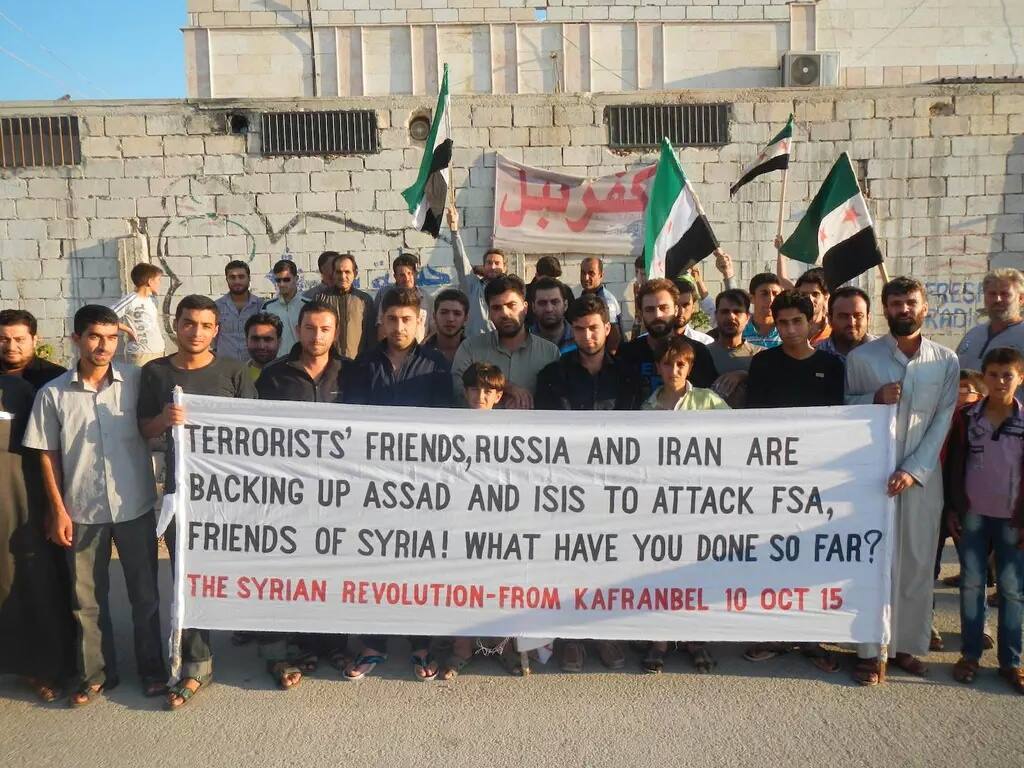
Letter from a Syrian refugee – Stop Assad’s bombs and “I would be the first to go home”

The Assad regime is still in power, killing seven times more civilians than Isis. World leaders have to act to stop the bombs from the sky. We can survive sniper fire, chemicals but the barrel bombs are unbearable. A no-fly zone or creation of safe zones would save lives instantly. And I would be the first person on the way home.

– Abo Adnan, Syrian refugee in a German refugee camp

****

Dear Friends,

I’m writing this to you from a refugee camp in Germany. All the Syrians here are so grateful for the welcome people have given us but we want to live in Syria, not Germany.

I was 22 when the fighting started in 2011. I was living in a neighbourhood called Ghouta, a short drive from Damascus. A year after the uprising the regime of Bashar al-Assad placed Ghouta under siege – this means nothing comes in or out – no food, no medicine, nothing. A year after that the regime attacked us with chemical weapons and more than a thousand were gassed to death. For years they have also dropped barrel bombs and missiles on us from regime aircraft. Normally we got struck eight times a day. How could we continue to survive that hell on earth?

I had to cross twenty checkpoints on fake documents to make it out of Syria. Each time your heart stops as you know that there is a chance you will be arrested and taken away. I made it out and survived a death boat. I have survived so many ways a human being can be killed.

At home I was a medical student. We had so many attacks I assisted more surgeries than most surgeons do by the time they retire. My dream is to only have to perform ‘normal surgeries’, what I trained for, not picking shrapnel from bombs out of children’s limbs.

We cannot go back while the war continues which is why we are asking for you to do everything you can to stop the war. All your governments agree there needs to be a political transition in Syria but no amount of words have made it happen. The Assad regime is still in power, killing seven times more civilians than Isis.

World leaders have to act to stop the bombs from the sky. We can survive sniper fire, chemicals but the barrel bombs are unbearable. A no-fly zone or creation of safe zones would save lives instantly. And I would be the first person on the way home.

Right now everybody in Europe is talking about us refugees. But not many are listening to us. Please sign this petition to Europe’s leaders asking them to do more to stop the bombs and help us return home:

https://act.thesyriacampaign.org/sign/we-want-to-go-home

Thank you,

Abo Adnan