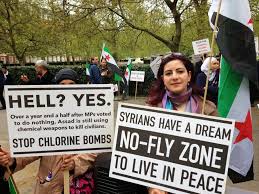
Syrian activists call for no-fly zone (shared from alaraby)

The regime of Syrian President Bashar al-Assad is the root cause of the conflict in Syria and, by extension, the refugee crisis that is now hitting Europe, as Syrians flee their homeland in their millions.

NFZone


Abubakr al-Shamahi (Date of publication: 8 September, 2015) Originally published at alaraby

Planet Syria, a network of more than 100 civil society groups working across Syria, briefed MPs and journalists at the Houses of Parliament in London before a parliamentary foreign affairs select committee meeting on Syria.

The panel assembled by Planet Syria argued that the regime of Syrian President Bashar al-Assad was the root cause of the conflict in Syria, and, by extension, the refugee crisis that is now hitting Europe, as Syrians flee their homeland in their millions.

“We asked activists how the world can help… People on the ground are specifically asked for a no-fly zone,” Mustafa Haid, a spokesperson for Planet Syria and the chairperson of Syrian nonprofit Dawlaty, told al-Araby al-Jadeed.

“We came to deliver their message, people under the barrel bombs are asking for this,” Haid added.

The imposition of a no-fly zone would almost certainly involve a barrage of bombing raids against Assad’s many airbases, refuelling infrastructure, storage hangars and other facilities spread around the country. Such operations are rarely casualty-free.

Haid, as well as his fellow spokesperson Assaad al-Achi, an economist before he became an activist, relayed their own experiences in Syria.

They also highlighted the damage caused by barrel bombs, which were described by Human Rights Watch in August as a greater threat to Syrian lives than the Islamic State group that has ravaged parts of Syria and Iraq.

“Syrians have described to me the sheer terror of waiting the 30 seconds or so for the barrel bomb to tumble to earth from a helicopter hovering overhead, not knowing until near the very end where its deadly point of impact will be,” HRW executive director Kenneth Roth said.

The British parliament rejected a move by Prime Minister David Cameron for military action against Assad in 2013, a vote that eventually weakened US President Barack Obama’s resolve to attack the Syrian regime, following a chemical weapons attack that killed hundreds of civilians in Damascus.

Activists, however, argue that prior inaction by the international community and the non-implementation of various UN resolutions against Assad have led to the current catastrophic situation, and that a no-fly zone would not involve Western troops fighting on the ground.

– See more at: http://www.alaraby.co.uk/english/news/2015/9/8/syrian-activists-call-for-no-fly-zone#sthash.POpMrnra.J1t6yflL.dpuf

Junk the international refugee system, and open the borders (reblogged from Open Borders: the Case)

Nothing about the modern refugee system makes sense. The way I see it, we have two choices. Either we can accept that, as much as we wish otherwise, we are little better than the governments of World War II who chose to let people fleeing violence die and suffer, in the name of “national defence” and “sovereign borders”. Or we can accept that every human being has the right to pursue a better life, as long as they are willing to pay the price to get there — the price of their ticket, and the price of lodging.

****

Refugee and asylum are hot topics these days, with conflict across the world and criminal violence often forcing people to set off for distant lands in search of a better life. It seems to me that most people arguing this issue operate under two misapprehensions regarding how refugee law works:

  1. They believe that refugees don’t have very particular or special rights to migrate under the law — refugees crossing a border without submitting to inspection is unlawful, and countries don’t have special obligations to accept refugees who set foot on their territory.
  2. They believe that international and domestic law adequately protects the rights of refugees, and that most of the problems to do with refugee and asylum-seeker rights originate from governments failing to adhere to their legal obligations, rather than any fundamental failing of refugee law.

Remarkably, I’ve encountered people who hold both views. Usually adherents of #1 are people who don’t know much about refugee law, and/or anti-immigration restrictionists, while adherents of #2 are generally mainstream left liberals. But there are certainly some people who appear to hold both sets of beliefs (possibly because they completely misunderstand both how refugee law works and the actual situation refugees face).

It’s actually pretty easy to debunk belief #1 — international law, and the domestic law of most developed countries (the US included) gives anyone fleeing persecution or torture the right to seek and obtain asylum outside their home country, becoming a refugee. You need to do nothing special to enter another country. If you have a legitimate refugee claim, crossing the border without initially obtaining any papers or passing any government inspection is completely legal. (If you think this doesn’t make sense, then consider that it wouldn’t make sense to prevent people from fleeing the Holocaust because their papers at the time weren’t in order.)

After you’ve left your home country and entered the country you’d like to seek asylum in, you must begin the formal process of obtaining refugee status — i.e., you have to start filling out forms and making your case for asylum. In most cases, this means a judge or other government official has to formally rule that you are a legitimate refugee. If they do, then you’re typically scot free and become a legal immigrant under the country’s immigration laws. If the judge rules you’re not a legitimate refugee — maybe the violence you fled wasn’t the right kind of violence — then you’ll be sent home.

Sometimes, you might not want to resettle permanently in the country you initially flee to. In some cases, governments, charities, and/or international bodies will help you migrate elsewhere under a formal refugee resettlement programme. This is usually centrally managed or planned by some large government or intergovernment bureaucracy.

Most countries are reluctant to help refugees resettle; the United Kingdom for example has said it will only resettle 500 refugees from Syria — a country beset by a civil war which has displaced millions of innocents. (“Displaced” of course is an euphemism for “forced millions to leave their home under the threat of murder, rape, or torture”.) As a result, the queues for resettlement are long and few refugees have any serious prospect for being resettled elsewhere — which is why most Syrian refugees are trapped in Jordan, Turkey, and Lebanon.

What I’ve just described is not fanciful or imagined — it’s the international refugee system as codified in international law and the domestic law of many countries. The “illegals” who show up in your waters on rickety boats or cross the desert straddling your border are, in many cases, people with legitimate asylum claims — which makes what they’re doing completely legal. They are no more wrong than a Jew fleeing the Holocaust would have been in trying to get to your country.

Now, it seems funky that I think the belief #2 I described is wrong. This system of refugee management has its flaws like any human creation, but it certainly sounds like it would, if implemented properly and in good faith, enable refugees to migrate away from persecution and violence. The line it draws between refugees and those seeking to migrate for other reasons is perhaps arbitrary, but not unreasonable on the face of it — if we had to pick and choose only one type of migrant for some reason, most of us would probably agree we ought to welcome the person fleeing murder.

But in the real world, it turns out that figuring out which side of this arbitrary line one is on can be difficult. It’s actually unclear, for example, whether child migrants to the US fleeing gang violence in El Salvador (“fleeing gang violence” here being an euphemism for “running away from people who’ve threatened to rape and then kill them”) actually legally qualify for refugee status. Even if they don’t, they arguably qualify for other protective status of some kind offered by US immigration law, but this is hardly a well-settled legal issue.

Some refugee advocates think the US government should offer special parole to these Latin American migrants, since they don’t fit any typical legal category of refugee. Others, like the UN and even the president of Honduras, argue that although they might not meet the technical definition of refugee, these people certainly fit the spirit and intention of refugee law, and should be classified as such.

Putting aside the thorny issue of child asylum-seekers for the moment, let’s reflect on the ludicrousness of the fact that most countries will not permit anyone claiming refugee status to actually legally travel there. If you enter irregularly, you can fully assert your legal right to stay — but it is illegal for you to travel in order to assert this legal right of asylum!

Say you want to fly from Guatemala to the US, or from Syria to the US, you need a visa. If you can’t prove you have the legal right to travel to the US, no airline or shipping company will issue you a ticket. Since almost all refugees can’t prove they have this right — thanks to the legal system requiring you to be present on the country’s territory to assert your asylum claim — almost all refugees and asylum-seekers are compelled to enter via irregular means, and seek out the aid of smugglers.

The refugees or migrants undertaking an arduous and dangerous journey from Somalia to Italy or Guatemala to the US do so not because they are criminals who have to resort to illegal means by virtue of their own evil — they do so because there is no legal way for them to travel to the US. Some refugees and asylum-seekers resort to other types of crime to travel in search of safety — I have heard stories of Tamil refugees from Sri Lanka flying to Western countries by faking fraudulent tourist or immigrant visas in their passports. After boarding their flight using this false documentation, they destroy the fraudulent documents, and claim asylum upon landing. This sort of fraud or human smuggling is just the perfectly-foreseeable and indefensible outcome of a legal system which criminalises the ordinary travel of people who already have the legal right to migrate.

Worse still, any good faith implementation of this legal system still must grapple with the problem of differentiating legitimate refugees from mere “economic migrants” or people seeking to reunite with family. Since international refugee law is silent about the rights of non-refugee migrants, even countries following this legal system in good faith feel free to persecute economic migrants. So if, say, the US government takes measures to deter Latin Americans from coming, this will inevitably discourage not just economic migrants. This will also discourage those who already have the legal right to migrate from exercising those legal rights accorded to them under US and international law. And there’s nothing wrong with this under refugee law, because state violence and coercion of economic migrants is perfectly fine.

To put the implications here in more concrete terms, ostensibly civilised developed countries really do try hard to intercept migrants — almost indiscriminately — before they reach their soil. If you can keep a potential asylum-seeker from touching land, then you can prevent them from ever asserting an asylum claim in the first place — even if they would be completely entitled to do so under your country’s laws. The international refugee system creates a perverse incentive to try very hard to keep refugees from coming, by offering this as a legal channel to stop them. And while states can certainly go overboard in taking harsh measures here, virtually all of them can find some ostensibly good-faith justification for doing so. After all, they aren’t intercepting these migrants for the sake of punishing refugees — they just want to stop economic migration!

This is exactly why Australia tries very hard, for example, to intercept migrants before they reach its waters, and to “process” any asylum claims offshore in countries like Nauru. While what they are doing might run afoul of the spirit of the law, Australia claims to be abiding by the exact letter of international and domestic refugee law. Similarly, the coast guards of European states like Greece and Italy often work to intercept migrants’ boats before they enter their waters — and if these boats do enter their waters, it is not unheard of for the coast guard to actually tow them back out. Such tows or “pushbacks” are actually illegal under refugee law, but there is nothing to prevent the coast guard from doing this, and there’s a very strong incentive to keep these people from touching land and asserting any claims of asylum.

Finally, the international refugee system in at least one important respect appears to be a figleaf for rich countries to disguise how they foist the responsibility for dealing with refugees onto poorer countries. Consider the present Syrian refugee crisis: millions of Syrians have been forced to flee their homes. Many of them live in camps in Syria. Hundreds of thousands, if not millions, more have fled to Turkey, Lebanon, or Jordan, and become refugees there.

Under refugee law, these people are now trapped in the country they’ve initially claimed asylum in. The governments of Turkey, Lebanon, and Jordan aren’t trying to gas them to death like Bashar Assad is, nor are they trying to oppress them in the way the Islamic State is presently doing in parts of Iraq and Syria. So these people have no legal way to leave the countries they initially flee to — and Turkey, Lebanon, and Jordan just have to deal with these populations.

In theory, the UN and various governments would work together to help resettle these refugees elsewhere in the world, so they don’t just burden the countries immediately next to the calamity that caused them to flee. In practice, rich countries like the UK agree to take a couple hundred refugees and call it a day.

People claim that taking refugees would overwhelm their countries. People from the West and other richer countries (like my own, Malaysia) can give all sorts of great excuses for why they cannot take in more than a few hundred refugees. But Turkey, Jordan, and Lebanon had no choice but to take in hundreds of thousands of refugees — this was and is their obligation under international law. Short of the conflict ending, there is no way for these migrants to leave. If a refugee living in Jordan or Turkey tries to migrate elsewhere, they can be legally rejected and treated as a mere “illegal” — they’re just “economic migrants”, not real “refugees”, since the governments of Jordan and Turkey don’t actually try to kill these people.

I won’t argue that these countries are perfect, or that they’ve been perfectly able to cope with these inflows, but it’s plain as day that these refugee flows have not caused a humanitarian disaster to befall the nationals of these countries. I don’t see masses of Turks, Jordanians, or Lebanese starving or going without shelter because of resources diverted to caring for Syrian refugees. If these poor and relatively small countries can cope with hundreds of thousands of refugees, it is frankly absurd that far richer and larger countries like Australia, Canada, the US, or the UK — or even Malaysia — can only cope with taking in a few hundred. Yet this absurdity is exactly what the international refugee system would recommend.

The international refugee system was meant to protect the rights of refugees to seek refuge from violence. Yet the outcome has been something quite plainly different. People seeking asylum from countries like Syria or Afghanistan who are caught by Australia and “processed” offshore live in detention camps where the conditions are so terrible that they often wish they’d never come — which is likely the desired effect from the Australian government’s point of view. Children fleeing threats of rape or murder from places like Honduras are now at risk of being deported back to face their assailants, simply because they might not technically be refugees. Governments pursue harsh measures to deter channels for migration, in the name of “legitimately” excluding economic migrants, even if these harsh measures force legitimate refugees to undertake arduous and dangerous journeys which leave them at the mercy of illicit smugglers and violent criminals.

Now, of course, you could argue that it’s only “fair” to take some measures to deter economic migration, even if harming a few refugees is the resulting collateral damage. Refugee advocate Sonia Nazario vehemently demands the deportation of economic migrants. The operative assumption seems to be that these migrants aren’t fleeing “real” danger or suffering.

I’ll let journalist Stephan Faris field this one, from his book Homelands: The Case for Open Immigration:

Life expectancy in [Nigeria] is 52 years, the 17th lowest in the world, compared with 79 years in the United States and 83 years in Italy. Out of every eight children born in the country, one dies before his or her fifth birthday. Only three out of every five adults are able to read and write. The chance a woman will die as a result of childbirth is better than 1 in 30.

If those numbers were a result of government persecution—if a state were intentionally targeting a specific ethnic group, cutting thirty years off the lives of its members, depriving 40 percent of them of an education, and poisoning and killing one child in eight and one mother in thirty—there would be little question that those who managed to escape were deserving of safety and protection.

And yet, if a Nigerian requests asylum in Europe or the United States, he or she faces an uphill battle. For the vast majority of Nigeria’s young and able, the legal routes of travel to safety and a better life, to places where women can give birth without worrying about dying or losing a child, have been securely barred.

The modern refugee system at its heart is incapable of assisting many fleeing truly horrific danger and suffering.

If a murderous dictator wants to murder your child, and you’re willing to pay thousands of dollars to smugglers who specialise in human trafficking via life-threatening desert or sea routes so your child can make it to Western soil, you might be able to make a claim of asylum and save his or her life.

But if your child dies from diarrhea because his parents were forced to live in a country with terrible health infrastructure and a poor medical system, then that’s totally fair. Any attempt you might have made to bring him to a country where doctors actually know how to treat diarrhea would have been mere “economic migration” — an unlawful act!

Development economist Lant Pritchett captures the absurdity well in his book Let Their People Come:

Amartya Sen has popularized the notion of “missing women” in Asia due to differential death rates and (increasingly) sex-selective abortion. Because the child mortality rate in India is about 100 per 1,000 while it is 8 per 1,000 in the United States, this implies that 92 per 1,000 more Indian children than U.S. children die before age five. This means there are 2.2 million missing Indian children each year. However, while the “missing women” is a standard refrain, I have never heard the term “missing Indians” to describe the results of the child mortality differentials between the rich world and India.

Almost as a perfect reductio ad absurdum, Nicolas Kristof in the New York Times has compared the low mortality rates in the United States to the even lower mortality rates in Singapore to discuss the issue of less than 20,000 missing Americans — with no mention of the issue that is smaller by orders of magnitude than the missing people in any poor country.

Nothing about the modern refugee system makes sense. The way I see it, we have two choices. Either we can accept that, as much as we wish otherwise, we are little better than the governments of World War II who chose to let people fleeing violence die and suffer, in the name of “national defence” and “sovereign borders”. Or we can accept that every human being has the right to pursue a better life, as long as they are willing to pay the price to get there — the price of their ticket, and the price of lodging.

Trying to arbitrarily redefine migration as a privilege accessible only to “legitimate” refugees is no way to protect human rights. Drawing this arbitrary line is merely an excuse for tolerating government oppression of innocent migrants, even the actual refugees among them. If we really care about human rights and the rights of refugees, then we ought to just junk the international refugee system — and open the borders.

Related reading

You might be interested in all our blog posts tagged refugees.

Here are a few posts in particular that might interest you:

“No one leaves home unless home is the mouth of a shark” A poem by a refugee (via Radio Free Syria)

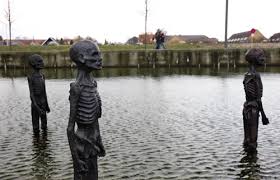
sculptures


“HOME”
(by Warsan Shire)

no one leaves home unless
home is the mouth of a shark
you only run for the border
when you see the whole city running as well
your neighbours running faster than you
breath bloody in their throats
the boy you went to school with
who kissed you dizzy behind the old tin factory
is holding a gun bigger than his body
you only leave home
when home won’t let you stay.
no one leaves home unless home chases you
fire under feet
hot blood in your belly
it’s not something you ever thought of doing
until the blade burnt threats into
your neck
and even then you carried the anthem under
your breath
only tearing up your passport in an airport toilets
sobbing as each mouthful of paper
made it clear that you wouldn’t be going back.
you have to understand,
that no one puts their children in a boat
unless the water is safer than the land
no one burns their palms
under trains
beneath carriages
no one spends days and nights in the stomach of a truck
feeding on newspaper unless the miles travelled
means something more than journey.
no one crawls under fences
no one wants to be beaten
pitied
no one chooses refugee camps
or strip searches where your
body is left aching
or prison,
because prison is safer
than a city of fire
and one prison guard
in the night
is better than a truckload
of men who look like your father
no one could take it
no one could stomach it
no one skin would be tough enough
the
go home blacks
refugees
dirty immigrants
asylum seekers
sucking our country dry
niggers with their hands out
they smell strange
savage
messed up their country and now they want
to mess ours up
how do the words
the dirty looks
roll off your backs
maybe because the blow is softer
than a limb torn off
or the words are more tender
than fourteen men between
your legs
or the insults are easier
to swallow
than rubble
than bone
than your child body
in pieces.
i want to go home,
but home is the mouth of a shark
home is the barrel of the gun
and no one would leave home
unless home chased you to the shore
unless home told you
to quicken your legs
leave your clothes behind
crawl through the desert
wade through the oceans
drown
save
be hunger
beg
forget pride
your survival is more important
no one leaves home until home is a sweaty voice in your ear
saying-
leave,
run away from me now
i dont know what i’ve become
but i know that anywhere
is safer than here.
by Somali poet Warsan Shire

Source: Radio Free Syria

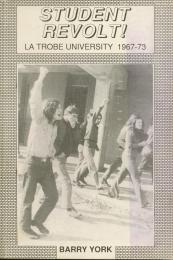
STUDENT REVOLT – La Trobe University 1967 to 1973

Student Revolt 001


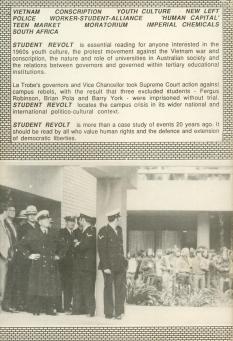
I’m pleased to make my book, Student Revolt: La Trobe University 1967-73 available on-line as a pdf. The book was published in 1989, with comrades helping finance it. It was based on my Master of Arts thesis, completed at the University of Sydney in 1984. The book was published in 1989, when La Trobe University was commemorating the 25th anniversary of the passage of the La Trobe University Act. The University declined my offer to contribute a chapter to their official history of the University and, as I expected, the official history trivialised and down-played what bourgeois academics and administrators still refer to as “the troubles” on the campus. It was actually a full-fledged student rebellion, questioning the nature and purpose of the universities under capitalism, and part of a global movement of young people questioning the inherited wisdom that held back progress by keeping the system in place.

Student Revolt blurb 001


I wish that rebellious questioning spirit would return to the campuses, which strike me as too bogged down by group-think and uncritical thinking in the Arts faculties. Yes, a generalisation but one borne out by what I read and experience – and confirmed by efforts to shut down research that does not fit the dominant paradigm and to censor ideas deemed offensive. I continue to embrace the motto “It is right to rebel!” – offensive though it may be to the professors, popes and princes.

Here it is: STUDENT REVOLT By Barry York


The fascists in Russia’s hybrid army

There’s an old saying about the thief who cries thief in order to distract attention from himself. The same applies to the supporters of Russian imperialism and the Putin regime. They have been quick to take on board Putin’s propaganda that paints the Ukraine independence struggle as a fascist one, yet far-right parties received a much smaller vote in the Ukrainian elections than do similar parties, some of which are neo-fascist, in western Europe and the UK. Also, a cursory survey of the websites of such far-right parties reveals sympathy for the “anti-fascist” Putin. Far right and fascist groups both in Russia and throughout Europe are backing the so-called Donetsk and Luhansk ‘People’s Republics’ (DPR/LPR) in word and deed.

– c21styork

* * *

The following is from Paul Canning and is reprinted for non-commercial reuse under aAttribution-Share Alike 3.0 Unported Creative Commons license.

Type ‘fascist Ukraine’ into Google and the first dozens of results all refer to the Ukrainian government and those forces fighting the Donbas separatists.

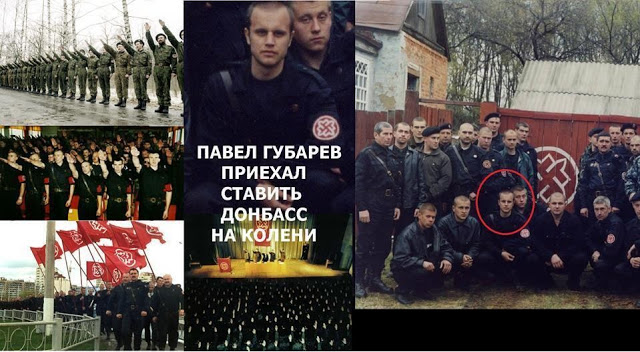
You will be hard pressed to find any references to the presence of fascists in Russia’s hybrid army in Ukraine. Ones like those pictured above in an astonishing piece of detective work by Dajey Petros.

Petros is a Dutch blogger who has been doing great work using similar tools to those employed by Eliot Higgins’ Bellingcat. Taking content from social media and using various tools to tell a story from it – like the story of the Russian missile which shot down the Malaysian Boeing.

Far right and fascist groups both in Russia and throughout Europe are backing the so-called Donetsk and Luhansk ‘People’s Republics’ (DPR/LPR) in word and deed. They are raising money for them, despite the sanctions. They hold mass rallies and other events. They send representatives to the Donbas to endorse the ‘Republics’. And they send Russians – and sometimes other Europeans – to join the fighting. All with the tacit approval of the Kremlin.

Gubarev

That approval was most sharply on display in March when Europe and Russia’s far right groups came together in a conference in St Petersberg. It was organised by the Rodina party whose leader is a Russian Deputy Prime Minister.

The event’s star was Alexei Milchakov, the leader of the ‘Rusich’ group of rebel fighters. Milchakov is infamous for photographs of him with a Nazi flag and a puppy he had allegedly killed. He has also posed in front of the dead bodies of Ukrainian soldiers.

Naming the separatist fascists

Many fascists were involved in setting up the DPR/LPR, such as Pavel Gubarev, the self-proclaimed first ‘People’s Governor of Donetsk’. His press secretary, Aleksander Kriakov, was described by Donetsk city Chief Rabbi Pinchas Vishedski as “the most famous anti-Semite in the region.”

When separatists took over TV broadcasting towers last year they boasted that:

Here, from Sloviansk, we are inflicting a powerful information conceptual blow to the biblical matrix … to Zionist zombie broadcasting.

They then presented a lecture by former Russian Conceptual Party Unity leader Konstantin Petrov, who the European Association for Jewish Culture (EAJC) describe as a “anti-Semitic neo-pagan national-Stalinist sect.”

In March last year Josip Zisels, Chair of the Association of Jewish Organizations and Communities in Ukraine, noted that pro-Russian organisations’ websites “have published many anti-Semitic materials which were meant to instigate hatred against the Maidan as being allegedly inspired by the Jews.”

Former DPR Prime Minister Aleksandr Borodai was a writer for the Russian fascist newspaper Zavtra. He opened the DPR’s first foreign ‘consulate’ on the premises of the Moscow branch of the Eurasian Youth Union (EYU), the youth wing of the Eurasia Party, headed by fascist ideologue Aleksandr Dugin. Dugin has openly called for genocide against Ukrainians.

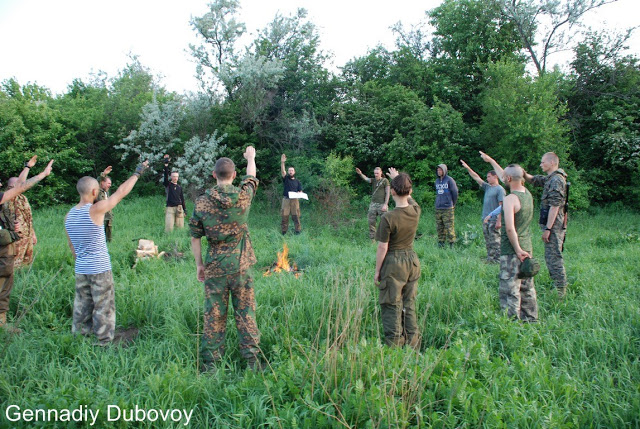
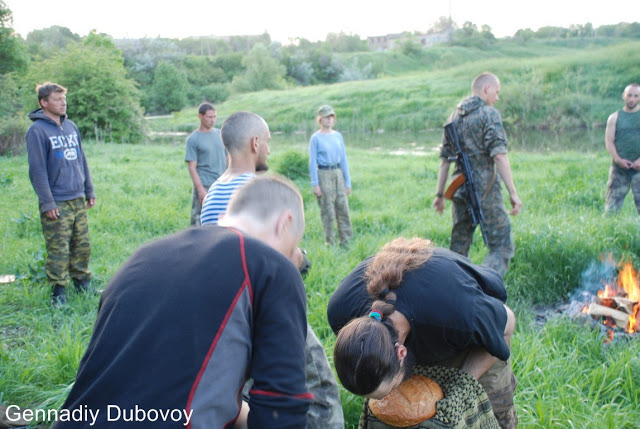
Another prominent Russian fascist in the Donbas is Gennadiy Dubovoy, whose colleagues are shown in the top and left photos participating in some sort of bizarre Nazi ritual. (See lots more whacky photos.)

Yuli Kharlamova

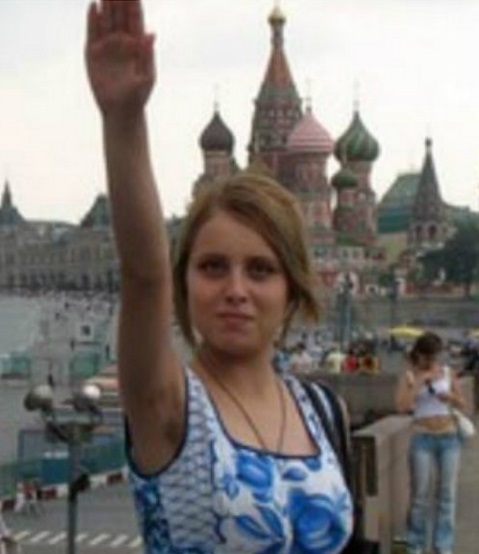
Participating in the ritual are several women and one is Yuli Kharlamova, a presenter on the Russian TV channel ANNA- News and an FSB (Russian security services) agent.

There are many other individual as well as organised Russian fascists who have been documented from social media engaged in leading roles among the separatists. As Petros puts it “in Russia’s [hybrid] army the Nazis structurally and openly belong to the core and they train others.” Not only that but Russian soldiers who have been captured have been found to have Nazi tattoos.

Here are the patches for five fascist militias in that separatist hybrid army (there are others):

And according to the expert on the far-right in Europe Anton Shekhovtsov there is evidence that proves that “Russian fascist organisations have been heavily infiltrating and instigating pro-Russian separatist movements in South-Eastern Ukraine” before the Maidan.

The real politics of the DPR/LPR

The UK has an organisation supported by leading lights in the so-called and unfortunately influential ‘Stop The War Coalition’ which claims that the DPR/LPR are socialists fighting fascists, but when the DPR/LPR organised sham elections last November socialists and communists were excluded.

The DPR constitution has the Russian Orthodox Church of the Moscow Patriarchate as the official religion. The Ukrainian Orthodox Church of the Kyivan Patriarchate, Ukrainian Greek Catholic Church, Roman Catholics, and Protestants, are officially regarded as ‘anti-Russian’ and have been actively persecuted.

According to a separatist recruitment video:

This war is a religious war. For Banderist money, agents of the Vatican, splitters, heretics fight against us, all of them traitors to Christ. And that’s why this war is a religious one.

The constitution also says that “any forms of perverted unions between people of the same sex are not acknowledged and will be prosecuted.”

The separatists running DPR/LNR have the documented support of only 18% of locals.

A further sign of the real politics of the separatists is shown by how anti-semitism fuels their infighting.

And in February, at a press conference, the leaders of the DPR/LPR, Zakharchenko and
Plotnitsky, ended their interview with anti-Semitic remarks.

Zakharchenko said: “I can’t remember, that at any time in Ukrainian history, cossacks were ruled by, well, not exactly those people, who ever carried a sword. Jews…”
Plotnitsky, (interrupting, grinning): “There is a video on Youtube ‘When the Jewish Cossacks have risen’, let them watch it”. Zakharchenko: “It’s not Jewish Cossacks, it’s miserable representatives of a great people, but they never ruled over cossacks. Taras Bulba and Taras Shevchenko would be turning in their graves because of such rulers in Ukraine.”

Abraham H. Foxman, National Director of the Anti-Defamation League (ADL), said that “those watching understood very well that this was an anti-Semitic appeal.”

This climate is being encouraged by Russian television, the only TV available in the ‘People’s Republics’, who during last year’s Ukrainian elections, accused leading candidates of being Jews.

Antisemitic meme against Alexander Khodakovsky, DPR ‘Security Council’ secretary

The lies about fascism in Ukraine

Human rights and Jewish groups both say that Russian claims, including by Putin himself, of rampant antisemitism, even ‘pogroms’, in Ukraineare not correct. Some of the incidents they recorded may actually have been orchestrated by Russian secret services, such as one which took place in July in Lviv.

The reality is that Ukraine has one of the lowest levels of anti-Semitic incidents in all of Europe, according to Josef Zissels, General Council Chairman of the Euro-Asian Jewish Congress.

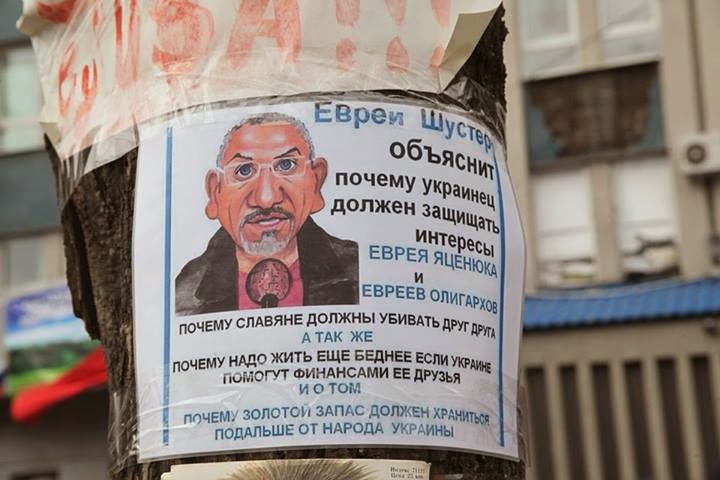
An antisemtic poster distributed in Luhansk during the initial unrest. It reads “Jew Shuster [Savik Shuster, Kyiv-based TV presenter] will explain why Ukrainians must defend the interests of Jew [Prime Minister Arseniy] Yatsenyuk and Jewish oligarchs. Why Slavs must kill each other.”

Researchers of Ukrainian nationalism issued a collective statement last March saying that the Maidan was a liberationist, and not extremist, mass action of civil protest. It condemned reporting which “misrepresents the role, salience and impact of Ukraine’s far right within the protest movement.”

Left forces in Ukraine have also consistently spoken out at the mischaracterisation of the Maidan revolution as a ‘fascist coup’, however their voices have been drowned by the Kremlin propaganda machine and its Western sympathisers – as well as by much of the mainstream reporting.

Dmitry Mrachnik (a member of the Ukrainian Autonomous Workers Union) is here extremely blunt!

The claim that fascists control Ukraine is propaganda by Putin. To those anarchists and left-wingers who believe Putin’s propaganda about a fascist regime in Ukraine and who support Russia I say:

Take a deep breath, gormless half-wits. For many years Russia has already had something like the kind of fascism which Ukraine is accused of. Anyone who supports fascists who save a neighbouring country from fascists must be either pretty stupid or completely devoid of any conscience.

The propaganda about Ukraine being ‘fascist’ directly fuels violence. It is consistently cited as a reason for those joining the DPR/LNR. This does not mean that the growth of nationalism in Ukraine should not be a concern.

Says Halya Coynash of Kharkiv Human Rights Protection Group:

Ukraine’s leaders have laid themselves open to criticism over the role of the Azov volunteer battalion, with its neo-Nazi leaders and probably members, as well as the more extreme elements in Right Sector and VO Svoboda. A few individuals such as Andriy Biletsky and Ihor Mosiychuk have won seats in Parliament, while others have received questionable appointments on the basis of their bravery in defending Ukraine. There are legitimate concerns about their role beyond the battlefield, as well as doubts about their motives as the recent conflict in Mukacheve has demonstrated.

All this is a gift for Kremlin propaganda, but it still does not justify broad claims about Ukrainian society. Ukraine’s two far-right parties did very badly in last year’s presidential and parliamentary elections, and no evidence exists that voters support anti-Semitic or xenophobic views. Now in Parliament, Biletsky reportedly claims that stories about his neo-Nazi and white supremacist views is all Russian slander. The denial is unconvincing, but it is telling that he sees the need to make it.

It is unlikely, she says that the Kremlin will “abandon its propaganda arsenal” and she warns about “fakes, manipulation, and total fabrication.”

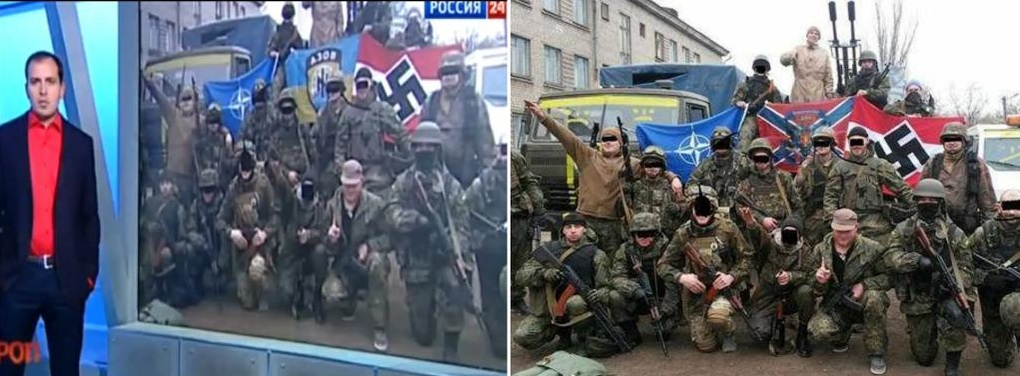
Petros uncovered one such manipulation last year. A member of the now famous Ukrainian Azov battalion, whose members undoubtedly do include fascists, had posted a photo of his battalion posing with a Swastika flag. Petros proved it was a photoshopped fake, the original had no Nazi flag in it. Nevertheless here it was on Russian primetime TV news …

It is entirely right that Western media should report, as the BBC’s leading news show ‘Newsnight’ did recently, on the far right in Ukraine. What is wrong is that the presence of fascists in powerful positions among the separatists is being totally ignored.

Western journalists often say that they strive for ‘balance’. Well, where is it? On this issue they are doing what the Russians do – only report one part of one story.

Second Anniversary of The Ghoutal Chemical Attack: Assad’s fascist regime must be overthrown

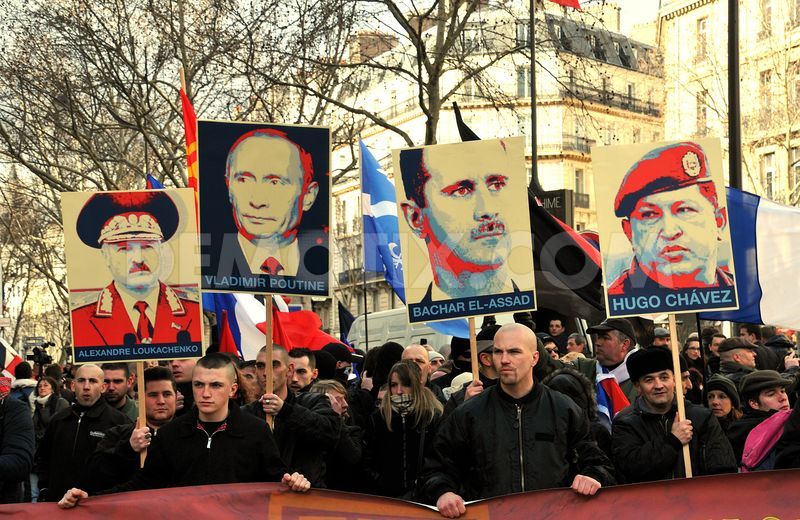
1359839008-nationalist-demonstration-against-globalism-and-imperialism--paris_1766972
Extreme right-wing protestors in Europe with portraits of those they support

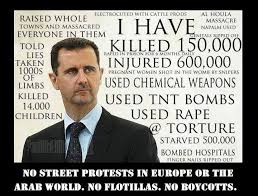
The Assad fascist regime is responsible for extreme human rights violations in Syria today. More than 220,000 people have been killed, 10 million people – half the country – have been forced from their homes, hundreds of thousands of political prisoners have been detained and 640,000 are living under brutal sieges without regular access to food, water or medicines. In September last year, the US-led coalition invaded Syrian airspace to bomb Daesh (ISIS) positions; yet a blind eye is turned when Assad’s aircraft bomb civilian populations and the revolutionary democrats from the same airspace, killing many more than Daesh.

* * * *

From Planet Syria: Two years ago on 21st August 2013 the world was focused on Syria after the government of Bashar al-Assad used Sarin on civilians in the worst chemical attack for a quarter of a century. (Since the Halabjah chemical attacks by the Saddam Hussein regime in 1988).

The world feigned outrage. Obama said a red line had been crossed.

But today the chemical attacks continue. Chlorine is routinely used in barrel bomb attacks on civilian neighborhoods. But it’s not the chemicals that are killing most people, it’s the bombs themselves.

Here are 5 things everyone should know about what is happening in Syria today:

1. The Assad regime is killing 7 times more civilians than Isis.

2. More than 11,000 barrel bombs made of scrap metal and high explosive have been rolled out of regime helicopters onto hospitals, homes and schools since the UN banned them. They are the biggest killer of civilians. They drive extremism.

3. These barrel bombs are the leading cause of displacement, forcing refugees to cross the Mediterranean and other borders.

4. Many of the barrel bombs are dropped on areas under siege. More than half a million people in Syria live in areas with no access to food, water or medicine since 2013, including the areas of Ghouta that were targeted by the sarin gas attacks in the same year.

5. The international anti-Isis coalition is flying in the same airspace where many of these barrel bombs are dropped, choosing to look the other way.

On the occasion of the second anniversary of the chemical attack on Ghouta, a suburb of Damascas, the National Coalition of Syrian Revolution and Opposition Forces has issued this statement:

It was a declared crime whose details and elements are well-known to everyone, whether they admitted it or not. They know the only party that does not lack the ability, the authority or the criminal will required to commit such a massacre, which is the Assad regime. They also fully aware that the regime has all the means of production, assembly and delivery of chemical weapons that were the tools of this this crime. They know the perpetrator by name, and also the names of the top regime officials who were involved with him. They know how he committed this crime and how he handed, with the utmost shamelessness, the murder weapon.

Two years have passed since the crime of the century, but the perpetrator is still at large. The families of 1,507 victims killed are still looking around for an international response equivalent to the size of the crime committed against their loved ones. And yet not a single measure has been taken to prevent the repetition of this crime. Death stills looms large over the head of Syrians, armed with every means of killing, ranging from knives and cleavers to barrel bombs, Scud missiles and chemical weapons. The Syrian Network for Human Rights documented 125 regime breaches of UN Security Council resolution 2118 and 56 breaches of UNSC resolution 2209 which criminalizes the military use of chlorine gas.

While we in the Syrian Coalition renew calls on the UN Security Council to shoulder its responsibilities in maintaining security and peace in Syria, and to take immediate action to stop the crimes against humanity and violations and to ensure that criminals are held accountable, we deplore the indifference of the international community which continues to deal with the blood of Syrians as a bargaining chip, a means to settle scores and exhaust opponents.

Having paid heavily for the sake of achieving our goals, we Syrians are now fully aware that we have to fight this battle relying only on the resolve of rebel fighters. Indeed, unity, rejecting discord, commitment to the principles of the revolution are the only guarantee of victory and liberating Syria from the Assad regime and its thuggish repressive security apparatuses and of the establishment of democratic rule which is bases on pluralism, justice and the rule of law.

We ask for Mercy for our fallen heroes, recovery for the wounded, and freedom for detainees.
Long live Syria and its people, free and with honor.

Assad’s strategy: don’t fight Daesh; direct it

The left has a proud history of opposition to fascism and indeed is the most reliable anti-fascist group politically. It is a puzzle as to how and why what passes for ‘left wing’ today can either be so neutral toward the Assad regime or adopt the entirely crypto-fascist slogan ‘Hands off Syria’. The puzzle is explained, in my opinion, by the fact that the left is more than a self-identifying label. It has a real content, defined by history, practice and theory. If someone tells you that western military involvement on the side of the Syrian people against the regime would be a disaster for the region, just ask the fundamental question: “A disaster for whom?” To those who beat their chests warning that US imperialism is out to dominate the region and that that claim somehow should mean leaving the unarmed populus to Assad’s barrel bombs, just tell them: “Your anti-imperialism is worthless if it ends up putting you on the side of the regional dictators who are oppressing and massacring the people as we speak”.

I wish to thank the good people at NOW. for permission to publish this article by Haid Haid, who is a program manager at the Heinrich Böll Stiftung’s office in Beirut. He tweets @HaidHaid22

c21styork

* * * *

 images

Assad is trying to turn his problems into opportunities by helping ISIS (Daesh; ISIL) choose what’s in his own best interests and allowing ISIS easier access to some areas than to others.

“Reports indicate that the regime is making air-strikes in support of#ISIL‘s advance on #Aleppo, aiding extremists against Syrian population,” the US Embassy in Syria tweeted on 1 June. Similar reports were published by other regional and international media outlets when ISIS made an unexpected and successful move against rebel groups north of Aleppo, disrupting their recent momentum.

To many of those who have been closely following what’s happening in Syria, this might not come as a surprise. Assad has avoided confronting ISIS, as they both benefit from one another. ISIS degrades and eliminates rebel groups that would otherwise be fighting Assad, and Assad’s regime presents itself to the West as the only local partner that can fight the terrorist group. This—at least publicly—unspoken agreement was broken in June last year after ISIS announced its caliphate. It seems, however, that the same arrangement is back on the table with some amendments due to recent developments.

Game changer Palmyra

Seizing Palmyra gave ISIS the advantage of many new strategic options, which will most likely change the dynamics of the armed conflict in Syria. The strategic location of Palmyra has allowed ISIS to cut the regime’s supply line to Deir Ezzor, and it opens the possibility of capturing other strategic locations, such as the Shaer gas and oil field. The broad desert has given them many alternative roads to various areas of Syria to expand and enforce their presence there; eastern Ghouta and eastern Qalamoun, rural Hama, rural Homs and rural Sweida. Capturing Palmyra was a game changer not only for ISIS but for the regime as well. Just consider the big number, and high symbolic value, of Assad regime losses on various fronts; the fear of the next rebels attack; the continued draining of resources (locally and regionally); the withdrawal of Iraqi militias who have returned home to fight; and the division in strategies between Assad and Iran—the former still trying to control all provincial centers, the latter restricting itself to areas considered useful within Iranian strategy.

Revised strategy

These developments have pushed Assad and his allies to find ways to cut down their losses and to conserve resources. It seems that Assad has found a way to turn his problems into opportunities by giving ISIS access to areas controlled by the rebels in order to drain their resources as they fight away from the regime, and he does so even if this costs him more territory. In Aleppo, for example, ISIS could advance through regime-controlled areas, including As-Safirah or Kweires Air Base, given the importance of these locations and due to pressure on the regime by other rebels groups in Idleb, combined with rumors that an Aleppo battle will be launched, which has made the regime even weaker. Even though capturing air bases might be considered its most important strategic goal, ISIS instead decided to intensify its attacks on areas controlled by rebels along the Suran-Mare axis in rural Aleppo. The regime also intensified its attacks on areas that have helped ISIS advance and control new villages. These developments forced many rebel groups, including members of the Army of Conquest coalition, to mobilize their forces and move them to prioritize fighting ISIS over the regime—at least in Aleppo.

The regime might also help ISIS to enforce its presence in eastern Ghouta, which will help the regime completely besiege Ghouta and engage rebels in another fight. Some recent reports mentioned that the regime has been busy transporting equipment from Al-Seine Airbase to Ad-Dumayr Airbase, which Assad’s opponents interpret as an evacuation plan. If this is the case, it could mean that the regime is either trying to conserve resources, or is scared that it might lose the air base, or both, which in any case will give ISIS access to eastern Ghouta. The same thing could also apply in eastern Qalamoun, Ar-Ruhaybah and Jayrud, to enforce their presence there and to keep the opposition busy in the fight against it.

US inaction

While the air force of the American-led coalition played a large role in defeating ISIS in Kobani, it didn’t react to ISIS’s latest attack on rebel-held areas, which gave ISIS the opportunity to move its forces freely. Many rebel leaders complained publically about the lack of US interest in helping them defeat ISIS in Syria, though it’s now apparent the US administration knows of the cooperation between Assad and ISIS. Sarcastically, activists started wondering if the US Air Force didn’t strike ISIS because Assad had crowded up the sky striking rebel groups. Maybe sarcasm is the only way that many Syrians, and to some extent non-Syrians, are able to understand US policy towards fighting ISIS.

* * * *

Iceland: a different vision (Bill Kerr)

In a world where the internet and governments are becoming less free the Icelandic visionaries see an opportunity to promote freedom as a nation building exercise

Never waste a good crisis (advice to those in other countries)

countries need to update their outdated constitutions

be clear about what you need to do and how to do it

catch the spirit of the nation by listening to the people

radical change only happens during crisis, at other times people become too complacent

* * * *

Thanks to Bill Kerr for permission to republish this post:

Iceland: a different vision

After hearing that the Pirate Party has become the most popular political party in Iceland (one source) I’ve been searching for information which explains how this happened.

What accounts for the difference in the way Iceland is developing politically?

The video at the top of this page, “From the Hell of the Crisis to the Paradise of Journalism” (1 hour 13 minutes) provides a dramatic and informative introduction to what has been happening in Iceland since the economic crisis of 2008 to the near present.

Alternatively, the paper on this page, Beyond WikiLeaks: The Icelandic Modern Media Initiative and the Creation of Free Speech Havens (pdf 24 pp), provides a written down version of similar information.

SUMMARY OF THE VIDEO:

“We were not separated from the majority of men by a boundary, but simply by another mode of vision. Our task was to represent an island in the world, a prototype perhaps, or at least a prospect of a different way of life”
– Herman Hesse. “Demian”

A particularly severe Banking crisis in 2008

Icelandic citizens in response held a weekly kitchen revolution outside parliament with clear demands (the Government, the Bankers and Monetary authorities should resign). These goals were achieved. Unlike other countries those responsible were punished.

A new government constitution was developed initially through crowd sourcing of 1000 citizens randomly (direct democracy) to develop it

The media was held complicit in not spotting the weakness of the Banks

Wikileaks helped by publishing information about corruption in those same Banks at that time

The Bank involved took legal steps to suppress that information – but this resulted in making things worse for them

In response the opportunity was taken by visionary leadership to launch a freedom of information revolution

One aim is transparent government, to move from secrecy by default to transparency by default

A large section of the video goes into detail of the FOI legislation, under nine subheadings. Also see Progress Report for detail

In a world where the internet and governments are becoming less free the Icelandic visionaries see an opportunity to promote freedom as a nation building exercise

Never waste a good crisis (advice to those in other countries)

countries need to update their outdated constitutions

be clear about what you need to do and how to do it

catch the spirit of the nation by listening to the people

radical change only happens during crisis, at other times people become too complacent

Role of PPPs (Public Private Partnerships) in Transition ( by Arthur Dent)

Guest post by Arthur Dent via Bill Kerr blogspot .

The need that has not been acted on is investment having become generally paralysed by world economic crisis. Not just traditional infrastructure but all kinds of large scale fixed capital construction projects are needed. The essence of transition from capitalism under such a scenario is that it is partially public and partially private.

* * * *

PPP = Public Private Partnerships

A scenario for transition from capitalism with socialized investment following another Great Depression and its (im)plausibility is discussed elsewhere.

For present purposes those assumptions are as arbitrary as the selection of some hypothetical specific PPP infrastructure project to pitch to some hypothetical target audience.

The need that has not been acted on is investment having become generally paralysed by world economic crisis. Not just traditional infrastructure but all kinds of large scale fixed capital construction projects are needed.

The essence of transition from capitalism under such a scenario is that it is partially public and partially private.

PPPs would be used for all major fixed capital construction projects that are significant for planning resumption of economic growth and ending mass unemployment. Buildings and plant that were previously (not) being privately financed, by single enterprises or project finance, not just the closely related “utilities”. Public institutions would also initially be largely untransformed, so public procurement of a traditional public utility infrastructure facility by a public agency would be subsumed under PPP arrangements as just another private participant that happens to be a public agency.

Public financial and economic planning and management organizations would be involved either as sponsors or minor participants in many types of build, own and operate projects, often taking substantial financial positions in both debt and equity based on the expropriated funds they are now able to invest as well as making ordinary commercial PPP arrangements with private participants.

The relatively small amount of economic and management expertise fully supportive of transition available to an inexperienced government would be heavily focused on the preparation, procurement and contract management/implementation of PPPs. They would have to structure the contracts so the private participants use their know how to maximize the public benefit in their own commercial interests. This would be very difficult and error prone, but not as implausible as simultaneously taking over all existing large economic institutions without enough skills to actually manage them in the public interest.

The much wider role of PPPs requires much better resourced public institutions responsible for PPPs. The relatively small numbers of government decision makers with adequate skills must supervise and structure appropriate incentives to motivate, much larger number of employees and consultants recruited from the private sector for their know how, despite their lack of support for transition.

Currently known “best practices” for PPPs would be generally applicable. There is no point in listing them. But the assumption of quite different circumstances imply many new lessons could only be learned from experience with at least the following differences from the usual circumstances.

1. Much greater transparency and much less corruption would be imposed on both the public and private participants as part of the broader social changes involved in transition.

2. Greater flexibility for detailed renegotiations would be necessitated by the circumstances of economic crisis and the more dynamic situations arising from transition.

3. Political, foreign exchange and national macroeconomic risks (interest rates etc) would be exclusively borne by the public participants and corresponding contingent liabilities and hedging or insurance costs appear openly on the central balance sheets. The public institutions responsible for exchange rates and macroeconomic stability would be closely involved in understanding the financial flows and risks they are assuming and the prices they require for asuming those risks and any hedging arrangements they may be able to make separately. Both international and local private participants would not need to make separate judgments or their own hedging arrangements for particular projects but only apply the sovereign risk ratings assessed uniformly by their own trusted ratings agencies.

4. Land use and resource management public agencies would likewise manage and appropriately price the responsibilities for land acquisition, site and regulatory risks.

5. Design, operations, construction, completion and maintenance performance risks would be exclusively borne by the private parties directly responsible for each aspect with detailed incentives tailored to reward overperformance and penalize underperformance. They would be carefully separated according to the expected and actual costs and risks borne by the participants engaged in each aspect and related global, national and sectoral statistical indexes.

6. Allocation of upside and downside market risks for supply of inputs and sale of outputs would be significantly more complex since the expropriation of private wealth for public investment in PPPs was made necessary by lack of profitable investment outlets in the prevailing market conditions of economic crisis.

The aspect for which each private participant is responsible must be commercially viable to that participant at the low competitive rates of return prevailing under crisis conditions. But the overall project need only be value for money to the public participants based on accepting an even lower (or even negative) return on their investment in order to achieve planned economic growth and rapid recovery from mass unemployment.

Transition from Capitalism (by Arthur Dent)

Guest post by Arthur Dent via Bill Kerr blogspot.

Any transition from capitalism in advanced capitalist countries as a result of another Great Depression would involve:

Inexperienced left governments required to urgently get the economy moving again and end mass unemployment because previous governments, whether claiming to be left or right, had been unable to do so.

Some level of rapid expropriation of privately owned wealth that was immobilized by the crisis now made available for socialized investment in new fixed capital construction projects to get the economy moving again and absorb unemployment.

The day after a change in government would be similar to the day before. The same social relations based on money, wage labor and capital, the same social institutions such as globalized large corporations, and national and local large, medium and small enterprises and bureaucratic government departments and agencies, and the same economic paralysis.

* * * *

This article is a placeholder for an introduction to a series of articles on various aspects of economic policy to be advocated before, and implemented during, the early stages of, a transition from capitalism in advanced capitalist countries under various different possible scenarios.

I am nowhere near ready to write any such articles, even as tentative drafts, so I cannot write an actual introduction.

Meanwhile one of the courses I am studying to become able to write such tentative drafts is a MOOC on “Public Private Partnerships” by the World Bank.

This requires as a final project for the policy and procedures track, publication of a “digital artefact” plus a description of the target audience in one hundred words.

I have published as my “digital artefact” the eight hundred word article on “Role of PPPs in Transition” [which will be published later – c21styork):

The key requirement is:
“Topic: Identify an infrastructure need that could be developed as a PPP. This could be a project that is in process of development, one on a country’s PPP project lists, or a need that has not been acted on. Think about the key facts or ideas you wish to convey by answering the following questions:
What is the infrastructure problem that the PPP is trying to solve?
What services are to be provided and are these services affordable?
What are the reasons that the private sector would want to participate?
How should these risks be allocated? Consider the country context in judging the risks and who should take them.”

I have identified as a “need that has not been acted on” the general paralysis of investment resulting in prolonged mass unemployment in another Great Depression worse than the 1930s following a financial crisis worse than 2008.

Such a worse financial crisis than 2008 does not seem to be entirely implausible since the last one seems to have been merely postponed rather than resolved by the extraordinary measures taken. Nor does another Great Depression worse than the 1930s seem entirely implausible following such a worse financial crisis.

The need is for all the infrastructure required to resume economic growth, not just traditional infrastructure like existing public utilities. The problem that has to be solved is that there are no profitable outlets for private investment in crisis conditions so investment must be socialized rather than left up to private investors.

This would require some form of state capitalism either as a transition back to “normal” private capitalism or as a transition away from capitalism.

The absence of any significant left in advanced capitalist countries, at least in the english speaking ones I am familiar with, makes any transition away from capitalism seem completely implausible. But then the continued absence of any significant left under the conditions of prolonged mass unemployment and economic paralysis seems even more implausible.

There are already important changes in the political climate of countries like Greece, Spain and Iceland that could become precursors of something much bigger. These countries are peripheral rather than central to the advanced capitalist world, but they are part of it and they are already facing serious economic and political crisis situations.

So I am writing for the target audience described at the end of this introduction, in the conceivable scenario described below.

The services to be provided are not traditional public utilities but the ending of prolonged mass unemployment through resumption of economic growth.

These services are affordable because prolonged mass unemployment is not affordable and both labor and capital are cheap in depression conditions. What is missing is profitability, not affordability.

The private sector would not particularly want to participate, but would not have better options available. Corporations would still want whatever contracts are available at the best returns they can competitively get for the benefit of their shareholders, whether or not some of their shares that used to belong to wealthy private individuals now belong to public institutions. Board members and senior managers who no longer wanted to participate because their incentives had been expropriated would be replaced by board members and managers willing to work for the owners, old and new, under the incentives currently being offered.

But the social system would not yet have been changed and risks and incentives would still have to be allocated in the context of an advanced capitalist country in crisis that is merely beginning a transition from capitalism, not one that has completed such a transition. So many of the same principles would have to still apply and new ones could only be understood and evolved over time.

Scenario

Any transition from capitalism in advanced capitalist countries as a result of another Great Depression would involve:

Inexperienced left governments required to urgently get the economy moving again and end mass unemployment because previous governments, whether claiming to be left or right, had been unable to do so.

Some level of rapid expropriation of privately owned wealth that was immobilized by the crisis now made available for socialized investment in new fixed capital construction projects to get the economy moving again and absorb unemployment.

The day after a change in government would be similar to the day before. The same social relations based on money, wage labor and capital, the same social institutions such as globalized large corporations, and national and local large, medium and small enterprises and bureaucratic government departments and agencies, and the same economic paralysis.

To simplify things I further assume a “simple” scenario with:

Expropriation narrowly targeted to take all and only the excess wealth of the top 1% of nationals.

This results in substantial investment funds becoming available to governments starting transition but most of the capital in each such country would still be held privately and by foreigners.

The most important capitalist countries such as the USA, China, Japan, and Germany would not be the first to start making the transition. But international financial and investment flows as well as trade continues.

Many top layers of management in most social institutions would be quite hostile to transition but there are enough supporters capable of supervising or replacing them.

Some of these assumptions may not look very plausible. But advocating measures based on such a “simple” case, would place the responsibility for different policies firmly with those who might prevent the policies discussed for this scenario by resorting to the breakup of international financial investment and trade flows, and civil and international wars.

Target Audience

I am studying economics, finance and other subjects to understand how capitalism works and become able to propose economic policies for transition from capitalism in advanced capitalist countries. Currently there is no significant left movement in such countries, but I am drafting tentative ideas for a wider future audience of prospective government policy makers expected when a financial crisis like 2008 eventually becomes another Great Depression like the 1930s. They are not concerned with some specific PPP project. I am conveying one possible policy option for managing partially socialized and partially still private investment projects using PPPs.