Turn down the hype (by Arthur Dent, formerly Albert Langer)

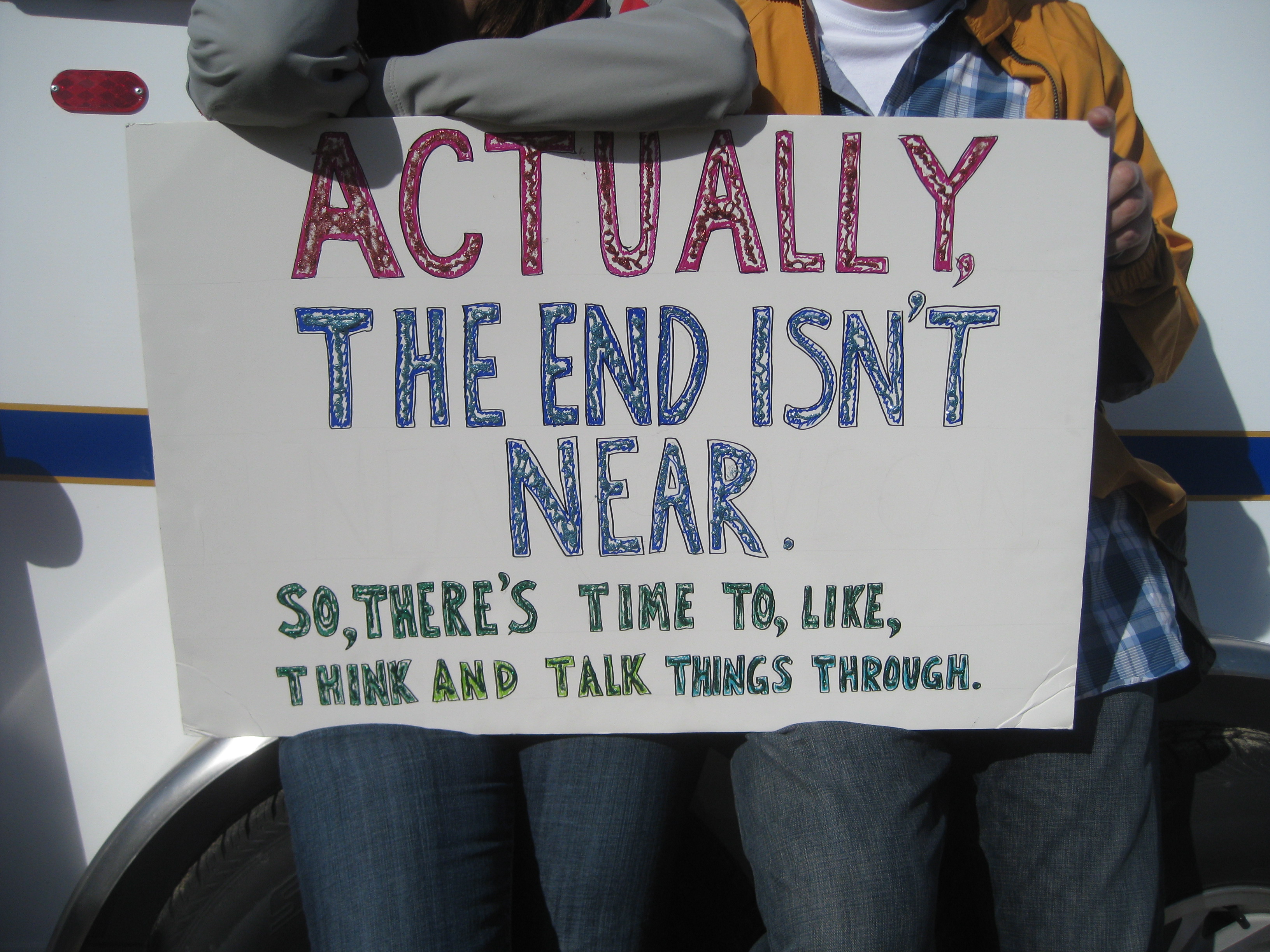
the-end-isnt-near


Originally published as a guest post at Bill Kerr‘s blog by Arthur Dent on 21st May, 2015.


* * * * * *

According to the World Bank:

“By acting now, acting together and acting differently, we will be able to transition to a low emissions, climate resilient development path and hold warming below 2°C.”(1)

To help achieve this, a MOOC sponsored by the World Bank (Turn Down the Heat) requires students to produce “digital artefacts” with the aim “create a sense of urgency and a call to action for individuals, companies or countries to change behaviors associated with a warming planet”.

My call is for the World Bank to change its behaviour and “turn down the hype”.

It should be obvious that none of the measures advocated by the World Bank have had much impact on the planet warming, and there is no reason to expect that creating a sense of urgency in support of more of the same will have a better result.

The IPCC’s authoritative report on Mitigation of Climate Change(2) shows clearly that there is no realistic prospect of holding warming below 2°C.

The simple reality is that most emissions will result from the rapid industrialization of developing countries like India and China who cannot and will not switch from the cheapest energy sources available while they remain poor. No amount of hype will change that reality.

If the problem was as grave and urgent as claimed there would be no alternative but for developed nations who can afford the cost to switch from cheaper fossil fuels to more expensive nuclear power and also pay the costs of the entire world doing the same. But the World Bank does not advocate that, so it is difficult to believe it takes its own hype seriously.

Wind and solar power cannot solve the problem because they are intermittant. Power is also needed when the wind is not blowing and the sun is not shining. There is no technology on the horizon that could store energy cheaply enough to compete with the dispatchable power from fossil fuels, even if wind and solar power was free. Instead of pretending that wind and solar could do the job it is clearly necessary to act differently. Since there is no viable replacement for fossil fuels on the horizon that developing countries could afford, it is necessary to do something very different from what the World Bank advocates.

We will need some breakthroughs in fundamental technology. Neither the regulatory nor the market pricing mechanisms advocated by the World Bank can achieve that. Massive investments in research and development and fundamental science are required. Contrary to the hype there is no “return” on that investment. As with all fundamental science, the results have to be made freely available to the countries that are too poor to pay for it. So the “free rider” problem ensures that no carbon pricing mechanism could motivate such investment. At present each developed country is hoping that somebody else will pay to develop the necessary technology. There is no “national” benefit in doing so. It is a global, not a national problem. The most ambitious national targets for R&D are about 3% of GDP for all purposes. These targets are not being met, despite the fact that new technology is the driving force for economic growth.

A global levy on developed countries that can afford it is required, to pay for the costs of a massive global R&D program that is not expected to produce any “return” on the investment, other than “merely” solving the problem of global warming.

That may require a significant expansion in the total scientific workforce and consequently a long lead time for education.

If it is not successful, then we will have to resort to some combination of geo-engineering, adaptation strategies and subsidizing nuclear power in all countries, at potentially vastly greater costs. But even if a massive global R&D program failed to produce clean energy competitive with fossil fuels, it would at least accelerate economic growth generally and enable the whole world to afford more expensive energy than fossil fuels more quickly.

“Modernization has liberated ever more people from lives of poverty and hard agricultural labor, women from chattel status, children and ethnic minorities from oppression, and societies from capricious and arbitrary governance. Greater resource productivity associated with modern socio-technological systems has allowed human societies to meet human needs with fewer resource inputs and less impact on the environment. More-productive economies are wealthier economies, capable of better meeting human needs while committing more of their economic surplus to non-economic amenities, including better human health, greater human freedom and opportunity, arts, culture, and the conservation of nature.”(3)

We need more modern technology, not medieval windmills.

(1) WDR 2010: Development and Climate Change
(2) Working Group 3
(3) An Ecomodernist Manifesto

Alarmism – it really frightens people and it sucks

zzz

California’s imminent deathbed? Really?

Green alarmism generates newspaper sales, TV ratings and hits on social media but it is a big problem standing in the way of reasoned and effective political responses to environmental problems. The latest alarmism comes from California where the Internet is abuzz with talk of California’s water supply running out in a year’s time. It is amazing how many publications, including mainstream ones, have run this line.

The Guardian’s headline said it all: “Drought-stricken California only has one year of water left, Nasa scientist warns”.

Good heavens! Who can argue with a NASA SCIENTIST?! The Guardian names the Nasa scientist – an expert on the global water cycle, Jay Famiglietti. He has an impressive curriculum vitae.

The original source for all this is the Los Angeles Times, which ran an opinion piece by Dr Famiglietti.

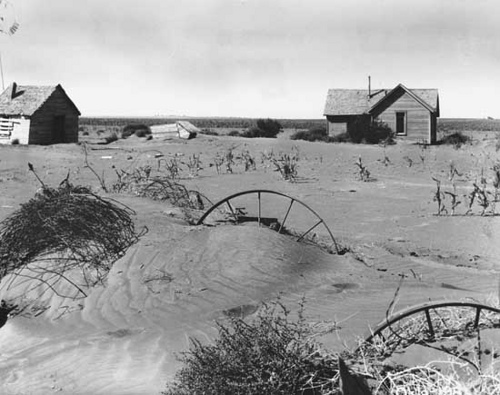
On social media, there is a photo doing the rounds showing the 1930s dustbowl period in the US with a caption: “R.I.P. California (1850-2016): what we’ll lose and learn from the world’s first major water collapse”. The opener claims that NASA has announced that California is on its death-bed and only has 12 months of water left.

Alarmism is a scourge but it can easily be repudiated with some good critical thinking:

1. Always read the article, not just the sensationalist heading and opening paragraph. In The Guardian above, the actual article offers no evidence whatsoever for the claim in the headline and Dr Famiglietti’s words do not make that claim. No other Nasa scientist is quoted. The Nasa scientist has been misrepresented. Neither does Nasa claim that California is on its death-bed.

2. Check the original source, do not rely on the journalist’s take on it. Who knows, they may be influenced by green doomsdayism! Or out to sell their paper. Or, more likely, both. In this case, on checking the LA Times article by Dr Famiglietti, there is again no claim by him that California’s water supply is about to run out within 12 months. The LA Times later ran a retraction, of sorts, pointing out that the original headline suggested that California only had a year’s supply of water left and that what they meant was that there was only a year’s supply in storage. So, the editor changed the headline. And also apologized to Dr Famiglietti for calling him James instead of Jay. This aspect to the apology ran first, followed by the bit about storage. True.

3. Google the scientist to see what they actually believe. Normally I would do this but it hasn’t been necessary as a week later, on March 20th this year, the LA Times itself published a second report which allowed correction by Dr Famiglietti of the original article’s misrepresentation of his views. The key bit is: “he never claimed that California has only a year of total water supply left”. Say what? Now that’s quite a difference, a huge difference, and a point of view that does not serve an alarmist agenda. But it won’t stop the scores of thousands of sharers of the original false report spreading their alarmism via social media and other media, all with the imprimatur of a (non-existent) Nasa scientific source.

The LA Times article continues:

“He (Dr Famiglietti, the Nasa scientist) explained that the state’s reservoirs have only about a one-year supply of water remaining. Reservoirs provide only a portion of the water used in California and are designed to store only a few years’ supply. But the online headline generated great interest. Famiglietti said it gave some the false impression that California is at risk of exhausting its water supplies. The satellite data he cited, which measure a wide variety of water resources, show “we are way worse off this year than last year,” he said. “But we’re not going to run out of water in 2016,” because decades worth of groundwater remain”.

Decades worth of groundwater. Okay?

4. Be rational in considering political responses. No-one disputes that California is experiencing a severe drought, one of the worst in its history. Like Australia, that’s the way it has been for a very long time. Severe droughts are part of the landscape of America’s west coast. California has a pressing problem to do with stored water – “way worse off than last year” – during a period of extended drought. Practical responses are needed.

Why is it that no Californian government has built a large dam for water storage since the mid-1970s? The State’s population has increased by 15 million since then. I have a feeling that those who spread false alarmism also oppose the construction of large new dams to capture the rain that does fall (and that has fallen over California since the last dam was built in the 1970s). This is a logical outcome of a ‘green’ world outlook that opposes progress through mastery of Nature and development and that seeks harmony with Nature through sustainability. It is the opposite of a Marxist-influenced left-wing outlook.

Oh yes, and some good news. While southern California is still in a bad way, northern California has had a reasonable soaking. Rainfall levels are at 100 percent of their historic average or above in nearly every city, and reservoirs, while still not back to normal, are steadily filling.

New dams anyone?

Remote hopelessness (via Bill Kerr blogspot)


Thanks to Bill Kerr for permission to republish the following post from his Bill Kerr blogspot.

* * * *

I watched Remote Hope on 4 Corners. In some respects it was quite a good expose about how bad things have become but it still didn’t drill down deep enough into the fundamental basis of the problem or interview those who have thought deeply about it and grappled with a solution.

Tony Abbott (“lifestyle choices”) and Colin Barnett (“put yourself in my shoes”) have both shot themselves in the foot and are easy targets. But what is needed is not a free kick of unpopular politicians but an honest description of the problem and some deep thought about a solution.

Some good people have thought deeply about the issue of remote indigenous community dysfunction: Peter Sutton, Noel Pearson, Marcia Langton, Bess Price and Stephanie Jarrett, to name a few. They are the whistle blowers and they blew the whistle a long time ago. Noel Pearson’s essay Our Right to Take Responsibility was delivered in 2000. Why didn’t the ABC interview these people?

I thought some of the people interviewed were very good in describing the problem:

  • the Broome mayor, Graeme Campbell
  • John Hammond, the Perth Lawyer, who supported some shut downs of dysfunctional communities
  • Anthony Watson who plans to camp on Cable Beach, inconveniencing tourists, and bringing a real problem to the attention of Australians
  • Karl O’Callaghan, the WA police commissioner, was good, pointing out facts (sex abuse 10 times higher than anywhere else), supporting closures of dysfunctional communities and even providing an emotional response, that he couldn’t sleep at night, whether rhetorical or not, it was correct
  • Susan Murphy right at the end, we can’t keep giving handouts

I thought Tammy Solonec of Amnesty International was terrible, talking about human rights in the abstract, not based on any analysis of reality.

The best attempt at a solution so far is that proposed by Noel Pearson and his Family Responsibility Commission. See the article by Catherine Ford about that, Great Expectations: Inside Noel Pearson’s social experiment.

Admittedly nothing about this issue is going to easy. But the problem came about due to bad policy that superficially looked like humane policy. Equal wages led to indigenous unemployment. Welfare led to alcohol and drug abuse and child abuse. The bad policy has dragged on for many years after it was pointed out. Nevertheless, bad policy can be corrected. Of course, it is too late for many but correction of bad policy offers real hope which can grow over time for some.

Kerry O’Brien said right at the end that there was no easy solution but still the puzzle is why they didn’t put Noel Pearson on who has come up with a hard solution. I think the ABC is more interested in easy hits on Abbott and Barnett than proposing a real solution. See my earlier article, The closure of remote indigenous communities, for links to the ideas of Marcia Langton and Stephanie Jarret on this issue.

Magna Carta: Reignite the spirit of rebellion!

Freedom is never given to us – it must be won.

As long as the human spirit retains its aspiration for liberty, Magna Carta will serve as a symbol of the neverending struggle for freedom.

No sooner did the rebellious barons force King John to grant them Magna Carta in June 1215 than it was annulled, just 10 weeks later, by Pope Innocent III. Although it was reissued by John’s son Henry in 1216, its status remained insecure, until a definitive version was conceded in 1225. What the experience of the 13th century demonstrated is that hard-won rights and freedoms can never be taken for granted.

Magna Carta was by no means the last word on freedom. It was a medieval document that provided safeguards against the arbitrary rule of the king. It implicitly upheld ideals that would gradually crystallise into a tradition that respected the rule of law. Some historians have questioned the iconic status of Magna Carta, on the grounds that it was a ‘Baron’s Charter’ and did little to protect ordinary people from injustice. However, what was important about this document was not simply what it said, but how it was seen by successive generations.

Magna Carta provided the foundation for a political culture that celebrated freedom against the exercise of arbitrary authority. English customary law drew on the precedent of the rebellion against King John to question and, in the end, unsettle the claim to Divine Right Kingship. Magna Carta was idealised and turned into a foundational myth by the radical wing of the parliamentary opposition to the Stuart dynasty. One of my heroes John Lilburne (1615-57), a true champion of liberty and one of the leading voices in the Levellers, linked the ideals of Magna Carta to the foundation of a new nation. Lilburne went to prison to defend the right not to incriminate oneself. He argued that self-incrimination violated Magna Carta.

Over the centuries, Magna Carta has become a historic document to which a bewildering variety of parties have attached their democratic and freedom-oriented ambitions. Although it has served as a foundation for English identity, its idealisation has transcended the borders of any single nation. Its universal appeal speaks to the universal attempt to overcome the obstacles to freedom.

The necessity of almost every generation since 1215 to appeal to the precedent set by Magna Carta points to the always precarious status of freedom. Freedom depends on a political culture that takes the principles of an open and democratic ethos seriously. History shows that freedoms that really mean something are won through the action of public-spirited people rather than being gifted by a benevolent ruler or state. In the current era, this lesson is often overlooked, as campaigners and movements look to the state to ‘empower’ them.

This misconceived project of finding freedom through the state rather than fromthe state is encouraged by an ideology that mistrusts people. Eight hundred years after the sealing of Magna Carta, we are confronted with the uncomfortable fact that in many Western societies, individual freedoms are no longer highly valued. The casual manner in which freedom of conscience and freedom of expression are often disregarded means that the rule of others – whether formal or informal — can too often be implemented with little resistance.

The spirit of rebellion which animated lovers of liberty from the 13th century onwards need to be reignited, so that the new generations assuming responsibility for the future understand that freedom is not just another word.

Frank Furedi is a sociologist and commentator. His latest book, First World War: Still No End in Sight, is published by Bloomsbury. (Order this book from Amazon (UK).)

War? Huh! What is it good for?! Over-throwing Fasc-ism! Say it again! Victory over fascism – 70th anniversary

“I have always believed and I still believe that it is the Red Army that has torn the guts out of the filthy Nazis”.
—Winston Churchill, Speech in the House of Commons, October 1944

* * * *

Awesome groove but bullshit lyrics

May 8 and May 9 marks Victory Days for Europe and the former Soviet Union and is commemorated around the world.

In Australia, the 70th anniversary of this world-historic event did not receive the recognition it deserved. Yet World War One, an inter-imperialist conflict in which the working classes had no real interest, has been a prominent part of television, radio and print-media diet.

The centenary of Gallipoli received scores of millions of dollars in government funding, beginning with the Gillard Labor Government’s provision of $83 million funding for it.

How the world would have been had Hitler and the Axis powers won is too horrendous to contemplate, but it took a terrible toll to defeat them.

In that struggle, Stalin and the Soviet Union played the lead role.

I’m not usually into speculative history, but I sometimes wonder how differently things would have developed had Britain and France agreed to Stalin’s pleas for ‘collective security’ against Hitler’s rise. This would have required collective action in the advent of German aggression. Sadly, the British ruling class at that time hoped that Hitler would keep to his promise to ‘turn east’ in keeping with the ‘lebenstraum’ agenda advocated in ‘Mein Kampf’.

All that can be done now is to ensure that VE Day and Soviet Victory Day continue to be commemorated and that the lessons about the nature of fascism and the need to defend democracy be learned.

The Allied victory in World War Two shows that there is such a thing as just war – war is not “futile” – and it is a momentous mistake to turn a blind eye to, or appease, fascist regimes.

It is ironic indeed that Russian President Putin, himself bearing so many characteristics of a fascist, is trying to attach himself to the anti-fascist Stalin and the Great Patriotic War while embarking upon imperialist aggression in the Ukraine.

Lest we forget the toll of the greatest anti-fascist struggle:

419,000 Americans died
451,000 Britons died
28,000,000 Soviets died.

The Axis deaths exceeded ten million.

In the world today, fascistic regimes such as that of al-Assad in Syria are just as deserving of overthrow as were Hitler, Mussolini and Franco. There are particular similarities with the latter – the rise of fascist dictatorship in Spain in the 1930s – when the international Left called for intervention by the West to restore the elected Republican government.

Only the Soviet Union took military action against Franco. Stalin provided the Republicans with between 634 and 806 planes, 331 and 362 tanks, and 1,034 and 1,895 artillery pieces. Not to do it would have meant leaving the Republicans open to massacre. Nazi Germany and Fascist Italy were certainly aiding the Franco regime, with Germany supplying powerful air and armoured units, while the British and French governments retained their policy of non-intervention.

Perhaps the finest way to honour the war dead is to ensure victory for the democratic forces in Syria and those elsewhere around the world fighting tyranny. To do this, to support our brothers and sisters fighting fascist regimes, may require war, military intervention.

Sometimes, only war can defeat fascism. Tragically, it is good for something.

* * * *

A case for an amnesty for asylum seekers in Australia

…in addition to the cost of keeping 2,500 people in detention, and in addition to the cost of ensuring the other 27,000 don’t abscond, why not advocate something that makes much more sense than wanting nicer, more efficient, ways of keeping people out? Why not allow them the opportunity to contribute to the community and society without the restrictions of the bridging visas by letting them in?

* * * *

images refugee
The bloke in the red shirt might be your next dentist…

* * * *  

Amnesties occur when a government grants a pardon to a group of individuals. It can apply to prisoners, or people in other forms of detention. Or even people not in prison or detention. An amnesty for asylum seekers would be a pathway to permanent residence. 

Australia’s experience of amnesties in the immigration field date back to Australia Day (26 January) 1976 when Prime Minister Malcolm Fraser granted amnesty to illegal immigrants. At that time, this meant individuals who had entered Australia lawfully but overstayed their visas. The period in which applications could be made for amnesty expired on 30 April that year. It was an offer too good to refuse.

The Coalition government realized that these ‘illegals’ were in the country anyway. They were part of Australian society, despite their official status, and working or bludging, or having fun, playing music, fishing, reading, chatting with neighbours, going to the pub, etc, like the rest of us. And, again like the rest of us, they had a future here.   Fraser’s standing in immigration history is being rewritten and mythologized by all-too-eager academics who seem to have put aside any semblance of critical approach.

Fraser was responsible for formalising the distinction between genuine and non-genuine refugees through the establishment of the Determination of Refugee Status Committee in 1978; a decision that laid the basis for all the subsequent problems arising from exclusion.  

When it came to the ‘Australia Day’ amnesty of 1976, Fraser gave with one hand while taking with the other. He also funded a special unit to hunt them down. A cost-benefit analysis may have found that the benefits outweighed the costs in letting them stay. Not that that is the only – or main – point. But what is important to note is that the amnesty did not alter the basic policy: over-stayers after 30 April 1976 were in big trouble if caught.  

Australia’s next experience of amnesty occurred during the Hawke years when, in 1989, Prime Minister Bob Hawke announced that the thousands of Chinese students studying in Australia would be permitted to remain here until 31 July 1990 on a temporary basis. This was later extended to June 1994 and then, as was the intention all along, 42,000 were allowed to apply for permanent residence.  Again, it was an offer too good to refuse. Who in their right mind, after the Tiananmen massacre, would want to return to live under a social-fascist regime compared to life in bourgeois-democratic Australia?  

The situation today: about 30,000 in limbo and detention  

Currently, in Australia, living as part of our community and society but separated from it by various restrictions imposed by a ‘bridging visa’ system, there are more than 27,000 people, mostly asylum seekers waiting to have their cases determined. Most have been waiting  for a long time.   There are also 2,500 in detention centres.

It’s always helpful to look on the bright side in any bad situation. There are about ten thousand fewer in detention today than there were under Gillard’s Labor government. When it comes to detention of asylum seekers, Labor holds the record. (Lest we forget).  

It is curious, to me, that pro-refugee groups tend to advocate the more rapid processing of these asylum seekers’ claims, as though it is fair enough to identify those who are not genuine refugees, rather than questioning the system itself. Sadly, this is the main paradigm in public discourse. Nearly everyone, the Greens included, think it’s fair enough to keep out asylum seekers who are not genuine refugees. So, a family might sell everything in, say, Iran, risk their lives by escaping, lose nearly everything to unscrupulous people-smugglers (note: these guys are not to be romanticized) and then having made it across the dangerous, often deadly, waters, under the old ‘Fraser system’ they could be be rejected because they are found to be ‘economic’ refugees not the ‘political’ type.   Needless to say, within this paradigm, they have to leave the country, which they will not do voluntarily. They therefore (the dominant thinking goes) need to be detained in some way, lest they abscond into the community. The Greens want this process to be accomplished quickly, more efficiently and ‘nicely’; Labor and the Coalition are rather less polite about it, though at each election since 1996, Shadow Ministers for Immigration have promised to ‘speed up’ the determination process.  

Those who were denied permanent residency because they were found to be economic refugees made the journey in order to have a better life – and, after such a journey you can be sure that means they will want to improve things generally. My parents paid ten pound each to get here in 1954, and were allowed in. Their motivation was a better life for themselves but mostly for my future. Both my parents made special contributions to their community (in Brunswick, Melbourne) and in other ways. Had they not been ‘authorised’ migrants but rather ‘economic refugees’, and allowed in, their contributions would have not been diminished in any way.

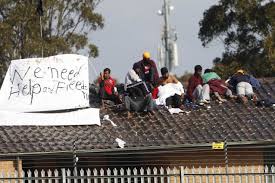
There are financial and human costs involved in maintaining these 30,000 people in their current state. Most of the costs are borne by government – you and me.   We are denying each of them the opportunity to be productive and useful members of society, as a result of restrictions placed on them through the bridging visas. As I say to my wife: That asylum seeker lighting a fire and jumping up and down on top of the detention centre’s roof may be our next dentist!   So, in addition to the cost of keeping 2,500 people in detention, and in addition to the cost of ensuring the other 27,000 don’t abscond, why not advocate something that makes much more sense than wanting nicer, more efficient, ways of keeping people out? Why not allow them the opportunity to contribute to the community and society without the restrictions of the bridging visas by letting them in?  

In other words: let’s call for an amnesty for them all.  

Given the current parliamentary political situation in Australia, the demand could reap some benefits. After all, isn’t the ALP keen to recapture votes it has lost to the Greens on this issue? Aren’t the Greens out to convince us that they represent a humanitarian alternative on the refugee issue? Wouldn’t Labor and the Greens have the numbers in this fine humanitarian and entirely practicable act?   And 30,000 is not a big number. For heaven’s sake, 30,000 is about a third of the net loss Australia experienced through permanent departures last year. And last year we took in 200,000 newcomers.

Above all, from the viewpoint of the prevailing consensus, the actual refugee policy would not have to change. Much as I think it should, and must – and will (one day). An amnesty can be granted as an act of compassion, without any need to change current refugee policy.  

‘Christian compassion’ for Australia Day next year.  

Let’s call it… er… well… “Christian compassion”. Yes, Christian compassion for ‘Australia Day’ 2016. Marking the 40th anniversary of the first amnesty granted by a Coalition government in Australia.  

Tony: ya there?  

Bill?  

Richard?  

* * * * 

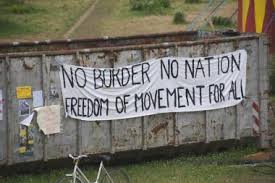
Let them in!

“What we have here is not a serious debate about border controls or free movement, but rather a clash between those who want to demonise migrants and those who want to infantilise them”. (Reprinted with permission from Spiked )


images ob


Following a week in which an eye-watering 1,000 migrants are thought to have perished in the Mediterranean, European officials and observers are frantically asking ‘What can be done?’, as if it’s a difficult question. But it isn’t. If you want to stop these terrible deaths at sea, there’s a simple solution: liberalise Europe’s approach to immigration; be as open as possible to the arrival of these budding workers and aspiring citizens from Africa and the Middle East. That is what can be done, and must be done.

Following the drowning of 400 migrants last week after their boat from Libya capsized, and the deaths of 700 more at the weekend, even politicians and commentators who normally turn a blind eye to this mayhem in the Mediterranean have had to address it. But their explanations for the drownings, and their solutions for preventing future deaths, leave much to be desired. Some pin the blame on what British PM David Cameron called the ‘appalling human traffickers’, those chancers who charge migrants a fortune for the trek and boat-trip to Europe. More liberal-leaning observers claim it was Europe’s cutting-back on rescue missions in the Med which contributed to the recent heightened death toll. ‘Stop the traffickers!’, says Cameron; ‘Restart the rescue!’, say people who are critical of Cameron. Both ignore the underlying problem, the thing that empowers the traffickers in the first place and which makes rescue missions necessary: Europe’s erection of a foreigner-deflecting forcefield around its shores. Unable, or unwilling, to criticise Fortress Europe, the political class instead obsesses over its symptoms.

Over the past two decades, thousands of non-European migrants have died as a consequence of Fortress Europe, of the EU’s seafaring policing of all immigration from Africa and Asia. Between 1993 and the end of 2012, there were 17,306 deaths of non-European migrants either during their journey to Europe or while in jail after they arrived. Some froze to death while stowed away in planes; others fell from the bottom of high-speed trains they were clinging to; many drowned off the coast of Italy. This grim death toll has risen enormously since 2012: hundreds more have drowned, most notably on boats from Libya, that place Cameron and Co said they had liberated and prevented from becoming a ‘failed pariah state festering on Europe’s southern border’. In truth, Cameron’s war turned Libya into a deeply divided post-state, in which an incredible third of the population have fled, mainly to Tunisia. Those who try to flee to Europe — into the arms of their supposed liberators — risk death or arrest.

This week, European officials will meet to discuss the migrant crisis, and, if Cameron’s comments are anything to go by, their focus will be on increasing rescue missions while clamping down on ‘the terrible people-traffickers’ who are apparently ‘at the heart of this problem’. This is perverse. The traffickers who, for a hefty price, give migrants a risky passage to Europe are only parasitical on the true heart of the problem, which is the closure of Europe to most non-European migrants. As an Italian commentator said following the deaths of more than 200 people off the coast of Italy in October 2013: ‘What brings thousands of people to trust criminals, pay them 10 times more than they would pay for a comfortable seat on a ferry or airplane, and risk their lives? The overarching answer, in its brutal obviousness, is that they may not legally get on those planes and ferries.’

On the other side of the political spectrum, among left-leaning observers and NGOs like Save the Children, it’s argued that it was the winding-down of sea-rescue missions that made the Mediterranean so dangerous. At the end of last year, the EU-backed, Italian-run rescue mission known as Mare Nostrum was scaled back and replaced by Triton, a smaller border patrol directly overseen by the EU, and apparently this is the problem: #RestartTheRescue goes the hashtag.

But this also makes no sense. Hundreds were drowning in the Med even when these so-called rescue missions were up and running. ‘So called’ because in fact many of the rescue missions now so nostalgically recalled by liberal observers were in fact border-policing operations. Alongside Italian navy forces, Frontex, the vast organisation that oversees EU member states’ collective efforts to police Europe’s external borders, carried out ‘rescue missions’ that were in fact policing in disguise, designed to be a deterrent to those aspiring to come to Europe. As a collection ofpro-immigration NGOs complained in 2008, ‘much of the rescue work by Frontex is in fact incidental to [its] deterrence campaign’, a deterrence campaign that was ‘so broad [and] so undiscriminating’ that often Frontex simply forced migrant boats back to their country of departure. These rescue missions were less about saving migrants than they were about saving Europe from migrants. Many boats got into trouble precisely while trying to avoid these ‘rescues’.

Yet now, liberal observers say #RestartTheRescues, or #DontLetThemDrown. That’s it? Don’t let them drown? Just as Cameron’s focus on wicked people-smugglers detracts attention from why migrants have to be smuggled — because they’re not allowed to enter Europe legally — so the other side’s call for better rescue services overlooks the bigger issue of why so many hundreds of people cram themselves on to unsafe boats to cross the Med. Both sides merely troubleshoot the consequences of a massive political problem they seem incapable of addressing: the existence of Fortress Europe.

What we have here is not a serious debate about border controls or free movement, but rather a clash between those who want to demonise migrants and those who want to infantilise them. On one side, right-leaning politicians, and a certain inflammatory newspaper columnist, depict either migrants or their facilitators as evil people. On the other side, NGOs and broadsheet observers treat them as victims, in need of rescue and some TLC from caring campaigners. Witness Save the Children’s obsessive focus on the children on these boats and the ‘emotional damage’ they may have suffered. This focus on the dependants gives the distinct impression that the migrants in general are a non-autonomous, helpless blob, and it allows Western liberals to imagine themselves in the role of saviour, rescuer of weak black people. As the photography expert Patricia Holland once said of the tendency of reporters in disaster zones to focus on children: ‘As the children in the image reveal their vulnerability, we long to protect them and provide for their needs.’ So it is in the discussion of the migrant crisis. If anything, liberals’ infantilisation of the migrants is worse than certain politicians’ demonisation of them, since the latter at least recognises that the migrants and their facilitators have some autonomy.

We shouldn’t demonise or infantilise these migrants. We should celebrate them for exercising their autonomy in very difficult circumstances and making a conscious decision to take a very risky journey to Europe. They want to come to this continent so badly that they’re willing to trek across deserts and sail across vast seas, and how do we repay their burning aspiration to join us? By criminalising them or patronising them, negating their desire for citizenship in a new world by treating them either as demons or infants, in need of punishment or parenting. That’s enough. We shouldn’t pity these migrants; we should admire them, for using guile, gumption and perseverance to come here. They’re precisely the kind of people sluggish Europe needs more of, an antidote to our students who can’t even clap without having a mental breakdown and our new generation who think that being told to ‘get on your bike’ to look for a job is tantamount to abuse. Let’s relax the borders and let them in to try their luck in our countries and see how they fare. If we do that, we’ll put the traffickers out of business, end the deaths in the Mediterranean, and, more importantly, do our part to enable the aspirations of human beings who have committed no crime other than wanting to realise their potential in our towns, our cities, alongside us.

Brendan O’Neill is the editor of spiked.

UK Election: Solidarity with Syria needed

Over 67,000 British civilians were killed in the Second World War. Around 40,000 of them were killed by air raids…. Today, more civilians have been killed in Syria than were killed in Britain in World War Two. The vast majority of them have been killed by the Assad regime: over 95% according to records collected by the Violations Documentation Center in Syria. (From Syria Solidarity UK)

* * * *

Over 67,000 British civilians were killed in the Second World War. Around 40,000 of them were killed by air raids.

When Hitler’s air force attacked, pilots from several other nations joined in defending Britain, including experienced fighter pilots from Poland and Czechoslovakia: the 303 “Kościuszko” Polish Fighter Squadron was amongst the most successful squadrons fighting in the Battle of Britain.

Today, more civilians have been killed in Syria than were killed in Britain in World War Two. The vast majority of them have been killed by the Assad regime: over 95% according to records collected by the Violations Documentation Center in Syria.

Today, no international pilots have come to defend Syrian civilians from Assad’s attacks. The US-led coalition is intervening in Syria, but not against Assad. He is free to bomb cities and towns and villages with Russian-supplied helicopters andIranian jet aircraft. Two in five of all civilians killed last year were killed by Assad’s air attacks. Over half the women and children killed in 2014 were killed by Assad’s air force.

This month marks 70 years since Anne Frank was killed in the Holocaust. TheAnne Frank Declaration is intended to draw from her life lessons for the present, not just memories of the past. It says:

Anne Frank is a symbol of the millions of innocent children who have been victims of persecution. Anne’s life shows us what can happen when prejudice and hatred go unchallenged.

Because prejudice and hatred harm us all, I declare that:

  • I will stand up for what is right and speak out against what is unfair and wrong
  • I will try to defend those who cannot defend themselves
  • I will strive for a world in which our differences will make no difference – a world in which everyone is treated fairly and has an equal chance in life

Many leading British politicians have signed this Declaration, including David Cameron and Ed Miliband, but when we look at their actions on Syria, we have to ask how well they are living up to their pledge.

On the last day of Parliament, the Coalition Government announced that they were joining the US-led effort to train Syrians to fight ISIS. Earlier it was reported that if re-elected the Conservatives intended to join US-led strikes against ISIS in Syria. Whatever the merits of these policies, they contained nothing to defend Syrian civilians from their greatest threat: the Assad regime. Assad and his allies are responsible for over 95% of killings of civilians. Assad’s forces continue to target civilians with barrel bombs, chlorine bombs, and Scud missiles.

The legal basis for joining US-led strikes against ISIS in Syria would be collective defence of the Republic of Iraq, not the humanitarian defence of Syrian civilians. It would not live up to David Cameron’s promise to “defend those who cannot defend themselves.” For that he would have to back action to stop Assad bombing civilians.

As for how well Ed Miliband is living up to his promise: Since he signed the Anne Frank Declaration, Ed Miliband has been talking about his August 2013 decision to block joint UK-US action in response to the Assad regime’s mass killing of civilians with Sarin chemical weapons. But in his telling of the story there was no mention of the men, women, and children poisoned. In his telling there was no mention of standing up to Assad, only of standing up to Obama.

Ed Miliband said that his decision in August 2013 proved that he is “tough enough” to be prime minister: “Hell yes.” Many of his supporters seem to agree, and “Hell yes” t-shirts have been produced, celebrating Ed Miliband’s toughness in helping get a mass-murdering regime off the hook.

Not that those supporters see it in quite that way. Jamie Glackin, Chair of Scottish Labour, denied that there was any connection between Ed Miliband’s “hell yes” phrase and the August 2013 chemical attack: “It’s got nothing to do with that. At all.”

But it has everything to do with that. Ed Miliband’s chosen anecdote to show toughness was to point to the time he prevented action against a mass-murdering dictatorship, one that gave refuge to a key Nazi war criminal, that has tortured its citizens on an industrial scale, that is inflicting starvation siegeson hundreds of thousands of people, that has driven half of the population from their homes, four million of them driven out of the country as refugees, and that has continued killing civilians in their tens of thousands since Ed Miliband said “no” to action.

Anne’s life shows us what can happen when prejudice and hatred go unchallenged.

When asked about the consequent events in Syria, Ed Miliband avoided taking any responsibility. “It’s a failure of the international community,” he said. But we are the international community. The UK is a key member of the international community, one of only five permanent members of the UN Security Council, and one of only three functioning democracies amongst those five. When Ed Miliband blocked UK action, the consequences were critical.

I will try to defend those who cannot defend themselves.

Anne Frank was 15 years old when she was killed in the Holocaust. You can read more about her at the Anne Frank Trust, and  at the Anne Frank House museum.

According to a November 2013 report by the Oxford Research Group, Stolen Futures: The hidden toll of child casualties in Syria, 128 children were recorded amongst the killed in the Ghouta chemical attack: 65 girls and 63 boys.

Something of two of those girls, Fatima Ghorra, three years old, and her sister, Hiba Ghorra, four years old, is told by Hisham Ashkar here.

The names of 54 of the girls killed are listed by the Violations Documentation Center in Syria. For some, clicking on a name will give a little more information, such as a photograph of one in life, or in death, or their age.

The Syrian Freedom Charter: Which side are you on?

The Assad regime in Syria tries hard to conflate the democratic resistance to its fascist rule with the Daesh (ISIS) terrorists. The Syrian Freedom Charter is the latest proof of Assad’s slander. It is a national unity document based on tens of thousands of face-to-face interviews with Syrians, in every governorate of the country, about what kind of society they want. Meanwhile the ‘anti-imperialism’ of the so-called western left serves well the US administration’s Ditherer-in-Chief in failing to effectively support the pro-democracy anti-fascist forces. A genuine left-wing position is no different today than it was in the 1960s: we oppose the oppressors who drop barrel bombs on the people and we stand with the oppressed. We understand that ‘Wherever there is repression, there is resistance’.

As the old folk song put it: Which side are you on?

* * * *

Democratic Revolution, Syrian Style's avatarالثورة الديمقراطية، الطراز السوري DEMOCRATIC REVOLUTION, SYRIAN STYLE

“The Syrian Freedom Charter is a national unity document based on tens of thousands of face-to-face interviews with Syrians, in every governorate of the country, about what kind of society they want. Over the course of a year, a team of over 100 activists assembled by FREE-Syria and the Local Coordination Committees (LLC) of Syria, completed more than 50,000 surveys.”— (Danny Postel, Pulse Media)

flag

View original post 454 more words

ASADA exposed… defend everyone’s civil liberties

All politically motivated attacks on anyone’s freedom should be exposed and fought. Agencies like ASADA that consider themselves above the law should be opposed and exposed. Anyone who has their rights restricted should be supported and encouraged to defend their rights.

Following post received, with gratitude, from guest blogger TomB.

* * * *

The investigation into Australian Football League club Essendon players receiving drugs has concluded that there was no illegal substance injected. The AFL’s anti-doping tribunal found that had proper records been kept then there would have been no need for an inquiry.

More than two years of investigations and public grandstanding by a government organisation fanned along by the media has now started to turn against that agency. The background to the investigation is now coming to light.

The Labor government wanted to get the focus off their incompetent government and were willing to ruin people’s careers and place others under unnecessary negative scrutiny, not to mention defamation slander and gossip that accompanies a witch hunt.  This was just to ‘buy time’ for the Labor government not to even save it – which nothing could do.

The media was happy to accommodate and the Australian Sports Anti-Doping Authority (ASADA) saw an opening for it to gain more money and more power. This was always the case and one journalist Chip Le Grande from The Australian did actually report most of the facts over the two years; however no other journalist did or bothered to acknowledge or respond to his articles. Even now there are journalists saying we will never know if they took illegal drugs. No player returned a positive test and there is no evidence of illegal drugs being administered. The criteria for not knowing is the same as for everyone else, we will never know if anyone is given something they weren’t supposed to get but any reasonable person assumes the doctor is giving you a flu shot when he says he is.

ASADA has now shifted focus to the way drugs were given and is trying to salvage some credibility by pretending to be concerned about the same players they want banned from professional sport. They are doing this not through the proper channels but through the media. The outcome has finally exposed what should have been reported from the beginning: a fruitless attempt by a government agency for relevancy and an orchestrated attempt by the government of the day to distract attention away from its poor governance.

The disappointing aspect  is that this was so easily achieved. So many people were only too happy to jump on board. They found a club isolated and players singled out and then “put the boots in”. Other clubs saw an advantage for themselves as did other players and took full advantage. Now they are trying to cover this up or make excuses for their opportunistic behaviour.

The political issue here is that it is still possible to have scapegoats, witch hunts etc. It may only be sport but it was instigated by a political party in order to gain popularity. The fact that it was the ALP is not surprising as one would expect that if any party is going to resort to fascist tactics it is the ALP. All politically motivated attacks on anyone’s freedom should be exposed and fought. Agencies like ASADA that consider themselves above the law should be opposed and exposed. Anyone who has their rights restricted should be supported and encouraged to defend their rights. It would seem at the moment professional sports people are denied the same rights as others.