Second Anniversary of The Ghoutal Chemical Attack: Assad’s fascist regime must be overthrown

1359839008-nationalist-demonstration-against-globalism-and-imperialism--paris_1766972
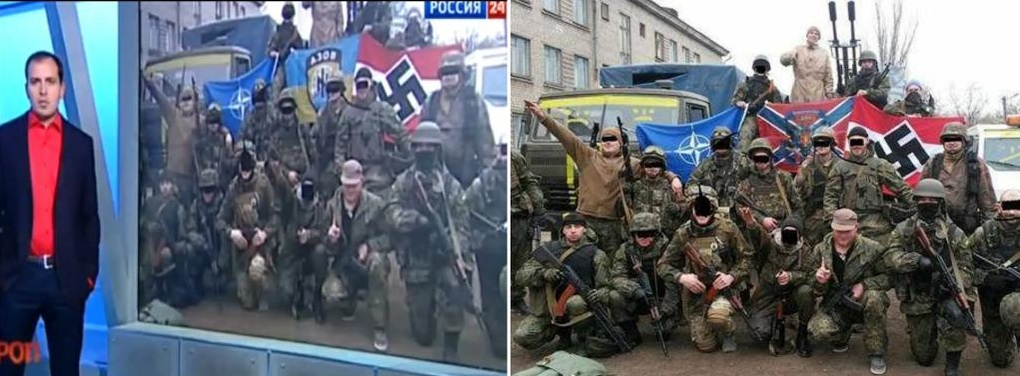
Extreme right-wing protestors in Europe with portraits of those they support

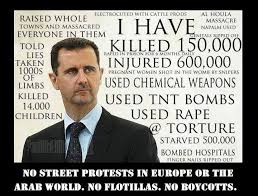
The Assad fascist regime is responsible for extreme human rights violations in Syria today. More than 220,000 people have been killed, 10 million people – half the country – have been forced from their homes, hundreds of thousands of political prisoners have been detained and 640,000 are living under brutal sieges without regular access to food, water or medicines. In September last year, the US-led coalition invaded Syrian airspace to bomb Daesh (ISIS) positions; yet a blind eye is turned when Assad’s aircraft bomb civilian populations and the revolutionary democrats from the same airspace, killing many more than Daesh.

* * * *

From Planet Syria: Two years ago on 21st August 2013 the world was focused on Syria after the government of Bashar al-Assad used Sarin on civilians in the worst chemical attack for a quarter of a century. (Since the Halabjah chemical attacks by the Saddam Hussein regime in 1988).

The world feigned outrage. Obama said a red line had been crossed.

But today the chemical attacks continue. Chlorine is routinely used in barrel bomb attacks on civilian neighborhoods. But it’s not the chemicals that are killing most people, it’s the bombs themselves.

Here are 5 things everyone should know about what is happening in Syria today:

1. The Assad regime is killing 7 times more civilians than Isis.

2. More than 11,000 barrel bombs made of scrap metal and high explosive have been rolled out of regime helicopters onto hospitals, homes and schools since the UN banned them. They are the biggest killer of civilians. They drive extremism.

3. These barrel bombs are the leading cause of displacement, forcing refugees to cross the Mediterranean and other borders.

4. Many of the barrel bombs are dropped on areas under siege. More than half a million people in Syria live in areas with no access to food, water or medicine since 2013, including the areas of Ghouta that were targeted by the sarin gas attacks in the same year.

5. The international anti-Isis coalition is flying in the same airspace where many of these barrel bombs are dropped, choosing to look the other way.

On the occasion of the second anniversary of the chemical attack on Ghouta, a suburb of Damascas, the National Coalition of Syrian Revolution and Opposition Forces has issued this statement:

It was a declared crime whose details and elements are well-known to everyone, whether they admitted it or not. They know the only party that does not lack the ability, the authority or the criminal will required to commit such a massacre, which is the Assad regime. They also fully aware that the regime has all the means of production, assembly and delivery of chemical weapons that were the tools of this this crime. They know the perpetrator by name, and also the names of the top regime officials who were involved with him. They know how he committed this crime and how he handed, with the utmost shamelessness, the murder weapon.

Two years have passed since the crime of the century, but the perpetrator is still at large. The families of 1,507 victims killed are still looking around for an international response equivalent to the size of the crime committed against their loved ones. And yet not a single measure has been taken to prevent the repetition of this crime. Death stills looms large over the head of Syrians, armed with every means of killing, ranging from knives and cleavers to barrel bombs, Scud missiles and chemical weapons. The Syrian Network for Human Rights documented 125 regime breaches of UN Security Council resolution 2118 and 56 breaches of UNSC resolution 2209 which criminalizes the military use of chlorine gas.

While we in the Syrian Coalition renew calls on the UN Security Council to shoulder its responsibilities in maintaining security and peace in Syria, and to take immediate action to stop the crimes against humanity and violations and to ensure that criminals are held accountable, we deplore the indifference of the international community which continues to deal with the blood of Syrians as a bargaining chip, a means to settle scores and exhaust opponents.

Having paid heavily for the sake of achieving our goals, we Syrians are now fully aware that we have to fight this battle relying only on the resolve of rebel fighters. Indeed, unity, rejecting discord, commitment to the principles of the revolution are the only guarantee of victory and liberating Syria from the Assad regime and its thuggish repressive security apparatuses and of the establishment of democratic rule which is bases on pluralism, justice and the rule of law.

We ask for Mercy for our fallen heroes, recovery for the wounded, and freedom for detainees.
Long live Syria and its people, free and with honor.

Assad’s strategy: don’t fight Daesh; direct it

The left has a proud history of opposition to fascism and indeed is the most reliable anti-fascist group politically. It is a puzzle as to how and why what passes for ‘left wing’ today can either be so neutral toward the Assad regime or adopt the entirely crypto-fascist slogan ‘Hands off Syria’. The puzzle is explained, in my opinion, by the fact that the left is more than a self-identifying label. It has a real content, defined by history, practice and theory. If someone tells you that western military involvement on the side of the Syrian people against the regime would be a disaster for the region, just ask the fundamental question: “A disaster for whom?” To those who beat their chests warning that US imperialism is out to dominate the region and that that claim somehow should mean leaving the unarmed populus to Assad’s barrel bombs, just tell them: “Your anti-imperialism is worthless if it ends up putting you on the side of the regional dictators who are oppressing and massacring the people as we speak”.

I wish to thank the good people at NOW. for permission to publish this article by Haid Haid, who is a program manager at the Heinrich Böll Stiftung’s office in Beirut. He tweets @HaidHaid22

c21styork

* * * *

 images

Assad is trying to turn his problems into opportunities by helping ISIS (Daesh; ISIL) choose what’s in his own best interests and allowing ISIS easier access to some areas than to others.

“Reports indicate that the regime is making air-strikes in support of#ISIL‘s advance on #Aleppo, aiding extremists against Syrian population,” the US Embassy in Syria tweeted on 1 June. Similar reports were published by other regional and international media outlets when ISIS made an unexpected and successful move against rebel groups north of Aleppo, disrupting their recent momentum.

To many of those who have been closely following what’s happening in Syria, this might not come as a surprise. Assad has avoided confronting ISIS, as they both benefit from one another. ISIS degrades and eliminates rebel groups that would otherwise be fighting Assad, and Assad’s regime presents itself to the West as the only local partner that can fight the terrorist group. This—at least publicly—unspoken agreement was broken in June last year after ISIS announced its caliphate. It seems, however, that the same arrangement is back on the table with some amendments due to recent developments.

Game changer Palmyra

Seizing Palmyra gave ISIS the advantage of many new strategic options, which will most likely change the dynamics of the armed conflict in Syria. The strategic location of Palmyra has allowed ISIS to cut the regime’s supply line to Deir Ezzor, and it opens the possibility of capturing other strategic locations, such as the Shaer gas and oil field. The broad desert has given them many alternative roads to various areas of Syria to expand and enforce their presence there; eastern Ghouta and eastern Qalamoun, rural Hama, rural Homs and rural Sweida. Capturing Palmyra was a game changer not only for ISIS but for the regime as well. Just consider the big number, and high symbolic value, of Assad regime losses on various fronts; the fear of the next rebels attack; the continued draining of resources (locally and regionally); the withdrawal of Iraqi militias who have returned home to fight; and the division in strategies between Assad and Iran—the former still trying to control all provincial centers, the latter restricting itself to areas considered useful within Iranian strategy.

Revised strategy

These developments have pushed Assad and his allies to find ways to cut down their losses and to conserve resources. It seems that Assad has found a way to turn his problems into opportunities by giving ISIS access to areas controlled by the rebels in order to drain their resources as they fight away from the regime, and he does so even if this costs him more territory. In Aleppo, for example, ISIS could advance through regime-controlled areas, including As-Safirah or Kweires Air Base, given the importance of these locations and due to pressure on the regime by other rebels groups in Idleb, combined with rumors that an Aleppo battle will be launched, which has made the regime even weaker. Even though capturing air bases might be considered its most important strategic goal, ISIS instead decided to intensify its attacks on areas controlled by rebels along the Suran-Mare axis in rural Aleppo. The regime also intensified its attacks on areas that have helped ISIS advance and control new villages. These developments forced many rebel groups, including members of the Army of Conquest coalition, to mobilize their forces and move them to prioritize fighting ISIS over the regime—at least in Aleppo.

The regime might also help ISIS to enforce its presence in eastern Ghouta, which will help the regime completely besiege Ghouta and engage rebels in another fight. Some recent reports mentioned that the regime has been busy transporting equipment from Al-Seine Airbase to Ad-Dumayr Airbase, which Assad’s opponents interpret as an evacuation plan. If this is the case, it could mean that the regime is either trying to conserve resources, or is scared that it might lose the air base, or both, which in any case will give ISIS access to eastern Ghouta. The same thing could also apply in eastern Qalamoun, Ar-Ruhaybah and Jayrud, to enforce their presence there and to keep the opposition busy in the fight against it.

US inaction

While the air force of the American-led coalition played a large role in defeating ISIS in Kobani, it didn’t react to ISIS’s latest attack on rebel-held areas, which gave ISIS the opportunity to move its forces freely. Many rebel leaders complained publically about the lack of US interest in helping them defeat ISIS in Syria, though it’s now apparent the US administration knows of the cooperation between Assad and ISIS. Sarcastically, activists started wondering if the US Air Force didn’t strike ISIS because Assad had crowded up the sky striking rebel groups. Maybe sarcasm is the only way that many Syrians, and to some extent non-Syrians, are able to understand US policy towards fighting ISIS.

* * * *

Iceland: a different vision (Bill Kerr)

In a world where the internet and governments are becoming less free the Icelandic visionaries see an opportunity to promote freedom as a nation building exercise

Never waste a good crisis (advice to those in other countries)

countries need to update their outdated constitutions

be clear about what you need to do and how to do it

catch the spirit of the nation by listening to the people

radical change only happens during crisis, at other times people become too complacent

* * * *

Thanks to Bill Kerr for permission to republish this post:

Iceland: a different vision

After hearing that the Pirate Party has become the most popular political party in Iceland (one source) I’ve been searching for information which explains how this happened.

What accounts for the difference in the way Iceland is developing politically?

The video at the top of this page, “From the Hell of the Crisis to the Paradise of Journalism” (1 hour 13 minutes) provides a dramatic and informative introduction to what has been happening in Iceland since the economic crisis of 2008 to the near present.

Alternatively, the paper on this page, Beyond WikiLeaks: The Icelandic Modern Media Initiative and the Creation of Free Speech Havens (pdf 24 pp), provides a written down version of similar information.

SUMMARY OF THE VIDEO:

“We were not separated from the majority of men by a boundary, but simply by another mode of vision. Our task was to represent an island in the world, a prototype perhaps, or at least a prospect of a different way of life”
– Herman Hesse. “Demian”

A particularly severe Banking crisis in 2008

Icelandic citizens in response held a weekly kitchen revolution outside parliament with clear demands (the Government, the Bankers and Monetary authorities should resign). These goals were achieved. Unlike other countries those responsible were punished.

A new government constitution was developed initially through crowd sourcing of 1000 citizens randomly (direct democracy) to develop it

The media was held complicit in not spotting the weakness of the Banks

Wikileaks helped by publishing information about corruption in those same Banks at that time

The Bank involved took legal steps to suppress that information – but this resulted in making things worse for them

In response the opportunity was taken by visionary leadership to launch a freedom of information revolution

One aim is transparent government, to move from secrecy by default to transparency by default

A large section of the video goes into detail of the FOI legislation, under nine subheadings. Also see Progress Report for detail

In a world where the internet and governments are becoming less free the Icelandic visionaries see an opportunity to promote freedom as a nation building exercise

Never waste a good crisis (advice to those in other countries)

countries need to update their outdated constitutions

be clear about what you need to do and how to do it

catch the spirit of the nation by listening to the people

radical change only happens during crisis, at other times people become too complacent

Role of PPPs (Public Private Partnerships) in Transition ( by Arthur Dent)

Guest post by Arthur Dent via Bill Kerr blogspot .

The need that has not been acted on is investment having become generally paralysed by world economic crisis. Not just traditional infrastructure but all kinds of large scale fixed capital construction projects are needed. The essence of transition from capitalism under such a scenario is that it is partially public and partially private.

* * * *

PPP = Public Private Partnerships

A scenario for transition from capitalism with socialized investment following another Great Depression and its (im)plausibility is discussed elsewhere.

For present purposes those assumptions are as arbitrary as the selection of some hypothetical specific PPP infrastructure project to pitch to some hypothetical target audience.

The need that has not been acted on is investment having become generally paralysed by world economic crisis. Not just traditional infrastructure but all kinds of large scale fixed capital construction projects are needed.

The essence of transition from capitalism under such a scenario is that it is partially public and partially private.

PPPs would be used for all major fixed capital construction projects that are significant for planning resumption of economic growth and ending mass unemployment. Buildings and plant that were previously (not) being privately financed, by single enterprises or project finance, not just the closely related “utilities”. Public institutions would also initially be largely untransformed, so public procurement of a traditional public utility infrastructure facility by a public agency would be subsumed under PPP arrangements as just another private participant that happens to be a public agency.

Public financial and economic planning and management organizations would be involved either as sponsors or minor participants in many types of build, own and operate projects, often taking substantial financial positions in both debt and equity based on the expropriated funds they are now able to invest as well as making ordinary commercial PPP arrangements with private participants.

The relatively small amount of economic and management expertise fully supportive of transition available to an inexperienced government would be heavily focused on the preparation, procurement and contract management/implementation of PPPs. They would have to structure the contracts so the private participants use their know how to maximize the public benefit in their own commercial interests. This would be very difficult and error prone, but not as implausible as simultaneously taking over all existing large economic institutions without enough skills to actually manage them in the public interest.

The much wider role of PPPs requires much better resourced public institutions responsible for PPPs. The relatively small numbers of government decision makers with adequate skills must supervise and structure appropriate incentives to motivate, much larger number of employees and consultants recruited from the private sector for their know how, despite their lack of support for transition.

Currently known “best practices” for PPPs would be generally applicable. There is no point in listing them. But the assumption of quite different circumstances imply many new lessons could only be learned from experience with at least the following differences from the usual circumstances.

1. Much greater transparency and much less corruption would be imposed on both the public and private participants as part of the broader social changes involved in transition.

2. Greater flexibility for detailed renegotiations would be necessitated by the circumstances of economic crisis and the more dynamic situations arising from transition.

3. Political, foreign exchange and national macroeconomic risks (interest rates etc) would be exclusively borne by the public participants and corresponding contingent liabilities and hedging or insurance costs appear openly on the central balance sheets. The public institutions responsible for exchange rates and macroeconomic stability would be closely involved in understanding the financial flows and risks they are assuming and the prices they require for asuming those risks and any hedging arrangements they may be able to make separately. Both international and local private participants would not need to make separate judgments or their own hedging arrangements for particular projects but only apply the sovereign risk ratings assessed uniformly by their own trusted ratings agencies.

4. Land use and resource management public agencies would likewise manage and appropriately price the responsibilities for land acquisition, site and regulatory risks.

5. Design, operations, construction, completion and maintenance performance risks would be exclusively borne by the private parties directly responsible for each aspect with detailed incentives tailored to reward overperformance and penalize underperformance. They would be carefully separated according to the expected and actual costs and risks borne by the participants engaged in each aspect and related global, national and sectoral statistical indexes.

6. Allocation of upside and downside market risks for supply of inputs and sale of outputs would be significantly more complex since the expropriation of private wealth for public investment in PPPs was made necessary by lack of profitable investment outlets in the prevailing market conditions of economic crisis.

The aspect for which each private participant is responsible must be commercially viable to that participant at the low competitive rates of return prevailing under crisis conditions. But the overall project need only be value for money to the public participants based on accepting an even lower (or even negative) return on their investment in order to achieve planned economic growth and rapid recovery from mass unemployment.

Transition from Capitalism (by Arthur Dent)

Guest post by Arthur Dent via Bill Kerr blogspot.

Any transition from capitalism in advanced capitalist countries as a result of another Great Depression would involve:

Inexperienced left governments required to urgently get the economy moving again and end mass unemployment because previous governments, whether claiming to be left or right, had been unable to do so.

Some level of rapid expropriation of privately owned wealth that was immobilized by the crisis now made available for socialized investment in new fixed capital construction projects to get the economy moving again and absorb unemployment.

The day after a change in government would be similar to the day before. The same social relations based on money, wage labor and capital, the same social institutions such as globalized large corporations, and national and local large, medium and small enterprises and bureaucratic government departments and agencies, and the same economic paralysis.

* * * *

This article is a placeholder for an introduction to a series of articles on various aspects of economic policy to be advocated before, and implemented during, the early stages of, a transition from capitalism in advanced capitalist countries under various different possible scenarios.

I am nowhere near ready to write any such articles, even as tentative drafts, so I cannot write an actual introduction.

Meanwhile one of the courses I am studying to become able to write such tentative drafts is a MOOC on “Public Private Partnerships” by the World Bank.

This requires as a final project for the policy and procedures track, publication of a “digital artefact” plus a description of the target audience in one hundred words.

I have published as my “digital artefact” the eight hundred word article on “Role of PPPs in Transition” [which will be published later – c21styork):

The key requirement is:
“Topic: Identify an infrastructure need that could be developed as a PPP. This could be a project that is in process of development, one on a country’s PPP project lists, or a need that has not been acted on. Think about the key facts or ideas you wish to convey by answering the following questions:
What is the infrastructure problem that the PPP is trying to solve?
What services are to be provided and are these services affordable?
What are the reasons that the private sector would want to participate?
How should these risks be allocated? Consider the country context in judging the risks and who should take them.”

I have identified as a “need that has not been acted on” the general paralysis of investment resulting in prolonged mass unemployment in another Great Depression worse than the 1930s following a financial crisis worse than 2008.

Such a worse financial crisis than 2008 does not seem to be entirely implausible since the last one seems to have been merely postponed rather than resolved by the extraordinary measures taken. Nor does another Great Depression worse than the 1930s seem entirely implausible following such a worse financial crisis.

The need is for all the infrastructure required to resume economic growth, not just traditional infrastructure like existing public utilities. The problem that has to be solved is that there are no profitable outlets for private investment in crisis conditions so investment must be socialized rather than left up to private investors.

This would require some form of state capitalism either as a transition back to “normal” private capitalism or as a transition away from capitalism.

The absence of any significant left in advanced capitalist countries, at least in the english speaking ones I am familiar with, makes any transition away from capitalism seem completely implausible. But then the continued absence of any significant left under the conditions of prolonged mass unemployment and economic paralysis seems even more implausible.

There are already important changes in the political climate of countries like Greece, Spain and Iceland that could become precursors of something much bigger. These countries are peripheral rather than central to the advanced capitalist world, but they are part of it and they are already facing serious economic and political crisis situations.

So I am writing for the target audience described at the end of this introduction, in the conceivable scenario described below.

The services to be provided are not traditional public utilities but the ending of prolonged mass unemployment through resumption of economic growth.

These services are affordable because prolonged mass unemployment is not affordable and both labor and capital are cheap in depression conditions. What is missing is profitability, not affordability.

The private sector would not particularly want to participate, but would not have better options available. Corporations would still want whatever contracts are available at the best returns they can competitively get for the benefit of their shareholders, whether or not some of their shares that used to belong to wealthy private individuals now belong to public institutions. Board members and senior managers who no longer wanted to participate because their incentives had been expropriated would be replaced by board members and managers willing to work for the owners, old and new, under the incentives currently being offered.

But the social system would not yet have been changed and risks and incentives would still have to be allocated in the context of an advanced capitalist country in crisis that is merely beginning a transition from capitalism, not one that has completed such a transition. So many of the same principles would have to still apply and new ones could only be understood and evolved over time.

Scenario

Any transition from capitalism in advanced capitalist countries as a result of another Great Depression would involve:

Inexperienced left governments required to urgently get the economy moving again and end mass unemployment because previous governments, whether claiming to be left or right, had been unable to do so.

Some level of rapid expropriation of privately owned wealth that was immobilized by the crisis now made available for socialized investment in new fixed capital construction projects to get the economy moving again and absorb unemployment.

The day after a change in government would be similar to the day before. The same social relations based on money, wage labor and capital, the same social institutions such as globalized large corporations, and national and local large, medium and small enterprises and bureaucratic government departments and agencies, and the same economic paralysis.

To simplify things I further assume a “simple” scenario with:

Expropriation narrowly targeted to take all and only the excess wealth of the top 1% of nationals.

This results in substantial investment funds becoming available to governments starting transition but most of the capital in each such country would still be held privately and by foreigners.

The most important capitalist countries such as the USA, China, Japan, and Germany would not be the first to start making the transition. But international financial and investment flows as well as trade continues.

Many top layers of management in most social institutions would be quite hostile to transition but there are enough supporters capable of supervising or replacing them.

Some of these assumptions may not look very plausible. But advocating measures based on such a “simple” case, would place the responsibility for different policies firmly with those who might prevent the policies discussed for this scenario by resorting to the breakup of international financial investment and trade flows, and civil and international wars.

Target Audience

I am studying economics, finance and other subjects to understand how capitalism works and become able to propose economic policies for transition from capitalism in advanced capitalist countries. Currently there is no significant left movement in such countries, but I am drafting tentative ideas for a wider future audience of prospective government policy makers expected when a financial crisis like 2008 eventually becomes another Great Depression like the 1930s. They are not concerned with some specific PPP project. I am conveying one possible policy option for managing partially socialized and partially still private investment projects using PPPs.

Turn down the hype (by Arthur Dent, formerly Albert Langer)

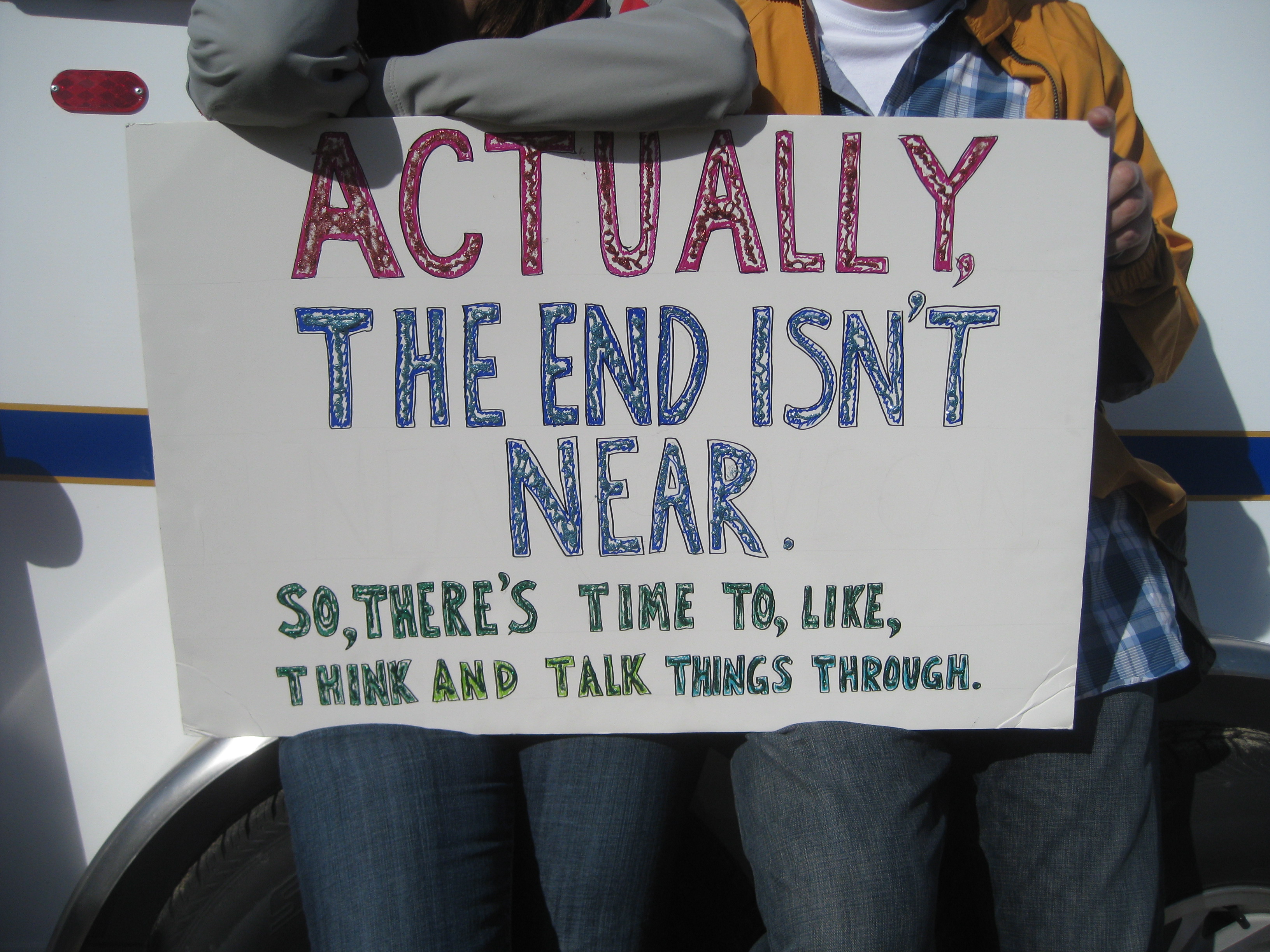
the-end-isnt-near


Originally published as a guest post at Bill Kerr‘s blog by Arthur Dent on 21st May, 2015.


* * * * * *

According to the World Bank:

“By acting now, acting together and acting differently, we will be able to transition to a low emissions, climate resilient development path and hold warming below 2°C.”(1)

To help achieve this, a MOOC sponsored by the World Bank (Turn Down the Heat) requires students to produce “digital artefacts” with the aim “create a sense of urgency and a call to action for individuals, companies or countries to change behaviors associated with a warming planet”.

My call is for the World Bank to change its behaviour and “turn down the hype”.

It should be obvious that none of the measures advocated by the World Bank have had much impact on the planet warming, and there is no reason to expect that creating a sense of urgency in support of more of the same will have a better result.

The IPCC’s authoritative report on Mitigation of Climate Change(2) shows clearly that there is no realistic prospect of holding warming below 2°C.

The simple reality is that most emissions will result from the rapid industrialization of developing countries like India and China who cannot and will not switch from the cheapest energy sources available while they remain poor. No amount of hype will change that reality.

If the problem was as grave and urgent as claimed there would be no alternative but for developed nations who can afford the cost to switch from cheaper fossil fuels to more expensive nuclear power and also pay the costs of the entire world doing the same. But the World Bank does not advocate that, so it is difficult to believe it takes its own hype seriously.

Wind and solar power cannot solve the problem because they are intermittant. Power is also needed when the wind is not blowing and the sun is not shining. There is no technology on the horizon that could store energy cheaply enough to compete with the dispatchable power from fossil fuels, even if wind and solar power was free. Instead of pretending that wind and solar could do the job it is clearly necessary to act differently. Since there is no viable replacement for fossil fuels on the horizon that developing countries could afford, it is necessary to do something very different from what the World Bank advocates.

We will need some breakthroughs in fundamental technology. Neither the regulatory nor the market pricing mechanisms advocated by the World Bank can achieve that. Massive investments in research and development and fundamental science are required. Contrary to the hype there is no “return” on that investment. As with all fundamental science, the results have to be made freely available to the countries that are too poor to pay for it. So the “free rider” problem ensures that no carbon pricing mechanism could motivate such investment. At present each developed country is hoping that somebody else will pay to develop the necessary technology. There is no “national” benefit in doing so. It is a global, not a national problem. The most ambitious national targets for R&D are about 3% of GDP for all purposes. These targets are not being met, despite the fact that new technology is the driving force for economic growth.

A global levy on developed countries that can afford it is required, to pay for the costs of a massive global R&D program that is not expected to produce any “return” on the investment, other than “merely” solving the problem of global warming.

That may require a significant expansion in the total scientific workforce and consequently a long lead time for education.

If it is not successful, then we will have to resort to some combination of geo-engineering, adaptation strategies and subsidizing nuclear power in all countries, at potentially vastly greater costs. But even if a massive global R&D program failed to produce clean energy competitive with fossil fuels, it would at least accelerate economic growth generally and enable the whole world to afford more expensive energy than fossil fuels more quickly.

“Modernization has liberated ever more people from lives of poverty and hard agricultural labor, women from chattel status, children and ethnic minorities from oppression, and societies from capricious and arbitrary governance. Greater resource productivity associated with modern socio-technological systems has allowed human societies to meet human needs with fewer resource inputs and less impact on the environment. More-productive economies are wealthier economies, capable of better meeting human needs while committing more of their economic surplus to non-economic amenities, including better human health, greater human freedom and opportunity, arts, culture, and the conservation of nature.”(3)

We need more modern technology, not medieval windmills.

(1) WDR 2010: Development and Climate Change
(2) Working Group 3
(3) An Ecomodernist Manifesto

Alarmism – it really frightens people and it sucks

zzz

California’s imminent deathbed? Really?

Green alarmism generates newspaper sales, TV ratings and hits on social media but it is a big problem standing in the way of reasoned and effective political responses to environmental problems. The latest alarmism comes from California where the Internet is abuzz with talk of California’s water supply running out in a year’s time. It is amazing how many publications, including mainstream ones, have run this line.

The Guardian’s headline said it all: “Drought-stricken California only has one year of water left, Nasa scientist warns”.

Good heavens! Who can argue with a NASA SCIENTIST?! The Guardian names the Nasa scientist – an expert on the global water cycle, Jay Famiglietti. He has an impressive curriculum vitae.

The original source for all this is the Los Angeles Times, which ran an opinion piece by Dr Famiglietti.

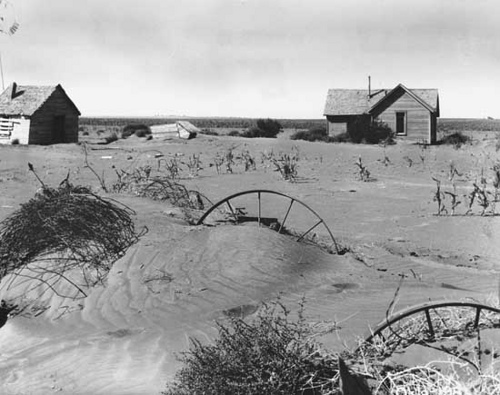
On social media, there is a photo doing the rounds showing the 1930s dustbowl period in the US with a caption: “R.I.P. California (1850-2016): what we’ll lose and learn from the world’s first major water collapse”. The opener claims that NASA has announced that California is on its death-bed and only has 12 months of water left.

Alarmism is a scourge but it can easily be repudiated with some good critical thinking:

1. Always read the article, not just the sensationalist heading and opening paragraph. In The Guardian above, the actual article offers no evidence whatsoever for the claim in the headline and Dr Famiglietti’s words do not make that claim. No other Nasa scientist is quoted. The Nasa scientist has been misrepresented. Neither does Nasa claim that California is on its death-bed.

2. Check the original source, do not rely on the journalist’s take on it. Who knows, they may be influenced by green doomsdayism! Or out to sell their paper. Or, more likely, both. In this case, on checking the LA Times article by Dr Famiglietti, there is again no claim by him that California’s water supply is about to run out within 12 months. The LA Times later ran a retraction, of sorts, pointing out that the original headline suggested that California only had a year’s supply of water left and that what they meant was that there was only a year’s supply in storage. So, the editor changed the headline. And also apologized to Dr Famiglietti for calling him James instead of Jay. This aspect to the apology ran first, followed by the bit about storage. True.

3. Google the scientist to see what they actually believe. Normally I would do this but it hasn’t been necessary as a week later, on March 20th this year, the LA Times itself published a second report which allowed correction by Dr Famiglietti of the original article’s misrepresentation of his views. The key bit is: “he never claimed that California has only a year of total water supply left”. Say what? Now that’s quite a difference, a huge difference, and a point of view that does not serve an alarmist agenda. But it won’t stop the scores of thousands of sharers of the original false report spreading their alarmism via social media and other media, all with the imprimatur of a (non-existent) Nasa scientific source.

The LA Times article continues:

“He (Dr Famiglietti, the Nasa scientist) explained that the state’s reservoirs have only about a one-year supply of water remaining. Reservoirs provide only a portion of the water used in California and are designed to store only a few years’ supply. But the online headline generated great interest. Famiglietti said it gave some the false impression that California is at risk of exhausting its water supplies. The satellite data he cited, which measure a wide variety of water resources, show “we are way worse off this year than last year,” he said. “But we’re not going to run out of water in 2016,” because decades worth of groundwater remain”.

Decades worth of groundwater. Okay?

4. Be rational in considering political responses. No-one disputes that California is experiencing a severe drought, one of the worst in its history. Like Australia, that’s the way it has been for a very long time. Severe droughts are part of the landscape of America’s west coast. California has a pressing problem to do with stored water – “way worse off than last year” – during a period of extended drought. Practical responses are needed.

Why is it that no Californian government has built a large dam for water storage since the mid-1970s? The State’s population has increased by 15 million since then. I have a feeling that those who spread false alarmism also oppose the construction of large new dams to capture the rain that does fall (and that has fallen over California since the last dam was built in the 1970s). This is a logical outcome of a ‘green’ world outlook that opposes progress through mastery of Nature and development and that seeks harmony with Nature through sustainability. It is the opposite of a Marxist-influenced left-wing outlook.

Oh yes, and some good news. While southern California is still in a bad way, northern California has had a reasonable soaking. Rainfall levels are at 100 percent of their historic average or above in nearly every city, and reservoirs, while still not back to normal, are steadily filling.

New dams anyone?

Remote hopelessness (via Bill Kerr blogspot)


Thanks to Bill Kerr for permission to republish the following post from his Bill Kerr blogspot.

* * * *

I watched Remote Hope on 4 Corners. In some respects it was quite a good expose about how bad things have become but it still didn’t drill down deep enough into the fundamental basis of the problem or interview those who have thought deeply about it and grappled with a solution.

Tony Abbott (“lifestyle choices”) and Colin Barnett (“put yourself in my shoes”) have both shot themselves in the foot and are easy targets. But what is needed is not a free kick of unpopular politicians but an honest description of the problem and some deep thought about a solution.

Some good people have thought deeply about the issue of remote indigenous community dysfunction: Peter Sutton, Noel Pearson, Marcia Langton, Bess Price and Stephanie Jarrett, to name a few. They are the whistle blowers and they blew the whistle a long time ago. Noel Pearson’s essay Our Right to Take Responsibility was delivered in 2000. Why didn’t the ABC interview these people?

I thought some of the people interviewed were very good in describing the problem:

  • the Broome mayor, Graeme Campbell
  • John Hammond, the Perth Lawyer, who supported some shut downs of dysfunctional communities
  • Anthony Watson who plans to camp on Cable Beach, inconveniencing tourists, and bringing a real problem to the attention of Australians
  • Karl O’Callaghan, the WA police commissioner, was good, pointing out facts (sex abuse 10 times higher than anywhere else), supporting closures of dysfunctional communities and even providing an emotional response, that he couldn’t sleep at night, whether rhetorical or not, it was correct
  • Susan Murphy right at the end, we can’t keep giving handouts

I thought Tammy Solonec of Amnesty International was terrible, talking about human rights in the abstract, not based on any analysis of reality.

The best attempt at a solution so far is that proposed by Noel Pearson and his Family Responsibility Commission. See the article by Catherine Ford about that, Great Expectations: Inside Noel Pearson’s social experiment.

Admittedly nothing about this issue is going to easy. But the problem came about due to bad policy that superficially looked like humane policy. Equal wages led to indigenous unemployment. Welfare led to alcohol and drug abuse and child abuse. The bad policy has dragged on for many years after it was pointed out. Nevertheless, bad policy can be corrected. Of course, it is too late for many but correction of bad policy offers real hope which can grow over time for some.

Kerry O’Brien said right at the end that there was no easy solution but still the puzzle is why they didn’t put Noel Pearson on who has come up with a hard solution. I think the ABC is more interested in easy hits on Abbott and Barnett than proposing a real solution. See my earlier article, The closure of remote indigenous communities, for links to the ideas of Marcia Langton and Stephanie Jarret on this issue.

Magna Carta: Reignite the spirit of rebellion!

Freedom is never given to us – it must be won.

As long as the human spirit retains its aspiration for liberty, Magna Carta will serve as a symbol of the neverending struggle for freedom.

No sooner did the rebellious barons force King John to grant them Magna Carta in June 1215 than it was annulled, just 10 weeks later, by Pope Innocent III. Although it was reissued by John’s son Henry in 1216, its status remained insecure, until a definitive version was conceded in 1225. What the experience of the 13th century demonstrated is that hard-won rights and freedoms can never be taken for granted.

Magna Carta was by no means the last word on freedom. It was a medieval document that provided safeguards against the arbitrary rule of the king. It implicitly upheld ideals that would gradually crystallise into a tradition that respected the rule of law. Some historians have questioned the iconic status of Magna Carta, on the grounds that it was a ‘Baron’s Charter’ and did little to protect ordinary people from injustice. However, what was important about this document was not simply what it said, but how it was seen by successive generations.

Magna Carta provided the foundation for a political culture that celebrated freedom against the exercise of arbitrary authority. English customary law drew on the precedent of the rebellion against King John to question and, in the end, unsettle the claim to Divine Right Kingship. Magna Carta was idealised and turned into a foundational myth by the radical wing of the parliamentary opposition to the Stuart dynasty. One of my heroes John Lilburne (1615-57), a true champion of liberty and one of the leading voices in the Levellers, linked the ideals of Magna Carta to the foundation of a new nation. Lilburne went to prison to defend the right not to incriminate oneself. He argued that self-incrimination violated Magna Carta.

Over the centuries, Magna Carta has become a historic document to which a bewildering variety of parties have attached their democratic and freedom-oriented ambitions. Although it has served as a foundation for English identity, its idealisation has transcended the borders of any single nation. Its universal appeal speaks to the universal attempt to overcome the obstacles to freedom.

The necessity of almost every generation since 1215 to appeal to the precedent set by Magna Carta points to the always precarious status of freedom. Freedom depends on a political culture that takes the principles of an open and democratic ethos seriously. History shows that freedoms that really mean something are won through the action of public-spirited people rather than being gifted by a benevolent ruler or state. In the current era, this lesson is often overlooked, as campaigners and movements look to the state to ‘empower’ them.

This misconceived project of finding freedom through the state rather than fromthe state is encouraged by an ideology that mistrusts people. Eight hundred years after the sealing of Magna Carta, we are confronted with the uncomfortable fact that in many Western societies, individual freedoms are no longer highly valued. The casual manner in which freedom of conscience and freedom of expression are often disregarded means that the rule of others – whether formal or informal — can too often be implemented with little resistance.

The spirit of rebellion which animated lovers of liberty from the 13th century onwards need to be reignited, so that the new generations assuming responsibility for the future understand that freedom is not just another word.

Frank Furedi is a sociologist and commentator. His latest book, First World War: Still No End in Sight, is published by Bloomsbury. (Order this book from Amazon (UK).)

War? Huh! What is it good for?! Over-throwing Fasc-ism! Say it again! Victory over fascism – 70th anniversary

“I have always believed and I still believe that it is the Red Army that has torn the guts out of the filthy Nazis”.
—Winston Churchill, Speech in the House of Commons, October 1944

* * * *

Awesome groove but bullshit lyrics

May 8 and May 9 marks Victory Days for Europe and the former Soviet Union and is commemorated around the world.

In Australia, the 70th anniversary of this world-historic event did not receive the recognition it deserved. Yet World War One, an inter-imperialist conflict in which the working classes had no real interest, has been a prominent part of television, radio and print-media diet.

The centenary of Gallipoli received scores of millions of dollars in government funding, beginning with the Gillard Labor Government’s provision of $83 million funding for it.

How the world would have been had Hitler and the Axis powers won is too horrendous to contemplate, but it took a terrible toll to defeat them.

In that struggle, Stalin and the Soviet Union played the lead role.

I’m not usually into speculative history, but I sometimes wonder how differently things would have developed had Britain and France agreed to Stalin’s pleas for ‘collective security’ against Hitler’s rise. This would have required collective action in the advent of German aggression. Sadly, the British ruling class at that time hoped that Hitler would keep to his promise to ‘turn east’ in keeping with the ‘lebenstraum’ agenda advocated in ‘Mein Kampf’.

All that can be done now is to ensure that VE Day and Soviet Victory Day continue to be commemorated and that the lessons about the nature of fascism and the need to defend democracy be learned.

The Allied victory in World War Two shows that there is such a thing as just war – war is not “futile” – and it is a momentous mistake to turn a blind eye to, or appease, fascist regimes.

It is ironic indeed that Russian President Putin, himself bearing so many characteristics of a fascist, is trying to attach himself to the anti-fascist Stalin and the Great Patriotic War while embarking upon imperialist aggression in the Ukraine.

Lest we forget the toll of the greatest anti-fascist struggle:

419,000 Americans died
451,000 Britons died
28,000,000 Soviets died.

The Axis deaths exceeded ten million.

In the world today, fascistic regimes such as that of al-Assad in Syria are just as deserving of overthrow as were Hitler, Mussolini and Franco. There are particular similarities with the latter – the rise of fascist dictatorship in Spain in the 1930s – when the international Left called for intervention by the West to restore the elected Republican government.

Only the Soviet Union took military action against Franco. Stalin provided the Republicans with between 634 and 806 planes, 331 and 362 tanks, and 1,034 and 1,895 artillery pieces. Not to do it would have meant leaving the Republicans open to massacre. Nazi Germany and Fascist Italy were certainly aiding the Franco regime, with Germany supplying powerful air and armoured units, while the British and French governments retained their policy of non-intervention.

Perhaps the finest way to honour the war dead is to ensure victory for the democratic forces in Syria and those elsewhere around the world fighting tyranny. To do this, to support our brothers and sisters fighting fascist regimes, may require war, military intervention.

Sometimes, only war can defeat fascism. Tragically, it is good for something.

* * * *