
Nina Simone was influenced by two actvists who were themselves influenced by Marxism and who she knew personally, Lorraine Hansberry and Langston Hughes. She was a fighter, who used her music as a weapon in struggle.
Continue readingCategory Archives: Uncategorized
Multipolarity, the Mantra of Authoritarianism (reprinted from ‘The India Forum: a journal-magazine on contemporary issues’ (December 2022)
I just wish the term ‘pseudo-left’ would be used instead of ‘Left’. Those who support the autocrats and fascists against the people struggling for democracy can never be regarded as on the left, no matter how they might self-identify.
******
Multipolarity,
the Mantra of Authoritarianism
The Left’s advocacy for ‘multipolarity’ against a US-led unipolar order has, in effect, defended authoritarianism across the world. The Left must reflect on how its language enables such regimes.
Continue readingTwilight of the American Left – from Unherd
This essay by Park Macdougal is reprinted from ‘Unherd’
“The most vulgar, simplistic view of the Left — that dissolves all the supposed distinctions between centrists, liberals, leftists, socialists, communists into one homogenous Democratic blob — happens to be correct.” So writes Benedict Cryptofash, an anonymous Twitter user and self-described “anti-leftist” whose other theoretical contributions include “the Left and Right are fake and gay” and “only libtards care about policy”.
Continue reading“Radicals” Book Launch 6pm Thursday 9 June

This Thursday. Solidarity Hall, Victoria Trades Hall
54 Victoria St, Carlton VIC 3053.
Continue reading‘An alien association’: Master of Arts thesis on Maoism and the Communist Party of China 1971-1977
The late John Herouvim wrote a Master of Arts thesis at La Trobe University in 1983, drawing on wide and meticulous research and interviews with Communist Party of Australia (ML) members and former members. The former members included veterans of the working class struggle such as Clarrie O’Shea, Bill Wilson and Marj Broadbent. Most of the interviewees were still members and requested anonymity but they wanted to speak because of their growing disillusionment with that party.
I only recently came upon a copy of the completed thesis. It hasn’t previously been scanned, to the best of my knowledge.
I am yet to read it properly but recall having a few differences with John, such as his use of the term ‘ultra left’ too loosely. At the time he was researching it, there were a few social-fascist types who tried to stop his progress. John purchased a large steel safe, like a fridge, in which he kept his notes and drafts. He told me once that the safe would even survive a bomb blast. Thank heavens, it was never put to that test.
Ted Hill, the party chairman, wasn’t happy about John’s research and declined to cooperate with him but I remember John telling me that Hill offered him unrestricted access to the archives of a small trade union should he drop the project and focus on a history of that union instead. Presumably, the party had strong influence in that union, whose name I forget.
The thesis is now an historical document about a party and period that, in my view today, represented the decline of the left. I didn’t articulate my frustrations in that way at the time but quit organisationally in late 1980 or early 1981 and had no problems with being interviewed by John for his thesis. I was in the esteemed company of Clarrie O’Shea, after all.
Nearly four decades on, I have scanned the thesis and share it here (in four parts).
****
Tiananmen Square 1989 – an American Marxist-Maoist’s view from the ground
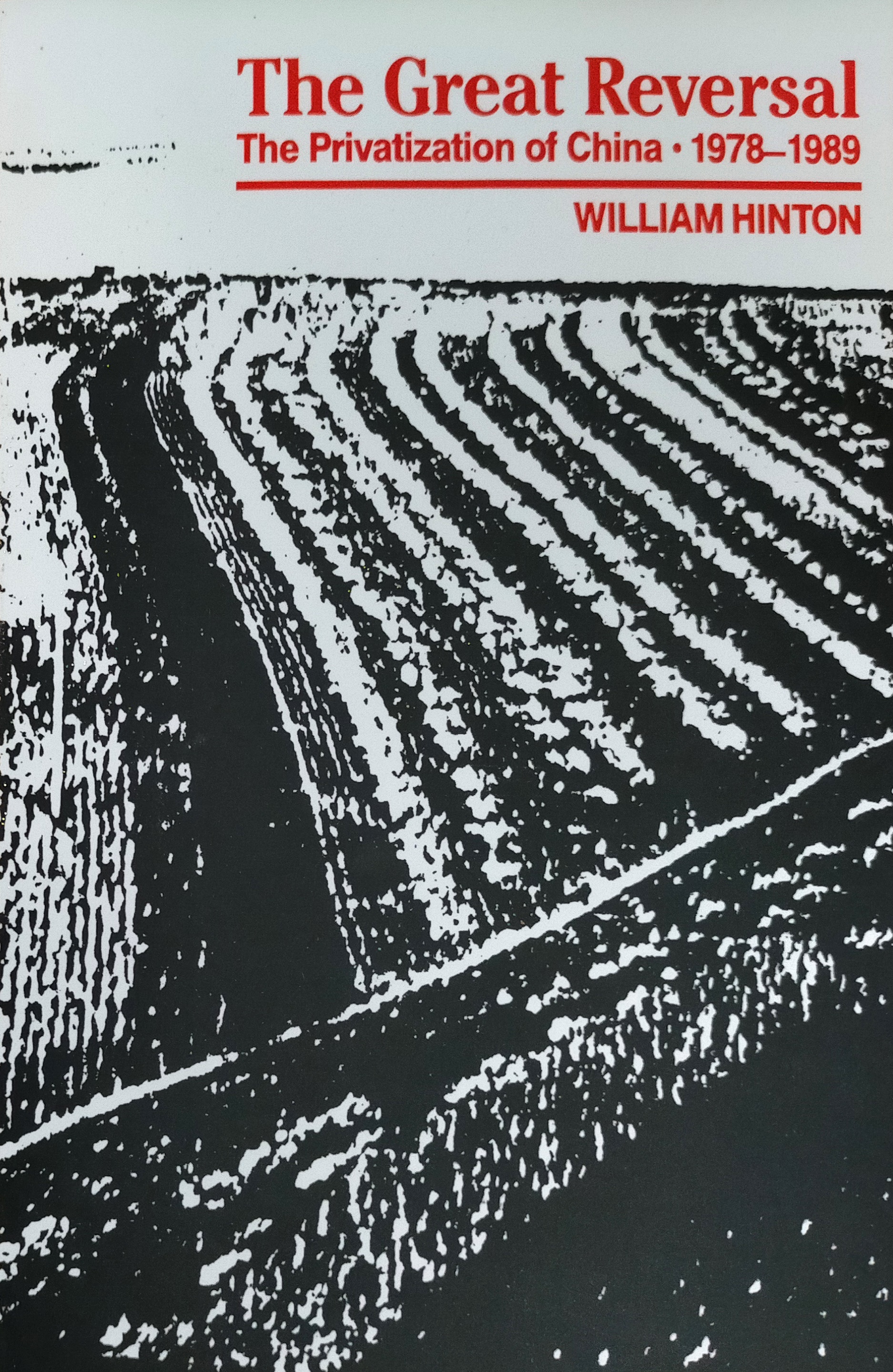
William Hinton (1919-2004) was an American Marxist who lived and worked in China before and after the revolution of 1949. In 1966, he wrote up his experiences and observations of daily life, class struggle, strategic planning and social transformation in Long Bow village. The book, ‘Fanshen‘, remains a classic. (‘Fanshen’ broadly means overturning something).
As a Marxist and ‘Maoist’, Hinton naturally rejected the ascendancy of the capitalist-roaders, such as Deng Xiaoping, and pulled no punches in his 1983 book, ‘Shenfan’ (meaning the opposite of Fanshen).
The account of what happened at Tiananmen Square in Hinton’s book is here.
I’m posting this because, incredibly, there are still people around who claim to be leftists but regard the rebellion as a foreign plot, its suppression as justified, and the massacre as fake news.
********
Iran – where there is repression, there is resistance
My only disagreement with this article is the author’s use of the word ‘leftists’ to describe those in alliance with the Iranian clericalist regime. She should use the term ‘pseudo-leftists’, as that is accurate…. B York
Iran: A New Wave of Mass Protests and Strikes
(written by Frieda Afary, reprinted from her blog ‘Iranian progressives in translation’)
Iran is experiencing another wave of mass protests and strikes as economic, social, political, environmental and health problems make it impossible for the large majority of the population to have the bare minimums needed to live.
Petrochemical Strikes, Protests Against Water Shortage
A new wave of mass protests over severe water shortage in the mainly ethnic Arab province of Khuseztan began on July 15. Protesters’ slogans have included: “Down with Dictatorship.”, “Down With Khamenei”, “We Don’t Want An Islamic Republic”, “The People Want the Regime to Fall.” Government security forces have shot and killed at least 8 protesters and injured and arrested many others. However, solidarity protests have started in Azarbaijan, Kurdistan, Isfahan, Sistan & Baluchistan and Tehran. Iranian filmmakers, teachers and writers’ groups have co-signed a joint statement in support of the protests. (https://iranwire.com/en/features/9985)
In the words of a statement of solidarity by the Tehran Bus Workers’ Syndicate: “The lack of water in Khuzestan today is rooted in the unprofessional, rapacious and profit-centered policies of the prior decades of capitalism in oil extraction and use of water for the steel industry, the income from which does not go to the people. These insatiable policies have deprived the people of Khuzestan of safe drinking water. Water is shut off for long hours and it is lacking for basic needs. Farmers and cattle growers have also been damaged and lost their livelihoods.” (https://www.akhbar-rooz.com/%d8%b3%d9%86%d8%af%db%8c%da%a9%d8%a7%db%8c-%d8%b4%d8%b1%da%a9%d8%aa-%d9%88%d8%a7%d8%ad%d8%af-%d8%b3%d8%b1%da%a9%d9%88%d8%a8-%d9%88-%da%a9%d8%b4%d8%aa%d8%a7%d8%b1-%d9%85%d8%b1%d8%af%d9%85-%d8%ac%d8%a7/)
The latest protests have followed a series of nationwide strikes of temporary contract workers in Iran’s oil and gas industry which is also heavily based in Khuzestan. The strikes which began on June 19 and have spread to a hundred production sites, are demanding permanent employment status, a $500 monthly wage, safe working conditions and the right to organize and be free of police surveillance. Haft Tapeh sugar cane workers on strike in Khuzestan are also asking for COVID vaccination and expressing solidarity with protests against the lack of water.
Economic Crisis and COVID Pandemic
Iran continues to suffer from a massive economic crisis brought about by the costs of its regional imperialist interventions in Syria, Iraq, Lebanon, Yemen, its nuclear and missile programs and the effects of U.S. economic sanctions. The official minimum wage is approximately $120 per month in a country where the cost of bare necessities for a family of 4 is $500 per month. Electricity is shut off for several hours on a daily basis. Access to the internet is becoming more limited or impossible for many because of the cost and government repression.
In this situation the COVID pandemic has been wreaking havoc on the population. The Delta variant of COVID continues to spread widely. Over 95% of the population is not vaccinated and has no access to any vaccines, much less safe ones. (https://graphics.reuters.com/world-coronavirus-tracker-and-maps/countries-and-territories/iran/) The official number of deaths is approximately 88,000, but the real numbers are much higher. (https://www.cnn.com/interactive/2020/health/coronavirus-maps-and-cases/ ) A large part of the population of 83 million has been infected. However, no accurate figures exist because of government repression.
COVID is spreading rapidly in Iran’s prisons, which have an official population of 190,000. Women prisoners are also suffering from and dying from COVID. They include journalists, teachers, feminist and labor activists, students, environmentalists, Kurdish and Arab civil right activists, as well as Baha’i and Sufi women.
Women Prisoners and Afghan Refugees
Nasrin Sotoudeh, imprisoned feminist human rights attorney and defender of the “Girls of Revolution Avenue” is suffering from a variety of health problems in addition to COVID. Narges Mohammadi, feminist activist against the death penalty who has been nominated for the Nobel Peace Prize, was released last year after a long prison sentence, only to receive another prison sentence which also includes 80 lashes for continuing to oppose the death penalty and “endangering national security.” She has been fighting this sentence, and has attended protests in solidarity with the people of Khuzestan, striking workers and the families of political prisoners. In a recent interview, she called Iranian women’s struggles “the Achilles heel of the Iranian regime”. (https://www.facebook.com/voicesofwomenforchange/videos/241864884051720) Sepideh Gholyan, feminist labor activist , imprisoned in Khuzestan, continues to write about the plight of ethnic Arab women prisoners. She has been savagely beaten in prison and is now on hunger strike.
Afghan migrants and refugees who number approximately 3 million in Iran continue to be expelled ( 450,000 expelled since 2020). The Iranian regime has been holding negotiations between Taliban and the Afghan government under the direction of Iranian foreign minister, Javad Zarif (https://www.radiozamaneh.com/676068/) and is helping the Taliban strengthen their power even though the Taliban have been killing members of the Shi’a Hazara population in Afghanistan. (https://www.washingtonpost.com/world/asia_pacific/afghanistan-hazara-taliban/2021/06/30/fae16a60-d815-11eb-8c87-ad6f27918c78_story.html)
Iran’s Continuing Regional Ambitions and U.S. Imperialism’s “Solutions”
In the midst of all these crises and protests, the Iranian government maintains its regional imperialist interventions in Syria, Iraq, and Lebanon. It promotes its plots to kidnap and assassinate opposition activists in exile. (https://iranhumanrights.org/2021/07/foiled-kidnapping-of-dissident-part-of-irans-ramped-up-campaign-to-crush-dissent/) It continues to develop its nuclear and missile programs and has stopped its negotiation with the U.S. Biden administration on returning to the JCPOA nuclear agreement.
The “election” of Ebrahim Raisi as Iran’s next president had the lowest rate of mass participation even by Iran’s standards which were very low to begin with. Raisi was previously the head of Iran’s judiciary and immediately prior to that, the head of GHORB, the construction conglomerate of the Islamic Revolutionary Guard Corps (IRGC). He is infamously known as a member of the “Death Commission” which ordered the executions of thousands of political prisoners in 1988. Under his watch, approximately 1500 people were killed by government forces during the November 2019 uprising. (https://www.reuters.com/article/us-iran-protests-specialreport/special-report-irans-leader-ordered-crackdown-on-unrest-do-whatever-it-takes-to-end-it-idUSKBN1YR0QR) Amnesty International has condemned him for committing crimes against humanity (https://www.amnesty.org/en/latest/news/2021/06/iran-ebrahim-raisi-must-be-investigated-for-crimes-against-humanity/)
U.S. New York Times columnist, Thomas Freedman reveals imperialist inhumanity in his recent column on Iran where he offers a “solution” that is “the best anyone can hope for with Iran.” (https://www.nytimes.com/2021/06/15/opinion/iran-biden-nuclear-deal.html?searchResultPosition=1) He argues that the U.S. with the help of Gulf states should give more financial aid to the Assad regime to kick Iran out of Syria, maintain Russia and Turkey as dominant powers and assure the continuation of the Assad regime. This he says would reduce Iran’s danger and satisfy the U.S. and Israel. To him, the people of the region, the Syrian Arabs and Kurds and the Iranian population, are mere pawns on the U.S. and global Imperialist chessboard.
Needed Progressive Solidarity with Struggles inside Iran
No less cynical are those leftists and so-called socialists around the world who support the Iranian regime as “anti-imperialist” or refuse to criticize it.
Those who limit their solidarity to calling for the removal of U.S. sanctions, refuse to recognize the complexity of the problems in Iran. They do not address the fact that these problems are rooted both in the external imperialism of the U.S., Russia. China and internal capitalist militarism and religious fundamentalism.
Any effort to engage in solidarity with the struggles inside Iran begins not only with calling for the removal of U.S. sanctions and an end to Israel’s attacks, but also simultaneously holding the Iranian regime accountable for its repression and exploitation of the people and environment of the region. That recognition demands calling for the immediate release of political prisoners, expressing solidarity with striking workers, feminist and environmental struggles, oppressed ethnic, sexual and religious minorities, and demanding Iran’s withdrawal from Syria, Iraq and an end to its interventions in Afghanistan, Lebanon and Yemen.
Frieda Afary
July 25, 2021
Radicals – remembering the sixties and Panel Discussion tomorrow Sat 22 May
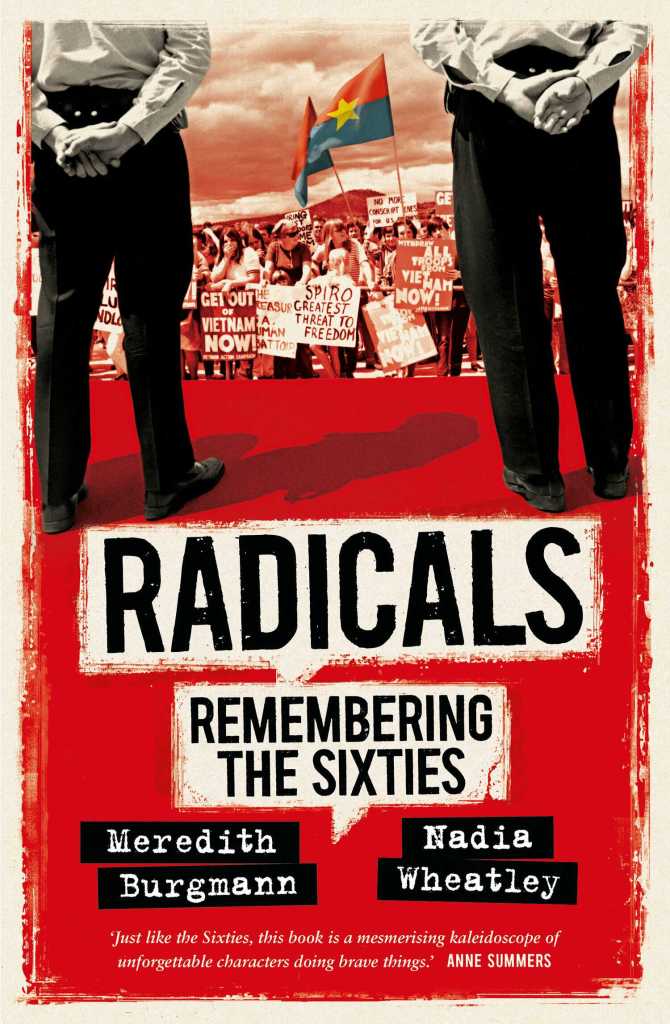
A review of “Radicals” by Meredith Burgmann and Nadia Wheatley has been overdue since March but will remain overdue since notice of a panel discussion on “What is Capitalism” will be obsolete tomorrow, this Saturday. The direct connecting link is simply that there is chapter on “Albert Langer (Arthur Dent): Hardened Apparatchik” in the book and Arthur Dent is also on the panel at discussion this Saturday, tomorrow.
I have been too preoccupied catching up on mRNA vaccine manufacturing to write on anything else and have run out of time to mention both separately.
For now I will focus on tomorrow’s discussion, but first just quickly provide links for the book in case anyone turning up here from the discussion might be interested. It is well worth reading for anyone wanting background on the Sixties in Australia (not just because it has a very friendly treatment of me in the chapter by a fellow rebel, Nadia Wheatley).
As well as the chapter and short bio notes at pp 362-3 there are background links on pp 380-381 including:
“It is Right to Rebel” written by Monash student radicals to pass on lessons. The epub version is better than the pdf:
https://archive.org/details/it-is-right-to-rebel-1972
Other works by Nadia can be found at:
You can order the book here:
http://nadiawheatley.com/book-shop/radicals-remembering-the-sixties
There will also be a Melbourne book launch on Thursday 24 June at Trades Hall 6pm to 8pm.
Q&A panel will have the Melbourne people described by chapters – Gary Foley, Margaret RoadKnight, Margaret Reynolds, Peter Bachelor and me. Links will eventually be at Nadia’s web pages above.
The cover highlights the flags of the National Liberation front of south Vietnam:
There is of course also a deeper connection between a panel discussion about Capitalism in the 2020s and a book about Radicals in the sixties – more than half a century ago.
That connection is the fact that Radicals were central to the existence of a broader Left in the sixties and the absence of Radicals is central to the absurdity of what gets passed off as the Left today. I’ll be speaking tomorrow putting forward some ideas on why Radicals fought the pseudoleft back then and why that must, and therefore will happen again.
So, first the panel discussion, this Saturday, tomorrow, 22 May, 3pm to 5pm at the rear lounge of the The Clyde Hotel
385 Cardigan St, Carlton, 3053. Postponed from original 1pm due to clash with Palestinian rally at 1pm, State Library:
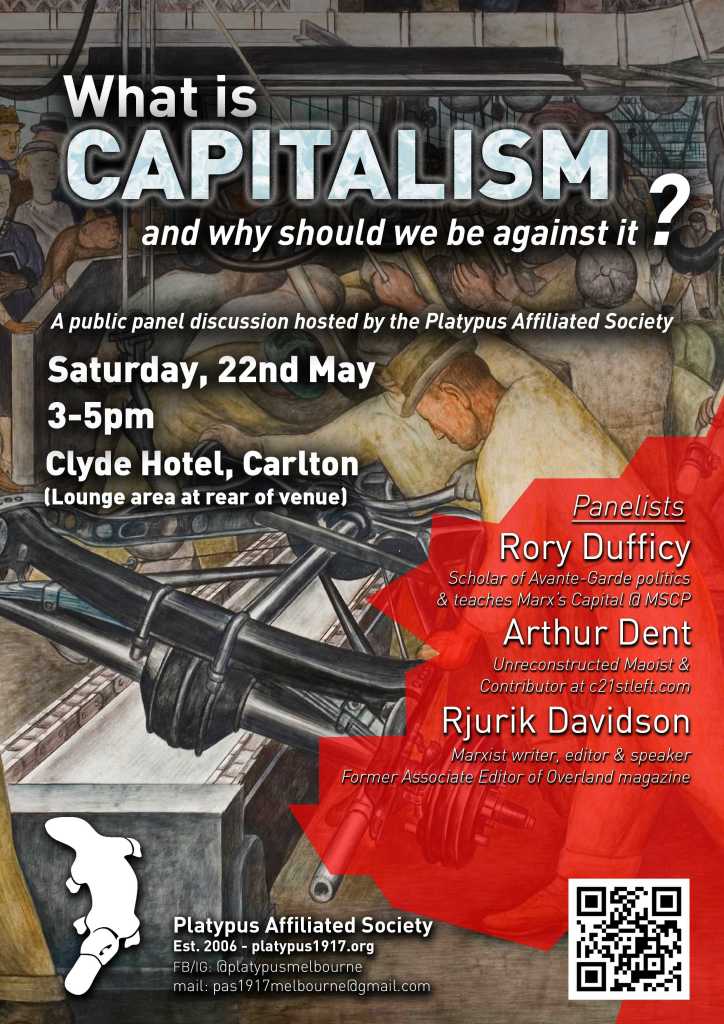
It is organized by a new Melbourne reading group affiliated to the international Platypus:
Melbourne
Their slogan is “The Left is Dead! Long Live the Left!” so we have something in common.
Unfortunately the title of their article explaining that excellent slogan is preceded by:
“Vicissitudes of historical consciousness and possibilities for emancipatory social politics today” and has lots of similar language from the “Frankfurt school”.
The people who obscured clear and simple slogans with that sort of language were not theoreticians but mere onlookers when there actually was a Radical Left in the sixties. Combining such opposite approaches in a single title perhaps suits affiliates of an egg laying mammal. So we have some differences too. I never got interested enough in the Frankfurt school to actually study their stuff, except for their first publication by Henryk Grossman, who had a theory of capitalist breakdown or collapse and was actually closer to Communism than to the Frankfurt school (while still obviously wrong about “breakdown”).
There is one central point of unity between revolutionary democrats and academic democrats. The pseudoleft that the mainstream tries to pretend is its old enemy on the left is in fact virulently anti-democratic and hostile to debate as well as being virulently anti-communist. That has always been characeristic of the far right. The broad Left has always been a milieu that lives and grows through debating opposing ideas. The pseudoleft is in fact far right.
Below is the panel descriiption for “What is Capitalism, and why should we be against it”:
The present is characterized not only by a political crisis of the global neoliberal order but also by differing interpretations of the cause of this crisis: Capitalism. If we are to interpret capitalism, we must also know how to change it. We ask the panelists to consider the following questions:
What is capitalism?
Is capitalism contradictory? If so, what is this contradiction and how does it relate to Left politics?
How has capitalism changed over time, and what have these changes meant politically for the Left?
Does class struggle take place today? If so, how, and what role should it play for the Left?
Is capitalism in crisis? If so, how? And how should the Left respond?
If a new era of global capitalism is emerging, how do we envision the future of capitalism and what are the implications of this for the Left?
The 15′ presentations will be transcribed for publication so to help the transciber I will include notes with references on that, point by point. First the references because my Android Tablet is about to crash. I will try to update this evening.
In 1962 Mao Tsetung said:
“The next 50 to 100 years or so, beginning from now, will be a great era of radical change in the social system throughout
the world, an earth-shaking era without equal in any previous historica! period. Living in such an era, we must be pnepared to engage in great struggles which will have many features different in form from those of the past.”
That was said when the Soviet Union and its satellites had already gone revisionist and the split in the international communist movement was becoming open. Nearly 80 years later we still have another 20 years “or so” to go.
Although the left upsurge in the sixties did not last a decade, nor succeed in revolutionary overthrow of all existing social conditions, a major reason it subsided was that the it succeeded in compelling the ruling class to adapt to a faster rate of change in the social system than any previous historical period.
When Marx and Engels wrote the Communist Manifesto, England was the most advanced society, but still with less than half the population urban. Today more than half the global population is urban.
A characeristic feature of the pseudoleft is its continual moaning that things have got worse and worse. In fact this period has seen the most rapid rise in both the numbers, the cultural and political level and the standard of living of the global working class.
From a revolutionary communist perspective it is far too slow. But it was fast enough for the radical left to be eclipsed by a reactionary pseudoleft that openly wants to at least slow things down to live more “simply”. There was certainly a lot more room for the productive forces to continue developing within the capitalist mode of production than Marx and Engels had hoped.
In looking up that quote from the Ninth National Congress documents I actually found it in:
Peking Review #25, June 18, 1976. (Slightly abridged translation of an article in Red Flag #6, 1976)
Text 39: “Capitalist-Roaders Are the Bourgeoisie Inside the Party”, by Fang Kang PDF format [10 pages; 715 KB]
https://www.bannedthought.net/China/MaoEra/GPCR/Mao5/AndMaoMakes5-Lotta-1978-Text39.pdf [pp 358-367]
It is reprinted in a book with lots of other background on Maoism:
And Mao Makes 5: Mao Tsetung’s last great battle, edited with an Introduction by Raymond Lotta, (Chicago: Banner Press, September 1978), 539 pages. [Because of the very large file size of the entire book, each section and each included article is also being made available here separately.]
Entire volume in one big file: Searchable PDF format [21,605 KB]
https://www.bannedthought.net/China/MaoEra/GPCR/Mao5/AndMaoMakes5-Lotta-1978-All.pdf
That can be found among the long list at:
https://www.bannedthought.net/China/MaoEra/GPCR/index.htm
Material from the Red Eureka Movement is listed in a separate section along with other sections for other Australian groups at:
https://www.marxists.org/history/erol/australia/index.htm#rem
This includes:
Click to access langer-maoism-after-mao.pdf
https://www.marxists.org/history/erol/australia/may-day-81.htm
The 12 issues of the “Discussion Bulletin” there are far more relevant than “The Rebel”.
Number 11 with the first 6 parts of “Unemployment and Revolution” is available here at C21stLeft.com
Part 7 is also in DB12 and also at:
https://www.marxists.org/history/erol/australia/rem-unemployment.htm
Basically we reached conclusions that the Sixties left had collapsed more than half a century ago and REM’s last publication was DB12 in September 1982.
More than a decade later, and nearly 3 decades ago “Red Politics” continued similar ideas:
https://www.simplymarxism.com/RP/RP.html
I will be quoting from “Some Questions” by “Perplexed” in Number 1, September 1993.
Other classic works I will or may reference include:
“The Communist Manifesto”
“Socialism – Utopian and Scientific”
and
“The Capitalist Cycle” by Pavel Maksakovsky.
The latter, are available at Library Genesis as is pretty well anything you might want to read (see wikipedia and google for proxy links)
Hope to update this evening.
Ok, update below – leaving above unfixed.
“Below is the panel descriiption for “What is Capitalism, and why should we be against it”:”
The term anti-capitalism, along with anti-globalism and anti-imperialism was adopted by the pseudoleft to absorb the progressive leftist movement that fights to accelerate the transition from feudalism to capitalism and from capitalism to communism into a mush combined with reactionary opposition to capitalism from open Malthusians such as the Greens.
According to the Communist Manifesto:
The bourgeoisie cannot exist without constantly revolutionising
the instruments of production, and thereby the relations of
production, and with them the whole relations of society. Conservation of the old modes of production in unaltered form, was, on the contrary, the first condition of existence for all earlier industrial classes. Constant revolutionising of production, uninterrupted disturbance of all social conditions, everlasting uncertainty and agitation distinguish the bourgeois epoch from all earlier ones. All fixed, fast-frozen relations, with their train of ancient and venerable prejudices and opinions, are swept away, all new-formed onesbecome antiquated before they can ossify. All that is solid melts into air, all that is holy is profaned, and man is at last compelled to face with sober senses, his real conditions of life, and his relations with his
kind.
The need of a constantly expanding market for its products
chases the bourgeoisie over the whole surface of the globe. It must nestle everywhere, settle everywhere, establish connexions everywhere.
The bourgeoisie has through its exploitation of the world market given a cosmopolitan character to production and consumption in every country. To the great chagrin of Reactionists, it has drawn from under the feet of industry the national ground on which it stood. All old-established national industries have been destroyed or are daily being destroyed. They are dislodged by new industries, whose introduction becomes a life and death question for all civilised nations, by industries that no longer work up indigenous raw material, but raw material drawn from the remotest zones; industries
whose products are consumed, not only at home, but in every
quarter of the globe. In place of the old wants, satisfied by the
productions of the country, we find new wants, requiring for their satisfaction the products of distant lands and climes. In place of the old local and national seclusion and self-sufficiency, we have intercourse in every direction, universal interdependence of nations. And as in material, so also in intellectual production. The intellectual creations of individual nations become common property. National one-sidedness and narrow-mindedness become more and more impossible, and from the numerous national and local literatures, there arises a world literature.
The bourgeoisie, by the rapid improvement of all instruments of production, by the immensely facilitated means of communication, draws all, even the most barbarian, nations into civilisation. The cheap prices of its commodities are the heavy artillery with which it batters down all Chinese walls, with which it forces the barbarians’ intensely obstinate hatred of foreigners to capitulate. It compels all nations, on pain of extinction, to adopt the bourgeois mode of production; it compels them to introduce what it calls civilisation into
their midst, i.e., to become bourgeois themselves. In one word, it creates a world after its own image.
The bourgeoisie has subjected the country to the rule of the towns.
It has created enormous cities, has greatly increased the urban
population as compared with the rural, and has thus rescued a
considerable part of the population from the idiocy of rural life. Just as it has made the country dependent on the towns, so it has made barbarian and semi-barbarian countries dependent on the civilised ones, nations of peasants on nations of bourgeois, the East on the West.
The bourgeoisie keeps more and more doing away with the
scattered state of the population, of the means of production, and of property. It has agglomerated population, centralised means of production, and has concentrated property in a few hands. Thenecessary consequence of this was political centralisation. Independent, or but loosely connected provinces with separate interests, laws, governments and systems of taxation, became lumped together into one nation, with one government, one code of laws, one national
class-interest, one frontier and one customs-tariff.
The bourgeoisie, during its rule of scarce one hundred years, has created more massive and more colossal productive forces than have all preceding generations together. Subjection of Nature’s forces to man, machinery, application of chemistry to industry and agriculture, steam-navigation, railways, electric telegraphs, clearing of whole continents for cultivation, canalisation of rivers, whole populations conjured out of the ground—what earlier century had even a presentiment that such productive forces slumbered in the lap of social labour?
Clearly what is called “the left” these days is naturally and instinctively against all that. But Communists see it as a necessary and desirable move away from the past and towards the future. We are not part of the “anti-capitalist” mush.
“The present is characterized not only by a political crisis of the global neoliberal order but also by differing interpretations of the cause of this crisis: Capitalism.”
Neither the “global neoliberal order” nor it’s “political crisis” were concepts debated among sixties Radicals or our opponents. There were equally vague terms like “the system” and “the establishment”. But we were part of an explicitly globalist, internationalist movement that had a revolutionary communist and therefore also revolutionary democratic core.
The main opponents of Radicals within the broader “Left” were what we called “revisionists” and “social democrats”. They were more inclined to call themselves “Socialists”.
As Engels wrote in the preface to the English edition of 1888 of the Manifesto quoted above:
“… when it was written, we could not have called it a socialist manifesto. By Socialists, in 1847, were understood, on the one hand the … mere sects, …gradually dying out; on the other hand, the most multifarious social quacks who, by all manner of
tinkering, professed to redress, without any danger to capital and profit, all sorts of social grievances, in both cases men outside the working-class movement, and looking rather to the
“educated” classes for support… Thus, in 1847, socialism was a middle-class movement, communism a working-class movement.
Socialism was, on the Continent at least, “respectable”; communism was the very opposite. And as our notion, from the very beginning, was that “the emancipation of the workers must be the act of the working class itself,” there could be no doubt as to which of the two names we must take.
Moreover, we have, ever since, been far from repudiating it.”
There was no need to quibble with their adoption of the term “Socialist”.
As far as I can make out the term “neoliberal order” was adopted when social democracy abandoned any pretence of aiming to eventually reform their way out of capitalism and the remnants of the revisionist “communists” had to come up with an even more mealy mouthed phrase than “socialist” to describe their common opposition to the center right.
The center right, like the center left was both conservative and reformist. Both sides of mainstream politics had very similar policies for adapting capitalism and avoiding another upsurge from a Radical left. By mouthing off more “militantly” against the “neoliberal order” people who could no longer even claim to be “socialist” were able to unite around the Keynesian adaptation of capitalism while posturing. In fact of course, as US President Richard Nixon said: “We are all Keynesians now”.
I do think there is an ongoing collapse of mainstream politics that could be described as a slow moving crisis and will eventually become a sudden sharp crisis when it actually confronts a Radical opposition. But I won’t try to interpret that and will instead focus on the more important crisis on the Left that has enabled the mainstream to keep limping on without facing a Radical opposition.
“If we are to interpret capitalism, we must also know how to change it.”
On the contrary, if we are to change the world and move on from its capitalist past and present to a communist future we must also understand where we are, how we got here and how things actually work in the world we live in now.
I prefer Marx’s version:
“Philosophers have hitherto only interpreted the world in various ways; the point is to change it.
That was the final 11th point in a list of “Theses on Feuerbach”. Here for the benefit of those stuck with the Frankfurt School is the third:
“The materialist doctrine that men are products of circumstances and upbringing, and that, therefore, changed men are products of changed circumstances and changed upbringing, forgets that it is men who change circumstances and that the educator must himself be educated. Hence this doctrine is bound to divide society into two parts, one of which is superior to society. The coincidence of the changing of circumstances and of human activity or self-change … can be conceived and rationally understood only as revolutionary practice.”
“We ask the panelists to consider the following questions:”
I prefer Lenin’s question “What is to be done?”. I prefer it precisely because I do not know the answer, whereas I can give glib replies to the questions posed to the panel.
“What is capitalism?”
Capitalism is generalized commodity production based on wage labour.
“Capital does not consist in the fact that accumulated labour serves living labour as a means for new production. It consists in the fact that living labour serves accumulated labour as the means of preserving and multiplying its exchange value.” (Marx “Wage Labour and Capital”, 1847)
For a deeper view it is necessary to study Marx’s 3 volumes of “Capital”, and fourth volume on “Theories of Surplus Value”. According to Lenin the theoreticians of the Second Internatinal could not understand the first chapters.
The first page of the preface to the first edition says:
“This work, … forms the continuation of my book [A Contribution to the Critique of Political Economy]
published in 1859….”
I strongly recommend starting with that beginning before its continuation.
Also the whole “Grundrisse” as well as its “Introduction”.
Marx also said in that preface.
“With the exception of the section on the form of value, there
fore, this volume cannot stand accused on the score of difficulty. I assume, of course, a reader who is willing to learn something new and therefore to think for himself.”
As Hilferding remarked, that assumption was unsubstantiated.
Such readers are rare. Actual readers usually get lost at the first 3 chapters on the form of value. Partly because they ignore the preface and don’t read the “Contribution” before its “continuation”. But mainly because they don’t think for themselves – and therefore don’t think dialectically.
“Is capitalism contradictory? If so, what is this contradiction and how does it relate to Left politics?”
It is not necessary to acquire a deep understanding of “Capital” in order grasp the central contradictions of capitalism and how they relate to Left politics.
Engels short pamphlet “Socialism: Utopian and Scientific” was a popular exposition read and understood widely in both the second and third internationals. It should be the starting point for anybody interested in actual Marxism as opposed to the “Marxians” (from Mars).
Engels made it easily accessible. I will not attempt to compress it further and there is no point discussing that central question with anybody that is not willing to read what the workers did read when they joined mass based Marxist workers parties before such parties ceased to exist.
“How has capitalism changed over time, and what have these changes meant politically for the Left?”
Although written nearly one and a half centuries ago I think Engels pamphlet was remarkably prescient in Part 3 on Historical Materialism. Complete ignorance of that has gone together with political bankruptcy of the pseudoleft.
“Does class struggle take place today? If so, how, and what role should it play for the Left?”
The class struggle plays a role for the pseudoleft. It is a prop for militant posturing and recruitment.
When there is a Left again it will that Left will instead play a role in the class struggle – educating, agitating and organizing.
The class struggle is essentially a political struggle and the present situation makes theoretical struggle primary.
Three areas of theoretical struggle that I am interested in are:
- Refuting bourgeois theories of macroeconomics and the business cycle by actually developing Marx’s theory of the capitalist cycle in the direction explained by Pavel Maksakovsky “The Capitalist Cycle”. http://libgen.rs/book/index.php?md5=EAC7E58D683A34F76BC03CBC0934E753
- Supporting modern science and rapid development of the most modern productive forces against greenie nature worship funded by the “Gas and Wind” lobby.
- Mobilizing a united front for war on the current and future pandemics based on the scientific understanding that none of us are safe until the whole world is effectively vaccinated.
“Is capitalism in crisis? If so, how? And how should the Left respond?”
The term “crisis” is widely misused. A Global Financial Crisis was aborted in 2007-9 by extraordinary measures that have not resolved the underlying disproportions but have also not been resolved by exploding into full scale crisis.
We have now reached an untenable situation with zero and even negative interest rates etc. It has gone on for some time but I still expect it to eventually result in a crisis much deeper than the 1930s Great Depression.
I don’t expect a Left capable of responding to develop until after the crisis has actually broken out.
Meanwhile I recommend preparing for theoretical struggle on crisis theory by serious study eg of Marx and Maksakovsky’s theory.
“If a new era of global capitalism is emerging, how do we envision the future of capitalism and what are the implications of this for the Left?”
Crises mark sudden phase shifts and leaps in development that make envisioning the results very speculative.
But I would expect the development of State Capital as the “National Capitalist” as described in Engels part 3 on “Historical Materialism” to be greatly accelerated. I would also expect it to be supported by the pseudoleft. I would also expect a revolutionary Left to again emerge at least in the aftermath.
Further update: Regardless of expectations we need to understand the basic mechanism of the 19th Century and early 20th Century business leading up to the Great Depression as a foundation for understanding what changed after that Great Depression and what is happening now. There should be some serious study of Maksakovsky in a reading group. Below is where I got to, before encountering Maksakovsky.
Unemployment and Revolution is about 4 decades old but was a serious attempt to get started on understanding the business cycle that should be followed up. Links below are still not included as DB11 in html at ERO, but should be. It deliberately avoids references to Marx to avoid distraction by polemics with inananities from Mars by “Marxians”.
Maksakovsky’s “The Capitalist Cycle” is nearly a century old but got much further on “overproduction” and the “cycle” than part 5 below. It clearly completes that part of the work done by Marx in volume 2, which Marx postponed to volume 3 but never completed.
Part 1. Emphasises that unemployment is specifically a problem connected with market economies. Then it gets slightly distracted to talk about science fiction and jellyfish.
Parts 2., and 3. Analyse the economic mechanisms that regulate “normal” unemployment, in order to explain the conservative arguments for “wage restraint” and why such arguments are wrong.
Part 4. Examines “technological” unemployment and shows that the increased unemployment now is not “technological”.
Part 5. Attempts an explanation of “overproduction” and “cyclical” unemployment (without great success).
Part 6.Considers various “solutions” from the labour movements, in the light of the earlier analysis, and rejects them all, but cheerfully, in view of part 7.
Part 7. Tries to give some concrete content to the idea that “the only solution is revolution”.
Unemployment and Revolution (Part 1) – by Albert Langer, written in 1981
Unemployment and revolution. Part 2: What ‘normally’ causes unemployment?
Unemployment and Revolution (Part 3): What regulates unemployment? (written by Albert Langer in 1981)
TECHNOLOGICAL UNEMPLOYMENT (Part 4 of ‘Unemployment and Revolution’, written by Albert Langer in 1981)
“Cyclical” Unemployment – Part 5 of ‘Unemployment and Revolution’ (by Albert Langer in 1981)
Solutions: Part 6 of ‘Unemployment and Revolution’ by Albert Langer, 1981
REVOLUTION: Part 7 of ‘Unemployment and Revolution’ by Albert Langer. (This part, a draft, was written in 1982, a year after the first paper).
See also note on Thomas Sekine at:
Thomas Sekine
Uneasy lies the head… Bertolt Brecht

I came across this poem, written by Bertolt Brecht (1898-1956) in the 1930s, in an edited collection called ‘Student Power’ edited by Julian Nagel and published in 1969. The poem is attributed to Brecht’s ‘Svendborg poems’ collection. The poems were written by Brecht when he was in exile from Nazi Germany on the Danish island of Funen.
We need a revival of the spirit fueling the poem. Its truths remain valid – pretty much everywhere.

Revolution, the power of song – Nina Simone (1969)

Originally published by byork at ‘Strange Times Last Superpower blog’ on December 9, 2009
Remember the Beatles’ reactionary song, ‘Revolution’? I liked them as a group, and still do, but, gee, it was disappointing to be a young revolutionist in the 1960s and hear them come out with lyrics against revolutionary change. Of course, the Beatles’ song was written from the perspective of the Establishment – lyrics about “minds that hate” and against “Chairman Mao” would not have made much sense to people who were struggling for survival and freedom in the Third World, not to mention in the ghettoes of the US.
Someone who, at that time, stood with the oppressed people was the great African American piano player, composer and singer, Nina Simone.
Poor Nina, she was not consistent later in life and her decline and end was a very sad one indeed. Her version of the Beatles’ song subverts it into an actual revolutionary song.
I’m sure she was addressing the Beatles with the lyrics:
“Some folks are gonna get the notion
I know they’ll say im preachin hate
But if i have to swim the ocean
Well i would just to communicate
Its not as simple as talkin jive
The daily struggle just to stay alive”.
And, hey, greenies, “It’s more than just air pollution”.
She recorded the song in 1969: “We’re in the middle of a revolution, coz I see the face of things to come”.
Enjoy! (And swim that ocean!)
Another great one by Nina Simone was her song about the desegregation struggle, and struggle for racial equality, in the US, called ‘Mississippi Goddam’. It was inspired by the murder of four girls in the bombing of the 16th Street Baptist Church on 15 September 1963 by members of the Ku Klux Klan. The song was banned in some parts of the ‘Deep South’.
Lyrics below. Youtube clip here: http://www.youtube.com/watch?v=NAYVaHEMK0I
(1963) Nina Simone
The name of this tune is Mississippi Goddam
And I mean every word of it
Alabama’s gotten me so upset
Tennessee made me lose my rest
And everybody knows about Mississippi Goddam
Alabama’s gotten me so upset
Tennessee made me lose my rest
And everybody knows about Mississippi Goddam
Can’t you see it
Can’t you feel it
It’s all in the air
I can’t stand the pressure much longer
Somebody say a prayer
Alabama’s gotten me so upset
Tennessee made me lose my rest
And everybody knows about Mississippi Goddam
This is a show tune
But the show hasn’t been written for it, yet
Hound dogs on my trail
School children sitting in jail
Black cat cross my path
I think every day’s gonna be my last
Lord have mercy on this land of mine
We all gonna get it in due time
I don’t belong here
I don’t belong there
I’ve even stopped believing in prayer
Don’t tell me
I tell you
Me and my people just about due
I’ve been there so I know
They keep on saying “Go slow!”
But that’s just the trouble
“do it slow”
Washing the windows
“do it slow”
Picking the cotton
“do it slow”
You’re just plain rotten
“do it slow”
You’re too damn lazy
“do it slow”
The thinking’s crazy
“do it slow”
Where am I going
What am I doing
I don’t know
I don’t know
Just try to do your very best
Stand up be counted with all the rest
For everybody knows about Mississippi Goddam
I made you thought I was kiddin’ didn’t we
Picket lines
School boycotts
They try to say it’s a communist plot
All I want is equality
for my sister my brother my people and me
Yes you lied to me all these years
You told me to wash and clean my ears
And talk real fine just like a lady
And you’d stop calling me Sister Sadie
Oh but this whole country is full of lies
You’re all gonna die and die like flies
I don’t trust you any more
You keep on saying “Go slow!”
“Go slow!”
But that’s just the trouble
“do it slow”
Desegregation
“do it slow”
Mass participation
“do it slow”
Reunification
“do it slow”
Do things gradually
“do it slow”
But bring more tragedy
“do it slow”
Why don’t you see it
Why don’t you feel it
I don’t know
I don’t know
You don’t have to live next to me
Just give me my equality
Everybody knows about Mississippi
Everybody knows about Alabama
Everybody knows about Mississippi Goddam
Revolution – Nina Simone (1969)

